

What you’ll learn in this article…
- NSU launched Veterans Health and American Indian Health MSN tracks July 2026.
- The AACN released updated nursing essentials with ACE concepts April 2026.
- NSU's new MSN tracks have an August 1, 2026 application deadline.
On July 10, 2026, Northeastern State University announced two new online MSN concentrations in Veterans Health and American Indian Health, joining a growing list of institutions expanding graduate nursing options this year. Persistent primary care shortages, the accelerating shift toward DNP preparation, and updated AACN Essentials are pushing schools to launch programs that align with emerging competency standards.
From new FNP and DNP pathways to specialized MSN and DNP degree options, the range of choices is broader than ever. For nurses, the challenge is verifying accreditation and clinical relevance in a regulatory environment that rewards advanced credentials but demands practical, population-specific expertise. Understanding DNP salary expectations by specialty can also help you weigh whether the additional investment aligns with your career goals.
Why 2026 Is a Landmark Year for NP and DNP Education
The April 2026 release of the updated AACN Essentials, incorporating new Access, Connection, and Engagement (ACE) concepts,1 signals that nursing schools are now deep into the competency-based education transition first outlined in 2021. With progression indicators completed in fall 20252 and faculty development workshops scheduled for later this year,3 2026 represents the point where curriculum restructuring becomes concrete rather than theoretical.
The AACN Essentials Pushes Curricular Overhaul
AACN member schools adopted the 2021 Essentials with a three-year transition window,4 and as of 2026, programs are finalizing maps that embed the new 10 domains and 8 concepts. The Essentials 2026 edition refines competencies and clarifies assessment expectations, prompting many universities to launch updated MSN and DNP tracks that directly align with the framework. This alignment is not optional: accreditation bodies are tying review standards to the Essentials, so programs launching now are designed from the ground up to satisfy both accreditation and practice-readiness benchmarks.
Employer Preferences for the DNP Grow, But MSN NP Remains Viable
No state requires the DNP for NP licensure as of 2025-2026, and the APRN Consensus Model does not mandate a practice doctorate.5 However, the AACN and NONPF have issued position statements supporting the DNP as the preferred graduate degree for advanced practice.6 Employer preferences in some health systems and academic settings are shifting toward doctorate-prepared NPs, but the MSN-to-NP pathway continues to prepare competent clinicians and remains the majority route. For nurses entering practice this year, the MSN NP is still a fully viable, licensure-eligible option, though many choose the DNP for leadership roles or to stay ahead of market trends. Those exploring why the terminal degree is gaining traction can find a detailed breakdown in why a DNP degree is becoming essential.
Workforce Shortages Drive Program Expansion
Persistent nursing workforce shortages, particularly in primary care and rural areas, are a direct catalyst for new program launches. HRSA projects ongoing deficits in registered nurse and advanced practice registered nurse supply, with many states reporting double-digit RN vacancy rates. The states with the largest nursing shortages illustrate just how unevenly this gap falls across the country. Universities are responding with accelerated, online, and specialty-focused graduate programs that can produce NPs faster and direct them to underserved populations. The NSU MSN tracks in Veterans Health and American Indian Health exemplify this demand-driven strategy.
DNP Enrollment Surges as 2026 Programs Launch
DNP enrollment continues to climb year-over-year, with AACN data showing sustained growth in both post-baccalaureate and post-master's DNP tracks. This upward trend coincides with the wave of new programs starting in 2026, many of which offer streamlined accelerated direct entry MSN programs and MSN-to-DNP options. As more nurses pursue terminal degrees, the pipeline of doctorally prepared faculty also expands, supporting further program growth across the country.
New NP and DNP Programs Launching in 2026: A National Roundup
Staying ahead of new NP and DNP program launches requires sifting through a flood of information to find the few programs that meet your career goals and accreditation standards. With multiple universities expanding offerings in 2026, a strategic approach to discovery matters more than ever.
Start with Official Accreditation and Approval Listings
The most reliable source for new program announcements is the American Association of Colleges of Nursing (AACN). Its newsroom and annual surveys track newly accredited NP and best DNP programs, giving you a vetted starting point. State boards of nursing often publish lists of approved graduate programs as soon as they receive authorization, which can be faster than waiting for institutional marketing pushes. Bookmark your state board's education page and check it monthly during peak announcement seasons.
Scan University Nursing School Websites Directly
Many institutions announce new concentrations before they appear in national databases. Look under 'Admissions' or 'Academics' on nursing school websites, specifically for NP or DNP track pages. Program directors often post updates about upcoming specialty areas and revised clinical hour requirements. Set up email alerts for universities in your region, and monitor their social media channels: LinkedIn and X (formerly Twitter) are common places for early announcements.
Leverage Professional Organizations and Conferences
The National Organization of Nurse Practitioner Faculties (NONPF) regularly features pilot programs and emerging specialties in its newsletters and conference sessions. Attending a NONPF meeting or webinar can connect you with faculty who are designing new DNP tracks before they go public. Similarly, the American Nurses Association and specialty nursing organizations often share member-exclusive updates about new education pathways.
Cross-Reference Workforce Trends to Evaluate Program Necessity
Before committing to a brand-new program, verify its alignment with workforce demand. The Bureau of Labor Statistics (BLS) Occupational Outlook page for nurse practitioners provides data on projected growth by region and specialty. Pair that with state board of nursing reports on practice barriers or underserved areas to gauge whether a new FNP, AGNP, or PMHNP track will have strong employability. A program that addresses a documented shortage, such as rural health or behavioral health, is more likely to secure clinical placements and employer partnerships. Reviewing nurse practitioner school interview questions in advance can also help you articulate how a new program's specialty aligns with your goals when you sit down with an admissions committee.
Spotlight: NSU Expands Online MSN With Veterans Health and American Indian Health Tracks
How does Northeastern State University's new MSN program address underserved populations in Oklahoma? On July 10, 2026, NSU announced two new online Master of Science in Nursing concentrations designed precisely for that purpose: Veterans Health and American Indian Health, as reported by the Cherokee Phoenix.1
Specialized Tracks Target Critical Needs
- Veterans Health: This track focuses on the physical, psychological, social, and long-term healthcare needs of military veterans. Nurses learn to navigate complex veteran care systems and address conditions from service-related trauma to chronic disease.
- American Indian Health: This concentration emphasizes culturally responsive care and strategies to reduce health disparities in tribal communities. Coursework covers traditional healing practices, tribal health policy, and community-based interventions.
Both tracks develop nursing leadership, policy navigation, and healthcare improvement skills. Oklahoma is home to dozens of tribal nations and a large veteran population, both of which face well-documented disparities in access and outcomes. These MSN pathways directly align with the state's healthcare workforce priorities.
Enrollment Details and Program Structure
The online MSN program accepts applications for the Fall 2026 cohort through August 1, 2026. Classes begin on August 17, 2026. The curriculum is delivered primarily online but includes hands-on practicum experiences in relevant clinical settings. NSU already offers MSN concentrations in Nursing Education, Administrative Leadership, and Nursing Informatics, and these new tracks expand that portfolio into high-need specialty areas.
Building on a Legacy of Nursing Education
NSU was the first institution in Oklahoma to offer a stand-alone RN to BSN program, a milestone that underscores the university's commitment to advancing nursing education. In Fall 2026, NSU will also welcome its first pre-licensure BSN cohort, further strengthening the pipeline from entry-level to advanced practice. Dr. Heather Fenton, director of nursing at NSU, and President Rodney Hanley have framed these expansions as a direct response to Oklahoma's healthcare needs. By preparing nurses who understand the cultural and clinical challenges of veteran and tribal health, NSU is helping to close critical gaps in care across the state and beyond. Nurses weighing their options can explore how long it takes to complete an RN to BSN program as one factor in planning their path to advanced practice.
Online, Hybrid, and On-Campus: Comparing New Program Formats
Choosing between online, hybrid, and on-campus graduate nursing programs shapes not just where you learn but how you engage with faculty, peers, and clinical placements. Each format carries distinct implications for your schedule, learning style, and the way potential employers view your degree. As universities launch new NP and DNP pathways in 2026, understanding the trade-offs among delivery methods helps you match a program to your career goals and life commitments.
Understanding Delivery Modes
- Online programs: Coursework is completed virtually through asynchronous modules, discussion boards, and occasional live sessions. Clinical hours are arranged at approved sites near the student's home. This format offers maximum flexibility for working nurses and those in rural areas.
- Hybrid programs: Combine online didactic instruction with required on-campus intensives, often held once or twice per semester, for hands-on labs, simulations, and in-person faculty mentoring. Clinical rotations follow the same local-preceptor model.
- On-campus programs: Traditional face-to-face classes occur on a set schedule. Labs, simulations, and most clinical placements are coordinated directly by the school. This format provides consistent peer interaction and immediate access to campus resources but demands geographic proximity.
What Employers Typically Look For
Employer acceptance of online and hybrid degrees has matured significantly, though some differences in perception persist. National employer surveys frequently indicate that the accreditation status and reputation of a program matter far more than delivery mode. Hiring managers in large health systems often do not distinguish between online and on-campus credentials for APRN roles, provided the degree is from a regionally accredited institution with programmatic accreditation from bodies like the CCNE or ACEN. However, in highly competitive markets, some recruiters may scrutinize the depth of clinical hours and the structure of precepted experiences. A hybrid program's on-campus residencies can signal more intensive hands-on training, which certain practice settings, such as academic medical centers, may view favorably. Professional nursing associations also note that strong alumni networks from established brick-and-mortar programs sometimes ease job placement, though an increasing number of online programs now actively build virtual mentorship and career pipelines.
Program Outcomes and Completion Trends
Enrollment data from the National Center for Education Statistics shows sustained growth in online graduate nursing education over the past decade. Completion rates can vary: on-campus programs often report slightly higher retention, likely influenced by structured schedules and direct faculty oversight. Online programs, on the other hand, require greater self-discipline and time-management skills, which can lead to longer time-to-degree or attrition for some students. Hybrid ADN programs attempt to balance flexibility with accountability by adding in-person touchpoints, and the same logic applies at the graduate level. When evaluating new 2026 programs, prospective students should ask about graduation rates, first-time NP certification pass rates, and job placement data, all of which are typically published on university websites or available through admissions counselors. Look for programs that transparently track and share these outcomes regardless of format.
Making the Right Choice for Your Career
No single format is universally superior. The right decision depends on your learning style, geographic constraints, career specialty, and personal responsibilities. An experienced RN with family obligations and limited local university options may thrive in a fully online DNP program that arranges clinicals nearby. A recent BSN graduate seeking the mentorship of a research-intensive environment might benefit from an on-campus experience. Hybrid pathways are increasingly popular for nurses who want the convenience of online learning with periodic face-to-face skill validation. As you research new NP and DNP programs opening in 2026, consider cost differences across nursing degree options alongside accreditation, curriculum quality, and clinical placement support, rather than focusing on format labels alone. The most important factor remains whether the program prepares you to sit for national certification and to practice competently in your chosen advanced nursing role.
Clinical Hours, Accreditation, and Curriculum at a Glance
What steps should you take to verify a new NP or DNP program's accreditation status and required clinical hours before applying?
Start at the Program's Official Website
Program websites are your first and most direct source of information. Whether you are evaluating a recently launched hybrid MSN NP at the University of Pittsburgh, a pediatric DNP at the University of Utah, or DNP programs near Oklahoma City, the program page typically lists the number of required clinical hours, any specialty-specific practicum details, and the accrediting body. Look for a section labeled "Curriculum," "Clinical Requirements," or "Accreditation." Bookmark the admissions and curriculum pages, because details can shift as new cohorts are added.
Verify Accreditation Through Recognized Agencies
Accreditation confirms that a program meets national quality standards and prepares graduates for certification. Nursing programs are typically accredited by either the Commission on Collegiate Nursing Education (CCNE), the Accreditation Commission for Education in Nursing (ACEN), or the Council on Accreditation of Nurse Anesthesia Educational Programs (COA) for nurse anesthesia. You can search each agency's online directory by institution name to see if a program holds current accreditation. Newly launched programs sometimes operate under "candidacy" status, meaning they are in the final stages of review. If you see that designation, contact the school to discuss how it affects licensure eligibility.
Use General Resources, But Cross-Reference
The Bureau of Labor Statistics (BLS.gov) provides an overview of nurse practitioner roles, but it does not publish program-specific clinical hour requirements. State nursing boards often post the minimum hours needed for licensure, while individual schools set their own, often higher, totals. For the most accurate number, always compare what you find on the program's website with the state board's rules. This is especially important for short-length DNP programs, where clinical hour expectations can vary by specialty and by state.
Contact the Admissions Office Directly
When a program is still in its first years of operation, details such as pending accreditation updates or evolving clinical placement partnerships may not be reflected online. An email or phone call to the admissions office can clarify these points. Ask specifically: "How many clinical hours are required for this concentration?" and "What is the program's current CCNE or ACEN accreditation status?" Admissions staff can also connect you with program directors for more in-depth curriculum discussions. This extra step takes minutes but can prevent costly surprises later.
Tuition and Cost Trends for New 2026 NP and DNP Programs
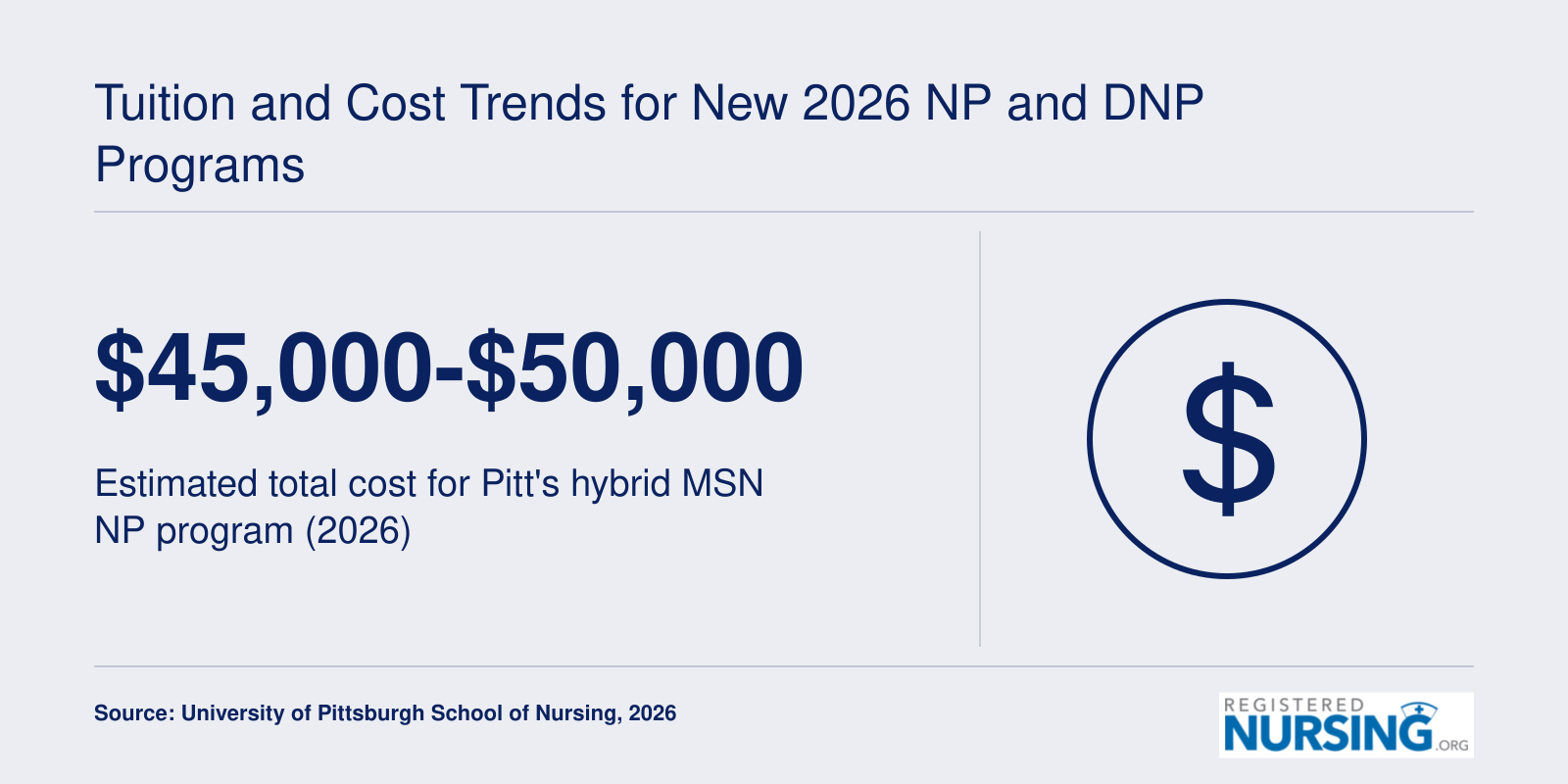
New graduate nursing programs launching in 2026 show a wide range of tuition models. While many online programs charge flat per-credit rates regardless of residency, some institutions still differentiate between in-state and out-of-state students. The University of Pittsburgh's hybrid MSN NP program, for instance, carries an estimated total cost of $45,000 to $50,000. Financial aid, graduate assistantships, and loan repayment programs may further offset costs.
DNP vs MSN for Nurse Practitioners: Which Path Makes Sense Now?
Choosing between the Master of Science in Nursing (MSN) and Doctor of Nursing Practice (DNP) for nurse practitioner (NP) preparation involves weighing immediate entry to practice against long-term professional currency. While both degrees qualify graduates for national NP certification and state licensure, the DNP offers enhanced clinical, leadership, and systems training that may better align with evolving healthcare expectations.
- MSN programs typically take two to three years post-BSN, allowing faster entry to NP practice and earlier income generation.
- DNP graduates gain advanced expertise in evidence-based practice, quality improvement, and healthcare policy, which can open leadership roles and academic faculty positions.
- Both MSN- and DNP-prepared NPs command similar starting salaries in most clinical settings, making the MSN a cost-effective choice for many.
- A DNP can future-proof your career if state boards or employers eventually require a doctorate for advanced practice, as some nursing organizations advocate.
- MSN curricula may offer fewer clock hours in leadership and systems thinking compared to the DNP, potentially limiting readiness for administrative roles.
- DNP programs usually add one to two years of full-time study beyond an MSN, increasing tuition, opportunity cost, and time away from practice.
- A small but growing number of institutions are phasing out MSN NP tracks in favor of BSN-to-DNP, which could make the MSN less accessible in the future.
- Accelerated BSN-to-DNP programs can compress the path to 36-48 months, but they remain intense and may not be feasible for working nurses who need a shorter timeline.
Application Timelines and Tips for Fall 2026 NP and DNP Cohorts
Northeastern State University's new MSN tracks close applications on August 1, 2026, with classes starting August 17, a tight timeline for fall entry.1
Key Application Deadlines for New 2026 Graduate Nursing Programs
While no central portal exists for NP and DNP applications, many programs are accepting fall 2026 applications now. NSU's August 1 deadline is one of the earliest. Other new and expanded programs operate on rolling or later summer deadlines, but exact dates vary by specialty. Prospective students should confirm with individual schools, as new programs often extend deadlines for their first cohort.
Step-by-Step Application Checklist
- Transcripts: Request official transcripts from every postsecondary institution attended. Some schools accept electronic delivery, but others require sealed paper copies. Allow at least three weeks for processing.
- Licensure verification: Active, unencumbered RN license documentation is standard. Most programs use Nursys or individual state board verification.
- Clinical experience documentation: Many NP and DNP programs require a minimum number of clinical practice hours as an RN. Prepare a detailed summary or verification form signed by a supervisor.
- Letters of recommendation: Typically two to three letters from academic or professional references. For new programs, letters highlighting clinical leadership or cultural competence can strengthen an application.
- Personal statement or essay: Tailor your statement to the program's mission, especially for specialized tracks like Veterans Health or American Indian Health.
- Resume or CV: Highlight advanced certifications, committee work, or quality improvement projects.
- Application fee: Fees range from $50 to $90 per program; budget accordingly if applying to multiple schools.
Tips for Applying to Newly Launched Programs
- Apply early: First cohorts are often small, and competition for seats may increase once a program gains recognition.
- Flexible criteria: New programs sometimes waive GRE requirements or accept slightly lower GPAs during inaugural years to build enrollment.
- Contact admissions directly: For brand-new pathways, admissions staff can clarify evolving requirements and connect you with the program director.
Navigating the Decentralized Application Landscape
Unlike NursingCAS used by some BSN prelicensure programs online, there is no unified application system for NP and DNP degrees. Each school sets its own timeline, prerequisites, and application portal. Keep a spreadsheet with login credentials, deadlines, and document statuses to track progress across multiple applications. This becomes especially important when managing overlapping requirements for new, untested programs that may have unique supplementary materials.
FAQs About New NP and DNP Programs in 2026
With numerous universities expanding graduate nursing offerings in 2026, prospective students have questions about program options, accreditation, and career impact. Here are answers to some of the most common FAQs about new NP and DNP pathways this year.
- Are there any 2 year DNP programs?
- Yes, some universities offer accelerated DNP programs that can be completed in as little as two years of full-time study, typically for nurses who already hold a master's degree. These fast-track options often require intensive coursework and clinical hours. New 2026 cohorts at several institutions feature compressed schedules to meet workforce demand quickly.
- Is NP changing to DNP?
- While the Doctor of Nursing Practice (DNP) is increasingly encouraged, it is not yet a universal requirement for nurse practitioner licensure. Organizations like the AACN advocate for the DNP as entry-level by 2025, but many state boards still accept MSN-prepared NPs. New 2026 programs frequently offer both MSN and DNP pathways to accommodate varying career goals.
- Which schools are launching new NP programs in 2026?
- A range of institutions are expanding graduate nursing options in 2026. For instance, Northeastern State University added MSN concentrations in Veterans Health and American Indian Health. Other universities nationwide are introducing new NP and DNP tracks, especially in primary care and mental health, to address provider shortages in underserved areas.
- What are the clinical hour requirements for new NP programs in 2026?
- Clinical hour requirements vary by program and specialty, but most NP programs mandate between 500 and 1,000 supervised clinical hours. New programs launching in 2026 generally align with national certification standards, often including 600+ hours for family nurse practitioner programs tracks. DNP programs typically require 1,000 post-BSN hours, with some offering credit for prior MSN clinical experiences.
- How do I apply to new DNP programs starting in fall 2026?
- Application processes typically involve submitting transcripts, a personal statement, letters of recommendation, and a resume. Many programs require an active RN license and a master's degree in nursing. Deadlines for fall 2026 cohorts often fall in early summer; for example, NSU's MSN applications close August 1, 2026. Always check the program's website for specific, up-to-date instructions.
- What is the difference between an MSN NP and a DNP NP?
- An MSN NP program focuses on advanced clinical coursework and prepares you for NP certification at the master's level. A DNP NP program adds training in leadership, evidence-based practice, quality improvement, and systems thinking, culminating in a doctoral project. Both pathways lead to NP licensure, but the DNP offers a deeper emphasis on practice scholarship and healthcare leadership.
- Do new NP programs accept transfer credits?
- Many new graduate nursing programs do accept transfer credits from accredited institutions, but policies vary. Typically, a maximum of 6 to 12 credits may be transferred, and courses must be recent and equivalent to the program's curriculum. Check with the admission office for a credit evaluation, especially for advanced pathophysiology or pharmacology courses. A useful overview of courses and credits transferred to RN to BSN/MSN bridge programs can help you understand what to expect before you apply.
- How can I verify accreditation status before enrolling in a new DNP or NP program?
- Accreditation can be confirmed by checking the Commission on Collegiate Nursing Education (CCNE) or Accreditation Commission for Education in Nursing (ACEN) directories online. For new programs, look for candidacy status if full accreditation is pending. If you have broader questions about program legitimacy, resources that address whether an online nursing degree is legitimate can help you ask the right questions before you enroll. Always ensure the program is regionally accredited and recognized by your state board of nursing.