What you’ll learn in this article…
- Tennessee projects a shortage of over 8,500 registered nurses by 2035.
- Bethel University's hybrid LPN-to-BSN costs $400 per credit, no prerequisites.
- The direct entry BSN at Bethel eliminates separate nursing applications.
By 2035, Tennessee alone projects a shortage of more than 8,500 registered nurses, a pressure that is reshaping nursing education nationwide. Bethel University's July 2026 launch of a Direct Entry BSN and a credit-for-experience hybrid online LPN to BSN programs pathway is one of the most recent examples of schools dismantling traditional admissions hurdles. The direct entry track eliminates prerequisites and separate applications, while the LPN bridge requires only a license with no prior college coursework. These models recognize that the workforce crisis demands faster, more inclusive pipelines without sacrificing outcomes: Bethel's BSN program reports a 92% five-year NCLEX average and a 100% employment rate among graduates. The shift toward competency-based, less bureaucratic nursing education is gaining momentum, and it is redefining who gets to become an RN.
Why LPN-To-BSN and Direct Entry Programs Are Expanding in 2026
The nursing field is experiencing a rapid reconfiguration of educational pathways, driven by an intensifying workforce crisis and a growing recognition that traditional admissions models leave too many qualified candidates behind.
The Workforce Crisis Fueling Program Growth
Federal workforce projections paint a stark picture: the national RN shortage is expected to peak in 2027,1 with rural areas already facing a 24 percent deficit.2 By 2035, Tennessee alone anticipates more than 8,500 unfilled RN positions,3 even as the total RN supply grows by 36 percent from 2022 levels.4 Across the U.S., nursing school enrollment growth has stalled at just 0.3 percent, far below what is needed to close the gap.
Redesigning Admissions for a Wider Pipeline
In response, nursing programs are stripping away traditional prerequisites. LPN to BSN programs now require only an active LPN license, bypassing prior college credit mandates. Direct entry BSN pathways admit students without a separate nursing application or pre-nursing coursework, collapsing the timeline for career changers and new high-school graduates. These changes remove bottlenecks that historically excluded capable candidates.
Direct Entry and LPN-to-BSN: Two Responses to One Shortage
Each model addresses a different segment of the shortage. Direct entry programs pull from the broader applicant pool, including those who might otherwise lack a clear nursing entry point. LPN-to-BSN bridge programs, by contrast, target the existing workforce of licensed practical nurses, a group already committed to healthcare but frequently blocked from advancement by rigid academic requirements. Both paths produce BSN-prepared nurses ready for RN licensure. For a broader look at what the data reveal, the nursing shortage fact sheet offers a useful national overview.
Competency Over Bureaucracy: A National Trend
Bethel University's recent launch of both pathways is part of a wider shift toward competency-based education.3 Schools across the country are rethinking credit-hour requirements and instead evaluating what students can demonstrate clinically. This trend, accelerated by post-pandemic flexibility and workforce demands, emphasizes speed and preparedness while maintaining program quality, a pragmatic recalibration that could define nursing education through the next decade.
How LPN-To-BSN Bridge Programs Work: Credit Transfer, Curriculum, and Timeline
LPN-to-BSN bridge programs are degree pathways designed specifically for licensed practical nurses who want to earn a Bachelor of Science in Nursing. These programs recognize that LPNs already possess clinical experience and foundational nursing knowledge, so they award advanced standing, meaning students can skip certain entry-level courses and jump directly into upper-division nursing coursework.
How Advanced Standing and Credit Transfer Work
The number of credits awarded varies widely. Some schools grant as few as 10 credits for prior LPN education (like Broward College),1 while others offer up to 48 credits out of a required 60 for the BSN (as seen at Lakeview College of Nursing).2 A more typical range is 15 to 30 credits. Colorado Mesa University, for example, grants 27 credits of advanced standing with a cap of 30 total nontraditional credits.3 Commonly bypassed courses include foundations of professional practice and basic pathophysiology. Many programs also enforce recency requirements: Lakeview requires science prerequisites to be completed within the last five years,2 and West Coast University limits gaps between nursing sequences to one year.4
What LPNs Still Need to Complete
Even with advanced standing, LPNs must complete the core BSN curriculum, which focuses on leadership, community health, research, and evidence-based practice. Courses in nursing leadership, population health, policy, and ethics are standard. Upper-division clinical experiences in areas like critical care, pediatrics, and mental health are required, as these are not covered in depth during LPN training. The goal is to build the analytical and decision-making skills expected of a baccalaureate-prepared nurse.
Realistic Timelines by Format
Full-time students can typically finish in 18 to 24 months, depending on the number of credits transferred. Part-time and hybrid options extend the timeline to three years or more, but they allow LPNs to continue working. LPN to BSN programs like the hybrid pathway at Bethel University, which requires only an LPN license and no prior college coursework, are designed with working nurses in mind.
Clinical Hours: What Counts and What Does Not
A common surprise is that prior LPN clinical hours rarely satisfy BSN clinical requirements. State boards and accrediting bodies set specific clinical hour mandates for BSN programs, and most do not accept substitute hours from LPN training. Some schools, like Fresno State, use challenge examinations to award credit,5 but these are the exception rather than the rule. Always confirm with the program how many clinical hours are required and whether your LPN experience offers any relief.
Direct Entry BSN Vs. Traditional BSN Vs. LPN-To-BSN: How They Compare
Traditional four-year BSN programs, accelerated direct entry tracks, and LPN-to-BSN bridge options each offer a distinct route to the RN credential. The right choice depends largely on your current educational standing and whether you already hold a nursing license.
Who Qualifies? Admissions and Prerequisites
Traditional BSN programs admit recent high school graduates or students with minimal college credit.1 Most require a separate, competitive nursing-school application after completing prerequisite science and general education courses. By contrast, a direct entry BSN pathway eliminates the additional application hurdle: it accepts students who already hold a non-nursing bachelor's degree or at least 60 college credits, folding them directly into the nursing curriculum without a detour through prerequisite chains.1 For licensed practical nurses, the LPN-to-BSN bridge has a distinct entry point: an active, unencumbered LPN license. Programs award substantial advanced standing, acknowledging prior clinical experience and coursework, and often do not require a prior associate degree or specific general education credits to enroll.2
Program Length and Academic Load
A traditional BSN spans about four academic years of full-time study.3 Direct entry MSN programs compress the same core nursing content into 12 to 24 months of intensive, year-round coursework designed for high-performing students who can devote full-time effort. LPN-to-BSN curriculums typically run 24 to 36 months and are frequently structured with part-time or hybrid flexibility so that working LPNs can continue earning while they study.2
Ideal Student Profiles
Each pathway targets a different learner. The traditional BSN suits recent high school graduates seeking the classic college-to-career pipeline. The direct entry BSN appeals to career changers, people with a degree in another field who want an efficient transition into nursing. The LPN-to-BSN bridge is specifically for experienced practical nurses ready to advance their scope of practice and earning power.
Same Finish Line: BSN Degree and RN License
All three pathways culminate in the same credential: a Bachelor of Science in Nursing degree and eligibility to sit for the NCLEX-RN exam. Once licensed, graduates from any route are equally qualified RNs, and national median annual wages for registered nurses reached $93,600 in 2024.3 Employers do not distinguish among the paths on a resume; what matters is the BSN credential and state licensure.
Online, Hybrid, and On-Campus LPN-To-BSN Formats Compared
What delivery formats are available for LPN-to-BSN programs, and which one fits your situation?
Fully Online Programs
Fully online LPN-to-BSN programs deliver all didactic coursework remotely, making them ideal for students who need maximum flexibility. Clinical rotations, however, must be completed in person at an approved healthcare facility near the student. The University of Arkansas offers an online pathway, but enrollment is limited to residents of Arkansas, Alabama, Kansas, Missouri, and Texas.1 Northern Michigan University provides online coursework with clinical placements arranged within a 100-mile radius of campus, suiting local learners who want the convenience of remote lectures.
Hybrid Programs
Hybrid models blend online classes with periodic on-campus sessions for labs, simulations, or intensives. This format works well for students who want some face-to-face interaction without relocating. Nebraska Methodist College runs a hybrid LPN-to-BSN requiring 127 credits, mixing virtual learning with on-site experiences. South College offers a hybrid track where the student takes responsibility for confirming that the program meets licensure rules in their state, a key consideration for out-of-state applicants.3
On-Campus Programs
Traditional on-campus programs require regular attendance at a physical campus for all instruction and clinicals. They suit students who learn best in a structured, in-person environment and who live near the school. Immaculata University4 and Saint Xavier University5 both offer face-to-face LPN-to-BSN courses. West Coast University-Miami operates a primarily campus-based program that spans 34 months, with some online components to round out the schedule.6
Who Arranges Clinical Placements?
A critical logistical factor is clinical placement responsibility. Some schools, like Northern Michigan University, coordinate placements within a set geographic area, leveraging partnerships with local hospitals. Many online programs, however, require students to secure their own preceptors and clinical sites. This can be challenging in regions with high competition for clinical slots. Always ask about placement support before enrolling, and investigate whether the program has existing agreements with facilities near you.
State Eligibility Restrictions
Online and hybrid LPN-to-BSN programs cannot always accept students from every state. SARA (State Authorization Reciprocity Agreement) and individual state board of nursing regulations limit cross-border enrollment. For example, the University of Arkansas online LPN-to-BSN is only open to residents of five states.1 South College explicitly states that students must verify licensure compatibility on their own.3 Before applying, confirm that the program is authorized to place you in clinicals and that its curriculum meets your state's licensure requirements.
Related Articles
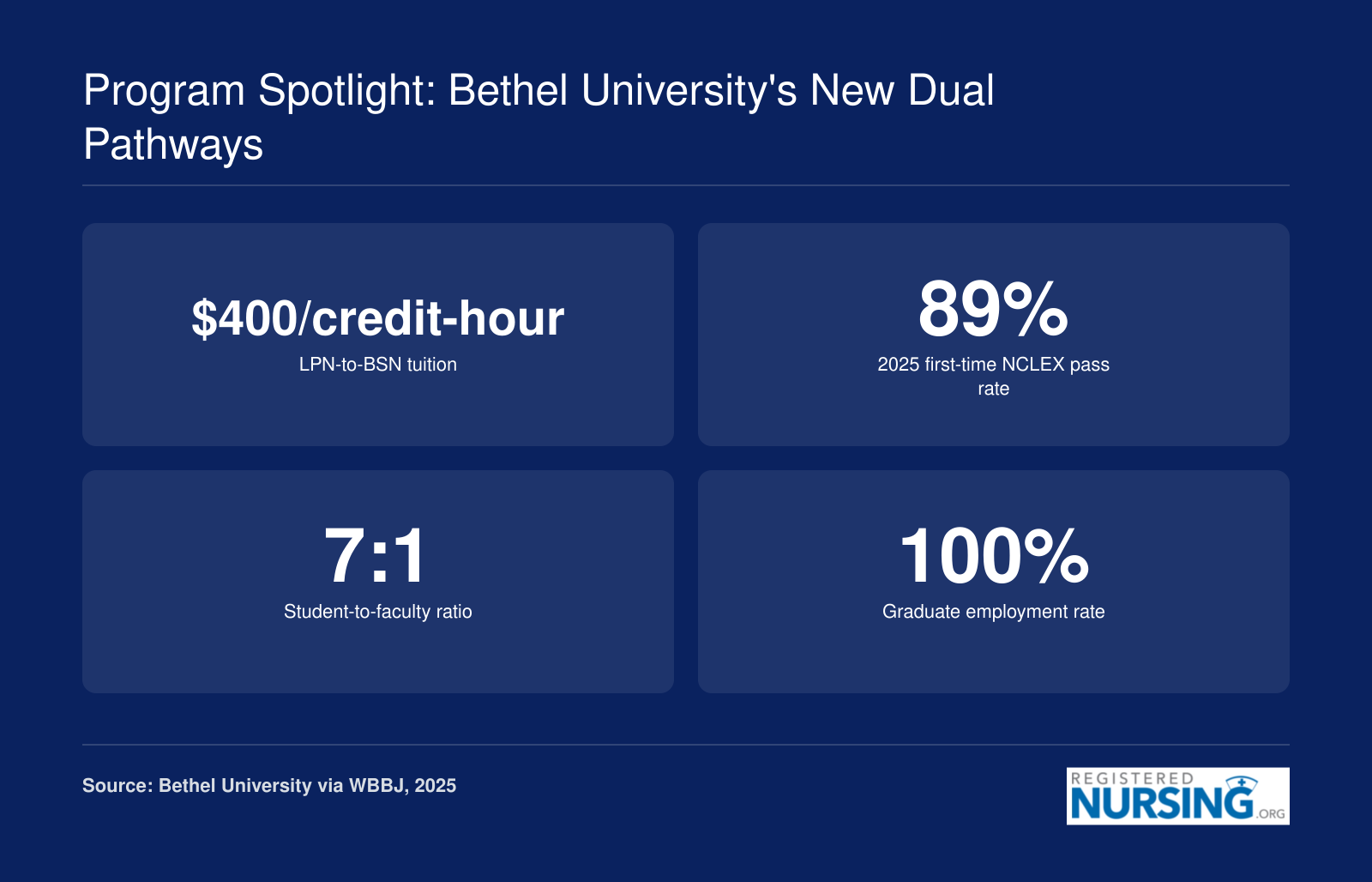
Program Spotlight: Bethel University's New Dual Pathways
Bethel University recently introduced two new pathways: a Direct Entry BSN that eliminates the separate application and prerequisites for first-year and transfer students, and a hybrid LPN-to-BSN that requires only an LPN license with no prior college coursework. Clinical partners include Le Bonheur Children's Hospital and St. Jude Children's Research Hospital, and the hybrid LPN-to-BSN admits one cohort each fall.
What to Look for When Choosing an LPN-To-BSN Program
Choosing an LPN-to-BSN program means evaluating more than just convenience or cost. It's about identifying a nursing school that will give you the strongest foundation for RN licensure and career advancement. Once you've decided to bridge from licensed practical nurse to registered nurse, the next step is to sort through your options with a critical eye. The right program for you will be one that meets all of the professional requirements while fitting your personal circumstances.
Accreditation: The Non-Negotiable Starting Point
Before you even look at tuition or scheduling, confirm the program holds national nursing accreditation from either the Commission on Collegiate Nursing Education (CCNE) or the Accreditation Commission for Education in Nursing (ACEN). Accreditation is essential for three reasons: it qualifies you to sit for the NCLEX-RN, it makes your degree recognized by employers, and it ensures that credits will transfer if you later pursue a graduate degree. Without accreditation, you may find yourself unable to get licensed or hired. Always verify the program's accreditation status directly through the CCNE or ACEN website rather than relying on a school's own marketing materials.
Understanding the Full Cost Breakdown
Costs vary widely, so look beyond the headline tuition rate. Focus on the per-credit charge and any additional nursing or technology fees that are tacked on each semester. For context, Bethel University's hybrid LPN-to-BSN pathway costs $400 per credit hour, a solid benchmark for an affordable option. Many LPN to BSN programs online fall between $300 and $600 per credit, and some private schools can charge much more. Multiply the per-credit rate by the total number of nursing credits required to get a true tuition estimate, then ask about lab fees, subscription costs for online learning tools, uniform and equipment expenses, and graduation fees. Many students overlook these add-ons, which can easily add $1,000 or more to the bottom line.
Scrutinize NCLEX-RN Pass Rates for the Bridge Track
A school may boast a high first-time NCLEX-RN pass rate for all BSN graduates, but the number that matters to you is the pass rate specifically for LPN-to-BSN students. These tracks can have different student profiles and support structures. Ask the program for two to three years of data on bridge-specific pass rates. Consistently high scores (85% or above) signal a curriculum and faculty that prepare working LPNs effectively for the next-level exam. How to read NCLEX-RN pass rate data can help you interpret what programs share and flag what they leave out. If a program won't share disaggregated data, treat that as a caution sign.
Verify State Board of Nursing Approval
Each state's board of nursing must approve a program for graduates to be eligible for licensure in that state. This is especially critical for online or hybrid programs that enroll students from multiple states. Even if a program is accredited, it may not hold approval in your state, which could block your path to an RN license. Before applying, check your state board's list of approved programs. Don't rely on the school's general statement: state authorization can change, and some institutions may be approved for one location but not another.
Assess Clinical Requirements and Support
Clinical rotations are the backbone of any nursing program, and LPN-to-BSN tracks vary significantly in how many hours they require and how they handle placements. Look for the total number of clinical hours built into the curriculum and confirm whether the school finds and arranges these placements for you, or if you are expected to secure your own. Programs that provide placement support save you significant time and stress. Also, clarify whether clinical rotations must be completed within a specific geographic radius, as this can be a dealbreaker for online students living far from the school's partner hospitals. Bethel's program, for example, partners with major hospitals like Le Bonheur Children's Hospital, which guarantees high-quality pediatric experiences for nearby students. If you're an LPN already working in a healthcare setting, ask whether your current workplace can serve as a clinical site, as some programs allow this arrangement.
Career and Salary Outcomes After Completing a BSN
Two roles, one license upgrade: the difference between earning as an LPN and earning as a BSN-prepared registered nurse can reshape your career and your paycheck.
Earning Potential: LPN vs. RN Salaries
LPNs and RNs both play vital roles, but the difference in educational preparation opens doors to higher earning potential and broader responsibilities. While LPNs typically earn a median annual wage in the range of $45,000 to $55,000 nationally, registered nurses with a BSN often see median salaries starting above $70,000, with experienced nurses in acute-care or specialty settings earning significantly more. These figures vary widely by state, employer type, and years of experience. BSN-prepared nurses are also more likely to qualify for leadership, public health, and case management roles that come with additional compensation.
Where the Data Comes From
For the most reliable salary comparisons, the Bureau of Labor Statistics Occupational Employment and Wage Statistics provides updated national and state-level data for both LPNs/LVNs and registered nurses. Professional organizations such as the American Nurses Association and specialty nursing associations periodically publish salary surveys broken down by degree level, years of experience, and work setting. Many nursing schools also share job placement rates and average starting salaries for recent graduates, offering a real-world snapshot of early-career earnings.
Beyond Base Pay
A BSN opens doors to roles that often include shift differentials, overtime, certification bonuses, and benefits packages not always available to LPNs. BSN graduates frequently report higher job satisfaction and faster career advancement, transitioning into charge nurse, educator, or informatics positions within a few years. For those who continue their education, accelerated MSN programs can build on a BSN foundation and lead to advanced practice roles with even greater earning potential. While an LPN to BSN online program requires an upfront investment of time and tuition, the long-term financial return typically justifies the cost, especially in regions with strong demand for BSN-prepared nurses.
Frequently Asked Questions About LPN-To-BSN Programs
Many licensed practical nurses seek a clear path to the BSN. Below, we address the most frequent questions about credit transfer, timelines, costs, and career benefits, drawing on program examples like Bethel University's newly launched hybrid pathway.
- Are there any fully online LPN-to-BSN programs?
- Most LPN-to-BSN bridge programs are hybrid, combining online coursework with in-person clinical rotations. Fully online options are rare because nursing accreditation requires hands-on clinical hours. For example, Bethel University's new LPN-to-BSN pathway uses a hybrid model, allowing working LPNs to complete theory online while attending local clinical placements, making it practical without being completely remote.
- How long does it take to go from LPN to BSN?
- The timeline varies, but typically LPN-to-BSN programs take two to three years of full-time study. Some accelerated tracks can be completed in as little as 18 months. Bethel University's hybrid program is designed to be completed in a structured cohort format, with one entering class each fall, enabling steady progress toward the BSN while balancing work responsibilities.
- How many credits do LPNs typically receive toward a BSN degree?
- Most programs award between 30 and 40 credits for an active LPN license and prior coursework, roughly equivalent to the first year of a BSN curriculum. This reduces the total credits needed from about 120 to around 80-90. The exact number depends on the program's transfer policy and prior college transcripts, if any.
- What is the difference between a direct entry BSN and a traditional BSN?
- A direct entry BSN eliminates the separate application process and prerequisite coursework typically required for a traditional BSN. At Bethel University, for instance, first-year and transfer students enter the nursing major immediately without competing for limited slots. Traditional BSNs often require several semesters of prerequisites and a competitive admission process into the nursing school.
- How much does an LPN-to-BSN program cost?
- Costs range widely, from about $10,000 to over $30,000 depending on the institution type and residency. As a specific example, Bethel University charges $400 per credit hour for its hybrid LPN-to-BSN program. Public universities often offer lower tuition for in-state students, while private schools may provide institutional aid. Total cost depends on credits needed and additional fees.
- What salary increase can LPNs expect after earning a BSN?
- Earning a BSN and becoming an RN typically results in a substantial salary boost. According to the latest Bureau of Labor Statistics data, the median annual wage for LPNs is about $60,000, while RNs earn over $86,000, a difference of more than $25,000 per year. In many regions, BSN-prepared nurses also qualify for higher-paying speciality roles and leadership positions.
- Do LPN-to-BSN programs require prior college coursework?
- Not necessarily. Programs like Bethel University's new hybrid pathway require only an active LPN license, with no prior college credit required. However, some bridge programs may expect completion of general education courses like English or anatomy before entry. Always check individual program prerequisites, as these can vary significantly between schools.