

What you’ll learn in this article…
- Most ADN programs cost under $20,000 at community colleges.
- Full-time students typically finish their ADN in about two years.
- ADN, ASN, and AAS graduates all take the same NCLEX-RN exam.
An accredited associate degree in nursing (ADN) qualifies you to sit for the NCLEX-RN, the same licensing exam required of bachelor's-prepared nurses. That makes the ADN the fastest widely available path to registered nursing, and the letters ADN, ASN, and AAS all point to the same license.
Most ADN programs are offered at community and technical colleges and take about two years of full-time study after prerequisites. Students complete nursing coursework and supervised clinical hours at a fraction of typical four-year tuition.
The tradeoff is access, not licensing. Many public programs use point-based admission and waitlists because seats are scarce, while some hospitals still prefer BSN hires for certain positions. Even so, the ADN remains a direct, lower-cost route to working as an RN.
ADN Vs. ASN Vs. AAS in Nursing: What's Actually Different?
All three degrees, ADN, ASN, and AAS, sit at the same associate level and qualify graduates to sit for the exact same licensure exam: the NCLEX-RN. The letters on the diploma do not create different tiers of registered nurse. What differs is the naming convention of the issuing school, the mix of coursework, and how easily credits transfer into a bachelor's program later.
The Degree Titles and Who Awards Them
Associate Degree in Nursing (ADN) is the most common label, typically awarded by community colleges and some technical schools. Associate of Science in Nursing (ASN) is often used interchangeably with ADN, or as a variant name at schools that classify their nursing program under a science division. Associate of Applied Science in Nursing (AAS) is more common at technical or career-focused colleges, where nursing is grouped with other applied health programs.
Accrediting bodies such as ACEN and CCNE do not treat these titles as separate categories, and state boards of nursing focus on whether the program is approved, not which three letters appear on the transcript.
Curriculum Emphasis
- ADN: A balanced blend of nursing theory, general education, and supervised clinicals.
- ASN: Similar to ADN, but often weighted slightly more toward clinical skills and science prerequisites.
- AAS: Tends to include a broader applied or technical component, sometimes with additional healthcare-related coursework and fewer traditional liberal arts credits.
None of these differences change scope of practice. A new RN with an AAS has the same license and legal authority as one with an ADN or ASN.
Licensure and Employer View
Eligibility for the NCLEX-RN comes from graduating an approved program, not from the degree title. Employers hiring entry-level RNs generally do not distinguish between the three. Where the choice does matter is transfer: ADN credits tend to move most smoothly into RN-to-BSN completion programs, while AAS coursework can sometimes require extra general education classes to bridge into a bachelor's.
ADN Program Requirements and How to Get Admitted
The hard part of ADN admission is usually not meeting the posted minimums; it is assembling a file that stays competitive when programs rank applicants by points rather than by submission date.
Prerequisite Courses and Grade Minimums
Most programs expect core college-level work before starting nursing courses. The common list includes Anatomy and Physiology I and II, Microbiology, Statistics, English Composition, and Developmental Psychology. Minimum grade standards vary: some require a C or better in each prerequisite, while competitive applicants often need As and Bs in the sciences.
GPA benchmarks cluster between 2.5 and 3.0, but the target is not one number. James Sprunt Community College lists a 2.8 minimum GPA for its ADN program.1 Caldwell Community College and Technical Institute uses a 2.5 minimum,2 and South Piedmont Community College also uses a 2.5.7 Alvin Community College sets a higher 3.0 minimum.6 Riverside City College illustrates the split-screen reality: the overall GPA minimum is 2.0, but the general education GPA and science GPA must each be at least 2.5.3 College of the Mainland requires a 2.80 prerequisite GPA.4 San Jacinto College sets a 2.5 science GPA minimum.5 If your science grades are weak, retake them before applying.
Entrance Exam Cutoffs: TEAS and HESI
Many ADN programs require a nursing school entrance exam, either the ATI TEAS or HESI A2. Cutoffs are concrete but not uniform. Caldwell Community College and Technical Institute requires a TEAS overall score of 63 and a science score of 51.2 South Piedmont Community College uses a TEAS composite minimum of 59.0%.7 Riverside City College and others use TEAS but may not publish a single cutoff, since the score often functions as ranking points.3
For HESI A2, College of the Mainland requires at least 78% in Math, Reading, Grammar, Basic Vocabulary, and A&P.4 Alvin Community College requires a HESI A2 reading score of at least 78 and a cumulative score of at least 78.6 The key pattern: hitting the minimum does not guarantee a seat. Higher exam scores usually earn more points in ranking, so a TEAS study guide can help you target weak areas.
Application Sequence and Non-Academic Requirements
The typical order is: finish prerequisites, take the entrance exam, submit the application, then complete background checks, immunization records, and CPR certification. Some programs add a nurse aide registry or CNA requirement. James Sprunt Community College says nurse aide registry is required.1 Lone Star College requires a background check.8 Many programs require up-to-date immunizations and BLS or CPR certification before clinical placement, not necessarily before application. Check whether your program wants a separate nursing school application in addition to the college application.
Points-Based Competitive Admission
Many ADN programs are not first-come, first-served. They score applicants on GPA, science GPA, entrance exam, prior degrees, healthcare experience, or local residency. That means the posted minimum is a floor, not a target. If your school publishes minimums but not average admitted scores, assume you need stronger numbers. Meeting all prerequisites and exam cutoffs makes you eligible; outperforming them makes you likely to receive an offer.
Admission Checklist at a Glance
- Complete Anatomy and Physiology I and II, Microbiology, Statistics, English Composition, and Developmental Psychology with strong grades.
- Verify program GPA minimums: cumulative 2.5 to 3.0 is common, but science GPA is often weighted heavily.
- Take the required entrance exam: ATI TEAS or HESI A2. Confirm the exact score required, often around 59 to 63 for TEAS composite or 78 for HESI sections.
- Submit both the college and nursing program applications if required.
- Complete background checks, immunization records, and CPR certification.
- Add any state-specific requirements such as nurse aide registry or CNA certification.
ADN Curriculum: Coursework and Clinical Hours
What will you actually study in an ADN program, and how many hours will you spend at a patient's bedside before you can sit for the NCLEX-RN? The short answer: a mix of nursing science courses, general education prerequisites, and several hundred hours of supervised clinical practice, sequenced so that theory feeds directly into hands-on rotations.
Typical Coursework Progression
Most ADN programs move students from foundational skills into progressively more complex patient populations. A common sequence looks like this:
- First year: Fundamentals of nursing, nursing pharmacology, health assessment, and adult medical-surgical nursing I. Prerequisites like anatomy and physiology, microbiology, and English composition are usually completed here or before admission.
- Second year: Medical-surgical nursing II, maternal-newborn (OB) nursing, pediatric nursing, mental health/psychiatric nursing, community and public health concepts, and a capstone or preceptorship course that supports the new graduate nurse transition toward independent RN practice.
Total credits generally fall between 60 and 72, including general education prerequisites. Programs that require heavier science or humanities loads land at the higher end.
Clinical Hours: What the Standards Actually Say
There is no national accreditor minimum for ADN clinical hours. ACEN, the primary accreditor for associate-level nursing programs, does not set a required clinical or practicum hour floor for practical, diploma, associate, or baccalaureate programs.1 CCNE's numeric hour standards apply to graduate programs, not ADN.2 AACN's Essentials framework similarly does not fix a specific hour count for entry-level programs, calling instead for sufficient direct and indirect care experiences.3
In practice, most ADN programs require roughly 500 to 750 total clinical hours across the curriculum.4 State boards fill the gap left by accreditors. California's Board of Registered Nursing, for example, mandates 500 direct patient care clinical hours in a board-approved setting, with at least 30 hours in each of five specialty areas: geriatrics, medical-surgical, mental health/psychiatric, obstetrics, and pediatrics.5 Other states set their own rules, so check your state board of nursing directly.
Simulation vs. Direct Patient Care
Direct patient care means time spent in real clinical settings caring for actual patients under supervision. Simulation lab hours, high-fidelity manikins, standardized patient scenarios, and virtual reality nursing education are typically supplemental. They only count toward required clinical hours when a state board or program explicitly permits substitution.4 OADN notes that where simulation is allowed, ADN programs commonly cap it at up to 250 hours of the 500-hour clinical requirement.6 The rest must be earned at the bedside.
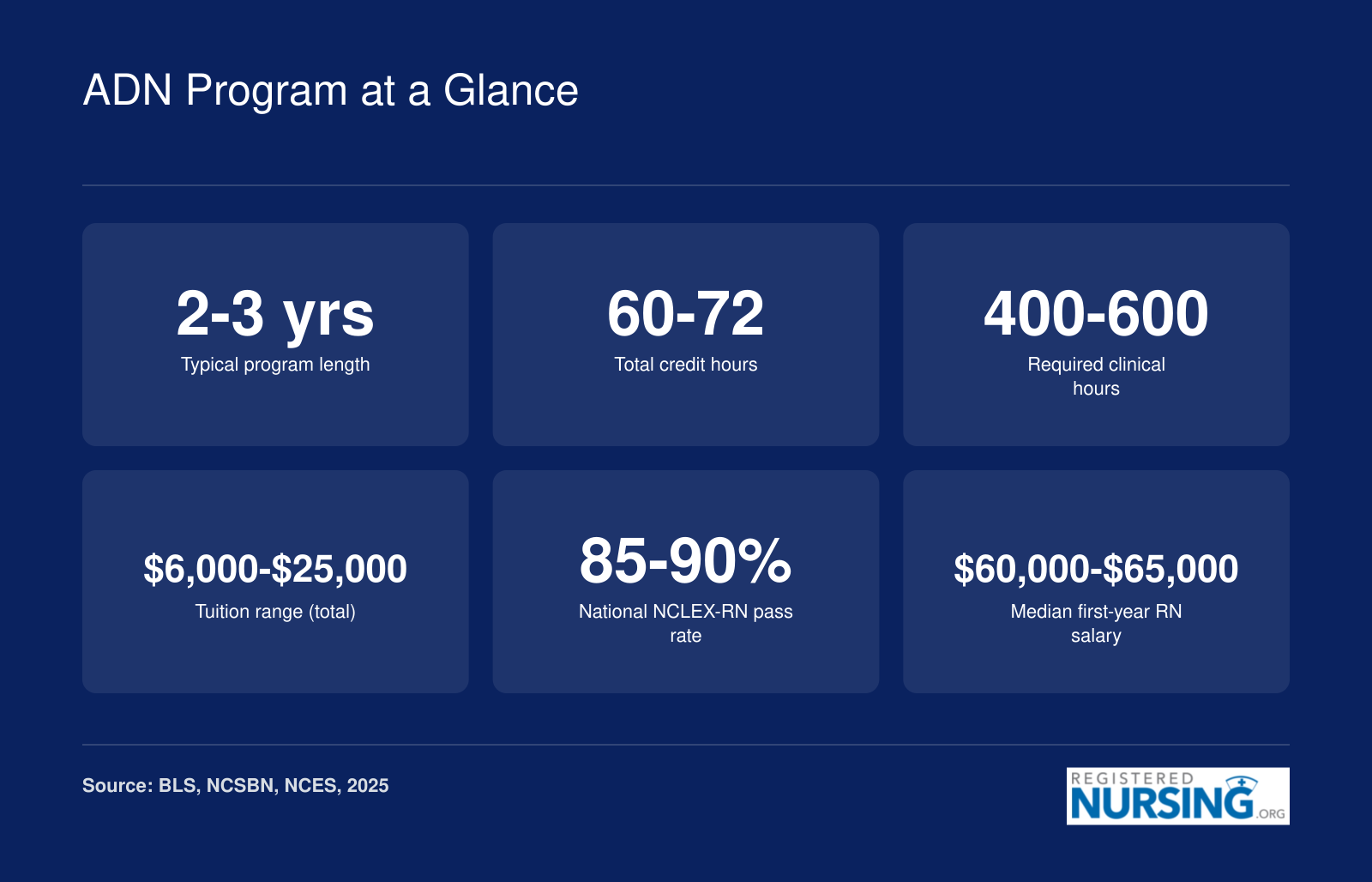
ADN Program at a Glance
An Associate Degree in Nursing packs clinical training and classroom instruction into a streamlined timeline, giving you the credentials to sit for the NCLEX-RN and launch your nursing career. Here are the numbers that matter most.
How Long Does an ADN Take? Full-Time, Part-Time, and Accelerated Options
The time it takes to earn an Associate Degree in Nursing depends on when you complete your prerequisites, whether you study full-time or part-time, and whether you already hold an LPN license. Most students finish in roughly two years, but the actual range stretches from about 12 months to four years depending on the path you choose.
Full-Time Timeline: The Standard Two-Year Track
A traditional full-time ADN program spans four semesters of nursing courses, typically completed across two academic years. What catches many students off guard is the prerequisite phase that comes before those four semesters. Courses such as anatomy and physiology, microbiology, developmental psychology, and college-level math are usually required for admission and can add one to two semesters to your total time. If you enter a community college with no prior college credits, plan on roughly two and a half to three years from your first class to graduation day. Students who knock out prerequisites during high school dual enrollment or at a community college before applying to a nursing program can stick closer to the two-year mark.
Part-Time, Evening, and Weekend Options
Not everyone can attend classes Monday through Friday during the day. A growing number of community colleges and career-focused institutions offer part-time, evening, or weekend scheduling tracks. These options typically stretch the program to three or four years, but they allow students to balance work and nursing school or manage family responsibilities while earning their degree. Some hybrid programs schedule campus time on just one or two days per week, with the remaining coursework delivered online. Blinn College, for example, runs a blended format with weekend clinicals starting in the second semester.1 If you are exploring part-time options, ask each school about seat availability, because evening and weekend cohorts are often smaller and more competitive.
Accelerated ADN Programs
If you have already completed your prerequisite courses, accelerated programs let you compress the nursing curriculum into roughly 12 to 20 months. These programs move fast, often running through summer semesters without a break. East Ohio College offers an 18-month hybrid ADN track.2 Midway University advertises a 16-month completion timeline. Joyce University of Nursing and Health Sciences runs a 20-month accelerated ASN. Because the pace is intense, most accelerated programs expect you to treat the program as a full-time commitment and discourage outside employment during enrollment.
Hybrid and Online Delivery
As of 2026, no fully online ADN program exists. Every program marketed as "online" is actually a hybrid: you complete lectures, readings, exams, and discussion boards through an online platform, but all clinical rotations and most lab sessions must happen in person at partner hospitals, clinics, or simulation centers. Weber State University uses a hybrid model that requires campus attendance one to two days per week for lab and clinical work.3 Rasmussen University offers its hybrid ADN across 16 campuses,4 and the University of Jamestown delivers online didactic coursework with clinicals held in the Fargo, North Dakota, area. If you see a school advertising a "100 percent online" nursing degree, dig into the details. The clinical hours will still require your physical presence.
LPN-to-RN Bridge Pathway
Licensed Practical Nurses can shorten the ADN timeline significantly through LPN to RN programs that award credit for prior LPN education and clinical experience. The exact number of credits you receive varies by school and state, but many bridge students save one to two semesters compared to the traditional track. Blue Ridge Community College and the Tampa area campus of one national program both offer three-semester LPN-to-RN options. Western Kentucky University structures its bridge ASN at 61 total credits, with transfer credit built in for LPN coursework. To qualify, you generally need an active, unencumbered LPN license, and some programs require a minimum number of clinical practice hours. Bridge cohorts tend to be small, so apply early and confirm that your LPN credentials meet the specific school's transfer policies before committing.
ADN Tuition and Financial Aid: What You'll Actually Pay
The biggest advantage of choosing an ADN over a BSN degree is cost, but the sticker price you see on a program page rarely tells the full story. Understanding the real total, and the aid available to offset it, can save you thousands and keep student debt manageable as you launch your nursing career.
What Community College ADN Programs Cost
Public two-year colleges remain the most affordable path to RN licensure. National averages for tuition and fees at public two-year institutions run roughly $4,150 per year for in-district students, putting the baseline for a two-year program around $8,300.1 In practice, published ADN program totals at community colleges vary by state, residency status, and whether the school charges a nursing-specific differential tuition. Recent examples illustrate the range:
- El Paso Community College: approximately $10,316 total2
- Richmond Community College: approximately $12,667 total3
- Lincoln Land Community College: approximately $15,342 total4
- Pima Community College: approximately $17,364 total (includes a differential tuition surcharge for the nursing program)5
- Rogue Community College: approximately $29,092 total (includes prerequisite coursework, universal fees, and additional expenses)6
Some cost aggregators place the typical community college ADN total between $4,000 and $15,000 over two years, though once you factor in prerequisites, differential tuition, and supplies, most students should budget in the $10,000 to $20,000 range.7
Out-of-district or out-of-state students often pay two to three times the in-district rate, so confirming your residency classification before you apply is worth the effort.
Private School Tuition: A Different Equation
Private nursing schools typically charge substantially more. The national average for tuition and fees at private nonprofit four-year institutions (used here as a proxy, since a clean ADN-only average is not published) sits near $45,000 per year.1 Even private two-year programs frequently land in the $30,000 to $80,000-plus range for the full ADN, depending on the institution and location. The accelerated timelines some private schools offer can be appealing, but weigh them against the total price tag before committing.
Beyond Tuition: Hidden Costs to Budget For
Tuition is only part of the bill. Plan for these additional expenses, which collectively can add $2,000 to $5,000 or more:
- Textbooks and digital access codes: often $500 to $1,500 across the program
- Scrubs, uniforms, and clinical shoes: typically $150 to $400
- Clinical supplies: stethoscope, blood pressure cuff, penlight, and nursing kit fees
- Background checks and drug screenings: required before clinical placement
- NCLEX-RN exam prep materials: review courses and question banks can range from free to over $500
- NCLEX-RN exam registration fee: $200 at the time of testing, plus state licensure application fees
Financial Aid That Can Cover Most (or All) of the Cost
Community college ADN tuition is low enough that a combination of grants, scholarships, and employer benefits can eliminate out-of-pocket costs entirely for many students.
- Federal Pell Grants: Available to students who demonstrate financial need, Pell Grants do not have to be repaid. Maximum awards can cover a significant portion, if not all, of community college ADN tuition each year.
- State nursing scholarships and grants: Many states fund scholarships specifically for nursing students, sometimes with a service commitment to work in an underserved area after graduation. Check your state's higher education agency for current offerings.
- HRSA Nurse Corps Scholarship Program: This competitive federal program covers tuition, fees, and a monthly living stipend in exchange for a two-year service commitment at a Critical Shortage Facility after licensure. It is one of the most generous awards available to nursing students.
- Employer tuition reimbursement: Hospitals, long-term care facilities, and health systems frequently offer tuition assistance to current employees pursuing nursing degrees. Some programs cover the full cost in return for a post-graduation work commitment.
- Institutional and community scholarships: Many colleges and local nursing organizations award smaller scholarships that, stacked together, meaningfully reduce your balance.
The bottom line: a community college ADN is one of the most cost-effective professional credentials you can earn. With strategic use of ADN financial aid, the net cost can be remarkably low, giving you a clear, affordable runway to sit for the NCLEX-RN and begin earning an RN salary.
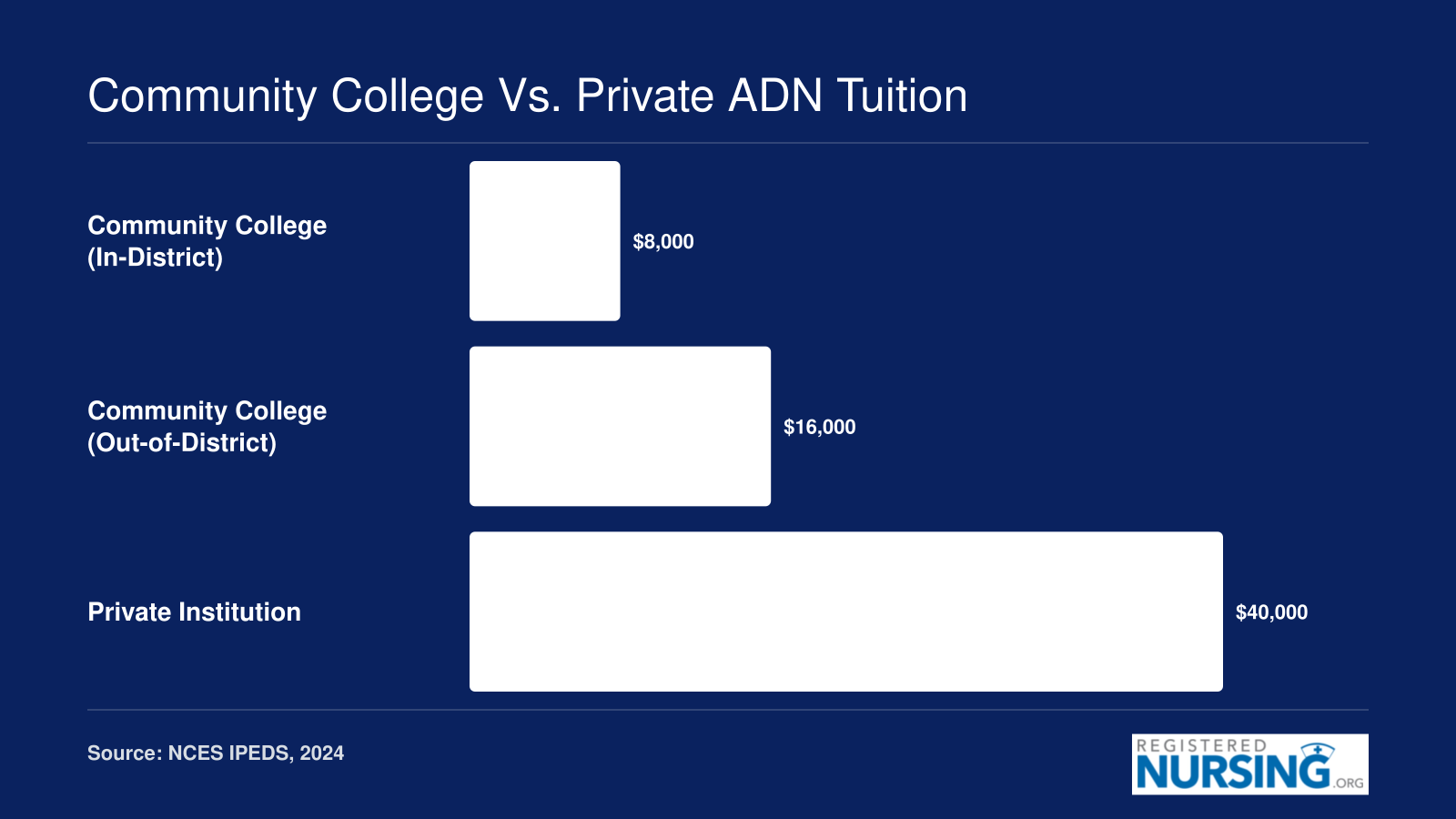
Community College Vs. Private ADN Tuition
ADN tuition varies dramatically depending on the type of institution and your residency status. Community colleges remain the most affordable path to an RN license, but costs can climb quickly at private schools or for out-of-district students.
NCLEX-RN Exam and RN Licensure After Your ADN
After finishing an ADN, the central tension is simple: the degree gets you to the exam faster and often for less money, but the NCLEX-RN is the actual gateway to practice, and it is the same test whether your diploma is from an associate or baccalaureate program. Passing it is not optional, and starting NCLEX prep during nursing school can make the first attempt count.
Same Exam for ADN and BSN Graduates
The NCLEX-RN is the national licensure exam for registered nursing in the United States. ADN and BSN graduates sit for the same computer-adaptive test, and state boards of nursing apply the same passing standard. In the most recent NCSBN data for 2025, first-time U.S.-educated RN candidates passed at 86.7% overall.1 Associate degree candidates passed at 86.1%, while baccalaureate candidates passed at 87.6%.1 The previous year's figures were higher: 90.6% for ADN candidates and 91.9% for BSN candidates in 2024, a gap of only 1.3 percentage points.2 In 2024, 84,580 ADN candidates and 99,204 BSN candidates tested.2 That near-parity is the surprising and useful number for prospective ADN students: the associate pathway does not put licensure out of reach. Still, program quality matters when you compare BSN vs ADN programs. NCSBN guidance notes that ADN programs were 45% less likely than BSN programs to have a first-time NCLEX pass rate at or above 80%.3
How to Apply for Licensure After Your ADN
The application flows through your state board of nursing and Pearson VUE, not through the nursing program alone. The usual sequence is: - Complete an ADN program that meets your state board's education requirements. - Apply to the state board of nursing for licensure eligibility. - Register for the NCLEX-RN with Pearson VUE (see the NCLEX-RN Exam Guide) and pay the exam fee. - Wait for the Authorization to Test, or ATT, which comes after the board confirms eligibility. - Schedule the exam at a Pearson VUE test center or through online proctoring where available.
Some states will not issue the ATT until they receive transcripts and any required background check materials, so start the board application as soon as you are eligible.
State-Specific Requirements and Renewal
State boards add their own requirements on top of the national exam. These often include a criminal background check and fingerprinting. Some states also require a nursing jurisprudence exam before licensure. After you are licensed, renewal may require continuing education, and the required hours vary by state. Confirm these requirements with your state board before you apply, because deadlines and fees differ.
One common question is whether ADN-educated RNs must complete a BSN within a certain number of years. BSN-completion timelines do appear in employer policies, scholarship conditions, military service requirements, and special program agreements, but no universal state law from the available national sources imposes the same fixed deadline on every ADN-educated RN. State statutes are not uniform, so if a BSN deadline is part of your employment plan, verify the exact requirement with the employer and the state board.
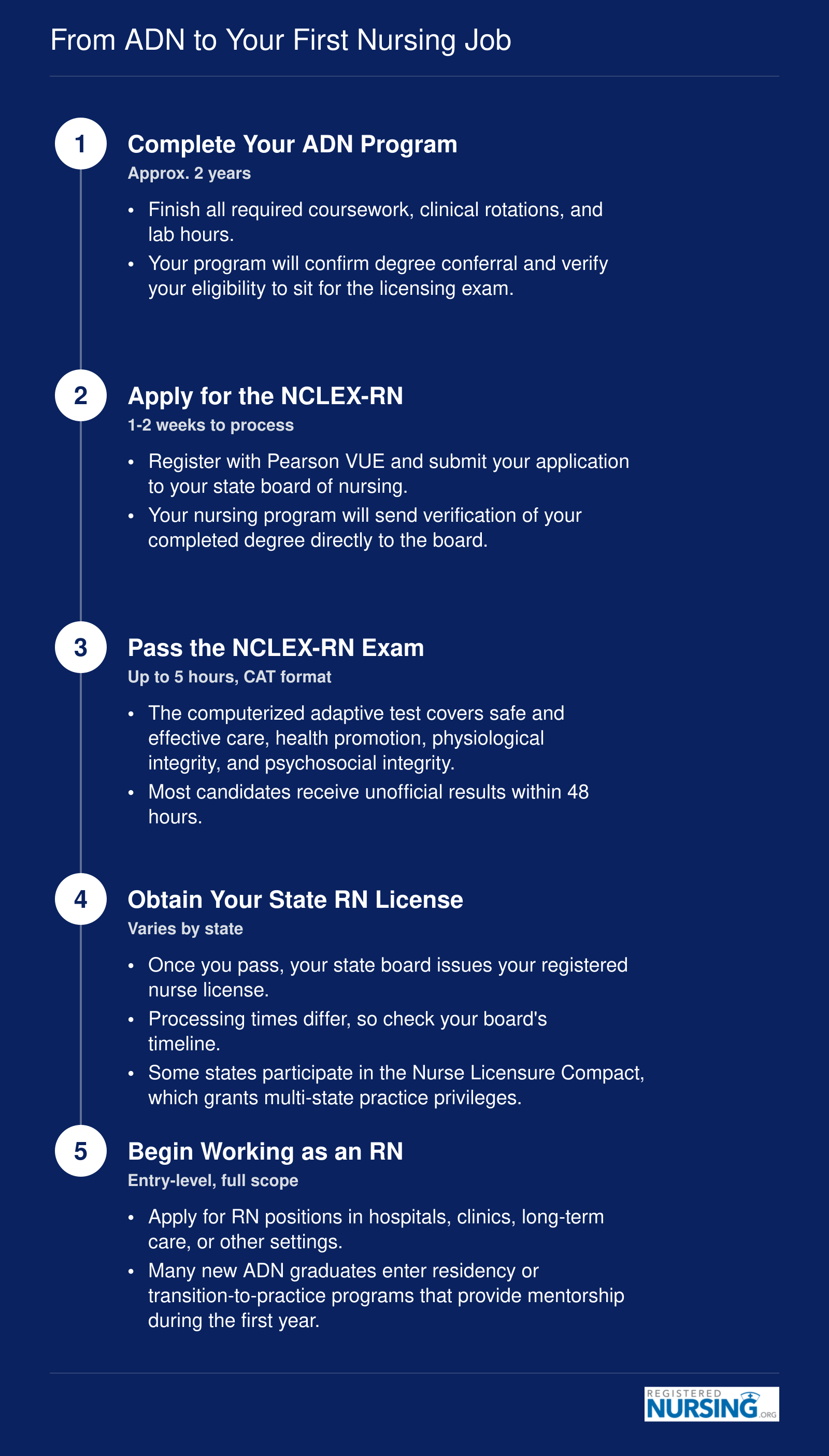
From ADN to Your First Nursing Job
Finishing your associate degree in nursing is a major milestone, but a few more steps stand between you and your first day on the unit. Here is the typical sequence new ADN graduates follow to become working registered nurses.
ADN Vs. BSN: Which Nursing Pathway Is Right for You?
Two years at a community college or four years at a university: both paths end at the same NCLEX-RN exam and the same RN license. The credential you earn on day one of your career is identical whether you walk in with an ADN or a BSN. What differs is what happens next: which employers call you back, which units will hire you, and how quickly you can move into leadership or specialty roles.
The Case for the ADN
The ADN is the faster, cheaper doorway into nursing, and for many students that math is decisive.
- Speed: Roughly two years to licensure versus four for a BSN, which means two extra years of RN income if you go straight to work.
- Cost: Community college tuition is a fraction of a four-year program, and financial aid tends to close the gap further.
- Same license: ADN and BSN graduates sit for the exact same NCLEX-RN and earn the identical Registered Nurse credential.
- Strong demand in key settings: Long-term care, rehabilitation, community clinics, home health, and outpatient facilities continue to hire ADN-prepared RNs actively.
The trade-offs are real, though. Many hospitals, particularly Magnet-designated facilities, now prefer or require a BSN for new hires. Survey data suggests roughly 72% of employers express a strong preference for BSN graduates and about 28% require a BSN for at least some new-hire roles. Management, public health, case management, and most graduate nursing tracks also expect a BSN, which is why a large share of ADN nurses eventually complete an RN-to-BSN bridge.
The Case for the BSN
BSN graduates report stronger early hiring signals: AACN data shows about 84% have a job offer at graduation and roughly 96% within four to six months. Starting pay tends to run higher as well, though the exact gap varies by market and source. The occupation-wide RN median wage sits near $86,070, with employer surveys putting ADN starting pay in the $55,000 to $75,000 range and BSN starting pay in the $65,000 to $90,000 range.
The downside is time and money: two additional years, higher tuition, and delayed earnings. For a student who plans to work in a setting where the BSN is not required, that investment may not pay back quickly.
How to Choose
Pick the ADN if cost, speed, and local hiring in non-hospital settings matter most, and treat RN-to-BSN as a likely next step. Pick the BSN up front if you already know you want hospital acute care, leadership, or graduate school, and the finances work. Either way, you become an RN.
Frequently Asked Questions About ADN Programs
Below are straightforward answers to the questions prospective ADN students ask most often. If you are weighing program formats, timelines, or career outcomes, these details will help you make a confident decision.