

What you’ll learn in this article…
- Dr. Shirleatha Dunlap now leads CCNE as chief nurse administrator.
- CCNE accredits more than 2,000 nursing programs nationally.
- Updated 2026 CCNE standards take effect January 1, 2027.
In July 2026, Dr. Shirleatha Dunlap, dean of the Mary Black College of Nursing at USC Upstate, was elected chief nurse administrator of the Commission on Collegiate Nursing Education. The election places a sitting program leader at the helm of the only national accreditor dedicated exclusively to baccalaureate, graduate, and residency nursing programs.
For the over 2,000 CCNE-accredited programs, this leadership change carries direct regulatory weight. The chief nurse administrator guides accreditation standards, policy revisions, and compliance expectations that shape curriculum, faculty qualifications, and clinical partnerships. Program directors, educators, and students nationwide have a clear stake in the priorities Dunlap brings to the role.
Who Is Dr. Shirleatha Dunlap? Her Nursing Education Leadership Journey
Academic Foundation and Credentials
Dr. Shirleatha Dunlap brings both academic depth and frontline nursing experience to the national stage. She earned her BSN in 2002 and went on to complete a PhD in Nursing in 2009,1 establishing an early foundation in evidence-based practice and nursing education research. Her commitment to teaching excellence is formalized through the Certified Nurse Educator (CNE) credential, a mark of distinction that signals mastery of the competencies needed to develop the next generation of nurses.2
Leadership Journey and Recognition
Dunlap's career arc reflects progressive responsibility in nursing academia. Before joining the University of South Carolina Upstate, she served as Associate Dean of Academic Programs at the University of Memphis from 2015 to 2019, where she oversaw curriculum development and faculty affairs.3 Her impact there was recognized with the Thomas Briggs Foundation Excellence in Teaching Award and inclusion among the Top 100 Nurses in Memphis and Shelby County.3 She also completed the AACN Leadership in Academic Nursing Fellowship, a selective program that cultivates executive skills for deans and senior faculty.3
In 2024, Dunlap became Dean and Professor of the Mary Black College of Nursing at USC Upstate.2 Just two years later, in CCNE's 2026 national election, she was chosen as the board's Chief Nurse Administrator, a role that places her at the center of accreditation policy.4 Chancellor Bennie L. Harris called the election "a testament to her exceptional leadership and commitment to advancing nursing education," while Provost Pamela Steinke emphasized that "her deep knowledge of nursing education and accreditation" will enrich the board's work.4
National Perspective from a Growing University
Dunlap's perspective as a dean at a public, growing institution like USC Upstate is especially valuable on a national board. She understands the resource constraints, diverse student populations, and regional workforce demands that many accredited programs face. Her voice ensures that CCNE standards remain both rigorous and attainable for a broad range of nursing schools, not just elite research universities.
As both a working dean and the CCNE chief nurse administrator, Dr. Dunlap brings frontline program insight directly into national policy. Her perspective bridges the gap between classroom realities and the accreditation standards that shape nursing education.
What Does the CCNE Chief Nurse Administrator Do? Breaking Down the Role
The Chief Nurse Administrator on the CCNE Board of Commissioners is not a hospital executive but a national policy leader shaping the standards that define quality in nursing education. While the title sounds clinical, this role is firmly rooted in academic governance, bridging the gap between what nursing schools teach and how programs are held accountable for excellence.
A Voice for Nursing Education Leadership
The CNA commissioner represents the perspective of deans, directors, and other top academic leaders who run nursing programs. CCNE relies on three such commissioners to ensure that accreditation policies reflect the real-world challenges of administering baccalaureate, graduate, and residency programs2. Each CNA brings at least five years of academic administration experience and a minimum of three years serving in a chief nurse administrator role within a nursing school, so they understand the pressure of balancing curriculum innovation, faculty development, and student outcomes1.
Key Duties on the Board
- Policy development: CNAs help draft and revise accreditation standards, ensuring they remain evidence-based and achievable.
- Standard setting: They vote on quality benchmarks that programs must meet, from clinical hour requirements to faculty qualifications.
- Accreditation decisions: When a program seeks initial or continuing accreditation, the board reviews compliance and renders decisions; CNAs weigh in with an educator's lens.
- Liaison role: CNAs communicate board actions back to nursing education communities, helping schools interpret standards and prepare for site visits.
How It Differs from a Hospital Chief Nursing Officer
A hospital chief nursing officer manages nursing staff, patient care delivery, and operational budgets within a healthcare system. The CCNE CNA, in contrast, focuses entirely on the academic enterprise. Their decisions influence what students learn before ever stepping onto a clinical floor, making them architects of the nursing workforce rather than managers of its current members.
Term and Governance Structure
Each CNA serves a three-year term, beginning on January 1 of the year following their election, and may be re-elected to a maximum of two consecutive terms1. To avoid conflicts of interest, commissioners recuse themselves from accreditation discussions involving their own institutions for a period of ten years after leaving the board2. Candidates must hold a doctoral degree and a graduate degree in nursing, maintain an active RN license, and currently serve as a chief nurse administrator at a nursing program1. Preference is given to those with prior experience as CCNE evaluators1.
Did you know? As of 2026, more than 2,000 nursing programs hold CCNE accreditation, spanning baccalaureate, master's, doctor of nursing practice, post-graduate APRN certificates, entry-to-practice residencies, and nurse practitioner fellowships, according to the CCNE Accredited Programs Directory.
How CCNE Elects Its Board of Commissioners: The 2026 Election Process
Filling a CCNE Board of Commissioners seat isn’t a single-step appointment; it’s a careful progression from open nomination through committee review and finally a vote by accredited programs. This multi-stage process balances broad input with rigorous vetting, ensuring that commissioners reflect the diverse perspectives of nursing education and practice.
From Nomination to Slate
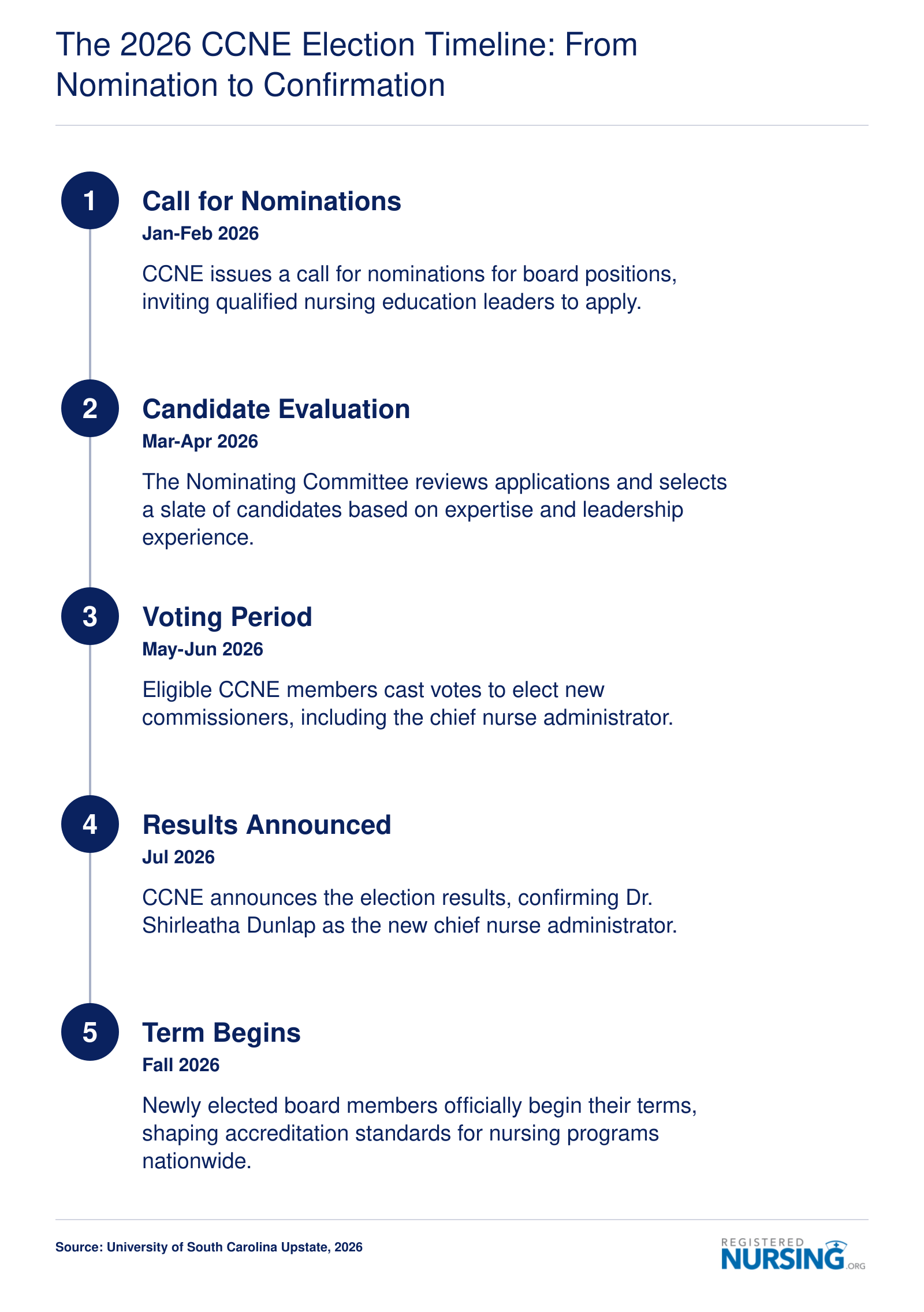
Each election cycle begins with an official call for nominations. For the 2026 election, any interested party, including institutions, organizations, current board or committee members, and even individuals self-nominating, was eligible to submit a candidate. The required materials included an online nomination form, a CV or resume, and at least one reference. The nomination deadline was March 12, 2026, with reference letters due by March 16.
After the nomination window closed, the Nominating Committee took over. This group reviewed all submissions and developed a balanced slate of candidates. The slate had to be submitted at least 60 days before CCNE’s annual meeting, ensuring ample time for voter review. The committee’s goal: assemble a group of nominees that represents the breadth of nursing academia and clinical practice while upholding CCNE’s standards.
Voting and Voter Eligibility
Voting opened in late spring 2026 using a secure electronic ballot. The electorate is limited to programs that hold CCNE accreditation, baccalaureate, graduate, and nurse residency or fellowship programs. Each accredited institution gets one vote1, meaning the decision rests squarely with the nursing education community. In 2026, the voter response rate reached 48 percent1, a solid turnout for a specialized professional election. Results were announced after the voting window closed, confirming the new commissioners, including Shirleatha Dunlap as chief nurse administrator.
Board Composition and Terms
New commissioners serve a three-year term, with staggered expiration dates to preserve institutional knowledge. The 2026 board includes members elected across distinct categories: the chief nurse administrator (Shirleatha Dunlap, PhD, RN, CNE), a practicing nurse (Amelia Malcom, PhDc, DNP, FNP-BC, CNE), and a professional consumer (Giselle Holness, DNP, AGPCNP-BC, PMHNP-BC, NE-BC). These roles ensure governance by individuals who understand curriculum delivery, direct patient care, and public accountability. All positions, including the chief nurse administrator, are filled through the same nomination and voting process, no separate pathway exists. This unified approach reinforces the principle that leadership in accreditation must stay rooted in the programs it serves.
The 2026 CCNE Election Timeline: From Nomination to Confirmation
Impact on Nursing Program Accreditation and Standards: Preparing for Change
What are the new CCNE accreditation standards for 2026, and how should nursing program leaders adjust their preparation strategies? As the Commission on Collegiate Nursing Education (CCNE) prepares to transition from the 2024 Standards to the 2026 Standards, effective January 1, 20272, program directors across baccalaureate and graduate nursing programs need to understand what is shifting and why it matters. The revised framework, approved by the Board of Commissioners2 after a public call for comments in spring 20265, retains a familiar four-part structure: Mission and Governance, Institutional Commitment and Resources, Curriculum and Teaching-Learning Practices, and Assessment and Achievement of Program Outcomes1. However, the details within each domain have been updated to reflect current priorities in nursing education.
Key Quality Benchmarks in the Current and Revised Standards
Both the 2024 and 2026 Standards hold programs to measurable performance thresholds. For program outcomes, CCNE expects a 70% completion rate, an 80% pass rate on licensure or certification exams (see how to read NCLEX-RN pass rate data), and a 70% employment rate for graduates3. These benchmarks remain firm signals of program effectiveness. The 2026 Standards also reinforce alignment with The Essentials: Core Competencies for Professional Nursing Education, which organizes nursing education around 10 domains, 8 concepts, and 45 competencies1. Program leaders should verify that their curricula map directly to these competencies.
Preparing for Competency-Based Education and Inclusive Curriculum
A major influence on the revised standards is the ongoing shift toward competency-based education (CBE). With Dean Shirleatha Dunlap now serving as CCNE's chief nurse administrator, her leadership may accelerate integration of CBE principles. Dunlap’s background as dean of a nursing college at USC Upstate suggests a focus on both academic rigor and innovation. While no formal policy changes have been announced, nursing programs that proactively adopt competency-based assessments and evidence-based teaching strategies will be well positioned for future site visits. Inclusion and interprofessional collaboration also surface in the new framework, reflecting broader calls for diversity in nursing1. Programs should review how their mission, faculty qualifications, and clinical partnerships support these aims.
Staying Alert to the Substantive Change Policy
In a dynamic regulatory environment, program leaders must also track the CCNE substantive change policy. Any significant alteration in curriculum, resources, or location requires notification to CCNE. The policy, housed within the Standards, Procedures & Guidelines document, ensures that even mid-cycle changes do not compromise accreditation status4. With new leadership and updated standards, CCNE may scrutinize changes more closely. Directors should maintain open communication with their accreditation liaisons and plan any major revisions well in advance of the 2027 implementation date to avoid compliance gaps.
Questions to Ask Yourself
What This Means for BSN, MSN, DNP, and NP Programs: A Degree-Level Breakdown
The election of Dr. Shirleatha Dunlap as CCNE chief nurse administrator comes at a pivotal time: the agency’s updated 2026 standards take effect January 1, 20271, and her leadership will shape how those standards are interpreted and evolved in the years ahead. While accreditation changes are rarely abrupt, program directors at every level should understand how refinements could affect their next self-study.
Baccalaureate Programs: Maintaining the Foundation
BSN programs, including traditional, accelerated, and RN-to-BSN pathways, are accountable for producing practice-ready graduates who pass the NCLEX and find employment. Current standards require an 80% first-time NCLEX pass rate and a 70% employment rate for graduates2. Under new leadership, programs may see heightened emphasis on clinical judgment development and competency-based education, but the core expectations remain tied to these measurable outcomes. RN-to-BSN programs, which often serve working nurses, may face increased scrutiny of their curriculum’s value-added beyond the ADN level, particularly in leadership and population health.
Master’s and Specialty Tracks: Navigating Clinical Rigor
MSN programs, especially nurse practitioner tracks, already adhere to stringent clinical hour minimums (500 hours for NP programs)3 and an 80% certification pass rate2. The CCNE board might prioritize aligning accreditation criteria with evolving national certification requirements. Programs in nursing informatics or other non-clinical specialties could see more explicit guidance on how non-clinical competencies translate to patient outcomes. The key for directors is tracking alignment between preceptor quality, clinical placement availability, and these benchmarks.
Doctoral Programs: Elevating Practice Scholarship
DNP programs face the highest clinical hour requirement at 1,000 hours3, and the capstone project is a focal point for demonstrating practice scholarship. As the CCNE board continues to refine what constitutes a rigorous DNP project, expect more detailed expectations around scholarly writing, sustainability of quality improvement initiatives, and interprofessional collaboration. The new administrator’s perspective as a nursing dean may bring pragmatic insights that strengthen the project’s real-world impact without inflating paperwork.
Preparing for Your Next Accreditation Cycle
Rather than anticipating radical overhauls, program directors should focus on these practical steps: review the 2026 standards documents carefully; benchmark your program’s current metrics against CCNE’s performance thresholds; ensure your faculty are familiar with the substantive change policy4; and watch for any forthcoming interpretations or guidance from the board. Dr. Dunlap’s transition from a campus leadership role to national policy means she understands the operational pressures nursing programs face. Her influence will likely steer the commission toward standards that are both ambitious and realistically achievable, reinforcing the goal of continuous improvement rather than disruptive change.
Lessons From the Past: How CCNE Leadership Changes Have Shaped Nursing Accreditation
How have past CCNE leadership changes shaped nursing accreditation standards? A look at the history of the Commission on Collegiate Nursing Education reveals a pattern: new board leaders often usher in updated standards and fresh priorities that ripple through nursing programs nationwide. While each chief nurse administrator brings a unique vision, the collective impact of these transitions has been a steady evolution of accreditation criteria to match the demands of modern healthcare.
The Cyclical Nature of Standards Revision
CCNE accreditation standards are not static documents. They undergo periodic revision, typically every five to ten years, to reflect changes in nursing practice, education research, and workforce needs. Historically, the start of a new chair or chief nurse administrator’s tenure has coincided with or closely preceded these revision cycles. This alignment is no coincidence: the Board of Commissioners, guided by its leadership, votes on standards updates and sets the strategic direction for the organization. A newly elected leader often brings energy and perspective that catalyze a thorough review of existing benchmarks.
How Leadership Vision Drives Change
Each chief nurse administrator steps into the role with professional experience that shapes their priorities. For example, a leader with a background in rural health might emphasize clinical placement standards that accommodate underserved areas, while one with expertise in graduate education may push for stronger residency requirements. Although individual administrators’ names and exact policy shifts are archived in CCNE records, the broader trend is clear: leadership transitions are pivotal moments that can accelerate changes already under discussion or introduce novel approaches. Programs seeking accreditation or reaccreditation often monitor these transitions closely, as they signal potential adjustments in self-study requirements or site visit protocols.
What This Means for Nursing Programs Today
For nursing programs at all degree levels, understanding the historical context of CCNE leadership provides strategic advantage. When a new chief nurse administrator is elected, it’s wise to review past patterns and prepare for possible standard revisions. While any specific changes under Dr. Dunlap’s tenure are yet to be determined, the fact that her election closely follows recent updates to the 2024 standards suggests that implementation and refinement, rather than wholesale revision, may be near-term priorities. Historically, such periods have focused on helping programs interpret and meet new expectations, with the board leadership guiding interpretive FAQs and educational resources. By staying attuned to CCNE announcements and engaging with the accreditation community, programs can navigate future shifts proactively rather than reactively.
Frequently Asked Questions About CCNE Leadership and Accreditation
Here are answers to common questions about the new CCNE chief nurse administrator and what this leadership change means for nursing programs and accreditation.
- Who is the new CCNE chief nurse administrator in 2026?
- Dr. Shirleatha Dunlap, Ph.D., RN, CNE, is the new chief nurse administrator, a role that exemplifies a seasoned nurse administrator. Elected during CCNE's 2026 national election, she serves as dean and professor at the Mary Black College of Nursing, University of South Carolina Upstate. She brings extensive academic leadership to the role.
- What is the CCNE substantive change policy?
- CCNE's substantive change policy requires nursing programs to report major modifications that could affect accreditation compliance, such as significant curriculum overhauls, new delivery formats, or organizational changes. This ensures continued alignment with CCNE standards and protects program quality.
- Is CCNE accreditation good for nursing?
- Yes, CCNE accreditation indicates a program meets rigorous national quality standards. Recognized by the U.S. Secretary of Education, it can enhance graduate eligibility for federal funding, advanced education, and employment preferences. It signals commitment to ongoing program improvement.
- How long is the term for a CCNE chief nurse administrator?
- The chief nurse administrator is a board member role, not an officer position. While CCNE officers serve one-year terms1, board commissioners typically serve longer terms. Dr. Dunlap's specific term length was not announced, but board appointments commonly last three years.
- When did the 2026 CCNE election take place?
- CCNE's 2026 national election occurred earlier this year. Although exact dates were not publicly detailed, elections typically align with the organization's spring cycle and precede the start of new board terms. Dr. Dunlap's election was confirmed by USC Upstate during that period.
- How does CCNE leadership affect nursing program standards?
- Individual leadership changes do not immediately alter accreditation standards1, but leaders like the chief nurse administrator help guide policy and revision discussions. CCNE is currently revising its 2024 standards, with a public comment deadline of May 26, 20262, providing an opportunity for influence.
- What is the difference between CCNE and ACEN accreditation?
- CCNE primarily accredits baccalaureate, graduate, and residency programs, while ACEN accredits all levels from practical to doctoral. Both are recognized by the U.S. Department of Education. The choice depends on program type and institutional preference, but both ensure quality nursing education.
- Will CCNE accreditation requirements change with new leadership?
- According to CCNE, leadership changes alone do not directly trigger requirement changes1. However, ongoing revisions like the 2026 standards update are shaped by board input. Programs should monitor any new drafts, but no immediate shifts are expected solely due to the new chief nurse administrator.
More than 2,000 nursing programs hold CCNE accreditation, and Dr. Shirleatha Dunlap’s election as chief nurse administrator puts a practicing dean at the center of national standards policy. Her background signals focus on curriculum alignment and student outcomes, while the 2026 election brought her perspective through a rigorous, multi-stage vote. Program leaders should attend CCNE public comment periods and review alignment with the 2026 Standards, effective January 2027. Informed preparation turns accreditation shifts into an opportunity to strengthen nursing education.