

What you’ll learn in this article…
- NMSU and UNM are New Mexico's only two DNP-granting universities.
- In-state doctoral tuition differs significantly between the two schools.
- All online DNP tracks still require 500 to 1,000 plus clinical hours.
New Mexico's DNP landscape is unusually compact: only two universities, New Mexico State University and the University of New Mexico, grant the Doctor of Nursing Practice in the state. That scarcity simplifies your search but raises the stakes on fit. NMSU's hybrid Family Nurse Practitioner track runs 77 credit hours with in-state tuition near $6,600 per year, while UNM offers a broader specialization menu, including pediatrics, psychiatric-mental health, and nurse-midwifery, at roughly $9,800 in-state annually.
Both schools deliver coursework largely online, though clinical rotations still require face-to-face hours across the state's mix of rural and urban sites. Nurses curious about the full scope of New Mexico nursing credentials and licensing will find this hybrid reality matters more than any marketing label.
Best DNP Programs in New Mexico: Rankings & Comparison
New Mexico offers seven distinct DNP program listings spread across just two universities, giving prospective students a focused but surprisingly diverse set of specialization options. Whether you are drawn to family practice, pediatrics, psychiatric care, midwifery, acute care, or nursing leadership, these programs share a common emphasis on serving rural and underserved communities. Note that graduation rates cited below reflect institution-wide figures, as DNP-specific rates are not separately reported. Program-level earnings and debt data are not yet available for these DNP tracks, so we include each school's overall median graduate earnings and debt to provide general ROI context.
How this list was built
- Net price and affordability
- Institution-wide graduation rate
- Available specialization breadth
- Delivery format flexibility
- Graduate earnings indicators
- Internal program database
- College Scorecard graduate earnings — collegescorecard.ed.gov
- NCES-IPEDS federal institutional data — nces.ed.gov
University of New Mexico
#1Albuquerque, NM · $15,000/yr
Best for: Nurses seeking diverse specialization choices
The University of New Mexico, based in Albuquerque, houses six DNP tracks within its College of Nursing, making it the most comprehensive doctoral nursing destination in the state. As a flagship research university and Hispanic-Serving Institution with an integrated Health Sciences Center, UNM pairs small cohort sizes (as low as 6:1 student-to-faculty ratios) with high-tech simulation facilities and clinical placements that span both urban and rural New Mexico. The institution-wide graduation rate is approximately 55%, the median overall graduate debt is $18,450, and graduates across all programs earn a median of roughly $44,800 ten years after enrollment.
- CCNE-accredited, 3-year post-bachelor's pathway
- 70 total credit hours with 825 clinical hours required
- Hybrid format combines online coursework with on-campus sessions
- Prepares graduates for ANCC or AANP FNP certification
- Clinical rotations available in both rural and urban settings
- Small class sizes with individualized faculty feedback
- Capstone project required for completion
- 3-year BSN-to-DNP track with no GRE or GMAT required
- 100% licensure pass rate reported by the program
- 8:1 student-to-faculty ratio with cohort-based learning
- 100 lab hours plus dedicated clinical placements
- Focuses on well-care and prevention for newborns through young adults
- WICHE tuition reciprocity available for eligible non-residents
- Hybrid delivery with online and on-campus components
- 100% certification pass rate reported
- No GRE required for admission
- Clinical placements arranged by the program
- 8:1 student-to-instructor ratio
- Prepares graduates for full prescriptive authority
- Emphasis on rural behavioral health care
- Accredited by the Accreditation Commission for Midwifery Education
- 6:1 student-to-instructor ratio in small cohorts
- No entrance exam required, test-optional admission policy
- Clinical placements secured by faculty across the state
- Scholarships and financial aid available
- Focus on rural and underserved maternal health populations
- 3-year hybrid program with 1,000 required clinical hours
- Minimum 3.0 GPA for admission consideration
- 83% of students receive financial aid
- Over $1.2 million in scholarship funding available
- Clinical placements arranged by the program
- Priority application deadline of December 1
- Requires active New Mexico RN license
- Fully online format designed for working nurses
- Part-time option and cohort-based structure available
- No entrance exam required for admission
- Prepares graduates for nurse manager and CNO roles
- WICHE tuition reciprocity for eligible non-resident students
- Faculty include experienced health care executives
New Mexico State University
#2Las Cruces, NM · $8,000 – $25,000/yr
Best for: Budget-conscious RNs in rural communities
New Mexico State University in Las Cruces offers a focused BSN-to-DNP Family Nurse Practitioner program that stands out for its integration of primary and mental health care training. Delivered mostly through asynchronous online coursework with a one-week on-campus intensive, the NMSU DNP program allows students to complete clinical hours in their home communities. The institution-wide graduation rate is approximately 55%, the median overall graduate debt sits at about $17,095, and the median earnings for all graduates ten years after enrollment are roughly $39,100. With an effective net price of about $8,889, NMSU is the more affordable of the state's two DNP-granting schools.
- 77 total credit hours over a 3-year timeline
- Mostly asynchronous online classes with on-campus orientation
- 1,000 clinical hours completed in your hometown community
- Integrated primary and mental health care curriculum
- Prepares for both ANCC and AANP FNP certification exams
- Interprofessional education experiences built into coursework
- Minimum 3.0 GPA and three letters of recommendation required
- Prerequisite courses required before enrollment
NMSU vs UNM DNP Programs: Side-By-Side Comparison
New Mexico's two flagship universities each bring distinct strengths to their DNP offerings. The comparison below captures the key differences across cost, format, specializations, and program structure so you can weigh the trade-offs at a glance. Where program-level earnings and debt data have not yet been published, we note that directly rather than estimate.
| Feature | New Mexico State University (NMSU) | University of New Mexico (UNM) |
|---|---|---|
| Location | Las Cruces, NM | Albuquerque, NM |
| Entry Pathways Offered | BSN-to-DNP, MSN-to-DNP | BSN-to-DNP |
| Primary Specialization Tracks | Family Nurse Practitioner (integrated primary & mental health), Psychiatric-Mental Health Nurse Practitioner (PMHNP), Nurse Anesthesiology | Pediatric Nurse Practitioner – Primary Care, Adult-Gerontology, additional population-health and leadership tracks |
| Nurse Anesthesiology Track | Yes, 102 credit hours, approximately 36 months, $893.76 per credit (roughly $91,164 total estimated cost as of 2026) | Not currently offered at the DNP level |
| BSN-to-DNP Per-Credit Cost (2025–2026) | $493.40 (Global Campus rate, same for in-state and out-of-state students) | $628.22 (in-state); out-of-state students should check for WICHE tuition reciprocity |
| BSN-to-DNP Estimated Total Cost | Varies by track, FNP track is 77 credits (roughly $38,000 at current rates); PMHNP track is 79 credits | Approximately $46,507 for the full program (in-state) |
| MSN-to-DNP Credits & Cost | 26–28 credits at $493.40 per credit (roughly $12,800–$13,800 total) | MSN-to-DNP pathway details are limited in published sources; contact UNM's College of Nursing directly |
| Program Format | Hybrid, mostly asynchronous online coursework with on-campus orientation and clinical seminars | Primarily campus-based with small class sizes (approximately 8:1 student-to-faculty ratio) |
| BSN-to-DNP Program Length | Approximately 36 months (3 years), fall start | Approximately 3 years, fall start |
| MSN-to-DNP Program Length | Approximately 24 months | Not widely published; verify with the program |
| Clinical Hour Requirements | 1,000 clinical hours (FNP track); clinical training arranged in your home community | 100 lab hours noted for PNP track; clinical placements arranged by the university; total clinical hour requirements vary by specialty |
| Certification Preparation | ANCC or AANP Family Nurse Practitioner certification (FNP track) | Reports 100% licensure pass rate for its Pediatric NP track |
| Institutional Designation | Hispanic-Serving Institution (HSI) | Hispanic-Serving Institution (HSI); part of a large academic Health Sciences Center |
| Median Graduate Debt (Institution-Wide) | Approximately $17,095 | Approximately $18,450 |
| Median Earnings 10 Years After Entry (Institution-Wide) | Approximately $39,067 | Approximately $44,792 |
| Program-Level Earnings (1-Year Post-Graduation) | Not yet reported for DNP programs | Not yet reported for DNP programs |
| Admissions Selectivity (University-Wide) | 89% acceptance rate | 95% acceptance rate |
| Key Differentiator | Flexible Global Campus pricing with no out-of-state premium; one of the few programs in the state offering a nurse anesthesiology doctorate | Access to UNM's Health Sciences Center, high-tech simulation facilities, and a strong focus on rural and underserved community care |
Questions to Ask Yourself
BSN-To-DNP vs MSN-To-DNP Pathways in New Mexico
Two paths lead to the Doctor of Nursing Practice in New Mexico: entering with a BSN and moving straight to the doctorate, or building on an existing MSN. The choice shapes how long you will study, what you will spend, and how many clinical hours you will complete.
BSN-to-DNP: The Direct Route from Bachelor's to Doctorate
For nurses who hold a Bachelor of Science in Nursing and want the most efficient path to advanced practice, BSN-to-DNP programs combine graduate-level coursework with doctoral preparation. New Mexico State University is the main option for this route in New Mexico, offering two specialty tracks: Family Nurse Practitioner and Psychiatric Mental Health Nurse Practitioner. The FNP track requires 77 credits and includes 1,088 clinical hours,1 while the PMHNP track needs 79 credits and 1,000 clinical hours.2 Both are designed to be completed in three years of full-time study, using a hybrid delivery model that blends online coursework with occasional on-campus sessions.3 Because these programs include both master's-level and doctoral content, the credit load is substantial, roughly double that of an MSN-to-DNP path. However, by skipping a standalone MSN, you avoid the time and expense of applying to and completing a separate master's degree before starting doctoral work. Nurses weighing that option can review Best Online MSN Programs in New Mexico to compare what a standalone master's entails.
MSN-to-DNP: Building on a Master's Degree
If you already have a Master of Science in Nursing, an MSN-to-DNP program streamlines the doctoral process by focusing only on the DNP essentials and a final scholarly project. Both NMSU and the University of New Mexico offer this pathway, and both can be finished in about two years of full-time study. At NMSU, the MSN-to-DNP program in Population Health Leadership requires 26 to 42 credits, depending on transfer and prior coursework, with 1,000 clinical hours.4 UNM's MSN-to-DNP asks for 30 credits, 200 clinical hours, and an additional 300 project hours, all delivered online.5 The lighter credit load means lower total tuition, and the shorter timeline gets you back to practice faster. Because MSN-to-DNP programs assume you have already mastered advanced clinical skills, the curriculum emphasizes leadership, systems thinking, and evidence-based practice over hands-on patient hours.
Choosing the Right Pathway for You
The decision often comes down to where you are in your career. A BSN-prepared nurse in New Mexico can currently only pursue a BSN-to-DNP at NMSU, with in-person components that require travel. MSN-prepared nurses have two online, shorter options. While the MSN-to-DNP costs less in total tuition because it requires about half the credits, the BSN-to-DNP can be more cost-effective long-term by eliminating the need to earn an MSN separately. Nurses exploring the broader advanced practice landscape in the state may also find it useful to review Nurse Practitioner (NP) Programs Online in New Mexico for context on specialty options. Consider your family and work obligations, your preferred specialty, and how soon you want to reach the doctoral level when weighing the two pathways.
DNP Specialization Tracks Available in New Mexico
New Mexico's two DNP-granting universities, NMSU and UNM, collectively offer a range of specialization tracks spanning direct patient care and systems leadership. The table below outlines each available track, the school that offers it, approximate credit hours, clinical hour requirements, and delivery format. Notably, NMSU's Nurse Anesthesiology (CRNA) track is the only program of its kind in the state, making it a critical differentiator for aspiring nurse anesthetists.
| Specialization Track | School | Entry Pathway | Credit Hours | Clinical Hours | Delivery Format |
|---|---|---|---|---|---|
| Family Nurse Practitioner (FNP) | NMSU | BSN to DNP | 77 | 1,088 (includes NP clinical, health assessment, and DNP project hours) | Online with in-person clinicals in student's community |
| Psychiatric/Mental Health Nurse Practitioner (PMHNP) | NMSU | BSN to DNP | 79 | Not yet published at the program level | Online with one-week on-campus intensive prior to third year; clinicals arranged in student's hometown |
| Nurse Anesthesiology (CRNA) | NMSU | BSN to DNP | 102 | 2,400 | Hybrid/campus-based (only CRNA track in New Mexico) |
| Population Health Leadership | NMSU | MSN to DNP | Not yet published at the program level | 1,000 | Fully online |
| Pediatric Nurse Practitioner, Primary Care (PNP-PC) | UNM | Post-baccalaureate | Not yet published at the program level | Includes 100 lab hours; additional clinical hours required | Campus-based in Albuquerque |
DNP Program Costs and Financial Aid in New Mexico
Balancing the cost of a DNP against future earning potential is essential for New Mexico nurses. The right financial strategy can turn a significant upfront investment into a rewarding, high-impact career.
Comparing Costs: NMSU vs. UNM
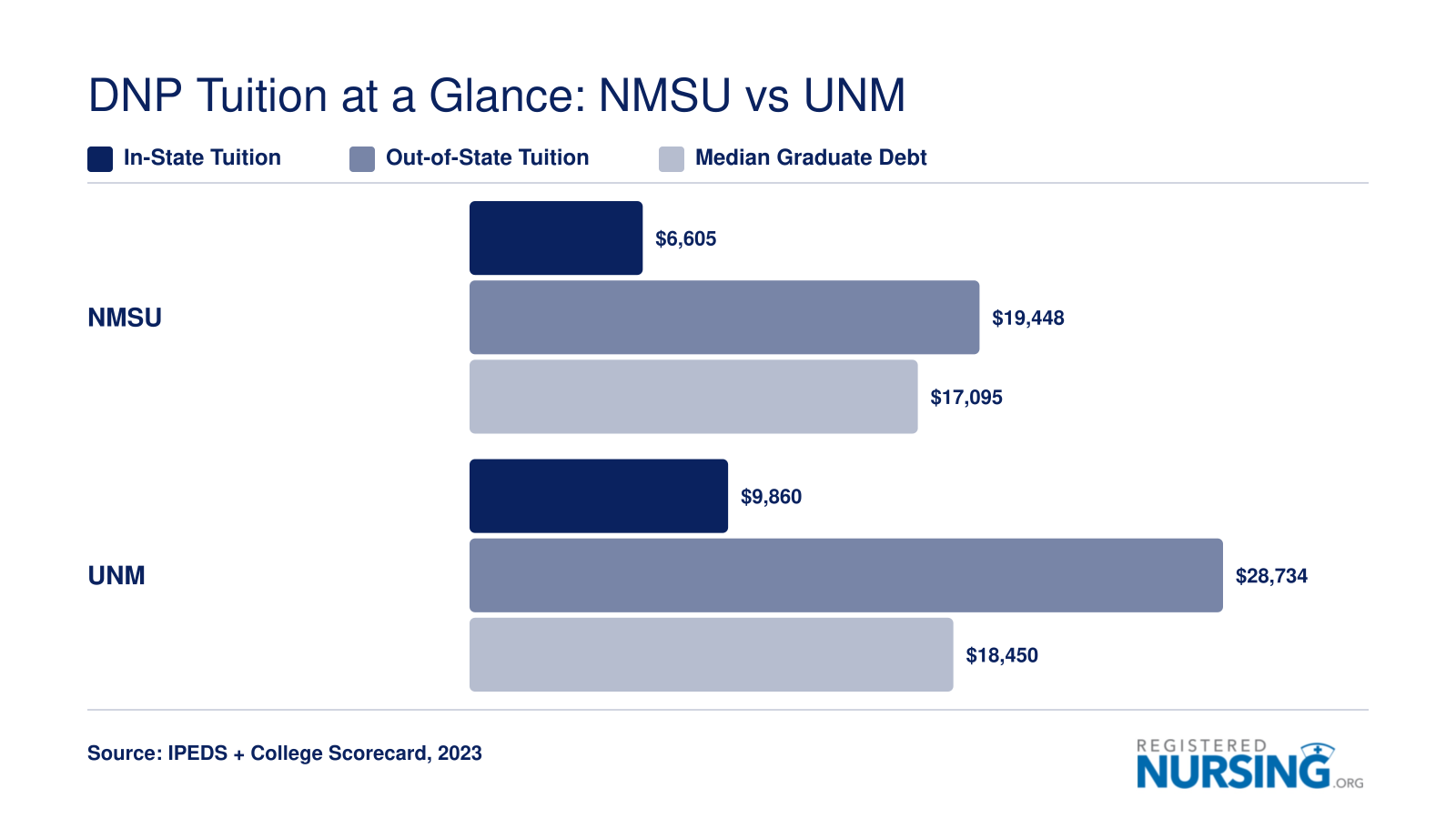
- Median doctoral debt: NMSU graduates carry a median of $17,095; UNM graduates carry $18,450. These figures reflect all doctoral programs, but they provide a baseline for comparing the two schools.
- Estimated total tuition (3-year program): For in-state students, NMSU's annual tuition of $6,605 totals roughly $19,815, while UNM's $9,860 annual rate totals about $29,580. Out-of-state students pay roughly $58,344 at NMSU and $86,202 at UNM.
- Cost per credit: NMSU's 77-credit hour program translates to approximately $257 per credit in-state; UNM's per-credit rate is higher, though the exact figure depends on the specific track.1
- Cheapest option: NMSU consistently offers the lowest total cost for both residents and non-residents. However, UNM participates in the Western Interstate Commission for Higher Education (WICHE) reciprocity program, which may allow eligible out-of-state students to pay in-state rates.
Financial Aid Opportunities for DNP Students
A range of scholarships, grants, and loan programs can significantly reduce the net cost. - NM Nursing Loan-for-Service: Awards up to $16,000 per year, renewable for up to four years, for students who commit to practice in a designated shortage area after graduation.2 - NMNPC Scholarships: Nine $3,000 awards are available each year for NM residents enrolled in a doctoral NP program with at least two years of NP experience and NMNPC membership. Application deadline is January 31.3 - UNM-specific support: The Meliora Scholarship ($1,000) targets first-generation and underrepresented graduate students with financial need.4 HRSA ANEW grants provide tuition support and stipends for DNP students focused on rural or primary care placements.5 A $1.6 million gift from BCBS New Mexico also funds scholarships for accelerated BSN and advanced practice DNP students.6 Graduate assistantships may offer stipends and tuition benefits; contact the College of Nursing for availability. - NMSU doctoral assistantships: Possible GA/TA positions are listed on the Scholar Dollar$ portal; students should inquire directly with the financial aid office. - Additional external scholarships: The Ann Olson Memorial Doctoral Scholarship awards $7,500 (deadline February 1).8 AANP offers $2,500-$5,000 for RNs in accredited NP programs completing between August 2026 and July 2027.9 The NMNAINA Student Success Award supports Native American nursing students enrolled in NM programs.10 - Federal loans: Graduate students may borrow up to the cost of attendance through Direct Unsubsidized Loans and Grad PLUS Loans.
Is the Investment Worth It? Debt-to-Earnings Perspective
Using institutional scorecard data, the median earnings of former students who received federal aid (measured 10 years after entry) is $39,067 at NMSU and $44,792 at UNM. This yields a debt-to-earnings ratio of roughly 0.44 for NMSU and 0.41 for UNM, both well below the 1.0 threshold often considered manageable. While DNP-specific earnings data is not yet available at the program level, these ratios suggest that graduates are likely to see a positive return on their educational investment, especially when combined with targeted financial aid. Nurses considering neighboring states can also review DNP programs in Colorado or DNP programs in Utah for regional cost comparisons.
DNP Tuition at a Glance: NMSU vs UNM
Tuition costs vary significantly between New Mexico's two DNP programs, especially for out-of-state students. The figures below compare in-state tuition, out-of-state tuition, and median graduate debt at each institution, based on data from the U.S. Department of Education.
Online and Hybrid DNP Options in New Mexico
The rise of flexible graduate nursing education has reshaped how working nurses pursue doctoral credentials, yet the term "online" requires careful interpretation when applied to DNP programs. Both New Mexico State University and the University of New Mexico offer pathways that incorporate substantial online coursework, but neither program is fully remote. Understanding what hybrid delivery actually entails will help you plan your schedule, budget for travel, and set realistic expectations for clinical requirements.
What "Online" Really Means for DNP Students
When New Mexico institutions describe their DNP programs as online, they are referring primarily to didactic coursework. Lectures, readings, discussion boards, and many assignments can be completed from anywhere with internet access. However, clinical practice hours must be completed in person under the supervision of qualified preceptors, and most programs require at least one on-campus intensive or orientation session.
NMSU's Family Nurse Practitioner and Psychiatric Mental Health Nurse Practitioner tracks are delivered online with required on-campus intensives.1 Students should expect a one-week intensive session held in Las Cruces, typically scheduled prior to the start of clinical practice experiences around the third year.2 The Nurse Anesthesiology DNP track at NMSU follows a different structure, operating as an on-campus or hybrid program with a three-year timeline and 2,400 required clinical hours.3
UNM's DNP program uses a hybrid model that combines online coursework with periodic campus-based sessions.4 This approach supports the university's emphasis on preparing nurses for rural and underserved practice settings throughout New Mexico.
Clinical Placement: Who Finds Your Site?
Clinical logistics differ significantly between the two universities. At NMSU, students are responsible for arranging their own clinical placements.1 You will identify preceptors in your own community, which may include nurse practitioners or physicians, and then work with NMSU to establish an affiliation agreement. This agreement must be processed before any clinical hours can count toward your degree, and the paperwork can take several months to finalize.4 Starting this process early is essential.
UNM takes a different approach by providing a dedicated clinical placement team that organizes sites throughout New Mexico.4 This school-arranged model can simplify logistics, particularly for students unfamiliar with the clinical landscape or those practicing in rural areas where preceptor relationships may not already exist.
Geographic Considerations for Out-of-State Students
If you are considering a New Mexico DNP program from out of state, NMSU's model may offer more flexibility. Because students arrange their own placements in their home communities, completing clinicals outside New Mexico is possible, though affiliation agreements with NMSU must still be secured. UNM's program, with its emphasis on New Mexico-based placements and rural health focus, is generally structured around clinical sites within the state. Prospective students should confirm geographic policies directly with each program before applying. You may also find it useful to compare best DNP programs nationally to understand how delivery models vary across institutions.
Planning for Required Intensives
Budget both time and money for any on-campus requirements. NMSU's one-week intensive in Las Cruces means arranging travel, lodging, and potentially time off from work. While intensive sessions are infrequent, they are not optional. UNM's hybrid format may involve multiple shorter campus visits depending on your specialty track. Clarifying the schedule of required in-person sessions during the application process will help you avoid surprises later in your program. Nurses already holding advanced credentials may also want to review New Mexico post-graduate certificate programs as an alternative pathway before committing to a full DNP.
Admission Requirements for NMSU and UNM DNP Programs
DNP admissions in New Mexico vary by institution and specialty track. Both NMSU and UNM expect a strong academic record, an active RN license, and a degree from an accredited nursing program, but the specific thresholds differ, especially for competitive specialty tracks like nurse anesthesiology. Below is a consolidated checklist of what you should prepare.
- Minimum GPANMSU requires a cumulative GPA of at least 3.0 for its FNP, PMHNP, and MSN-to-DNP tracks. The Nurse Anesthesiology BSN-to-DNP track at NMSU sets a higher bar: a 3.4 cumulative GPA and a 3.4 science GPA. UNM's DNP program generally expects a comparable GPA minimum, though applicants should verify current thresholds directly with UNM's College of Nursing, as requirements can shift between admission cycles.
- Required Degrees and LicensureBSN-to-DNP applicants must hold a Bachelor of Science in Nursing from a nationally accredited program and maintain an active, unencumbered RN license. MSN-to-DNP applicants need an MSN from an accredited program. For NMSU's MSN-to-DNP pathway, a national advanced-practice certification may also be expected depending on the specialty. UNM similarly requires an accredited BSN or MSN, plus active RN licensure.
- Clinical and Work ExperienceNMSU's FNP and PMHNP BSN-to-DNP tracks do not require prior work experience, making them accessible to newer graduates. By contrast, the Nurse Anesthesiology track requires at least two years of RN experience, including a minimum of one year in a critical-care setting, plus 24 hours of CRNA shadowing. UNM's DNP tracks generally favor candidates with clinical experience, though specific hour requirements vary by concentration.
- Prerequisite Courses and CertificationsA completed statistics course is required across all NMSU DNP tracks. Nurse Anesthesiology applicants must additionally hold current CCRN, ACLS, PALS, and BLS certifications before applying. UNM may have its own prerequisite coursework; prospective students should consult UNM's nursing admissions page for the latest list.
- Application ComponentsBoth programs typically require a personal statement outlining professional goals, a current résumé or CV, and letters of recommendation, usually two to three from individuals who can speak to your clinical competence and academic readiness. NMSU confirms that an interview is required for all DNP tracks, including BSN-to-DNP and MSN-to-DNP pathways. UNM may also incorporate interviews or portfolio reviews depending on the specialty.
- Competitiveness and SelectivityNMSU's graduate nursing programs reported an admission rate of roughly 70 percent in a recent cycle, with 72 of 103 applicants accepted and 49 ultimately enrolling. That figure spans all graduate nursing tracks, so individual DNP specialties, particularly nurse anesthesiology, may be more selective. UNM does not widely publish acceptance-rate data for its DNP program, but cohort sizes tend to be limited, and the program is generally regarded as competitive. Applying early and exceeding minimum requirements strengthens your candidacy at either school.
DNP Career Outcomes and Salary in New Mexico
What can DNP graduates in New Mexico expect to earn after completing their degree? The answer depends on specialty, practice setting, and experience level, but the data point toward strong returns.
Earnings and Employment Outlook
Program-level earnings data for NMSU and UNM DNP graduates are not yet published in federal college scorecard datasets. However, Bureau of Labor Statistics wage surveys offer reliable benchmarks for the occupations these programs prepare you to enter. Nurse practitioners in New Mexico earned a median annual wage of $138,440 in 2024, with mid-career earners (75th percentile) reaching $156,000. Entry-level NPs (25th percentile) started near $113,240. These figures track above the 2023 national NP median of $126,260,2 reflecting New Mexico's competitive compensation for advanced practice nurses.
For those pursuing nurse anesthesia training, the Albuquerque metro area reported a mean annual wage of $250,490 in 2023 for certified registered nurse anesthetists, with total employment of 140 CRNAs.3 That translates to an hourly rate of roughly $105.96. While New Mexico's CRNA workforce is relatively small, demand remains steady as the state's healthcare infrastructure expands.
Certification Pass Rates as Quality Signals
Both NMSU and UNM publicly report strong outcomes for graduates sitting for national certification exams. UNM's Pediatric Nurse Practitioner track, for example, maintains a 100 percent licensure pass rate in recent cohorts. Understanding how to interpret pass-rate data is valuable when comparing programs; our guide on reading NCLEX-RN pass rate data offers a useful framework for evaluating any nursing school's published outcomes. Published pass-rate data for NMSU's Family Nurse Practitioner and UNM's Psychiatric-Mental Health Nurse Practitioner tracks are not consistently disclosed in publicly available Commission on Collegiate Nursing Education or accreditation reports, but both programs hold full accreditation and meet national benchmarks for graduate preparedness.
Return on Investment
How quickly does the DNP pay for itself? NMSU's DNP program costs roughly $6,605 per year for in-state students (total program tuition around $19,815 over three years), while UNM charges $9,860 annually (approximately $29,580 total). Federal debt-to-earnings ratios are not yet available at the program level, but simple arithmetic offers a useful proxy. A nurse practitioner earning the state median of $138,440 would recover NMSU's total tuition in fewer than three months of work, or UNM's in just over two months. Even entry-level earners at the 25th percentile ($113,240) would recoup program costs within a single quarter of practice. That rapid payback period, combined with projected statewide growth in NP demand,4 positions the DNP as a high-value credential in New Mexico's healthcare economy.
Frequently Asked Questions About DNP Programs in New Mexico
Choosing a DNP program is a major decision, and prospective students often have overlapping questions about cost, format, and timelines. Below are answers to the most common questions about pursuing a Doctor of Nursing Practice in New Mexico.