

What you’ll learn in this article…
- CPTC certification is becoming the industry standard for advancement.
- Fifty-six federally designated OPOs employ most organ procurement coordinators.
- Both RN and allied health professionals can enter this career.
An organ procurement coordinator is the clinical professional who manages the entire donor organ recovery process, from identifying a potential donor through surgical recovery and transport to transplant centers. Most organ procurement coordinators come to the role as registered nurses with ICU, trauma nurse experience, or emergency department backgrounds, though allied health professionals with strong clinical experience also enter the field. The position is distinct from transplant coordinators, who work on the recipient side, managing waitlist patients and post-transplant care.
Because the role blends advanced clinical skills, family counseling, and logistical coordination under time pressure, organ procurement organizations typically require several years of acute care nursing before hiring. Most of the 56 federally designated organ procurement organizations in the United States now prefer or require the Certified Procurement Transplant Coordinator credential for advancement beyond entry-level roles.
Organ Procurement Coordinator Vs. Transplant Coordinator
Two sides of the same lifesaving process define these roles: one focuses on identifying and recovering organs from donors, while the other manages the care and preparation of recipients awaiting transplant. Though the titles are sometimes used interchangeably in job postings, the day-to-day responsibilities, work environments, and career trajectories differ in meaningful ways.
Focus Area and Employer Type
Organ procurement coordinators work on the donor side of the transplantation system. They are typically employed by Organ Procurement Organizations, the federally designated agencies responsible for recovering organs and tissues within a defined geographic region.1 Their primary mission is to identify potential donors, coordinate clinical evaluations, and facilitate the surgical recovery of organs for transplant.
Transplant coordinators, by contrast, work on the recipient side. They are based at transplant centers and guide patients through the evaluation, listing, pre-transplant care, and post-operative recovery.1 Their work revolves around optimizing recipient health, managing waitlist status, and coordinating with surgical teams and insurance providers.
Key Responsibilities
Organ procurement coordinators spend much of their time in donor hospitals, responding to referrals around the clock. They conduct family consent discussions, manage donor medical management protocols, and coordinate organ recovery surgeries. The role demands excellent crisis communication skills, clinical assessment expertise, and the ability to navigate ethically complex situations with families facing sudden loss.
Transplant nursing encompasses coordinators who, meanwhile, build longer-term relationships with patients. They conduct pre-transplant evaluations, educate candidates about the waitlist process, coordinate immunosuppressive therapy, monitor lab values, and provide follow-up care after surgery. The role requires deep knowledge of transplant pharmacology, immunology, and chronic disease management.
Typical Credentials and Salary Range
Most organ procurement coordinators enter the field with an Associate Degree in Nursing and acute-care RN experience, though many hold bachelor's degrees.2 The preferred certification is the Certified Procurement Transplant Coordinator credential.3 Nationally, organ procurement coordinators earn a mean annual wage of approximately 65,020 dollars.2
Transplant coordinators typically hold a Bachelor's degree in Nursing or an allied health field and often pursue the Certified Clinical Transplant Coordinator credential.1 Mean annual wages for transplant coordinators average around 72,000 dollars, reflecting the additional outpatient case-management complexity and the longer patient relationships inherent in the role.1
Reading Job Descriptions Carefully
Some employers use the term "transplant coordinator" as an umbrella label for both procurement and recipient coordination roles, while others distinguish the two clearly. Candidates should focus on the listed responsibilities rather than the job title alone. A posting that emphasizes donor hospital collaboration, family consent, and organ recovery points to procurement coordination, even if the title reads "transplant coordinator." Conversely, a role centered on pre-transplant evaluation, waitlist management, and post-operative follow-up is recipient-focused, regardless of the title used. When evaluating either path, it also helps to review how nurse coordinator roles are structured more broadly, since care coordination principles overlap across many specialties.
What Does an Organ Procurement Coordinator Do?
Organ procurement coordinators manage one of the most time-sensitive processes in medicine, often juggling complex clinical logistics while supporting families through profound grief. The role demands both technical precision and deep emotional intelligence, all under conditions that rarely follow a predictable schedule.
Referral Evaluation and Donor Assessment
The process begins when a hospital notifies the organ procurement organization about a potential donor. Coordinators evaluate the referral by reviewing medical records, lab results, and the patient's history to determine suitability for donation. This assessment happens quickly because organ viability depends on minimizing time between cardiac death and recovery.
Once a potential donor is identified, coordinators travel to the hospital to conduct a thorough clinical evaluation. They work alongside ICU nurses and critical care staff to maintain organ function, order additional testing, and coordinate with transplant centers to match organs with recipients on the waiting list. Because coordinators often serve a geographic territory rather than a single facility, they may drive several hours or fly by small plane or helicopter to reach donor hospitals.
Family Authorization Conversations
Among the most challenging aspects of the role is guiding grieving families through the donation decision. Coordinators explain the process, answer questions, and provide emotional support while respecting cultural and religious considerations. These conversations require sensitivity and patience, often occurring in the middle of the night when families are exhausted and overwhelmed.
Coordinators must balance compassion with clinical urgency. Organ preservation timelines leave little room for delay, yet families deserve the space to make an informed, unpressured choice. Successfully navigating this tension is central to the work.
Surgical Recovery and Transport Logistics
After authorization, coordinators orchestrate the surgical recovery. They schedule operating room time, assemble recovery teams (often including surgeons from multiple transplant centers), and ensure preservation solutions and equipment are ready. During the procedure, coordinators document each organ's condition and coordinate packaging for transport.
Getting organs to recipients quickly is critical. Coordinators arrange ground ambulances, commercial flights, or charter aircraft depending on distance and urgency. They track each organ's journey and communicate constantly with receiving transplant teams.
The On-Call Reality
Organ donation does not follow business hours. Many coordinators work 12-hour shifts,1 and on-call requirements are substantial. Some positions involve 12 to 15 on-call days per month,2 while others may require 20 days of availability.3 UCLA Health coordinators work 24-hour shifts Monday through Friday with rotating weekends and holidays.4 One major medical center reports that coordinators spend more than 50 percent of their time on call.5
Travel compounds the unpredictability. Coordinators at some organizations use company vehicles, personal cars, or even small planes and helicopters, much like flight transport nurses to reach hospitals across a multi-state service area.5 This schedule can strain work-life balance, and successful coordinators develop strategies for rest and recovery between demanding cases.
Despite the intensity, many coordinators find the work deeply rewarding. Each case represents a chance to honor a donor's legacy and save multiple lives, a purpose that sustains professionals through the most difficult moments of the job.
Questions to Ask Yourself
How to Become an Organ Procurement Coordinator
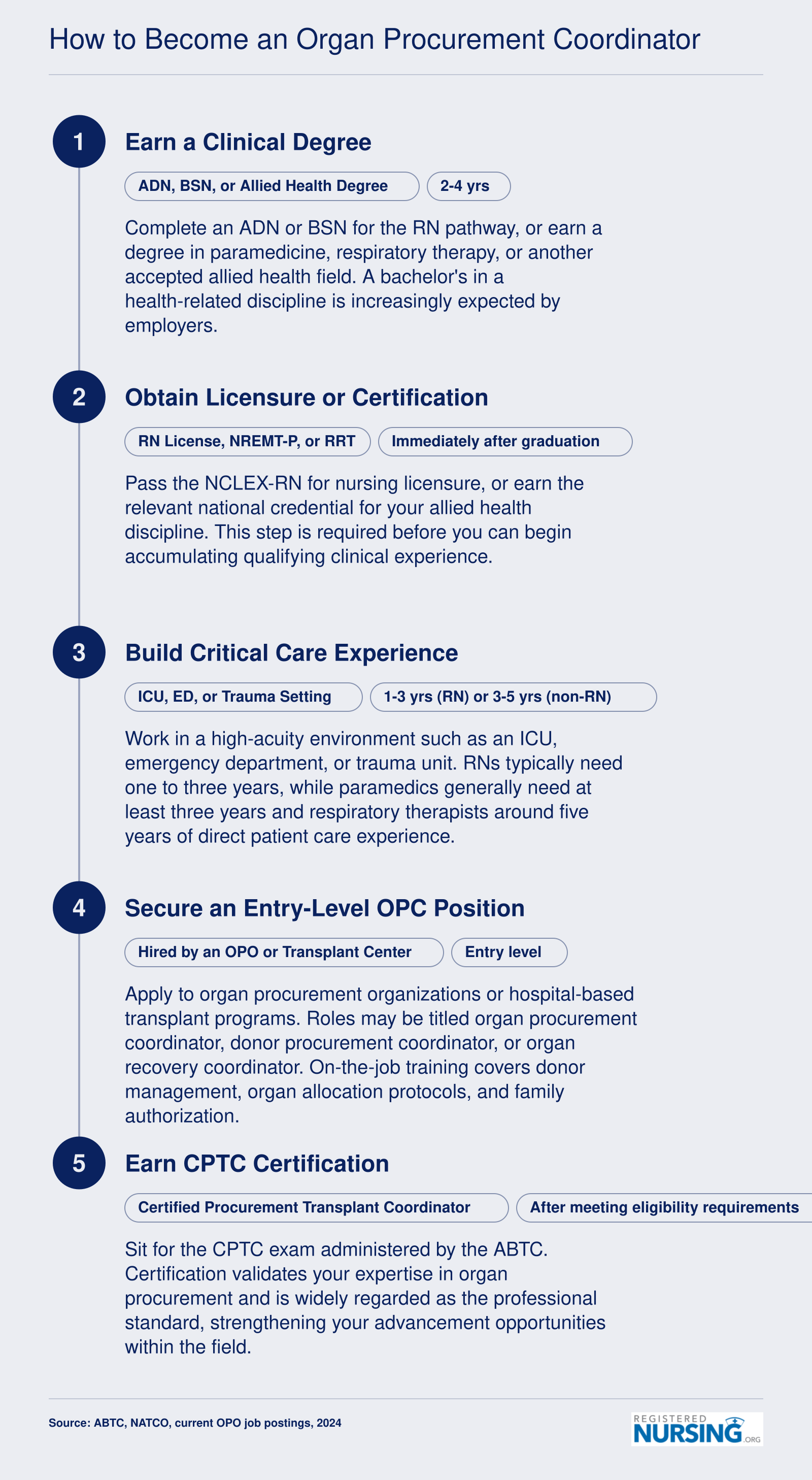
Most organ procurement coordinators follow one of two clinical tracks: the RN pathway or the allied health pathway. While a BSN is increasingly preferred by organ procurement organizations, ADN-prepared nurses with strong ICU, ED, or trauma experience remain competitive candidates. Non-RN clinicians such as paramedics and respiratory therapists can also enter the field with additional clinical experience.
Non-RN Pathways Into Organ Procurement Coordination
While registered nurses fill the majority of organ procurement coordinator roles, they are not the only clinicians organ procurement organizations (OPOs) hire. If you come from an allied health background, there is a real path in, though it usually requires more clinical experience and a careful read of each job posting.
Allied Health Backgrounds That Commonly Qualify
The non-RN professionals most often considered for procurement coordinator roles include:
- Paramedics: Widely accepted at many OPOs because of their strong airway, hemodynamic, and field triage skills.
- Respiratory therapists: Valued for ventilator management and oxygenation expertise during donor stabilization.
- Surgical technologists: Often hired specifically for organ recovery and operating room roles rather than clinical donor management.
- EMTs and physician assistants: Accepted on an employer-specific basis; some OPOs list them explicitly, others do not.
Paramedics and respiratory therapists tend to be the most broadly accepted. Surgical techs and EMTs are more employer-dependent, so acceptance varies significantly from one OPO to the next.
Narrower Initial Scope
Non-RN coordinators sometimes enter through a more focused role. Rather than managing a donor from referral through recovery, a surgical technologist may be hired as a procurement or recovery coordinator whose primary responsibility is assisting the surgical team during organ recovery. Full clinical donor management, including medication titration and ventilator adjustments, is often reserved for RN coordinators or advanced practice clinicians, depending on scope of practice vs scope of employment and OPO policy.
Experience Expectations
Because OPOs cannot rely on the broad clinical foundation of an RN license, non-RN candidates typically need more years of directly relevant experience to be competitive. Three to five years in critical care nursing, emergency, trauma, or operating room settings is a common expectation, and some postings ask for more.
Check Each Job Posting
Requirements vary widely. Some OPOs are strictly RN-only, while others explicitly welcome paramedics, RRTs, or surgical techs. Read each posting carefully and, when in doubt, contact the OPO's recruiter before ruling yourself in or out.
CPTC Certification and Other Credentials
Voluntary certification is quickly becoming the industry standard for organ procurement coordinators who want to move beyond entry-level positions. While many organ procurement organizations still hire candidates without the credential, the Certified Procurement Transplant Coordinator designation signals mastery of the clinical, ethical, and logistical competencies the role demands.
The CPTC Credential
The American Board for Transplant Certification administers the CPTC exam, the most widely recognized credential for procurement professionals.1 To qualify, candidates must have at least one year of direct organ procurement experience,2 which means most coordinators sit for the exam after gaining foundational skills on the job.
The exam is computer-based and consists entirely of multiple-choice questions covering donor evaluation, surgical recovery protocols, organ allocation, family communication, and regulatory compliance.3 Candidates who do not pass may retake the exam after a 90-day waiting period, with a maximum of three attempts permitted.2 After a third unsuccessful attempt, candidates must complete 20 additional Category 1 continuing education credits before reapplying.2
Maintaining Your Certification
CPTC certification remains valid for three years.2 To recertify, credential holders must earn 60 Continuing Education Points for Transplant Coordinators, with a minimum of 20 credits in Category 1 activities such as accredited conferences, peer-reviewed publications, or ABTC-approved courses.4 The recertification fee is $395 for a single credential. Coordinators who hold both the CPTC and a second ABTC credential pay $495 and must accumulate 90 total credits across the renewal cycle.5
The Certified Transplant Preservationist Option
Professionals focused specifically on organ preservation rather than the full scope of procurement coordination may pursue the Certified Transplant Preservationist credential. Eligibility mirrors the CPTC path, requiring one year of hands-on experience in organ preservation.2 The CTP exam is also computer-based and multiple-choice, with the same three-year renewal period and 60-credit continuing education requirement.4 The credential underwent a job task analysis in 2025 to ensure exam content reflects current preservation science and emerging technologies.6
Why Certification Matters for Career Growth
Entry-level coordinator roles do not always require certification, but hiring trends favor credentialed candidates. Just as surgical nursing certification has become a marker of professional commitment in the OR, CPTC is increasingly listed as preferred or required for supervisory positions, quality assurance roles, and regional leadership at top-tier organ procurement organizations. Certification also strengthens your standing if you transition into related fields such as transplant program management or regulatory affairs. For coordinators committed to long-term advancement, earning the CPTC early in your career positions you ahead of peers competing for the same promotions. If you are weighing how specialty credentials compare across nursing roles, exploring why nurses pursue certifications like CNOR can offer useful perspective on the broader value of credentialing.
Organ Procurement Coordinator Salary: National Overview
Because the Bureau of Labor Statistics does not publish a separate occupational category for organ procurement coordinators, compensation data for these professionals is most commonly benchmarked against the broader Registered Nurses classification, which includes many nurses who work in transplant and organ procurement settings. The figures below reflect 2024 national wage data for registered nurses. Organ procurement coordinators who hold specialized credentials such as the Certified Procurement Transplant Coordinator (CPTC) designation, or who work in high acuity organ procurement organizations, may earn above these benchmarks.
| Wage Metric | Annual Salary |
|---|---|
| 25th Percentile | $78,610 |
| Median (50th Percentile) | $93,600 |
| Mean (Average) | $98,430 |
| 75th Percentile | $107,960 |
Organ Procurement Coordinator Salary by State
Organ procurement coordinators are most often classified alongside registered nurses in federal wage data. The table below uses 2024 figures from the Bureau of Labor Statistics for registered nurses, which serve as a reliable proxy for understanding how organ procurement coordinator pay varies by state. Keep in mind that specialized roles like organ procurement coordination may command slightly higher or lower pay depending on the employer and local cost of living.
| State | Total RN Employment | 25th Percentile | Median Salary | 75th Percentile | Mean Salary |
|---|---|---|---|---|---|
| Rhode Island | 10,760 | $83,870 | $99,960 | $112,540 | $99,770 |
| Arizona | 64,430 | $81,390 | $96,890 | $105,450 | $95,230 |
| New Hampshire | 16,580 | $79,720 | $96,830 | $105,500 | $94,620 |
| Maryland | 48,980 | $81,470 | $96,830 | $104,840 | $96,650 |
| Colorado | 54,510 | $81,790 | $96,520 | $104,370 | $95,470 |
| Delaware | 13,260 | $82,600 | $92,610 | $108,360 | $95,450 |
| Texas | 261,050 | $77,450 | $90,010 | $102,200 | $91,690 |
| Virginia | 77,420 | $77,650 | $88,820 | $100,920 | $90,930 |
| New Mexico | 17,510 | $82,630 | $88,260 | $104,720 | $94,360 |
| Pennsylvania | 146,840 | $78,570 | $87,610 | $102,030 | $90,830 |
| Georgia | 97,410 | $76,600 | $86,560 | $104,790 | $91,960 |
| Illinois | 139,900 | $79,150 | $86,410 | $103,660 | $91,130 |
| Idaho | 14,540 | $78,020 | $86,100 | $100,220 | $89,770 |
| Wisconsin | 64,960 | $79,570 | $86,070 | $100,680 | $90,450 |
| Michigan | 104,210 | $80,030 | $85,670 | $101,210 | $90,580 |
| Vermont | 7,240 | $79,980 | $85,150 | $104,110 | $92,710 |
| Maine | 16,280 | $76,890 | $82,860 | $98,000 | $87,440 |
| Florida | 218,100 | $77,070 | $82,850 | $99,260 | $88,200 |
| Utah | 25,780 | $77,030 | $82,270 | $101,530 | $88,240 |
| North Carolina | 108,510 | $74,710 | $81,860 | $98,720 | $86,270 |
| Wyoming | 5,180 | $75,540 | $81,790 | $100,910 | $88,020 |
| Montana | 10,540 | $77,800 | $81,560 | $100,510 | $88,480 |
| Ohio | 138,360 | $77,420 | $81,250 | $97,440 | $86,110 |
| Oklahoma | 32,870 | $75,320 | $81,160 | $96,460 | $85,800 |
| Nebraska | 24,180 | $76,430 | $81,020 | $93,140 | $82,890 |
Highest-Paying Metro Areas for Organ Procurement Coordinators
Because the Bureau of Labor Statistics does not track organ procurement coordinators as a separate occupation, the figures below reflect 2024 data for registered nurses, the professional category under which most procurement coordinators are classified. Actual organ procurement coordinator salaries in these metros may differ based on employer, on-call requirements, and specialty certifications such as the CPTC. Markets with large transplant centers and higher costs of living tend to offer the strongest compensation.
| Metro Area | Total RN Employment | 25th Percentile | Median Salary | Mean Salary | 75th Percentile |
|---|---|---|---|---|---|
| San Francisco, Oakland, Fremont, CA | 40,750 | $150,580 | $188,020 | $178,450 | $212,190 |
| Los Angeles, Long Beach, Anaheim, CA | 107,340 | $108,150 | $133,440 | $138,010 | $165,290 |
| Seattle, Tacoma, Bellevue, WA | 37,250 | $101,140 | $118,570 | $120,260 | $132,160 |
| New York, Newark, Jersey City, NY and NJ | 195,470 | $100,530 | $113,490 | $115,650 | $128,430 |
| Boston, Cambridge, Newton, MA and NH | 66,440 | $84,200 | $102,440 | $115,710 | $137,160 |
| Minneapolis, St. Paul, Bloomington, MN and WI | 40,510 | $87,670 | $102,240 | $102,790 | $116,000 |
| Washington, Arlington, Alexandria, DC, VA, MD, and WV | 43,640 | $83,570 | $101,800 | $102,510 | $110,760 |
| Philadelphia, Camden, Wilmington, PA, NJ, DE, and MD | 74,840 | $84,040 | $99,210 | $97,510 | $107,800 |
| Dallas, Fort Worth, Arlington, TX | 72,640 | $79,170 | $98,740 | $96,720 | $106,850 |
| Phoenix, Mesa, Chandler, AZ | 46,330 | $82,270 | $98,160 | $96,220 | $105,900 |
| Houston, Pasadena, The Woodlands, TX | 65,300 | $79,640 | $97,810 | $96,730 | $105,970 |
| Chicago, Naperville, Elgin, IL and IN | 100,620 | $81,320 | $96,480 | $94,580 | $104,730 |
| Atlanta, Sandy Springs, Roswell, GA | 54,370 | $79,700 | $96,370 | $96,640 | $107,550 |
| Detroit, Warren, Dearborn, MI | 44,280 | $81,140 | $88,980 | $92,680 | $101,880 |
| Miami, Fort Lauderdale, West Palm Beach, FL | 59,880 | $78,240 | $85,610 | $92,070 | $103,110 |
Bureau of Labor Statistics salary figures reflect Registered Nurses as a broad category, so they serve as a useful baseline rather than a precise benchmark for organ procurement coordinators. In practice, OPC salaries often exceed those general medians because of the demanding on-call schedules, irregular hours, and highly specialized clinical skills the role requires. Actual compensation can also shift significantly depending on the size of the organ procurement organization, regional cost of living, and overall case volume.
Where Do Organ Procurement Coordinators Work?
Fifty-six federally designated Organ Procurement Organizations, commonly called OPOs, serve as the primary employers of organ procurement coordinators across the United States. Understanding where these professionals work, and the structure of the organizations behind them, helps clarify what daily life in this career actually looks like.
Organ Procurement Organizations
Each OPO is a nonprofit organization that covers a specific geographic service area, and together these 56 organizations blanket the entire country. When a potential organ donor is identified at any hospital within an OPO's territory, the procurement coordinator is dispatched to manage the case. OPOs operate around the clock, and their coordinators must be ready to respond at any hour. Because the work is inherently mobile, travel is one of the defining features of the role. A coordinator might drive two hours to a rural community hospital one night and respond to a Level I trauma center the next morning. The donor hospital, not the OPO's office, is where much of the hands-on work takes place.
Transplant Centers and Academic Medical Systems
Transplant centers housed within large academic medical systems represent another significant employment setting. Some of these centers employ in-house organ procurement nurses who work directly alongside OPO teams during the donor management and organ recovery process. These hospital-based roles tend to involve less travel because the coordinator works primarily within a single facility or health system, though close collaboration with the regional OPO remains essential.
Donor Services Organizations
Donor services organizations that coordinate tissue and eye donation also hire professionals with procurement coordination skills. While the scope differs from solid organ recovery, the workflow shares many similarities, including family authorization conversations, donor evaluation, and logistical coordination across multiple surgical teams. Nurses drawn to this kind of cross-functional, team-based work may also find value in exploring nephrology nurse roles, which involve ongoing care for patients who may eventually need transplant services.
The Role of Travel
Regardless of the employer type, prospective coordinators should expect travel to be a routine part of the job. An OPO's service area can span an entire state or even parts of multiple states, and coordinators go wherever the donor is. This mobility requirement is one reason the role appeals to nurses who thrive in fast-paced, unpredictable environments rather than fixed clinical settings. Nurses considering this lifestyle may also want to review the pros and cons of becoming a travel nurse for a broader perspective on mobile nursing careers.
Job Outlook and Career Advancement
Organ procurement coordination sits at the intersection of critical care nursing, transplant medicine, and public health policy, which makes its outlook a bit more nuanced than general RN projections. Still, the broader nursing forecast offers a useful starting point.
The Broader Nursing Baseline
The Bureau of Labor Statistics projects registered nurse employment to grow 5% between 2024 and 2034, faster than the average across all occupations, with roughly 189,100 openings per year.1 The wider healthcare and social assistance sector is expected to expand 8.4% over the same period, adding about 2 million new jobs.2 Organ procurement coordinators are not tracked as a separate BLS category, so these figures are best read as a floor rather than a precise forecast.
Why Procurement May Outpace General Nursing
Several forces suggest demand for procurement coordinators will grow at least as quickly, and possibly faster, than the RN average:
- Transplant waitlists in the United States continue to exceed 100,000 candidates, sustaining pressure on OPOs to increase recovery volumes.
- Policy shifts, including expanded donor eligibility criteria and CMS performance metrics that hold OPOs accountable for higher recovery rates, are pushing organizations to expand their coordinator workforce. Coordinators who develop expertise in health policy nursing are particularly well positioned for these allocation and compliance roles.
- Advances in perfusion technology and organ preservation are enabling recoveries that previously would not have been viable, adding case volume.
A Typical Career Ladder
Most coordinators follow a recognizable progression:
- Entry level procurement coordinator: field cases under supervision, build donor management skills.
- Senior coordinator or team lead: mentor newer staff, handle complex donors, take on-call leadership.
- Clinical manager: oversee scheduling, quality metrics, and coordinator performance.
- Director of nursing or director of clinical services: lead the clinical arm of an OPO.
- VP of operations or executive leadership: shape organizational strategy, CMS compliance, and community outreach.
Lateral Moves and Credentials That Accelerate Advancement
Experienced coordinators often pivot into transplant coordination on the recipient side, allocation and policy roles with UNOS, hospital administration, or clinical education and simulation training within OPOs. These lateral paths broaden long-term options considerably.
CPTC certification is close to expected for advancement past the senior coordinator level, and a BSN or MSN meaningfully shortens the path into management. Coordinators who combine field experience with a graduate degree in nursing, public health, or health administration tend to move into nurse executive roles the fastest.
Frequently Asked Questions About Organ Procurement Coordinators
Organ procurement coordination is a rewarding but demanding career that raises many practical questions for prospective professionals. Below are answers to some of the most common questions about entering and thriving in this field.
- What is the difference between an organ procurement coordinator and a transplant coordinator?
- An organ procurement coordinator works on the donation side, identifying potential donors, obtaining consent from families, managing the medical care of donors, and coordinating organ recovery. A transplant coordinator works on the recipient side at a transplant center, evaluating candidates, managing waitlists, and guiding patients through pre- and post-transplant care. Both roles require strong clinical knowledge, but they operate at different stages of the transplant process.
- Do you need to be an RN to become an organ procurement coordinator?
- Not always. While many organ procurement organizations (OPOs) prefer or require candidates to hold an RN license, some hire professionals with other clinical backgrounds, such as respiratory therapists, paramedics, surgical technologists, or those with relevant bachelor's degrees in health sciences. That said, nursing remains the most common and competitive pathway, and holding a BSN can strengthen your candidacy significantly.
- How much on-call time do organ procurement coordinators work?
- On-call demands are substantial. Organ donation does not follow a predictable schedule, so coordinators frequently work nights, weekends, and holidays. Many OPOs use rotating on-call schedules, and it is common for coordinators to be on call several days per month. Shifts can extend well beyond a standard workday when an active organ recovery case is underway, making flexibility a critical trait for anyone considering this career.
- What is CPTC certification and is it required?
- The Certified Procurement Transplant Coordinator (CPTC) credential is offered by the American Board for Transplant Certification (ABTC). It validates expertise in organ procurement, donor management, and the regulatory framework surrounding donation. While CPTC certification is not legally mandated, many employers strongly prefer or require it. Candidates typically need at least one year of full-time procurement experience before sitting for the exam.
- How long does it take to become an organ procurement coordinator?
- The timeline depends on your educational pathway. Earning a BSN typically takes about four years, and most OPOs require one to three years of clinical experience, often in telemetry nurse settings or emergency nursing. Adding time for on-the-job OPO training and optional CPTC certification, most professionals enter the role within five to seven years after starting their nursing education.
- Is organ procurement coordination emotionally difficult?
- Yes, this career involves significant emotional challenges. Coordinators regularly interact with grieving families during some of the most difficult moments of their lives and must approach consent conversations with empathy and sensitivity. The unpredictable hours and high-stakes nature of organ recovery add to the stress. However, many coordinators describe the work as profoundly meaningful, citing the ability to save multiple lives through a single donation as a powerful source of purpose and resilience. Professionals navigating these emotional demands often benefit from the same coping strategies found in other long term care nurse and high-acuity specialties.
Explore More
- Ambulatory Care Nurse
- Burn Unit Nurse
- Cardiac Nurse
- Cath Lab Nurse
- Charge Nurse
- Chief Nursing Officer (CNO)
- Correctional Nurse
- CVOR Nurse
- Dermatology Nurse
- Developmental Disability Nurse
- Director of Nursing
- Domestic Violence Nurse
- Emergency Room Nurse
- ENT Nurse
- ET Nurse
- Fertility Nurse
- Flight/Transport Nurse
- Forensic Nurse Salary & Career Guide
- Genetic Nurse
- Geriatric Nurse
- Health Policy Nurse
- Healthcare Administrator
- Healthcare Manager
- Home Health Nurse
- Hospice Nurse
- Camp Nurse
- GI Nurse
- Holistic Nurse
- Labor and Delivery Nurse
- Nurse Writer
- Psychiatric Nurse
- School Nurse
- Telemetry Nurse
- Travel Nurse
- Aesthetic Nurse
- Infusion/IV Nurse
- Oncology Nurse
- ICU Nurse
- Infection Control Nurse
- Legal Nurse Consultant
- LTC Nurse
- Managed Care Nurse
- Medical-Surgical Nurse
- Military (Combat) Nurse
- Missionary Nurse
- Mother Baby Nurse
- Nephrology Nurse
- Neuroscience Nurse
- NICU Nurse
- Nurse Administrator
- Nurse Attorney
- Nurse Care Coordinator
- Nurse Case Manager
- Nurse Entrepreneur
- Nurse Executive
- Nurse Health Coach
- Nurse Manager
- Obstetric (OB) Nurse
- Occupational Health Nurse
- Operating Room Nurse
- Ophthalmic Nurse
- Orthopedic Nurse
- Pain Management Nurse
- Palliative Care Nurse
- Parish Nurse
- Patient Advocate Nurse
- Pediatric Endocrinology Nurse
- Perianesthesia (PACU) Nurse
- Perinatal Nurse
- Plastic Surgery Nurse
- Public/Community Health Nurse
- Radiology Nurse
- Rehabilitation Nurse
- Research Nurse
- Respiratory Nurse
- Rheumatology Nurse
- Substance Abuse Nurse
- Telephone Triage Nurse
- Transcultural Nursing
- Transplant Nurse
- Trauma Nurse
- Wound Care Nurse (WOCN)