

What you’ll learn in this article…
- A BSN is the standard entry point for public health nursing roles.
- BLS projects 5 percent RN job growth from 2024 to 2034.
- Choosing an MSN over an MPH preserves clinical prescriptive authority.
Public health nursing has moved closer to the center of U.S. health policy in the years since COVID-19 exposed critical gaps in community-level infrastructure, and demand for nurses who understand population-level prevention has not receded.
Community and public health nursing is a specialty that treats entire populations as its patient. Community health nursing typically involves direct services at the local level: home visits, school clinics, disease screening, and case management for underserved groups. Public health nursing operates at a higher altitude, shaping policy, designing surveillance programs, and coordinating responses across agencies. The two terms overlap in daily practice, but the distinction matters when choosing an advanced degree or specialty role.
The central tension for most nurses entering this field is credentialing: a BSN is the de facto entry standard for public health positions, and advancement into leadership or policy almost always requires a graduate degree, a specialty certification, or both. Whether that means an MSN in public health nursing or an MPH depends on the work you want to do. Nurses who want to stay close to direct community care sometimes also consider long-term care nursing as a complementary specialty, given its focus on vulnerable and underserved populations.
How to Become a Public Health Nurse
Entering public health nursing requires a clear educational foundation in nursing, not just public health, and the path you choose determines how quickly you can move into community-level practice.
The Education Ladder: ADN, BSN, MSN, and Beyond
The standard route into nursing begins with either an Associate Degree in Nursing (ADN) or a Bachelor of Science in Nursing (BSN), followed by passing the NCLEX-RN to earn registered nurse licensure. If you are weighing your options early on, a comparison of ADN vs BSN nursing degrees can help clarify which starting point fits your timeline and goals. While an ADN qualifies you to sit for the NCLEX-RN, most public health nurse (PHN) positions require at minimum a BSN. Employers in government agencies, school districts, and nonprofit organizations typically expect the broader population-health coursework that a BSN curriculum provides, including epidemiology, biostatistics, and community assessment.
For advanced roles such as nurse manager , clinical specialist, or policy advisor, a Master of Science in Nursing (MSN) or Doctor of Nursing Practice (DNP) with a public health focus is increasingly the standard expectation. These graduate degrees open doors to leadership positions, program design, and independent practice in some states.
Bridge Programs and Online Options
Nurses who already hold an ADN can move up efficiently through bridge pathways:
- RN-to-BSN: Typically 12 to 18 months, designed for working nurses who want to meet the BSN threshold for public health roles.
- RN-to-MSN: Combines undergraduate and graduate coursework into a single streamlined track, saving time for nurses who know they want advanced practice.
- BSN-to-MSN: The traditional graduate pathway, usually two years of full-time study.
Many of these programs are available fully online, making community and public health nursing education accessible to nurses who are already working in clinical settings. Online programs often include a practicum or clinical placement in a local health department or community organization, so you gain hands-on public health experience in your own region.
Can You Become a Nurse with a Public Health Degree?
This is a common question, and the answer is straightforward: a Master of Public Health (MPH) or bachelor's degree in public health does not, on its own, qualify you for RN licensure. You must complete an accredited nursing program and pass the NCLEX-RN. That said, an MPH is a powerful complement to an existing nursing license. Nurses who pair their RN with an MPH often find themselves well positioned for epidemiology, health policy, and program evaluation roles. The two credentials together create a skill set that is highly valued in government and global health organizations.
State-Specific Requirements
Keep in mind that some states impose additional requirements beyond the RN license and a BSN. California is the most notable example, requiring a separate Public Health Nurse (PHN) certificate issued by the Board of Registered Nursing. A handful of other states have similar designations or endorsements. These credentials are covered in detail in the certifications section below, so be sure to check what your state requires before mapping out your education plan. Public health nurses who work in school settings, for instance, may also want to review school nurse requirements, which can vary by state alongside PHN designations.
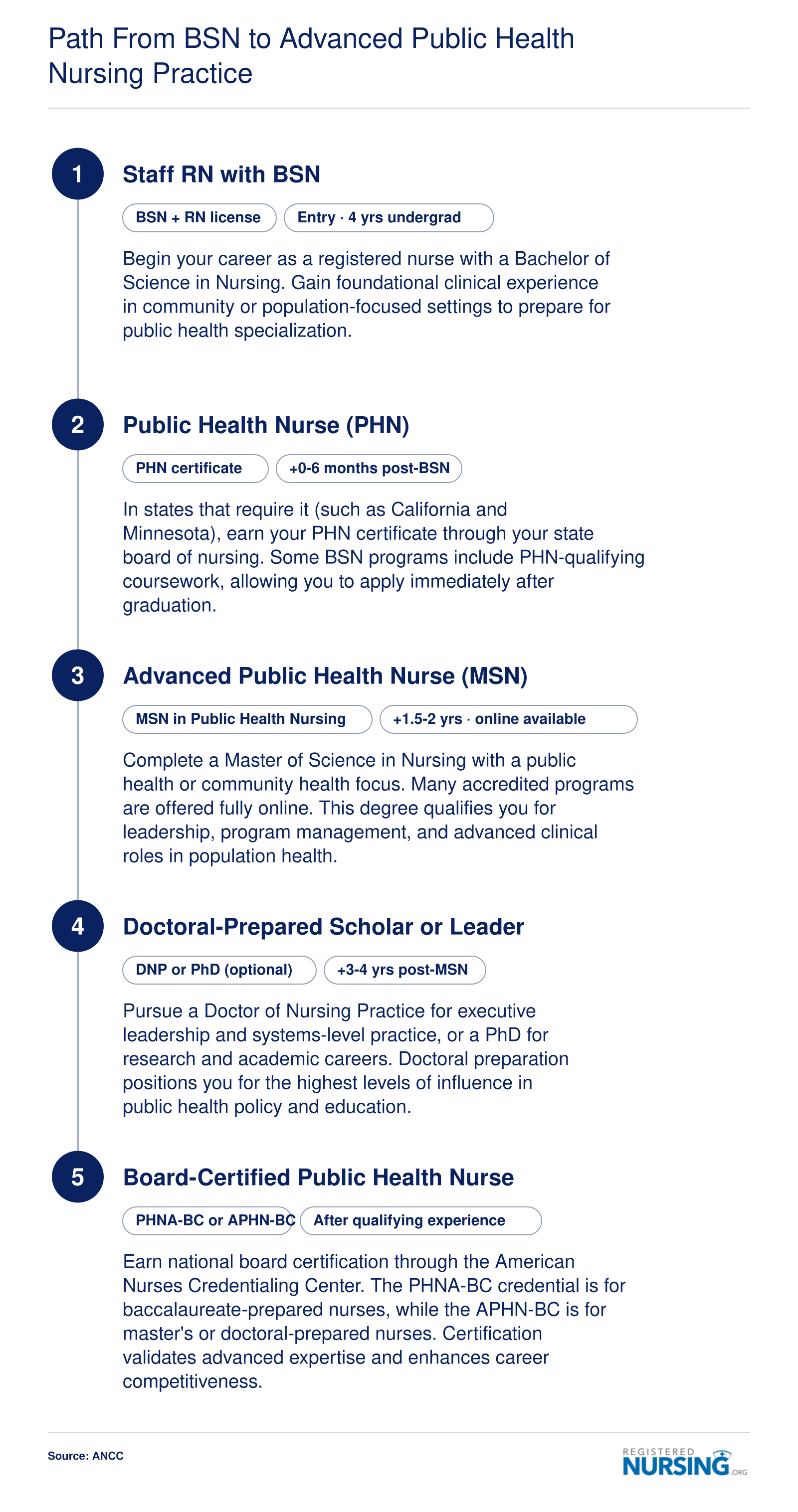
Path From BSN to Advanced Public Health Nursing Practice
Advancing in public health nursing follows a clear credentialing ladder. Each stage builds clinical expertise and opens doors to leadership, research, and specialized practice roles. Most MSN programs offer online or hybrid formats, making it possible to advance while working full time.
Public Health Nurse Certifications and Credentials
Public health nursing certifications and credentials are formal, nationally or state-recognized designations that verify a nurse's education and competence in population health, epidemiology, program planning, and community interventions. While every public health nurse must first hold an active RN license, additional certifications serve as optional proof of specialized expertise, though some employers and states make them mandatory.
National Board Certifications
The American Nurses Credentialing Center offers two public health nursing certifications.1 The Public Health Nursing , Advanced certification (PHNA-BC) was historically open to BSN-prepared nurses with 2,000 practice hours in the last three years. The Advanced Public Health Nursing certification (APHN-BC) was designed for master's-prepared clinical specialists in public health. As of 2026, both are in renewal-only status; neither credential accepts new candidates, though current holders can renew for five-year cycles by completing 75 continuing education contact hours and a portfolio of professional development activities.2
For those entering the field today, the Certified in Public Health (CPH) credential from the National Board of Public Health Examiners offers a relevant, interdisciplinary alternative.1 The CPH is not nurse-specific; it is open to any public health professional with a graduate degree in public health or a graduate degree in another discipline plus qualifying field experience. Candidates sit for a computer-based exam covering biostatistics, epidemiology, environmental health, social and behavioral sciences, and health policy. The credential lasts ten years before renewal is required.
State-Level PHN Credentials
California's Board of Registered Nursing issues a distinct Public Health Nurse certificate to RNs who hold a BSN and complete prescribed public health nursing coursework and supervised field experience, typically during their BSN or through a post-baccalaureate program.1 This state-specific credential is mandatory to use the title of Public Health Nurse or work in certain local health departments within California.
Minnesota and Washington recognize Public Health Nurse as a role designation within health agencies, generally requiring an RN license and a BSN, but neither state issues a separate board certificate. Most other states require only an RN license for public health nursing roles.
Academic Certificates vs. Board Certification
A post-master's certificate in public health nursing is an academic credential, typically 12 to 18 credit hours, designed for nurse practitioners, clinical nurse specialists, or other advanced practice nurses who want to pivot into population health leadership. These programs award a transcript notation, not a license or board credential. Board certification, by contrast, is a professional practice credential issued by a national certifying body after you meet eligibility and, when new candidates are accepted, pass an exam. Nurses working in managed care nursing roles sometimes pursue similar academic certificates to broaden their population health skill set.
Why Certification Matters
Even in states without PHN credential mandates, many public health agencies and federal grantees prefer or require board certification for supervisory or specialist positions. Holding a recognized certification signals that you meet a national standard of competence, can improve your eligibility for promotion, and may raise your starting or midcareer salary by several thousand dollars annually. Nurses curious about how specialty credentials compare across disciplines may also find it useful to review what a home health nurse pursues in terms of certification and scope.
Questions to Ask Yourself
MSN in Public Health Vs. MPH: Which Degree Is Right for You?
Should you pursue an MSN in Public Health Nursing or an MPH to advance your public health career?
This question confronts many nurses who want to move beyond bedside care into population health work. Both degrees open doors in public health, but they lead to distinctly different career trajectories. Your choice depends on whether you want to maintain clinical nursing practice or transition into administrative and research roles.
Understanding the Core Differences
The MSN in Public Health Nursing prepares you for clinical nursing leadership within community and population health settings.1 This degree keeps you firmly within the nursing profession while expanding your scope to include program development, health promotion, and community assessment from a nursing perspective. If you choose an APRN track within your MSN program, you can qualify for advanced practice certification and prescriptive authority.1
The MPH, by contrast, is a multidisciplinary degree focused on public health administration, epidemiology, health policy, and biostatistics.2 It does not confer nursing credentials or qualify you for APRN certification. Instead, it prepares you for roles that may not require a nursing license at all.
Career Paths Each Degree Enables
Your degree choice shapes which positions you can pursue:
- MSN in Public Health Nursing: Advanced nursing roles in health departments, hospitals, and community organizations. Positions include clinical coordinator, and APRN roles if you complete that track.3
- MPH: Epidemiologist positions, health program administrator, health policy analyst, or health officer roles. These positions emphasize data analysis, program evaluation, and policy development rather than direct patient care.4
Health departments hire both degree holders, but for different functions. MSN graduates typically lead nursing teams and deliver clinical services, while MPH graduates often work in epidemiology, surveillance, and administration.3 Hospitals employ MSN graduates in advanced nursing and leadership positions, whereas MPH holders typically work in quality improvement, population health analytics, and non-nursing operational roles.2
Credential Recognition and Eligibility
The MSN carries nursing-specific credential recognition through state boards of nursing and specialty certification bodies.3 This matters if you want to maintain your identity as a nurse and potentially advance to roles requiring nursing licensure.
The MPH is widely recognized across public health, government, and nonprofit sectors regardless of your previous professional background.4 For epidemiologist positions, the MPH is the primary qualifying credential. Health officer roles, which oversee public health departments, typically require or prefer an MPH.4
Making Your Decision
Consider these questions as you choose:
- Do you want to continue practicing clinical nursing? The MSN preserves that option.
- Are you drawn to data analysis, research design, and policy work? The MPH emphasizes these competencies.
- Do you aspire to APRN certification? Only the MSN with an APRN track qualifies you.1
- Is your goal to become a health department director or epidemiologist? The MPH is the standard pathway.4
Some nurses pursue Dual MSN/MPH Degree Programs, though this requires significant time and financial investment. Others find that one degree fully supports their career goals. Review job postings for positions that interest you to see which credential employers require or prefer.
What Does a Public Health Nurse Do?
A public health nurse (PHN) focuses on the health of entire communities rather than individual patients, working to prevent disease, reduce health disparities, and build the conditions that allow people to thrive. Instead of waiting for patients to arrive in a clinic, PHNs go where people live, work, and learn.
Core Functions in Daily Practice
The work of a PHN spans several interconnected responsibilities:
- Community health assessments: PHNs gather and analyze data on illness rates, vaccination coverage, environmental hazards, and social determinants to identify where a community's health risks are concentrated.
- Disease surveillance and outbreak response: During a communicable disease outbreak, a PHN may spend the day conducting contact tracing, coordinating with the county health department, and communicating risk reduction guidance to affected neighborhoods.
- Health education and promotion: PHNs design and deliver campaigns targeting issues like tobacco use, childhood obesity, or opioid safety. A typical Tuesday might involve running an immunization clinic at an elementary school and teaching parents how to recognize early signs of flu complications.
- Care coordination for vulnerable populations: PHNs often manage maternal-infant home visiting programs, connecting new mothers experiencing poverty or housing instability with prenatal resources, mental health nurse support, and early childhood services.
- Policy advocacy: PHNs translate community health data into recommendations for local decision-makers, advocating for safer housing codes, expanded food access, or needle exchange programs , work that closely mirrors what a nurse advocate does in clinical settings.
The Quad Council Coalition Framework
The Quad Council Coalition of Public Health Nursing Organizations provides the professional framework that organizes this work. Its core competency domains, assessment, policy development, and assurance, guide how PHNs gather evidence, shape health policy, and ensure communities actually receive the services they need. Most public health nursing job descriptions, orientation programs, and continuing education curricula are built around these competencies.
Advanced Practice: A Broader Scope
Nurses who pursue graduate-level education in public health (at the MSN or DNP level) take on a distinctly different scope of practice. Rather than delivering direct community interventions, advanced practice public health nurses design the programs that staff nurses implement. Their responsibilities include:
- Writing and managing federal and foundation grants to fund community health initiatives
- Conducting population health analytics to model the impact of policy changes
- Leading multidisciplinary teams across health departments, hospitals, and community organizations
- Evaluating program effectiveness using epidemiological methods
For nurses drawn to care coordination across complex cases, the skills developed in case management nursing offer a complementary foundation. The shift from entry-level to advanced practice is less about learning new tasks and more about moving from delivering care to architecting the systems that make care possible across entire populations.
Where Do Public Health Nurses Work?
Public health nurses practice across a wide range of settings, each offering a distinct focus and population served. While many PHNs work for government agencies at the local, state, or federal level, others find roles in nonprofit organizations, schools, and community clinics. The table below outlines common work environments, typical employers, and the types of roles PHNs fill in each setting.
| Setting | Typical Employer Examples | Primary Focus | Common PHN Roles |
|---|---|---|---|
| Local Health Departments | County and city public health departments | Population health, disease surveillance, immunization programs, and emergency preparedness | Public health nurse, communicable disease nurse, immunization coordinator, maternal and child health nurse |
| State and Federal Agencies | State departments of health, CDC, Indian Health Service, FEMA | Policy development, epidemiological investigation, national health initiatives | Epidemiology nurse, program manager, disaster response nurse, health policy analyst |
| Schools (K through 12 and Universities) | Public school districts, colleges, universities | Student health screenings, health education, chronic condition management | School nurse, student health coordinator, wellness program nurse |
| Community Health Centers and Free Clinics | Federally Qualified Health Centers (FQHCs), charitable clinics | Primary care access for underserved and uninsured populations | Community health nurse, care coordinator, patient navigator |
| Nonprofit and Advocacy Organizations | American Red Cross, Visiting Nurse Associations, faith-based health ministries | Health promotion, outreach to vulnerable populations, disaster relief | Outreach nurse, case manager, health educator, home visit nurse |
| Occupational and Workplace Settings | Large employers, corporate wellness programs, manufacturing firms | Workplace injury prevention, employee wellness, regulatory compliance | Occupational health nurse, wellness program coordinator |
| Home Health and Visiting Nurse Services | Home health agencies, public health visiting nurse programs | In-home assessments, chronic disease management, postpartum support | Home visiting nurse, maternal health nurse, geriatric care nurse |
| International and Global Health Organizations | World Health Organization, UNICEF, Doctors Without Borders, Peace Corps | Global disease prevention, vaccination campaigns, humanitarian aid | Global health nurse, field nurse, program coordinator |
Public Health Nurse Salary: National Overview
Public health nurses are classified under the broader registered nurse (RN) occupation for federal wage reporting purposes. The figures below reflect national salary data for registered nurses as reported by the Bureau of Labor Statistics using 2024 Occupational Employment and Wage Statistics. Because public health nurses often work in government or nonprofit settings, individual salaries may fall above or below these benchmarks depending on employer type, geographic location, and years of experience.
| Salary Metric | Annual Amount |
|---|---|
| Median (50th Percentile) | $93,600 |
| 25th Percentile | $78,610 |
| Mean (Average) | $98,430 |
| 75th Percentile | $107,960 |
| Total National Employment | 3,282,010 |
Public Health Nurse Salary by State
Salaries for registered nurses working in public and community health vary significantly from state to state, influenced by cost of living, demand, and local funding for public health initiatives. The figures below reflect 2024 data for registered nurses from the Bureau of Labor Statistics Occupational Employment and Wage Statistics program. Keep in mind that nurses in dedicated public health roles may earn slightly above or below these benchmarks depending on the employer and setting.
| State | Total Employed RNs | 25th Percentile | Median Salary | 75th Percentile | Mean Salary |
|---|---|---|---|---|---|
| Rhode Island | 10,760 | $83,870 | $99,960 | $112,540 | $99,770 |
| Arizona | 64,430 | $81,390 | $96,890 | $105,450 | $95,230 |
| New Hampshire | 16,580 | $79,720 | $96,830 | $105,500 | $94,620 |
| Maryland | 48,980 | $81,470 | $96,830 | $104,840 | $96,650 |
| Colorado | 54,510 | $81,790 | $96,520 | $104,370 | $95,470 |
| Delaware | 13,260 | $82,600 | $92,610 | $108,360 | $95,450 |
| Texas | 261,050 | $77,450 | $90,010 | $102,200 | $91,690 |
| Virginia | 77,420 | $77,650 | $88,820 | $100,920 | $90,930 |
| New Mexico | 17,510 | $82,630 | $88,260 | $104,720 | $94,360 |
| Pennsylvania | 146,840 | $78,570 | $87,610 | $102,030 | $90,830 |
| Georgia | 97,410 | $76,600 | $86,560 | $104,790 | $91,960 |
| Illinois | 139,900 | $79,150 | $86,410 | $103,660 | $91,130 |
| Idaho | 14,540 | $78,020 | $86,100 | $100,220 | $89,770 |
| Wisconsin | 64,960 | $79,570 | $86,070 | $100,680 | $90,450 |
| Michigan | 104,210 | $80,030 | $85,670 | $101,210 | $90,580 |
| Vermont | 7,240 | $79,980 | $85,150 | $104,110 | $92,710 |
| Maine | 16,280 | $76,890 | $82,860 | $98,000 | $87,440 |
| Florida | 218,100 | $77,070 | $82,850 | $99,260 | $88,200 |
| Utah | 25,780 | $77,030 | $82,270 | $101,530 | $88,240 |
| North Carolina | 108,510 | $74,710 | $81,860 | $98,720 | $86,270 |
| Wyoming | 5,180 | $75,540 | $81,790 | $100,910 | $88,020 |
| Montana | 10,540 | $77,800 | $81,560 | $100,510 | $88,480 |
| Ohio | 138,360 | $77,420 | $81,250 | $97,440 | $86,110 |
| Oklahoma | 32,870 | $75,320 | $81,160 | $96,460 | $85,800 |
| Nebraska | 24,180 | $76,430 | $81,020 | $93,140 | $82,890 |
Highest-Paying Metro Areas for Public Health Nurses
Geography plays a significant role in public health nurse compensation. The following table highlights the metropolitan areas that offer the highest average salaries for registered nurses, including those working in public and community health settings. Figures reflect 2024 data from the Bureau of Labor Statistics Occupational Employment and Wage Statistics program. Keep in mind that metros with the highest pay often have a correspondingly higher cost of living.
| Metropolitan Area | Total RN Employment | 25th Percentile Salary | Median Salary | Mean Salary | 75th Percentile Salary |
|---|---|---|---|---|---|
| San Francisco, Oakland, Fremont, CA | 40,750 | $150,580 | $188,020 | $178,450 | $212,190 |
| Los Angeles, Long Beach, Anaheim, CA | 107,340 | $108,150 | $133,440 | $138,010 | $165,290 |
| Seattle, Tacoma, Bellevue, WA | 37,250 | $101,140 | $118,570 | $120,260 | $132,160 |
| New York, Newark, Jersey City, NY and NJ | 195,470 | $100,530 | $113,490 | $115,650 | $128,430 |
| Boston, Cambridge, Newton, MA and NH | 66,440 | $84,200 | $102,440 | $115,710 | $137,160 |
| Minneapolis, St. Paul, Bloomington, MN and WI | 40,510 | $87,670 | $102,240 | $102,790 | $116,000 |
| Washington, Arlington, Alexandria, DC, VA, MD, WV | 43,640 | $83,570 | $101,800 | $102,510 | $110,760 |
| Philadelphia, Camden, Wilmington, PA, NJ, DE, MD | 74,840 | $84,040 | $99,210 | $97,510 | $107,800 |
| Dallas, Fort Worth, Arlington, TX | 72,640 | $79,170 | $98,740 | $96,720 | $106,850 |
| Phoenix, Mesa, Chandler, AZ | 46,330 | $82,270 | $98,160 | $96,220 | $105,900 |
| Houston, Pasadena, The Woodlands, TX | 65,300 | $79,640 | $97,810 | $96,730 | $105,970 |
| Atlanta, Sandy Springs, Roswell, GA | 54,370 | $79,700 | $96,370 | $96,640 | $107,550 |
| Chicago, Naperville, Elgin, IL and IN | 100,620 | $81,320 | $96,480 | $94,580 | $104,730 |
| Detroit, Warren, Dearborn, MI | 44,280 | $81,140 | $88,980 | $92,680 | $101,880 |
| Miami, Fort Lauderdale, West Palm Beach, FL | 59,880 | $78,240 | $85,610 | $92,070 | $103,110 |
Public Health Nursing Job Outlook and Career Advancement
The Bureau of Labor Statistics projects 5 percent job growth for registered nurses between 2024 and 2034, adding approximately 166,100 new positions to the workforce.1 This pace is faster than the average for all occupations, and the Occupational Outlook Handbook designates registered nurses as a Bright Outlook occupation, meaning strong demand, excellent pay, or rapid growth.2 Public health nursing demand within this larger RN picture varies by region and funding climate, but pandemic-era investments in public health infrastructure have reshaped hiring at local and state health departments in significant ways.
How Pandemic Investment Shaped Public Health Demand
Federal and state governments channeled billions of dollars into public health departments during and after the COVID-19 pandemic, funding vaccine clinics, contact tracing teams, data systems, and community outreach. Many agencies used these funds to add permanent public health nurse positions or upgrade temporary roles into career-track posts. By 2026, much of the emergency supplemental funding has expired, but departments that built new programs, mobile clinics, maternal health initiatives, and infectious disease teams retained core nursing staff. Workforce reports from the Association of State and Territorial Health Officials show that agencies still face recruitment challenges in rural areas and for advanced-practice public health roles, making qualified candidates competitive in the market.
Demand for public health nurses tends to be more stable than acute-care RN demand, since government budgets follow cycles rather than patient census. Retirements, especially among senior public health nurses who entered the field in the 1990s, are opening leadership and management slots at an accelerating rate.
Career Advancement Pathways
Specializations for community-oriented nurses offer a useful frame for understanding the full range of advancement options in public health nursing. Clear tracks include:
- Staff public health nurse: Entry level with a BSN and RN license, conducting home visits, immunizations, and community assessments.
- Senior public health nurse: Three to five years of experience, often leading disease investigations or program coordination.
- Nurse manager or director of community health programs: Supervises a team, manages grants, and reports to the health officer.
- Chief nursing officer at a health department: Oversees all nursing staff and clinical operations; typically requires an MSN or DNP.
An academic and research track is also available. Nurses who earn a DNP or PhD move into faculty roles, policy fellowships, and epidemiologist-nurse hybrid positions that bridge clinical care and data science. MSN and DNP credentials open doors to health officer appointments in smaller jurisdictions, policy analyst roles at state agencies, and consultant positions with national organizations. These opportunities are rarely accessible to BSN-level nurses, regardless of years of experience, because the positions carry education and credential requirements set in state law or grant guidelines.
Common Questions About Public Health Nursing
Below are answers to some of the most frequently asked questions about entering and advancing in public health nursing. For deeper coverage of any topic, refer to the relevant section earlier in this guide.
What is the difference between community health nursing and public health nursing?
Can you become a nurse with a public health degree?
Do you need a master's degree to work as a public health nurse?
What certifications do public health nurses need?
Is an MSN in public health nursing the same as an MPH?
Can you get a public health nursing degree online?
Explore More
- Ambulatory Care Nurse
- Burn Unit Nurse
- Cardiac Nurse
- Cath Lab Nurse
- Charge Nurse
- Chief Nursing Officer (CNO)
- Correctional Nurse
- CVOR Nurse
- Dermatology Nurse
- Developmental Disability Nurse
- Director of Nursing
- Domestic Violence Nurse
- Emergency Room Nurse
- ENT Nurse
- ET Nurse
- Fertility Nurse
- Flight/Transport Nurse
- Forensic Nurse Salary & Career Guide
- Genetic Nurse
- Geriatric Nurse
- Health Policy Nurse
- Healthcare Administrator
- Healthcare Manager
- Home Health Nurse
- Hospice Nurse
- Camp Nurse
- GI Nurse
- Holistic Nurse
- Labor and Delivery Nurse
- Nurse Writer
- Psychiatric Nurse
- School Nurse
- Telemetry Nurse
- Travel Nurse
- Aesthetic Nurse
- Infusion/IV Nurse
- Oncology Nurse
- ICU Nurse
- Infection Control Nurse
- Legal Nurse Consultant
- LTC Nurse
- Managed Care Nurse
- Medical-Surgical Nurse
- Military (Combat) Nurse
- Missionary Nurse
- Mother Baby Nurse
- Nephrology Nurse
- Neuroscience Nurse
- NICU Nurse
- Nurse Administrator
- Nurse Attorney
- Nurse Care Coordinator
- Nurse Case Manager
- Nurse Entrepreneur
- Nurse Executive
- Nurse Health Coach
- Nurse Manager
- Obstetric (OB) Nurse
- Occupational Health Nurse
- Operating Room Nurse
- Ophthalmic Nurse
- Organ Procurement Coordinator
- Orthopedic Nurse
- Pain Management Nurse
- Palliative Care Nurse
- Parish Nurse
- Patient Advocate Nurse
- Pediatric Endocrinology Nurse
- Perianesthesia (PACU) Nurse
- Perinatal Nurse
- Plastic Surgery Nurse
- Radiology Nurse
- Rehabilitation Nurse
- Research Nurse
- Respiratory Nurse
- Rheumatology Nurse
- Substance Abuse Nurse
- Telephone Triage Nurse
- Transcultural Nursing
- Transplant Nurse
- Trauma Nurse
- Wound Care Nurse (WOCN)