

What you’ll learn in this article…
- CORLN is the only nationally recognized specialty certification for ENT nurses.
- ENT nurses work across outpatient clinics, hospitals, and operating rooms.
- Median RN pay varies widely by state, often exceeding six figures in top metros.
Roughly 15 percent of American adults report some degree of hearing difficulty alone, and that figure does not account for the millions treated each year for sinusitis, tonsillitis, head and neck cancers, or balance disorders. An ENT nurse, also called an otorhinolaryngology nurse, is a registered nurse who specializes in the care of patients with conditions affecting the ear, nose, and throat. These nurses work across outpatient clinics, hospital units, and operating rooms, treating patient populations that range from pediatric to geriatric nursing.
The specialty rewards clinical precision and strong patient communication in equal measure. Demand tracks closely with broader RN employment growth, yet ENT nursing remains a niche where the CORLN certification and targeted experience carry outsized weight in hiring decisions.
What Does an ENT Nurse Do on a Daily Basis?
What procedures and responsibilities fill an ENT nurse's typical shift?
The answer varies significantly depending on the setting, but across clinic, hospital, and surgical environments, ENT nurses share a core focus: caring for patients whose conditions affect hearing, balance, the nose, sinuses, throat, and related structures of the head and neck. The work is procedurally rich, fast-moving, and spans patients from young children receiving ear tube placements to adults managing chronic sinus disease or recovering from complex head and neck surgeries.
In the Outpatient Clinic
Clinic-based ENT nurses tend to see a high volume of patients throughout the day. Their responsibilities typically include rooming patients, obtaining focused health histories, reviewing medications, and preparing exam rooms with the specialized equipment ENT providers rely on. Nurses in this setting frequently assist with in-office procedures such as nasal endoscopy, cerumen removal, and flexible laryngoscopy. Patient education is central to clinic nursing: explaining post-procedure care instructions, discussing medication management for chronic conditions like allergies or acid reflux affecting the throat, and helping patients understand what to expect before and after surgery.
For reliable, detailed descriptions of scope-of-practice in this setting, the Society of Otorhinolaryngology and Head-Neck Nurses (SOHN) publishes practice guidelines that are worth reviewing directly.
In the Operating Room and Perioperative Settings
ENT nurses working in surgical environments focus on perioperative care. Preoperatively, they confirm patient identity, review consents, conduct nursing assessments, and ensure surgical checklists are complete. Common ENT procedures they support include myringotomy with tube insertion, septoplasty, functional endoscopic sinus surgery, tonsillectomy, and various laryngeal or neck surgeries. Those interested in broader surgical nursing roles may also find value in exploring what an operating room nurse does across other specialties.
Postoperatively, these nurses monitor patients for airway concerns, pain, bleeding, and nausea, all of which carry specific significance in head and neck surgery. Tracheostomy care and management is a critical competency for ENT nurses in both surgical and inpatient settings, requiring close attention to airway patency, humidification, and tube changes.
Finding Reliable Detail on Daily Tasks
Because ENT nursing workflows differ by employer and subspecialty, the most grounded picture of daily duties comes from a few targeted strategies:
- Job postings: Searching current ENT nurse listings reveals exactly what hiring managers expect in terms of tasks and procedures.
- Job shadowing: Contacting local hospitals or ENT practices directly to request an informational interview or a shadow day gives real-world workflow insight that no article can fully replicate.
- SOHN resources: The professional organization for this specialty maintains educational materials and connects nurses with peers who can speak to daily realities.
- Procedure manuals: Platforms like Medscape offer step-by-step clinical references for procedures such as nasal endoscopy or tracheostomy care, helping nurses understand the clinical context behind their responsibilities.
Taken together, these sources give a far more accurate and current picture of the role than any generalized description alone. For comparison, the ophthalmic nurse specialty offers a similarly focused, procedure-rich clinic experience that illustrates how narrowly defined nursing roles can be within sensory and head-region care.
Clinic Vs. Hospital Vs. OR: Where ENT Nurses Work
ENT nurses practice across three primary settings: outpatient clinics, hospital units, and surgical suites. Each environment offers a distinct pace, scope of practice, and patient population, and many experienced ENT nurses move between settings over the course of their careers or split their time across multiple sites within a single health system.
Outpatient ENT Clinics
Outpatient clinics form the largest employment sector for ENT nurses. These settings typically involve scheduled appointments, diagnostic procedures such as flexible laryngoscopy or audiometry, and follow-up care for chronic conditions like recurrent sinusitis or hearing loss. The pace is predictable, and nurses perform patient education, prepare examination rooms, assist with in-office biopsies or foreign body removals, and coordinate referrals to audiology, speech therapy, or surgical scheduling. Clinic nurses rarely manage acute emergencies but must recognize warning signs such as airway compromise or postoperative bleeding that require urgent escalation. Work hours tend to align with standard business days, making this setting attractive to nurses seeking work-life balance.
Hospital ENT Units
Hospital-based ENT nurses care for inpatients recovering from major head and neck surgeries, trauma patients with facial fractures, or individuals with airway infections requiring observation. Responsibilities include tracheostomy care, monitoring for postoperative complications like hematoma or chyle leak, managing pain and nutrition in patients with reconstructed oral cavities, and coordinating discharge planning with speech pathologists and home health nurses. Hospital shifts often rotate through days, nights, and weekends, and the acuity level is higher than in clinics. Nurses in this setting must be comfortable with complex wound care, enteral feeding tubes, and rapid response to airway emergencies.
Operating Room ENT Nursing
Operating room ENT nurses circulate or scrub for procedures ranging from tonsillectomies and septoplasties to free-flap reconstructions and skull base tumor resections. The role demands deep knowledge of surgical instrumentation, sterile technique, anatomy, and anticipation of the surgeon's needs. OR nurses collaborate closely with anesthesia teams to manage airway access during delicate facial or laryngeal cases and must be prepared for rare but critical events such as intraoperative hemorrhage. The work schedule varies by facility but often includes on-call rotations for trauma and emergency cases. Nurses drawn to this environment may also find parallels with the procedural focus valued by oncology nurses who work in surgical oncology suites. This setting appeals to nurses who prefer procedural expertise and a highly structured, team-based environment over longitudinal patient relationships.
Questions to Ask Yourself
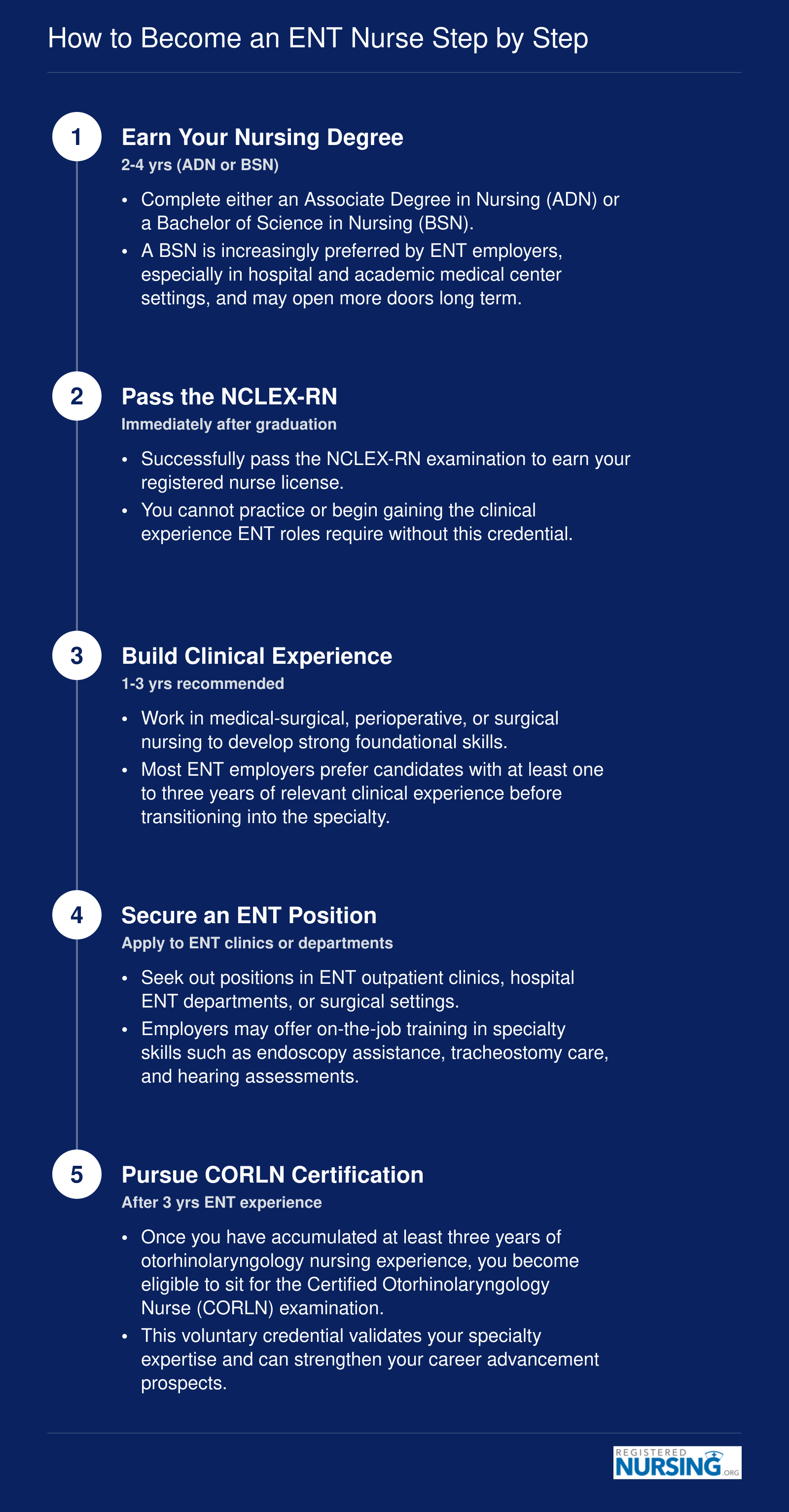
How to Become an ENT Nurse Step by Step
The path to becoming an otorhinolaryngology nurse follows a clear sequence, though your total timeline depends on the degree you choose and how quickly you build specialty experience. From start to CORLN certification eligibility, most nurses can expect the journey to take roughly 3 to 6 years.
Can New Graduates Get ENT Nurse Jobs?
Landing an ENT nursing position straight out of school is possible, though it requires a deliberate strategy because most employers prefer candidates with one to two years of clinical experience.
What the Job Market Looks Like for New Grads
The reality is that many ENT departments at academic medical centers and large hospital systems list prior nursing experience as a preferred or required qualification. Hiring managers want nurses who are already comfortable with assessment skills, medication administration, and fast-paced workflows before they layer on the specialty knowledge unique to otorhinolaryngology. That said, new graduates are not shut out entirely. Some large health systems run nurse residency programs that rotate new hires through multiple specialties, and ENT is sometimes included among those rotations. Completing one of these programs can serve as a direct path into the specialty.
Outpatient ENT clinics affiliated with private physician practices tend to be more welcoming to new graduates than academic centers. These settings typically see a higher volume of routine visits (hearing evaluations, allergy management, sinus follow-ups) and may be willing to invest in on-the-job training for a motivated new nurse.
Stepping-Stone Roles That Build Transferable Skills
If a dedicated ENT role is not available right away, certain positions will accelerate your readiness:
- Medical-surgical nursing: Builds a strong assessment foundation and comfort with post-operative care, both of which translate directly to ENT work.
- Perioperative or OR nursing: Develops surgical assisting skills relevant to tonsillectomies, septoplasties, and other ENT procedures.
- Ambulatory surgery center (ASC) nursing: Mirrors the outpatient surgical environment where many ENT procedures take place.
Even six months to a year in one of these roles can make your resume significantly more competitive for ENT openings.
How to Strengthen Your Candidacy While Still in School
The single best move you can make during your nursing program is to pursue a nursing capstone clinical rotation in an ENT department. Direct exposure to the specialty demonstrates genuine interest and gives you hands-on familiarity with ENT-specific procedures, instruments, and patient populations. If your program does not offer an ENT-specific rotation, request placement in a head and neck surgery unit or an outpatient surgical clinic where ENT cases are common.
Networking matters, too. Connecting with ENT nurses through professional organizations or clinical preceptors can alert you to openings before they are widely posted. Many specialty positions are filled through internal referrals, so building relationships early gives you a meaningful advantage when you are ready to apply.
ENT Nurse Certification: CORLN and Other Credentials
Earning a specialty certification signals to employers, colleagues, and patients that you have validated expertise in otorhinolaryngology nursing. While no state requires certification to work in an ENT setting, the Certified Otorhinolaryngology Nurse credential has become the gold standard for nurses who want to distinguish themselves and unlock advancement opportunities.
What Is the CORLN Credential?
The CORLN designation is administered by the National Certification Board for Otorhinolaryngology and Head-Neck Nursing, an independent body affiliated with the Society of Otorhinolaryngology and Head-Neck Nurses.1 Passing the exam demonstrates mastery of anatomy and physiology of the ear, nose, throat, and head-neck region, as well as competence in pre-operative assessment, post-surgical management, patient education, and disease-specific interventions.
Employers increasingly list CORLN as preferred or required on job postings because certified nurses tend to deliver more consistent, evidence-based care. Many healthcare systems also tie certification to clinical ladder advancement or salary differentials, making the credential a tangible investment in your earning potential.
Eligibility and Exam Details
Before applying, candidates must hold a current, unrestricted RN license and document at least three years of experience in otorhinolaryngology nursing practice.2 Once eligible, you may register for one of two annual testing windows. For 2026, the spring window runs from May 9 through May 23 with an application deadline of April 8, and the fall window runs from October 3 through October 17 with applications due by September 2.1
The computer-based exam contains 250 questions and allows three and a half hours to complete.3 The passing threshold is not publicly disclosed, but the exam blueprint covers clinical topics such as hearing and balance disorders, airway management, oncology of the head and neck, and pediatric ENT conditions. Fees for 2026 are $325 for SOHN members and $425 for non-members.3
Maintaining Your Certification
CORLN certification remains valid for five years. To renew, you must accumulate 100 contact hours of approved continuing education from SOHN or providers accredited by the American Nurses Credentialing Center.4 Up to 25 of those hours may come from physician-focused CME activities if they relate to otorhinolaryngology. You can also earn credit by publishing peer-reviewed articles or presenting at professional conferences, with each activity worth up to 10 points.3 Renewal applications must be submitted at least two months before your certification expires, and renewal fees mirror the original exam cost.
Complementary Credentials Worth Considering
While CORLN should be your primary goal, supplementary certifications can round out your qualifications depending on your practice setting. Nurses who care for critically ill post-operative patients in intensive care may benefit from the CCRN credential, a certification path explored in depth for critical care nurses. Those who specialize in tracheostomy care or complex wound management might pursue the certification held by a wound care nurse, which focuses on wound, ostomy, and continence nursing. These credentials complement CORLN and can open doors to leadership roles or subspecialty positions within larger ENT programs.
ENT Nurse Salary and Pay by State
Because the Bureau of Labor Statistics does not publish a separate pay category for ENT nurses, the figures below reflect overall registered nurse compensation in each state. ENT nurses who hold specialty credentials such as the CORLN certification or who work in surgical settings may earn toward the higher end of these ranges. Data comes from the 2024 Occupational Employment and Wage Statistics published by the U.S. Bureau of Labor Statistics.
| State | Total RN Employment | 25th Percentile | Median Salary | Mean Salary | 75th Percentile |
|---|---|---|---|---|---|
| Rhode Island | 10,760 | $83,870 | $99,960 | $99,770 | $112,540 |
| Arizona | 64,430 | $81,390 | $96,890 | $95,230 | $105,450 |
| New Hampshire | 16,580 | $79,720 | $96,830 | $94,620 | $105,500 |
| Maryland | 48,980 | $81,470 | $96,830 | $96,650 | $104,840 |
| Colorado | 54,510 | $81,790 | $96,520 | $95,470 | $104,370 |
| Delaware | 13,260 | $82,600 | $92,610 | $95,450 | $108,360 |
| Texas | 261,050 | $77,450 | $90,010 | $91,690 | $102,200 |
| Virginia | 77,420 | $77,650 | $88,820 | $90,930 | $100,920 |
| New Mexico | 17,510 | $82,630 | $88,260 | $94,360 | $104,720 |
| Pennsylvania | 146,840 | $78,570 | $87,610 | $90,830 | $102,030 |
| Georgia | 97,410 | $76,600 | $86,560 | $91,960 | $104,790 |
| Illinois | 139,900 | $79,150 | $86,410 | $91,130 | $103,660 |
| Idaho | 14,540 | $78,020 | $86,100 | $89,770 | $100,220 |
| Wisconsin | 64,960 | $79,570 | $86,070 | $90,450 | $100,680 |
| Michigan | 104,210 | $80,030 | $85,670 | $90,580 | $101,210 |
| Vermont | 7,240 | $79,980 | $85,150 | $92,710 | $104,110 |
| Maine | 16,280 | $76,890 | $82,860 | $87,440 | $98,000 |
| Florida | 218,100 | $77,070 | $82,850 | $88,200 | $99,260 |
| Utah | 25,780 | $77,030 | $82,270 | $88,240 | $101,530 |
| North Carolina | 108,510 | $74,710 | $81,860 | $86,270 | $98,720 |
| Wyoming | 5,180 | $75,540 | $81,790 | $88,020 | $100,910 |
| Montana | 10,540 | $77,800 | $81,560 | $88,480 | $100,510 |
| Ohio | 138,360 | $77,420 | $81,250 | $86,110 | $97,440 |
| Oklahoma | 32,870 | $75,320 | $81,160 | $85,800 | $96,460 |
| Nebraska | 24,180 | $76,430 | $81,020 | $82,890 | $93,140 |
ENT Nurse Salary by Metro Area
Because the Bureau of Labor Statistics does not publish a separate pay category for ENT nurses, the figures below reflect general registered nurse wages across the largest U.S. metro areas, drawn from the 2024 Occupational Employment and Wage Statistics. ENT nurses in these metros can expect pay in line with these benchmarks, with potential premiums for surgical or specialty clinic experience. California metros consistently lead in overall RN compensation, though cost of living should factor into any relocation decision.
| Metro Area | Total RN Employment | 25th Percentile | Median Salary | 75th Percentile | Mean Salary |
|---|---|---|---|---|---|
| San Francisco, Oakland, Fremont, CA | 40,750 | $150,580 | $188,020 | $212,190 | $178,450 |
| Los Angeles, Long Beach, Anaheim, CA | 107,340 | $108,150 | $133,440 | $165,290 | $138,010 |
| Seattle, Tacoma, Bellevue, WA | 37,250 | $101,140 | $118,570 | $132,160 | $120,260 |
| New York, Newark, Jersey City, NY and NJ | 195,470 | $100,530 | $113,490 | $128,430 | $115,650 |
| Boston, Cambridge, Newton, MA and NH | 66,440 | $84,200 | $102,440 | $137,160 | $115,710 |
| Minneapolis, St. Paul, Bloomington, MN and WI | 40,510 | $87,670 | $102,240 | $116,000 | $102,790 |
| Washington, Arlington, Alexandria, DC, VA, MD, WV | 43,640 | $83,570 | $101,800 | $110,760 | $102,510 |
| Philadelphia, Camden, Wilmington, PA, NJ, DE, MD | 74,840 | $84,040 | $99,210 | $107,800 | $97,510 |
| Dallas, Fort Worth, Arlington, TX | 72,640 | $79,170 | $98,740 | $106,850 | $96,720 |
| Phoenix, Mesa, Chandler, AZ | 46,330 | $82,270 | $98,160 | $105,900 | $96,220 |
| Houston, Pasadena, The Woodlands, TX | 65,300 | $79,640 | $97,810 | $105,970 | $96,730 |
| Chicago, Naperville, Elgin, IL and IN | 100,620 | $81,320 | $96,480 | $104,730 | $94,580 |
| Atlanta, Sandy Springs, Roswell, GA | 54,370 | $79,700 | $96,370 | $107,550 | $96,640 |
| Detroit, Warren, Dearborn, MI | 44,280 | $81,140 | $88,980 | $101,880 | $92,680 |
| Miami, Fort Lauderdale, West Palm Beach, FL | 59,880 | $78,240 | $85,610 | $103,110 | $92,070 |
ENT Nurse Career Outlook and Advancement
Nurses building an ENT career face a choice early on: stay at the RN level and deepen clinical expertise, or pursue an advanced practice degree that expands your scope into diagnosis and prescribing. Both paths have real momentum behind them, and the specialty itself is growing for reasons tied to demographics.
Demand Drivers in ENT
The Bureau of Labor Statistics projects registered nurse employment (SOC 29-1141) will grow 4.9% from 2024 to 2034, adding roughly 166,100 jobs to a workforce of about 3.39 million.1 That headline number understates what is happening inside otolaryngology. An aging population is fueling steady demand for hearing loss evaluation and cochlear implant care, obstructive sleep apnea treatment, chronic sinus disease management, and head-and-neck cancer screening. ENT clinics and surgical services are expanding to meet that volume, and nurses with specialty experience are competitive candidates.
The ENT Nurse Practitioner Pathway
Nurses who want to diagnose, order imaging, and manage otolaryngology patients independently (within state law) typically pursue an MSN or DNP, most commonly with an adult-gerontology or family NP focus. Otolaryngology is a subspecialty layered on top of that primary certification, usually through on-the-job training with an ENT physician group, a post-graduate fellowship where available, or continuing education through professional societies. NPs must hold a master's degree at minimum, pass national NP certification, and maintain state APRN licensure.2 Compared with RN-level ENT nursing, the NP scope covers independent patient evaluation, prescribing, and procedures such as flexible laryngoscopy or cerumen removal in many settings. BLS projects nurse practitioner employment (SOC 29-1171) will grow 40.1% over the decade, one of the fastest rates in healthcare.3
Clinical Nurse Specialist and Leadership Routes
The adult gerontology nurse practitioner track is a strong alternative for nurses who want to stay close to the clinical side of care while expanding their scope through advanced certification. CNS roles in ENT often center on staff education, evidence-based protocol development, quality improvement projects, and clinical research support.
Leadership is another direction that does not require an advanced clinical degree. Experienced ENT nurses commonly move into charge nurse roles, ENT clinic manager positions, or ENT service line coordinator jobs that oversee scheduling, staffing, and outcomes across the outpatient clinic, OR, and inpatient units. Long-term care nurse roles also occasionally recruit ENT-experienced nurses as the senior population requiring chronic ear, nose, and throat management continues to grow.
According to the National Institute on Deafness and Other Communication Disorders, roughly 15 percent of American adults report some degree of hearing trouble. That is nearly one in every six adults, representing just one slice of the vast population affected by ear, nose, and throat conditions and highlighting the steady demand for skilled ENT nurses nationwide.
Helpful ENT Nursing Organizations and Resources
ENT nursing has a richer professional infrastructure than many nurses realize, and tapping into that network early can shape how quickly you grow in the specialty.
The Society of Otorhinolaryngology and Head-Neck Nurses (SOHN)
SOHN is the cornerstone organization for nurses working in this specialty. Membership gives you access to continuing education modules hosted on the SOHN website, discounted registration for the annual SOHN convention, and a community of peers who understand the day-to-day realities of ENT practice. The annual conference rotates locations and covers clinical updates, hands-on skills workshops, and networking events that connect staff nurses with advanced practice colleagues and physician partners.
One practical note worth keeping in mind: joining SOHN before you sit for the CORLN certification exam is a straightforward way to reduce costs and improve preparation. Members receive discounted exam registration fees and access to study resources that are not available to non-members. If you are planning to pursue CORLN within the next year or two, membership pays for itself quickly.
Journals and Continuing Education
The ORL-Head and Neck Nursing journal is SOHN's peer-reviewed publication and serves as a primary source of evidence-based clinical content for the specialty. Reading it regularly keeps you current on practice changes and provides CE credit opportunities. SOHN's online learning modules offer a convenient way to accumulate CE hours between conferences, covering topics from audiologic screening to head and neck oncology care.
Additional Professional Connections
Beyond SOHN, several other organizations are worth knowing:
- American Academy of Otolaryngology-Head and Neck Surgery (AAO-HNS): Primarily a physician organization, but its annual meeting and published clinical practice guidelines are valuable for any ENT nurse who wants to understand the broader interdisciplinary landscape.
- American Nurses Association (ANA): The ANA's specialty interest groups and online communities offer a space to connect with nurses across settings who share interests in surgical, ambulatory, or oncology nursing, all of which overlap with ENT work.
- Online forums and communities: Nurse-focused platforms and specialty-specific discussion groups on professional networks can surface real-world advice on job searching, certification study, and navigating challenging clinical situations.
Building even a loose connection to these resources before you specialize puts you ahead when it comes time to certify, advance, or simply find colleagues who speak your clinical language. Nurses who branch into related specialties, such as a charge nurse role or a dermatology nurse position, often find that the professional habits formed through active organization membership travel well across settings.
Frequently Asked Questions About ENT Nursing
ENT nursing is a rewarding specialty, but prospective nurses often have practical questions before committing to this career path. Below are concise, straightforward answers to the questions we hear most often.
How long does it take to become an ENT nurse?
How difficult is it to become an ENT nurse?
Do ENT nurses need special certification?
How much does an ENT nurse make?
Are there entry-level ENT nurse jobs for new graduates?
What is the difference between an ENT nurse and an ENT nurse practitioner?
Explore More
- Ambulatory Care Nurse
- Burn Unit Nurse
- Cardiac Nurse
- Cath Lab Nurse
- Charge Nurse
- Chief Nursing Officer (CNO)
- Correctional Nurse
- CVOR Nurse
- Dermatology Nurse
- Developmental Disability Nurse
- Director of Nursing
- Domestic Violence Nurse
- Emergency Room Nurse
- ET Nurse
- Fertility Nurse
- Flight/Transport Nurse
- Forensic Nurse Salary & Career Guide
- Genetic Nurse
- Geriatric Nurse
- Health Policy Nurse
- Healthcare Administrator
- Healthcare Manager
- Home Health Nurse
- Hospice Nurse
- Camp Nurse
- GI Nurse
- Holistic Nurse
- Labor and Delivery Nurse
- Nurse Writer
- Psychiatric Nurse
- School Nurse
- Telemetry Nurse
- Travel Nurse
- Aesthetic Nurse
- Infusion/IV Nurse
- Oncology Nurse
- ICU Nurse
- Infection Control Nurse
- Legal Nurse Consultant
- LTC Nurse
- Managed Care Nurse
- Medical-Surgical Nurse
- Military (Combat) Nurse
- Missionary Nurse
- Mother Baby Nurse
- Nephrology Nurse
- Neuroscience Nurse
- NICU Nurse
- Nurse Administrator
- Nurse Attorney
- Nurse Care Coordinator
- Nurse Case Manager
- Nurse Entrepreneur
- Nurse Executive
- Nurse Health Coach
- Nurse Manager
- Obstetric (OB) Nurse
- Occupational Health Nurse
- Operating Room Nurse
- Ophthalmic Nurse
- Organ Procurement Coordinator
- Orthopedic Nurse
- Pain Management Nurse
- Palliative Care Nurse
- Parish Nurse
- Patient Advocate Nurse
- Pediatric Endocrinology Nurse
- Perianesthesia (PACU) Nurse
- Perinatal Nurse
- Plastic Surgery Nurse
- Public/Community Health Nurse
- Radiology Nurse
- Rehabilitation Nurse
- Research Nurse
- Respiratory Nurse
- Rheumatology Nurse
- Substance Abuse Nurse
- Telephone Triage Nurse
- Transcultural Nursing
- Transplant Nurse
- Trauma Nurse
- Wound Care Nurse (WOCN)