

What you’ll learn in this article…
- Nevada DNP programs at three accredited schools cost roughly $30,000 to $80,000 total.
- UNLV offers the most specialty tracks, including FNP and psychiatric mental health.
- Nevada nurse practitioners earn a median salary of $121,610 per year.
Earning a BSN first or entering with an MSN already in hand: the pathway you choose shapes both your timeline and total investment in a Nevada DNP. With only three institutions offering the degree statewide, program selection carries real weight. UNLV, UNR, and Touro University Nevada each structure their doctoral tracks differently, from hybrid formats requiring periodic campus intensives to online coursework paired with local clinical placements.
Admission standards, tuition ranges, and specialty concentrations vary enough that understanding the details matters before you apply. Nevada's APRN workforce remains undersized relative to population growth, and DNP-prepared nurses increasingly fill leadership and primary care gaps in both urban Las Vegas and rural communities. Nurses who want a foundation before committing to doctoral study can review RN to BSN Nevada pathways or explore what Nevada schools offer accelerated BSN programs as a starting point.
Best DNP Programs in Nevada: Rankings Overview
Nevada offers a small but strong selection of Doctor of Nursing Practice programs, anchored by two public research universities and one private institution. All three schools hold CCNE accreditation and participate in a statewide DNP consortium designed to address Nevada's growing demand for advanced practice nurses and nurse leaders. Because options are limited, understanding each school's concentrations, delivery format, and cost structure is essential to choosing the right fit. Graduation rates cited below reflect institution-wide figures reported to the U.S. Department of Education, not DNP-specific completion rates, as program-level data is not available for these schools.
- Graduate earnings potential
- Institutional graduation rate
- Net price and affordability
- Program breadth and concentrations
- Delivery format flexibility
- College Scorecard graduate earnings — collegescorecard.ed.gov
- NCES-IPEDS federal institutional data — nces.ed.gov
- Independent program research
- Internal program database
University of Nevada-Las Vegas
#1Las Vegas, NV · $10,000/yr
Best for: Working nurses wanting multiple specialty tracks
UNLV's DNP lives within the University of Nevada DNP consortium, giving students access to shared faculty and courses across the state's public university system. The program offers four distinct tracks, including BSN-to-DNP and post-master's pathways, all delivered primarily online to accommodate working nurses across Nevada's vast geography. As a public institution, UNLV provides a significant cost advantage over private alternatives, with an average net price of roughly $10,359 and an institution-wide graduation rate of about 51%.
- 4 tracks: FNP, PMHNP, CRNA, Post-Master's Advanced Practice
- Primarily online delivery with limited campus requirements
- BSN-to-DNP and post-master's entry pathways available
- Part of the statewide University of Nevada DNP consortium
- Emphasizes evidence-based practice and healthcare policy
- Prepares graduates for faculty, executive, and specialist roles
- CCNE accredited terminal practice degree
- Scholarships available for doctoral nursing students
University of Nevada-Reno
#2Reno, NV · $16,000/yr (net price)
Best for: BSN holders seeking a research university environment
The University of Nevada, Reno's Orvis School of Nursing offers one of the broadest DNP concentration menus in the state, spanning clinical, leadership, and education tracks through both BSN-to-DNP and MSN-to-DNP pathways. As a Carnegie R1 research institution, UNR pairs rigorous scholarship with coordinated clinical placements, so students can focus on skill-building rather than hunting for preceptors. Its institution-wide graduation rate of approximately 61% is the highest among Nevada's DNP-granting schools, and the average net price of about $15,927 remains well below private alternatives.
- BSN-to-DNP pathway with online delivery
- Clinical placements coordinated by the school
- Prepares for primary care across the lifespan
- CCNE accredited with evidence-based curriculum
- Part of the statewide University of Nevada DNP consortium
- Carnegie R1 research institution resources available
- Concentrations in Nurse Executive and Clinical Education Leadership
- Hybrid format with BSN and MSN entry pathways
- Focuses on strategic innovation and organizational change
- Prepares for roles such as nurse executive or clinical director
- CCNE accredited with emphasis on interprofessional collaboration
- Nationwide online access with periodic campus engagement
- 72 total credit hours with 780 clinical practicum hours
- Full-time and part-time scheduling options available
- 8 to 12 semesters to complete depending on pace
- Eligible for AACN or ANCC certification upon graduation
- On-campus immersion component required
- Capstone scholarly project required for completion
Touro University Nevada
#3Henderson, NV
Best for: MSN-prepared nurses seeking accelerated completion
Touro University Nevada is the state's only private DNP option, offering a focused Leadership concentration through a fully online, post-master's format. Students choose between an accelerated one-year full-time track or a two-year part-time track, with three start dates per year providing frequent entry points. The program features a unique partnership with JBI, an international research institute, which enriches the evidence-based practice curriculum. As a private institution, Touro's tuition runs higher than Nevada's public schools, but its streamlined 33-credit curriculum and flexible pacing appeal to MSN-prepared nurses ready to finish quickly.
- 100% online coursework with no required campus visits
- Accelerated 1-year or standard 2-year completion options
- Three annual start dates: fall, spring, and summer
- CCNE accredited with JBI research partnership
- 33-credit post-master's curriculum
- Practicum completed in the student's local area
- Prepares for nurse executive and healthcare consultant roles
- Minimum 3.0 GPA required for admission
DNP Tuition and Total Cost Comparison in Nevada
Understanding the full cost of a DNP program is essential before you commit. The table below compares in-state and out-of-state tuition rates, institution-wide average net price after aid, median graduate debt, and an estimated monthly loan payment on a standard 10-year repayment plan. Keep in mind that net price figures reflect the institution-wide average for all students after financial aid, so your actual DNP costs may differ. Additional expenses such as clinical placement fees, textbook and supply costs, and DNP scholarly project expenses (including IRB fees, data collection tools, and formatting or binding charges) can add several thousand dollars beyond sticker tuition. The cost gap between Nevada's two public universities and the state's private institutions is significant: public in-state tuition runs roughly $7,000 to $7,400 per year, while private per-credit rates can push total program costs above $60,000.
| School | Sector | In-State Tuition (Annual) | Out-of-State Tuition (Annual) | Net Price (Institutional Avg.) | Median Graduate Debt | Est. Monthly Payment (10-Year) |
|---|---|---|---|---|---|---|
| University of Nevada, Las Vegas (UNLV) | Public | $7,413 | $25,555 | $10,359 | $19,450 | Approx. $205 |
| University of Nevada, Reno (UNR) | Public | $7,032 | $25,174 | $15,927 | $18,922 | Approx. $199 |
| Touro University Nevada | Private | $625 per credit ($60,400 total program) | $625 per credit ($60,400 total program) | N/A | N/A | N/A |
| Roseman University of Health Sciences | Private | N/A | N/A | N/A | N/A | N/A |
Questions to Ask Yourself
BSN-To-DNP Vs. MSN-To-DNP Pathways in Nevada
Choosing between a BSN-to-DNP and an MSN-to-DNP pathway depends on where you are in your nursing career and how quickly you want to reach doctoral-level practice. Nevada's nursing schools offer both options, but the structure, timeline, and clinical requirements differ significantly. Understanding these distinctions will help you select the pathway that aligns with your professional goals and personal circumstances.
BSN-to-DNP Pathway Overview
The BSN-to-DNP pathway is designed for nurses who hold a Bachelor of Science in Nursing and want to bypass the master's degree to move directly into doctoral study. This route typically requires more credit hours than the post-master's option because it incorporates advanced practice coursework that MSN-prepared nurses have already completed.
One important consideration is whether a BSN-to-DNP program awards an intermediate MSN along the way. Some programs grant the master's credential once you complete a certain number of credits, allowing you to sit for certification exams before finishing the doctorate. Others require full program completion before conferring any degree. This distinction matters for your timeline to licensure and practice authority, so contact each program's admissions office directly to clarify how credentials are structured.
Expect BSN-to-DNP programs to span three to four years of full-time study, though part-time options may extend that timeline. Clinical hour requirements align with national standards set by the American Association of Colleges of Nursing (AACN), which recommends a minimum of 1,000 post-baccalaureate clinical hours for nurse practitioner preparation.
MSN-to-DNP Pathway Overview
The MSN-to-DNP pathway, sometimes called the post-master's DNP, is built for nurses who already hold a master's degree in nursing. Because you have completed graduate-level coursework, this pathway requires fewer credits and focuses primarily on the DNP Essentials, including systems leadership, quality improvement, and the scholarly project.
Post-master's DNP programs in Nevada can often be completed in one to two years of full-time study. Part-time schedules are common, accommodating working APRNs who want to continue practicing while advancing their credentials. If you are already a licensed advanced practice nurse, you may also want to explore nurse practitioner programs in Nevada for context on how NP specialties align with DNP-level preparation. Clinical hour requirements depend on what you completed during your master's program. Most schools will evaluate your prior clinical hours and determine how many additional hours you need to meet the 1,000-hour threshold.
How to Research Your Options
Program details change frequently, so always verify current information through official school websites. UNLV, UNR, Touro University Nevada, and Roseman University each publish their own credit requirements, clinical expectations, and program timelines. The AACN and the Nevada Nurses Association are also reliable resources for understanding national standards and how Nevada programs typically align with them. Nurses weighing a broader range of terminal-degree options can also consult a national overview of best doctor of nursing practice programs to benchmark what top schools require.
For general career context, including salary ranges and employment projections, the Bureau of Labor Statistics provides useful data on advanced practice registered nurses. However, specific program costs, admission criteria, and curriculum details can only be confirmed by contacting the institutions directly.
Online Vs. Hybrid DNP Formats: What to Expect at Each School
Up to seven campus visits are required for UNLV's BSN-to-DNP Family Nurse Practitioner track,1 illustrating why "online" DNP programs in Nevada rarely mean fully remote learning. Understanding each school's on-campus requirements helps you plan around work schedules, family obligations, and travel logistics before you commit to a program.
What "Online" Really Means for Nevada DNP Students
Most Nevada DNP programs blend asynchronous coursework with mandatory in-person components. These on-site requirements typically include orientation sessions, clinical intensives, skills labs, and DNP project defenses. The frequency and duration of campus visits vary significantly by program and specialization track.
UNLV's post-MSN DNP pathway, for example, requires only a few campus visits across its 31 to 32 credit curriculum,2 making it more accessible for working nurses who already hold certification in an advanced practice role. In contrast, the BSN-to-DNP FNP track spans 68 to 70 credits and requires multiple immersion experiences throughout the three-year program. If you are working while in nursing school or balancing a full clinical caseload, these visit windows deserve careful review before you apply.
Touro University Nevada offers what may be the most flexible option for students seeking minimal travel. Their MSN-to-DNP program is described as exclusively online,3 with practicum hours completed in students' states of residence where they hold an active RN license. This format works well for nurses who cannot relocate or travel frequently to Nevada.
Specialty Tracks Shape Your On-Campus Requirements
Your chosen specialization significantly affects how much time you will spend on campus. UNLV's CRNA track operates as a 36-month hybrid program4 with more intensive clinical and simulation requirements than leadership-focused tracks. Nurse anesthesia education demands hands-on training that cannot be replicated through virtual learning alone.
Executive leadership and health systems tracks typically have lighter residency requirements since their competencies emphasize organizational strategy, quality improvement, and policy development rather than direct clinical skill acquisition.
DNP Project and Clinical Hour Structure
Every DNP student must complete a scholarly project demonstrating practice-level impact. UNLV's post-MSN track requires 300 clinical hours focused on a practice-change project,5 which involves identifying a clinical problem, implementing an evidence-based intervention, and evaluating outcomes.
Many programs allow students to complete clinical hours at their current workplace, provided the site meets program requirements and offers appropriate preceptor supervision. Touro explicitly permits practicum completion in your state of residence, which opens possibilities for using familiar clinical settings. Guidance on nursing capstone clinical rotation preparation can help you anticipate what preceptors and program coordinators expect during this phase. However, you should confirm specific site approval processes with your program coordinator before assuming your employer will qualify.
Planning Your Schedule Around Campus Requirements
Before applying, request a detailed calendar of required on-site dates from each program you are considering. Factor in travel costs, time away from work, and childcare needs. Some immersion weekends span three to four consecutive days, while others may require only single-day attendance for project presentations or certification exams. This planning helps you choose a format that fits your life while meeting rigorous doctoral-level expectations.
Admission Requirements for Nevada DNP Programs
DNP programs in Nevada are moving toward more flexible admission pathways, but competitive entry standards still reflect the rigor of doctoral-level nursing education. All programs require an active, unencumbered RN license and a minimum of one year of clinical experience.1 A master's degree or a BSN with a master's-equivalent component is the standard prerequisite, though some post-master's tracks may also require national board certification in an advanced practice specialty.
General Admission Requirements Across Nevada DNP Programs
- GPA Minimum: A cumulative GPA of 3.0 or higher is typical. Some programs, like UNLV's, set a higher bar of 3.5.2
- Prior Degree: Applicants typically hold an MSN or BSN with a master's-level component (e.g., for BSN-to-DNP paths).
- RN Licensure: Current, unencumbered compact or Nevada RN license is mandatory.
- Standardized Tests: While GRE scores are required at UNLV, many other schools have moved to test-optional policies. Check each program's latest requirements.
Program-Specific Highlights
- UNLV DNP Program: Requires a 3.5 GPA, official GRE scores, three letters of recommendation, and a professional statement.2 An active, unencumbered RN license and one year of post-licensure clinical experience are also required. Post-master's applicants may need national certification in their APRN specialty.
- Other Nevada Programs (UNR, Touro, Roseman): These schools generally follow similar core requirements, including an active RN license, a BSN or MSN, and clinical experience, but specific GPA cutoffs and test policies vary. For instance, many do not require the GRE, and some may evaluate advanced practice certification on a case-by-case basis. Always confirm directly with the program.
Clinical Experience and Certification
Most Nevada DNP programs expect at least one year of direct patient care experience as a registered nurse.1 For post-master's applicants, current national board certification in a relevant advanced practice role (e.g., FNP, AG-ACNP) is commonly required. This ensures that those entering the DNP with an existing APRN foundation can seamlessly transition into doctoral-level coursework. Nurses exploring how to strengthen their credentials before applying may also find it useful to review RN to BSN programs in Nevada as a reference point for foundational academic pathways in the state.
Application Deadlines
Deadlines differ widely. UNLV typically follows a fixed annual deadline, while other schools may offer rolling admissions or multiple start dates. Prospective students should plan to submit materials at least six months before the intended start term and contact each program's admission office for the most current timeline. Those interested in Nevada-based psychiatric mental health nurse practitioner programs near Reno should also verify whether their specialty certification aligns with DNP post-master's entry requirements.
Nevada's public DNP programs typically cost $30,000 to $50,000 in total tuition for residents, while private options can exceed $80,000. Public universities offer the most budget-friendly path, though private programs may feature accelerated tracks or additional specialty concentrations that appeal to nurses seeking faster credential completion.
DNP Career Outcomes and Salaries in Nevada
Nevada nurse practitioners earned a median annual salary of $121,610 according to Bureau of Labor Statistics data,1 placing the state among those with competitive advanced practice compensation relative to national figures. With roughly 1,800 NPs employed statewide, the field is established enough to show clear wage patterns across experience levels and specialties.
What Nevada NPs Actually Earn
The wage spread in Nevada is wide, which matters when you are weighing the cost of a DNP program against your expected return. Entry-level or lower-volume practice settings cluster around $87,340 at the 10th percentile,1 while experienced NPs in high-demand roles can reach $165,240 at the 90th percentile. The middle half of the profession earns between $103,250 and $135,470. On an hourly basis, that translates to roughly $41.99 at the 10th percentile and $58.47 at the median, with top earners approaching $79.44 per hour.1
For a broader view of how these figures compare across specialties and states, the DNP salary by state and specialty resource offers useful context. Certified Registered Nurse Anesthetists represent a separate, higher-earning tier. CRNA compensation in Nevada consistently outpaces NP wages by a substantial margin, and the DNP is increasingly required for entry into CRNA practice under national education standards.
Las Vegas vs. Reno: Does Location Move the Needle?
Market size and employer mix do influence where within that wage band you land. The Las Vegas-Henderson-Paradise metro, anchored by large hospital systems, a growing medical corridor, and a high volume of specialty practices, tends to support stronger negotiating positions for DNP-prepared clinicians. Reno offers a smaller but stable market with proximity to the University of Nevada health sciences programs, which can create academic and clinical employment opportunities that do not always show up in straight salary comparisons.
ROI: Framing the Investment
Program-level earnings data for the Nevada DNP programs tracked here are not yet published, so direct comparisons between what a graduate earns in year one versus year four after completing a specific program cannot be made with precision at this time. What the available data does show is that median debt at completion varies meaningfully by school. Graduates from public programs at UNLV and the University of Nevada-Reno carry median debt figures in the range of $19,000 to $19,500, while the private Touro University Nevada program shows a much lower median debt figure closer to $12,500, likely reflecting a mix of funding sources and enrollment characteristics. Set against NP median wages above $120,000, even the higher debt figures represent a relatively short payback horizon for most graduates who move into full-time clinical roles.
Beyond NP and CRNA Roles
Not every DNP graduate pursues direct patient care. Nurse executives, health system administrators, and clinical faculty represent a growing share of DNP career paths, particularly in a state that is actively building out its healthcare infrastructure. Salary benchmarks for those roles are less standardized than BLS wage data for clinical specialties, and compensation varies considerably by organization size, setting, and whether the position is academic or administrative. Prospective students interested in those tracks should request outcomes data directly from programs and speak with current faculty about where recent graduates have landed. Those already holding advanced credentials may also find that Nevada post-graduate certificate programs can open doors to additional clinical or leadership specializations without a full degree commitment.
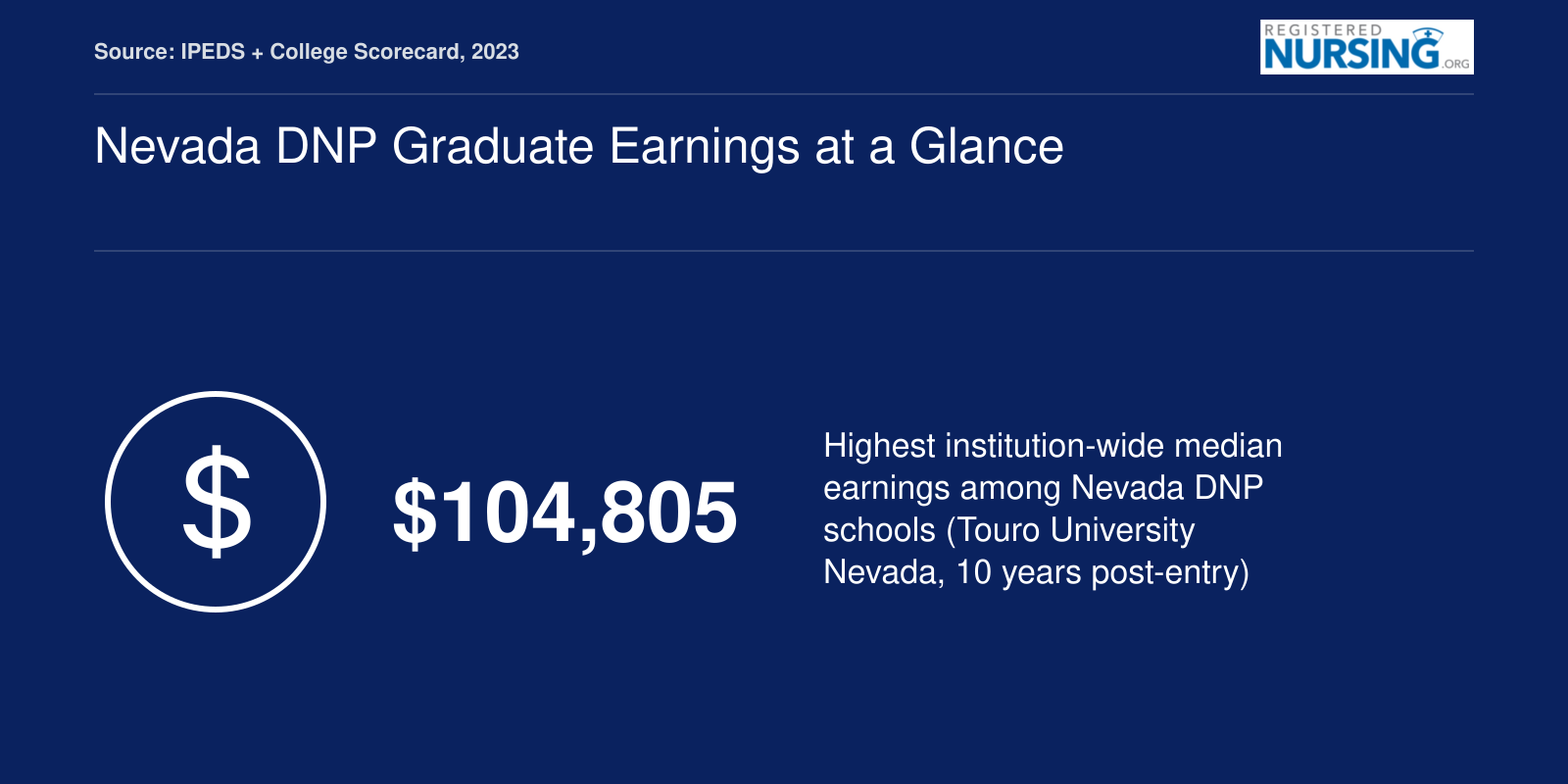
Nevada DNP Graduate Earnings at a Glance
Program-level earnings data for Nevada DNP graduates, such as median salary at one year or four years after completion, are not yet published by the U.S. Department of Education. However, institution-wide median earnings provide a useful benchmark for evaluating the return on your DNP investment.
UNLV DNP Program Spotlight
The University of Nevada, Las Vegas offers the most comprehensive Doctor of Nursing Practice program in the state, with multiple specialty tracks designed to prepare advanced practice nurses for clinical leadership across a range of settings.
Available DNP Tracks and Specialties
As of the most recent program information, UNLV organizes its DNP degree into several sub-plans that serve different career goals:1
- Family Nurse Practitioner (FNP): An active track that prepares graduates for primary care across the lifespan, leading to FNP certification and APRN licensure.
- Certified Registered Nurse Anesthetist (CRNA): An active doctoral-level track for students pursuing careers in nurse anesthesia, with rigorous clinical training requirements.2
- Advanced Practice Track: An active pathway generally suited for nurses who already hold an MSN with APRN certification and wish to complete the terminal practice doctorate.
- Psychiatric-Mental Health Nurse Practitioner (PMHNP): UNLV has a PMHNP curriculum on record requiring 46 credits.3 However, this track was on hold during the 2025-2026 academic year. Prospective students should contact the School of Nursing directly for the latest status, as availability may shift from year to year.
UNLV has also offered executive nursing leadership and adult-gerontology content areas in the past. If you are interested in a specialty not listed above, it is worth reaching out to the admissions office, as track offerings can evolve.
The UNR and UNLV Consortium
Historically, the University of Nevada, Reno and UNLV operated a nursing consortium that allowed students to access coursework and faculty expertise across both campuses. This arrangement was particularly useful for tracks with limited enrollment or specialized clinical placements. While the consortium framework has undergone changes over the years, both institutions continue to coordinate on certain graduate nursing initiatives within the Nevada System of Higher Education. Students should verify directly with UNLV whether any current DNP tracks involve cross-campus coursework or clinical partnerships with UNR, as the structure may look different than it did in earlier years. Nurses considering graduate study at either institution may also want to review MSN programs in Nevada as a potential step before pursuing doctoral-level work.
Credits, Timeline, and Clinical Hours
Credit requirements at UNLV vary by track. The PMHNP curriculum, for example, is built around 46 credits, while the CRNA track typically requires a significantly higher credit load given the depth of anesthesia training involved. BSN-to-DNP students should plan for three to four years of full-time study, while post-MSN students may complete requirements in a shorter timeframe depending on the track. All DNP candidates must complete a scholarly project (sometimes called a DNP project) and accumulate a substantial number of supervised clinical hours, generally a minimum of 1,000 post-baccalaureate clinical hours across the program.
Accreditation
UNLV's DNP program is accredited by the Commission on Collegiate Nursing Education (CCNE), the widely recognized accrediting body for baccalaureate, master's, and doctoral nursing programs.4 The CRNA track carries its own specialized accreditation through the Council on Accreditation of Nurse Anesthesia Educational Programs (COA), which is required for graduates to sit for the national certification examination in nurse anesthesia. Prospective students should confirm accreditation status directly with UNLV or the relevant accrediting body, as accreditation cycles are periodically renewed.
Tuition Considerations
UNLV, as a public institution in the Nevada System of Higher Education, offers significantly lower tuition rates for Nevada residents compared to out-of-state applicants. In-state graduate tuition is among the more affordable options for a DNP in the western United States, though students should account for program-specific fees, clinical placement costs, and any differential tuition that may apply to nursing courses. Detailed cost comparisons appear earlier in this article. Out-of-state students may want to explore whether establishing Nevada residency before or during enrollment could reduce overall expenses.
For the most current admissions timelines, application deadlines, and track-specific details, visit the UNLV School of Nursing directly or review the program's nursing practice handbook, which is updated each academic year.5
Nevada APRN Licensure After Earning Your DNP
Frequently Asked Questions About Nevada DNP Programs
Choosing the right Doctor of Nursing Practice program involves weighing timelines, costs, and format options. Below are answers to some of the most common questions prospective students ask about DNP programs in Nevada.
- How long does it take to complete a DNP program in Nevada?
- Timeline depends on your entry point. BSN-to-DNP programs typically require three to four years of full-time study because they incorporate master's level coursework along with doctoral requirements. MSN-to-DNP (post-master's) programs are shorter, generally taking two to three years. Part-time options may extend the timeline but offer greater flexibility for working nurses.
- Can you complete a DNP program entirely online in Nevada?
- Most Nevada DNP programs use a hybrid format that combines online coursework with periodic on-campus intensives or clinical residency hours. Fully online didactic courses are common, but clinical practicum requirements must be completed in person at approved sites. Students should confirm each school's specific on-site expectations before enrolling.
- What is the difference between a BSN-to-DNP and an MSN-to-DNP program?
- A BSN-to-DNP pathway is designed for nurses who hold a bachelor's degree and want to earn their doctorate without first completing a standalone master's program. It covers both master's and doctoral competencies in one continuous track. An MSN-to-DNP program is built for nurses who already hold a master's degree and focuses on advanced practice scholarship, leadership, and the DNP scholarly project. Nurses weighing their options can also explore direct entry MSN programs as an alternative route into graduate nursing education.
- How much does a DNP program cost in Nevada?
- Total costs vary by institution and residency status. In-state tuition at public universities such as UNLV tends to be significantly lower than out-of-state or private rates. Students should budget for tuition, fees, clinical placement expenses, and course materials. Reviewing each school's published tuition schedules and financial aid offerings is the best way to estimate your total investment.
- What is the salary for a DNP-prepared nurse in Nevada?
- DNP-prepared nurses in Nevada, particularly those working as nurse practitioners or in executive leadership roles, often earn well above the state average for registered nurses. Nevada's strong healthcare market and growing population contribute to competitive compensation. Exact figures vary by specialty, employer, and years of experience, so researching role-specific salary data is recommended.
- Are Nevada DNP programs accredited by CCNE?
- Accreditation status varies by program. The University of Nevada, Las Vegas (UNLV) DNP program holds accreditation from the Commission on Collegiate Nursing Education (CCNE), which is widely recognized as a mark of quality. Always verify a program's current accreditation directly through the CCNE or the school's website before applying, as accreditation cycles and statuses can change.