

What you’ll learn in this article…
- CRNAs are the highest-paid DNP specialty, averaging over $212,000 annually.
- State location can swing DNP pay by $100,000 or more.
- Board certification adds roughly $5,000 to $15,000 per year in earnings.
DNP-prepared nurses earn anywhere from around $130,000 a year as certified nurse midwives to over $230,000 as nurse anesthetists, a gap of roughly $100,000 that hinges almost entirely on specialty choice. Within those roles, state of practice and years of experience can shift compensation another 20 to 40 percent in either direction.
The Doctor of Nursing Practice sits at the top of clinical nursing credentials, and the salaries reflect that position. Yet the actual figure on any given pay stub depends on a tangle of variables: whether you choose primary care or anesthesia, whether you practice in DNP programs in Illinois|Illinois or Alabama, and whether you have five years of post-doctoral experience or fifteen. Exploring DNP programs in Georgia can also help prospective students weigh regional markets against long-term earning potential before committing to a path.
How Much Does a DNP Make? National Salary Overview
The Doctor of Nursing Practice (DNP) opens doors to some of the highest-paying roles in nursing. The table below shows national salary data for the three major advanced practice registered nurse (APRN) categories most commonly associated with a DNP, drawn from the 2024 Occupational Employment and Wage Statistics published by the U.S. Bureau of Labor Statistics. Nurse anesthetists (CRNAs) command the highest earnings by a wide margin, with a median salary exceeding $223,000. Nurse practitioners and nurse midwives earn solidly in the six figures as well, with median salaries near $129,000.
| Role | Total Employment | 25th Percentile Salary | Median Salary | Mean (Average) Salary | 75th Percentile Salary |
|---|---|---|---|---|---|
| Nurse Anesthetists (CRNAs) | 50,350 | $187,110 | $223,210 | $231,700 | N/A |
| Nurse Practitioners (NPs) | 307,390 | $109,940 | $129,210 | $132,000 | $149,570 |
| Nurse Midwives (CNMs) | 8,280 | $104,260 | $128,790 | $128,110 | $146,520 |
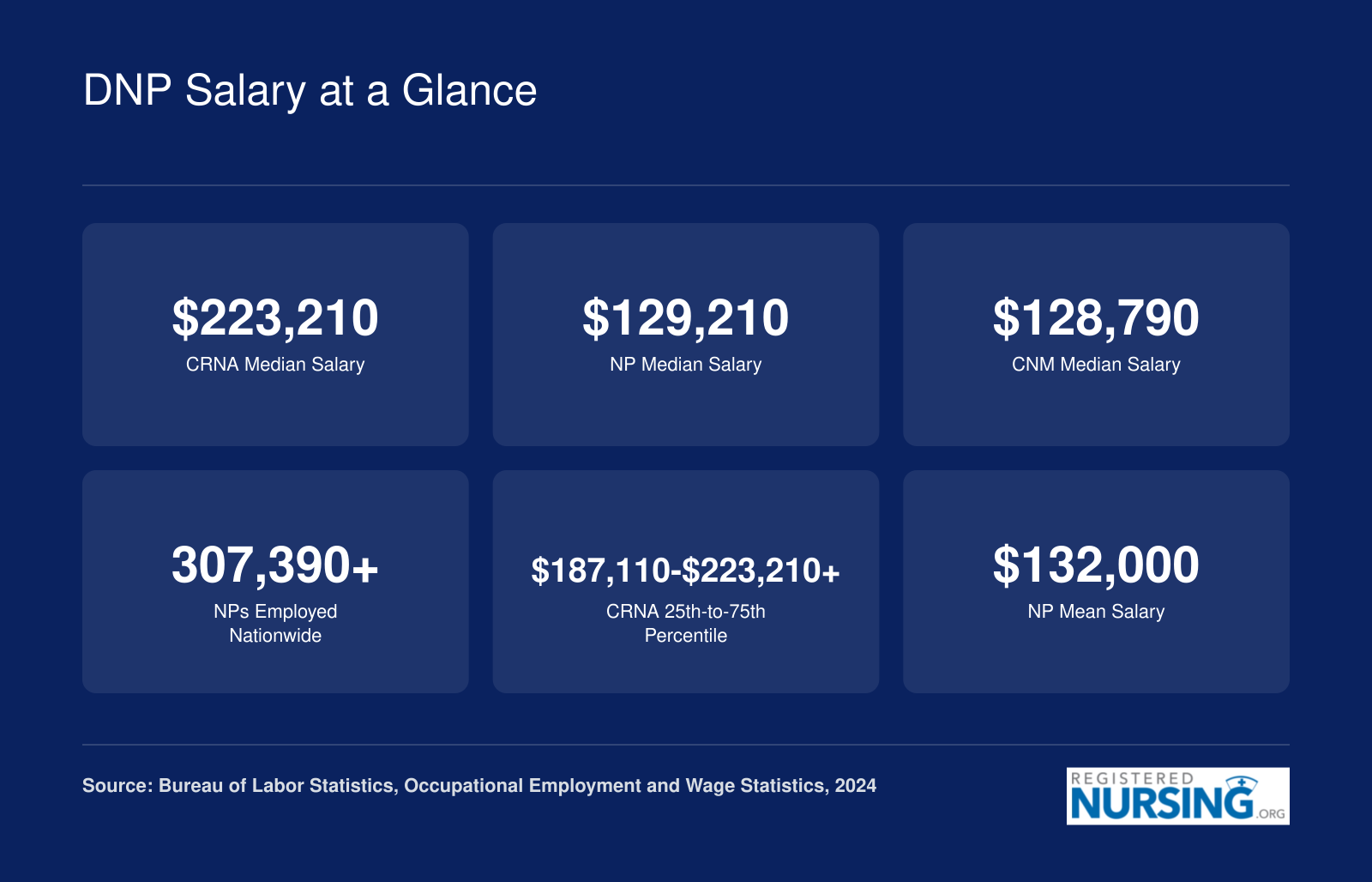
DNP Salary at a Glance
Before exploring detailed breakdowns by specialty, state, and experience level, here is a quick snapshot of DNP-level earning power across the most common advanced practice roles.
DNP Salary by Specialty: NP, CRNA, CNM, and More
Specialty choice is the single biggest lever a DNP graduate can pull on lifetime earnings, and the spread between the top and bottom of the profession has widened as demand for anesthesia and psychiatric care has outpaced supply. Below is how the major DNP career paths compare, using the most recent Bureau of Labor Statistics wage data alongside supplementary industry surveys where BLS does not track a role separately.
Nurse Anesthetists (CRNAs) Lead the Field
CRNAs are consistently the highest-paid advanced practice nurses. BLS reports a median annual wage of $223,210 for Nurse Anesthetists, with a mean of $231,700 across roughly 50,350 practitioners nationwide. The 25th percentile still sits above $187,000, meaning even entry-level CRNAs typically out-earn most other nursing roles. Three forces sustain the premium: a broad anesthesia scope of practice, steady surgical and procedural demand, and a limited pipeline (CRNA programs are small, competitive, and now uniformly doctoral). For a direct comparison of these two high-earning paths, CRNA vs. NP career considerations are worth reviewing before committing to a specialty.
Nurse Practitioners: A Big Category With Real Internal Variation
BLS groups all NP specialties into a single occupation, reporting a median of $129,210 and a mean of $132,000 across about 307,390 NPs. That headline number masks meaningful differences by specialty. For a deeper breakdown, the nurse practitioner salary guide covers specialty-level differentials in detail. Industry compensation surveys from the American Association of Nurse Practitioners generally show psychiatric mental health NPs (PMHNPs) commanding a premium over the NP average, driven by the national behavioral health shortage. Acute care NPs (AGACNPs) working in hospital and ICU settings also tend to earn above the median, while family NPs (FNPs) typically cluster near the BLS midpoint. Treat these differentials as directional rather than exact, since survey samples vary year to year.
Nurse Midwives and Executive Roles
Certified Nurse Midwives earn a BLS median of $128,790 (mean $128,110), but the workforce is small (around 8,280 nationally), so regional demand swings pay significantly.
DNP-prepared nurse executive roles sit outside the BLS APRN categories and require supplementary data:
- Nurse Director: roughly $120,000 to $170,000 nationally, with about 71% of directors earning between $100,000 and $170,000.1
- Nurse Manager: roughly $80,000 to $130,000, a common stepping-stone role for DNP leadership graduates.2
- CNO and VP of Nursing: top nurse executives frequently start at $150,000 and climb well beyond; AONL data shows about 10% of nurse leaders earn $250,000 or more.1
- Nursing Informatics Director: typically overlaps the director band, with variation by health-system size and IT complexity.
Nurse Educators: Lower Pay, Growing Demand
DNP holders in academic faculty roles generally earn less than clinical peers, often in the $80,000 to $110,000 range depending on rank and institution. The tradeoff is schedule flexibility, tenure potential, and a nationwide faculty shortage that is expanding hiring.
DNP Salary by State: Highest and Lowest Paying States
DNP salaries vary dramatically from state to state, and where you practice can mean a difference of $100,000 or more in annual pay. The table below highlights the highest and lowest paying states for three major DNP specialties: Nurse Practitioners (NPs), Certified Registered Nurse Anesthetists (CRNAs), and Certified Nurse Midwives (CNMs). All figures reflect 2024 data from the Bureau of Labor Statistics Occupational Employment and Wage Statistics program.
| State | Specialty | Mean Annual Salary | Median Annual Salary | 25th Percentile | 75th Percentile |
|---|---|---|---|---|---|
| California | Nurse Practitioner | $173,190 | $166,610 | $140,260 | $205,400 |
| New York | Nurse Practitioner | $148,410 | $145,390 | $128,190 | $164,670 |
| Oregon | Nurse Practitioner | $148,030 | $144,600 | $129,840 | $163,240 |
| Massachusetts | Nurse Practitioner | $145,140 | $138,890 | $125,590 | $160,310 |
| Washington | Nurse Practitioner | $143,620 | $140,220 | $125,890 | $161,730 |
| Alaska | Nurse Practitioner | $142,340 | $145,450 | $104,000 | $165,510 |
| Connecticut | Nurse Practitioner | $141,140 | $138,960 | $125,910 | $159,680 |
| New Jersey | Nurse Practitioner | $140,470 | $149,620 | $126,030 | $162,250 |
| Rhode Island | Nurse Practitioner | $139,600 | $130,710 | $126,200 | $160,030 |
| New Mexico | Nurse Practitioner | $136,620 | $138,440 | $113,240 | $156,000 |
| Arizona | Nurse Practitioner | $132,920 | $133,790 | $115,290 | $151,650 |
| Michigan | Nurse Anesthetist | $230,360 | $234,520 | $211,530 | N/A |
| North Dakota | Nurse Anesthetist | $229,180 | $232,420 | $216,890 | $234,940 |
| Iowa | Nurse Anesthetist | $245,780 | $229,950 | $218,050 | N/A |
| Maine | Nurse Anesthetist | $238,440 | $229,900 | $216,400 | N/A |
| Texas | Nurse Anesthetist | $248,670 | $227,580 | $199,200 | N/A |
| North Carolina | Nurse Anesthetist | $226,030 | $226,460 | $211,410 | N/A |
| South Carolina | Nurse Anesthetist | $267,410 | $225,800 | $218,820 | N/A |
| Connecticut | Nurse Anesthetist | $223,660 | $227,930 | $184,250 | N/A |
| Delaware | Nurse Anesthetist | $215,760 | $236,800 | $145,380 | N/A |
| Puerto Rico | Nurse Anesthetist | $65,380 | $61,170 | $58,050 | $69,150 |
| California | Nurse Midwife | $179,630 | $196,700 | $152,470 | $207,780 |
| Massachusetts | Nurse Midwife | $165,820 | $155,710 | $150,250 | $185,530 |
| Washington | Nurse Midwife | $149,980 | $145,000 | $122,420 | $169,730 |
| New York | Nurse Midwife | $138,570 | $137,860 | $118,490 | $154,710 |
| New Jersey | Nurse Midwife | $138,980 | $135,680 | $133,020 | $154,000 |
| Vermont | Nurse Midwife | $138,410 | $140,240 | $124,350 | $145,580 |
| Utah | Nurse Midwife | $135,190 | $138,020 | $104,800 | $146,220 |
| Tennessee | Nurse Midwife | $109,870 | $97,380 | $96,650 | $126,060 |
| Delaware | Nurse Midwife | $109,580 | $99,060 | $98,800 | $126,460 |
| Idaho | Nurse Midwife | $66,830 | $89,870 | $20,780 | $103,520 |
Questions to Ask Yourself
Cost-Of-Living Adjusted DNP Salary by State
A six-figure salary in California does not buy what the same number buys in Tennessee, and for DNP-prepared nurses evaluating job offers across states, purchasing power often matters more than the raw figure on a pay stub. When regional price differences are factored in, some of the highest-paying states on paper fall to the middle of the pack, while states with modest nominal salaries deliver stronger real earnings.
Methodology: How Adjusted Salaries Are Calculated
The adjusted salaries presented here divide each state's BLS median annual pay for nurse practitioners (the largest segment of DNP-prepared nurses) by that state's Regional Price Parity (RPP) index from the Bureau of Economic Analysis, then multiply by 100.1 RPP measures the cost of goods and services in a state relative to the national average. An RPP of 110 means prices are 10% above the national baseline; an RPP of 88 means prices are 12% below. By dividing salary by RPP and normalizing, we express what a dollar of earnings actually purchases in each location.
Top-Paying States Shrink After Adjustment
California's nominal median NP salary of approximately $158,000 ranks among the highest in the nation, but the state's RPP of 110.7 means housing, groceries, and services cost 11% more than the national average.1 After adjustment, California's purchasing power drops to roughly $142,700, still strong, but no longer leading the pack. DNP programs in Massachusetts follow a similar pattern to the state itself (RPP 108.2): high nominal pay offset by expensive markets, as does New Jersey (RPP 108.8).
New York illustrates the effect most starkly. Despite a nominal salary in the $140,000 to $150,000 range in many metro areas, cost-of-living indices in New York City and surrounding counties can push effective purchasing power well below that of nurses in the Southeast or Midwest.
Lower-Cost States Deliver Stronger Real Earnings
Texas and DNP programs in Tennessee stand out as states where modest nominal salaries stretch further. Texas, with an RPP near the national average, offers close to dollar-for-dollar purchasing power on a median NP salary around $120,000.1 Tennessee, with an RPP of approximately 91, turns a $115,000 nominal salary into roughly $126,000 in adjusted terms, outpacing several higher-paying coastal markets.
Other states in the lower-cost tier include Alabama (RPP 88.4), Arkansas (RPP 86.9), and Mississippi (RPP 87.0).1 A DNP earning $110,000 in Alabama enjoys purchasing power equivalent to $124,400 nationally, often exceeding the real take-home value of a $135,000 salary in a high-cost state.
Bottom Line: Salary Comparisons Require Context
Nominal salary rankings tell only half the story. A $20,000 difference on paper can vanish, or reverse, once housing costs, state income tax, and daily expenses are accounted for. When evaluating offers, calculate what your salary will actually buy in the market where you plan to live and work. Reviewing best DNP programs by state can also help you weigh program location against long-term earning potential.
DNP Salary by Metro Area: Top-Paying Cities
DNP salaries vary significantly depending on where you practice, with major metro areas often offering premium compensation to attract talent. The tables below break down mean annual salaries for nurse practitioners, nurse anesthetists, and nurse midwives across the highest-employing metropolitan areas, based on 2024 data from the Bureau of Labor Statistics Occupational Employment and Wage Statistics program. Keep in mind that higher metro salaries often reflect higher costs of living, so weigh these figures against local housing, taxes, and expenses.
| Metro Area | Role | Total Employed | Mean Annual Salary | 25th Percentile | Median Salary | 75th Percentile |
|---|---|---|---|---|---|---|
| New York, Newark, Jersey City (NY, NJ) | Nurse Practitioner | 19,850 | $151,510 | $135,120 | $152,790 | $167,870 |
| Los Angeles, Long Beach, Anaheim (CA) | Nurse Practitioner | 6,400 | $165,030 | $140,230 | $164,510 | $184,670 |
| Boston, Cambridge, Newton (MA, NH) | Nurse Practitioner | 6,660 | $146,850 | $126,120 | $138,890 | $161,750 |
| Miami, Fort Lauderdale, West Palm Beach (FL) | Nurse Practitioner | 9,200 | $132,730 | $109,990 | $135,450 | $150,840 |
| Phoenix, Mesa, Chandler (AZ) | Nurse Practitioner | 5,970 | $132,670 | $115,290 | $134,630 | $151,670 |
| Philadelphia, Camden, Wilmington (PA, NJ, DE, MD) | Nurse Practitioner | 5,780 | $133,360 | $115,400 | $131,590 | $147,900 |
| Chicago, Naperville, Elgin (IL, IN) | Nurse Practitioner | 6,930 | $131,580 | $114,540 | $131,690 | $141,010 |
| Atlanta, Sandy Springs, Roswell (GA) | Nurse Practitioner | 6,280 | $129,710 | $115,690 | $128,640 | $140,140 |
| Minneapolis, St. Paul, Bloomington (MN, WI) | Nurse Practitioner | 5,680 | $128,740 | $106,660 | $128,570 | $139,590 |
| Nashville, Murfreesboro, Franklin (TN) | Nurse Practitioner | 5,380 | $112,610 | $101,520 | $116,160 | $129,590 |
| New York, Newark, Jersey City (NY, NJ) | Nurse Anesthetist | 1,500 | $263,220 | $229,990 | N/A | N/A |
| Minneapolis, St. Paul, Bloomington (MN, WI) | Nurse Anesthetist | 1,700 | $243,390 | $214,210 | $233,030 | N/A |
| Charlotte, Concord, Gastonia (NC, SC) | Nurse Anesthetist | 980 | $239,390 | $221,630 | $238,780 | N/A |
| Houston, Pasadena, The Woodlands (TX) | Nurse Anesthetist | 900 | $236,150 | $197,830 | $235,490 | N/A |
| Dallas, Fort Worth, Arlington (TX) | Nurse Anesthetist | 1,530 | $233,050 | $203,560 | $204,020 | N/A |
| Detroit, Warren, Dearborn (MI) | Nurse Anesthetist | 1,590 | $226,560 | $211,530 | $230,450 | N/A |
| Kansas City (MO, KS) | Nurse Anesthetist | 820 | $207,220 | $171,130 | $189,740 | $221,550 |
| Nashville, Murfreesboro, Franklin (TN) | Nurse Anesthetist | 1,020 | $198,430 | $186,150 | $203,400 | $206,790 |
| Tampa, St. Petersburg, Clearwater (FL) | Nurse Anesthetist | 1,130 | $187,140 | $127,860 | $197,660 | $198,420 |
| San Francisco, Oakland, Fremont (CA) | Nurse Midwife | 200 | $188,930 | $171,630 | $204,980 | $207,780 |
| Los Angeles, Long Beach, Anaheim (CA) | Nurse Midwife | 190 | $190,340 | $167,280 | $190,230 | $223,800 |
| New York, Newark, Jersey City (NY, NJ) | Nurse Midwife | 400 | $143,540 | $130,020 | $138,980 | $158,030 |
| Washington, Arlington, Alexandria (DC, VA, MD, WV) | Nurse Midwife | 320 | $138,460 | $135,630 | $139,770 | $150,840 |
| Miami, Fort Lauderdale, West Palm Beach (FL) | Nurse Midwife | 310 | $130,910 | $107,260 | $131,690 | $141,010 |
| Atlanta, Sandy Springs, Roswell (GA) | Nurse Midwife | 310 | $126,800 | $101,710 | $125,830 | $157,880 |
| Minneapolis, St. Paul, Bloomington (MN, WI) | Nurse Midwife | 180 | $125,750 | $99,270 | $127,160 | $141,430 |
| Portland, Vancouver, Hillsboro (OR, WA) | Nurse Midwife | 200 | $117,220 | $101,400 | $123,080 | $142,440 |
| Chicago, Naperville, Elgin (IL, IN) | Nurse Midwife | 200 | $105,340 | $59,310 | $110,090 | $133,130 |
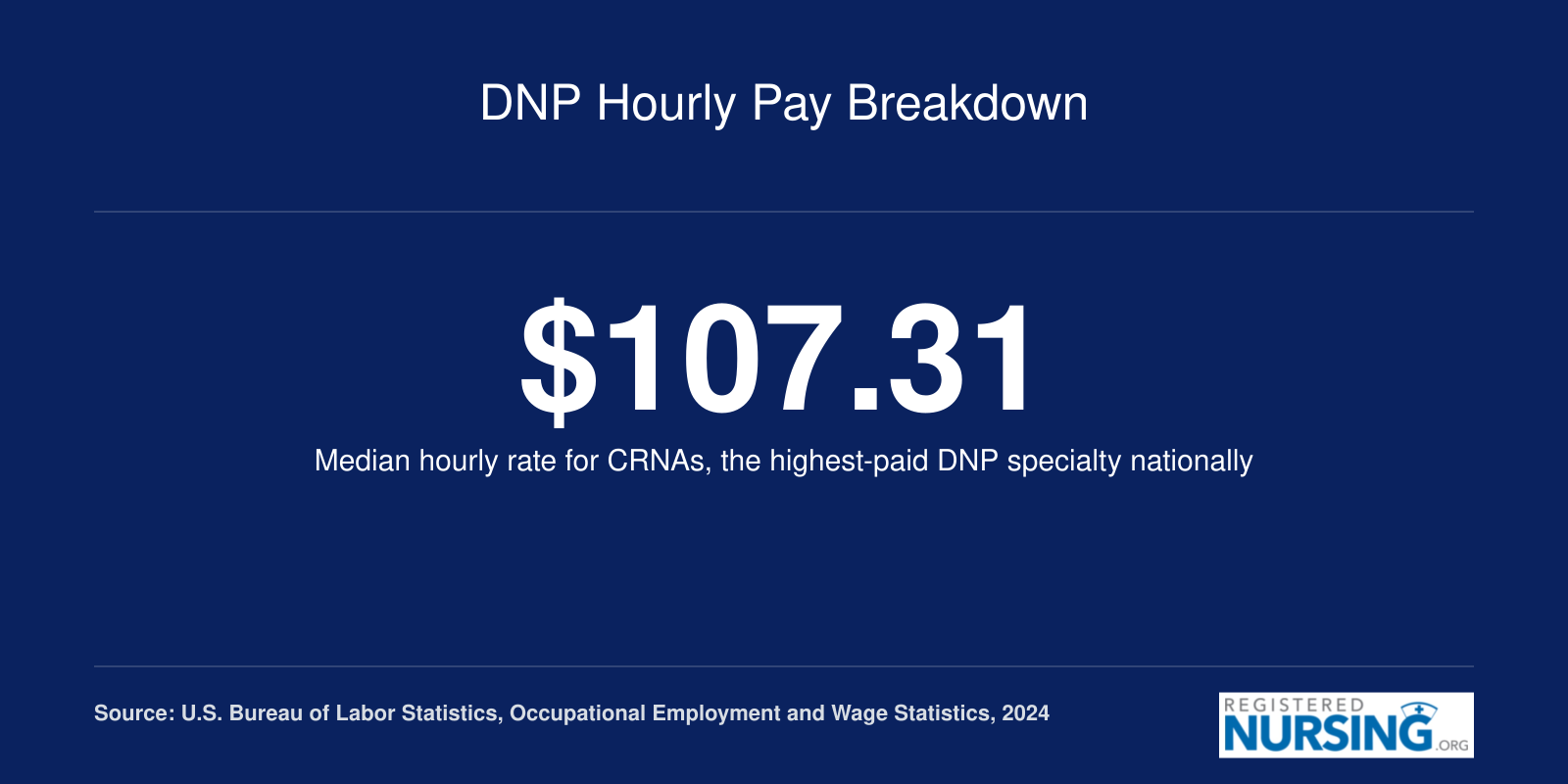
DNP Hourly Pay Breakdown
Converting annual salaries to hourly rates using the standard 2,080-hour work year reveals clear differences across DNP specialties. Nurse Practitioners earn roughly $53 to $72 per hour between the 25th and 75th percentiles, while Certified Nurse Midwives fall in a similar range of about $50 to $70 per hour. Certified Registered Nurse Anesthetists command the highest hourly rates, with the 25th to 75th percentile spread running from approximately $90 to well above $107 per hour. Keep in mind that overtime pay, per-diem shifts, and locum tenens assignments can push effective hourly rates significantly higher than these base figures.
DNP Salary by Experience Level
Years of practice after earning a DNP matter almost as much as the specialty you choose, yet pinpointing exactly how much experience is worth can be tricky. The Bureau of Labor Statistics does not break advanced practice nursing salaries down by years of experience, so the clearest national picture comes from compensation surveys and aggregated self-reported data.
What the Numbers Show for Nurse Practitioners
PayScale data from 2024 provides a useful experience-to-salary progression for nurse practitioners nationally:
- Less than 1 year: approximately $101,4001
- 1 to 4 years: approximately $110,9001
- 5 to 9 years: approximately $118,2002
- 10 to 19 years: approximately $121,4002
The jump from the earliest career stage to the one-to-four-year bracket is roughly $9,500, reflecting the premium employers place on a nurse practitioner who has moved past the initial learning curve. Each subsequent five-year increment adds a smaller dollar amount. The gap between the five-to-nine-year mark and the ten-to-nineteen-year mark is only about $3,200, suggesting that salary growth for NPs in purely clinical roles begins to plateau in the second decade of practice.
The CRNA Experience Curve
CRNAs start at a significantly higher baseline, with early-career salaries commonly landing in the $170,000 to $190,000 range based on available compensation survey data. Mid-career CRNAs with roughly five to nine years of experience frequently report total compensation above $210,000, while those with ten or more years can exceed $230,000. However, because the starting salary is already high, the percentage gain from one experience bracket to the next tends to be narrower than what NPs see early on. A CRNA who stays in clinical anesthesia may find that negotiating call differentials or per-diem rates matters more than seniority alone once they pass the decade mark.
Why Specialty and Career Path Interact With Experience
Experience does not operate in a vacuum. An NP who transitions from direct patient care into a clinical leadership or administrative role after seven or eight years can see a sharper salary increase than the averages above suggest, because the move resets the growth curve. By contrast, a CRNA who remains in the same facility and the same call rotation may experience relatively flat growth after about ten years, since there is a natural ceiling on hourly anesthesia reimbursement.
The practical takeaway: early in a DNP career, simply accumulating clinical hours delivers meaningful raises. Later, the biggest salary leaps come from strategic decisions, such as adding a subspecialty certification, relocating to a higher-paying market like DNP programs in Minnesota or DNP programs in Virginia, or moving into academic or executive roles. Experience is a necessary ingredient, but it is rarely the only one that determines your long-term earning trajectory.
DNP Vs. MSN Salary: Is a DNP Worth the Cost?
Choosing between a DNP and an MSN often comes down to one question: will the extra investment pay off? The answer depends on your specialty, your career goals, and whether you value the non-monetary advantages the doctorate brings. Here is how the numbers break down.
Salary Premium by Role
The DNP salary premium is real, but it varies dramatically by role. For clinical nurse practitioner specialties like family nurse practitioner and psychiatric-mental health nurse practitioner, DNP holders typically earn about 2 to 5 percent more than their MSN-prepared peers.1 In dollar terms, that translates to roughly $2,500 to $6,500 per year depending on the specialty.
CRNAs see a much larger premium. DNP-prepared nurse anesthetists earn an estimated 8 to 12 percent more than those with a master's degree, which works out to approximately $17,600 to $26,400 in additional annual income.1 When you look across all NP roles combined, the premium averages around $6,000 to $7,000 per year.
The takeaway is clear: the DNP salary advantage is not evenly distributed. It concentrates most heavily in anesthesia and in executive or leadership tracks, where the doctoral credential can be a prerequisite for top-tier positions.
What the Degree Costs
Program costs range widely depending on format and institution type.
- Post-MSN DNP (public, in-state): Around $561 per credit, with most programs requiring 32 to 40 credits, for a total of roughly $30,000 to $60,000.2
- Post-MSN DNP (private): Approximately $1,024 per credit, pushing total tuition toward the higher end of that range.2
- BSN-to-DNP: These longer programs require 65 to 82 credits and generally cost between $40,000 and $75,000.2
For comparison, accelerated MSN programs typically run $35,000 to $65,000.4 If you already hold an MSN, the incremental cost of a post-MSN DNP program is the more relevant figure.
Simple Payback Period
Using the post-MSN DNP cost range of $30,000 to $60,000 and the annual premium data above, you can calculate a rough payback timeline.
For FNPs and PMHNPs earning an extra $2,500 to $6,500 per year, the payback period stretches to roughly 5 to 17 years, not including opportunity costs like lost wages during clinicals.1 For CRNAs, the math is far more favorable. A premium of $17,600 to $26,400 per year against a program cost in the $30,000 to $60,000 range means most CRNAs recoup their investment within two to four years.
These estimates assume the salary premium remains constant over time, which is conservative. Many DNP holders move into higher-paying leadership positions as their careers progress, accelerating the return.
Beyond the Paycheck
Reducing the DNP decision to salary alone misses several important factors.
- Scope of practice: Some states grant broader prescriptive authority or independent practice rights more readily to doctorally prepared APRNs.
- Faculty eligibility: Most university nursing programs require or strongly prefer a doctoral degree for tenure-track faculty positions. If teaching interests you, the DNP opens that door.
- Executive roles: Chief nursing officer and other C-suite positions increasingly list a doctoral degree as a minimum qualification.
- Future-proofing: The American Association of Colleges of Nursing has long recommended the DNP as the entry-level degree for advanced practice nursing. While a hard mandate has not been universally adopted, the trend favors doctoral preparation.
If you are a clinical NP planning to stay in direct patient care, the financial case for a DNP is modest but may still be worthwhile when paired with the non-monetary benefits. If you are a CRNA, or you aspire to leadership, education, or policy roles, the return on investment becomes substantially stronger. Evaluate the total picture, including your state's regulatory landscape and your long-term career trajectory, before making your decision. Nurses weighing program options can also review BSN-to-DNP programs in Colorado or similar state-level resources to compare tuition structures across institution types.
Factors That Influence DNP Salary
Board-certified DNPs typically earn $5,000 to $15,000 more per year than those without additional credentials, with the largest premiums attached to the CRNA certification and the Psychiatric Mental Health Nurse Practitioner (PMHNP) credential. This premium is only one piece of a complex salary equation shaped by practice setting, state regulations, employer type, and union presence.
Practice Setting: Where You Work Shapes What You Earn
Hospital-employed DNPs consistently report the highest base salaries among all employment settings. According to recent compensation surveys, acute-care hospital positions pay a median of roughly $130,000 for nurse practitioners, while DNPs in outpatient clinics often earn closer to $120,000. Academic roles, especially those at teaching institutions, tend to lag further, with salaries in the $100,000 to $115,000 range. Telehealth positions, which have expanded rapidly, offer comparable pay to clinic-based roles but sometimes come with productivity bonuses that can add $10,000 or more annually. The gap between settings has widened in the last three years as hospitals compete for advanced practice talent.
Certifications That Boost Your Base Pay
Beyond core NP or CNS certification, subspecialty board certifications add measurable value to a DNP's salary offer. The Acute Care Nurse Practitioner (ACNPC-AG) and Family Nurse Practitioner (FNP-C) credentials typically yield a $5,000 to $10,000 premium. More specialized certs, such as a Certificate of Added Qualification (CAQ) in pain management, hospice and palliative care, or cardiovascular nursing, can add up to $15,000. Among all certifications, the CRNA pathway dominates: certified registered nurse anesthetists with a DNP routinely earn $200,000 to $250,000, reflecting the high-stakes, procedure-oriented nature of the role.
Full Practice Authority and Negotiation Leverage
State scope-of-practice laws directly influence earning potential. The American Association of Nurse Practitioners maps states into full, reduced, and restricted practice categories. DNPs in full-practice states, such as Oregon, New Mexico, and DNP programs in Iowa, have stronger negotiation leverage because they can practice independently, which often translates to higher base pay and better incentive structures. In contrast, DNPs in restricted states may be tied to physician-supervised practice arrangements that cap earning power. Job offers in full-practice states commonly include a 10% to 15% salary premium over similar roles in more restrictive environments, though cost-of-living differences must be weighed. Nurses weighing where to practice can also consult resources on the best states for Family Nurse Practitioners to see how scope-of-practice rankings intersect with pay.
Union vs. Non-Union and Employer Type
Unionized settings, particularly in states with strong nurses' unions like DNP programs in California and New York, often feature higher base wages, structured step increases, and clear overtime pay. The Veterans Health Administration (VA) stands out for its competitive pay scales, loan repayment benefits, and pension plans, making it an underappreciated salary driver. Academic medical centers may offer lower base pay but fund continuing education, conference travel, and research time, indirect compensation that can add $5,000 to $10,000 in annual value. Rural health clinics, conversely, might pay less but can include loan forgiveness or sign-on bonuses of $20,000 or more, which effectively boost total compensation.
Common Questions About DNP Salaries
Earning a Doctor of Nursing Practice opens doors to higher pay and expanded clinical or leadership roles, but the financial picture varies by specialty, experience, and setting. Below are answers to the questions prospective and current DNP students ask most often.
What is the highest-paying DNP specialty?
How much does a DNP make per hour?
Is a DNP degree worth the cost compared to an MSN?
Do DNP-prepared nurses earn more than physician assistants?
How much more does a DNP make than a BSN-prepared RN?
Does a DNP increase salary for nurse educators?
Best DNP Programs by State
- Alabama
- Alaska
- Arizona
- Arkansas
- California
- Colorado
- Connecticut
- Delaware
- Florida
- Georgia
- Hawaii
- Idaho
- Illinois
- Indiana
- Iowa
- Kansas
- Kentucky
- Louisiana
- Maine
- Maryland
- Massachusetts
- Michigan
- Minnesota
- Mississippi
- Missouri
- Montana
- Nebraska
- Nevada
- New Hampshire
- New Jersey
- New Mexico
- New York
- North Carolina
- North Dakota
- Ohio
- Oklahoma
- Oregon
- Pennsylvania
- Rhode Island
- South Carolina
- South Dakota
- Tennessee
- Texas
- Utah
- Vermont
- Virginia
- Washington
- Washington DC
- West Virginia
- Wisconsin
- Wyoming