

What you’ll learn in this article…
- Most RNs reach pain management certification within four to six years.
- Top-paying metro areas offer RN salaries exceeding $120,000 annually.
- Both PMGT-BC and ASPMN credentials require 2,000 hours of specialty practice.
Pain management nursing is a clinical specialty focused on assessing, treating, and educating patients experiencing acute and chronic pain conditions. Unlike general medical-surgical nurses who encounter pain as one of many patient concerns, pain management nurses complete specialized training in pharmacology, interventional procedures, and opioid stewardship that positions them as experts in a field under intense scrutiny from regulators, insurers, and the public.
The distinction matters because chronic pain affects an estimated 50 million American adults, and the ongoing opioid crisis has elevated the need for nurses who can balance effective analgesia with responsible prescribing practices. Case management nurses often intersect with pain management teams to coordinate long-term care plans for patients with complex chronic conditions. National certification through ANCC or ASPMN requires at least two years of dedicated pain management experience, creating a clear credentialing pathway for RNs seeking to specialize. Neuroscience nurses bring complementary expertise in neurological pain pathways that can enrich a pain management nurse's clinical foundation.
What Does a Pain Management Nurse Do?
An RN-level pain nurse and an NP-level pain nurse may work side by side in the same clinic, yet their daily responsibilities, clinical authority, and legal scope differ significantly. Understanding both roles clarifies what this specialty looks like in practice and which path fits your career goals.
Core Daily Duties
Regardless of licensure level, pain management nurses share a set of foundational tasks that drive patient outcomes:
- Comprehensive pain assessments: Using validated scales such as the Numeric Rating Scale, the Brief Pain Inventory, and the Wong-Baker FACES scale, pain nurses evaluate pain intensity, quality, location, and functional impact before and after every intervention.
- Medication administration and titration: This includes oral analgesics, patient-controlled analgesia pumps, intravenous infusions, and adjuvant medications such as anticonvulsants or muscle relaxants. Nurses monitor for therapeutic response and adverse effects in real time. Pharmacological Pain Management: NCLEX-RN provides a solid foundation for understanding how these agents work across clinical contexts.
- Procedural support: Pain management nurses prepare patients for interventional procedures like nerve blocks, epidural steroid injections, and spinal cord stimulator trials. At the RN level, this means performing pre- and post-procedure assessments, assisting with sterile setup, managing catheter care, and monitoring vital signs throughout recovery.
- Patient and family education: A significant portion of each shift involves teaching non-pharmacological strategies such as guided imagery, heat and cold therapy, mindfulness techniques, and activity modification. Nurses also educate patients on realistic pain expectations and when to seek urgent care.
- Detailed documentation: Pain management is one of the most documentation-intensive nursing specialties. Nurses track pain scores over time, log medication efficacy, record functional outcomes, and contribute data to quality improvement programs that measure department-wide performance.
Interdisciplinary Collaboration
Pain rarely responds to a single treatment. That reality places pain management nurses at the center of interdisciplinary care teams that typically include anesthesiologists, physiatrists, psychologists, physical therapists, and addiction medicine specialists. The nurse coordinates the care plan by synthesizing input from each provider, relaying patient responses, and adjusting the day-to-day approach as the patient's condition evolves.2 This collaborative model is embedded in the 17 competency standards outlined in the Pain Management Nursing Scope and Standards of Practice published by the ANA and ASPMN.3
Opioid Stewardship Responsibilities
Opioid stewardship has become one of the defining responsibilities of this specialty. At the RN level, nurses assess patients before every opioid dose, monitor for sedation and respiratory depression, and educate patients on safe medication storage and disposal.4 Nurse practitioners expand that scope considerably. NP-level pain nurses consult prescription drug monitoring programs before every controlled-substance prescription, order urine drug screenings, initiate opioid treatment agreements, design individualized tapering protocols, and refer patients to addiction treatment when indicated.5 Both levels of practice contribute to a clinic's broader stewardship goals, but the NP carries prescriptive and diagnostic authority that positions them as the opioid stewardship lead in many settings.
RN vs. NP Scope of Practice
The distinction between RN-level and NP-level pain nurses goes beyond opioid management. An RN's scope centers on assessment, multimodal intervention, monitoring, education, and care coordination. RNs do not prescribe medications or order diagnostic imaging independently.3
Nurse practitioners in pain management hold prescribing authority, order diagnostics such as MRIs and nerve conduction studies, and can perform select procedures, including trigger point injections, peripheral joint injections, and superficial nerve blocks.5 High-risk interventional procedures like epidural steroid injections, intrathecal pump implantation, and complex neuromodulation remain physician-led. As of 2026, 27 states grant NPs full practice authority, allowing them to evaluate, diagnose, and manage pain patients without a formal collaborative agreement with a physician.6
Whether you enter at the RN or NP level, the specialty demands meticulous record-keeping, strong clinical judgment, and the ability to advocate for patients whose pain is often invisible to others. The ASPMN Core Curriculum for Pain Management Nursing, now in its fourth edition, remains the primary reference for the knowledge base expected at both levels of practice.7
Where Do Pain Management Nurses Work?
Pain management nurses practice across a diverse range of clinical environments, each offering unique opportunities to specialize in acute, chronic, or end-of-life pain care.
Hospital Inpatient Pain Management
Hospital inpatient units employ pain management nurses to care for patients with complex postoperative pain, acute trauma, oncology pain syndromes, and palliative care needs.1 These positions provide access to multidisciplinary teams, including anesthesiologists, pharmacists, and physical therapists, and expose nurses to high-acuity cases that require advanced pain assessment and intervention.1 Shifts typically follow full-time inpatient schedules, including nights, weekends, and holidays.
Outpatient Pain Management Clinics
Hospital-owned outpatient pain clinics treat patients with acute and chronic conditions such as back pain, neck pain, joint disorders, spinal stenosis, neuropathy, and cancer-related pain.2 These settings emphasize chronic pain management, quality-of-life interventions, and procedure-heavy workflows, including epidural steroid injections, nerve blocks, and radiofrequency ablations. Outpatient clinics generally operate on weekday daytime hours, offering more predictable scheduling than inpatient roles.3
Ambulatory Surgery Centers
Ambulatory care nurses in surgery center roles focus on pre- and post-operative pain management, discharge planning, and patient education.1 These facilities offer full-time daytime hours and a perioperative specialty focus with predictable schedules. The emphasis on same-day discharge requires strong teaching skills and attention to multimodal analgesia protocols.
Hospice and Palliative Care Settings
Hospices and palliative care facilities employ both registered nurses and nurse practitioners to manage end-of-life symptom control, complex opioid regimens, and family counseling.4 A palliative care nurse in these settings emphasizes holistic, patient-centered care, while NPs utilize prescriptive authority to manage complex symptom burdens. Work settings include both facility-based and community home visits, requiring flexible full-time schedules. Nurses drawn to community-based end-of-life work may also consider a role as a hospice nurse for closely related opportunities.
Specialty and Interventional Pain Clinics
Free-standing specialty pain clinics and interventional pain practices employ nurse practitioners in high-volume, longitudinal chronic pain management roles.4 NPs in these settings exercise diagnostic and prescriptive authority, develop comprehensive pain management plans, and may earn productivity-based bonuses.5 Clinic hours are typically full-time weekdays.
Pain management nurses also find opportunities in academic medical centers, rehabilitation hospitals, and Veterans Health Administration facilities.3 School clinical placement data and alumni outcomes from pain management nursing tracks confirm that graduates enter a mix of inpatient, outpatient, and specialty settings.
Questions to Ask Yourself
How to Become a Pain Management Nurse Step by Step
The path from nursing student to certified pain management nurse follows a clear credentialing ladder. Most RNs can reach certification within four to six years of starting nursing school. A BSN is increasingly preferred by employers and required for many pain clinic positions.
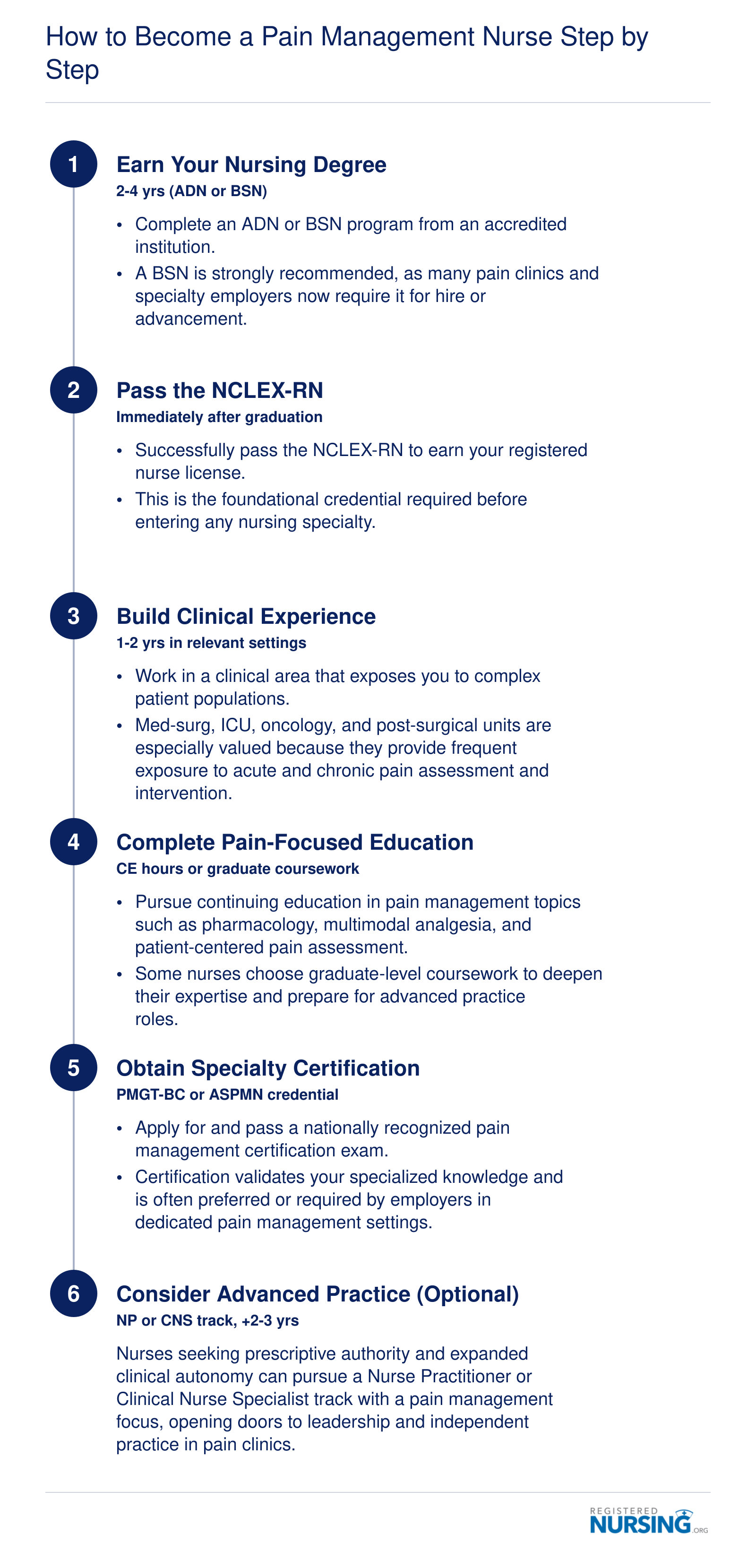
How to Become a Pain Management Nurse: The Complete Pathway
Becoming a certified pain management nurse is a structured journey that builds on core nursing competencies and layers in specialized pain science, assessment, and intervention skills. The process typically spans four to six years from initial enrollment in nursing school through certification, though timelines vary based on the degree you choose and how quickly you gain the required clinical hours.
Step 1: Earn Your Nursing Degree
You can enter registered nursing through either an Associate Degree in Nursing (ADN) or a Bachelor of Science in Nursing (BSN). An ADN takes roughly two years and costs less, making it an accessible pathway for many prospective nurses. However, most pain clinics, hospital-based pain services, and multispecialty groups prefer or require a BSN for specialty roles. A BSN program runs four years and includes courses in pathophysiology, pharmacology, health assessment, and evidence-based practice that directly support advanced pain management work. If you start with an ADN, plan to complete an RN to BSN program within your first few years of practice to remain competitive for pain management positions.
Step 2: Pass NCLEX-RN and Build Foundational Clinical Experience
After graduation, you must pass the NCLEX-RN exam to obtain your registered nurse license. Once licensed, spend at least one to two years in bedside roles that expose you to complex pain cases. Surgical units, oncology nurse floors, trauma centers, and palliative care teams all provide rich opportunities to observe acute and chronic pain, practice detailed pain assessments, and collaborate with interdisciplinary teams. This foundational experience is not just a certification prerequisite; it develops the clinical judgment and empathy essential for effective pain management nursing.
Step 3: Seek Pain-Specific Education and Mentorship
Before applying for certification, deepen your pain management knowledge through continuing education courses, workshops offered by professional organizations, or nurse residency programs in pain clinics. Seek mentorship from a pain management advanced practice nurse or a physician in pain medicine. Many hospitals and outpatient pain centers offer structured onboarding for nurses transitioning into pain roles, which accelerates your learning curve and helps you meet the practice-hour requirements. Nurses with a background as an orthopedic nurse often find this transition especially natural, given their existing focus on musculoskeletal pain and rehabilitation.
Step 4: Apply for Certification
Once you have logged the required clinical hours and completed the necessary continuing education credits, apply for either the Pain Management Nursing Certification (PMGT-BC) through ANCC or the American Society for Pain Management Nursing credential. Certification validates your expertise, enhances your credibility with employers and patients, and often leads to higher compensation. From nursing school entry to certification, the complete timeline averages four to six years, though nurses who start with a BSN and work full-time in high-acuity settings may reach certification closer to the four-year mark.
Pain Management Nurse Certification: PMGT-BC vs ASPMN Credential
National certification in pain management nursing validates a clinician's specialized knowledge and is increasingly valued by employers in hospital pain services, hospice, and outpatient clinics. While both the American Nurses Credentialing Center (ANCC) and the American Society for Pain Management Nursing (ASPMN) offer respected credentials, they differ in focus, eligibility, and maintenance requirements.
PMGT-BC: The ANCC Pain Management Nursing Certification
The ANCC's Pain Management Nursing board certification (PMGT-BC) is designed for registered nurses who manage pain across the lifespan in a variety of settings. Eligibility typically requires an active RN license, a minimum number of practice hours in pain management over a recent period, and completion of continuing education in the field. The examination covers core domains such as pain assessment, pharmacologic and nonpharmacologic interventions, and patient education. The ANCC publishes current exam blueprints, fees, and renewal criteria on its website, where nurses can find the most up-to-date application packets and test center information.
Recertification for the PMGT-BC credential generally involves a combination of practice hours, professional development activities, and a renewal fee every five years. Specific CE requirements and the number of required clinical hours are updated periodically, so candidates should verify details directly with the ANCC before applying.
ASPMN: The American Society for Pain Management Nursing Credential
The ASPMN offers a separate pain management certification that reflects its mission to advance and promote optimal nursing care for people affected by pain. Eligibility criteria, exam content, and renewal procedures are outlined in the ASPMN certification handbook, available on the society's official site. While similar in scope to the ANCC credential, the ASPMN certification may emphasize different competency areas or target a slightly different nursing audience. The exam format, number of questions, and time limit are specified in the candidate handbook, and application fees are subject to membership status and timing.
Renewal for the ASPMN credential often requires ongoing membership in the organization, submission of continuing education units, and a renewal fee. As certification policies can change, nurses are encouraged to review the latest ASPMN policies before committing to one path.
Choosing Between the Two Credentials
Both the PMGT-BC and the ASPMN certification are recognized within the nursing community. Some employers may show a preference for one over the other, depending on organizational standards or local market trends. Nurses might choose the ANCC pathway if they already hold other ANCC certifications or work in a Magnet recognized facility, while the ASPMN credential may appeal to those who want deep engagement with a pain nursing professional specialty organization. Holistic nursing practitioners, for instance, sometimes pursue complementary certifications alongside pain management credentials to broaden their nonpharmacologic skill set. Long-term care nurses and home health nurses represent two practice settings where pain management certification is especially meaningful for career advancement.
Staying Current: Verification and Renewal
Certification policies, including eligibility windows and exam fees, are revised over time. Professional forums and nursing journals occasionally publish discussions on recent updates or trends in pass rates, but these should be corroborated with primary sources. Nurses preparing for either exam should regularly check the official ANCC and ASPMN websites for the most accurate and current information. Beginning the process early and ensuring all documentation is in order can smooth the path to earning a nationally recognized pain management nursing certification.
Both the PMGT-BC and ASPMN credentials require a minimum of two years, or 2,000 hours, of pain management nursing practice before you are eligible to sit for the certification exam. Plan your clinical rotations and job placements with this timeline in mind from day one of your nursing career so you can qualify as early as possible.
Pain Management Nurse Salary: National Overview
Pain management nurses are registered nurses who specialize in assessing and treating patients with acute and chronic pain conditions. Because the Bureau of Labor Statistics does not track pain management nurses as a separate category, salary data reflects the broader registered nurse occupation. Nurses who hold specialty certification or work in high-acuity pain clinic settings may earn above these benchmarks, particularly those in advanced practice roles.
| Salary Percentile | Annual Salary |
|---|---|
| 25th Percentile | $78,610 |
| Median (50th Percentile) | $93,600 |
| Mean (Average) | $98,430 |
| 75th Percentile | $107,960 |
Pain Management Nurse Salary by State
Pain management nurse salaries vary significantly depending on where you practice. Because the Bureau of Labor Statistics does not publish a separate occupational category for pain management nurses, the figures below reflect registered nurse wages by state, drawn from the 2024 Occupational Employment and Wage Statistics. Nurses who hold pain management certification or work in specialized pain clinics may earn above these medians, particularly in states with high demand for specialty care.
| State | Total RN Employment | 25th Percentile | Median Salary | 75th Percentile | Mean Salary |
|---|---|---|---|---|---|
| Rhode Island | 10,760 | $83,870 | $99,960 | $112,540 | $99,770 |
| Arizona | 64,430 | $81,390 | $96,890 | $105,450 | $95,230 |
| New Hampshire | 16,580 | $79,720 | $96,830 | $105,500 | $94,620 |
| Maryland | 48,980 | $81,470 | $96,830 | $104,840 | $96,650 |
| Colorado | 54,510 | $81,790 | $96,520 | $104,370 | $95,470 |
| Delaware | 13,260 | $82,600 | $92,610 | $108,360 | $95,450 |
| Texas | 261,050 | $77,450 | $90,010 | $102,200 | $91,690 |
| Virginia | 77,420 | $77,650 | $88,820 | $100,920 | $90,930 |
| New Mexico | 17,510 | $82,630 | $88,260 | $104,720 | $94,360 |
| Pennsylvania | 146,840 | $78,570 | $87,610 | $102,030 | $90,830 |
| Georgia | 97,410 | $76,600 | $86,560 | $104,790 | $91,960 |
| Illinois | 139,900 | $79,150 | $86,410 | $103,660 | $91,130 |
| Idaho | 14,540 | $78,020 | $86,100 | $100,220 | $89,770 |
| Wisconsin | 64,960 | $79,570 | $86,070 | $100,680 | $90,450 |
| Michigan | 104,210 | $80,030 | $85,670 | $101,210 | $90,580 |
| Vermont | 7,240 | $79,980 | $85,150 | $104,110 | $92,710 |
| Maine | 16,280 | $76,890 | $82,860 | $98,000 | $87,440 |
| Florida | 218,100 | $77,070 | $82,850 | $99,260 | $88,200 |
| Utah | 25,780 | $77,030 | $82,270 | $101,530 | $88,240 |
| North Carolina | 108,510 | $74,710 | $81,860 | $98,720 | $86,270 |
| Wyoming | 5,180 | $75,540 | $81,790 | $100,910 | $88,020 |
| Montana | 10,540 | $77,800 | $81,560 | $100,510 | $88,480 |
| Ohio | 138,360 | $77,420 | $81,250 | $97,440 | $86,110 |
| Oklahoma | 32,870 | $75,320 | $81,160 | $96,460 | $85,800 |
| Nebraska | 24,180 | $76,430 | $81,020 | $93,140 | $82,890 |
Highest-Paying Metro Areas for Pain Management Nurses
Location plays a significant role in earning potential for pain management nurses. The table below highlights the highest-paying metropolitan areas based on registered nurse wage data from the Bureau of Labor Statistics (2024). Because the BLS does not break out a separate category for pain management nurses, these figures reflect the broader RN workforce. Nurses with pain management certification or specialty experience in these metros can often command salaries at or above the 75th percentile.
| Metropolitan Area | Total RN Employment | 25th Percentile | Median Salary | Mean Salary | 75th Percentile |
|---|---|---|---|---|---|
| San Francisco, Oakland, Fremont, CA | 40,750 | $150,580 | $188,020 | $178,450 | $212,190 |
| Los Angeles, Long Beach, Anaheim, CA | 107,340 | $108,150 | $133,440 | $138,010 | $165,290 |
| Seattle, Tacoma, Bellevue, WA | 37,250 | $101,140 | $118,570 | $120,260 | $132,160 |
| Boston, Cambridge, Newton, MA and NH | 66,440 | $84,200 | $102,440 | $115,710 | $137,160 |
| New York, Newark, Jersey City, NY and NJ | 195,470 | $100,530 | $113,490 | $115,650 | $128,430 |
| Minneapolis, St. Paul, Bloomington, MN and WI | 40,510 | $87,670 | $102,240 | $102,790 | $116,000 |
| Washington, Arlington, Alexandria, DC, VA, MD, WV | 43,640 | $83,570 | $101,800 | $102,510 | $110,760 |
| Dallas, Fort Worth, Arlington, TX | 72,640 | $79,170 | $98,740 | $96,720 | $106,850 |
| Philadelphia, Camden, Wilmington, PA, NJ, DE, MD | 74,840 | $84,040 | $99,210 | $97,510 | $107,800 |
| Phoenix, Mesa, Chandler, AZ | 46,330 | $82,270 | $98,160 | $96,220 | $105,900 |
| Houston, Pasadena, The Woodlands, TX | 65,300 | $79,640 | $97,810 | $96,730 | $105,970 |
| Atlanta, Sandy Springs, Roswell, GA | 54,370 | $79,700 | $96,370 | $96,640 | $107,550 |
| Chicago, Naperville, Elgin, IL and IN | 100,620 | $81,320 | $96,480 | $94,580 | $104,730 |
| Detroit, Warren, Dearborn, MI | 44,280 | $81,140 | $88,980 | $92,680 | $101,880 |
| Miami, Fort Lauderdale, West Palm Beach, FL | 59,880 | $78,240 | $85,610 | $92,070 | $103,110 |
The Bureau of Labor Statistics projects a 5% growth rate for registered nurses through 2034, with approximately 189,100 openings annually. Pain management specialists are positioned to benefit even more from this demand as the ongoing opioid crisis and aging population drive urgent needs for nurses skilled in treating chronic pain conditions.
Career Advancement and Specialization Options
The chronic pain epidemic and national focus on opioid stewardship are reshaping career pathways for pain management nurses, creating new opportunities at both the bedside and beyond.
The Advanced Practice Route: Pain Management NP or CNS
Moving into an advanced practice role as a nurse practitioner or clinical nurse specialist is one of the most direct ways to expand your scope and earnings. An MSN or DNP degree unlocks independent prescribing authority, procedure privileges, and leadership in pain programs.1 While a registered nurse nationally earns a median annual salary of $70,000, pain management nurse practitioners see a median of $92,000, with top-paying states like New York ($130,921) and California ($128,460) pushing earnings significantly higher.2 NP programs require a concentration such as FNP, AG-ACNP, or PMHNP, along with at least 500 clinical hours, and are accredited by CCNE or ACEN. MSN tracks take 18 to 24 months; BSN-to-DNP pathways span roughly 36 to 48 months, while MSN-to-DNP options often waive the GRE for qualified applicants.1
Non-Clinical Career Paths
Pain management expertise also opens doors to non-bedside roles that shape systems and teams:
- Program Coordinator: Oversee interdisciplinary pain clinics, aligning treatments with best practices and regulatory standards.
- Nurse Educator: Develop and deliver pain management curriculum for staff, students, or community partners.
- Clinical Research Coordinator: Manage trials for new analgesics, devices, or non-pharmacologic interventions.
- Quality Improvement Lead: Drive opioid stewardship initiatives and reduce adverse drug events across healthcare facilities.
Subspecialty Niches
Deepening your focus in a particular population or treatment modality can increase both job satisfaction and marketability:
- Pediatric Pain Management: Apply age-appropriate assessment tools and family-centered care in children's hospitals.
- Oncology Pain: Blend symptom management with palliative strategies for patients undergoing active treatment or survivorship care.
- Palliative Care: Work within hospice or consultative teams to address complex pain at the end of life.
- Interventional Pain: Collaborate with anesthesiologists on injections, nerve blocks, and spinal cord stimulators in procedure-heavy clinics.
- Addiction Medicine Crossover: Support patients with co-occurring chronic pain and substance use disorders, bridging two high-need fields. A psychiatric nurse background can provide valuable grounding for this crossover role.
Job Security in a Growing Field
Demand for pain management specialists continues to climb. The opioid crisis and the rising prevalence of chronic pain conditions have made this a high-priority specialty for health systems. Nurse practitioner roles, in particular, are projected to grow 31%, far outpacing the average for all occupations.4 Even at the RN level, a 5% growth rate indicates steady replacement and new positions, making pain management nursing a stable, forward-looking career choice. Nurses considering a parallel specialty path may also find that geriatric nursing complements chronic pain care, given the high prevalence of persistent pain in older adult populations.
Professional Organizations and Continuing Education Resources
Pain management nurses maintain clinical excellence through structured continuing education administered by three national organizations: ASPMN (American Society for Pain Management Nursing), ANCC (American Nurses Credentialing Center), and historically APS (American Pain Society, which ceased operations in 2019 and transferred educational resources to other pain medicine organizations). These bodies set the standards for ongoing competency, credential renewal, and evidence-based practice updates in this rapidly evolving specialty.
ANCC Pain Management Nursing Certification Renewal Requirements
The PMGT-BC credential requires renewal every five years with 75 total continuing education hours, of which 30 must focus specifically on pain management topics.1 At least 60 of the 75 hours must carry formal approval from ANCC-accredited providers, Joint Accreditation for Interprofessional Continuing Education, AMA PRA Category 1, or recognized academic institutions and hospitals.2 ASPMN-provided education automatically qualifies. Renewal fees range from $250 for ANA members to $295 for ASPMN members and $350 for non-members.2 Nurses must also complete one professional development activity such as precepting, publishing, or presenting during the five-year cycle.2
ASPMN Pain Management Nursing Credential Maintenance
The ASPMN credential follows a parallel five-year renewal cycle.3 Specific hour requirements are structured similarly to ANCC standards, emphasizing pain-specific content and evidence-based practice updates. ASPMN members benefit from streamlined access to approved CE through the organization's online portal and annual conference sessions.
High-Impact Continuing Education Resources
Pain management nurses should prioritize these four CE pathways. If you have broader questions about how CE and CME requirements work across nursing specialties, the CE/CME FAQs for Medical Professionals resource offers a practical overview.
- ASPMN Annual Conference: Multi-day event offering 15 to 25 contact hours of pain-specific education, networking with thought leaders, and exposure to emerging research. Registration typically ranges from $300 to $600.
- ANCC Online CE Modules: Self-paced courses on pain assessment, pharmacology updates, and non-pharmacologic interventions. Individual modules cost $20 to $50 and qualify for formal CE credit.
- University-Based Pain Management Certificate Programs: Advanced programs from institutions such as Case Western Reserve University and University of Washington provide 30 to 60 contact hours of graduate-level education in pain science, delivered online or hybrid format.
- Free or Low-Cost Platforms: Medscape Nursing, CDC EPIC (Education in Palliative and End-of-Life Care), and state nursing association webinars offer no-cost CE on opioid stewardship, multimodal analgesia, and regulatory updates.
Opioid Prescribing Guidelines and Regulatory Compliance
Staying current on CDC opioid prescribing guidelines and state-specific mandates is non-negotiable for pain management nurses. The 2022 CDC Clinical Practice Guideline for Prescribing Opioids for Pain introduced significant updates to dosing thresholds, urine drug screening protocols, and naloxone co-prescribing recommendations. Many states now require two to four hours of opioid-specific CE biennially for license renewal. Nurses working in states with prescription drug monitoring program (PDMP) mandates must complete additional training on database queries and risk stratification tools. These regulatory CE requirements often count toward both state licensure and national certification renewal totals. Critical care nurses in pain-intensive settings, for example, face overlapping compliance demands across specialty credentialing and state licensure.
Frequently Asked Questions About Pain Management Nursing
Pain management nursing is a rewarding specialty, but navigating the path from education to certification can raise a lot of questions. Below are straightforward answers to the most common questions prospective and practicing pain management nurses ask.
- How many years does it take to become a pain management nurse?
- Most nurses reach the pain management specialty in about four to six years total. That timeline includes earning your nursing degree (two years for an ADN or four years for a BSN), passing the NCLEX-RN, and then gaining the clinical experience required for certification. The PMGT-BC credential, for example, requires a minimum of two years of pain management nursing practice before you can sit for the exam.
- What certifications do pain management nurses need?
- The most widely recognized credential is the Pain Management Nursing Certification (PMGT-BC), offered through the American Nurses Credentialing Center. The American Society for Pain Management Nursing also offers continuing education and professional development pathways. While certification is not always legally required, earning a credential demonstrates advanced competency and can improve your job prospects and earning potential.
- How much does a pain management nurse make compared to a general RN?
- Pain management nurses typically earn salaries at or above the national median for registered nurses. Exact figures vary by region, employer, and experience level, but nurses who hold specialty certifications and work in high-demand settings such as pain clinics or operating room nurse environments often command higher compensation than general staff RNs. Advanced practice roles like pain management nurse practitioners earn considerably more.
- What is the difference between PMGT-BC and ASPMN certification?
- The PMGT-BC is a formal board certification issued by the American Nurses Credentialing Center after passing a standardized exam. It validates clinical expertise in pain management nursing. ASPMN (the American Society for Pain Management Nursing) is a professional organization that provides education, resources, and continuing education opportunities but does not issue a competing board certification. Many nurses pursue PMGT-BC certification while also maintaining ASPMN membership for ongoing professional development.
- Can you become a pain management nurse with an ADN instead of a BSN?
- Yes. The PMGT-BC certification requires an active RN license and qualifying clinical experience, not a specific degree level, so ADN-prepared nurses are eligible. However, many employers prefer or require a BSN, and holding a bachelor's degree can open doors to leadership and advanced practice roles. Completing an RN-to-BSN bridge program while working in pain management is a practical way to strengthen your qualifications.
- What is the job outlook for pain management nurses?
- The job outlook is strong. An aging population, rising rates of chronic pain conditions, and growing awareness of multimodal, patient-centered pain care are driving demand for nurses with pain management expertise. The Bureau of Labor Statistics projects faster-than-average growth for registered nurses overall, and specialty areas like pain management are expected to see sustained need as healthcare systems expand their pain services. Nurses interested in related specialties may also find opportunities as an infusion nurse or a wound care nurse, where pain management skills transfer well.
Explore More
- Ambulatory Care Nurse
- Burn Unit Nurse
- Cardiac Nurse
- Cath Lab Nurse
- Charge Nurse
- Chief Nursing Officer (CNO)
- Correctional Nurse
- CVOR Nurse
- Dermatology Nurse
- Developmental Disability Nurse
- Director of Nursing
- Domestic Violence Nurse
- Emergency Room Nurse
- ENT Nurse
- ET Nurse
- Fertility Nurse
- Flight/Transport Nurse
- Forensic Nurse Salary & Career Guide
- Genetic Nurse
- Geriatric Nurse
- Health Policy Nurse
- Healthcare Administrator
- Healthcare Manager
- Home Health Nurse
- Hospice Nurse
- Camp Nurse
- GI Nurse
- Holistic Nurse
- Labor and Delivery Nurse
- Nurse Writer
- Psychiatric Nurse
- School Nurse
- Telemetry Nurse
- Travel Nurse
- Aesthetic Nurse
- Infusion/IV Nurse
- Oncology Nurse
- ICU Nurse
- Infection Control Nurse
- Legal Nurse Consultant
- LTC Nurse
- Managed Care Nurse
- Medical-Surgical Nurse
- Military (Combat) Nurse
- Missionary Nurse
- Mother Baby Nurse
- Nephrology Nurse
- Neuroscience Nurse
- NICU Nurse
- Nurse Administrator
- Nurse Attorney
- Nurse Care Coordinator
- Nurse Case Manager
- Nurse Entrepreneur
- Nurse Executive
- Nurse Health Coach
- Nurse Manager
- Obstetric (OB) Nurse
- Occupational Health Nurse
- Operating Room Nurse
- Ophthalmic Nurse
- Organ Procurement Coordinator
- Orthopedic Nurse
- Palliative Care Nurse
- Parish Nurse
- Patient Advocate Nurse
- Pediatric Endocrinology Nurse
- Perianesthesia (PACU) Nurse
- Perinatal Nurse
- Plastic Surgery Nurse
- Public/Community Health Nurse
- Radiology Nurse
- Rehabilitation Nurse
- Research Nurse
- Respiratory Nurse
- Rheumatology Nurse
- Substance Abuse Nurse
- Telephone Triage Nurse
- Transcultural Nursing
- Transplant Nurse
- Trauma Nurse
- Wound Care Nurse (WOCN)