

What you’ll learn in this article…
- NYU Langone's pipeline will send two seniors to nursing school in 2026.
- New York has 17,000 nursing openings yearly but only 10,000 new nurses.
- Most nursing pipeline programs are tuition-free through employer funding.
New York State projects more than 17,000 annual nursing openings through 2032, yet only about 10,000 new nurses enter the workforce each year. That gap has spurred a nationwide push for high school to nursing pipeline programs: structured pathways that introduce students to nursing careers through coursework, clinical exposure, paid work experiences, or dual enrollment. Models range from corporate work-study partnerships like NYU Langone and Cristo Rey New York to statewide dual enrollment initiatives, each aiming to diversify the profession and reduce financial barriers. For students weighing which entry-level credential to pursue first, understanding whether becoming a CNA is worth it can clarify a practical first step. While costs and program quality vary, early recruitment programs are rapidly becoming essential to building a sustainable nursing workforce.
Why the Nursing Shortage Makes High School Recruitment Critical
Why is recruiting high school students into nursing more urgent than ever?
The nursing shortage is not a temporary hiccup. It is a long-term workforce challenge that demands early intervention. Building a pipeline from high school to nursing education helps ensure a steady flow of new nurses to replace retiring professionals and meet growing healthcare demands. To understand the scope of the problem, prospective students and educators should explore authoritative data sources that track national and local trends.
National Job Outlook and Growth Projections
The U.S. Bureau of Labor Statistics (BLS) Occupational Outlook Handbook provides the most current estimates of registered nurse employment growth and annual job openings. These projections consistently show that healthcare occupations, particularly nursing, will add more jobs than most other fields. The data highlight why starting career preparation early, even in high school, can position students for stable, well-paying work. Our nursing shortage fact sheet pulls together the key figures every aspiring nurse and educator should know.
Nursing School Enrollment and Capacity Constraints
Nursing schools across the country struggle to expand capacity, in part due to faculty shortages and limited clinical placement sites. The American Association of Colleges of Nursing (AACN) regularly publishes data on enrollment trends, including the number of qualified applicants turned away from baccalaureate nursing programs. This bottleneck means that even as demand for nurses soars, the education system cannot produce graduates quickly enough. High school pipeline programs address this by exposing students to nursing careers and prerequisite coursework, increasing the number of prepared, motivated applicants who can succeed in competitive nursing programs. Early exposure also helps students weigh which nursing degree is right for them before they ever submit a college application.
State-Level Workforce Shortages
The Health Resources and Services Administration (HRSA) releases projections of nursing supply and demand by state, identifying regions with the most severe projected shortfalls. These reports often reveal that rural and underserved areas face the deepest deficits, a pattern documented in detail when you look at the states with the largest nursing shortages. For the most localized picture, state nursing associations and boards of nursing publish workforce reports and recruitment pipeline updates. Checking these resources can help students and families weigh nursing as a career that offers geographic flexibility and mission-driven work.
Each of these sources confirms a simple truth: without early recruitment, the gap between how many nurses we need and how many we train will continue to widen. High school pipeline programs are a practical, scalable solution to that challenge.
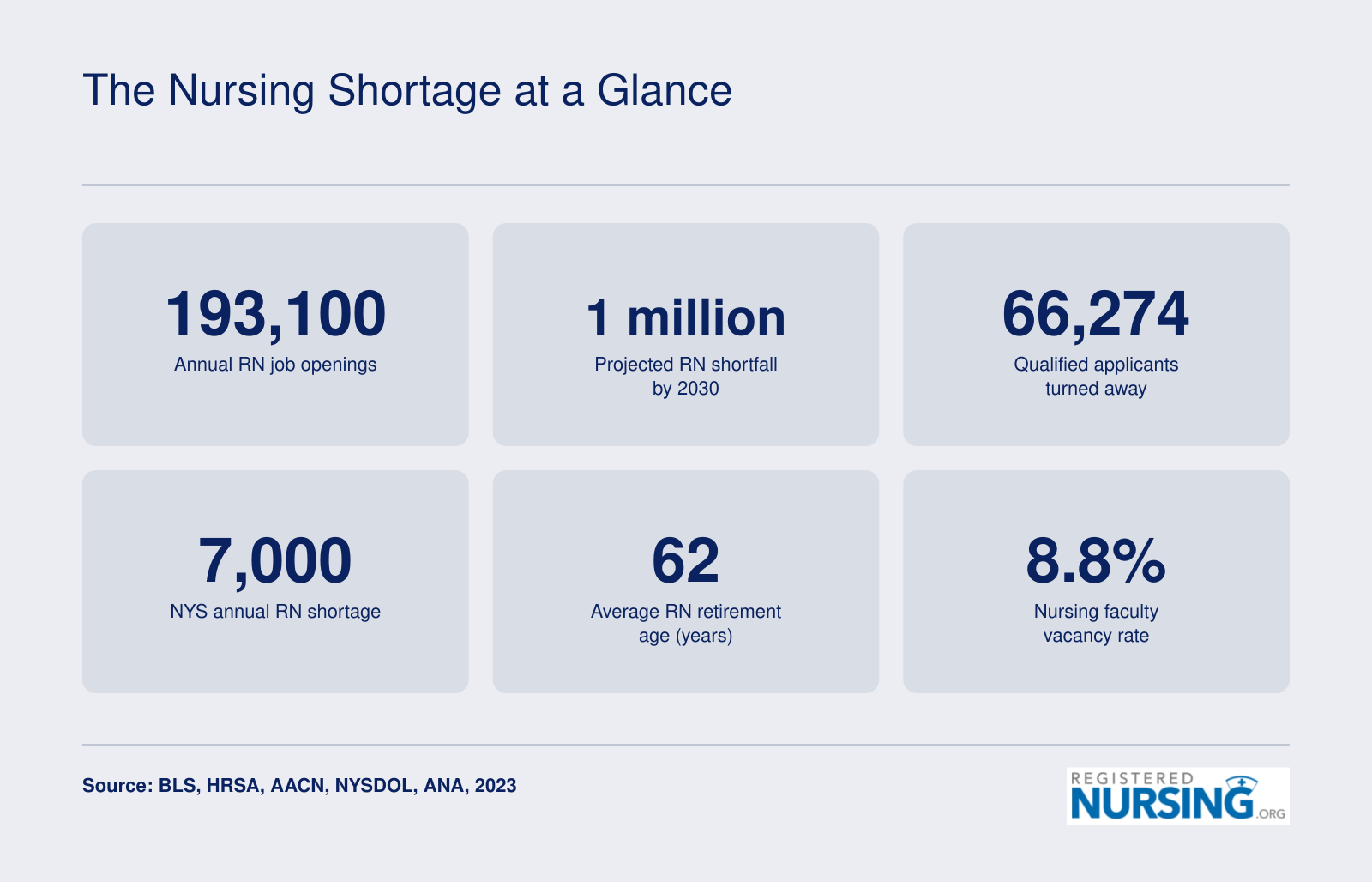
The Nursing Shortage at a Glance
The U.S. healthcare system faces a critical nursing workforce shortage, with demand outpacing supply across the country. These key figures illustrate the scale of the challenge.
What Is a High School to Nursing Pipeline Program?
New York State alone projects more than 17,000 annual nursing openings through 2032, while only about 10,000 new nurses enter the profession each year. This widening gap has accelerated the adoption of high school to nursing pipeline programs: formally structured collaborations that connect secondary students with colleges, universities, and health systems to build a direct route into nursing careers.
What Defines a High School to Nursing Pipeline?
A pipeline program is more than a career-day presentation or a brochure in a guidance office. It is an institutional partnership that embeds nursing-specific coursework, mentored clinical exposure, and academic support into a student's high school experience. Participants may earn dual enrollment credits, gain Certified Nursing Assistant (CNA) or other entry-level credentials, and receive dedicated advising that continues into college. Many programs guarantee admission to partner nursing schools or offer priority consideration, creating a seamless transition from high school to an associate or bachelor's degree program. Understanding which nursing degree to choose early can help students and families set realistic goals from the start.
How Pipeline Programs Differ from General Advice
Generic pre-nursing guidance, such as recommending science prerequisites or volunteering at a hospital, leaves students to navigate the path on their own. A pipeline, by contrast, is backed by signed agreements between schools and employers. It provides a clearly mapped track with milestones, funding for tuition or test prep, and often a stipend or wage for work-based learning. This institutional commitment removes guesswork and lowers barriers for students who might otherwise lack the resources or networks to pursue nursing.
Who Pipeline Programs Serve
Most pipelines target high school juniors and seniors, though some engage freshmen to build interest early. Many are intentionally designed to reach students from underrepresented backgrounds, aiming to strengthen both the size and diversity of the nursing workforce. By meeting students where they are, academically and socioeconomically, these programs help cultivate talent that might otherwise be overlooked.
Types of High School Nursing Pipeline Models Compared
Not every nursing pipeline program looks the same. Across the country, schools and health systems have developed distinct models to bring high school students closer to nursing careers, each with its own structure, intensity, and pathway to licensure.
Dual Enrollment programs allow high schoolers to earn college nursing credits before graduation. Bethune-Cookman University's program in Florida is one example, giving students a head start on prerequisite coursework and reducing the time needed to complete a degree later.1
Early College ADN programs go a step further. Galen College of Nursing in Kentucky has developed a model that lets qualifying high school students begin working toward an Associate Degree in Nursing, potentially compressing the total time to licensure.2 Students interested in this accelerated path may also want to explore accelerated ADN programs available at other institutions.
Simulation-Based Summer Immersion programs offer a concentrated, hands-on introduction to clinical nursing skills. The ADVANCCE/IGNITE program in Texas places students in realistic clinical scenarios over a summer session, building both confidence and competence without requiring school-year commitment.3 These experiences mirror what nursing simulation labs transform in nursing education, giving students a realistic preview of the profession.
Work-Study and Mentorship models, like the NYU Langone partnership with Cristo Rey New York High School, embed students in actual healthcare settings during the school year. Students rotate through clinical and nonclinical roles under the guidance of nursing professionals, with mentorship woven into every placement.4
Pipeline and Exposure programs, such as Temple University's Healthcare Scholars Program in Pennsylvania, focus on broadening access for underrepresented students by pairing academic preparation with healthcare industry exposure and professional networking.5
Each model addresses a different entry point and student need. Together, they represent a growing ecosystem of early pathways designed to build the nursing workforce from the ground up.
Spotlight: NYU Langone and Cristo Rey's Corporate Work-Study Nursing Pipeline
In 2023, NYU Langone Health forged a partnership with Cristo Rey New York High School's Corporate Work Study Program, creating a direct pipeline for high school students into clinical and nonclinical health care roles.1 The collaboration launched with eight students in fall 2024 and expanded to 11 participants in the 2025-2026 academic year. Significantly, two graduating seniors from the current cohort have already committed to nursing programs beginning in fall 2026, demonstrating the pipeline's power to convert early exposure into tangible career commitments.
A Growing Partnership
New York State projects more than 17,000 annual nursing openings between 2022 and 2032, yet only about 10,000 new nurses enter the workforce each year.1 NYU Langone's initiative directly targets this shortfall by immersing high schoolers in a real health care environment. Students attend Cristo Rey's college-preparatory classes four days a week and spend one full day at NYU Langone's Manhattan campus, rotating through departments such as nursing informatics, patient transport, and outpatient clinics.
The Corporate Work Study Model
The Corporate Work Study Program embeds paid, hands-on work experience into the school curriculum. At NYU Langone, students gain exposure to both the art and science of nursing, observing patient interactions, learning medical terminology, and understanding hospital operations. For students weighing how to manage school alongside real-world responsibilities, working while in nursing school offers practical guidance on striking that balance. This model demystifies health care careers and builds the confidence that traditional classroom instruction cannot replicate.
Mentorship and College Readiness
Althea Mighten, EdD, DNP, APRN, senior director of nursing for innovation and inquiry, captures the mentorship philosophy underpinning the program: "You belong here." These three words anchor a culture that actively counters imposter syndrome, especially vital for students from underrepresented backgrounds. With 99% of Cristo Rey New York graduates attending college, the partnership leverages an already strong academic foundation and channels it toward nursing.1 Students considering RN school can look to this model as proof that structured mentorship and early clinical exposure make the path forward far more accessible. The model's early success, paired with that mentorship culture, makes it replicable for health systems nationwide seeking to build diverse, locally rooted nursing workforces.
How Pipeline Programs Address Diversity in Nursing
Why Diversity in Nursing Matters
Research consistently shows that patients have better health outcomes when their caregivers share similar backgrounds and understand their cultural context. Despite this, the nursing workforce does not reflect the communities it serves. Black representation in nursing remains critically low, with Black males making up roughly 2% of registered nurses, while Hispanic and Native American nurses are also significantly underrepresented. Pipeline programs that recruit from high schools in underserved communities are a direct strategy to close these gaps.
Targeting Underrepresented Students
High school nursing pipeline programs intentionally partner with Title I schools, historically Black colleges and universities (HBCUs), and community organizations in disadvantaged neighborhoods. These initiatives provide early exposure to healthcare careers, mentorship, and academic support that students might not otherwise receive. By meeting students where they are, pipeline programs break down barriers to entry, including financial constraints and limited access to advanced science coursework. Understanding barriers to continuing nursing education helps illustrate why early intervention matters so much for underrepresented groups.
A Model for Access: Cristo Rey and NYU Langone
The partnership between NYU Langone Health and Cristo Rey New York High School illustrates how a corporate work-study model can build a diverse nursing pipeline. Cristo Rey serves predominantly low-income students of color, 99% of whom go on to college.1 Through the program, students gain hands-on experience in clinical and nonclinical roles, mentoring, and a clear pathway to nursing. Two graduating seniors from the 2025-2026 cohort plan to enter nursing programs in fall 2026, showing the tangible impact of early recruitment.
Federal and State Support for Diversity Pipelines
Government programs like the Health Resources and Services Administration (HRSA) Nursing Workforce Diversity (NWD) program, authorized under Title VIII of the Public Health Service Act, provide funding specifically to expand nursing education for students from disadvantaged backgrounds.2 In fiscal year 2026, $20 million will support up to 36 awards, with individual grants capped at $555,000 per year across a four-year project period running September 2026 through August 2030.3 Eligible applicants include accredited nursing schools, community-based organizations, faith-based organizations, and tribal entities, with no cost-sharing requirement.3 Pipeline components can include partnerships with primary and secondary schools, high school health academies, dual enrollment, and summer bridge programs.2 These grants require tracking enrollment, retention, graduation, and post-graduation outcomes, ensuring accountability and sustained impact. By investing in these programs, state and federal agencies aim to build a nursing workforce that truly reflects the nation's diversity.
Costs, Funding, and Financial Benefits of Nursing Pipeline Programs
Nursing pipeline programs are rewriting the equation for college affordability, shifting the financial burden away from students before they ever set foot on a college campus. Most programs cost students little or nothing, replacing tuition bills with employer stipends, state subsidies, and dual-enrollment credits that can slash the cost of a nursing degree by five figures.
Why Most Pipeline Programs Cost Little or Nothing
The typical high school pathway into nursing is built around free or dramatically reduced coursework. Career and technical education (CTE) classes are often covered by public school budgets, while dual-enrollment partnerships let students take college-level courses at a fraction of the normal price. Across the country, dual-enrollment nursing credits range from $60 to $250 per credit hour, with many states capping or waiving those fees entirely for qualifying students.1 For example, Missouri State University, West Plains charges just $75 per credit hour for dual-enrollment courses,1 and Virginia Wesleyan University charges $95.2 In Tennessee, the Dual Enrollment Grant covers the full $197 per-credit cost at institutions like Nashville State Community College.3 These figures stand in stark contrast to the per-credit rates at traditional nursing schools: Chamberlain University, a private institution, bills $780 per credit hour for its BSN program.4 Some pipeline models go even further, paying students for clinical exposure. The NYU Langone corporate work-study program, for instance, places high school students in paid hospital roles, letting them earn income while building healthcare skills.
Real Savings: Credits That Compound Before College Starts
Banking college credits in high school generates savings that multiply quickly. A student who completes 15 to 30 dual-enrollment credits can save between $5,000 and $20,000 on tuition, depending on the state and the eventual nursing program. A national survey of nursing pipeline programs reported median total savings of $3,000 to $10,000 per student, with the higher end achieved by those who entered a BSN program with a full semester's worth of transfer credits. Since a traditional BSN degree runs between $40,000 and $100,000 in total tuition and fees, arriving with even a single semester of credits eliminates thousands of dollars and shortens the path to licensure. Understanding what credits transfer to RN to BSN programs can help students plan this strategy effectively. For students who pursue an associate degree in nursing (ADN), where total program costs average $23,900 to $66,320, the relative savings are just as meaningful, often making the difference between graduating debt-free or carrying loans.
Who Pays? Funding Sources for Pipeline Initiatives
These programs do not fund themselves. A mix of federal, state, and private dollars supports the high school nursing pipeline:
- Perkins V grants: Federal funding allocated to states for CTE programs covers equipment, curriculum, and teacher training for health science pathways.
- State dual-enrollment subsidies: Many states, like Tennessee, directly pay tuition for high school students taking college courses, removing cost as a barrier.
- Hospital system sponsorships: Health systems such as NYU Langone fund internal work-study slots, paying student wages and mentoring costs as a long-term recruitment investment.
- HRSA grants: The Health Resources and Services Administration awards workforce development grants that target underserved communities, often funding pipeline partnerships between schools and healthcare employers.
- Pell Grant eligibility: Although less common, some dual-enrolled students qualify for federal Pell Grants if they are enrolled in an eligible postsecondary program, further defraying expenses.
- Local scholarships: Targeted grants like Illinois' Will County HEROES Grant and AIM HIGH Scholarship each provide up to $7,500 toward healthcare education for qualifying high school graduates.7
A Financial Comparison: Traditional Path vs. Pipeline Entry
A student who enters a BSN program with no prior credits will pay the full sticker price for all 120-plus credit hours. At an average in-state public university rate of $500 per credit, that adds up to $60,000. Now compare a pipeline student who earns 20 dual-enrollment credits at $100 per credit: $2,000 spent in high school, then 100 remaining credits at $500 each, for a total of $52,000. The $8,000 difference does not include the time saved, which allows earlier entry into the workforce and sooner earning potential. For students weighing degree options, the traditional BSN vs. accelerated BSN comparison is worth reviewing to see which path best fits their timeline. For students who take advantage of free CTE courses or zero-cost dual enrollment, the savings climb higher. And because many pipeline programs target students from underrepresented backgrounds, these financial advantages directly support broader goals of building a more diverse and economically accessible nursing workforce.
How to Find and Apply to a Nursing Pipeline Program
Finding a high school nursing pipeline program requires more than a simple web search; students and families must know where to look and what separates a rigorous pathway from a superficial one.
Where to Search for Pipeline Programs
Start with your state's Career and Technical Education (CTE) directory, which lists approved health science pathways and dual-enrollment opportunities. Contact community college dual-enrollment offices directly; they often coordinate with local high schools and hospitals but may not heavily advertise nursing-specific tracks. Hospital human resources departments can be a goldmine, especially at major health systems, which may run youth volunteer, internship, or formal pipeline initiatives even if they lack a dedicated website. Finally, search the Health Resources and Services Administration (HRSA) grant database for federally funded pipeline projects in your region; many target underserved communities and include nursing career exposure.
What to Look for in a Quality Program
A strong pipeline program goes beyond after-school shadowing. Evaluate options by these criteria: - College credit transferability: Verify that any dual-enrollment credits align with nursing prerequisites at your intended BSN nursing programs. Not all credits transfer, and nursing schools have strict science course specifications. - Substantial clinical exposure: The program should include hands-on activities like simulation lab practice, patient interaction under supervision, or rotations across different units, not just classroom instruction. - Structured mentorship: Look for assigned nurse mentors who meet with students regularly, not occasional guest speakers. This personal connection is crucial for retention and professional identity. - Clear articulation agreements: Strong programs have formal partnerships with BSN-granting institutions, ensuring a smooth transition from high school to college nursing tracks, sometimes with guaranteed admission or priority status.
Understanding Typical Eligibility Requirements
Most programs set a minimum GPA between 2.5 and 3.0, though competitive ones may expect higher. Prerequisite coursework often includes biology, chemistry, and Algebra II completed by the start of the program. Application timelines vary, but many open in the spring of sophomore or junior year, with selections made for the following academic year. Some require letters of recommendation and a personal statement demonstrating commitment to nursing.
High School Courses That Strengthen Your Application
Even if you do not yet have access to a formal pipeline, these classes build a competitive foundation for any nursing pathway: - AP Biology or dual-enrollment anatomy and physiology - Chemistry (a common nursing school prerequisite) - Statistics (increasingly preferred over calculus for nursing) - Psychology or sociology (for understanding patient behavior) - Health science electives, if available, to explore healthcare terminology and basic skills. Students who want a head start on the financial side of training can also review CNA classes cost and certification to understand entry-level healthcare education expenses.
Risks, Tradeoffs, and What to Consider Before Enrolling
Most resources highlight the promise of high school nursing pipelines, but few address the real-world tradeoffs. Being honest about both the benefits and the drawbacks helps you decide whether this path fits your goals and life.
- Tuition savings through dual enrollment or sponsored coursework can meaningfully reduce the cost of a nursing degree.
- Early clinical exposure lets you test your interest in nursing before committing to years of higher education.
- Mentorship and a professional network built during high school strengthen your BSN application and career foundation.
- A structured pathway often accelerates prerequisites, giving you a head start on nursing school admission.
- Juggling a demanding program alongside regular high school classes can increase stress and risk of burnout.
- Not all dual-enrollment credits transfer to every BSN program, which may limit your college choices later.
- Locking into a career track early leaves less room to explore other interests that might emerge in college.
- The intensive schedule often means missing out on typical high school activities and social experiences.
Frequently Asked Questions About High School Nursing Pipeline Programs
These frequently asked questions address how high school students can start building a nursing career and how early pipeline programs are reshaping the future of the profession. Use this guide to explore practical steps, program options, and the impact of such initiatives.
- What can I do in high school to prepare to be a nurse?
- To prepare for a nursing career, focus on science and math courses like biology and chemistry. Volunteer at hospitals or clinics to gain experience, and join health-focused clubs. Look for pipeline programs that offer mentorship or clinical exposure. Shadowing a nurse can provide valuable insight into the profession.
- Can you get into a nursing program right after high school?
- Yes, many colleges offer direct-entry BSN degree programs for recent high school graduates, and community colleges have open-enrollment ADN programs. You'll need strong grades in prerequisite courses. Some pipeline programs with dual enrollment let you earn college credits while in high school, smoothing the transition.
- What classes should I take in high school if I want to go into nursing?
- Take biology, chemistry, and anatomy if offered. Math (algebra and statistics) is important for medication calculations. English and communication courses sharpen the skills needed for patient interaction. Advanced Placement or dual-enrollment science courses can give you a head start on college prerequisites.
- What is a nursing pipeline program and how does it work?
- A nursing pipeline program creates a structured pathway from high school to nursing school. It may include dual enrollment, clinical exposure, mentorship, or work-study. For example, NYU Langone's partnership with Cristo Rey High School places students in hospital roles, giving them hands-on experience and a direct link to nursing education.
- How do nursing pipeline programs help with the nursing shortage?
- Pipeline programs expand the nursing workforce by attracting students early and nurturing their interest. With New York alone projecting over 17,000 annual openings but only 10,000 new nurses entering each year, these initiatives build a reliable, homegrown talent pool that can close the gap and reduce future shortages.
- Are there nursing pipeline programs that focus on diversity and underrepresented students?
- Yes, many pipeline programs specifically target underrepresented students to diversify the nursing workforce. NYU Langone's work with Cristo Rey, a school serving diverse, low-income students, illustrates this approach well. The effort aligns with broader conversations about promoting diversity and inclusion in nursing schools, and Dr. Althea Mighten reinforces that message directly: "You belong here."
- Do dual-enrollment nursing credits transfer to all BSN programs?
- Not automatically. Transferability depends on whether your high school's dual-enrollment partner has an articulation agreement with the BSN program you later attend. It's worth reviewing what courses and credits can transfer to an RN to BSN or MSN bridge program to understand how articulation agreements generally work. Always confirm with the college's admissions office before enrolling in any dual-enrollment courses.