

What you’ll learn in this article…
- DNP programs require 1,000 total supervised clinical hours to graduate.
- Tuition ranges from roughly $20,000 to over $100,000 depending on the school.
- Nurse practitioners with a DNP earn a median salary near $130,000 annually.
The Doctor of Nursing Practice (DNP) is the terminal clinical degree in nursing, endorsed by the American Association of Colleges of Nursing since 2004 as the preferred preparation for advanced practice roles. It differs sharply from a PhD in Nursing, which trains researchers and academic scientists. A DNP trains expert clinicians, health-system leaders, and policy influencers.
That clinical-versus-research split shapes every downstream decision: admissions requirements, clinical hour minimums, program length, tuition, and the roles you can hold after graduation. Post-BSN programs typically run three to four years and require at least 1,000 supervised clinical hours, while post-MSN pathways compress that timeline considerably. The credential now sits at the center of a growing debate over what preparation advanced practice nursing should require, and why the DNP degree is becoming essential to that conversation. Nurses weighing the executive side of the profession may also want to explore DNP executive leadership programs as a focused starting point.
DNP Degree Requirements: Admissions, Clinical Hours, and Curriculum
Doctor of Nursing Practice programs combine academic rigor with extensive clinical training, requiring applicants to meet baseline credentials before matriculation and complete a structured curriculum anchored by evidence-based practice and clinical immersion.
Admissions Criteria
Most DNP programs require an active, unencumbered registered nurse license issued by a state board of nursing. Applicants typically must hold a Bachelor of Science in Nursing or Master of Science in Nursing from an accredited institution, with a cumulative GPA of 3.0 to 3.5 on a 4.0 scale.1 Schools also consider clinical experience, often preferring candidates with one to three years of direct patient care or specialty nursing practice. A personal statement articulating professional goals, leadership experience, and the rationale for doctoral study is a standard component of the application portfolio. Some programs require letters of recommendation from nurse leaders or faculty who can speak to the applicant's clinical competence and scholarly potential. Graduate Record Examination scores are less common in nursing admissions but may be requested by select institutions.
Clinical Hour Standards
The American Association of Colleges of Nursing recommends 1,000 post-baccalaureate clinical hours for DNP graduates,2 a benchmark adopted by the Commission on Collegiate Nursing Education and the Accreditation Commission for Education in Nursing for Advanced Practice Registered Nurse programs. Non-APRN tracks such as nurse executive or health systems leadership typically require 500 hours under ACEN standards,2 though individual programs may exceed this floor. Students entering with an MSN often carry forward hours from their master's clinical training, so BSN-to-DNP and MSN-to-DNP pathways differ in the number of additional clinical hours required during doctoral coursework.
Specialty tracks vary in total clinical immersion. Family Nurse Practitioner tracks generally require 1,000 to 1,260 hours,2 while Certified Registered Nurse Anesthetist programs mandate approximately 2,000 hours to meet anesthesia certification body standards.3 Psychiatric-Mental Health Nurse Practitioner tracks mirror the FNP range at 1,000 to 1,260 hours.4 Nurse executive concentrations require 500 to 1,088 hours, depending on whether the curriculum emphasizes direct care or administrative competencies.5 These totals reflect the cumulative post-baccalaureate clinical experience, not hours specific to the doctoral capstone project.
Curriculum Components
DNP curricula blend advanced clinical science with population health, policy, and leadership coursework. Core didactic topics typically include advanced pathophysiology, advanced pharmacology, and advanced health assessment, particularly in APRN tracks. Additional courses cover health policy and advocacy, population health management, evidence-based practice and research translation, health informatics and data analytics, and organizational leadership and quality improvement. These components align with the competency domains outlined in the AACN Essentials Framework,1 preparing graduates to lead practice change in clinical and administrative settings. Exploring best Doctor of Nursing Practice programs can help prospective students compare how individual schools structure these requirements.
The DNP Scholarly Project
In place of a traditional dissertation, DNP students complete a scholarly project that addresses a real-world practice problem through evidence synthesis and implementation science. The project applies existing research to improve clinical outcomes, enhance care delivery processes, or inform health policy. Faculty expect a rigorous needs assessment, intervention design, evaluation plan, and dissemination strategy, but the focus remains on translating evidence rather than generating new knowledge through original research. This distinction separates the DNP capstone from the PhD dissertation, which tests hypotheses and contributes original findings to the scientific literature. Choosing the right focus is an early priority, and resources on how to choose the perfect RN capstone project offer practical guidance for navigating that decision. The scholarly project culminates in a final defense and often yields presentations at professional conferences or publications in practice journals.
How Long Does a DNP Take? Program Pathways and Formats
How many years does a DNP degree actually take? The timeline depends on your starting point, whether you hold a BSN or an MSN, and whether you study full-time or part-time. Most programs also offer flexible formats to help working nurses manage clinical hours alongside coursework.
Typical Timelines by Entry Pathway
- BSN-to-DNP (full-time): 3 to 4 years (roughly 36, 48 months). This is the most common route for nurses entering directly from a bachelor's degree.1
- BSN-to-DNP (part-time): 4 to 7 years (48, 84 months), allowing you to continue working while progressing at a slower pace.1
- MSN-to-DNP (full-time): Usually 1 to 2 years (12, 24 months). If your MSN is in an advanced practice specialty, the program often requires 36, 42 credits and can be completed in as few as three to four semesters.2
- MSN-to-DNP (part-time): 2 to 4 years (24, 48 months), with flexibility for employed nurses in leadership or clinical roles.1
Exact durations vary by institution. For instance, Maryville University's BSN-to-DNP full-time track spans 3 to 4 years, while Herzing University offers an accelerated BSN-to-DNP completing in 28, 32 months.2 MSN-to-DNP leadership tracks frequently finish in 12, 18 months, while clinical MSN-to-DNP concentrations may take up to 24 months.2
Part-Time and Accelerated Options
Many schools structure cohorts to accommodate the schedules of working nurses. Part-time plans extend the timeline but allow you to maintain income. Accelerated or executive-style programs compress coursework into intensive blocks or year-round study. For example, Delta State University's RN-to-DNP pathway is designed to be completed in 4 years, and its BSN-to-DNP in 3 years.4 The University of St. Augustine's DNP-FNP full-time program takes about 40 months.5 Nurses exploring accelerated MSN programs before a DNP may also find that a direct-entry route shortens overall time to doctoral completion.
Be aware that part-time DNP students often take 6, 8 credits per term, while full-time loads range from 9 to 12 credits. That difference directly impacts total time to degree.
Online, Hybrid, and On-Campus Formats
Because all DNP programs require a significant number of clinical practice hours (typically 1,000 post-baccalaureate hours), most schools use a hybrid model. Coursework is delivered online, while clinical rotations are arranged in your local community. Fully on-campus DNP programs are rare; fully online programs exist but still require in-person clinical placements. The hybrid approach gives you geographic flexibility without compromising hands-on training.
An important note for working nurses: online versus on-campus graduates have comparable certification pass rates and employment outcomes. Employers focus on your credential and clinical competence, not on the delivery method of your classes. Nurses in states like Georgia or California will find both hybrid and fully online options available through accredited institutions.
Outcomes Across Formats
Data from recent years (2020, 2026) confirm that DNP graduates from online, hybrid, and on-campus programs achieve similar success on national certification exams and in job placement.3 What matters most is program accreditation and your clinical experience, not whether lectures were delivered in person. So when choosing a format, prioritize a schedule that fits your life, knowing that employer expectations remain consistent.
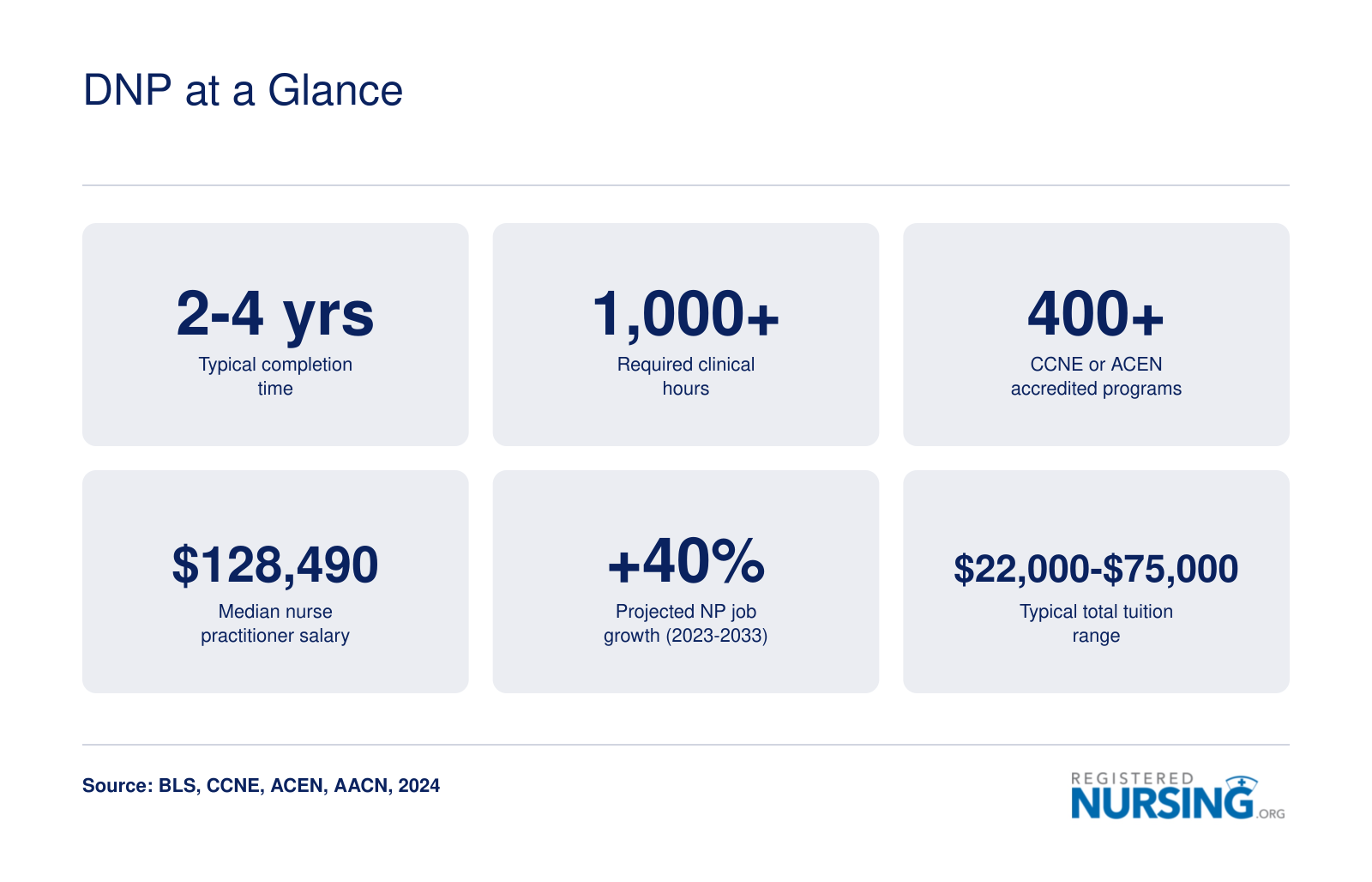
DNP at a Glance
Before exploring the details, here are the headline numbers that define the Doctor of Nursing Practice pathway. These figures offer a quick snapshot of what to expect in terms of time, cost, clinical requirements, and career outcomes.
How Much Does a DNP Cost?
The cost of a DNP degree is the total you pay in tuition, fees, and related expenses to earn the highest practice-focused doctorate in nursing. That number varies widely depending on the school, the program pathway, and the format you choose, so pinning down a single figure without looking at specific programs is not realistic or helpful.
What Drives Cost Differences
Several factors push DNP tuition up or down from one program to the next.
- Pathway: A BSN-to-DNP program covers more total credits than an MSN-to-DNP program, which typically means a higher overall cost for students entering with a bachelor's degree.
- School type: Public universities generally charge lower tuition, especially for in-state residents, while private institutions often set higher per-credit rates regardless of residency.
- Format: Online and hybrid programs can reduce indirect costs like commuting and relocation, though tuition per credit hour is not always lower than on-campus equivalents. Some schools charge identical rates across formats.
- Specialization: Certain tracks, particularly those requiring specialized simulation labs or intensified clinical supervision, may carry additional fees beyond standard tuition.
Because these variables interact in different ways at every institution, cost comparisons require looking at each school individually rather than relying on a single national average. Browsing DNP programs in Michigan or DNP programs in Virginia, for example, quickly illustrates how tuition structures differ across public and private institutions in different states.
Where to Find Reliable Cost Information
The most accurate source for any DNP program's cost is the university itself. Tuition and fee schedules on official school websites are updated regularly and reflect current rates. When you review them, look for the per-credit-hour rate, the total required credits for your pathway, and any mandatory fees that are charged each semester regardless of enrollment level.
The American Association of Colleges of Nursing (AACN) maintains a searchable database called "Find Your Program" that lets you identify accredited DNP programs by specialty and location. Once you have a list of programs that interest you, the next step is visiting each school's official tuition page directly.
If the published figures are unclear or seem outdated, contact the nursing school's admissions office. Admissions staff can confirm current tuition, explain fee structures, and walk you through available financial aid, scholarships, and employer tuition reimbursement options that could meaningfully reduce your out-of-pocket cost.
Putting Cost in Context
For general context on how education investment relates to nursing career earnings, the Bureau of Labor Statistics (BLS.gov) publishes occupational data that can help you think through the long-term picture. DNP-prepared nurses tend to qualify for advanced practice and leadership roles that carry higher earning potential than entry-level positions, though specific salary outcomes depend on specialty, setting, and geography.
Approaching cost research the same way you would approach any clinical decision, by going to primary sources and verifying the information directly, will give you the clearest picture of what a DNP will actually cost you.
Before you calculate the return on a DNP, factor in what you won't actually pay. Many hospital systems now offer tuition reimbursement for nurses pursuing doctoral degrees, and federal programs like the National Health Service Corps and Public Service Loan Forgiveness can dramatically reduce out-of-pocket costs for nurses working in qualifying settings.
DNP Specializations and Career Paths
The central tension most nurses face here is not whether a DNP adds value, but which specialty track aligns with their clinical interests, lifestyle, and long-term ambitions. The degree itself is a framework; what you build inside it shapes every career outcome that follows.
Clinical Specialty Tracks
Most DNP students enter through a nurse practitioner track, and the options are broad:
- Family Nurse Practitioner (FNP): The most common entry point, preparing graduates for primary care across the lifespan in clinics, community health centers, and private practice.
- Certified Registered Nurse Anesthetist (CRNA): As of 2025, all new CRNAs must complete a doctoral-level program, making the DNP the standard credential for anesthesia practice.
- Psychiatric-Mental Health Nurse Practitioner (PMHNP): Addresses the growing shortage of behavioral health providers, with practice ranging from outpatient therapy to inpatient psychiatric units.
- Adult-Gerontology NP (AGNP): Focuses on adult and older adult populations, with acute and primary care concentrations available.
- Neonatal Nurse Practitioner (NNP): Specializes in the care of critically ill newborns in neonatal intensive care settings.
- Clinical Nurse Specialist (CNS): A distinct advanced practice role focused on improving care systems, educating staff, and driving quality outcomes at the unit or organizational level.
Is a DNP Higher Than an NP?
This question comes up often, and the short answer is: a DNP is a degree, while NP is a role. You do not need a DNP to practice as an NP today. Most currently practicing NPs hold a master's degree and deliver excellent, autonomous care. What the DNP adds is depth in systems thinking, evidence translation, leadership, and organizational management. Those layers tend to expand scope in practical terms, open doors to executive roles, and increase nurse practitioner earning potential over a career arc.
Leadership and Emerging Tracks
Not every DNP graduate moves into direct patient care. Nurse executive and health systems leadership tracks prepare graduates to step into roles historically filled by MBAs and MHAs, bringing clinical credibility to boardroom decisions. Nurse educator tracks produce faculty who can shape the next generation of practitioners.
Emerging specialty areas are also growing quickly. Emerging nursing specialties in informatics, public health, and health policy reflect the profession's expanding influence beyond the bedside. DNP-prepared nurses in these tracks are increasingly shaping electronic health record implementation, community health strategy, and state and federal policy development, areas where clinical context is a competitive advantage that no business degree can replicate. For nurses still weighing specialty direction, reviewing career paths for advancing nurses can help clarify which advanced practice track best fits your goals.
DNP Salary by Role and State
Earning a DNP opens the door to some of the highest-paying roles in nursing. The table below compares national salary benchmarks for common DNP-level positions alongside registered nurses for context. According to Bureau of Labor Statistics projections, nurse practitioner employment alone is expected to grow 40.1% between 2024 and 2034, adding roughly 128,400 new positions. Medical and health services managers, another popular pathway for DNP graduates, are projected to grow 23.2% over the same period, with approximately 142,900 new jobs anticipated.
| Role | National Median Salary | 25th Percentile | 75th Percentile | Total Employment |
|---|---|---|---|---|
| Nurse Practitioners | $129,210 | $109,940 | $149,570 | 307,390 |
| Medical and Health Services Managers | $117,960 | $88,560 | $162,420 | 565,840 |
| Nursing Instructors and Teachers (Postsecondary) | $79,940 | $62,210 | $102,020 | 74,250 |
| Registered Nurses | $93,600 | $78,610 | $107,960 | 3,282,010 |
Questions to Ask Yourself
DNP Vs. PHD Vs. Other Nursing Doctorates
The degree you choose shapes your daily work, earning potential, and professional identity for decades. Understanding the distinctions between a Doctor of Nursing Practice, a PhD in Nursing, and an EdD in Nursing helps you invest your time and tuition in the credential that matches your career vision.
Practice vs. Research vs. Education
Each doctoral pathway serves a different purpose within the profession. The DNP is practice-focused, preparing graduates for advanced practice registered nurse roles where patient care remains central. Nurse practitioners, nurse anesthetists, nurse midwives, and clinical nurse specialists typically pursue this route because it emphasizes clinical expertise, systems leadership, and evidence-based quality improvement.1
The PhD in Nursing is research-focused. Graduates generate new knowledge through original studies, often working in academic or research institutions rather than at the bedside. Patient care involvement tends to be low to moderate because the role centers on designing studies, securing grants, and publishing findings that other clinicians apply.1
The EdD in Nursing is education-focused. This doctorate suits nurses who want to lead nursing programs, develop curricula, or shape policy within academic settings. Patient care involvement varies depending on whether the graduate maintains a clinical practice alongside teaching responsibilities.1
Where Each Degree Leads
Employers increasingly prefer the DNP for advanced practice roles in hospitals, clinics, and specialty practices. According to the American Association of Colleges of Nursing, DNP enrollment continues to outpace PhD enrollment as the profession moves toward practice doctorates for clinical leadership.2
PhD holders typically land positions in universities, research centers, or governmental agencies focused on health policy. Their salaries often reflect academic pay scales, which can differ from clinical compensation.
EdD graduates gravitate toward nursing education administration, faculty roles, or curriculum development. Because nursing schools face faculty shortages, demand for doctorally prepared educators remains strong.
Salary and Employment Considerations
The Bureau of Labor Statistics reports that nurse practitioners, many of whom now hold DNPs, earn median salaries above $125,000 annually with job growth projected well above average. For a closer look at how compensation breaks down by specialty and state, reviewing DNP salary by specialty provides useful context. PhD-prepared nurse researchers and EdD-prepared educators often earn competitive academic salaries, though clinical roles may offer higher base pay depending on specialty and region. Specialty-specific surveys published in nursing journals show that APRNs in acute care or anesthesia subspecialties command premium compensation.
Choosing the Right Path
If direct patient care energizes you, the DNP aligns with your goals. If generating new evidence through rigorous research excites you, the PhD offers that foundation. If shaping the next generation of nurses is your calling, the EdD prepares you for academic leadership. Nurses drawn to organizational influence may also find that a chief nursing officer role sits naturally at the end of a DNP track. Each doctorate holds value; the right choice depends on how you want to spend your career.
DNP Accreditation: Why It Matters
Accreditation is the single most important credential a DNP program can hold, and it is worth understanding before you compare curricula, cost, or format. A program that lacks recognized accreditation can quietly foreclose your entire career plan: no certification exam, no APRN license, no federal loans.
The Two Accrediting Bodies
Two national bodies review U.S. nursing programs at the graduate level, and most DNP programs hold one of them.
- CCNE (Commission on Collegiate Nursing Education): An autonomous arm of the American Association of Colleges of Nursing, CCNE accredits baccalaureate, graduate, and post-graduate APRN residency programs. It evaluates mission and governance, institutional commitment, curriculum quality, and program effectiveness. CCNE accredits only degree programs at four-year colleges and universities.
- ACEN (Accreditation Commission for Education in Nursing): ACEN accredits nursing programs at every level, from practical nursing through the clinical doctorate. Its standards cover mission, faculty, students, curriculum, resources, and outcomes. Because ACEN reviews the full ladder, it is often found at institutions that also run associate or diploma programs.
Both are recognized by the U.S. Department of Education and the Council for Higher Education Accreditation. Either is acceptable for a DNP; the practical difference is institutional fit rather than prestige.
Why It Determines Your License and Loans
Graduating from a non-accredited DNP program can disqualify you from sitting for national certification through the ANCC or the AANP Certification Board, and state boards of nursing generally require certification from an accredited program before granting APRN licensure.1 The financial stakes are just as concrete: federal Title IV student loans, most state grants, employer tuition benefits, and nearly every private scholarship require enrollment in an accredited program.
The DNP-as-Entry-to-Practice Question
The AACN first proposed in 2004 that the DNP become the entry-level degree for advanced practice by 2015.2 That target came and went. As of 2026, the DNP remains the preferred, not required, terminal degree for APRNs.3 NONPF has recommended the DNP as the entry point for nurse practitioners, but neither the NCSBN nor any state board has adopted a DNP mandate for licensure, and both the ANCC and AANP still certify MSN-prepared NPs.1 The AACN itself now describes the timeline as aspirational and continues to support both MSN and DNP pathways.3 For prospective students in 2026, that means an accredited MSN remains a valid route into APRN practice, while the DNP is increasingly positioned as the long-term standard. If you are weighing your options, reviewing DNP programs in Illinois or DNP programs in North Carolina can help you compare accredited programs across different institution types.
Before enrolling, verify your program's accreditation status on the CCNE or ACEN directory. This single step protects your certification eligibility and financial aid: it is the most important checkbox you will check.
Frequently Asked Questions About DNP Degrees
Choosing to pursue a Doctor of Nursing Practice is a significant decision, and it is natural to have questions about the degree's purpose, timeline, and career impact. Below are answers to the most common questions prospective DNP students ask.
- What is the purpose of a DNP degree?
- The DNP is a practice-focused doctoral degree designed to prepare nurses for the highest level of clinical practice, leadership, and systems improvement. Unlike research-focused doctorates, the DNP emphasizes translating evidence into practice, improving patient outcomes, and shaping healthcare policy. It equips graduates to lead interdisciplinary teams, design quality initiatives, and serve in advanced practice or executive roles across diverse healthcare settings.
- Is a DNP higher than a nurse practitioner?
- A DNP is a degree, while nurse practitioner (NP) is a role. Many NPs hold a master's degree, so earning a DNP represents a higher level of education. However, a DNP is not required to practice as an NP in most states. The DNP builds on NP training by adding depth in evidence-based practice, organizational leadership, and health systems management, positioning graduates for broader influence in clinical and administrative arenas.
- Is a DNP the same as a PhD in nursing?
- No. The DNP is a clinical practice doctorate focused on applying research to improve patient care, quality, and health systems. A PhD in nursing is a research doctorate that prepares scholars to generate new knowledge through original research and teach at the university level. DNP students typically complete a scholarly project addressing a real-world clinical problem, whereas PhD students produce a traditional dissertation contributing to nursing science.
- How long does it take to get a DNP degree?
- Timelines vary by entry point and enrollment status. BSN to DNP programs generally take three to four years of full-time study. Post-master's DNP programs are shorter, typically requiring one to two years. Part-time options can extend the timeline by a year or more. Clinical hour requirements, which often total 1,000 supervised practice hours across the program, are a key factor influencing overall program length.
- What can you do with a DNP degree?
- A DNP opens doors to advanced clinical roles such as family nurse practitioner, certified nurse midwife, or nurse anesthetist, as well as leadership positions including clinical director and health policy advisor. Graduates also pursue roles in healthcare consulting, academic faculty positions, and population health management. The degree is versatile, supporting careers in hospitals, private practices, public health agencies, and academic institutions.
- Do you need a DNP to practice as a nurse practitioner?
- Currently, a DNP is not required to practice as a nurse practitioner in any U.S. state. A master's degree (MSN) with NP specialization meets licensure requirements. However, nursing organizations have long recommended transitioning the entry level for advanced practice to the doctoral level. Some employers increasingly prefer or incentivize the DNP. Checking your state's specific requirements and employer expectations is always a smart step before choosing a program. You can browse DNP programs in California or other states to compare what accredited options are available near you.
- Can you get a DNP online?
- Yes. Many accredited universities offer DNP programs in an online or hybrid format, making the degree accessible to working nurses. Online programs deliver coursework through virtual platforms, while clinical hours are typically completed in person at approved practice sites near the student's location. When evaluating online options, confirm that the program holds accreditation from the CCNE or ACEN to ensure the degree meets professional and employer standards.
Best DNP Programs by State
- Alabama
- Alaska
- Arizona
- Arkansas
- California
- Colorado
- Connecticut
- Delaware
- Florida
- Georgia
- Hawaii
- Idaho
- Illinois
- Indiana
- Iowa
- Kansas
- Kentucky
- Louisiana
- Maine
- Maryland
- Massachusetts
- Michigan
- Minnesota
- Mississippi
- Missouri
- Montana
- Nebraska
- Nevada
- New Hampshire
- New Jersey
- New Mexico
- New York
- North Carolina
- North Dakota
- Ohio
- Oklahoma
- Oregon
- Pennsylvania
- Rhode Island
- South Carolina
- South Dakota
- Tennessee
- Texas
- Utah
- Vermont
- Virginia
- Washington
- Washington DC
- West Virginia
- Wisconsin
- Wyoming