

What you’ll learn in this article…
- Most nurse executive roles require an MSN or higher plus 10 to 15 years of experience.
- ANCC offers two credentials: the NE-BC and the advanced NEA-BC certification.
- Top metro areas pay medical and health services managers well above six figures annually.
Nurse executives occupy the most senior nursing leadership positions in hospitals and healthcare systems, with total compensation often exceeding $150,000 and reaching well above $200,000 in large urban markets. These leaders shape organizational policy, manage multimillion-dollar budgets, and drive patient-care quality at the system level. Titles such as Chief Nursing Officer (CNO), Vice President of Nursing, and Chief Nurse Executive all describe variations of this role, and the specific designation depends on the organization's structure and scope.
Reaching a nurse executive position typically requires a decade or more of progressive clinical and leadership experience, plus a graduate degree in nursing administration, healthcare administration, or business. Most CNOs also hold national certification and have demonstrated success in roles such as nurse leader or CNL, director, or vice president before advancing to the executive suite.
The practical tension facing aspiring nurse executives centers on education choice: whether to pursue an MSN in nursing leadership, an MHA, an MBA, or a DNP, and how certifications such as NE-BC and NEA-BC influence hiring and compensation. Market demand remains strong, but the pathway requires sustained investment in both clinical credibility and business competency.
What Does a Nurse Executive Do?
A nurse executive serves as the most senior nursing leader within a healthcare organization, guiding clinical practice, shaping policy, and aligning nursing operations with the system's strategic goals. The role blends clinical expertise with business acumen to drive quality, safety, and financial performance. Below, we break down the responsibilities into three core areas, map them to formal leadership competencies, and explore how the role adapts to different care settings.
Three Pillars of Responsibility
- Strategic Leadership: Nurse executives set system-wide policy, lead quality improvement initiatives, and ensure regulatory compliance. They translate organizational vision into actionable nursing strategies, often overseeing accreditation readiness and performance metrics.
- Operational Management: This pillar covers staffing models, budgeting, resource allocation, and interdepartmental coordination. Executives balance patient acuity, workforce capacity, and fiscal constraints to maintain efficient daily operations.
- Clinical Governance: Focusing on patient safety and care standards, they champion evidence-based practice adoption, monitor sentinel events, and hold teams accountable to clinical outcomes. They bridge the gap between bedside reality and boardroom decisions.
The AONL Competency Framework in Action
The American Organization for Nursing Leadership (AONL) defines five competency domains for nurse executives, revised most recently in 2022.1 These domains provide a structured lens for understanding the role:
- Communication and Relationship Building: Fostering collaboration across disciplines and building trust with stakeholders, from frontline nurses to community partners.
- Knowledge of the Healthcare Environment: Understanding reimbursement models, health policy, population health trends, and emerging technologies that shape care delivery.
- Leadership: Inspiring a shared vision, cultivating the next generation of nurse manager role candidates and senior leaders, and modeling ethical, inclusive behavior.
- Professionalism: Upholding standards of practice, advocating for the profession, and committing to lifelong learning.
- Business Skills: Mastering financial management, strategic planning, and data analytics to drive operational excellence.
Daily work weaves through all five domains. For instance, launching a fall-prevention program requires relationship building, clinical knowledge, business justification, and leadership to gain buy-in.
How the Role Varies by Setting
- Hospital Systems: A Chief Nursing Officer (CNO) often oversees multi-facility standardization of nursing practice, aligns policies across campuses, and manages large-scale workforce pipelines. The focus is on throughput, quality metrics, and system integration.
- Outpatient and Ambulatory Settings: Nurse executives here may prioritize population health, care coordination, and community partnerships. They often work closely with accountable care organizations and managed care nursing contracts.
- Long-Term Care and Rehabilitation: Leaders navigate state and federal regulations for chronic care, manage interdisciplinary teams, and emphasize patient-centered quality of life alongside clinical outcomes. A strong grasp of long term care nurse practice is foundational in this setting.
Reporting Structure and Organizational Influence
Nurse executives typically report directly to the Chief Executive Officer (CEO) or Chief Operating Officer (COO), and they hold a seat at the C-suite table. In this capacity, they represent nursing's perspective in board-level decisions, advocate for resources, and serve as a visible role model for clinical staff. Their influence extends beyond nursing departments to shape organizational culture, patient experience strategies, and community health initiatives. When strategic planning occurs, the nurse executive ensures that the patient care lens remains central to all discussions about growth, cost management, and service line development.
Nurse Executive Vs. Nurse Administrator Vs. Nurse Manager
Where does a nurse executive fit compared to a nurse administrator or nurse manager, and are these titles actually different roles or just different words for the same job? The short answer: they sit at three distinct levels of leadership, each with its own scope, focus, and reporting line, even though the educational floor for all three is typically a Master of Science in Nursing.2
Scope of Practice
The cleanest way to separate these titles is by the size of the sandbox each leader plays in.
- Nurse Manager: Runs a single unit or clinical area, such as a medical-surgical floor, an ICU, or a labor and delivery unit. This is unit-level operational leadership: staffing the schedule, coaching bedside nurses, and keeping day-to-day patient care running.
- Nurse Administrator: Oversees a department or an entire facility. Administrators supervise multiple nurse managers and translate organizational goals into departmental operations.
- Nurse Executive: Leads nursing across the whole organization or health system. Titles like chief nursing officer or chief nurse executive fall here. The work is strategic: policy, budgets, workforce planning, and long-range change.
Reporting Hierarchy
The chain of command generally flows upward through these roles. Nurse managers report to nurse administrators or directors. Administrators report into executive leadership. Nurse executives sit at the top of the nursing structure and report to the CEO or board, representing nursing at the C-suite table.
Primary Focus
Each role solves a different kind of problem:
- Nurse managers focus on direct patient-care operations and frontline staff performance.3
- Nurse administrators focus on departmental oversight, resource allocation, and regulatory compliance across their area.
- Nurse executives focus on strategic planning, organizational policy, and system-wide change initiatives.3
A useful mental model: nurse managers keep today running, nurse administrators keep this quarter running, and nurse executives shape where the organization will be in three to five years. All three paths reward strong clinical grounding, but the executive role also calls for expertise in healthcare management alongside nursing expertise, a combination that sets C-suite nursing leaders apart.
Questions to Ask Yourself
How to Become a Nurse Executive
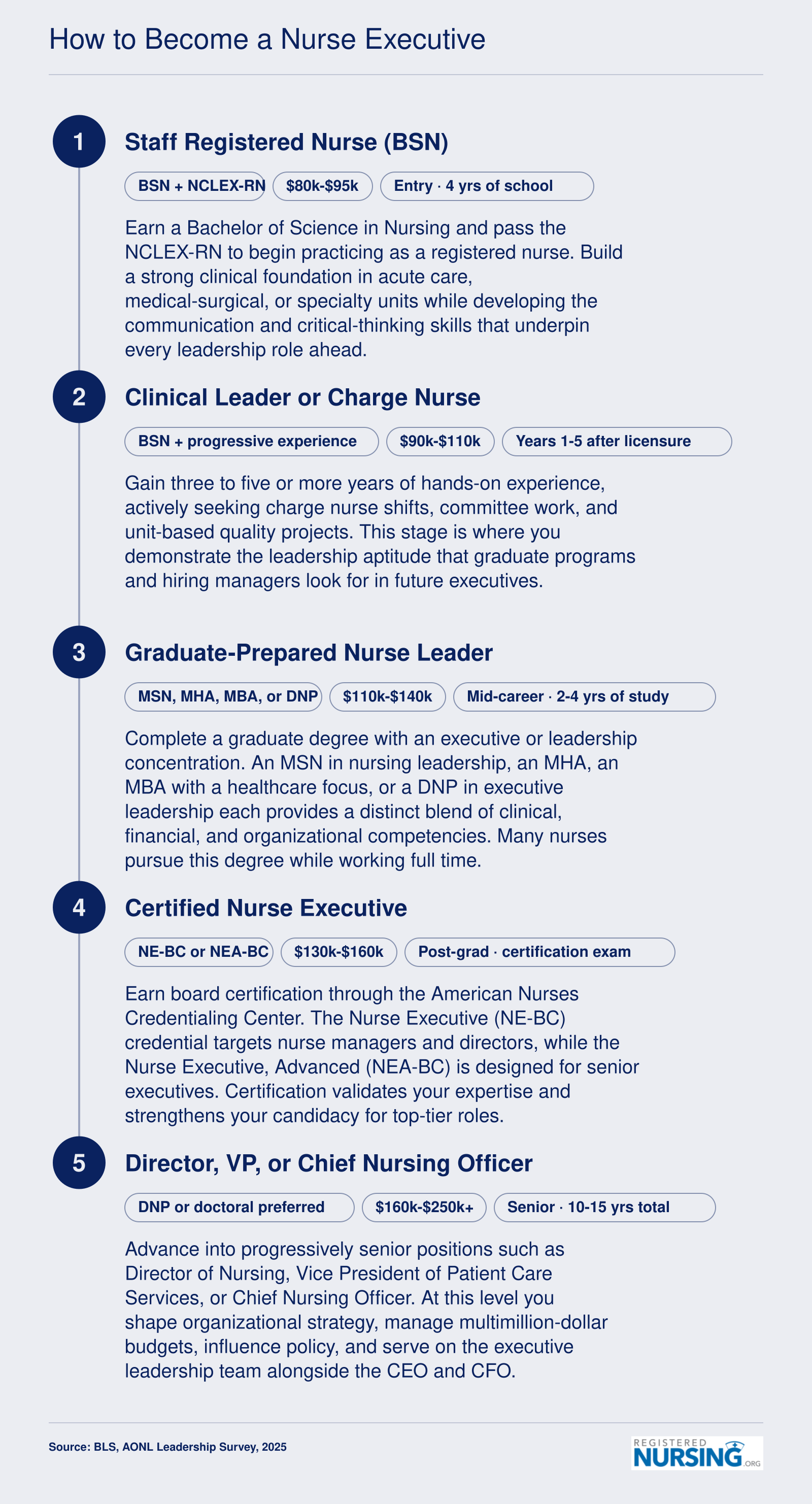
Reaching the C-suite in nursing is a long-term commitment that typically spans 10 to 15 years from your first degree to a chief nursing officer role. The pathway below outlines the five major milestones, along with approximate timelines and credentials at each stage, so you can map out a realistic plan.
Education Requirements: MSN Vs. MHA Vs. MBA Vs. DNP
Clinically focused versus business oriented: that fundamental distinction shapes how aspiring nurse executives choose among the graduate degrees that qualify them for top leadership roles. Each pathway develops different competencies, and the right choice depends on your career goals, your current experience, and the organizational culture where you hope to lead.
Master of Science in Nursing (MSN)
An MSN with a nursing leadership or executive track remains the most common credential among nurse executives. Curricula typically blend advanced nursing theory with healthcare policy, quality improvement, and financial management. Because MSN programs require a nursing license for admission, graduates emerge with both clinical credibility and foundational business skills. Many chief nursing officers began their executive journeys here.
Master of Health Administration (MHA)
An MHA emphasizes healthcare operations, strategic planning, and regulatory compliance. Coursework often mirrors an MBA but is tailored to hospitals, health systems, and payer organizations. Nurses who pursue an MHA signal strong interest in the business side of care delivery. This degree can be especially attractive to health systems seeking executives who will manage budgets, negotiate contracts, or oversee multi-site operations.
Master of Business Administration (MBA)
The MBA offers broad business training: finance, marketing, organizational behavior, and data analytics. Healthcare-focused MBA concentrations are available at many universities and add sector-specific electives. Employers sometimes view an MBA favorably when hiring for roles that interface heavily with non-clinical departments or corporate boards. However, an MBA alone does not address clinical governance, so many nurses pair it with clinical experience or a dual degree.
Doctor of Nursing Practice (DNP)
A DNP is the terminal practice doctorate for nursing. Best DNP programs for executive tracks focus on systems leadership, evidence-based practice transformation, and health policy at the organizational or national level. Although not universally required, a DNP can strengthen candidacy for academic medical centers and large health systems that value doctoral preparation. Some nurses complete a post-master's DNP after earning an MSN.
Which Degree Do Employers Prefer?
Job postings for chief nursing officer and vice president of nursing positions frequently list an MSN as the minimum requirement, with an MHA, MBA, or DNP noted as preferred. According to guidance from the Bureau of Labor Statistics, medical and health services managers, a category that includes nurse executives, typically need at least a master's degree. Professional associations such as the American Organization for Nursing Leadership encourage graduate education that combines clinical insight with business acumen.
When reviewing current openings, you will notice that many employers value the degree less than demonstrated executive competencies: strategic thinking, financial stewardship, and a track record of leading quality outcomes. Dual degrees, such as an MSN/MBA or DNP/MHA, are increasingly popular among candidates who want to cover both clinical and operational expectations. Charge nurses who have already developed frontline leadership skills often find that pairing progressive experience with graduate education creates a compelling profile for executive roles. Ultimately, the strongest preparation pairs graduate education with progressive leadership experience and, often, board certification in nursing executive practice.
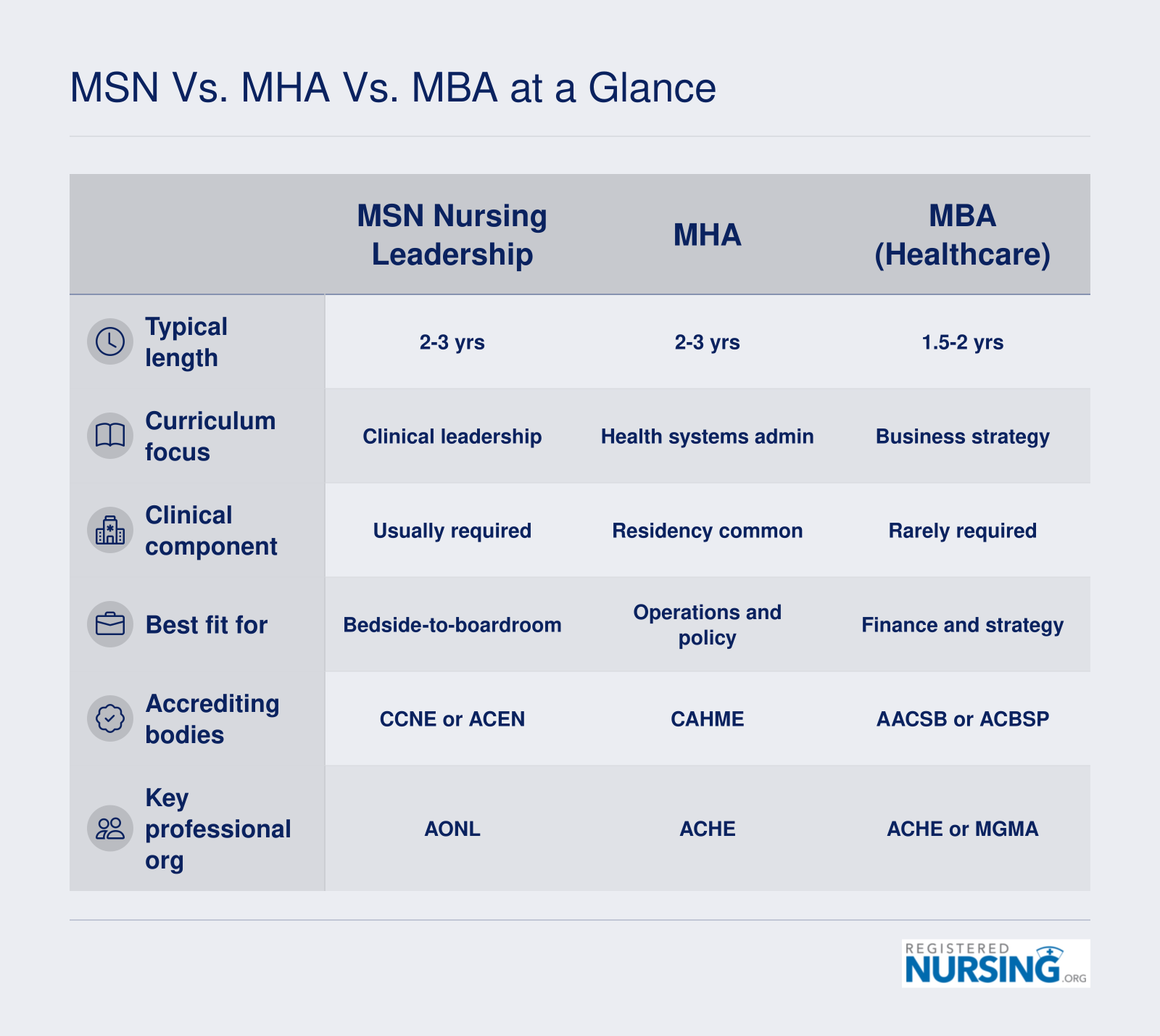
MSN Vs. MHA Vs. MBA at a Glance
Three graduate degrees can position you for nurse executive roles, but each one emphasizes different competencies. Program length, cost, and curriculum focus vary widely across institutions, so check individual university websites and consult organizations such as AACN and ACHE for the most current benchmarks before committing.
Nurse Executive Certifications: NE-BC and NEA-BC
Which certification should a nurse executive pursue, and what does it take to earn one?
The American Nurses Credentialing Center (ANCC) offers two credentials specifically designed for nurse leaders who have moved into executive or senior administrative roles. Understanding the difference between them, and knowing where to get accurate, current details, will save you considerable time as you plan your next career step.
NE-BC vs. NEA-BC: What Sets Them Apart
The Nurse Executive Certification (NE-BC) is generally aimed at nurses working in executive roles at the unit, department, or service-line level. The Nurse Executive Advanced certification (NEA-BC) is designed for those operating at a broader organizational scope, often at the C-suite or system level. Both credentials signal to employers and colleagues that you have met a defined standard of knowledge in nursing leadership and administration.
Because eligibility requirements, practice-hour thresholds, continuing education expectations, exam content domains, and application fees are subject to change, the most reliable place to confirm current details is the ANCC website itself. Checking there before you begin preparing, and again before you apply, protects you from acting on outdated information.
How to Prepare Effectively
Preparation strategies vary widely among candidates, and no single approach works for everyone. A few avenues worth exploring:
- Professional associations: The American Organization for Nursing Leadership (AONL) supports nurse leaders at every stage and may offer study resources, peer networks, or guidance on how practicing executives approached the exam.
- Graduate nursing programs: Faculty at MSN or DNP programs with a nurse executive or nursing administration track often have firsthand familiarity with the credential process and can point you toward useful preparation materials.
- Peer conversations: Colleagues who have already earned the NE-BC or NEA-BC are frequently the most candid source of insight about exam difficulty and preparation time.
Published pass rates are not always available for these credentials. If that data matters to your planning, contact ANCC directly or ask AONL whether they have access to any aggregated outcome information.
Recertification and Staying Current
Earning the credential is only part of the commitment. Both certifications carry a renewal cycle that typically involves continuing education and, in some cases, additional practice requirements. The specifics can shift, so monitoring the ANCC website on a regular basis ensures you are not caught off guard as your renewal date approaches.
For broader context on the nurse executive role, including how it fits within the healthcare workforce, the Bureau of Labor Statistics Occupational Outlook Handbook is a useful starting point. For the credential itself, however, ANCC remains the authoritative source.
Nurse Executive Salary: National Overview
Because the Bureau of Labor Statistics does not track nurse executives as a standalone occupation, salaries are most commonly benchmarked against the Medical and Health Services Managers category, which includes chief nursing officers, vice presidents of nursing, and other executive nurse leaders. The table below compares this group with registered nurses and nurse practitioners to illustrate the earning premium that comes with moving into executive leadership. All figures reflect 2024 data from the Occupational Employment and Wage Statistics program.
| Occupation | Total Employment | 25th Percentile | Median Salary | 75th Percentile | Mean Salary |
|---|---|---|---|---|---|
| Medical and Health Services Managers (includes Nurse Executives) | 565,840 | $88,560 | $117,960 | $162,420 | $137,730 |
| Nurse Practitioners | 307,390 | $109,940 | $129,210 | $149,570 | $132,000 |
| Registered Nurses | 3,282,010 | $78,610 | $93,600 | $107,960 | $98,430 |
Nurse executives earn substantially more than most other nursing roles: Bureau of Labor Statistics data shows top nurse executive positions reaching well above six figures, often outpacing staff RNs by 60,000 dollars or more annually and exceeding nurse practitioner median wages by a comparable margin. That salary gap reflects the leadership premium and makes the investment in advanced education and certification a financially compelling move.
Nurse Executive Salary by State
Nurse executive salaries vary significantly depending on where you practice, driven by differences in cost of living, demand, and health system budgets. The table below draws from 2024 data published by the Bureau of Labor Statistics for medical and health services managers, the occupational category that includes nurse executives. States with large, complex hospital systems and higher costs of living tend to offer the most competitive compensation.
| State | Total Employed | 25th Percentile | Median Salary | Mean Salary | 75th Percentile |
|---|---|---|---|---|---|
| District of Columbia | 2,170 | $124,490 | $161,050 | $176,520 | $203,280 |
| New York | 31,010 | $111,780 | $149,820 | $177,230 | $207,430 |
| New Jersey | 16,070 | $106,280 | $132,250 | $169,520 | $174,330 |
| Georgia | 9,610 | $105,000 | $136,030 | $168,460 | $181,520 |
| Washington | 7,740 | $118,980 | $143,300 | $165,140 | $180,080 |
| Oregon | 5,580 | $107,350 | $135,530 | $158,230 | $174,960 |
| California | 68,800 | $90,790 | $136,500 | $154,620 | $203,400 |
| Hawaii | 2,590 | $108,840 | $140,750 | $154,160 | $167,540 |
| Maryland | 15,650 | $103,530 | $132,590 | $151,580 | $171,140 |
| Mississippi | 4,560 | $72,100 | $89,960 | $103,770 | $113,520 |
| Alabama | 9,320 | $77,160 | $92,950 | $101,790 | $108,200 |
| Arkansas | 6,100 | $71,960 | $88,340 | $101,000 | $108,900 |
| Puerto Rico | 1,300 | $58,480 | $77,830 | $98,420 | $130,780 |
Highest-Paying Metro Areas for Nurse Executives
Location plays a major role in nurse executive compensation. The following table highlights the top-paying metropolitan areas for medical and health services managers, the Bureau of Labor Statistics category that includes nurse executives. Data reflects 2024 figures from the Occupational Employment and Wage Statistics program. Note that the cost of living in these metros, particularly in New York and San Francisco, can offset some of the salary advantage.
| Metro Area | Total Employment | 25th Percentile | Median Salary | Mean Salary | 75th Percentile |
|---|---|---|---|---|---|
| New York, Newark, Jersey City (NY, NJ) | 33,540 | $120,590 | $157,910 | $183,580 | $208,550 |
| San Francisco, Oakland, Fremont (CA) | 11,210 | $104,440 | $168,750 | $180,440 | $221,540 |
| Boston, Cambridge, Newton (MA, NH) | 14,330 | $103,730 | $134,980 | $165,730 | $198,480 |
| Washington, Arlington, Alexandria (DC, VA, MD, WV) | 11,640 | $115,290 | $136,490 | $156,970 | $173,780 |
| Chicago, Naperville, Elgin (IL, IN) | 15,760 | $97,260 | $124,350 | $141,690 | $164,620 |
| Phoenix, Mesa, Chandler (AZ) | 8,070 | $93,360 | $124,050 | $141,220 | $165,920 |
| Philadelphia, Camden, Wilmington (PA, NJ, DE, MD) | 12,620 | $92,710 | $119,250 | $135,550 | $150,800 |
| Miami, Fort Lauderdale, West Palm Beach (FL) | 12,020 | $94,340 | $114,790 | $135,000 | $155,150 |
| Houston, Pasadena, The Woodlands (TX) | 13,050 | $95,560 | $119,990 | $131,510 | $153,050 |
| Dallas, Fort Worth, Arlington (TX) | 16,260 | $81,300 | $111,610 | $130,480 | $146,000 |
Career Outlook and Advancement Opportunities
Nurse executives face a choice between climbing within a single organization and building a broader system-level or C-suite profile, and the labor market currently rewards both paths. The Bureau of Labor Statistics projects employment of medical and health services managers, the closest proxy occupation for nurse executives, to grow 23% from 2024 to 2034, adding roughly 142,900 jobs and averaging about 62,100 openings each year.1 That is far faster than the average for all occupations and signals sustained hiring demand through the next decade.
The Typical Advancement Ladder
Most nurse executives arrive at the top of the org chart through a recognizable progression. The steps are not rigid, but the pattern holds across most acute care organizations:
- Nurse manager: running a single unit, owning staffing, budget, and quality metrics for that department.
- Director of nursing: overseeing multiple units or a service line such as critical care, women's health, or perioperative services.
- Vice president of patient care services: setting nursing strategy across a hospital and reporting to the CNO or CEO.
- Chief nursing officer (CNO): the top nursing role in a single hospital, accountable for practice standards, workforce, and outcomes.
- System chief nurse executive: leading nursing across a multi-hospital system, often with dotted-line authority over each facility's CNO.
Emerging Roles Beyond the CNO Seat
The traditional CNO title is no longer the only endpoint. Nurse executives are increasingly stepping into Chief Experience Officer roles, where they shape patient and family engagement strategy, and Chief Quality Officer positions, where clinical background is a real advantage over a pure administrative pedigree. Nurse entrepreneurs represent another growing path, as experienced nurse leaders launch consulting firms and healthcare ventures that draw directly on their executive experience. Health system boards are also actively recruiting nurse leaders to bring clinical perspective to governance, and appointments to hospital and payer boards have become a meaningful late-career track.
What Is Driving the Demand
Several forces are pushing organizations to invest in senior nursing leadership at the same time. The aging population is expanding both patient volume and care complexity. Persistent nursing workforce shortages require executives who can rebuild pipelines, retention, and staffing models. Magnet designation, which many hospitals pursue as a quality credential, explicitly requires nurse leaders with graduate degrees and formal authority. And value-based care contracts tie reimbursement to outcomes that nurse executives are uniquely positioned to influence.
Frequently Asked Questions About Nurse Executives
Below are answers to some of the most common questions prospective and current nurses ask about the nurse executive role. For deeper exploration of any topic, follow the references to the relevant sections earlier in this guide.
- How do you become a nurse executive?
- Start by earning your BSN and obtaining RN licensure, then build several years of progressive clinical and leadership experience. Next, complete a graduate degree such as an MSN, MHA, MBA, or DNP with a focus on healthcare leadership. Finally, pursue a professional certification like the NE-BC or NEA-BC. The "How to Become a Nurse Executive" section above outlines each step in detail.
- How much does nurse executive certification cost?
- Exam fees for the ANCC Nurse Executive certification (NE-BC) and the Nurse Executive, Advanced certification (NEA-BC) typically range from roughly $270 to $395, depending on ANCC membership status. Additional costs may include application fees, study materials, and continuing education. See the "Nurse Executive Certifications" section for eligibility requirements and renewal details.
- What is the difference between a nurse executive and a nurse manager?
- A nurse manager oversees day-to-day operations of a specific unit or department, handling staffing, budgets, and patient care standards at the frontline level. A nurse executive operates at the organizational or system level, setting strategic direction, shaping policy, and representing nursing in the C-suite. The "Nurse Executive vs. Nurse Administrator vs. Nurse Manager" section compares all three roles side by side.
- What degree do you need to be a nurse executive?
- Most nurse executive positions require at least a master's degree. Common options include the MSN in nursing leadership, the MHA, or the MBA with a healthcare concentration. Some Chief Nursing Officer roles prefer or require a DNP salary and career outlook, and understanding that earning potential can help you weigh the investment. The "Education Requirements" section compares these pathways to help you choose the best fit.
- How much do nurse executives make?
- Nurse executive salaries vary by location, employer type, and experience, but six-figure compensation is standard for these senior roles. Geographic location plays a significant part, with metropolitan areas and states that have higher costs of living generally offering the strongest pay. Review the salary tables earlier in this guide for national, state, and metro-level breakdowns.
- Is a DNP required to become a Chief Nursing Officer?
- A DNP is not universally required, but it is increasingly preferred for Chief Nursing Officer (CNO) positions at large health systems and academic medical centers. Many CNOs hold an MSN, MHA, or MBA paired with extensive executive experience. Earning a DNP can strengthen your candidacy and may be essential at organizations that emphasize doctoral-level leadership credentials.
Explore More
- Ambulatory Care Nurse
- Burn Unit Nurse
- Cardiac Nurse
- Cath Lab Nurse
- Charge Nurse
- Chief Nursing Officer (CNO)
- Correctional Nurse
- CVOR Nurse
- Dermatology Nurse
- Developmental Disability Nurse
- Director of Nursing
- Domestic Violence Nurse
- Emergency Room Nurse
- ENT Nurse
- ET Nurse
- Fertility Nurse
- Flight/Transport Nurse
- Forensic Nurse Salary & Career Guide
- Genetic Nurse
- Geriatric Nurse
- Health Policy Nurse
- Healthcare Administrator
- Healthcare Manager
- Home Health Nurse
- Hospice Nurse
- Camp Nurse
- GI Nurse
- Holistic Nurse
- Labor and Delivery Nurse
- Nurse Writer
- Psychiatric Nurse
- School Nurse
- Telemetry Nurse
- Travel Nurse
- Aesthetic Nurse
- Infusion/IV Nurse
- Oncology Nurse
- ICU Nurse
- Infection Control Nurse
- Legal Nurse Consultant
- LTC Nurse
- Managed Care Nurse
- Medical-Surgical Nurse
- Military (Combat) Nurse
- Missionary Nurse
- Mother Baby Nurse
- Nephrology Nurse
- Neuroscience Nurse
- NICU Nurse
- Nurse Administrator
- Nurse Attorney
- Nurse Care Coordinator
- Nurse Case Manager
- Nurse Entrepreneur
- Nurse Health Coach
- Nurse Manager
- Obstetric (OB) Nurse
- Occupational Health Nurse
- Operating Room Nurse
- Ophthalmic Nurse
- Organ Procurement Coordinator
- Orthopedic Nurse
- Pain Management Nurse
- Palliative Care Nurse
- Parish Nurse
- Patient Advocate Nurse
- Pediatric Endocrinology Nurse
- Perianesthesia (PACU) Nurse
- Perinatal Nurse
- Plastic Surgery Nurse
- Public/Community Health Nurse
- Radiology Nurse
- Rehabilitation Nurse
- Research Nurse
- Respiratory Nurse
- Rheumatology Nurse
- Substance Abuse Nurse
- Telephone Triage Nurse
- Transcultural Nursing
- Transplant Nurse
- Trauma Nurse
- Wound Care Nurse (WOCN)