

What you’ll learn in this article…
- CPAN and CAPA certification each require 1,200 hours of perianesthesia experience.
- The BLS projects 6% RN job growth through 2034.
- Most nurses reach perianesthesia certification in 5 to 7 years.
Perianesthesia nursing encompasses three distinct phases of anesthesia care: preadmission assessment and preparation, Phase I recovery immediately following anesthesia, and Phase II discharge and transition back to home or an inpatient bed. Each phase requires different skill sets, patient populations, and clinical priorities. The term is often confused with PACU nursing, but PACU refers specifically to Phase I recovery units, making it a subset of the broader perianesthesia umbrella.
The American Society of PeriAnesthesia Nurses recognizes perianesthesia nursing as a formally defined specialty with its own body of knowledge, certification pathways, and clinical standards. Nurses who work in preadmission testing, Phase I and Phase II recovery, or ambulatory surgery centers all fall under this specialty, even though their day-to-day responsibilities may differ significantly.
Most perianesthesia nurses begin their careers in acute care or critical care settings before transitioning into a surgical environment. Nurses with backgrounds in high-acuity units, including those with flight and transport nursing experience, sometimes find the clinical reflexes they have built translate directly into PACU practice. National certification through the CPAN or CAPA credential is not legally required to practice but is increasingly expected by employers and closely correlated with higher salaries.
Perianesthesia Nurse Vs. PACU Nurse Vs. Perioperative Nurse
These three nursing roles all center on surgical patients, but each covers a distinct slice of the care timeline. Understanding where they overlap and where they diverge helps you interpret job postings, target the right certifications, and plan your career path.
Perianesthesia Nursing: The Full Anesthesia Continuum
Perianesthesia nursing spans every phase of anesthesia care, from the moment a patient is scheduled for surgery through complete recovery. The specialty divides into three phases:
- Preadmission Testing (PAT): Nurses assess patients days or weeks before surgery, reviewing medical history, medications, and anesthesia risks.
- Phase I Recovery: Immediately after surgery, patients require intensive monitoring as they emerge from anesthesia. Airway management, pain control, and hemodynamic stability are the priorities.
- Phase II Recovery: Once stable, patients transition to ambulatory recovery, where nurses prepare them for discharge and provide post-op education.
A perianesthesia nurse may rotate across all three phases or specialize in one, depending on the facility.
PACU Nursing: Phase I and Phase II Focus
Post-Anesthesia Care Unit nurses work specifically in Phase I and Phase II recovery. In practice, most employers use "PACU nurse" and "perianesthesia nurse" interchangeably. When you see a PACU job listing, read the description carefully because it may include preadmission responsibilities, ambulatory surgery recovery duties, or both. The job title alone rarely tells the whole story.
Perioperative Nursing: Inside the Operating Room
Perioperative nurses, often called OR nurses or circulating nurses, manage patient care during surgery itself. They position patients, maintain sterile fields, anticipate surgeon needs, and document intraoperative events. While perianesthesia nurses hand off patients at the OR door and receive them afterward, perioperative nurses remain throughout the procedure.
Some hospitals cross-train staff so that one nurse can float between the OR and PACU, but the core skill sets differ. Perioperative nursing centers on surgical technique support and sterile protocols; perianesthesia nursing emphasizes anesthesia recovery, airway vigilance, and rapid assessment of post-op complications.
Decoding Job Postings
Because "PACU nurse" appears in the vast majority of listings, you may need to scan the job description for clues. Look for mentions of preadmission testing, ambulatory surgery centers, or Phase I recovery to gauge how broad the role actually is. If a posting lists CPAN or CAPA certification as preferred, the employer expects full perianesthesia competencies rather than Phase I care alone.
What Does a Perianesthesia Nurse Do?
The growing volume of same-day surgical procedures across the United States has placed perianesthesia nurses at the center of patient safety during one of the most vulnerable windows in any surgical experience: the transition into and out of anesthesia. Their responsibilities span three distinct care phases, each demanding a different clinical focus, and the work carries staffing realities that every prospective PACU nurse should understand before applying.
Three Phases of Perianesthesia Care
Perianesthesia nursing is organized around preadmission, Phase I recovery, and Phase II recovery. Each phase calls for a specific skill set.
- Preadmission: The nurse performs comprehensive health assessments, reviews medication histories, identifies anesthesia risk factors, and educates patients and families about what to expect before, during, and after surgery. Surgical preparation tasks such as IV placement, baseline vital signs, and verification of consent documents also fall in this phase.
- Phase I (immediate post-anesthesia): This is the highest-acuity window. Nurses manage airway patency, monitor hemodynamic status continuously, assess pain using validated scales, and watch for emergence delirium, a state of agitation and confusion that can occur as anesthesia wears off. Interventions must be rapid and precise because patients in this phase are at peak risk for respiratory depression and cardiovascular instability.
- Phase II (discharge preparation): Once a patient meets specific recovery benchmarks, the Phase II nurse takes over. Responsibilities include scoring discharge readiness, coaching patients and family members on home care instructions, managing oral pain medications, encouraging ambulation, and confirming that safe transportation is arranged.
Monitoring Technologies and Scoring Systems
Perianesthesia nurses rely on several monitoring tools throughout these phases:
- Pulse oximetry and capnography to track oxygenation and ventilation
- Continuous ECG monitoring to detect cardiac rhythm changes , skills that overlap with those of a telemetry nurse in other high-acuity settings
- Aldrete scoring to evaluate Phase I recovery milestones such as consciousness, circulation, respiration, oxygen saturation, and activity level
- Post-Anesthesia Discharge Scoring System (PADSS) criteria to determine whether a patient in Phase II is safe for release
These tools are not passive readouts. Nurses interpret trends in real time and escalate concerns to the anesthesia team or surgeon when values deviate from expected recovery patterns.
Complications That Demand Quick Thinking
Post-anesthesia complications are common enough that managing them is a core competency rather than an exception.1 Perianesthesia nurses routinely address:
- Post-operative nausea and vomiting, one of the most frequent patient complaints after general anesthesia
- Hypothermia caused by prolonged exposure in cold operating rooms combined with anesthesia-related thermoregulation impairment
- Respiratory depression, particularly in patients who received opioids or deep sedation
- Emergence agitation, which can pose safety risks to both the patient and staff
- Acute pain crises that require titrated IV medication and close reassessment
The pace can shift from calm to critical in seconds, making this a high-acuity, fast-paced environment where clinical judgment under pressure is essential.
Nurse-to-Patient Ratios and Typical Caseload
Staffing ratios are a defining feature of PACU work and one of the most common questions candidates ask. In Phase I recovery, the recommended ratio is 1:1 for unstable patients and no more than 1:2 once a patient is stabilized.2 Phase II ratios are wider, typically ranging from 1:3 to 1:4, reflecting the lower acuity of patients approaching discharge.2 Over the course of a shift, a single nurse may care for multiple patients sequentially as surgical cases cycle through, but the ratio at any given moment stays within these guidelines to maintain safety.
Shifts generally range from 8 to 12 hours,3 with start times commonly falling between 0600 and 1300 depending on the facility's surgical schedule. Research supported by NIOSH indicates that shifts lasting 10 hours or longer are associated with poorer quality and safety outcomes, and shifts exceeding 13 hours carry more than double the risk of poor safety reports.4 Many facilities cap individual shifts at 12 hours and weekly hours at 60 to mitigate fatigue-related errors.5
On-Call Expectations and Schedule Realities
One factor that surprises many nurses entering perianesthesia care is the on-call requirement. Most hospital PACU positions require regular on-call availability for nights, weekends, and holidays. A common structure involves taking call approximately once per week for seven out of every eight weeks,6 though some facilities use a rotation of two to three on-call shifts over a six-week cycle.7 When called in, nurses are typically expected to arrive within 30 to 60 minutes.6
Ambulatory surgery center roles tend to offer a notable advantage in this area. Because these facilities operate on more predictable daytime schedules and handle lower-acuity procedures, on-call obligations are often lighter or nonexistent. Perianesthesia nurses who transition between settings sometimes find the experience comparable to that of a operating room nurse moving from hospital to outpatient care. Shift lengths at outpatient centers generally fall in the 8 to 10 hour range,8 making them an appealing option for nurses who prioritize schedule stability. Hospital-based PACUs, by contrast, often run 8 to 12 hour shifts with the added unpredictability of emergency surgical cases that extend the day.3
How to Become a Perianesthesia Nurse
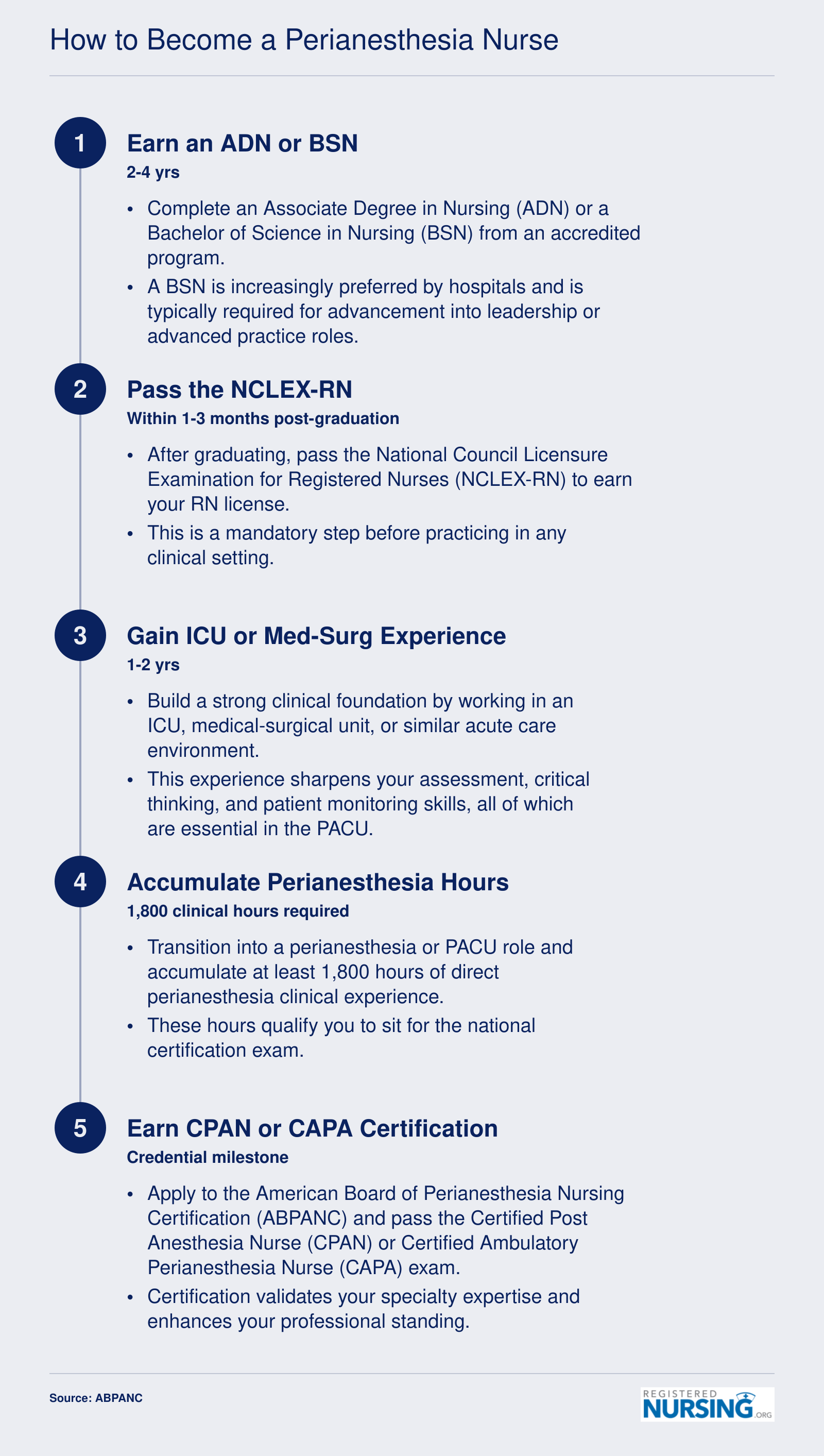
Becoming a certified perianesthesia nurse requires a combination of formal education, clinical licensure, hands-on experience, and specialty certification. Most nurses complete this journey in approximately 5 to 7 years from entering nursing school. A BSN is increasingly preferred by employers and often required for career advancement.
Step-By-Step Path to Perianesthesia Nursing
Perianesthesia nursing is a specialty you work toward deliberately. The path involves a clear sequence of education, hands-on clinical experience, and strategic career moves, and understanding that sequence can save you years of detours.
Start with the Right Educational Foundation
The minimum entry point is an Associate Degree in Nursing, which takes roughly two years to complete and qualifies you to sit for the NCLEX-RN. That credential will get you licensed, but many hospital systems, particularly those pursuing or holding Magnet Recognition status, now require or strongly prefer nurses with a Bachelor of Science in Nursing. A BSN takes about four years and opens significantly more doors at larger academic medical centers, which tend to operate the busiest and most complex PACU units. If you already hold an ADN and are working as an RN, an RN-to-BSN bridge program lets you close that gap while you continue working full-time.
Build Your Acute-Care Foundation First
Most nurses do not step into a PACU role directly from nursing school, and there is good reason for that. Perianesthesia patients can deteriorate rapidly in the immediate post-operative period, and the assessment skills required, including airway management, hemodynamic monitoring, and pain titration, are developed through experience in high-acuity environments. ICU nurse experience, critical care step-down, and emergency nursing are the most common pipelines into perianesthesia work. Even one to two years in a medical-surgical ICU builds the clinical reflexes that PACU nurse managers are looking for.
Accumulate the Hours That Unlock Certification
Once you are working in a perianesthesia setting, your next milestone is eligibility for the CPAN or CAPA certification exams. Both require 1,800 hours of perianesthesia nursing practice within the three years preceding your application. Working full-time in a PACU, that threshold typically takes roughly 12 to 18 months to reach, depending on your schedule and whether those hours are logged in the qualifying practice area.
Break In Strategically
If you are currently in a different specialty and targeting a PACU transition, a few practical moves can shorten the timeline considerably:
- Express interest early: Tell your nurse manager or the PACU director before a position opens. Many units fill roles through internal interest before posting them publicly.
- Volunteer for float shifts: Some facilities allow experienced RNs to pick up PACU shifts as a float, which builds familiarity and demonstrates commitment.
- Join ASPAN as a student or affiliate member: The American Society of PeriAnesthesia Nurses offers resources and networking that can connect you with mentors actively working in the specialty.
- Shadow before you apply: A single shadowing day in a PACU gives you language and context that makes your interview answers noticeably stronger.
The path is structured but absolutely navigable. Nurses who plan their clinical experiences with this specialty in mind typically make the transition faster and with greater confidence once they arrive.
CPAN and CAPA Certification: Requirements, Exam, and Recertification
The American Board of Perianesthesia Nursing Certification (ABPANC) offers two credentials, and both require 1,200 hours of direct perianesthesia nursing practice completed within the two years preceding your application, plus an active, unrestricted RN license.1
CPAN vs. CAPA: Which Credential Fits Your Practice
The Certified Post Anesthesia Nurse (CPAN) credential validates expertise in caring for patients recovering from anesthesia in Phase I (immediate post-anesthesia) and Phase II (transition to discharge or inpatient unit) settings. It is the credential most closely associated with the traditional PACU bedside role.
The Certified Ambulatory Perianesthesia Nurse (CAPA) credential focuses on preanesthesia assessment, Phase II recovery, and extended observation in ambulatory surgery centers and outpatient settings. Nurses who work across the full continuum sometimes pursue both, earning the dual CPAN/CAPA distinction.
Eligibility is otherwise identical for the two exams. Candidates must be currently practicing in perianesthesia nursing at the time of application, and international RNs may sit for the exam through a separate pathway.2 Exam fees are $350 for ASPAN members and $424 for non-members,3 with two administration windows offered each year.
Exam Structure and Content
Both exams are computer-based, delivered at Prometric testing centers or through remote proctoring.4 Each exam contains 185 total questions (140 scored, 45 unscored pilot items) with a three-hour time limit and a scaled passing score of 450.5 The most recent Spring 2025 CPAN administration reported a 62% pass rate.6
CPAN content is weighted across five domains:7
- Monitoring and intervention: 35%
- Anesthesia and its effects: 24%
- Physiological considerations: 18%
- Care considerations: 14%
- Professional practice: 9%
CAPA content covers similar domains with greater emphasis on preoperative preparation, patient education, and discharge planning.
Recertification and Career Payoff
Certification is valid for three years. To recertify, nurses must document 900 hours of perianesthesia practice during the certification period and complete 70 contact hours of continuing education aligned with the exam blueprint.8 The recertification-by-exam option remains available through November 15, 2026, after which recertification will move exclusively to the CE and practice-hour pathway.9
Certification consistently correlates with higher earnings and preferred hiring status. Many hospitals, particularly Magnet-designated facilities, list CPAN or CAPA as required or strongly preferred for PACU roles and pay a certification differential ranging from roughly $1 to $3 per hour. The credential also signals alignment with ASPAN's Standards for Perianesthesia Nursing Practice, the framework that governs safe recovery care nationwide. Nurses with a background in cardiac care nursing or cardiovascular operating room work may find the transition to perianesthesia certification especially manageable, given overlapping clinical skill sets.
Perianesthesia Nurse Salary: National Overview
Because the Bureau of Labor Statistics does not publish a separate pay category for perianesthesia or PACU nurses, salary estimates are drawn from the broader Registered Nurses classification. Perianesthesia nurses with specialty certification (CPAN or CAPA) and significant critical care experience often earn salaries at or above the 75th percentile of this range. The figures below reflect 2024 national wage data for registered nurses, based on more than 3.28 million employed RNs across the country.
| Pay Metric | Annual Salary |
|---|---|
| 25th Percentile | $78,610 |
| Median (50th Percentile) | $93,600 |
| Mean (Average) | $98,430 |
| 75th Percentile | $107,960 |
Perianesthesia Nurse Salary by State
Because the Bureau of Labor Statistics does not track perianesthesia nurses as a separate category, the figures below reflect overall registered nurse wages in each state. Perianesthesia and PACU nurses who hold specialty certifications such as the CPAN or CAPA often earn at or above these medians, particularly in high-volume surgical centers. Data is drawn from the 2024 Occupational Employment and Wage Statistics published by the BLS.
| State | Total RN Employment | 25th Percentile | Median Salary | 75th Percentile | Mean Salary |
|---|---|---|---|---|---|
| Rhode Island | 10,760 | $83,870 | $99,960 | $112,540 | $99,770 |
| Arizona | 64,430 | $81,390 | $96,890 | $105,450 | $95,230 |
| New Hampshire | 16,580 | $79,720 | $96,830 | $105,500 | $94,620 |
| Maryland | 48,980 | $81,470 | $96,830 | $104,840 | $96,650 |
| Colorado | 54,510 | $81,790 | $96,520 | $104,370 | $95,470 |
| Delaware | 13,260 | $82,600 | $92,610 | $108,360 | $95,450 |
| Texas | 261,050 | $77,450 | $90,010 | $102,200 | $91,690 |
| Virginia | 77,420 | $77,650 | $88,820 | $100,920 | $90,930 |
| New Mexico | 17,510 | $82,630 | $88,260 | $104,720 | $94,360 |
| Pennsylvania | 146,840 | $78,570 | $87,610 | $102,030 | $90,830 |
| Georgia | 97,410 | $76,600 | $86,560 | $104,790 | $91,960 |
| Illinois | 139,900 | $79,150 | $86,410 | $103,660 | $91,130 |
| Idaho | 14,540 | $78,020 | $86,100 | $100,220 | $89,770 |
| Wisconsin | 64,960 | $79,570 | $86,070 | $100,680 | $90,450 |
| Michigan | 104,210 | $80,030 | $85,670 | $101,210 | $90,580 |
| Vermont | 7,240 | $79,980 | $85,150 | $104,110 | $92,710 |
| Maine | 16,280 | $76,890 | $82,860 | $98,000 | $87,440 |
| Florida | 218,100 | $77,070 | $82,850 | $99,260 | $88,200 |
| Utah | 25,780 | $77,030 | $82,270 | $101,530 | $88,240 |
| North Carolina | 108,510 | $74,710 | $81,860 | $98,720 | $86,270 |
| Wyoming | 5,180 | $75,540 | $81,790 | $100,910 | $88,020 |
| Montana | 10,540 | $77,800 | $81,560 | $100,510 | $88,480 |
| Ohio | 138,360 | $77,420 | $81,250 | $97,440 | $86,110 |
| Oklahoma | 32,870 | $75,320 | $81,160 | $96,460 | $85,800 |
| Nebraska | 24,180 | $76,430 | $81,020 | $93,140 | $82,890 |
Highest-Paying Metro Areas for Perianesthesia Nurses
Because federal wage data does not break out perianesthesia nurses as a separate category, the figures below reflect registered nurse salaries in the highest-paying major metro areas. Perianesthesia nurses with CPAN or CAPA certification often earn at or above these benchmarks, particularly in surgical centers and large hospital systems. Data is drawn from the 2024 Occupational Employment and Wage Statistics published by the U.S. Bureau of Labor Statistics.
| Metro Area | Total RN Employment | 25th Percentile | Median Salary | Mean Salary | 75th Percentile |
|---|---|---|---|---|---|
| San Francisco, Oakland, Fremont, CA | 40,750 | $150,580 | $188,020 | $178,450 | $212,190 |
| Los Angeles, Long Beach, Anaheim, CA | 107,340 | $108,150 | $133,440 | $138,010 | $165,290 |
| Seattle, Tacoma, Bellevue, WA | 37,250 | $101,140 | $118,570 | $120,260 | $132,160 |
| Boston, Cambridge, Newton, MA and NH | 66,440 | $84,200 | $102,440 | $115,710 | $137,160 |
| New York, Newark, Jersey City, NY and NJ | 195,470 | $100,530 | $113,490 | $115,650 | $128,430 |
| Minneapolis, St. Paul, Bloomington, MN and WI | 40,510 | $87,670 | $102,240 | $102,790 | $116,000 |
| Washington, Arlington, Alexandria, DC, VA, MD, WV | 43,640 | $83,570 | $101,800 | $102,510 | $110,760 |
| Philadelphia, Camden, Wilmington, PA, NJ, DE, MD | 74,840 | $84,040 | $99,210 | $97,510 | $107,800 |
| Dallas, Fort Worth, Arlington, TX | 72,640 | $79,170 | $98,740 | $96,720 | $106,850 |
| Phoenix, Mesa, Chandler, AZ | 46,330 | $82,270 | $98,160 | $96,220 | $105,900 |
| Houston, Pasadena, The Woodlands, TX | 65,300 | $79,640 | $97,810 | $96,730 | $105,970 |
| Chicago, Naperville, Elgin, IL and IN | 100,620 | $81,320 | $96,480 | $94,580 | $104,730 |
| Atlanta, Sandy Springs, Roswell, GA | 54,370 | $79,700 | $96,370 | $96,640 | $107,550 |
| Detroit, Warren, Dearborn, MI | 44,280 | $81,140 | $88,980 | $92,680 | $101,880 |
| Miami, Fort Lauderdale, West Palm Beach, FL | 59,880 | $78,240 | $85,610 | $92,070 | $103,110 |
Job Outlook and Demand Trends for Perianesthesia Nurses
Perianesthesia nursing sits at the intersection of several powerful forces reshaping healthcare demand. Understanding those forces helps you gauge both job security and long-term career potential in this specialty.
National Growth Projections for Registered Nurses
According to the Bureau of Labor Statistics, registered nurse employment is projected to grow 5 percent from 2024 to 2034, adding roughly 166,100 new positions over that decade.1 With an estimated 189,100 openings expected each year when accounting for both new jobs and vacancies from nurses leaving the workforce, the hiring pipeline is substantial.1 That overall growth rate is considered "as fast as average" across all occupations, but perianesthesia nursing is positioned to outperform the broader RN average because of structural shifts in where and how surgery is delivered.
The Outpatient Surgery Boom
One of the most consequential trends for PACU nurses is the rapid expansion of ambulatory surgery centers (ASCs). Advances in minimally invasive technique, anesthesia safety, and same-day recovery protocols have moved thousands of procedures out of hospitals and into freestanding outpatient facilities. Registered nurses working in ambulatory care settings saw growth of roughly 40 percent over the decade ending in 2024, a pace far exceeding hospital-based nursing overall.2 That shift has created dedicated perianesthesia positions outside traditional hospital ORs, broadening the field considerably.
Aging Population and Surgical Volume
The demographic math also favors continued demand. As the U.S. population ages, surgical volumes for joint replacements, cataract removals, cardiac care, and spine procedures are climbing steadily. These are precisely the case types that flow through PACU and phase-two recovery units in high numbers. More surgeries mean more patients requiring skilled post-anesthesia monitoring, and facilities need experienced perianesthesia nurses to staff those recovery bays safely. Orthopedic nurses working in surgical settings see this same volume pressure firsthand, as joint replacement caseloads continue to rise.
Staffing Shortages and the Retirement Wave
Beyond new job creation, a significant share of those annual openings reflects attrition. A large cohort of experienced RNs, many of whom entered the profession during the nursing boom of the 1980s and 1990s, is approaching retirement age. Perianesthesia units, which tend to attract senior nurses who prefer a structured, procedure-focused environment, will feel this retirement wave acutely. For a broader picture of where shortages are hitting hardest, the states with the largest nursing shortages shows which markets face the steepest gaps. For nurses entering or advancing within the specialty, the combination of growing case volume and departing experienced staff translates into strong hiring conditions and real leverage when negotiating schedules, compensation, and practice settings.
Career Growth: From PACU Nurse to Advanced Practice
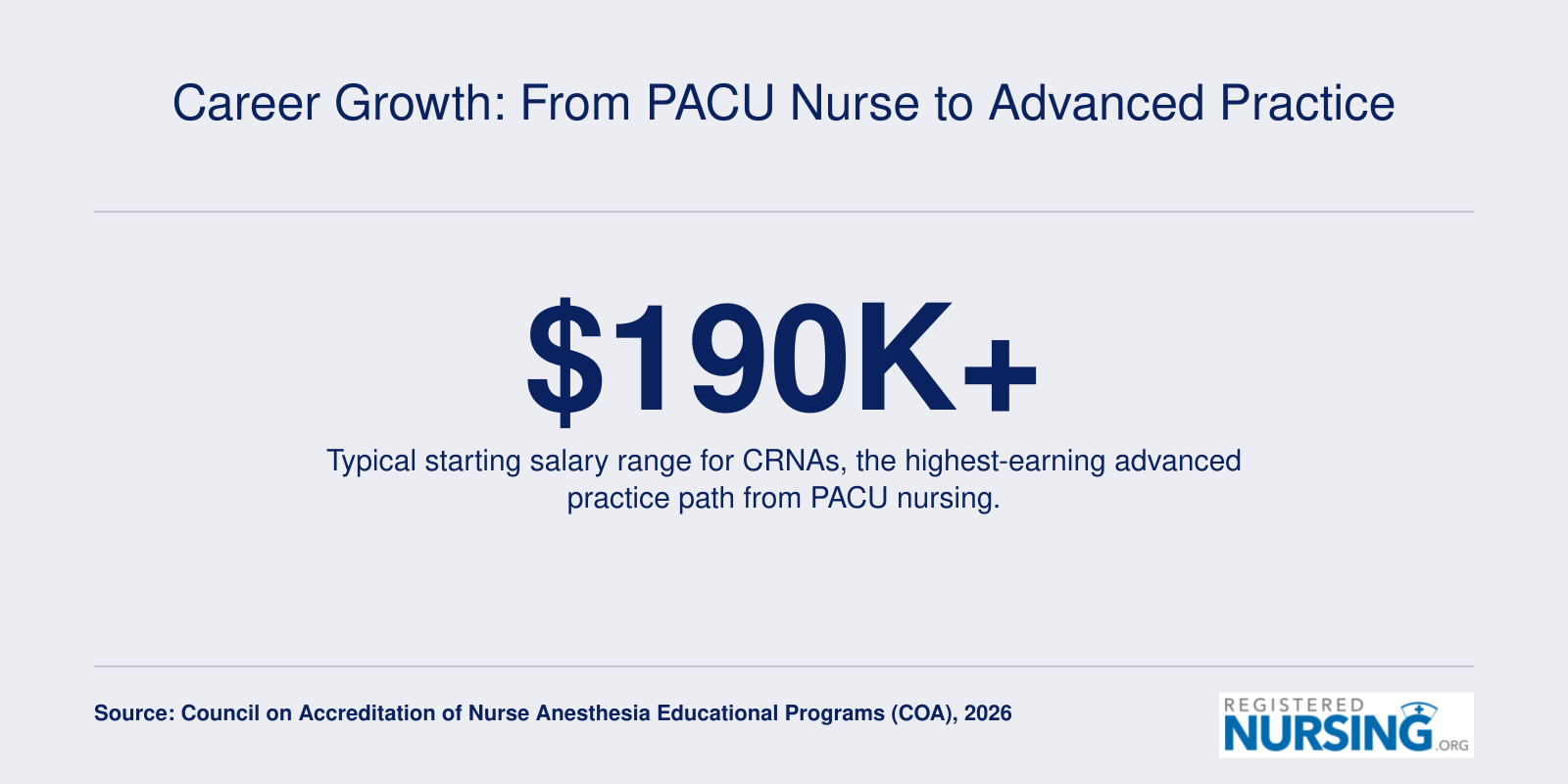
A career in perianesthesia nursing opens multiple advancement pathways, from frontline clinical roles to executive leadership or advanced practice. Bedside PACU nurses can progress to charge nurse positions ($90,000 to $120,000), then move into clinical nurse specialist or nurse educator roles ($90,000 to $145,000), nursing leadership such as director or CNO ($130,000 to $250,000), or pursue a Doctor of Nursing Practice to become a CRNA ($190,000 to $250,000). Notably, most COA-accredited CRNA programs accept qualifying PACU experience as ICU-level critical care experience, making the PACU an excellent launchpad for nurse anesthesia careers.
Where Do Perianesthesia Nurses Work?
Where you work as a perianesthesia nurse shapes nearly every dimension of your day: the intensity of your patients, your schedule, and how much control you have over your personal time. The four most common settings each offer a distinct tradeoff, and knowing those differences can help you choose a position that fits both your clinical goals and your life outside work.
Hospital PACU
The hospital post-anesthesia care unit handles the widest range of cases, from routine laparoscopic procedures to complex cardiac and neurosurgical patients. That breadth means high acuity and strong clinical growth opportunities, but it also comes with unpredictability. On-call requirements are common, particularly at trauma centers and teaching hospitals, and weekend and holiday rotations are standard. For nurses who want exposure to complex presentations and access to specialist teams, the hospital PACU remains the richest training ground.
Ambulatory Surgery Centers
Ambulatory surgery centers (ASCs) are the fastest-growing setting for perianesthesia practice,1 driven by ongoing shifts of elective procedures out of the hospital. Patients arrive, undergo surgery, recover, and go home the same day, which keeps acuity generally lower than inpatient PACUs. Schedules tend to follow business hours, on-call demands are minimal, and weekend work is rare. Many nurses who prioritize work-life balance find ASCs a strong fit, particularly at mid-career. Nurses drawn to outpatient environments may also find that experience as an ambulatory care nurse translates well into this setting.
Freestanding GI and Endoscopy Labs
Gastrointestinal and endoscopy labs focus on procedural sedation for colonoscopies, upper endoscopies, and related procedures. Acuity is typically lower than in surgical PACUs, and the patient flow is high-volume and predictable. These settings almost never require on-call shifts, and hours closely mirror a standard clinic day. The tradeoff is narrower clinical variety, which can feel limiting for nurses seeking ongoing skill development.
Cardiac Catheterization Labs
Cath labs occupy a middle ground. Patients undergoing diagnostic or interventional cardiac procedures can deteriorate quickly, so acuity is higher than in an endoscopy suite. Some facilities require on-call availability for emergent cases. The schedule varies by institution, but many cardiac cath lab nurses work four longer shifts rather than five standard ones, which appeals to nurses who value extended days off.
Across all four settings, perianesthesia nurses earn more than the general registered nurse average,2 a reflection of the specialized monitoring and rapid-response skills the role demands. Your choice of setting is less about salary and more about which patient population and schedule structure you can sustain long-term.
Frequently Asked Questions About Perianesthesia Nursing
Below are answers to some of the most common questions prospective and practicing nurses ask about perianesthesia nursing. For deeper detail on any topic, refer to the corresponding section earlier in this article.
- What is the difference between a perianesthesia nurse and a PACU nurse?
- A PACU nurse is a type of perianesthesia nurse who works specifically in the post anesthesia care unit, monitoring patients as they emerge from sedation. Perianesthesia nursing is the broader specialty that spans all phases of anesthesia care, including preanesthesia assessment, intraoperative support, and post anesthesia recovery. In everyday practice, many facilities use the terms interchangeably, but the scope of perianesthesia nursing is wider.
- How long does it take to become a certified perianesthesia nurse?
- From the start of nursing school, expect roughly four to six years. You will need an ADN (about two years) or a BSN (about four years), followed by passing the NCLEX-RN. After that, most candidates spend at least 1,800 hours in direct perianesthesia patient care before sitting for the CPAN or CAPA certification exam. The total timeline depends on which ADN vs BSN degree path you choose and how quickly you accumulate clinical hours.
- How much does a perianesthesia nurse make?
- According to recent Bureau of Labor Statistics data, registered nurses earn a median annual salary of approximately $86,070 nationally. Perianesthesia nurses with specialty certification often earn above that median, with salaries varying by state, metro area, and employer. Refer to the salary tables in this article for state by state and metro level breakdowns.
- What certifications do perianesthesia nurses need?
- Perianesthesia nurses can pursue two credentials offered by the American Board of Perianesthesia Nursing Certification (ABPANC): the Certified Post Anesthesia Nurse (CPAN) for Phase I recovery and the Certified Ambulatory Perianesthesia Nurse (CAPA) for preanesthesia and Phase II care. While certification is voluntary, it is strongly preferred by employers and demonstrates advanced competency in the specialty.
- How long would it take to become a nurse anesthetist (CRNA) starting from perianesthesia nursing?
- If you are already a practicing perianesthesia nurse with a BSN, you will typically need one or more years of critical care experience in an ICU nurse setting, followed by a doctoral level nurse anesthesia program lasting three to four years. From an active perianesthesia role, plan on roughly four to six additional years total. Your PACU background provides a strong clinical foundation, though most CRNA programs require dedicated ICU hours.
- Can you work as a perianesthesia nurse with an ADN instead of a BSN?
- Yes. Many hospitals and ambulatory surgery centers hire ADN prepared registered nurses for perianesthesia roles. However, a growing number of employers prefer or require a BSN, especially at academic medical centers and Magnet designated facilities. If you hold an ADN, an RN to BSN bridge program can strengthen your qualifications and open doors to advancement, including eligibility for graduate programs.
Resources and Professional Organizations for Perianesthesia Nurses
Some perianesthesia nurses lean on national organizations for standards and certification, while others find the most value in local chapter events and peer networks. The specialty rests on both pillars, and the strongest careers draw from a mix of these resources.
National Organizations and Certification Resources
The American Society of PeriAnesthesia Nurses (ASPAN) is the primary professional organization for PACU and perianesthesia nurses. Membership includes access to the ASPAN Standards of Perianesthesia Nursing Practice, which define evidence-based clinical guidelines for all phases of care. Members also receive discounted registration for the annual ASPAN National Conference, a multi-day event featuring expert speakers, hands-on workshops, and poster presentations. Additionally, ASPAN publishes the Journal of PeriAnesthesia Nursing (see below) and offers networking through component chapters.
For certification specifically, the American Board of Perianesthesia Nursing Certification (ABPANC) administers the CPAN and CAPA exams. ABPANC's website provides detailed exam handbooks, sample questions, and recertification requirements. Study resources include official practice tests and recommended reading lists, helping nurses prepare systematically.
The Journal of PeriAnesthesia Nursing
This peer-reviewed journal is the official research publication for the specialty. It publishes original studies, case reports, clinical reviews, and guideline updates relevant to pre-procedure, intra-procedure, and post-anesthesia care. Many ASPAN members access it as a membership benefit, and it serves as a key reference for evidence-based practice.
Continuing Education and Local Chapters
Maintaining certification requires ongoing education. ASPAN's online CE portal offers on-demand modules covering pain management, airway emergencies, and updated standards. Other platforms also include perianesthesia-focused courses that count toward licensure and certification renewal. Beyond digital platforms, local ASPAN chapters frequently organize in-person seminars, study groups, and networking events that provide both CE hours and collegial support. Nurses who want to broaden their clinical perspective sometimes explore related specialties, such as burn care nursing or neuroscience nursing, to better understand patient populations that frequently transition through the perioperative setting.
Explore More
- Ambulatory Care Nurse
- Burn Unit Nurse
- Cardiac Nurse
- Cath Lab Nurse
- Charge Nurse
- Chief Nursing Officer (CNO)
- Correctional Nurse
- CVOR Nurse
- Dermatology Nurse
- Developmental Disability Nurse
- Director of Nursing
- Domestic Violence Nurse
- Emergency Room Nurse
- ENT Nurse
- ET Nurse
- Fertility Nurse
- Flight/Transport Nurse
- Forensic Nurse Salary & Career Guide
- Genetic Nurse
- Geriatric Nurse
- Health Policy Nurse
- Healthcare Administrator
- Healthcare Manager
- Home Health Nurse
- Hospice Nurse
- Camp Nurse
- GI Nurse
- Holistic Nurse
- Labor and Delivery Nurse
- Nurse Writer
- Psychiatric Nurse
- School Nurse
- Telemetry Nurse
- Travel Nurse
- Aesthetic Nurse
- Infusion/IV Nurse
- Oncology Nurse
- ICU Nurse
- Infection Control Nurse
- Legal Nurse Consultant
- LTC Nurse
- Managed Care Nurse
- Medical-Surgical Nurse
- Military (Combat) Nurse
- Missionary Nurse
- Mother Baby Nurse
- Nephrology Nurse
- Neuroscience Nurse
- NICU Nurse
- Nurse Administrator
- Nurse Attorney
- Nurse Care Coordinator
- Nurse Case Manager
- Nurse Entrepreneur
- Nurse Executive
- Nurse Health Coach
- Nurse Manager
- Obstetric (OB) Nurse
- Occupational Health Nurse
- Operating Room Nurse
- Ophthalmic Nurse
- Organ Procurement Coordinator
- Orthopedic Nurse
- Pain Management Nurse
- Palliative Care Nurse
- Parish Nurse
- Patient Advocate Nurse
- Pediatric Endocrinology Nurse
- Perinatal Nurse
- Plastic Surgery Nurse
- Public/Community Health Nurse
- Radiology Nurse
- Rehabilitation Nurse
- Research Nurse
- Respiratory Nurse
- Rheumatology Nurse
- Substance Abuse Nurse
- Telephone Triage Nurse
- Transcultural Nursing
- Transplant Nurse
- Trauma Nurse
- Wound Care Nurse (WOCN)