

What you’ll learn in this article…
- PCCN certification carries a 79 percent first-time pass rate.
- Most hospitals now prefer a BSN for telemetry unit hires.
- Specialty certification is linked to higher pay and faster advancement.
In a hospital, cardiac monitoring ranges from the one-to-one surveillance of an ICU to the periodic checks on a general medical floor. Telemetry nursing sits between these extremes, providing continuous remote cardiac monitoring for patients whose conditions are serious but not critical enough for intensive care. These nurses track real-time rhythms on centralized screens, watching for early signs of decompensation.
Typical telemetry patients include those recovering from open-heart surgery, managing heart failure exacerbations, presenting with new-onset arrhythmias, or undergoing chest pain observation. The work demands rapid clinical judgment and an intimate knowledge of electrocardiogram interpretation.
As hospitals shift more care to progressive care units, telemetry nursing has become a fast-growing specialty that bridges the gap between emergency care nursing and critical care intensity, drawing nurses who want meaningful cardiac monitoring experience without the full intensity of an ICU assignment.
Telemetry Nursing Vs. ICU, Step-Down, and Cardiac Cath Lab Roles
Understanding how telemetry nursing fits among related roles helps you chart a deliberate career path. Each unit shares a focus on monitoring and cardiac physiology, yet differs significantly in patient acuity, required skills, and daily pace.
Telemetry vs. ICU Telemetry nurses care for patients who are medically complex but stable enough not to need continuous one-on-one intervention. ICU nurses manage the most critically ill patients, often on mechanical ventilators or multiple vasoactive drips, with a lower nurse-to-patient ratio (typically 1:2 versus telemetry's 1:4 or 1:5). ICU demands faster, higher-stakes decision-making and a deeper command of invasive monitoring. Many experienced telemetry nurses transition to the ICU as a logical step toward critical care.
Telemetry vs. Step-Down Step-down units (also called progressive care units) sit between telemetry and the ICU on the acuity spectrum. In practice, the distinction is often institutional: some hospitals label their continuous-monitoring floors "telemetry," while others call them "step-down." Both require strong rhythm interpretation skills and comfort with frequent reassessment, making the roles largely interchangeable in many settings.
Telemetry vs. Cardiac Cath Lab The cardiac cath lab nurse works in a procedure-based environment, assisting with catheterizations, angioplasties, and stent placements rather than managing an ongoing patient assignment. Cath lab shifts are more task-focused and procedurally intensive, often without overnight call in community hospitals. Telemetry experience is a common and valued pathway into cath lab nursing because it builds the cardiac assessment foundation those procedures demand.
Choosing Your Path If you thrive on continuous monitoring and building rapport with patients over a shift, telemetry is a strong fit. If you prefer acute procedural work, the cath lab may appeal. For those drawn to the highest-acuity environment, pursuing cardiac care nursing or ICU experience first is a well-traveled route. Knowing where each role sits on the acuity and workflow spectrum lets you make an intentional move rather than simply accepting the next available opening.
How to Become a Telemetry Nurse Step by Step
Most hospitals now require or strongly prefer a Bachelor of Science in Nursing for telemetry unit hires, shifting the baseline for entry into cardiac monitoring roles. The traditional pathway remains intact, but educational expectations have risen as patient acuity climbs and hospitals pursue Magnet designation.
Earn Your Nursing Degree and Pass the NCLEX-RN
Begin by completing an Associate Degree in Nursing or a Bachelor of Science in Nursing from an accredited program. ADN programs typically take two years, while BSN programs require four years. Both lead to RN licensure, but ADN graduates increasingly face narrower hiring prospects in acute-care telemetry units. After graduation, pass the NCLEX-RN examination and apply for state licensure. Many ADN holders pursue nursing bridge programs during their first year of practice to meet hospital BSN preferences, opening doors to telemetry positions that might otherwise remain closed.
Build Foundational Clinical Experience
Telemetry units rarely hire brand-new nurses, because cardiac monitoring demands fluency in rhythm interpretation, hemodynamic assessment, and rapid response to unstable patients. Plan to work one to two years in a medical-surgical unit, progressive care, or step-down setting to develop time management, critical-thinking skills, and comfort with sicker populations. This experience teaches you to prioritize multiple patients, recognize subtle deterioration, and communicate effectively with the care team. Some academic medical centers and large health systems now offer telemetry residency programs that accept new graduates directly into structured mentorship tracks, compressing the timeline for those who match into competitive cohorts.
Apply to Telemetry Positions and Continue Learning
Once you have accrued the necessary floor experience, apply to open telemetry positions at hospitals that align with your career goals. Most candidates reach a telemetry role three to five years after starting nursing school: two to four years of education plus one to two years of bedside practice. During your first months on the unit, expect intensive orientation focused on rhythm strip interpretation, cardiac pathophysiology, and titration of vasoactive medications. Facilities typically pair new telemetry nurses with preceptors for eight to twelve weeks. Nurses who later want to expand their scope often explore roles such as critical care nursing or transition into other high-acuity specialties.
Is Telemetry Nursing Hard?
Yes, the learning curve is steep. Rhythm interpretation can feel overwhelming when you are juggling four to six monitored patients, each on multiple drips and requiring hourly assessments. However, the challenge is achievable with structured mentorship, regular practice reading strips, and willingness to ask for help. Most telemetry nurses report confidence within six to twelve months as pattern recognition solidifies and clinical judgment matures.
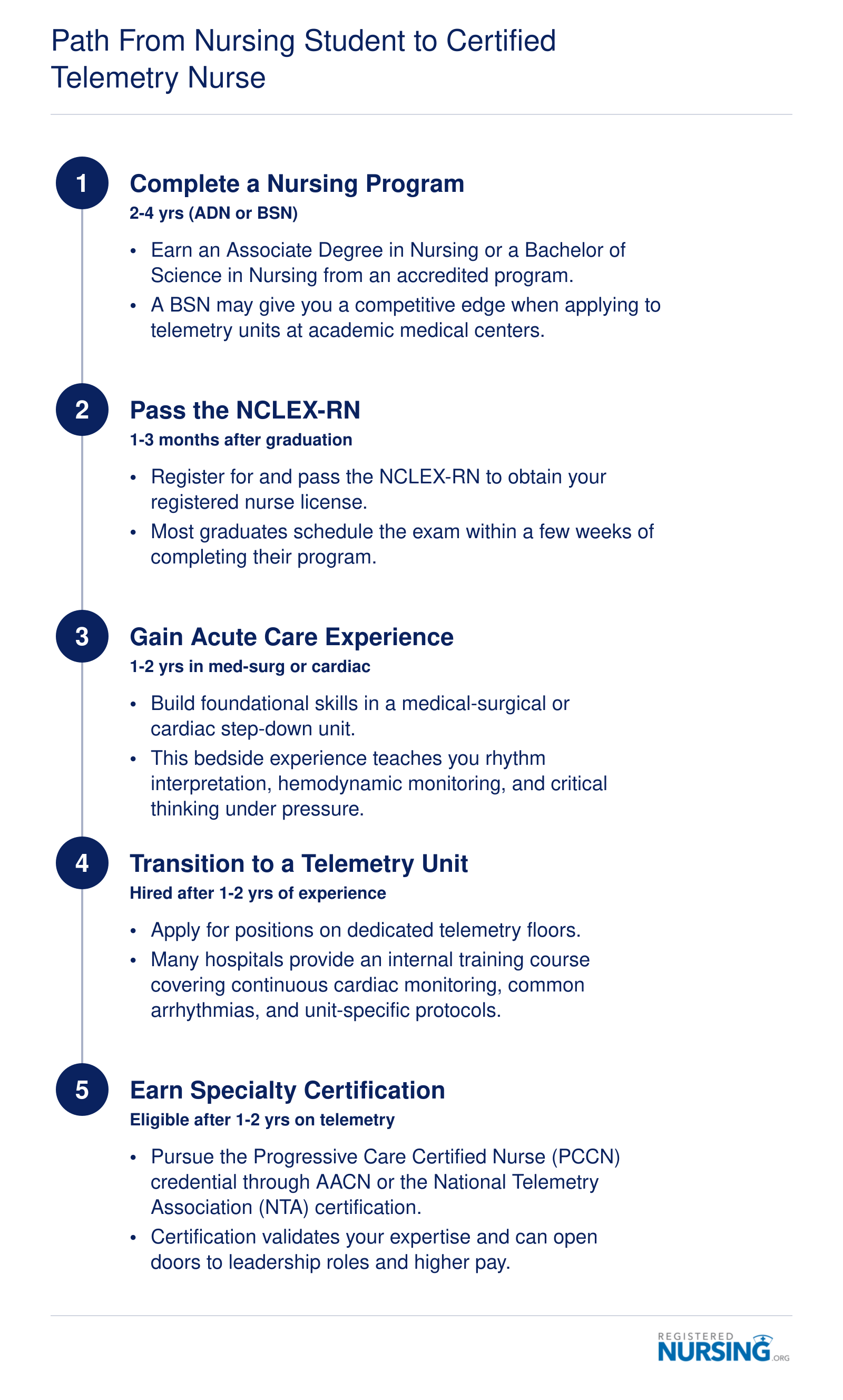
Path From Nursing Student to Certified Telemetry Nurse
The journey from nursing student to certified telemetry nurse follows a clear progression. Each stage builds the clinical knowledge and hands-on experience needed before pursuing specialty certification.
What Does a Telemetry Nurse Do on a Daily Basis?
Telemetry nurses juggle continuous cardiac surveillance, rapid clinical decision-making, and hands-on patient care across twelve-hour shifts. The role demands technical proficiency with cardiac monitors, clinical judgment to distinguish critical events from background noise, and clear communication with interdisciplinary teams.
Continuous Cardiac Monitor Surveillance and Rhythm Interpretation
The hallmark of telemetry nursing is real-time monitoring of cardiac rhythms. Throughout each shift, nurses interpret EKG tracings displayed at central stations and bedside monitors. They identify arrhythmias such as atrial fibrillation, ventricular tachycardia, heart blocks, and ST-segment changes that signal ischemia. When a dangerous rhythm appears, the telemetry nurse initiates protocols, notifies the provider, and prepares emergency interventions. Many units require nurses to document rhythm strips in the patient chart at regular intervals and whenever abnormal findings occur.
Medication Administration and IV Management
Telemetry patients frequently receive complex medication regimens. Nurses administer antiarrhythmics such as amiodarone and metoprolol, anticoagulants including heparin and warfarin, and vasopressors or inotropes for hemodynamic support. Each drug demands careful titration, monitoring for therapeutic effect, and vigilance for adverse reactions. IV management is constant: nurses place and maintain peripheral lines, manage central venous catheters, and troubleshoot infusion pumps. Boluses, drip-rate adjustments, and fluid balance calculations are routine.
Alarm Management and Clinical Judgment
Telemetry floors generate hundreds of monitor alarms each shift. A critical competency is distinguishing actionable alarms from artifact caused by patient movement, loose leads, or electrical interference. Inexperienced nurses may respond to every alert, while seasoned telemetry nurses recognize patterns and prioritize true clinical events. This skill protects patients from alarm fatigue and ensures urgent situations receive immediate attention.
Patient Education and Discharge Teaching
Telemetry nurses translate complex cardiac care diagnoses into language patients and families understand. They explain why continuous monitoring is necessary, what specific rhythms mean, and how medications work. Before discharge, nurses teach patients about new prescriptions, dietary modifications (such as sodium restriction or anticoagulation diet considerations), activity restrictions, and warning signs that require emergency care.
Interdisciplinary Collaboration and Documentation
Telemetry care requires coordination with cardiologists, hospitalists, electrophysiologists, respiratory nurses, and rapid response teams. Nurses relay clinical changes during rounds, call providers for new orders, and activate emergency protocols when patients decompensate. Documentation load is substantial: nurses chart assessments, rhythm interpretations, interventions, medication responses, and patient education throughout the shift. Typical nurse-to-patient ratios on telemetry units range from four to one up to five to one, depending on acuity and hospital staffing models.
Telemetry Nurse Certifications Compared: PCCN Vs. NTA Vs. AACN Credentials
The PCCN exam, administered by the American Association of Critical-Care Nurses, carries a first-time pass rate of 79 percent and is widely regarded as the gold standard credential for progressive care and telemetry nurses. Understanding what each certification offers, and what it costs, helps you decide which path fits your career stage and your employer's expectations.
The Legal Baseline vs. Employer Reality
No state board of nursing requires a telemetry-specific certification to work in a telemetry unit. Your active, unencumbered RN license is the only legal requirement to practice. That said, employer expectations vary considerably. Academic medical centers and large health systems frequently list PCCN as preferred, or even required, for experienced telemetry positions. Community hospitals are more likely to accept unit-based competency validation in place of a national credential. Travel nursing agencies occupy a middle ground: a growing number of telemetry contracts explicitly list PCCN or an equivalent as a preferred qualification, which can affect your placement options and contract rates.
Framing certification as a career accelerator rather than a gatekeeper is the most honest way to think about it. Nurses who hold a recognized credential tend to move into charge nurse and preceptor roles faster, and the credential signals a level of specialty knowledge that matters during performance reviews and salary negotiations.
PCCN at a Glance
The PCCN is offered by AACN and targets nurses working in progressive care, step-down, and telemetry settings. Eligibility requires a current, unencumbered U.S. RN or APRN license plus 1,750 clinical hours in the past two years, with at least 875 of those hours logged in the most recent year.2 The exam consists of 150 questions and has a 180-minute time limit. Testing takes place at PSI test centers or through live remote proctoring.
- Exam fee: $260 for AACN members, $375 for non-members2
- Renewal cycle: Every three years4
- Renewal fee: $150 for members, $230 for non-members4
- Employer recognition: Broadly recognized as a national specialty certification
NTA Telemetry Certification at a Glance
The National Telemetry Association offers a lower-barrier alternative. There is no RN license requirement and no minimum practice-hour threshold, making it accessible to monitor technicians and other allied health professionals, not just registered nurses.2 The exam has 100 questions and a 120-minute time limit, delivered online through the NTA platform in proctored or non-proctored formats.
- Exam fee: $90
- Renewal cycle: Every two years
- Renewal fee: $70
- Employer recognition: Not broadly recognized as a major nursing specialty certification; pass rate is not published
Which One Should You Pursue?
For RNs whose primary goal is career advancement within hospital systems, negotiating becoming a travel nurse contracts, or positioning for leadership roles, the PCCN is the stronger investment. The higher cost and stricter eligibility requirements reflect the credential's weight in the job market. The NTA certification can serve as a supplemental signal of rhythm interpretation knowledge, particularly earlier in a career before you accumulate the practice hours PCCN requires, but it should not be treated as a substitute at most acute-care employers. If your budget is a factor, AACN membership can reduce your exam fee substantially, often making membership worthwhile on the cost of a single exam alone. For a broader look at credentials available to specialty nurses, Nursing Certifications offers a helpful overview of options across practice areas.
Certification Exam Prep: Content Domains and Study Strategies
Passing the PCCN or NTA telemetry certification exam requires focused preparation across a broad clinical content base, typically over six to eight weeks of structured study. Understanding the test blueprint and aligning your study plan with the content domains tested gives you the clearest path to success.
PCCN Exam Structure and Content Domains
The PCCN examination consists of 150 multiple-choice questions administered over 150 minutes. Of these, 125 questions are scored while 25 are pretest items that do not affect your result. The exam divides its content into two major categories: clinical judgment (80 percent of scored questions) and professional caring and ethical practice (20 percent). Within the clinical judgment domain, cardiovascular topics account for 20 percent of the exam, reflecting the centrality of cardiac monitoring and intervention in telemetry practice. Other content domains include pulmonary, endocrine, hematology and immunology, neurology, gastrointestinal, renal, multisystem, and behavioral and psychosocial topics. A passing scaled score of 68 is required, and the first-time pass rate in 2025 was 79 percent, a figure that underscores the importance of thorough preparation.
Recommended Study Resources
The AACN offers its own PCCN Certification Review, an online self-paced course that maps directly to the exam blueprint and provides case-based scenarios mirroring the clinical judgment format.2 Pairing this with the AACN TestRun Practice Exam gives you a realistic preview of question style and difficulty.3 Third-party resources include the PCCN Study Guide 2025-2026 by Lydia Morrison, available through retailers, and the FREE PCCN Study Guide 2026 from Career Employer, which provides structured self-study frameworks at no cost.4 Mobile learners can access PCCN Exam Prep apps on Android, offering practice questions and timed simulations on the go. For rhythm interpretation, dedicated EKG practice tools and online strip libraries help sharpen the pattern-recognition skills essential to telemetry nursing.
Practical Study Strategies
Begin your preparation six to eight weeks before your test date. Create a study calendar that allocates time to each content domain based on its exam weight and your personal confidence level. Use your daily unit experience as a study aid: when you encounter a patient with atrial fibrillation, review the pathophysiology, treatment algorithms, and potential complications that evening. Nurses who hold or are pursuing Critical Care Nurse Certification often use a similar domain-based study approach, and many of the strategies transfer well to PCCN prep. Form study groups with colleagues preparing for the same exam to discuss case scenarios, quiz each other on rhythm strips, and share mnemonic devices. Many successful candidates report that teaching content to a peer solidifies their own understanding. Finally, take at least one full-length practice exam under timed conditions to build stamina and identify any remaining knowledge gaps before test day.
Where Do Telemetry Nurses Work?
Where can you practice telemetry nursing beyond a traditional hospital floor? Telemetry nurses work in a diverse range of settings, each offering distinct patient populations, acuity levels, and workflow models. Understanding these environments helps you target the practice setting that aligns with your career goals and preferred patient mix.
Hospital Telemetry and Progressive Care Units
The majority of telemetry nurses work in hospital-based progressive care or step-down units, where patients require continuous cardiac monitoring but not the full ventilator or vasoactive drip support typical of critical care nursing. Large academic medical centers typically operate dedicated telemetry floors staffed exclusively with certified telemetry and cardiac nurses, often handling higher-acuity cases such as post-procedural cardiac patients, acute heart failure exacerbations, and complex arrhythmia management. In contrast, smaller community hospitals frequently combine telemetry with medical-surgical responsibilities, meaning you may care for telemetry-monitored cardiac patients alongside general medical admissions on the same unit.
Cardiac Step-Down and Specialty Units
Many hospitals maintain standalone cardiac step-down units that bridge the gap between the cardiovascular ICU and general telemetry floors. These units serve patients immediately post-catheterization, after open-heart surgery, or during active titration of cardiac medications. Telemetry training is foundational for these roles, and nurses often pursue Cardiac Vascular Nurse Certification to differentiate their expertise.
Remote Telemetry Monitoring Centers
A growing niche within telemetry nursing involves centralized monitoring stations where nurses review rhythm strips and alert bedside staff to critical changes across multiple hospital units or even multiple facilities. Remote cardiac monitoring positions allow experienced telemetry nurses to leverage their interpretive skills in a more focused role, often with schedule flexibility and reduced physical patient care demands. Nurses interested in this model may also want to explore remote nursing jobs more broadly, as centralized monitoring roles share many characteristics with other work-from-home RN positions. These roles typically require prior bedside telemetry experience and strong proficiency in arrhythmia recognition.
Travel Nursing Assignments
Telemetry ranks among the highest-demand specialties in travel nursing, driven by chronic staffing shortages in progressive care units nationwide. Travel agencies actively recruit telemetry-certified nurses for 13-week contracts that often command premium hourly rates and housing stipends. National certification through AACN or NTA frequently differentiates candidates for the most competitive assignments, and hospitals in underserved or high-turnover markets may offer sign-on bonuses or contract extensions to retain skilled travelers.
Telemetry Nurse Salary: National Overview
Because the Bureau of Labor Statistics groups telemetry nurses under the broader Registered Nurses category, the figures below reflect national wage data for all RNs. Telemetry nurses with specialty certification or experience in high-acuity cardiac monitoring units often earn toward the upper end of this range. The following table draws from the most recent Occupational Employment and Wage Statistics published by the BLS (2024 data).
| Wage Measure | Annual Salary |
|---|---|
| 25th Percentile | $78,610 |
| Median (50th Percentile) | $93,600 |
| Mean (Average) | $98,430 |
| 75th Percentile | $107,960 |
Telemetry Nurse Salary by State
Telemetry nurses are classified under the broader registered nurses category by the Bureau of Labor Statistics, so the figures below reflect RN wages across each state. Actual telemetry nurse compensation may vary based on specialty certification, facility type, and shift differentials. Data is drawn from the Occupational Employment and Wage Statistics program (2024).
| State | Total RNs Employed | 25th Percentile | Median Salary | 75th Percentile | Mean Salary |
|---|---|---|---|---|---|
| Rhode Island | 10,760 | $83,870 | $99,960 | $112,540 | $99,770 |
| Arizona | 64,430 | $81,390 | $96,890 | $105,450 | $95,230 |
| New Hampshire | 16,580 | $79,720 | $96,830 | $105,500 | $94,620 |
| Maryland | 48,980 | $81,470 | $96,830 | $104,840 | $96,650 |
| Colorado | 54,510 | $81,790 | $96,520 | $104,370 | $95,470 |
| Delaware | 13,260 | $82,600 | $92,610 | $108,360 | $95,450 |
| Texas | 261,050 | $77,450 | $90,010 | $102,200 | $91,690 |
| Virginia | 77,420 | $77,650 | $88,820 | $100,920 | $90,930 |
| New Mexico | 17,510 | $82,630 | $88,260 | $104,720 | $94,360 |
| Pennsylvania | 146,840 | $78,570 | $87,610 | $102,030 | $90,830 |
| Georgia | 97,410 | $76,600 | $86,560 | $104,790 | $91,960 |
| Illinois | 139,900 | $79,150 | $86,410 | $103,660 | $91,130 |
| Idaho | 14,540 | $78,020 | $86,100 | $100,220 | $89,770 |
| Wisconsin | 64,960 | $79,570 | $86,070 | $100,680 | $90,450 |
| Michigan | 104,210 | $80,030 | $85,670 | $101,210 | $90,580 |
| Vermont | 7,240 | $79,980 | $85,150 | $104,110 | $92,710 |
| Maine | 16,280 | $76,890 | $82,860 | $98,000 | $87,440 |
| Florida | 218,100 | $77,070 | $82,850 | $99,260 | $88,200 |
| Utah | 25,780 | $77,030 | $82,270 | $101,530 | $88,240 |
| North Carolina | 108,510 | $74,710 | $81,860 | $98,720 | $86,270 |
| Wyoming | 5,180 | $75,540 | $81,790 | $100,910 | $88,020 |
| Montana | 10,540 | $77,800 | $81,560 | $100,510 | $88,480 |
| Ohio | 138,360 | $77,420 | $81,250 | $97,440 | $86,110 |
| Oklahoma | 32,870 | $75,320 | $81,160 | $96,460 | $85,800 |
| Nebraska | 24,180 | $76,430 | $81,020 | $93,140 | $82,890 |
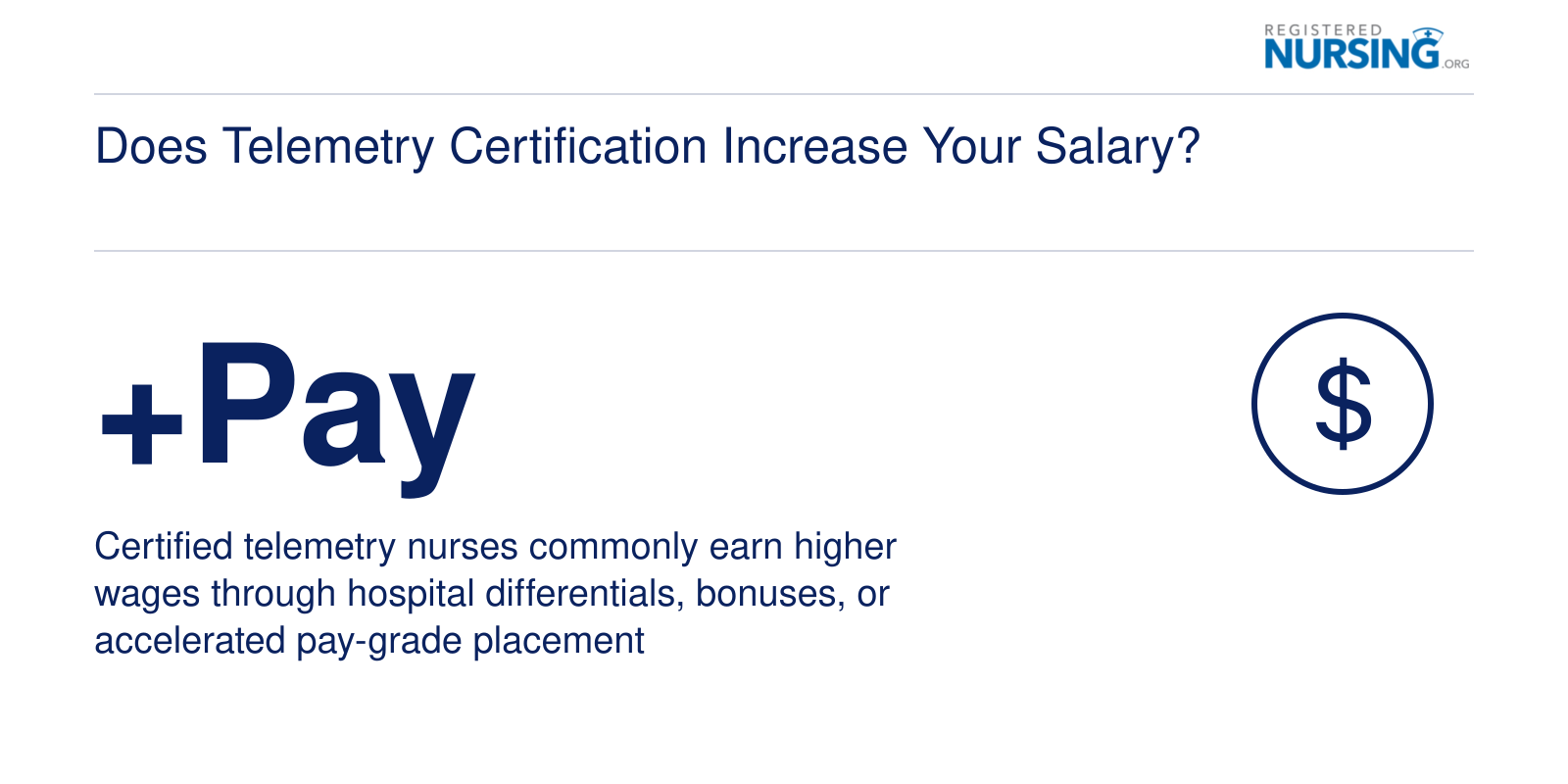
Does Telemetry Certification Increase Your Salary?
While exact dollar figures vary by employer, region, and experience level, holding a specialty certification in telemetry or progressive care nursing is widely associated with higher compensation. Many hospitals offer certification pay differentials or bonuses to nurses who earn credentials such as the PCCN. To get the clearest picture for your market, consult salary data from the Bureau of Labor Statistics (BLS.gov), review compensation surveys published by the American Association of Critical-Care Nurses (AACN), check posted pay scales on hospital career pages, and compare real-world reports from nurses on professional networking sites and nursing forums.
Highest-Paying Metro Areas for Telemetry Nurses
Because federal data does not break out telemetry nurses separately, the figures below reflect registered nurse wages across major metropolitan areas, drawn from the Occupational Employment and Wage Statistics program (2024). Telemetry nurses in these metros can expect compensation in line with, or slightly above, these RN benchmarks, particularly in facilities with high cardiac acuity. The table is sorted by mean annual wage to highlight the metros where earning potential is strongest.
| Metropolitan Area | Total RN Employment | Mean Annual Wage | 25th Percentile | Median Annual Wage | 75th Percentile |
|---|---|---|---|---|---|
| San Francisco, Oakland, Fremont, CA | 40,750 | $178,450 | $150,580 | $188,020 | $212,190 |
| Los Angeles, Long Beach, Anaheim, CA | 107,340 | $138,010 | $108,150 | $133,440 | $165,290 |
| Seattle, Tacoma, Bellevue, WA | 37,250 | $120,260 | $101,140 | $118,570 | $132,160 |
| Boston, Cambridge, Newton, MA and NH | 66,440 | $115,710 | $84,200 | $102,440 | $137,160 |
| New York, Newark, Jersey City, NY and NJ | 195,470 | $115,650 | $100,530 | $113,490 | $128,430 |
| Minneapolis, St. Paul, Bloomington, MN and WI | 40,510 | $102,790 | $87,670 | $102,240 | $116,000 |
| Washington, Arlington, Alexandria, DC, VA, MD, WV | 43,640 | $102,510 | $83,570 | $101,800 | $110,760 |
| Philadelphia, Camden, Wilmington, PA, NJ, DE, MD | 74,840 | $97,510 | $84,040 | $99,210 | $107,800 |
| Dallas, Fort Worth, Arlington, TX | 72,640 | $96,720 | $79,170 | $98,740 | $106,850 |
| Houston, Pasadena, The Woodlands, TX | 65,300 | $96,730 | $79,640 | $97,810 | $105,970 |
| Atlanta, Sandy Springs, Roswell, GA | 54,370 | $96,640 | $79,700 | $96,370 | $107,550 |
| Phoenix, Mesa, Chandler, AZ | 46,330 | $96,220 | $82,270 | $98,160 | $105,900 |
| Chicago, Naperville, Elgin, IL and IN | 100,620 | $94,580 | $81,320 | $96,480 | $104,730 |
| Detroit, Warren, Dearborn, MI | 44,280 | $92,680 | $81,140 | $88,980 | $101,880 |
| Miami, Fort Lauderdale, West Palm Beach, FL | 59,880 | $92,070 | $78,240 | $85,610 | $103,110 |
Career Path and Advancement for Telemetry Nurses
Hospitals continue to expand progressive care units as they seek alternatives to costly intensive care beds, creating a sustained pipeline of advancement opportunities for telemetry nurses. For experienced telemetry RNs, progression typically follows a well-defined ladder, beginning with specialty certification and culminating in either advanced practice or leadership roles tailored to acute cardiac care.
Staff Nurse to Charge Nurse
Most telemetry nurses begin as staff RNs on a progressive care or step-down unit. After gaining two to three years of experience and earning the Progressive Care Certified Nurse credential, the next step is often a charge nurse position. Charge nurses coordinate shift assignments, troubleshoot staffing gaps, and serve as the clinical resource for less experienced colleagues. Many organizations prefer candidates who have demonstrated proficiency in arrhythmia interpretation and de-escalation of high-acuity patients.
Leadership and Education Tracks
From the charge role, telemetry nurses can pursue two parallel paths. The clinical educator track involves designing unit-based competency programs, leading cardiac rhythm workshops, and mentoring new graduates through residency rotations. The unit manager or assistant nurse manager track shifts focus to budget oversight, quality metrics, and regulatory compliance. Both pathways typically require or strongly favor a Bachelor of Science in Nursing degree, and many managers complete a Master of Science in Nursing with a concentration in nursing administration or health systems leadership. Resources on nurse manager leadership recommendations can help nurses prepare for these responsibilities.
Lateral Moves Into Critical Care
Telemetry experience is widely considered a springboard to intensive care, cardiac catheterization labs, and electrophysiology suites. Progressive care units expose nurses to hemodynamic monitoring, vasoactive drips, and rapid-response scenarios that closely mirror critical care nurse workflows. Once telemetry nurses accumulate the requisite ICU hours, they can pursue the Critical Care Registered Nurse certification, creating a natural credential ladder from PCCN to CCRN.
Advanced Practice and Long-Term Trajectories
Nurse practitioner specialization in acute care or cardiology is a common long-term goal for telemetry nurses. Acute Care Nurse Practitioner and Adult-Gerontology Acute Care Nurse Practitioner programs prepare graduates to manage complex cardiovascular cases in hospital settings. According to the Bureau of Labor Statistics, employment of registered nurses is projected to grow 5 percent from 2024 to 2034, with approximately 189,100 openings each year.1 Progressive care and cardiac specialties are expected to see comparable or slightly higher demand as the population ages and chronic heart conditions rise. Nurses aiming for the highest academic credential may also consider best DNP programs to expand into executive or doctoral-level advanced practice roles. This growth translates to steady opportunities for telemetry nurses at every career stage, from bedside clinician to doctoral-prepared advanced practice provider.
Common Questions About Telemetry Nursing
Telemetry nursing attracts a lot of questions from nurses who are weighing specialty options. Below are straightforward answers to the topics that come up most often.
- How long does it take to become a telemetry nurse?
- Most nurses can transition into a telemetry role within two to four years after earning their initial nursing license. That timeline includes completing an ADN or BSN program (two to four years), passing the NCLEX-RN, and gaining at least one year of acute care experience. Some hospitals hire new graduates into telemetry residency programs, which can shorten the path.
- What is the difference between PCCN and NTA telemetry certification?
- The Progressive Care Certified Nurse (PCCN) credential, offered by the AACN, is a nationally recognized certification that covers a broad range of progressive and step-down care competencies. The National Telemetry Association (NTA) certification is more narrowly focused on cardiac rhythm interpretation and monitoring skills. PCCN generally carries more weight for career advancement, while NTA is a solid entry point for building rhythm analysis expertise.
- Is telemetry nursing hard?
- Telemetry nursing is demanding but manageable with the right preparation. Nurses must interpret cardiac rhythms quickly, manage multiple monitored patients at once, and respond to rapid changes in patient status. Strong critical thinking and comfort with technology are essential. Many nurses describe it as a challenging yet rewarding specialty that sharpens clinical skills applicable across acute care settings.
- What certifications do telemetry nurses need?
- An active RN license is the baseline requirement. Beyond that, most employers prefer or require Basic Life Support (BLS) and Advanced Cardiovascular Life Support (ACLS) certifications. Specialty credentials such as the PCCN or NTA certification are not always mandatory but are increasingly valued for hiring preference, higher pay, and advancement into trauma nurse or leadership roles.
- Can you work as a telemetry nurse with an ADN instead of a BSN?
- Yes. Many hospitals hire ADN-prepared nurses into telemetry units, especially in areas experiencing staffing shortages. However, some facilities, particularly Magnet-designated hospitals, prefer or require a BSN. Pursuing an RN-to-BSN program while working on a telemetry floor is a common strategy that keeps career options open and may lead to higher compensation over time.
- Do travel telemetry nurses need certification?
- Certification is not universally required, but it gives travel nurses a competitive edge. Most staffing agencies expect current BLS and ACLS credentials at a minimum, and many facility contracts list PCCN or equivalent certification as preferred. Having a recognized credential can open access to higher-paying assignments and make a candidate stand out in a crowded applicant pool.
Explore More
- Ambulatory Care Nurse
- Burn Unit Nurse
- Cardiac Nurse
- Cath Lab Nurse
- Charge Nurse
- Chief Nursing Officer (CNO)
- Correctional Nurse
- CVOR Nurse
- Dermatology Nurse
- Developmental Disability Nurse
- Director of Nursing
- Domestic Violence Nurse
- Emergency Room Nurse
- ENT Nurse
- ET Nurse
- Fertility Nurse
- Flight/Transport Nurse
- Forensic Nurse Salary & Career Guide
- Genetic Nurse
- Geriatric Nurse
- Health Policy Nurse
- Healthcare Administrator
- Healthcare Manager
- Home Health Nurse
- Hospice Nurse
- Camp Nurse
- GI Nurse
- Holistic Nurse
- Labor and Delivery Nurse
- Nurse Writer
- Psychiatric Nurse
- School Nurse
- Travel Nurse
- Aesthetic Nurse
- Infusion/IV Nurse
- Oncology Nurse
- ICU Nurse
- Infection Control Nurse
- Legal Nurse Consultant
- LTC Nurse
- Managed Care Nurse
- Medical-Surgical Nurse
- Military (Combat) Nurse
- Missionary Nurse
- Mother Baby Nurse
- Nephrology Nurse
- Neuroscience Nurse
- NICU Nurse
- Nurse Administrator
- Nurse Attorney
- Nurse Care Coordinator
- Nurse Case Manager
- Nurse Entrepreneur
- Nurse Executive
- Nurse Health Coach
- Nurse Manager
- Obstetric (OB) Nurse
- Occupational Health Nurse
- Operating Room Nurse
- Ophthalmic Nurse
- Organ Procurement Coordinator
- Orthopedic Nurse
- Pain Management Nurse
- Palliative Care Nurse
- Parish Nurse
- Patient Advocate Nurse
- Pediatric Endocrinology Nurse
- Perianesthesia (PACU) Nurse
- Perinatal Nurse
- Plastic Surgery Nurse
- Public/Community Health Nurse
- Radiology Nurse
- Rehabilitation Nurse
- Research Nurse
- Respiratory Nurse
- Rheumatology Nurse
- Substance Abuse Nurse
- Telephone Triage Nurse
- Transcultural Nursing
- Transplant Nurse
- Trauma Nurse
- Wound Care Nurse (WOCN)