

What you’ll learn in this article…
- Only 19 percent of U.S. nursing homes met all federal staffing standards in 2024.
- ADN or BSN holders can enter LTC nursing after passing the NCLEX-RN.
- BLS projects 5 percent RN job growth nationwide from 2024 to 2034.
Roughly 1.3 million residents live in the nation's approximately 15,000 nursing homes at any given time, yet fewer than one in five of those facilities met all federal staffing standards as of 2024. The registered nurses who staff these settings, commonly called LTC nurses, provide ongoing care to people with chronic illnesses, disabilities, and age-related conditions across stays that last weeks, months, or even years.
Unlike acute-care hospital nursing, LTC nursing centers on relationship-based care at lower acuity levels. Nurses manage complex medication regimens, coordinate interdisciplinary teams, and monitor gradual changes in residents they know well. Some LTC nurses also pursue a palliative care nurse path, deepening their focus on comfort-focused symptom management within the same resident population. The trade-off between clinical autonomy and resource constraints defines much of the specialty, making facility selection and credential planning especially important for long-term career satisfaction.
What Does a Long-Term Care Nurse Do?
Only about 19 percent of U.S. nursing homes met all federal staffing standards as of 2024,1 which tells you something important about the workload LTC nurses carry every single day.
A Shift from Start to Finish
A long-term care nursing shift begins with handoff report, where the outgoing nurse walks you through every resident who had a change in condition, a new order, or an upcoming procedure. From there, the pace is relentless but rhythmic. Medication passes, which can involve dozens of residents and a wide range of chronic-condition drugs, take up a significant block of the morning. Assessments run parallel: vital signs, skin checks, pain screening, and cognitive status evaluations woven into rounds as you move from room to room.
Wound care nurse responsibilities overlap here: catheter management and post-acute treatments like IV antibiotics or tube feedings come next, depending on your unit's census. By midday, family members call or visit, and the RN is typically the person fielding those conversations, explaining care plans, addressing concerns, and sometimes delivering difficult news.
Charting is constant rather than saved for the end of the shift. In LTC, documentation carries regulatory weight, and incomplete records can trigger survey deficiencies that affect the facility's rating and funding. Understanding nursing charting systems helps new LTC nurses get ahead of that burden before it becomes overwhelming.
The RN's Supervisory Role
In most LTC settings, one RN oversees a team of licensed practical nurses and certified nursing assistants. You are not just a bedside clinician. You delegate tasks, review LPN assessments, coach CNAs on resident-specific care approaches, and make the clinical judgment calls about when a change in condition warrants a call to the attending physician or nurse practitioner. That supervisory layer is one of the sharpest differences between LTC and acute-care nursing, and it requires a comfort with leadership that new grads sometimes underestimate. The role closely mirrors what a charge nurse handles in other inpatient settings.
Staffing Context
Federal rules have required an RN on-site around the clock and a licensed nurse present for 24 hours a day.2 However, the numeric minimum staffing floors that CMS finalized in 2024 were repealed in early 2026,3 leaving specific hours-per-resident-day targets off the books federally, though facilities must still conduct individual assessments to determine appropriate staffing.4 Nationally, RNs averaged roughly 0.55 hours of direct care per resident per day in 2024, while nursing assistants provided closer to 2.45 hours.5 Those numbers shape how you prioritize and triage throughout a shift.
Who You Will Care For
The LTC patient population is far from uniform. On any given shift you might be managing:
- Post-stroke residents: working through rehab goals while monitoring for recurrence or aspiration risk
- Dementia and Alzheimer's patients: requiring behavioral interventions, fall prevention, and careful communication with families
- Chronic heart failure residents: daily weights, fluid restrictions, and symptom surveillance are non-negotiable
- End-of-life and hospice overlap: comfort-focused care, symptom management, and family support often fall squarely on the LTC nurse
Documentation and Compliance
Beyond bedside care, LTC nurses carry a documentation burden that surprises many newcomers. The Minimum Data Set, known as the MDS, is a standardized assessment tool required for Medicare and Medicaid reimbursement. Completing or contributing to MDS assessments, building individualized care plans, and producing compliance-ready records for state and federal surveyors are core responsibilities, not optional extras. If paperwork is not your strength, LTC will push you to develop it quickly.
LTC Nurse Vs. Hospital Nurse: Key Differences
Choosing between long-term care and hospital nursing involves weighing trade-offs in pace, patient relationships, acuity, and compensation. While both paths require the same foundational RN licensure, the day-to-day reality of each setting diverges significantly.
Pace and Acuity
Hospital nursing is typically fast-paced and acute-focused. Nurses in medical-surgical units, intensive care, or emergency care manage patients with rapidly changing conditions, coordinate with multidisciplinary teams, and handle frequent admissions and discharges. Long-term care nursing, by contrast, centers on stability and continuity. LTC nurses care for residents over months or years, managing chronic conditions, administering medications, coordinating with physicians for periodic assessments, and often serving as the primary clinical decision-maker on the floor. The acuity is lower, but the responsibility for comprehensive assessment and early intervention is high.
Patient Relationships
One of the most frequently cited differences is the depth of patient relationships. Hospital nurses may care for a patient for a few days or weeks; LTC nurses often follow the same residents through seasons and milestones. Many LTC nurses describe their work as deeply relational, with time to know residents' preferences, family dynamics, and life stories. Understanding the importance of the nurse-patient relationship for patient care helps explain why so many nurses are drawn to the LTC setting. Hospital nurses value the intellectual challenge and clinical variety of acute care. The trade-off is personal connection versus clinical intensity.
Compensation
Nationally, hospital nurses earn more on average. The median annual wage for hospital-based registered nurses is approximately $75,0301, compared to $66,250 for long-term care nurses.1 Hourly medians reflect the same gap: $34.21 in hospitals versus $30.00 in LTC settings.1 Mean wages follow the same pattern, with hospital RNs averaging $81,680 and LTC nurses $72,090.2 Geographic location, shift differentials, and facility type introduce variability, but the hospital premium is consistent across most states.
Schedule and Lifestyle
Long-term care facilities often offer more predictable schedules. While weekend and holiday rotation still applies, many LTC nurses work straight day or evening shifts without the rotating nights common in hospitals. Hospital nurses frequently rotate through 12-hour shifts and may face mandatory overtime during staffing shortages. For nurses seeking work-life balance or managing family responsibilities, the scheduling flexibility in LTC can be a decisive factor.
Skill Set and Professional Development
Hospital nursing exposes RNs to cutting-edge technology, complex procedures, and a broad range of diagnoses. LTC nursing emphasizes clinical judgment, chronic disease management, wound care, palliative care, and leadership. LTC nurses often function with greater autonomy, particularly in facilities with limited on-site physician presence. Both settings build valuable but distinct competencies.
Long-term care nurses frequently exercise greater clinical autonomy than their hospital counterparts. With limited physician coverage, especially on nights and weekends, an LTC nurse must assess, intervene, and coordinate care with greater independence. This responsibility sharpens decision-making skills early in a career, building confidence that serves nurses well in any setting. It's a demanding aspect of the role, but one that many nurses find professionally rewarding.
How to Become a Long-Term Care Nurse
The path to becoming a long-term care nurse follows the same foundational steps as any registered nursing career, with opportunities to specialize along the way. A BSN is increasingly preferred by employers, but ADN-prepared nurses are still widely accepted in LTC settings, making this an accessible entry point for many aspiring nurses.
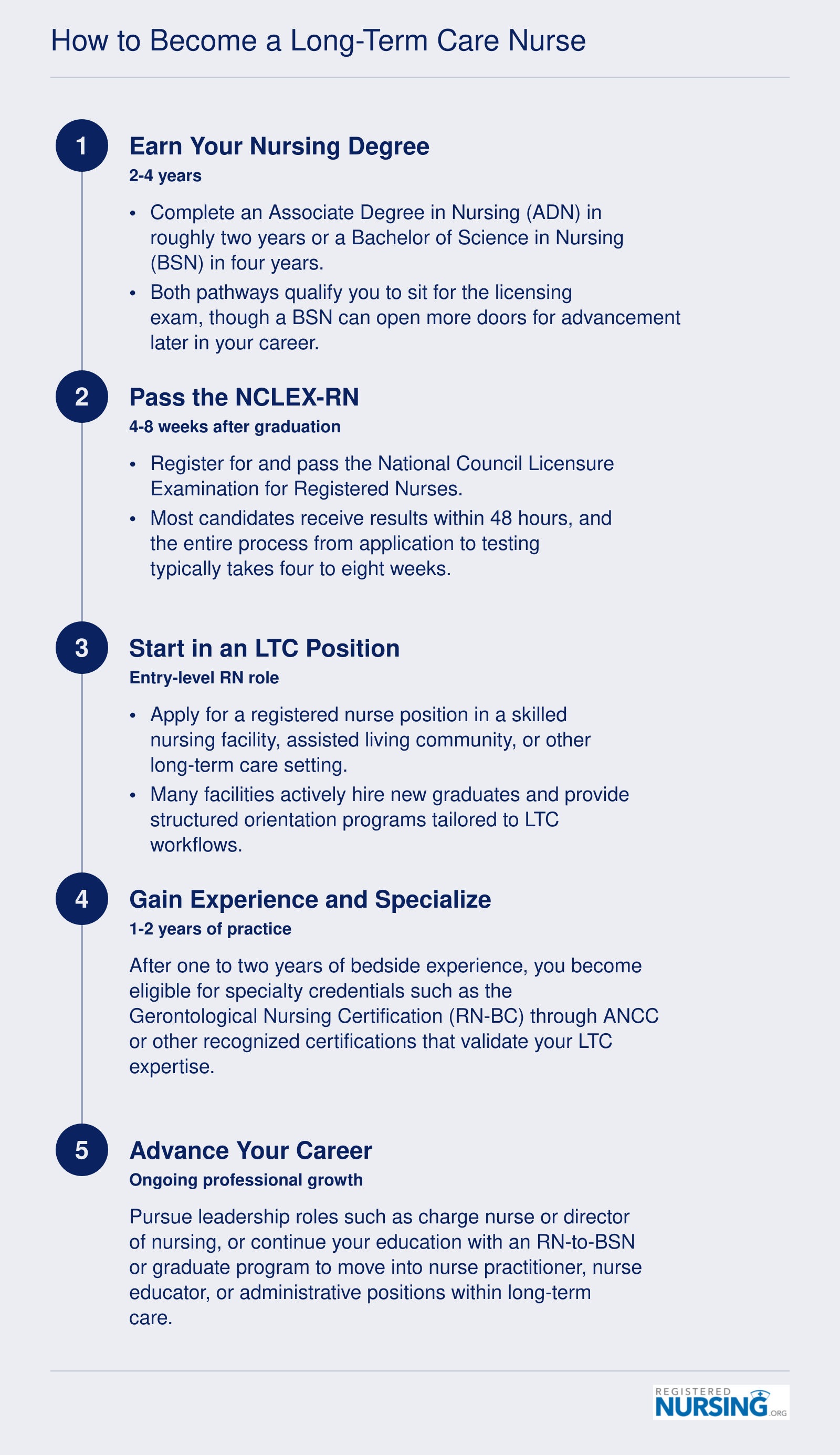
Is Long-Term Care Nursing a Good First Job for New Graduates?
Long-term care nursing is a setting where new graduates care for the same residents over weeks, months, and sometimes years, managing chronic conditions and coordinating a team of LPNs and CNAs. The short answer to whether it makes a good first job: yes, with important caveats. LTC can accelerate the skills that define a strong nurse, but the quality of your first year depends heavily on the employer you choose.
What You Will Gain (and What You May Miss)
A new grad in LTC develops assessment, prioritization, and delegation skills faster than in almost any other setting. When you are the only RN on a unit of 30 to 60 residents, you learn to triage subtle changes, direct a team, and make judgment calls without a rapid response button on the wall. That said, LTC has historically offered less structured preceptorship than hospital-based new grad programs. If you start in a facility with a two-week orientation and no ongoing mentor, the learning curve can feel isolating. Exploring nursing residencies and internships before accepting an offer is one way to compare what structured support actually looks like across settings.
The Growth of LTC Nurse Residencies
Structured nurse residency programs in long-term care are still less common than hospital residencies, but they are expanding through academic partnerships, workforce grants, and state-sponsored initiatives.1 Programs typically run 4 to 12 months and are delivered online or in hybrid formats.1 The University of Utah offers a 9-month online residency across 12 modules.1 New Jersey has funded a 12-month residency with cohorts of around 37 nurses.2 NYU Meyers and the Hartford Institute for Geriatric Nursing (HIGN) run an online residency for long-term care nurses that has posted certification pass rates of 80% in its first cohort and 90% in its second.3 The Geri-Res model out of the University of Wisconsin is built for both new graduates and experienced nurses entering LTC.4
Is 40 Too Old to Go to School for Nursing?
No, and LTC is arguably the most welcoming setting for second-career nurses. Life experience, patience, and the ability to build rapport with older adults and their families are genuine clinical assets in this environment. Many facilities actively recruit career-changers because the emotional maturity translates directly into better resident care. Geriatric nursing rewards the interpersonal depth that people entering the profession later in life often bring.
What to Look for in an LTC Employer
- Orientation length: Aim for a minimum of 6 to 8 weeks on the unit, not two.
- Mentor availability: Ask whether you will be paired with a named preceptor and for how long.
- Residency or fellowship: Ask directly if the facility partners with a formal LTC residency.
- Facility rating: Check the CMS five-star rating on Medicare.gov before you accept an offer.
- Staffing ratios: Ask how many residents you will cover on days, evenings, and nights.
LTC Nurse Certifications and Credentials
Pursuing a specialty certification means weighing the upfront cost and study time against the long-term career gains it can unlock. LTC nurses can choose from several nationally recognized credentials that demonstrate expertise in geriatric, progressive, or wound care, areas central to long-term care. Others focus on infection prevention or nursing leadership, opening doors to management roles. For a broader look at what is available across the profession, the guide on advanced certifications available for nurses is a useful starting point.
Key Certifications for Long-Term Care Nurses
- GERO-BC (Gerontological Nursing): Issued by the American Nurses Credentialing Center (ANCC).1 RNs need 2 years of practice, 2,000 clinical hours in gerontology, and 30 hours of continuing education in the field. The computer-based exam contains 150 questions (125 scored, 25 pretest) over 180 minutes. Renewal is every 5 years.
- PCCN (Progressive Care Certified Nurse): Administered by the American Association of Critical-Care Nurses (AACN). This credential is relevant for LTC nurses who manage patients with complex conditions, like those on ventilators or with cardiac issues. Eligibility includes progressive care clinical hours and an active RN license.
- CWOCN (Certified Wound Ostomy Continence Nurse): Offered by the Wound, Ostomy and Continence Nursing Certification Board (WOCNCB). Nurses complete a WOCN-accredited education program and then pass specialty exams. LTC nurses with this certification become go-to experts in pressure injury prevention and management. The enterostomal therapy nurse specialty overlaps closely with this credential.
- LTC-CIP (Long-Term Care Certification in Infection Prevention): From the Certification Board of Infection Control and Epidemiology (CBIC).2 The credential is designed for professionals in long-term care; it requires post-secondary education in a health-related field and at least one year of recommended infection prevention experience.2 The exam costs $445, scored on a scale of 300-900, with a passing score of 700. Retakes are available after 90 days.3
- Leadership-focused credentials: For nurses aiming for director roles, the DNS-CT (Director of Nursing Services, Certified) from the American Association of Post-Acute Care Nursing (AAPACN) demands 2 years of LTC experience plus 1 year in leadership, with an 80% pass threshold and 2-year renewal.4 The CDONA/LTC (Certified Director of Nursing Administration in Long Term Care) from NADONA requires an active RN license and targets nurse executives.5
Do Certifications Boost Pay or Job Prospects?
While no national data set directly ties each certification to a salary bump, industry surveys and recruiters consistently report that certified nurses stand out. Employers often view certification as proof of specialized competence, which can tip hiring decisions in your favor and accelerate advancement. Some facilities offer differentials or contribute to credential renewal fees. Anecdotally, nurses with wound care or infection control certifications are particularly valued in skilled nursing facilities facing regulatory scrutiny.
MDS 3.0 Training and RAI Certification: Practical Skills That Matter
Beyond board certifications, mastering the Minimum Data Set (MDS) 3.0 and Resident Assessment Instrument (RAI) process is a must for nurses in Medicare- and Medicaid-certified nursing homes. While not formal credentials, these skills are often listed in LTC nurse job descriptions. Completing MDS training through organizations like AANAC or obtaining RAI competency certification signals to employers that you can manage assessments, care planning, and reimbursement, a direct line to roles such as MDS Coordinator.
Questions to Ask Yourself
Long-Term Care Nurse Salary by State
Salaries for registered nurses working in long-term care vary considerably by state, influenced by cost of living, demand, and local labor market conditions. The figures below reflect overall registered nurse compensation reported by the Bureau of Labor Statistics (Occupational Employment and Wage Statistics, 2024). Because BLS data is not broken out specifically for long-term care settings, actual LTC nurse pay in a given state may be somewhat lower or higher than these medians depending on the employer and facility type.
| State | Total RN Employment | 25th Percentile Salary | Median Salary | 75th Percentile Salary | Mean Salary |
|---|---|---|---|---|---|
| Rhode Island | 10,760 | $83,870 | $99,960 | $112,540 | $99,770 |
| Arizona | 64,430 | $81,390 | $96,890 | $105,450 | $95,230 |
| New Hampshire | 16,580 | $79,720 | $96,830 | $105,500 | $94,620 |
| Maryland | 48,980 | $81,470 | $96,830 | $104,840 | $96,650 |
| Colorado | 54,510 | $81,790 | $96,520 | $104,370 | $95,470 |
| Delaware | 13,260 | $82,600 | $92,610 | $108,360 | $95,450 |
| Texas | 261,050 | $77,450 | $90,010 | $102,200 | $91,690 |
| Virginia | 77,420 | $77,650 | $88,820 | $100,920 | $90,930 |
| New Mexico | 17,510 | $82,630 | $88,260 | $104,720 | $94,360 |
| Pennsylvania | 146,840 | $78,570 | $87,610 | $102,030 | $90,830 |
| Georgia | 97,410 | $76,600 | $86,560 | $104,790 | $91,960 |
| Illinois | 139,900 | $79,150 | $86,410 | $103,660 | $91,130 |
| Idaho | 14,540 | $78,020 | $86,100 | $100,220 | $89,770 |
| Wisconsin | 64,960 | $79,570 | $86,070 | $100,680 | $90,450 |
| Michigan | 104,210 | $80,030 | $85,670 | $101,210 | $90,580 |
| Vermont | 7,240 | $79,980 | $85,150 | $104,110 | $92,710 |
| Maine | 16,280 | $76,890 | $82,860 | $98,000 | $87,440 |
| Florida | 218,100 | $77,070 | $82,850 | $99,260 | $88,200 |
| Utah | 25,780 | $77,030 | $82,270 | $101,530 | $88,240 |
| North Carolina | 108,510 | $74,710 | $81,860 | $98,720 | $86,270 |
| Wyoming | 5,180 | $75,540 | $81,790 | $100,910 | $88,020 |
| Montana | 10,540 | $77,800 | $81,560 | $100,510 | $88,480 |
| Ohio | 138,360 | $77,420 | $81,250 | $97,440 | $86,110 |
| Oklahoma | 32,870 | $75,320 | $81,160 | $96,460 | $85,800 |
| Nebraska | 24,180 | $76,430 | $81,020 | $93,140 | $82,890 |
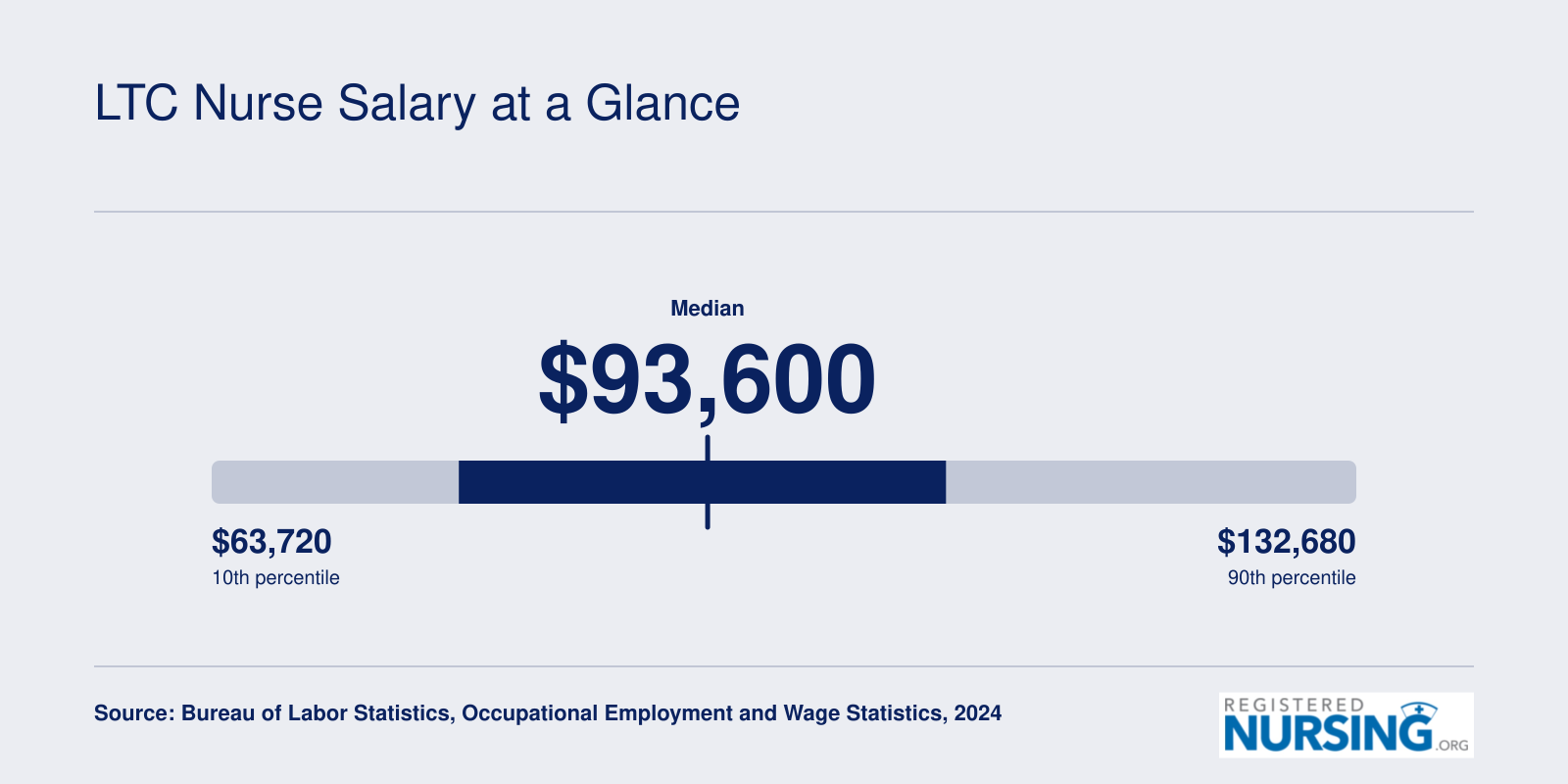
LTC Nurse Salary at a Glance
Registered nurse salaries in long-term care settings generally follow national RN wage trends, though they often track slightly below acute-care hospital RN pay. This difference largely reflects the funding models that skilled nursing facilities and other LTC employers operate under, including heavier reliance on Medicare and Medicaid reimbursement rates. The percentiles below represent the national RN salary distribution reported by the Bureau of Labor Statistics.
Where Do Long-Term Care Nurses Work?
What types of facilities actually hire long-term care nurses, and how does the day-to-day work change depending on the setting?
LTC nursing is not confined to a single type of workplace. The umbrella covers several distinct care environments, each with its own patient population, acuity level, and staffing model. Understanding these differences can help you choose a setting that matches your clinical interests and preferred work style.
Skilled Nursing Facilities
Skilled nursing facilities (SNFs) employ the largest share of LTC nurses nationwide. In a SNF, you typically manage a higher resident load, sometimes 20 to 30 or more patients per shift, depending on the unit. Much of the hands-on care (bathing, feeding, repositioning) is delegated to certified nursing assistants, while the RN focuses on assessments, medication administration, care plan coordination, and communication with physicians and families. Charge nurse responsibilities are common even for relatively new RNs in this setting.
Many SNFs also house dedicated hospice or palliative care units. Nurses who work in these co-located hospice programs blend LTC skills with end-of-life symptom management, family support, and comfort-focused care planning.
Assisted Living Communities
Assisted living is one of the fastest-growing segments of long-term care. Residents in these communities are generally more independent than SNF residents, so the RN role centers on health monitoring, medication oversight, chronic disease education, and coordinating outside specialist visits. Staffing ratios tend to be lighter, and the pace can feel less acute, though you may be the only licensed nurse on site during certain shifts.
Long-Term Acute Care Hospitals and Inpatient Rehab
Long-term acute care hospitals (LTACHs) serve patients who need extended hospital-level care, such as prolonged ventilator weaning or complex wound management. Inpatient rehabilitation facilities focus on intensive therapy after events like stroke or traumatic injury, often requiring skills similar to those used by an orthopedic nurse. Both settings require RNs comfortable with higher-acuity clinical skills, and nurse-to-patient ratios are typically lower than in a traditional SNF.
Home Health Agencies
Home health is another rapidly expanding area of LTC nursing. Here, you work independently, visiting one patient at a time in their own residence. Visits may involve wound care, IV therapy, patient and caregiver education, or post-surgical assessments. Autonomy is high, and strong critical-thinking skills are essential because you do not have colleagues immediately nearby to consult. Nurses drawn to this level of independence may also want to explore work from home nursing jobs for remote and hybrid RN roles.
While the majority of LTC nursing positions remain in skilled nursing facilities, job growth in assisted living and home health continues to outpace traditional facility-based roles, giving nurses more options than ever when choosing where to build a long-term care career.
LTC Nurse Burnout, Turnover, and How to Protect Yourself
Understanding Burnout in Long-Term Care
Burnout is a state of emotional, mental, and physical exhaustion caused by prolonged stress. In long-term care settings, nurses face unique pressures: forming deep bonds with residents who often decline over time, managing complex chronic conditions, and working with limited resources. Industry workforce surveys frequently point to nursing homes as having higher turnover rates for RNs compared to other healthcare settings. Contributing factors include heavy patient workloads, mandatory overtime, and the emotional toll of caring for residents with dementia or terminal illnesses.
Why Turnover Rates Are So High
Staffing instability in long-term care can create a vicious cycle. When a facility is short-staffed, remaining nurses take on more responsibilities, which accelerates burnout and leads to more resignations. Academic research published in nursing journals suggests that burnout is not just about the number of hours worked but also about the lack of control over work conditions and insufficient support from management. New graduates may feel particularly vulnerable if they enter LTC without strong mentorship or realistic expectations about the pace and emotional demands.
Strategies to Protect Your Well-Being
Protecting yourself starts with recognizing the early signs of burnout: fatigue, irritability, detachment, or a sense of reduced accomplishment. Practical steps include:
- Set boundaries: Advocate for reasonable patient assignments and avoid excessive overtime. Learn to say no when you are stretched too thin.
- Seek peer support: Build relationships with coworkers who understand the unique stresses of LTC. Informal debriefing or formal support groups can help.
- Use employee assistance programs: Many facilities offer confidential counseling or wellness resources. Do not hesitate to use them.
- Prioritize self-care: Regular exercise, adequate sleep, and hobbies outside work are not luxuries; they are essential for resilience.
- Pursue professional development: Gaining certification or advancing your education can open doors to less strenuous roles or more supportive environments, including home health nursing or holistic nursing.
Remember, no job is worth sacrificing your health. If a workplace consistently ignores safety or staffing concerns, it may be time to explore other settings. Long-term care nursing can be deeply rewarding, but it requires a sustainable approach to your own well-being.
The facility you choose matters as much as the role itself. Before accepting a position, search Medicare.gov for CMS Five-Star Quality Ratings. Facilities with higher ratings consistently show stronger staffing levels and lower turnover, two factors that directly affect your daily workload and job satisfaction.
Career Outlook and Advancement in LTC Nursing
The Bureau of Labor Statistics projects 5 percent growth for registered nurses across all settings between 2024 and 2034, with approximately 189,100 annual job openings.1 While separate projections for nursing care facilities are not published for the current decade, the broader healthcare and social assistance sector is expected to grow by 8.4 percent during the same period, outpacing the economy-wide average of 3.1 percent.2 Historical data showed RN employment in long-term care facilities grew by 24 percent between 2014 and 2024, substantially faster than hospital-based RN growth at 9 percent.3 These trends suggest that demand for nurses in aging-services settings will remain strong and likely exceed the overall RN growth rate.
The LTC Career Ladder
Long-term care offers a clear progression from entry-level aide to executive leadership. The typical path begins as a certified nursing assistant (CNA), then advances to licensed practical nurse (LPN), and on to registered nurse (RN). Understanding the differences between these credentials is worthwhile early in your career; a comparison of LPN vs ADN vs BSN programs can help you choose the right educational path. From the staff RN level, nurses commonly move into charge nurse roles, which carry shift-leadership responsibilities and modest salary increases over base RN pay. The next tier includes assistant director of nursing (ADON) and director of nursing (DON) positions, which require management skills and often a bachelor's degree or higher. Directors of nursing in skilled nursing facilities typically earn between $85,000 and $110,000 annually, depending on facility size and region. Parallel to the administrative track, nurses may specialize as Minimum Data Set (MDS) coordinators, focusing on regulatory assessments and reimbursement without direct supervisory duties.
Advanced Practice and Education Roles
Long-term care experience is increasingly valued in geriatric nurse practitioner programs, health administration master's degrees, and nursing faculty roles. Advanced Practice Registered Nurse (APRN) credentials open the door to these positions, with geriatric NPs who work in nursing facilities earning median salaries in the range of $115,000 to $125,000, reflecting both advanced credentials and specialized expertise. Nurse educators who teach in community college LPN or ADN programs often draw on years of LTC practice to ground clinical instruction. Many DONs pursue graduate degrees part-time while working, leveraging tuition reimbursement programs offered by large facility operators.
Why Demand Will Outpace General RN Growth
The United States population aged 65 and older is projected to reach 73 million by 2030, creating sustained pressure on nursing homes, assisted living communities, and home health agencies. This demographic driver explains why historical growth in LTC nursing outpaced hospital growth by nearly three-to-one.3 Facilities are competing for qualified nurses by offering sign-on bonuses, loan repayment, and accelerated promotion tracks. For nurses willing to specialize in geriatrics and master the regulatory environment, career advancement opportunities in long-term care are both plentiful and financially rewarding.
Frequently Asked Questions About LTC Nursing
Long-term care nursing raises plenty of questions, whether you are exploring the field for the first time or weighing it against other specialties. Below are concise answers to the questions prospective and current LTC nurses ask most often.
- What does an LTC nurse do on a typical day?
- A typical day includes administering medications, performing assessments, coordinating with physicians and therapists, updating care plans, and supervising CNAs. LTC nurses also provide wound care, manage chronic conditions like diabetes or heart failure, and communicate with residents' families. For a detailed breakdown, see the section on what a long-term care nurse does earlier in this article.
- Is 40 too old to go to school for nursing?
- Not at all. Many nurses begin their education in their 40s, 50s, or later. Nursing programs value life experience, and mature students often excel because of strong communication and problem-solving skills. ADN programs can be completed in about two years, making a career change very achievable. Working while in nursing school is also a realistic option for many adult learners, since flexible scheduling and part-time tracks are widely available. Age is not a barrier to licensure or employment in long-term care or any other nursing specialty.
- What is the difference between an LTC nurse and a hospital nurse?
- Hospital nurses typically manage acute, short-term conditions with rapid patient turnover, while LTC nurses build long-term relationships with residents and focus on chronic disease management, quality of life, and end-of-life care. LTC settings generally have a slower, more predictable pace but higher nurse-to-patient ratios. Nurses drawn to acute settings with continuous cardiac monitoring may find a role as a telemetry nurse a useful comparison point when evaluating where they fit best. The earlier comparison section of this article covers additional distinctions.
- What certifications do you need for long-term care nursing?
- An active RN or LPN license is the baseline requirement. Beyond that, certifications are optional but valuable. Popular credentials include the Gerontological Nursing Certification from ANCC, the Certified in Long-Term Care (CLTC) designation, and wound care certifications. These credentials demonstrate specialized knowledge and can improve job prospects and earning potential, as discussed in the certifications section above.
- Is long-term care nursing a good first job for new graduates?
- Yes, for many new nurses it is an excellent starting point. LTC positions help new graduates build strong assessment, time management, and critical thinking skills. You will manage a larger patient load independently, which accelerates clinical confidence. Tips from your final clinical rotation in nursing school can translate directly into that first LTC role, especially around prioritization and communication with interdisciplinary teams. The environment also offers mentorship opportunities and more predictable schedules compared to hospital rotations.
- How much do long-term care nurses make by state?
- LTC nurse salaries vary widely by state, with higher-cost-of-living states such as California, Hawaii, and Massachusetts typically offering the highest pay. Nationally, long-term care RN salaries generally align with broader registered nurse wage trends, though they can fall slightly below acute-care averages. The salary-by-state table earlier in this article provides a detailed state-level breakdown of current figures.
Explore More
- Ambulatory Care Nurse
- Burn Unit Nurse
- Cardiac Nurse
- Cath Lab Nurse
- Charge Nurse
- Chief Nursing Officer (CNO)
- Correctional Nurse
- CVOR Nurse
- Dermatology Nurse
- Developmental Disability Nurse
- Director of Nursing
- Domestic Violence Nurse
- Emergency Room Nurse
- ENT Nurse
- ET Nurse
- Fertility Nurse
- Flight/Transport Nurse
- Forensic Nurse Salary & Career Guide
- Genetic Nurse
- Geriatric Nurse
- Health Policy Nurse
- Healthcare Administrator
- Healthcare Manager
- Home Health Nurse
- Hospice Nurse
- Camp Nurse
- GI Nurse
- Holistic Nurse
- Labor and Delivery Nurse
- Nurse Writer
- Psychiatric Nurse
- School Nurse
- Telemetry Nurse
- Travel Nurse
- Aesthetic Nurse
- Infusion/IV Nurse
- Oncology Nurse
- ICU Nurse
- Infection Control Nurse
- Legal Nurse Consultant
- Managed Care Nurse
- Medical-Surgical Nurse
- Military (Combat) Nurse
- Missionary Nurse
- Mother Baby Nurse
- Nephrology Nurse
- Neuroscience Nurse
- NICU Nurse
- Nurse Administrator
- Nurse Attorney
- Nurse Care Coordinator
- Nurse Case Manager
- Nurse Entrepreneur
- Nurse Executive
- Nurse Health Coach
- Nurse Manager
- Obstetric (OB) Nurse
- Occupational Health Nurse
- Operating Room Nurse
- Ophthalmic Nurse
- Organ Procurement Coordinator
- Orthopedic Nurse
- Pain Management Nurse
- Palliative Care Nurse
- Parish Nurse
- Patient Advocate Nurse
- Pediatric Endocrinology Nurse
- Perianesthesia (PACU) Nurse
- Perinatal Nurse
- Plastic Surgery Nurse
- Public/Community Health Nurse
- Radiology Nurse
- Rehabilitation Nurse
- Research Nurse
- Respiratory Nurse
- Rheumatology Nurse
- Substance Abuse Nurse
- Telephone Triage Nurse
- Transcultural Nursing
- Transplant Nurse
- Trauma Nurse
- Wound Care Nurse (WOCN)