

America needs nurses. The United States Bureau of Labor Statistics (BLS) projects job openings for registered nurses (RNs) will grow 5% over the 2024-2034 period, resulting in up to 166,100 new jobs nationwide. In Tennessee, the need is even greater. Data from Projections Central, a BLS-sponsored organization, estimates that the need for RNs will grow by 13% in Tennessee from 2022 to 2032.
If you're looking for Tennessee nursing programs, it can be difficult to understand how to choose the right school. There are many different factors to consider, from cost to location. For many students, one of the most confusing aspects of choosing a Tennessee nursing school is understanding how state approval and accreditation work together. There are several types of approval and accreditation, and each affects your licensure eligibility, financial aid, ability to transfer credits, and career options.
This article aims to help you understand three distinct layers that protect your nursing education: state Board of Nursing approval, institutional accreditation, and programmatic accreditation. Each layer serves a specific purpose and protects a different part of your education. This guide uses South College, a Tennessee-based nursing education provider, as a practical benchmark to illustrate how these three layers work together and to help you understand what to look for when evaluating any nursing program.
Level 1: Tennessee State Board of Nursing Approval
What Is State Board of Nursing Approval?
The first factor to consider when evaluating a nursing school is approval from the state Board of Nursing (BON). When a pre‑licensure nursing program is approved by the board, it means the program meets specific state standards for what it teaches and how its students perform, including:
- Topics covered in the curriculum
- Clinical experience hours and activities
- Student safety and well-being
- National Council Licensure Examination (NCLEX) first-time pass rates
Why State Nursing Board Approval Matters to You
State board approval of a nursing program is mandatory for graduates to become licensed as an RN or licensed practical nurse (LPN) in Tennessee or any other state. Without it, you won't be eligible to sit for the NCLEX after you graduate, which makes obtaining a nursing license impossible.
State boards of nursing monitor the first-time NCLEX pass rates at each school. Schools that fall below state expectations may face corrective action or even lose their approval.
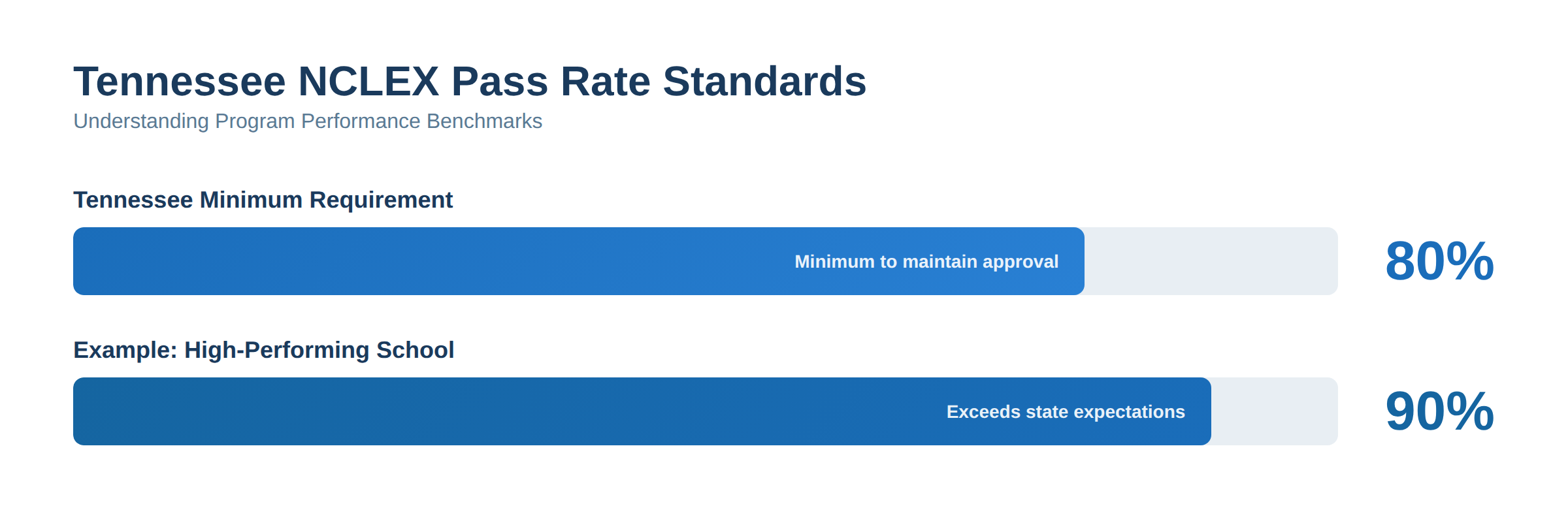
In Tennessee, the state board requires a minimum NCLEX pass rate of 80%. South College's Bachelor of Science in Nursing program, for example, reports that its nursing graduates recently achieved a 90% pass rate on the NCLEX-RN exam, demonstrating outcomes that exceed state expectations.
A Note on the Next Generation NCLEX (NGN)
Since April 2023, the NCLEX has shifted from knowledge recall toward clinical judgment, testing whether graduates can think through complex, evolving patient scenarios. This is known as the "Next Gen NCLEX" or "NGN". New question formats include case study evaluations, matrix grids, and extended multiple-response items, with some questions offering partial credit. This means strong NCLEX prep now requires more than memorization; programs need to actively teach clinical decision-making. When evaluating Tennessee nursing schools, ask how the program has updated its curriculum and NCLEX prep resources to align with the NGN format, and whether recent pass rates accurately reflect student performance on the new exam.
Tennessee Nursing Approval/Accreditation Checklist: State Board Approval
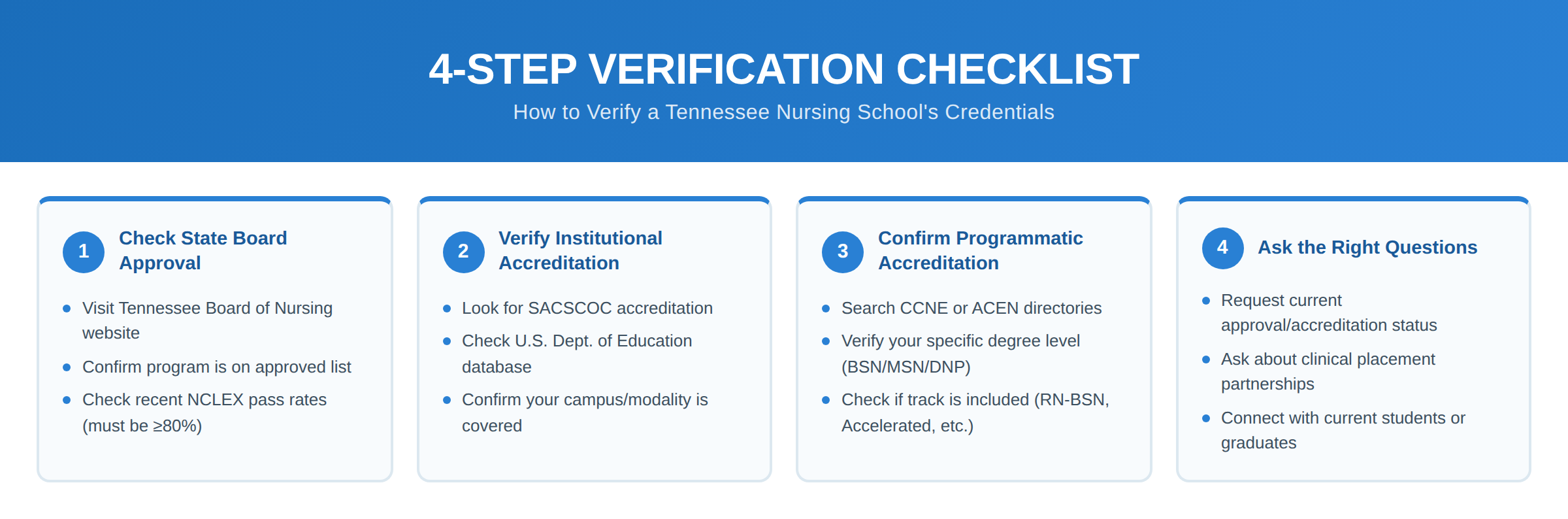
Confirm: Is this specific program and campus listed as “approved” by the Tennessee Board of Nursing? This information should be prominently displayed on a school's website; look for a page or section titled "accreditations and approvals". You can also visit the Tennessee Board of Nursing website to view lists of currently approved schools.
Ask: What is the program’s recent first-time NCLEX pass rate, and how does it compare with Tennessee's required 80% benchmark? Again, the Tennessee Board of Nursing's website lists the NCLEX pass rates for each school, usually going back five years.
Level 2: Institutional Accreditation
What Is Institutional Accreditation?
The next level to look for when evaluating a Tennessee nursing school is institutional accreditation. Institutional accreditation is the quality standard applied to the entire college or university itself, not just the nursing program.
Several institutional accreditors operate in the United States. They are independent of the government but must be recognized by the U.S. Department of Education for their decisions to be accepted. Some work primarily with career-focused schools, while others work mainly with two- and four-year colleges and universities, as well as those offering graduate programs.
The Southern Association of Colleges and Schools Commission on Colleges (SACSCOC) is an institutional accreditor for many Tennessee public and private colleges and universities, as well as schools in much of the Southeast. For our example school, South College, the institutional accreditor is SACSCOC.
Why Does Institutional Accreditation Matter for Nursing Schools?
Institutional accreditation matters because it gives you more options for financing your education and, if you need to do so, transferring from one school to another while maintaining as many credits as possible.
Financial Aid: U.S. federal financial aid, including grants and loans, is available only to students attending institutions accredited by agencies recognized by the U.S. Department of Education (including SACSCOC). If your Tennessee nursing school is not accredited in this way, you will need to find other ways to finance your education.
Credit Transfer and Mobility: Many institutions give the most favorable transfer treatment to credits earned at colleges and universities accredited by the same institutional accreditor they use, such as SACSCOC for many Tennessee schools. If you enroll in a program accredited by a different institutional accreditor, your credits may not transfer as easily, which could mean retaking courses and spending additional time and money.
South College has institutional accreditation from SACSCOC. This benefits Tennessee nursing students who might want to stack credentials (such as LPN to RN and RN to BSN pathways) or transfer credits if circumstances change. See Tennessee RN to BSN Programs.
Tennessee Nursing Approval/Accreditation Checklist: Institutional Accreditation
Confirm: Is the college or university that offers the nursing program you're interested in accredited by SACSCOC (or another U.S. Department of Education-recognized accreditor)? Again, this will be listed on the school's website, usually on a page called "accreditation". You can also double-check the U.S. Department of Education's website.
Ask: If you had to transfer out, would your nursing and general education credits likely transfer with you? You can ask admissions staff about this, or look up student reviews on sites like Google or Reddit.
Level 3: Programmatic Accreditation (CCNE/ACEN)
What Is Programmatic Nursing Accreditation?
Programmatic accreditation is an optional, discipline-specific review of nursing program quality that supplements institutional accreditation. There are two major nursing program accreditors in the U.S.:
- Commission on Collegiate Nursing Education (CCNE)
- Accreditation Commission for Education in Nursing (ACEN)
Why CCNE/ACEN Status Matters to Students
Graduate School Admission: Many Master of Science in Nursing (MSN), Doctor of Nursing Practice (DNP), and other advanced nursing programs require a BSN from a CCNE or ACEN accredited program.
Career Advancement: Some large health systems and employers, including "Magnet®" hospitals, Veterans Affairs, and the Department of Defense, prefer or require candidates who have graduated from programmatically accredited nursing schools.
South College’s nursing programs hold programmatic accreditation (CCNE and ACEN, depending on the level and location). This accreditation supports students who plan to apply to competitive MSN or DNP programs.
Tennessee Nursing Approval/Accreditation Checklist: Programmatic Accreditation
Ask: Is this exact nursing program (BSN, Accelerated BSN, MSN) programmatically accredited by CCNE or ACEN?
Confirm: If you plan to pursue graduate school, do your target MSN/DNP programs require CCNE/ACEN-accredited undergraduate preparation?
Putting the Tennessee Nursing School Accreditation Pieces Together
Think of approval and accreditation as a three-level stack:
- Base: Tennessee Board of Nursing approval (eligibility to sit for NCLEX and obtain a license)
- Middle: SACSCOC institutional accreditation (financial aid and credit mobility)
- Top: CCNE/ACEN programmatic accreditation (eligibility for certain graduate programs and career path options)
Each of the three levels protects a different part of your education and career path. South College shows how they can work together in one clear pathway. Its pre-licensure programs are approved by the Tennessee Board of Nursing, it is institutionally accredited by SACSCOC, and key nursing programs also hold CCNE/ACEN accreditation.
Step-by-Step: How to Verify a Tennessee Nursing School's Approval and Accreditation
Step 1: Check State Board Approval Online
- Look up the Tennessee Board of Nursing’s list of approved pre-licensure programs on the Tennessee Department of Health website.
- Match the exact program name, degree, and campus to what the school advertises.
Step 2: Check for Institutional Accreditation
- Visit the SACSCOC TN directory or the “Accreditation” page of the school you're considering to confirm its institutional accreditation status.
- Make sure the campus and modality you plan to attend are included in the accreditation scope.
Step 3: Check CCNE/ACEN Programmatic Accreditation
- Search the TN CCNE or ACEN public directories by institution name and verify that the degree level (BSN, MSN, DNP) and track (RN to BSN, Accelerated BSN) you intend to enroll in are covered.
After completing each step above, take screenshots or save PDFs that confirm each level of approval and accreditation.
Step 4: Follow Up with Schools That Interest You
Contact the schools you're considering and talk with an admissions advisor. Be sure to ask the following questions:
- What is your school's current status with the Tennessee State Board of Nursing? What are the most recent NCLEX pass rates, and do these encompass NGN results?
- Is the school institutionally accredited? If not, how does this impact financial aid options, or credit transfer if I need to move?
- Does this nursing program have CCNE or ACEN accreditation, in case I want to pursue a graduate degree in the future or apply to certain jobs?
- How do clinical placements work at this nursing school, and what clinical partnerships does the school have?
- Can I talk to graduates or current nursing students about their experiences?
Special Situations: Online and Hybrid Nursing Programs and Interstate Authorization
If you plan to study nursing online or through a program based in another state, confirm that the school is authorized to operate in your state, both by the state’s higher education authority and, where applicable, its Board of Nursing, before you enroll.
While some schools only accept students from certain states, others are covered by the State Authorization Reciprocity Agreement (SARA). SARA is a voluntary agreement between member states that allows participating schools to enroll online students from other SARA member states without needing individual state-by-state authorization (NC-SARA, 2025).
There is one important distinction to keep in mind, though: SARA covers only institutional authorization for distance education; it does not affect professional licensing requirements. If you plan to complete clinical hours in a state other than Tennessee, confirm with that state’s Board of Nursing that it accepts out-of-state clinical placements and that the program meets any applicable state-specific requirements (NC-SARA, 2025).
Not all states participate in SARA. California, for example, is not a member. Students who reside there and want to enroll in an online Tennessee-based nursing program may need to verify that the school holds separate authorization from California’s Bureau for Private Postsecondary Education before enrolling.
Planning for Interstate Mobility After Graduating from a Nursing Program
Tennessee is a member of the Nurse Licensure Compact (NLC), which currently includes 43 U.S. states and territories. Under the NLC, nurses who hold a Tennessee multistate license can practice in other compact states without applying for an additional license (NCSBN, 2025). If you want to move to a non-compact state, you will apply for licensure by endorsement, which requires holding an active, unencumbered license and having passed the NCLEX. In most cases, graduating from a Tennessee Board of Nursing-approved program and passing the NCLEX is all you need to practice in another state.
Most U.S. states and territories are part of the NLC, which allows nurses to move across state lines, update their licensure, and continue practicing with minimal or no additional training requirements. However, not all do; California, for example, is a notable exception. It's always a good idea to find out where your state stands with the NLC. Our RN License Transfer and NLC Guide will give you additional information for you to consider.
Making Informed Decisions About Your Nursing Education
Understanding the three levels: state approval, institutional accreditation, and programmatic accreditation, helps you make informed choices about Tennessee nursing schools. By using South College as a benchmark, you can see how a well-structured pathway aligns Board of Nursing approval, institutional accreditation, and programmatic accreditation into one educational pathway.
Taking time to verify approval and accreditation status before enrollment protects your investment, ensures eligibility for licensure and financial aid, and keeps career opportunities, from graduate school to specialized clinical roles, within reach.
References
- Tennessee Board of Nursing. (2025). Position Statements May 2025. Tennessee Department of Health.
https://www.tn.gov/content/dam/tn/health/healthprofboards/nursing/position-statements/Position%20Statements%20May%202025.pdf
- Tennessee Board of Nursing. (2025). Continuing Competence Requirements 05-2025. Tennessee Department of Health. https://www.tn.gov/content/dam/tn/health/healthprofboards/nursing/continuing-education/Competency Requirements 05-2025.pdf
- South College. (2026). Accreditations and Approvals.
https://www.south.edu/about/accreditations-and-approvals/ - South College. (2025). Bachelor of Science in Nursing (Traditional).
https://www.south.edu/program/bachelor-science-nursing/ - South College. (2025). South College nursing students achieve 90% pass rate on NCLEX-RN exam.
https://www.south.edu/asn-program-effectiveness-data-knoxville/ - Kaplan Test Prep. (2025). NCLEX Pass Rates 2025: What You Need to Know.
https://www.kaptest.com/study/nclex/nclex-pass-rates-what-you-need-to-know/ - RPC Consulting. (2025). Changes to Tennessee’s Certificate of Need Program.
https://rpcconsulting.com/changes-to-tennessees-con-program/ - NC-SARA. (2025). SARA for students. National Council for State Authorization Reciprocity Agreements.
https://nc-sara.org/sara-students
Latest Articles & Guides
One of the keys to success as a registered nurse is embracing lifelong learning. Our articles and guides address hot topics and current events in nursing, from education to career mobility and beyond. No matter where you are on your nursing journey, there’s an article to help you build your knowledge base.
Browse our latest articles, curated specifically for modern nurses.