

What you’ll learn in this article…
- Camp nurses earn an average of $1,544 per week plus free housing and meals.
- An active RN license and current BLS certification are the core requirements.
- Nearly 5 million children attend summer camp annually, driving steady nurse demand.
Hospital nursing and camp nursing share the same license but demand very different skill sets. A camp nurse, typically an RN, serves as the sole healthcare provider at a residential or day camp, managing everything from sunburn and sprained ankles to anaphylaxis and fracture stabilization, often miles from the nearest emergency department. The role is heavily pediatric, broadly autonomous, and shaped by standing orders rather than a physician down the hall.
LPNs and EMTs fill camp health roles at some sites, but the majority of accredited camps require or prefer a registered nurse. Because the nurse usually works without other licensed clinicians on-site, clinical judgment carries outsized weight in a setting where backup may be a flight nurse ride away.
How to Become a Camp Nurse
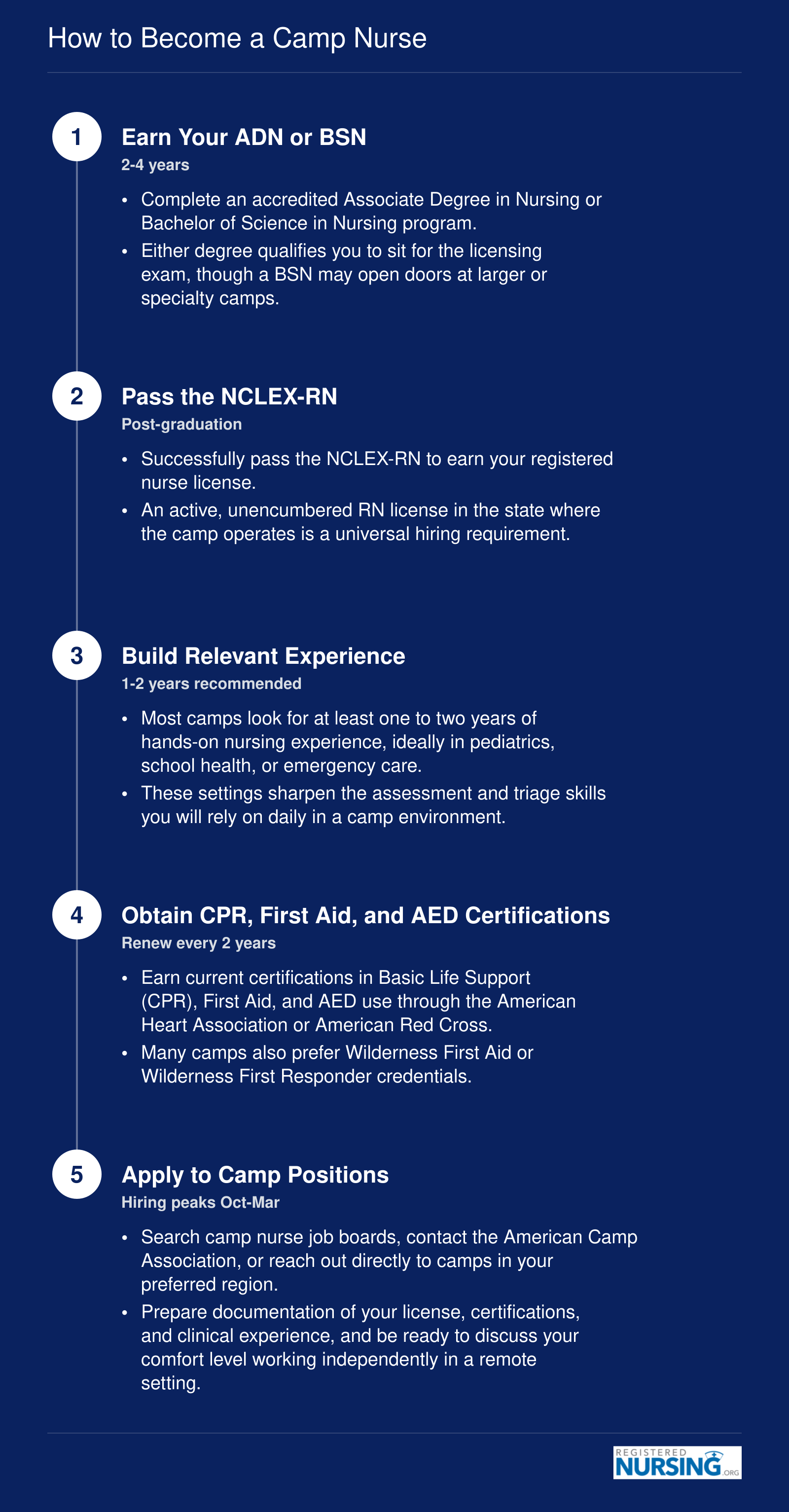
Becoming a camp nurse follows a clear credentialing path that most registered nurses can complete within a few years of entering the profession. While some camps hire LPNs or paramedics in a health-officer capacity, the RN credential remains the industry standard for independent camp nursing practice.
Camp Nurse Requirements and Certifications
Camp nursing has steadily gained recognition as a distinct practice area, and the credentials expected of camp nurses now reflect a more structured set of professional standards than in years past.
At its core, working as a camp nurse requires an active, unencumbered registered nurse (RN) license in the state where the camp operates. Some camps also hire licensed practical nurses or licensed vocational nurses (LPN/LVN), though many prefer or require the RN credential. Beyond licensure, most employers expect current Basic Life Support (BLS) certification, and camps that serve remote or wilderness settings often look for Wilderness First Aid or Advanced Wilderness Life Support training as well.
Professional Organizations and Certification Resources
Two organizations serve as essential reference points for anyone considering camp nursing. The Association of Camp Nurses (ACN), found at campnurse.org, is the primary professional body dedicated to this specialty. Prospective camp nurses should explore the Membership and Professional Development sections of the ACN site for information on current membership benefits, educational offerings, and any formal certification programs the organization may offer. Because program details can change from year to year, checking the site directly ensures you have the most up-to-date information.
The American Camp Association (ACA), at acacamps.org, sets accreditation standards for camps across the country. Under the Health and Wellness section of their accreditation guidelines, the ACA outlines healthcare staffing requirements that accredited camps must follow. These standards address topics such as nurse-to-camper ratios, required healthcare provider credentials, and documentation expectations. If a camp holds ACA accreditation, you can expect its hiring practices to align with those benchmarks.
State Regulations and Licensure Considerations
National standards from organizations like the ACA provide a baseline, but state health department regulations often layer on additional or more specific requirements. Some states maintain their own mandated nurse-to-camper ratios, define which medications camp nurses may administer without a physician present, or require camps to keep a licensed healthcare provider on-site around the clock. These official state codes can override national guidelines, so it is critical to cross-reference the rules published by the health department in the state where you plan to work.
What Employers Actually Expect
Posted requirements on paper do not always tell the full story. Reviewing real camp nurse job postings, whether on camp websites, nursing job boards, or seasonal employment platforms, gives you practical insight into what employers prioritize right now. Common requests beyond licensure and BLS certification include:
- Pediatric experience: Many camps serve children and teens, and employers frequently prefer nurses with backgrounds in pediatrics, school nursing, or emergency care.
- Medication management skills: Camps routinely manage daily medications for dozens of campers, so comfort with medication administration and documentation is a recurring expectation.
- Chronic condition management: Experience with asthma, diabetes, severe allergies, and seizure disorders appears frequently in listings.
- Autonomy and independent judgment: Camp health centers are often staffed by a single nurse or a very small team, so employers look for candidates who can triage, assess, and make care decisions with limited immediate physician oversight. This mirrors the independent practice environment faced by emergency nurses in fast-moving, resource-constrained settings.
If you are unsure whether your qualifications align with a particular camp's needs, contacting the camp directly is a simple and effective step. Camp health directors are typically happy to discuss their requirements and can clarify whether additional certifications, training hours, or specialty experience would strengthen your application.
Taking the time to verify your state's specific regulations, review current professional organization offerings, and study real-world job postings will position you well before you ever submit your first application.
Camp Nurse Scope of Practice and Medication Rules
A camp nurse's authority to act is defined by the nurse practice act of the state where the camp physically sits, layered with standing orders from the camp's medical director. Those two documents, not the camp director's preferences, set the outer limits of what you can assess, treat, and delegate.
Standing Orders and the Assess-Treat-Refer Decision
Camp standing orders must be signed by a physician or an appropriately authorized NP or PA, and they must be updated at least annually. They typically cover common camp complaints: minor wounds, insect stings, headaches, GI upset, allergic reactions, and asthma exacerbations. Within those protocols, an RN has independent nursing authority to assess, triage, and treat. Outside them, the nurse contacts the medical director for guidance or activates EMS.
The practical triage question is simple: does this camper need an intervention that exceeds the standing order or the nurse's scope? Anaphylaxis with airway compromise, suspected fractures, altered mental status, chest pain, and heat stroke are 911 calls, full stop. A scraped knee, a mild sunburn, or a low-grade fever handled under protocol are not.
RN, LPN, and EMT: Three Different Roles
These titles are not interchangeable at camp, even when the person is competent and willing.
- Registered Nurse: Independent nursing authority. Assesses campers, builds care plans, administers medications, and (critically) delegates tasks to trained non-nurse staff.
- Licensed Practical Nurse: Must work under the direction and supervision of an RN or a licensed independent practitioner. An LPN cannot delegate medication administration.
- EMT: Functions as unlicensed assistive personnel unless the camp operates within a formal EMS system. EMTs cannot perform activities that require nursing or medical judgment, and their scope is oriented toward emergency intervention, not routine daily care.
Medication Delegation: Why It Matters at Scale
A mid-size camp may have 200 campers, and a third of them arrive with daily prescription medications. In most states, only an RN can delegate medication administration to trained non-nurse staff (counselors, health aides), and the delegation covers tasks, not clinical judgment. The RN retains responsibility for assessment, decision-making, and any PRN calls. Parent consent alone is never sufficient authorization; a prescriber order or standing order is required.
State-by-State Variation
Rules differ meaningfully across state lines. Washington allows out-of-state nurses to practice temporarily at camps for up to six months under Nursing Commission Advisory Opinion 2.10 (2022). Oregon is stricter: an Oregon license is required for camp nurses, with out-of-state nurses limited to narrow federal or school exceptions, per the Board of Nursing's 2019 Sentinel guidance. Kentucky regulates youth camps under 902 KAR 10:040, which includes specific medical supervision requirements. The universal rule: a camp nurse must be licensed in the state where the camp is physically located, regardless of where the nurse lives or where campers come from.
What Does a Camp Nurse Do? Daily Duties and Responsibilities
Camp nursing revolves around a structured daily rhythm of medication administration, injury assessment, and health surveillance, punctuated by unpredictable emergencies. The role demands clinical autonomy, since most camps operate with a single nurse who serves as the sole healthcare provider on site.
Morning: Med Pass and Health Screenings
Mornings often begin before campers wake up. The nurse reviews the medication administration record (MAR) and prepares daily doses. The first med pass typically occurs at breakfast, when campers line up for prescribed medications, over-the-counter supplements, and allergy shots. Nurses verify the "five rights" of medication administration: right patient, right drug, right dose, right route, and right time. For new arrivals, mornings may include health screenings: checking immunization records, reviewing health histories, conducting head lice checks, and identifying campers with chronic conditions like asthma or diabetes.
Midday: Sick Call, Injury Triage, and Heat Checks
After morning activities, the health center opens for sick call. Campers present with complaints ranging from stomachaches and headaches to sprains, cuts, and insect bites. The nurse triages each case, providing first aid, assessing for more serious conditions, and deciding whether a camper needs rest, observation, or transfer to a higher level of care. During hot summer days, hydration and heat checks become critical. Nurses monitor campers and staff for signs of heat exhaustion and ensure water stations are accessible. They may also conduct spot checks on activity areas for safety hazards.
Evening: Second Med Pass, Documentation, and Parent Communication
A second medication pass typically follows dinner or bedtime routines. Evening is also the busiest documentation period. Nurses record all encounters, treatments, medication refusals, and outcomes in camper health logs. They complete incident reports for any injury requiring more than basic first aid. Many camps follow American Camp Association (ACA) standards that mandate detailed record-keeping for medications and treatments. If a camper was injured or became ill, the nurse calls parents to explain the situation, the care provided, and any follow-up instructions.
Emergency Duties: When Minutes Matter
Camp nurses must be ready to respond to severe emergencies without immediate backup. Anaphylactic reactions, asthma attacks, fractures, seizures, and water-related incidents require rapid assessment and stabilization. The nurse administers epinephrine, albuterol, or CPR as needed and calls 911. Because camps are often in remote locations, the nurse may need to manage a victim for 20 minutes or more until emergency medical services (EMS) arrive. Preparing for this level of autonomy means staying current with emergency protocols and maintaining a fully stocked crash cart or emergency bag.
Documentation: A Legal and Professional Necessity
Thorough documentation protects both the camper and the nurse. Daily logs track every medication given, every sick call visit, and every parent phone call. Incident reports capture the details of injuries, witnesses, and actions taken. ACA-accredited camps require that these records be maintained according to healthcare documentation standards. Accurate healthcare charting advantages and disadvantages are worth understanding before you arrive, since consistent records also support continuity of care if a camper needs follow-up after the season or if a dispute arises later.
On-Call at Overnight Camps: 24/7 Availability
At overnight camps, the nurse is on duty around the clock. They often sleep in or adjacent to the health center so they can respond quickly to nighttime issues. Common after-hours calls include homesickness-related anxiety, bedwetting, nightmares, or middle-of-the-night fevers and stomach bugs. The nurse provides reassurance, administers PRN medications, and decides whether a camper can stay in the cabin or needs to be isolated in the health center. This constant availability is both the greatest challenge and the deepest reward of camp nursing, a role that shares the independent, community-focused spirit of community and public health nursing.
Questions to Ask Yourself
Camp Types and How the Nurse Role Differs
Not all camp nursing looks the same, and choosing the right setting may matter as much as choosing nursing itself.
Day Camps
Day camps operate on defined daytime hours, which makes the schedule feel closer to school nursing than to inpatient care. You handle acute first aid, administer scheduled medications, and coordinate rapid referrals when a situation exceeds on-site capacity.1 Because campers leave at the end of the day and a hospital or urgent care center is rarely far away, the clinical burden stays manageable. This setup appeals to nurses who want a meaningful seasonal role without sacrificing structured hours or proximity to backup care.
Resident (Overnight) Camps
Overnight camps shift the picture considerably. You live on-site and carry 24-hour responsibility, including on-call coverage through the night. That means managing nighttime emergencies, monitoring campers with chronic conditions across the full day, and stabilizing patients autonomously before transport is available.2 The autonomy is real, and so is the accountability. Nurses who thrive here tend to be comfortable making independent clinical decisions in settings where a physician is not immediately present.
Special-Needs and Medical Camps
Camps serving campers with diabetes, epilepsy, autism, or complex medical histories represent the most clinically intensive end of the spectrum. Duties can include IV therapy, respiratory support, and the kind of chronic condition management more often associated with a developmental disability nurse or pediatric inpatient unit.3 These roles typically require specialty or inpatient experience, and they tend to compensate accordingly. If you have a pediatric background and want to use it in a meaningful community context, this setting is worth a close look.
Sports, Adventure, and Wilderness Camps
Sports and outdoor adventure camps shift the clinical focus toward musculoskeletal injuries, environmental exposures, and remote stabilization. Concussion protocols and orthopedic nurse skills are daily concerns rather than occasional ones. Wilderness medicine training, while not always required, gives you a practical edge and can make you a significantly stronger candidate. Emergency and urgent-care nurses often find this environment a natural fit.2
Knowing which camp type aligns with your clinical background, lifestyle preferences, and risk tolerance is the clearest first step toward finding a role you will actually want to return to each season.
Camp Nurse Salary and Total Compensation
Camp nurses nationwide earn an average of $1,544 per week as of 2025, though total compensation extends well beyond the paycheck.1 Understanding how seasonal nursing pay compares to traditional hospital roles requires looking at both cash wages and the significant value of included room and board.
How Camp Nurse Pay Differs from Year-Round Nursing Salaries
Registered nurses working in hospitals and other year-round settings earn a median annual salary of $93,600 according to 2024 Bureau of Labor Statistics data. Camp nursing operates on an entirely different compensation model. Rather than annual salaries, camp nurses receive weekly wages for seasonal contracts that typically run 8 to 10 weeks during the summer months.3 This means a camp nurse working a full 10-week season at the national average weekly rate would earn approximately $15,440 in direct wages before considering the value of housing and meals.
Weekly pay for camp nurses varies based on experience, camp type, and geographic location. Current 2025 data shows that nurses at the 25th percentile earn around $1,182 per week, while those at the 75th percentile bring in $1,730 weekly.1 Top earners in specialized roles or high-cost markets can command $2,269 per week or more. For example, camp nurses working in the San Francisco-Oakland-Hayward area average $3,215 per week, reflecting both regional cost-of-living differences and competitive summer hiring markets.4
The Hidden Value: Room, Board, and Total Compensation
Overnight camps provide on-site housing and three meals daily throughout the contract period. This benefit carries substantial cash-equivalent value that many nurses overlook when comparing seasonal camp work to per-diem or part-time hospital shifts. Industry estimates place the weekly value of camp-provided room and board between $200 and $400, depending on the camp's location and amenities.
For a nurse earning $1,544 per week with an additional $300 in housing and meal value, total weekly compensation reaches approximately $1,844. Over a 10-week contract, that represents nearly $18,500 in total compensation, plus the nurse pays no rent, utilities, or grocery bills during those summer months. This arrangement can be particularly advantageous for nurses who maintain a primary residence elsewhere or who supplement camp income with off-season work.
Specialty Roles and Premium Pay Opportunities
Camps serving children with special medical needs, chronic conditions, or disabilities typically offer higher weekly rates to attract nurses with relevant clinical backgrounds. Similarly, director of nursing positions at camps that involve supervising other medical staff, managing medication protocols for dozens of campers, and coordinating with parents and physicians command premium compensation. These leadership roles often pay in the upper percentile ranges and may extend beyond the standard camper season to include staff training weeks.
Many camp nurses maintain school nursing positions, per-diem hospital shifts, or other part-time nursing work during the academic year, treating camp nursing as a seasonal supplement to year-round income rather than a standalone career. This hybrid approach allows nurses to enjoy the unique lifestyle benefits of camp while maintaining clinical skills and financial stability throughout the full calendar year.
Camp Nurse Salary by State
The table below shows median annual salaries for registered nurses across 25 states, drawn from the Occupational Employment and Wage Statistics program (2024) published by the U.S. Bureau of Labor Statistics. Because camp nurse positions are seasonal and often include room and board, these year-round RN figures do not translate directly to camp pay. However, states with higher overall RN wages tend to offer more competitive weekly camp nurse rates as well. States with heavy camp density, particularly in the Northeast, Upper Midwest, and Pacific Northwest, also tend to have more open positions each summer. Rhode Island, Arizona, New Hampshire, Maryland, and Colorado top this list, each reporting median RN salaries above $96,000.
| State | Median Annual RN Salary | 25th Percentile | 75th Percentile | Total RN Employment |
|---|---|---|---|---|
| Rhode Island | $99,960 | $83,870 | $112,540 | 10,760 |
| Arizona | $96,890 | $81,390 | $105,450 | 64,430 |
| New Hampshire | $96,830 | $79,720 | $105,500 | 16,580 |
| Maryland | $96,830 | $81,470 | $104,840 | 48,980 |
| Colorado | $96,520 | $81,790 | $104,370 | 54,510 |
| Delaware | $92,610 | $82,600 | $108,360 | 13,260 |
| Texas | $90,010 | $77,450 | $102,200 | 261,050 |
| Virginia | $88,820 | $77,650 | $100,920 | 77,420 |
| New Mexico | $88,260 | $82,630 | $104,720 | 17,510 |
| Pennsylvania | $87,610 | $78,570 | $102,030 | 146,840 |
| Georgia | $86,560 | $76,600 | $104,790 | 97,410 |
| Illinois | $86,410 | $79,150 | $103,660 | 139,900 |
| Idaho | $86,100 | $78,020 | $100,220 | 14,540 |
| Wisconsin | $86,070 | $79,570 | $100,680 | 64,960 |
| Michigan | $85,670 | $80,030 | $101,210 | 104,210 |
| Vermont | $85,150 | $79,980 | $104,110 | 7,240 |
| Maine | $82,860 | $76,890 | $98,000 | 16,280 |
| Florida | $82,850 | $77,070 | $99,260 | 218,100 |
| Utah | $82,270 | $77,030 | $101,530 | 25,780 |
| North Carolina | $81,860 | $74,710 | $98,720 | 108,510 |
| Wyoming | $81,790 | $75,540 | $100,910 | 5,180 |
| Montana | $81,560 | $77,800 | $100,510 | 10,540 |
| Ohio | $81,250 | $77,420 | $97,440 | 138,360 |
| Oklahoma | $81,160 | $75,320 | $96,460 | 32,870 |
| Nebraska | $81,020 | $76,430 | $93,140 | 24,180 |
When comparing camp nursing to hospital per-diem work, remember that overnight camp positions include free housing, three meals daily, and often laundry services for eight to ten weeks. Once you subtract rent, groceries, and utilities from a typical per-diem paycheck, many nurses find the real take-home value of a camp contract matches or exceeds what they would net working in town.
Job Outlook and How to Find Camp Nurse Positions
The nationwide nursing shortage continues to ripple into seasonal and specialty settings, making camp nursing a role where demand regularly outpaces supply during peak hiring months each spring and summer.
Understanding the Broader Job Outlook
The Bureau of Labor Statistics (BLS) projects strong growth for registered nurses over the coming decade, driven by an aging population, expanded access to healthcare, and the ongoing need to replace retiring clinicians. While BLS data covers the profession as a whole rather than camp nursing specifically, those macro trends translate directly into tighter labor pools for every employer that needs an RN, including residential and day camps. When hospitals and clinics are competing aggressively for nurses, camps must work harder to attract qualified candidates, which often means improved compensation packages, flexible scheduling, and family-friendly perks.
Because camp nursing is seasonal by nature, it does not appear as its own occupational category in federal labor statistics. That makes it important to look beyond government data and consult nursing resources for a realistic picture of demand.
Where to Find Camp Nurse Openings
Several channels are particularly useful for locating positions and gauging hiring patterns:
- Association of Camp Nursing (ACN) job board: The ACN maintains a dedicated job board at acn.org that lists seasonal and year-round camp health positions. It is one of the most targeted resources available and a good barometer of how many camps are actively recruiting.
- Camp-specific job sites: Platforms such as CampJobs aggregate openings across hundreds of camps nationwide. Browsing these listings over several weeks can reveal which regions and camp types have the most urgent needs.
- General job boards: Indeed, LinkedIn, and similar platforms carry camp nurse postings, especially from larger organizations. Setting up keyword alerts for "camp nurse" or "summer camp RN" ensures new listings land in your inbox as soon as they appear.
- Direct outreach: Many camps, particularly smaller or specialty programs, fill their healthcare staff through word of mouth or by recruiting from a returning pool. Contacting camps directly, especially those accredited by the American Camp Association (ACA), can uncover positions that never make it to a public job board.
Networking and Staying Current
Camp nursing has a tight-knit professional community, and networking within it can be just as effective as browsing job boards. Consider joining camp nursing forums, attending ACN conferences or webinars, and participating in online groups where camp health professionals share openings and discuss trends. Conversations in these spaces often surface real-time insights about which camps are expanding health services, which states are seeing increased regulatory requirements, and where compensation is trending upward.
The ACA periodically releases statements and resources related to camp healthcare staffing, and reviewing those publications can help you understand what camps are looking for in their medical teams. Staying informed about evolving standards, such as updated camper-to-nurse ratios or medication management protocols, positions you as a knowledgeable candidate. Nurses who also work in adjacent community-facing roles, such as school nursing, often find that overlapping skill sets make them especially competitive for camp positions.
Timing Your Job Search
Most camps begin recruiting healthcare staff in late winter and continue through early spring. Positions at popular or well-funded camps can fill quickly, so starting your search early gives you the widest selection. If you are flexible on location or camp type, you may find openings well into late spring or even early summer, as some camps scramble to fill last-minute vacancies. Keeping your resume, nursing license documentation, and any relevant certifications current and ready to submit will help you move quickly when the right opportunity appears.
Nearly 5 million children attend summer camp in the United States each year, according to the American Camp Association. That scale is a big reason camp nurses are in steady demand: from day camps to overnight wilderness programs, someone has to manage everything from bee stings to daily medications for thousands of kids at a time.
Frequently Asked Questions About Camp Nursing
Camp nursing raises practical questions about licensing, pay, and day-to-day logistics. Below are straightforward answers to the questions prospective camp nurses ask most often.
- Do you need to be an RN to work as a camp nurse?
- Most camps require at least an RN license, and many prefer candidates with a BSN. Some camps will hire LPNs or LVNs, but they typically must work under the supervision of an RN or a camp physician. Emergency medical technicians (EMTs) or paramedics sometimes fill health roles at smaller camps, though their scope of practice is more limited. Always check the specific camp's requirements and your state's nurse practice act before applying.
- How much do camp nurses make per week?
- Weekly pay for camp nurses varies widely depending on the camp type, location, and whether it is a residential or day program. Many residential camp nurses earn roughly $800 to $1,500 per week in direct wages. However, the total compensation package often includes free room, meals, and use of camp amenities, which can add significant value. Day camp nurses are typically paid an hourly rate comparable to outpatient or school nurse roles in the same region.
- What certifications do camp nurses need beyond their nursing license?
- An active, unencumbered RN license is the baseline. Beyond that, most camps require current Basic Life Support (BLS) certification, and many prefer or require Pediatric Advanced Life Support (PALS) or Wilderness First Aid. CPR and AED certification is considered essential. Some camps also value training in asthma management, anaphylaxis response, or mental health first aid. While no single national "camp nurse certification" exists, the Association of Camp Nursing offers professional development resources.
- What is the difference between a camp nurse at a day camp vs. an overnight camp?
- At a day camp, the nurse typically works set daytime hours, handles minor injuries, administers scheduled medications, and sends ill campers home to their families. At an overnight (residential) camp, the nurse provides around-the-clock coverage, manages homesickness, handles nighttime emergencies, and often lives on site. Overnight camp nurses also coordinate more complex medication storage and administration since campers may be away from home for weeks at a time.
- How do I find camp nurse jobs near me?
- Start with the American Camp Association's job board, which lists positions by state and camp type. The Association of Camp Nursing also maintains a job listing page. General job search platforms such as Indeed and LinkedIn frequently post seasonal camp nurse openings beginning in late winter. Networking through local nursing associations and contacting camps directly are also effective strategies. Many camps begin recruiting for the following summer as early as January or February.
- Can I work as a camp nurse in a state where I am not licensed?
- Generally, you must hold a valid nursing license in the state where the camp is located. If you are a member of the Nurse Licensure Compact (NLC), your multistate license allows you to practice in any other compact state without obtaining a separate license. You can review the details of compact membership and the transfer process in this RN License Transfer and NLC Guide. If the camp is in a non-compact state, you will need to apply for licensure there. Begin this process well in advance, as processing times can take several weeks or longer.
Explore More
- Ambulatory Care Nurse
- Burn Unit Nurse
- Cardiac Nurse
- Cath Lab Nurse
- Charge Nurse
- Chief Nursing Officer (CNO)
- Correctional Nurse
- CVOR Nurse
- Dermatology Nurse
- Developmental Disability Nurse
- Director of Nursing
- Domestic Violence Nurse
- Emergency Room Nurse
- ENT Nurse
- ET Nurse
- Fertility Nurse
- Flight/Transport Nurse
- Forensic Nurse Salary & Career Guide
- Genetic Nurse
- Geriatric Nurse
- Health Policy Nurse
- Healthcare Administrator
- Healthcare Manager
- Home Health Nurse
- Hospice Nurse
- GI Nurse
- Holistic Nurse
- Labor and Delivery Nurse
- Nurse Writer
- Psychiatric Nurse
- School Nurse
- Telemetry Nurse
- Travel Nurse
- Aesthetic Nurse
- Infusion/IV Nurse
- Oncology Nurse
- ICU Nurse
- Infection Control Nurse
- Legal Nurse Consultant
- LTC Nurse
- Managed Care Nurse
- Medical-Surgical Nurse
- Military (Combat) Nurse
- Missionary Nurse
- Mother Baby Nurse
- Nephrology Nurse
- Neuroscience Nurse
- NICU Nurse
- Nurse Administrator
- Nurse Attorney
- Nurse Care Coordinator
- Nurse Case Manager
- Nurse Entrepreneur
- Nurse Executive
- Nurse Health Coach
- Nurse Manager
- Obstetric (OB) Nurse
- Occupational Health Nurse
- Operating Room Nurse
- Ophthalmic Nurse
- Organ Procurement Coordinator
- Orthopedic Nurse
- Pain Management Nurse
- Palliative Care Nurse
- Parish Nurse
- Patient Advocate Nurse
- Pediatric Endocrinology Nurse
- Perianesthesia (PACU) Nurse
- Perinatal Nurse
- Plastic Surgery Nurse
- Public/Community Health Nurse
- Radiology Nurse
- Rehabilitation Nurse
- Research Nurse
- Respiratory Nurse
- Rheumatology Nurse
- Substance Abuse Nurse
- Telephone Triage Nurse
- Transcultural Nursing
- Transplant Nurse
- Trauma Nurse
- Wound Care Nurse (WOCN)