

What you’ll learn in this article…
- Most ER nurses reach their first emergency department role within 2 to 4 years.
- The CEN credential from BCEN is the top specialty certification for emergency nurses.
- Over 56% of emergency nurses have experienced physical assault at work.
Emergency room nurses occupy one of the most demanding positions in acute care, delivering frontline treatment to patients who arrive with anything from chest pain and stroke symptoms to traumatic injuries and psychiatric emergencies. Unlike critical care nurses in the ICU, who manage a smaller census of critically ill patients over extended periods, ER nurses must rapidly triage, stabilize, and either discharge or transfer dozens of patients each shift. Trauma nurses, a subset of emergency nursing, focus specifically on injury resuscitation, often within a designated trauma center.
The role requires an RN license, but the real differentiator is the ability to pivot between acuity levels in seconds. Certification options like the CEN credential, salary variation by state and metro area, and the realities of shift work all shape what this career actually looks like once you are on the floor.
How to Become an Emergency Room Nurse
How long does it actually take to become an emergency room nurse, and what steps do you need to follow?
The honest answer depends on your starting point and the degree path you choose, but most nurses reach their first ER position somewhere between three and six years after beginning nursing school. Here is the clearest roadmap available.
Step 1: Earn Your Nursing Degree
You have two main entry points:
- Associate Degree in Nursing (ADN): Typically two to three years at a community college. The faster, more affordable route to sitting for the NCLEX-RN, but it comes with trade-offs.
- Bachelor of Science in Nursing (BSN): A four-year university program that is increasingly the standard expectation at Magnet-designated hospitals and large health systems.
If you earn an ADN, plan from day one to complete an nursing bridge program. Many employers now require or strongly prefer the BSN for advancement, and some large EDs will not consider candidates for charge or supervisory roles without it. Bridge programs are widely available online and can be completed in 12 to 24 months while you work.
Not sure which entry point fits your situation? Weighing ADN vs BSN: how to choose the right path early saves time and money down the road.
Step 2: Pass the NCLEX-RN
After graduating, you must pass the National Council Licensure Examination to become a licensed RN. Most candidates sit for the exam within a few months of graduation. Passing on the first attempt is the norm for well-prepared graduates, though focused review courses can help if your program felt thin on test-taking strategy.
Step 3: Build Clinical Experience
This is where the traditional advice and the newer reality diverge. Historically, new graduates were told to spend one to two years in medical-surgical nursing before applying to the ED. That path still works and remains solid preparation. However, many hospital systems now offer structured 12-to-18-month new-graduate emergency residency programs that bring new RNs directly into the ED with intensive mentorship, simulation training, and gradual responsibility.
If a new-grad ER residency is available to you, it is a legitimate and increasingly common pathway. If it is not, aim for acute-care experience in a setting with high patient acuity, such as medical-surgical, telemetry nurse units, or stepdown units, before making the transition.
Step 4: Apply to an ED Position
With your license, a degree, and either residency completion or one to two years of acute-care experience behind you, you are ready to apply. Tailor your resume to highlight assessment skills, rapid decision-making, and any exposure to high-acuity or time-sensitive situations.
Once you are working in the ED, pursuing a specialty certification such as the Certified Emergency Nurse (CEN) credential typically becomes the next milestone, usually after one to two years in the department.
Timeline Summary
To put it plainly:
- Minimum timeline: Roughly three years (ADN plus direct experience or a new-grad residency program).
- More common timeline: Five to six years (BSN plus one to two years of experience plus optional certification).
The longer path is not wasted time. Every month of clinical experience you accumulate before stepping into the ED makes you a more capable, confident emergency nurse.
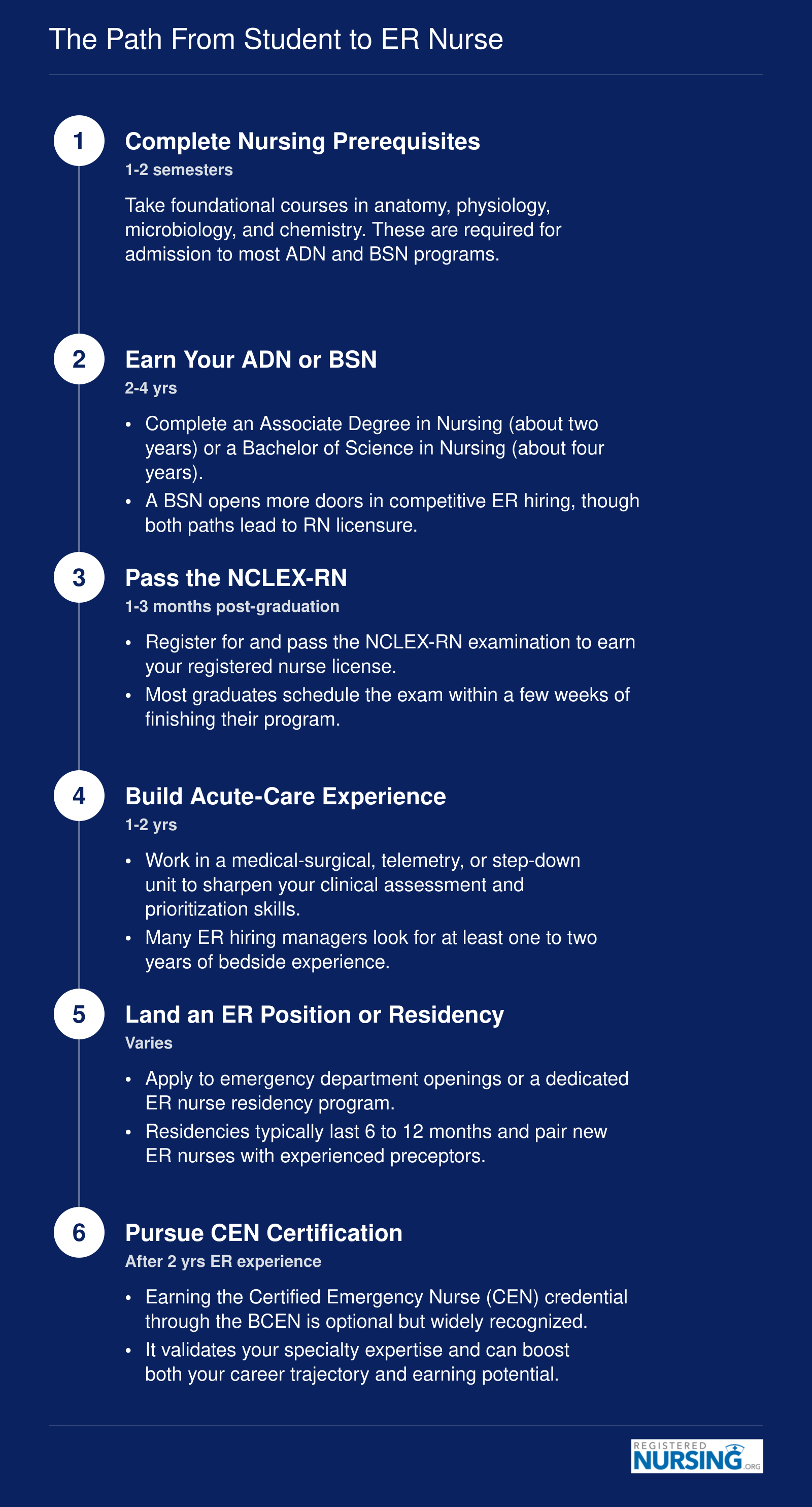
The Path From Student to ER Nurse
Breaking into emergency nursing requires a clear sequence of education, licensure, and hands-on experience. Here is the typical pathway, along with approximate timelines at each stage.
Emergency Nurse Certifications: CEN, CPEN, TCRN & More
The Certified Emergency Nurse (CEN) credential, issued by the Board of Certification for Emergency Nursing (BCEN), remains the most widely recognized specialty certification for nurses working in emergency departments.1 Earning it, along with related credentials like the CPEN and TCRN, signals clinical expertise and can open doors to leadership roles, higher pay, and greater professional credibility.
CEN: Certified Emergency Nurse
The CEN is designed for registered nurses who practice across the full spectrum of emergency care, from medical emergencies and trauma to pediatric and psychiatric presentations. Key details include:
- Eligibility: You must hold a current, unencumbered RN license. BCEN recommends at least two years of emergency nursing experience before sitting for the exam, though it is not a strict prerequisite.2
- Exam format: The test consists of 175 multiple-choice questions (150 scored and 25 unscored pilot items), and you have three hours to complete it. The current passing threshold is 99 correct answers out of the 150 scored questions.3
- Cost: The initial examination fee is approximately $380. Recertification costs $280.4
- Renewal cycle: CEN certification is valid for four years. You can recertify by retaking the exam or by accumulating a combination of continuing education hours and clinical practice hours that meet BCEN's requirements.4
CPEN: Certified Pediatric Emergency Nurse
If your practice focuses on pediatric emergency patients, the CPEN credential demonstrates specialized competency in caring for children and adolescents in acute settings. Eligibility requires a current, unencumbered RN license in an approved jurisdiction, and BCEN recommends relevant specialty experience.5 Like the CEN, the CPEN renews every four years with a $280 recertification fee.
TCRN: Trauma Certified Registered Nurse
The TCRN is geared toward nurses who provide care across the trauma continuum, from initial resuscitation through rehabilitation. It is especially valuable in Level I and Level II trauma centers. Eligibility mirrors the CPEN requirements: a current RN license and recommended specialty experience. The four-year renewal cycle and $280 recertification fee also apply. For a broader look at this credential, see our guide to trauma nurse certification.
Additional Courses Worth Knowing
Beyond BCEN certifications, two courses from the Emergency Nurses Association (ENA) frequently appear on ER nurse resumes:
- TNCC (Trauma Nursing Core Course): A provider-level course focused on systematic trauma assessment and intervention. Many trauma centers require or strongly prefer TNCC completion.
- ENPC (Emergency Nursing Pediatric Course): Covers the unique assessment and management considerations for pediatric emergencies. It pairs well with the CPEN for nurses who treat a high volume of pediatric patients.
Neither TNCC nor ENPC is a certification in the same sense as CEN, CPEN, or TCRN. They are competency-based courses that must be renewed on their own schedules.
Is Certification Worth the Investment?
While BCEN does not publish a single definitive salary premium figure, surveys within the nursing profession consistently suggest that certified emergency nurses tend to earn more than their non-certified peers. Many hospitals also offer certification differential pay or bonuses as an incentive. Beyond compensation, certification can strengthen your candidacy for charge nurse positions, clinical educator roles, and eventual advanced practice pathways. Our overview of nursing certifications can help you map out your credentials plan. If you are serious about building a long-term career in emergency nursing, pursuing at least the CEN is a strategic move that pays dividends in both professional growth and earning potential.
Questions to Ask Yourself
What Does an ER Nurse Do on a Typical Shift?
No two shifts in an emergency department are alike, and that unpredictability is precisely what defines the role.
Core Clinical Duties
An ER nurse's responsibilities span the full arc of emergency care. From the moment a patient arrives, the nurse may perform triage using the Emergency Severity Index (ESI), a five-level system that assigns priority based on acuity and resource needs. From there, duties expand rapidly:
- Triage and assessment: Collecting chief complaints, vital signs, and initial history to determine urgency level.
- Procedures: Starting IVs, drawing blood, inserting urinary catheters, applying splints, and performing wound care and suture assistance.
- Medication administration: Pushing time-sensitive medications including analgesics, anticoagulants, and vasoactive drips.
- Reassessment: Monitoring patients continuously for deterioration or improvement, particularly in crowded departments where conditions can change quickly.
- Discharge education and handoff: Providing clear instructions at discharge and conducting structured handoff communication to incoming nurses or admitting teams.
On a single shift, an ER nurse might care for a toddler with a fever, a middle-aged patient in active cardiac arrest, and an elderly person with a hip fracture. That breadth of acuity is what separates emergency nursing from most floor nursing roles, including critical care nursing in the ICU.
Shift Patterns and Scheduling
The 12-hour shift is the dominant model in U.S. emergency departments.1 Nationally, around 75 percent of hospital nurses work 12-hour shifts, and emergency nursing follows that pattern closely.2 Most EDs run a day rotation (7 a.m. to 7 p.m.) and a night rotation (7 p.m. to 7 a.m.), with nurses typically working three to four shifts per week.2 Some facilities offer 8-hour shifts or flexible scheduling, particularly in smaller or outpatient urgent care settings, but these remain less common in full-service EDs.
Patient Ratios and Volume
Staffing in an emergency department is not one-size-fits-all. In high-acuity treatment areas, nurses typically carry a ratio of one nurse to three or four patients.3 In resuscitation bays, where the sickest patients land, that ratio drops to one-to-one or one-to-two.3 In fast-track or low-acuity areas, a single nurse may manage four to six patients at once.3
Patient volume varies considerably by facility type. A small community ED may see 60 to 120 patients per day, while a busy community hospital or smaller academic center handles 120 to 250 daily visits.3 Large tertiary and academic medical centers can see 250 to 400 patients in a single day, translating to annual volumes of 80,000 to 150,000 visits.3 That volume, combined with the acuity range, means an ER nurse makes dozens of independent clinical judgments every shift, a cognitive load that rewards preparation and experience in equal measure.
Emergency Room Nurse Salary: National Overview
Emergency room nurse compensation varies widely based on experience, geographic location, and employment type. The figures below reflect available data from multiple industry sources as well as broader registered nurse wage statistics from the U.S. Bureau of Labor Statistics. Keep in mind that ER nurse specific salary data is often reported separately from general RN figures, so ranges may differ across sources.
| Pay Metric | Amount | Notes |
|---|---|---|
| Median Annual Salary (ER Nurse) | $86,737 | Reported from ER nurse specific salary surveys (2024) |
| Median Hourly Wage (ER Nurse) | $42.00 | ER nurse specific estimate (2024) |
| Entry-Level Hourly Range (ER Nurse) | $31.66 to $34.01 | Typical for nurses with 0 to 2 years of ER experience |
| Entry-Level Annual Range (ER Nurse) | $66,000 to $71,000 | Approximate range for early-career ER nurses |
| 90th Percentile Annual Salary (ER Nurse) | $156,000 | Top earners in high-cost or high-acuity settings |
| Median Annual Salary (All RNs, National) | $93,600 | BLS Occupational Employment and Wage Statistics (2024) |
| 25th Percentile Annual Salary (All RNs) | $78,610 | BLS data covering all registered nurses nationally |
| 75th Percentile Annual Salary (All RNs) | $107,960 | BLS data covering all registered nurses nationally |
| Mean Annual Salary (All RNs) | $98,430 | Based on approximately 3.28 million employed RNs |
| Travel ER Nurse, Median Weekly Pay | $2,126 | Travel contracts typically include housing stipends |
| Travel ER Nurse, Weekly Pay Range | $2,000 to $3,000 | Varies by agency, location, and contract length |
ER Nurse Salary by State
Emergency room nurse pay varies significantly depending on where you practice. The table below uses registered nurse wage data from the Bureau of Labor Statistics (2024), which captures the broader RN category that includes ER nurses. Keep in mind that ER nurses often earn shift differentials, weekend premiums, and overtime pay that can push total compensation above these base figures.
| State | Total RNs Employed | 25th Percentile | Median Salary | 75th Percentile | Mean Salary |
|---|---|---|---|---|---|
| Rhode Island | 10,760 | $83,870 | $99,960 | $112,540 | $99,770 |
| Arizona | 64,430 | $81,390 | $96,890 | $105,450 | $95,230 |
| New Hampshire | 16,580 | $79,720 | $96,830 | $105,500 | $94,620 |
| Maryland | 48,980 | $81,470 | $96,830 | $104,840 | $96,650 |
| Colorado | 54,510 | $81,790 | $96,520 | $104,370 | $95,470 |
| Delaware | 13,260 | $82,600 | $92,610 | $108,360 | $95,450 |
| Texas | 261,050 | $77,450 | $90,010 | $102,200 | $91,690 |
| Virginia | 77,420 | $77,650 | $88,820 | $100,920 | $90,930 |
| New Mexico | 17,510 | $82,630 | $88,260 | $104,720 | $94,360 |
| Pennsylvania | 146,840 | $78,570 | $87,610 | $102,030 | $90,830 |
| Georgia | 97,410 | $76,600 | $86,560 | $104,790 | $91,960 |
| Illinois | 139,900 | $79,150 | $86,410 | $103,660 | $91,130 |
| Idaho | 14,540 | $78,020 | $86,100 | $100,220 | $89,770 |
| Wisconsin | 64,960 | $79,570 | $86,070 | $100,680 | $90,450 |
| Michigan | 104,210 | $80,030 | $85,670 | $101,210 | $90,580 |
| Vermont | 7,240 | $79,980 | $85,150 | $104,110 | $92,710 |
| Maine | 16,280 | $76,890 | $82,860 | $98,000 | $87,440 |
| Florida | 218,100 | $77,070 | $82,850 | $99,260 | $88,200 |
| Utah | 25,780 | $77,030 | $82,270 | $101,530 | $88,240 |
| North Carolina | 108,510 | $74,710 | $81,860 | $98,720 | $86,270 |
| Wyoming | 5,180 | $75,540 | $81,790 | $100,910 | $88,020 |
| Montana | 10,540 | $77,800 | $81,560 | $100,510 | $88,480 |
| Ohio | 138,360 | $77,420 | $81,250 | $97,440 | $86,110 |
| Oklahoma | 32,870 | $75,320 | $81,160 | $96,460 | $85,800 |
| Nebraska | 24,180 | $76,430 | $81,020 | $93,140 | $82,890 |
Highest-Paying Metro Areas for ER Nurses
Emergency room nurses in certain metro areas earn significantly more than the national average, though cost of living varies widely across these regions. The figures below reflect 2024 data for registered nurses from the Bureau of Labor Statistics Occupational Employment and Wage Statistics program. Because the BLS does not break out ER nurses as a separate category, these numbers represent all registered nurses in each metro area and serve as a useful benchmark for emergency nursing compensation.
| Metro Area | Total RN Employment | 25th Percentile | Median Salary | Mean Salary | 75th Percentile |
|---|---|---|---|---|---|
| San Francisco, Oakland, Fremont, CA | 40,750 | $150,580 | $188,020 | $178,450 | $212,190 |
| Los Angeles, Long Beach, Anaheim, CA | 107,340 | $108,150 | $133,440 | $138,010 | $165,290 |
| Seattle, Tacoma, Bellevue, WA | 37,250 | $101,140 | $118,570 | $120,260 | $132,160 |
| Boston, Cambridge, Newton, MA and NH | 66,440 | $84,200 | $102,440 | $115,710 | $137,160 |
| New York, Newark, Jersey City, NY and NJ | 195,470 | $100,530 | $113,490 | $115,650 | $128,430 |
| Minneapolis, St. Paul, Bloomington, MN and WI | 40,510 | $87,670 | $102,240 | $102,790 | $116,000 |
| Washington, Arlington, Alexandria, DC, VA, MD, WV | 43,640 | $83,570 | $101,800 | $102,510 | $110,760 |
| Dallas, Fort Worth, Arlington, TX | 72,640 | $79,170 | $98,740 | $96,720 | $106,850 |
| Phoenix, Mesa, Chandler, AZ | 46,330 | $82,270 | $98,160 | $96,220 | $105,900 |
| Philadelphia, Camden, Wilmington, PA, NJ, DE, MD | 74,840 | $84,040 | $99,210 | $97,510 | $107,800 |
| Houston, Pasadena, The Woodlands, TX | 65,300 | $79,640 | $97,810 | $96,730 | $105,970 |
| Atlanta, Sandy Springs, Roswell, GA | 54,370 | $79,700 | $96,370 | $96,640 | $107,550 |
| Chicago, Naperville, Elgin, IL and IN | 100,620 | $81,320 | $96,480 | $94,580 | $104,730 |
| Detroit, Warren, Dearborn, MI | 44,280 | $81,140 | $88,980 | $92,680 | $101,880 |
| Miami, Fort Lauderdale, West Palm Beach, FL | 59,880 | $78,240 | $85,610 | $92,070 | $103,110 |
ER Nurse Vs. ICU Nurse Vs. Trauma Nurse: Key Differences
Emergency room, intensive care unit, and trauma nurses share a registered nurse foundation but diverge sharply in pace, patient mix, and clinical focus. Understanding these distinctions helps you align your temperament, skills, and career goals with the right specialty. The Bureau of Labor Statistics classifies all three under the broader Registered Nurses occupation, so median pay and employment projections appear as a single category. For nuanced comparisons, professional associations and nursing program outcomes reports offer deeper insights into day-to-day realities and employer expectations.
Core Role and Clinical Environment
Emergency room nurses perform rapid assessment, stabilization, and triage across an undifferentiated patient population. You might stabilize a chest-pain case, splint a fracture, manage a psychiatric crisis, and discharge a minor laceration within the same hour. ER nurses thrive on unpredictability and must switch gears constantly.
ICU nurses deliver continuous, highly focused care to critically ill patients who have already been stabilized in the ER or emerged from surgery. Instead of variety, ICU work demands depth: ventilator management, complex drips, hemodynamic monitoring, and vigilant assessment of subtle changes in physiology. Patient-to-nurse ratios typically run one or two to one, allowing for meticulous attention.1
Trauma nurses specialize in caring for patients who have suffered significant traumatic injuries such as gunshot wounds, motor vehicle collisions, major falls, or penetrating injuries. Trauma nurses may work in a dedicated trauma bay within the emergency department, on a trauma surgery team, or in a trauma intensive care unit. The role emphasizes advanced trauma life support protocols, rapid resuscitation, and coordination with multidisciplinary teams.
Patient Load and Case Mix
Emergency nurses routinely manage up to ten patients per shift,3 moving between rooms and balancing competing acuity levels. The case mix is the broadest in nursing: injuries, acute illness, cardiac events, neurologic emergencies, and behavioral health crises all arrive without warning.
ICU nurses care for fewer patients at once, often just one or two, but with far greater physiological instability and monitoring needs. The narrower case mix demands familiarity with advanced life support, sedation protocols, and organ-support technologies.
Trauma nurses encounter primarily injury-driven cases, often as part of a defined trauma activation protocol. Patient load varies by setting; in a busy Level I trauma center, you may see multiple critical activations in a single shift, each requiring immediate, coordinated intervention.
Where to Find Authoritative Comparisons
Visit the Bureau of Labor Statistics Occupational Outlook Handbook for median pay, growth projections, and state-level employment data for registered nurses. The Emergency Nurses Association, American Association of Critical-Care Nurses, and Society of Trauma Nurses publish member surveys, whitepapers, and annual reports with employer-perception studies and role overlap analyses. Cross-reference real-time job postings on Indeed, LinkedIn, or Glassdoor, filtering by specialty in the same geographic area to compare requirements, certifications, and salary ranges directly. If you are weighing an advanced practice path, exploring Emergency Nurse Practitioner programs can also clarify how each specialty translates into graduate-level roles.
According to the Emergency Nurses Association's 2024 workplace violence study, 56% of emergency nurses have been physically assaulted while at work, a figure that far surpasses violence rates in other care settings and emphasizes the daily dangers these professionals navigate.
Burnout, Stress & Self-Care for Emergency Nurses
Emergency nursing is rewarding, but the emotional and physical weight of the work is real. The central tension most ER nurses navigate is this: the qualities that make someone good at emergency care, an ability to stay calm under pressure, deep empathy, relentless problem-solving, are the same qualities that put them at risk of burning out when those reserves run dry.
The Scope of the Problem
Burnout in emergency nursing is widely recognized as a serious occupational concern, not a personal failing. ER nurses routinely manage high patient volumes, frequent exposure to trauma and death, unpredictable shift demands, and short staffing. On top of that, workplace violence in emergency departments is a persistent and well-documented issue. Studies and professional surveys consistently identify emergency nurses among the nursing specialties most likely to experience verbal threats and physical aggression from patients or visitors.
For current data on burnout prevalence and workplace violence trends, the Emergency Nurses Association (ENA) and the American Nurses Association (ANA) both publish reports and surveys that are updated regularly. Checking their websites directly gives you access to findings that reflect recent conditions rather than pre-pandemic norms, which have shifted significantly.
Evidence-Based Coping Strategies
Managing stress as a nurse is not simply a matter of toughening up. Research points to structured approaches that actually work. Some of the most supported strategies include:
- Peer support programs: Structured debriefs after high-acuity or traumatic events help teams process shared experiences rather than absorb them in isolation.
- Mindfulness-based interventions: Short, consistent mindfulness practices have shown measurable reductions in stress among emergency nurses in multiple studies.
- Boundaries around scheduling: Predictable rotations and adequate rest between shifts protect against cumulative fatigue.
- Seeking professional support early: Many nurses wait too long to access counseling or employee assistance programs. Treating mental health as a routine part of professional maintenance, not a crisis response, makes a meaningful difference.
The ENA offers toolkits and webinars specifically aimed at resilience in emergency nursing. Academic databases such as PubMed and CINAHL are good starting points if you want to read the peer-reviewed evidence behind specific interventions.
Building a Sustainable Practice
Self-care for nurses is not a luxury layered on top of a demanding career. It is part of the job. Nurses who build sustainable habits early, whether that means protecting sleep, cultivating relationships outside of work, or setting clear professional limits, tend to stay in emergency nursing longer and with greater satisfaction.
The field genuinely needs experienced ER nurses. Staying well enough to keep doing the work is both a personal priority and, in a real sense, a professional responsibility to your patients and your team.
Career Ladder: From ER Nurse to Nurse Practitioner and Beyond
What career paths open up after you gain experience as an emergency room nurse?
The emergency department is one of the most versatile springboards in nursing. Once you build a solid clinical foundation, typically two to three years of bedside experience, you can move upward through leadership, advanced practice, or even pivot into non-clinical roles. Here is how the most common trajectories unfold.
Clinical Leadership Track
The first rung many ER nurses reach for is the charge nurse role, where you coordinate patient flow, manage staffing in real time, and serve as the on-shift decision-maker. From there, a natural progression looks like this:
- Charge nurse: Develops triage oversight and team coordination skills, usually without requiring additional degrees.
- Clinical educator: Designs orientation programs, runs skills labs, and mentors new hires. A BSN is typically expected, and a master's degree in nursing education strengthens your candidacy.
- Nurse Manager: Oversees departmental budgets, quality metrics, and staff performance. Most hospitals require a BSN at minimum, and many prefer an MSN or MBA.
- Director of emergency services: A senior leadership position responsible for strategic planning, regulatory compliance, and cross-departmental collaboration. An MSN or DNP is the standard credential at this level.
Holding a CEN or other emergency-focused certification signals specialized expertise and often gives candidates an edge when competing for these roles.
Emergency Nurse Practitioner Path
A growing number of emergency departments now staff nurse practitioners to manage fast-track and lower-acuity patients, reducing wait times and improving throughput. The most common route is earning a Family Nurse Practitioner (FNP) degree through an AANP- or ANCC-accredited program, then focusing your clinical hours and post-graduate practice in the ED setting. Some programs now offer an Emergency Nurse Practitioner Certification subspecialty track, reflecting the rising demand for NPs with dedicated emergency training. Your years of ER experience, paired with certifications like the CEN, can strengthen both your NP program application and your marketability after graduation.
Non-Clinical Pivots
Not every advancement path stays at the bedside. ER nurses bring a unique skill set to several non-clinical careers:
- Legal nurse consulting: Reviewing medical records and offering expert analysis in malpractice or personal injury cases. Emergency experience is especially valued because of the high-stakes, time-sensitive documentation involved.
- EMS education: Teaching paramedics and EMTs, often through community colleges or fire academies, drawing directly on your emergency department knowledge.
- Nursing informatics with an ED workflow focus: From Bedside to Bytes: Why Nursing Informatics Deserves a Serious Look explains how nurses help hospitals design, implement, and optimize electronic health record systems and triage algorithms tailored to emergency care.
Each of these paths benefits from the rapid assessment skills, adaptability, and clinical breadth you develop in the ER. The key takeaway is that emergency nursing does not box you in. It positions you for virtually any direction you choose to grow.
Frequently Asked Questions About Emergency Room Nursing
Emergency nursing is one of the most dynamic specialties in healthcare, and it naturally raises a lot of questions. Below are straightforward answers to the concerns prospective and current ER nurses ask most often.
- How long does it take to become an ER nurse?
- Most nurses reach the ER within two to four years. You will need roughly two years for an ADN or four years for a BSN, followed by passing the NCLEX-RN. Some hospitals hire new graduates into residency programs, while others prefer at least one year of acute care experience before placing nurses in the emergency department.
- What certifications should an emergency nurse pursue first?
- The Certified Emergency Nurse (CEN) credential is widely considered the gold standard and a strong first choice. After earning CEN, you can branch out into the Certified Pediatric Emergency Nurse (CPEN) or Trauma Certified Registered Nurse (TCRN) based on your patient population. Most certification bodies require at least two years of relevant clinical experience before you sit for the exam.
- Is emergency nursing a stressful career?
- Yes, emergency nursing consistently ranks among the most stressful nursing specialties. Unpredictable patient volumes, high acuity cases, workplace violence, and emotionally intense situations all contribute to elevated stress levels. However, many ER nurses thrive on the fast pace. Building strong self-care habits, using employer assistance programs, and cultivating peer support networks can help manage the demands effectively. A resource like How to Manage Your Stress as a Nurse offers practical strategies tailored to healthcare professionals.
- What is the difference between an ER nurse and an urgent care nurse?
- ER nurses work in hospital emergency departments and handle life-threatening conditions such as cardiac arrest, major trauma, and stroke. Urgent care nurses typically staff freestanding clinics that treat non-emergent issues like minor fractures, infections, and lacerations. The pace, acuity level, and scope of interventions in the ER are significantly higher, and ER nurses generally need more specialized training and certifications. For comparison, roles like ambulatory care nursing operate at a similarly outpatient-focused level but with a different patient mix and scope.
- Do ER nurses make more than floor nurses?
- In most markets, ER nurses do earn more than general medical-surgical floor nurses. The difference often comes from shift differentials for nights, weekends, and holidays, as well as premium pay tied to specialized skills and certifications. Geographic location and facility type also influence the gap, but emergency department experience typically commands a noticeable salary advantage.
- Can you go straight into ER nursing after graduating?
- It is possible, though not guaranteed. A growing number of hospitals offer new-graduate emergency department residency or fellowship programs that pair recent graduates with experienced preceptors over several months. Nursing Residencies and Internships are competitive, so a strong clinical record, BLS and ACLS certifications, and any emergency department clinical rotations completed during school will strengthen your application.
Explore More
- Ambulatory Care Nurse
- Burn Unit Nurse
- Cardiac Nurse
- Cath Lab Nurse
- Charge Nurse
- Chief Nursing Officer (CNO)
- Correctional Nurse
- CVOR Nurse
- Dermatology Nurse
- Developmental Disability Nurse
- Director of Nursing
- Domestic Violence Nurse
- ENT Nurse
- ET Nurse
- Fertility Nurse
- Flight/Transport Nurse
- Forensic Nurse Salary & Career Guide
- Genetic Nurse
- Geriatric Nurse
- Health Policy Nurse
- Healthcare Administrator
- Healthcare Manager
- Home Health Nurse
- Hospice Nurse
- Camp Nurse
- GI Nurse
- Holistic Nurse
- Labor and Delivery Nurse
- Nurse Writer
- Psychiatric Nurse
- School Nurse
- Telemetry Nurse
- Travel Nurse
- Aesthetic Nurse
- Infusion/IV Nurse
- Oncology Nurse
- ICU Nurse
- Infection Control Nurse
- Legal Nurse Consultant
- LTC Nurse
- Managed Care Nurse
- Medical-Surgical Nurse
- Military (Combat) Nurse
- Missionary Nurse
- Mother Baby Nurse
- Nephrology Nurse
- Neuroscience Nurse
- NICU Nurse
- Nurse Administrator
- Nurse Attorney
- Nurse Care Coordinator
- Nurse Case Manager
- Nurse Entrepreneur
- Nurse Executive
- Nurse Health Coach
- Nurse Manager
- Obstetric (OB) Nurse
- Occupational Health Nurse
- Operating Room Nurse
- Ophthalmic Nurse
- Organ Procurement Coordinator
- Orthopedic Nurse
- Pain Management Nurse
- Palliative Care Nurse
- Parish Nurse
- Patient Advocate Nurse
- Pediatric Endocrinology Nurse
- Perianesthesia (PACU) Nurse
- Perinatal Nurse
- Plastic Surgery Nurse
- Public/Community Health Nurse
- Radiology Nurse
- Rehabilitation Nurse
- Research Nurse
- Respiratory Nurse
- Rheumatology Nurse
- Substance Abuse Nurse
- Telephone Triage Nurse
- Transcultural Nursing
- Transplant Nurse
- Trauma Nurse
- Wound Care Nurse (WOCN)