

What you’ll learn in this article…
- Median RN salary is roughly $86,070, with top-paying states exceeding $100,000.
- RN employment is projected to grow 5 percent from 2024 to 2034.
- CHPN certification requires two years of experience and 500 clinical hours.
Palliative care nursing is one of the most clinically demanding and conceptually misunderstood specialties in the profession. Many nurses and patients assume palliative care is synonymous with dying, but that framing is incorrect. Palliative care is a specialty for patients facing serious illness at any stage, from a new cancer diagnosis to a chronic condition managed over years, with the core goal of relieving symptoms and improving quality of life alongside curative or active treatment.
The confusion with hospice nursing is the most common barrier to understanding what this specialty actually is. Hospice care is a subset of palliative care, reserved for patients who have stopped pursuing curative treatment and are typically within six months of death. Palliative care is broader, and so is the nursing role within it.
Demand for palliative care nurses is outpacing the current workforce. An aging U.S. population, rising rates of chronic disease, and growing institutional recognition of symptom management as a clinical priority have all accelerated hiring in this field across hospitals, outpatient clinics, ambulatory care settings, and long-term care facilities. Nurses drawn to this work will find a specialty that rewards both clinical precision and the kind of sustained human presence that nurse care coordinators and interdisciplinary teams depend on most.
Palliative Care Nurse Vs. Hospice Nurse: Key Differences
What is the difference between a palliative care nurse and a hospice nurse? Many nurses use the terms interchangeably, but the roles serve distinct patient populations at different points along the serious-illness trajectory. Palliative care is an umbrella specialty focused on relieving suffering and improving quality of life at any stage of serious illness.1 Hospice care, in contrast, is a subset of palliative care reserved for the final weeks or months of life. Understanding these distinctions helps you choose the right pathway and prepare for the clinical realities of each role.
Patient Prognosis and Timing of Care
Palliative care nurses work with patients at any point after a serious diagnosis, from the day of diagnosis through recovery, chronic management, or end of life. These patients may live for years with conditions such as heart failure, advanced cancer, or neurodegenerative disease. Hospice nurses, by comparison, care for patients with a terminal prognosis, typically six months or less if the illness follows its expected course.1 Hospice admission requires two physicians to certify this prognosis and the patient's decision to forgo curative treatment.
Treatment Goals and Curative Care
A defining difference lies in the role of curative treatment. Palliative care can run alongside chemotherapy, surgery, dialysis, or any life-prolonging intervention. The goal is symptom management and quality of life without requiring patients to abandon hope for remission or recovery. Hospice, however, is elected when a patient chooses to stop curative measures and focus exclusively on comfort.1 Medicare's hospice benefit covers all comfort-related services but does not pay for treatments aimed at curing the underlying disease.
Clinical Settings
Palliative care nurses typically work on hospital consult teams, in outpatient clinics, or embedded within specialty units such as oncology or cardiology. Hospice nurses deliver care in patients' homes, freestanding hospice facilities, nursing homes, or hospital-based hospice units. The work environment for hospice leans more heavily toward home visits and coordination with family caregivers.
Certification Pathways
Both specialties recognize the Hospice and Palliative Nurse (CHPN) credential offered by the Hospice and Palliative Credentialing Center. Advanced practice nurses may pursue the Advanced Certified Hospice and Palliative Nurse (ACHPN) credential. For a closer look at requirements and exam preparation, see the Hospice Nurse Certification guide. Because hospice is a subset of palliative care, the same certification often applies to both roles, and clinical skills transfer readily between settings. However, job descriptions and day-to-day responsibilities differ in scope, requiring nurses to adapt communication styles and care plans to the patient's prognosis and treatment decisions.
Overlap and Career Mobility
Hospice nursing is, in effect, a specialized application of palliative care principles to the end-of-life phase. Nurses often move between the two roles over the course of a career, deepening expertise in symptom management, family support, and interdisciplinary collaboration. Mastery of one domain builds fluency in the other, making both pathways mutually reinforcing for professional growth.
What Does a Palliative Care Nurse Do?
Palliative care nurses occupy a unique position in healthcare, serving as advocates, educators, and skilled clinicians who specialize in improving quality of life for patients facing serious illness. Their work extends far beyond traditional bedside care, requiring a blend of clinical expertise and profound interpersonal skill.
Core Daily Responsibilities
The foundation of palliative nursing centers on comprehensive symptom management and patient advocacy. On any given day, a palliative care nurse might:
- Assess symptoms: Conduct thorough evaluations of pain, nausea, fatigue, shortness of breath, and other distressing symptoms using validated assessment tools.
- Manage medications: Collaborate with physicians to titrate pain medications, adjust antiemetics, and ensure patients receive optimal relief with minimal side effects.
- Facilitate goals-of-care conversations: Guide patients and families through difficult discussions about treatment preferences, advance directives, and what matters most to them.
- Coordinate interdisciplinary care: Serve as the communication hub between oncologists, cardiologists, primary care providers, social workers, chaplains, and other specialists.
A Day in the Life
Morning begins with interdisciplinary rounds, where the palliative care team reviews each patient's status, discusses overnight changes, and adjusts care plans accordingly. The nurse provides critical input on symptom trends and family concerns observed during bedside care.
By mid-morning, the focus shifts to direct patient care and family meetings. A palliative nurse might spend an hour with a patient newly diagnosed with advanced heart failure, explaining what palliative support looks like alongside curative treatment. Later, they may sit with a family struggling to understand their loved one's prognosis, translating complex medical information into language that helps them make informed decisions.
Afternoons often involve updating care plans based on the day's assessments, coordinating discharge planning for patients transitioning home with hospice or home health services, and completing thorough documentation that captures both clinical data and the patient's expressed wishes.
Skills That Set Palliative Nurses Apart
What distinguishes exceptional palliative care nurses is their ability to navigate ambiguity. Unlike many nursing specialties where treatment goals are clear, palliative care often involves sitting with uncertainty about prognosis while still providing meaningful support.
Advanced communication skills prove essential. These nurses must discuss end-of-life care openly yet sensitively, recognizing that each patient and family approaches death differently based on cultural background, religious beliefs, and personal values. Improving cultural competence in nurses goes hand in hand with emotional intelligence, as nurses must read nonverbal cues and adapt their approach accordingly.
Palliative nurses often describe themselves as bridges. They connect specialists who may see a patient infrequently with primary care providers who know the patient's history. They link clinical teams with social workers addressing practical concerns like financial stress or caregiver burnout. This bridging role requires not just clinical knowledge but also diplomatic skill and the ability to advocate effectively across professional boundaries.
Questions to Ask Yourself
Where Do Palliative Care Nurses Work?
Palliative care has moved well beyond the hospital walls where it was born, and today's nurses can build a career across at least six distinct practice settings, each with its own rhythm and demands.
Hospital-Based Consult Teams
Inpatient consult services remain the largest employer of palliative care nurses. Here, you round with an interdisciplinary team, respond to consults from oncology, ICU, and medicine floors, and manage complex symptom crises alongside goals-of-care conversations. Acuity is high, days are fast-paced, and you rarely follow a patient for long.
Outpatient Palliative Clinics
Clinic-based roles have grown as health systems push palliative care upstream into chronic illness management. Nurses in this setting see patients on scheduled visits, coordinate with primary care and specialty teams, and focus on longitudinal symptom management. If you're weighing a move away from inpatient work, understanding the challenges of transitioning from hospital nursing to clinic care can help you set realistic expectations. Schedules are typically weekday hours with fewer nights and weekends.
Home-Based and Community Programs
Home-based palliative care is the fastest-growing segment of the field. Nurses drive to patients' homes, work with significant autonomy, and often manage a caseload independently between physician or nurse practitioner visits. Emotional intimacy with families is greater, but so is professional isolation.
Long-Term Care and Skilled Nursing Facilities
SNFs and assisted living communities increasingly contract with palliative teams to support residents with advanced dementia, heart failure, and frailty. The pace is steadier, and the long-term care nurse role shares considerable overlap with palliative work in these environments, but staff education and family communication take up much of the day.
Hospice Organizations
Many hospice agencies now run upstream palliative programs alongside their hospice service line, giving nurses exposure to both patient populations.
Telehealth Palliative Care
Virtual palliative programs, accelerated by the pandemic, now reach rural nursing populations and those too ill to travel. Video visits demand strong communication skills but eliminate the windshield time of home-based work.
Setting shapes everything: your autonomy, patient acuity, schedule predictability, and the emotional weight you carry home. Factor these tradeoffs into your career planning before you accept a role, not after.
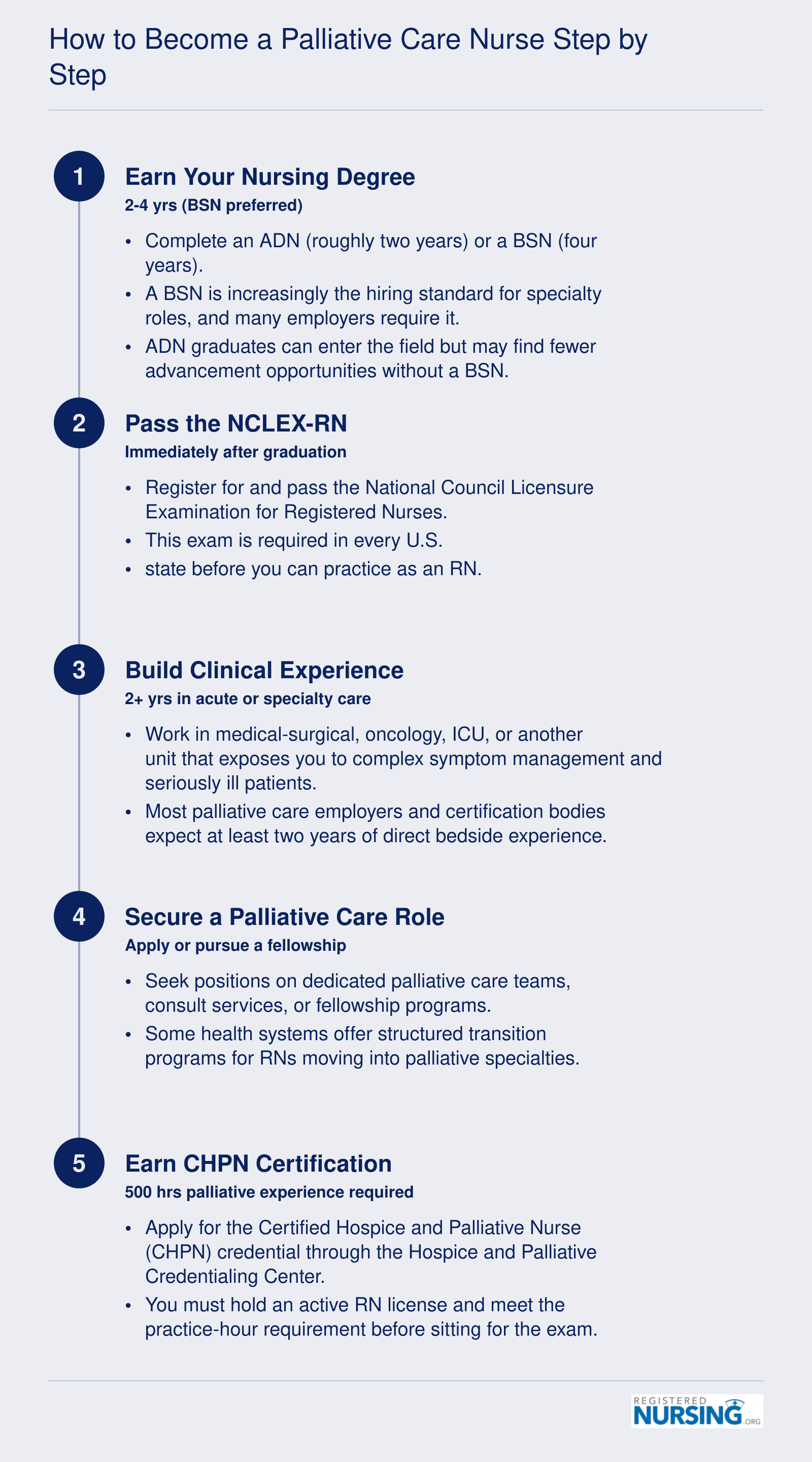
How to Become a Palliative Care Nurse Step by Step
The path from nursing student to certified palliative care nurse typically spans four to six years. While an Associate Degree in Nursing (ADN) qualifies you to sit for the NCLEX-RN and begin practice, a Bachelor of Science in Nursing (BSN) is increasingly the preferred credential. BSN-prepared nurses generally have access to more palliative care positions, leadership roles, and graduate-level advancement opportunities.
Palliative Care Nurse Certification Requirements
Earning a specialty certification in palliative care is voluntary, yet it is increasingly expected by employers and strongly correlated with higher pay, greater professional credibility, and expanded career opportunities. Two credentials from the Hospice and Palliative Credentialing Center (HPCC) dominate the field: the CHPN for registered nurses and the ACHPN for advanced practice registered nurses.
CHPN: Certified Hospice and Palliative Nurse
The CHPN is the most widely recognized credential for RNs working in palliative or hospice settings.1 To sit for the exam, you need an active, unrestricted RN license plus documented practice hours in hospice or palliative care, specifically 500 hours within the most recent 12 months or 1,000 hours within the most recent 24 months.
The exam itself consists of 150 multiple-choice questions administered over a three-hour window.2 Content areas cover patient and family care, education, interdisciplinary collaboration, and ethical or legal considerations. Recent pass rates have ranged from roughly 69 to 75 percent, so focused preparation matters.2 The exam fee is $415 as of 2025, and the credential is valid for four years before renewal is required.3
ACHPN: Advanced Certified Hospice and Palliative Nurse
The ACHPN is designed for nurse practitioners and clinical nurse specialists who want to demonstrate advanced competence.4 Eligibility requires an active APRN license, completion of a graduate-level NP or CNS program, a 500-hour clinical practicum, and 500 to 1,000 practice hours in hospice or palliative care (following the same 12- or 24-month window as the CHPN).
The ACHPN exam contains 175 questions, 150 of which are scored and 25 of which are unscored pretest items.5 The test spans four content domains, with Evaluation and Management representing the largest share and Professionalism and Practice covering topics like quality improvement and interprofessional leadership. Like the CHPN, the ACHPN must be renewed every four years, and renewal requires 100 professional development points.6
Study Tips and Preparation Timeline
Most candidates benefit from a structured study plan of roughly 8 to 12 weeks. Beyond the credentials covered here, reviewing advanced certifications available for nurses can help you map a broader professional development strategy. Consider these resources and strategies:
- HPNA Core Curriculum: The textbook published by the Hospice and Palliative Nurses Association covers every exam domain in depth and is widely regarded as the single most important study resource.
- Practice exams: Timed practice tests help you acclimate to the question style and identify weak areas. Several online platforms offer CHPN and ACHPN question banks.
- Study groups: Connecting with colleagues who are also preparing can reinforce difficult concepts, especially around pain management pharmacology and ethical decision-making.
- Continuing education courses: Many hospitals and professional organizations offer palliative care CE modules that double as both exam prep and renewal credit.
Whether you pursue the CHPN or the ACHPN, certification signals to employers, patients, and interdisciplinary care teams that you have met a rigorous, nationally recognized standard of palliative care knowledge.
Palliative Care Nurse Salary: National Overview
The U.S. Bureau of Labor Statistics does not report salary data specifically for palliative care nurses, so the figures below reflect national wage data for all registered nurses as reported in the 2024 Occupational Employment and Wage Statistics. Keep in mind that nurses who hold a palliative care specialty certification often command a pay premium above these general RN benchmarks. Employers recognize the advanced skill set, and survey data from professional nursing organizations suggest that specialty-certified nurses can earn several thousand dollars more per year than their non-certified peers.
| Wage Percentile | Annual Salary |
|---|---|
| 25th Percentile | $78,610 |
| Median (50th Percentile) | $93,600 |
| 75th Percentile | $107,960 |
| Mean (Average) | $98,430 |
Palliative Care Nurse Salary by State
Palliative care nurse salaries vary significantly by location. The table below highlights registered nurse earnings across 25 states, based on data from the Occupational Employment and Wage Statistics program (2024) published by the U.S. Bureau of Labor Statistics. Keep in mind that a higher nominal salary does not always translate to greater purchasing power. For example, while Rhode Island posts the highest median RN salary on this list, states like Texas and Oklahoma offer lower cost of living, which can make a moderate salary stretch considerably further.
| State | Total RN Employment | 25th Percentile | Median Salary | 75th Percentile | Mean Salary |
|---|---|---|---|---|---|
| Rhode Island | 10,760 | $83,870 | $99,960 | $112,540 | $99,770 |
| Arizona | 64,430 | $81,390 | $96,890 | $105,450 | $95,230 |
| New Hampshire | 16,580 | $79,720 | $96,830 | $105,500 | $94,620 |
| Maryland | 48,980 | $81,470 | $96,830 | $104,840 | $96,650 |
| Colorado | 54,510 | $81,790 | $96,520 | $104,370 | $95,470 |
| Delaware | 13,260 | $82,600 | $92,610 | $108,360 | $95,450 |
| Texas | 261,050 | $77,450 | $90,010 | $102,200 | $91,690 |
| Virginia | 77,420 | $77,650 | $88,820 | $100,920 | $90,930 |
| New Mexico | 17,510 | $82,630 | $88,260 | $104,720 | $94,360 |
| Pennsylvania | 146,840 | $78,570 | $87,610 | $102,030 | $90,830 |
| Georgia | 97,410 | $76,600 | $86,560 | $104,790 | $91,960 |
| Illinois | 139,900 | $79,150 | $86,410 | $103,660 | $91,130 |
| Idaho | 14,540 | $78,020 | $86,100 | $100,220 | $89,770 |
| Wisconsin | 64,960 | $79,570 | $86,070 | $100,680 | $90,450 |
| Michigan | 104,210 | $80,030 | $85,670 | $101,210 | $90,580 |
| Vermont | 7,240 | $79,980 | $85,150 | $104,110 | $92,710 |
| Maine | 16,280 | $76,890 | $82,860 | $98,000 | $87,440 |
| Florida | 218,100 | $77,070 | $82,850 | $99,260 | $88,200 |
| Utah | 25,780 | $77,030 | $82,270 | $101,530 | $88,240 |
| North Carolina | 108,510 | $74,710 | $81,860 | $98,720 | $86,270 |
| Wyoming | 5,180 | $75,540 | $81,790 | $100,910 | $88,020 |
| Montana | 10,540 | $77,800 | $81,560 | $100,510 | $88,480 |
| Ohio | 138,360 | $77,420 | $81,250 | $97,440 | $86,110 |
| Oklahoma | 32,870 | $75,320 | $81,160 | $96,460 | $85,800 |
| Nebraska | 24,180 | $76,430 | $81,020 | $93,140 | $82,890 |
Job Outlook for Palliative Care Nurses
Choosing a nursing specialty means weighing passion against practicality, and palliative care offers strong footing on both fronts. The Bureau of Labor Statistics projects overall registered nurse employment to grow by 5 percent from 2024 to 2034, with approximately 189,100 openings annually.1 While that baseline growth is solid, palliative care nursing is positioned to outpace the broader field due to several converging factors.
Why Palliative Care Demand Is Accelerating
The aging of the American population is the primary driver. As the number of adults living with multiple chronic conditions increases, so does the need for nurses skilled in symptom management and care coordination across the illness trajectory. Unlike hospice, which serves patients in the final six months of life, palliative care can begin at diagnosis and continue alongside curative treatment, expanding the patient population that benefits from these services.
Insurance and reimbursement changes have also fueled growth. The shift toward value-based care models rewards hospitals and health systems for improving patient satisfaction, reducing unnecessary hospitalizations, and managing complex cases efficiently. Palliative care teams excel in all three areas, which has prompted administrators to invest in staffing. Additionally, The Joint Commission now offers advanced certification for palliative care programs, signaling the specialty's move from optional add-on to institutional standard.
Growth in Hospital-Based Programs
Data from the Center to Advance Palliative Care indicates that the majority of large U.S. hospitals now operate dedicated palliative care programs, a figure that has climbed steadily over the past two decades. Smaller hospitals and outpatient settings are following suit, creating new positions for nurses who hold specialty certifications or have demonstrated competency in this area. Hospital nursing vs. clinical nursing settings both continue to expand palliative care teams, giving credentialed nurses more options than ever before.
The Practical Takeaway
For nurses evaluating career paths, palliative care represents a high-demand niche within an already-growing profession. Job security is strong, opportunities span multiple care settings, and the specialty's momentum shows no signs of slowing. If meaningful work with medically complex patients appeals to you, the outlook supports making the investment in specialized training.
Career Advancement in Palliative Care Nursing
What options exist for palliative care nurses who want to grow beyond bedside practice? The career ladder in palliative care nursing offers meaningful progression, whether you prefer clinical expertise, advanced practice roles, or leadership positions that shape how organizations deliver comfort-focused care.
The Clinical Career Ladder
Most palliative care nurses begin at the bedside, providing direct patient care in hospitals, outpatient clinics, or home settings. From this foundation, several advancement paths emerge:
- Palliative Care Nurse Practitioner: Requires an MSN or DNP with palliative focus. NPs gain prescriptive authority and can bill independently in many states, significantly expanding their scope of practice.
- Clinical Nurse Specialist: Focuses on improving care quality across units or systems while maintaining clinical expertise.
- Palliative Program Director or Administrator: Oversees entire palliative care departments, managing budgets, staff, and strategic initiatives. This role shares many competencies with a director of nursing position in larger health systems.
The nurse practitioner pathway represents the most common clinical advancement route. Palliative care NPs conduct comprehensive assessments, manage complex symptom regimens, lead family meetings, and coordinate interdisciplinary care plans with significant autonomy.
Graduate Programs for Palliative Specialization
Several well-established programs prepare nurses for advanced palliative practice. The University of Maryland, Baltimore offers an online M.S. in Palliative Care designed for working nurses seeking flexibility.1 CU Anschutz provides a campus-based or hybrid Master of Science in Palliative Care requiring 33 credits over approximately 22 months.2
For nurses who already hold an NP credential, post-master's certificate options add palliative specialization without completing another full degree. Walden University offers an online Post-Master's Certificate in Palliative Care.4 The University of North Texas Health Science Center provides a 12-credit online Palliative and Hospice Nursing Graduate Certificate for those seeking focused training.3
After completing graduate education, the Advanced Certified Hospice and Palliative Nurse credential validates specialty expertise and often opens doors to leadership roles. Nurses who want to survey accelerated MSN programs before committing to a specific palliative track will find several direct-entry options worth comparing.
Non-Clinical Advancement Paths
Not every experienced palliative nurse wants to remain in direct patient care. Alternative career directions include:
- Palliative care education, training the next generation of nurses
- Research focused on symptom management, communication, or care delivery models
- Quality improvement leadership, analyzing outcomes and implementing evidence-based protocols
- Palliative care consulting, helping organizations develop or strengthen their programs
These roles leverage clinical experience while shifting focus toward broader system impact.
Salary Expectations at Advanced Levels
Advancement typically brings significant compensation increases. Current data shows palliative care nurse practitioners earn a median annual wage of approximately $97,000 nationally, with hourly rates around $46.67.5 However, NP-level palliative roles frequently reach $100,000 to $130,000 or higher depending on geographic location, employer type, and years of experience. Program directors and administrators may earn comparable or greater salaries, particularly in larger health systems.
Whether you pursue clinical mastery, teaching, research, or leadership, palliative care nursing offers a career that deepens in meaning as your responsibilities grow.
The Emotional Side: Burnout and Resilience in Palliative Care Nursing
Is palliative care nursing emotionally difficult? The honest answer is yes, and that is only half the picture. The work is genuinely hard, and acknowledging that is not a warning to stay away. It is a starting point for building the kind of resilience that allows nurses in this specialty to sustain long, meaningful careers.
What the Research Shows
Burnout in this field is not a rare edge case. A 2023 scoping review of 59 studies on hospice and palliative care professionals found burnout prevalence ranging from 3% to 66% depending on setting, role, and measurement tool.1 A 2024 analysis placed the overall rate among palliative and hospice care workers at roughly 49%.2 Earlier survey data from palliative care nurses specifically found that around 24% reported high emotional exhaustion, 30% scored high on depersonalization, and 28% reported low feelings of personal accomplishment.3 Low professional quality of life consistently emerges as one of the strongest risk factors across studies.4
Those numbers do not mean burnout is inevitable. They mean the field demands intentional support structures, both from individuals and from employers.
Evidence-Based Coping Strategies
Research points to several approaches that genuinely help palliative care nurses sustain their wellbeing over time:
- Peer support programs: Connecting regularly with colleagues who share the same clinical realities reduces isolation and normalizes the grief that comes with end-of-life care.2
- Structured debriefing: Team debriefs after particularly difficult cases give nurses a sanctioned space to process emotions before they accumulate.
- Mindfulness-based stress reduction: Mindfulness practices have shown consistent benefits for healthcare workers in high-stress specialties, helping to create psychological separation between work and personal life. post-pandemic mental health data and resources offers additional context on workforce wellbeing trends shaping current practice.
- Reflective practice: Journaling or structured reflection on meaningful patient encounters helps nurses find purpose in the work, which research identifies as a protective factor alongside social support and strong end-of-life care training.5
Maintaining clear boundaries between work and personal time is not a luxury in this specialty. It is a professional skill.
What to Look for in an Employer
When evaluating a position in palliative care, ask direct questions about institutional support. The employers worth working for will have concrete answers. Look for:
- Access to employee assistance programs or bereavement counseling for staff6
- Manageable caseloads that allow nurses time with each patient and family7
- Team-based care models where physicians, social workers, chaplains, and nurses share the emotional load
- Regular supervisor check-ins that go beyond task management to address staff wellbeing6
Palliative care nursing carries real weight. The nurses who thrive in it are not people who feel nothing. They are people who have built honest relationships with their own limits and who work within systems designed to hold them up.
While palliative care certification (CHPN) remains technically voluntary, top employers increasingly treat it as a baseline expectation when hiring. Beyond employability, certified palliative care nurses consistently report higher job satisfaction and greater career mobility, making the credential a smart investment for any nurse serious about long-term growth in this specialty.
Frequently Asked Questions About Palliative Care Nursing
Below are answers to some of the most common questions prospective palliative care nurses ask. Each response offers a brief overview, and you can find more detailed information in the corresponding sections of this guide.
- What degree do you need to be a palliative care nurse?
- At minimum, you need an Associate Degree in Nursing (ADN) and an active RN license. However, many employers prefer or require a Bachelor of Science in Nursing (BSN), especially in hospital-based palliative care programs. If you are weighing your options, a closer look at ADN vs BSN nursing degree choices can help clarify which path fits your goals. Advanced practice roles, such as palliative care nurse practitioner, require a master's or doctoral degree. See the step-by-step section above for a full breakdown of the educational pathway.
- How much do palliative care nurses make in the US?
- Palliative care nurse salaries vary by location, experience, and credentials. Registered nurses working in palliative care settings generally earn salaries consistent with the broader RN profession, with advanced certifications and specialized experience often commanding higher pay. The salary overview and state-by-state tables earlier in this article provide more specific figures.
- What is the difference between a palliative care nurse and a hospice nurse?
- Palliative care nurses work with patients at any stage of a serious illness, often alongside curative treatments. Hospice nurses focus specifically on patients who have a terminal prognosis and have transitioned to comfort-focused care. Both specialize in symptom management and quality of life, but their patient populations and care goals differ. The comparison section earlier in this guide explores these distinctions in detail.
- What certifications do palliative care nurses need?
- Certification is not always mandatory, but it is strongly recommended. RNs can pursue the Certified Hospice and Palliative Nurse (CHPN) credential through the Hospice and Palliative Credentialing Center. Advanced practice nurses may earn the Advanced Certified Hospice and Palliative Nurse (ACHPN) credential. The certification requirements section above outlines eligibility criteria and exam details.
- Is palliative care nursing emotionally difficult?
- Yes, palliative care nursing can be emotionally demanding. Nurses regularly support patients and families facing serious illness, grief, and difficult decisions. However, many palliative care nurses report deep professional fulfillment from the meaningful connections they build. Developing resilience strategies, seeking peer support, and utilizing employer wellness resources are essential. The section on burnout and resilience covers practical coping approaches.
- Can you become a palliative care nurse with an ADN instead of a BSN?
- Yes, nurses with an ADN and an active RN license can work in palliative care. Many begin their palliative care careers with an associate degree and gain experience in medical, surgical, or oncology units before specializing. That said, earning a BSN can open additional opportunities, particularly in leadership roles and larger health systems. An RN to BSN program is a common next step for ADN-prepared nurses in this field.
Explore More
- Ambulatory Care Nurse
- Burn Unit Nurse
- Cardiac Nurse
- Cath Lab Nurse
- Charge Nurse
- Chief Nursing Officer (CNO)
- Correctional Nurse
- CVOR Nurse
- Dermatology Nurse
- Developmental Disability Nurse
- Director of Nursing
- Domestic Violence Nurse
- Emergency Room Nurse
- ENT Nurse
- ET Nurse
- Fertility Nurse
- Flight/Transport Nurse
- Forensic Nurse Salary & Career Guide
- Genetic Nurse
- Geriatric Nurse
- Health Policy Nurse
- Healthcare Administrator
- Healthcare Manager
- Home Health Nurse
- Hospice Nurse
- Camp Nurse
- GI Nurse
- Holistic Nurse
- Labor and Delivery Nurse
- Nurse Writer
- Psychiatric Nurse
- School Nurse
- Telemetry Nurse
- Travel Nurse
- Aesthetic Nurse
- Infusion/IV Nurse
- Oncology Nurse
- ICU Nurse
- Infection Control Nurse
- Legal Nurse Consultant
- LTC Nurse
- Managed Care Nurse
- Medical-Surgical Nurse
- Military (Combat) Nurse
- Missionary Nurse
- Mother Baby Nurse
- Nephrology Nurse
- Neuroscience Nurse
- NICU Nurse
- Nurse Administrator
- Nurse Attorney
- Nurse Care Coordinator
- Nurse Case Manager
- Nurse Entrepreneur
- Nurse Executive
- Nurse Health Coach
- Nurse Manager
- Obstetric (OB) Nurse
- Occupational Health Nurse
- Operating Room Nurse
- Ophthalmic Nurse
- Organ Procurement Coordinator
- Orthopedic Nurse
- Pain Management Nurse
- Parish Nurse
- Patient Advocate Nurse
- Pediatric Endocrinology Nurse
- Perianesthesia (PACU) Nurse
- Perinatal Nurse
- Plastic Surgery Nurse
- Public/Community Health Nurse
- Radiology Nurse
- Rehabilitation Nurse
- Research Nurse
- Respiratory Nurse
- Rheumatology Nurse
- Substance Abuse Nurse
- Telephone Triage Nurse
- Transcultural Nursing
- Transplant Nurse
- Trauma Nurse
- Wound Care Nurse (WOCN)