

What you’ll learn in this article…
- Nurse entrepreneur income ranges from below salaried pay to six figures annually.
- About 27 states grant NPs full practice authority for independent clinics.
- Startup costs span from a few hundred dollars to several hundred thousand.
What exactly does a nurse entrepreneur do, and how is it different from bedside nursing? A nurse entrepreneur is a licensed RN, LPN, or APRN who owns and operates a healthcare-related business rather than working solely as a W-2 employee. The role can be clinical, running a home health agency, an independent nurse practitioner clinic, an IV hydration lounge, or entirely non-clinical: health coaching, legal nurse consulting, medical writing, continuing education, or nurse staffing.
The tension most nurses face is real. Clinical ventures often demand six-figure startup capital, state licensure, and malpractice coverage, while consulting and content businesses can launch for under $2,000 but require sharper marketing skills. Nurses considering a coaching-based venture can explore what the nurse health coach path looks like before committing to a business model. With nurse practitioner demand projected to grow 40.1% through 2034, the market conditions favor nurses willing to build something of their own.
Types of Nursing Businesses You Can Start
The choice between launching a nursing business quickly with minimal investment or building a larger enterprise with significant regulatory and capital requirements shapes every other decision you will make. Understanding where each business model falls on that spectrum helps you match your resources, risk tolerance, and long-term goals to the right opportunity.
Low-Barrier Business Models
Several nursing businesses can be launched with an RN or BSN license, modest startup costs, and flexible work arrangements. These options answer a common question directly: yes, nurses can absolutely start their own business without an NP degree.
- Health and Wellness Coaching: RNs can become certified health coaches and work with clients on weight management, stress reduction, chronic disease prevention, and lifestyle modification. Startup costs typically include certification fees and basic marketing. No prescriptive authority is needed.
- Medical Writing: Nurses with strong writing skills can create content for healthcare publications, pharmaceutical companies, continuing education providers, and digital health platforms. This business requires little more than a computer, portfolio samples, and professional liability coverage.
- Legal Nurse Consulting: RNs review medical records, identify standards of care, and provide expert opinions for attorneys handling malpractice, personal injury, and workers' compensation cases. Certification is available but not required in most states, and overhead remains low.
- Nurse Education and CE Course Development: Experienced nurses can develop and sell continuing education courses through online platforms or directly to healthcare facilities. Accreditation through organizations like ANCC adds credibility but is not always mandatory for certain course types.
- Nurse Consulting: RNs and BSNs advise healthcare organizations on clinical workflows, quality improvement, patient safety, infection control, and regulatory compliance. Consulting engagements can be project-based or retainer arrangements.
Moderate Complexity Models
These businesses require more regulatory navigation, potentially higher startup capital, or specialized training, but still remain accessible to RNs and BSNs in many states.
- Private Duty Nursing: Providing one-on-one care to clients in their homes allows RNs to set their own rates and schedules. Requirements vary by state, with some requiring home health agency licensure even for solo practitioners, while others permit independent contractor arrangements. Learn more about the day-to-day scope in this private duty nurse job description.
- Telehealth Practice: RNs can offer triage services, chronic disease education, care coordination, and post-discharge follow-up through telehealth platforms. Multi-state practice requires attention to the Nurse Licensure Compact and state-specific telehealth regulations. NP licensure is required for practices involving diagnosis and prescribing.
- Corporate Wellness Programs: Businesses increasingly hire nurses to design workplace health initiatives, conduct biometric screenings, manage occupational health needs, and coordinate employee wellness challenges. This model often combines consulting with direct service delivery.
Higher Capital and Regulatory Burden Models
Some nursing businesses involve substantial startup costs, complex licensing requirements, and ongoing compliance obligations.
- Home Health Agency: Opening a Medicare-certified home health agency requires state licensure, federal certification, accreditation, significant working capital for payroll before reimbursement, and dedicated administrative infrastructure. Many states have certificate-of-need laws that add another layer of approval.
- IV Hydration Therapy Business: These wellness-focused clinics offer vitamin infusions, hydration therapy, and recovery services. Regulations vary dramatically by state. Some require physician oversight or NP involvement for IV administration, while others permit RN-owned operations with medical director agreements. Startup costs include clinical space, supplies, liability insurance, and marketing. RNs considering this path may find it helpful to review what infusion nurse certification involves before building out a service menu.
Emerging 2025 to 2026 Opportunities
Recent changes in reimbursement and technology have opened new business models for entrepreneurial nurses.
- Remote Patient Monitoring Services: Nurses can launch businesses that manage RPM programs for physician practices, helping track vital signs, interpret data, and conduct patient outreach. Medicare reimbursement expansion has made this model increasingly viable.
- Chronic Care Management Services: Similar to RPM, CCM businesses provide ongoing care coordination for patients with multiple chronic conditions. RNs can bill under physician supervision arrangements while managing day-to-day patient communication.
Each of these models carries different implications for licensing, scope of practice, and income potential. The right choice depends on your clinical background, available capital, appetite for regulatory complexity, and vision for how large you want your business to grow.
Questions to Ask Yourself
How to Become a Nurse Entrepreneur: Step-By-Step
Launching a nursing business is not a leap into the unknown so much as a deliberate series of decisions, each one building on the last. The nurses who succeed tend to follow a recognizable sequence, even if the timeline varies.
Step 1: Accumulate Real Clinical Experience
Two to five years of hands-on practice is the practical baseline most successful nurse entrepreneurs cite before going out on their own. The reasons go beyond confidence. Clinical time builds the professional network you will lean on for referrals, the judgment you need to navigate complex client situations, and the credibility that makes prospective clients trust you with their care or their money. An MBA is a nice credential; a reputation earned at the bedside is essential.
Step 2: Identify Your Niche and Validate Demand
Before writing a single page of a business plan, find out whether anyone will actually pay for what you want to offer. Talk to potential clients, survey colleagues, and research competitors in your target geography. Your niche might be wound care consulting, telehealth coaching, legal nurse consulting, or something else entirely. The goal is to confirm that a real market exists before you commit significant time or money.
Step 3: Write a Lean Business Plan
A lean business plan does not need to run forty pages. It should answer four questions: What problem do you solve? Who pays you? How do you reach them? What does it cost to deliver your service? Free templates from the Small Business Administration (SBA) are a solid starting point. SCORE, the SBA-affiliated mentorship network, pairs entrepreneurs with experienced business advisors at no charge, and a growing number of nurse-entrepreneur-specific incubators offer cohort programs, peer support, and sometimes seed funding.
Start the business as a side venture while you are still employed whenever possible. This reduces financial pressure and gives you runway to iterate without risking your household income.
Steps 4 and 5: Legal Structure, Licenses, and Insurance
Choosing a legal entity, typically a sole proprietorship, LLC, or S-corporation, shapes your taxes, liability exposure, and administrative burden. Most new nurse entrepreneurs begin with an LLC for its liability protection and relative simplicity, then revisit the structure once revenue grows. At the same time, secure all required licenses for your specific service type, carry professional liability (malpractice) insurance, and confirm that your planned services fall within your scope of practice.
Scope of practice is where many nurses encounter surprises. An RN and an NP operate under different legal authorities, and those boundaries shift from state to state. What an NP can order, prescribe, or independently manage in one state may require physician collaboration in another. Research your state's nurse practice act before finalizing your service offerings.
Steps 6 and 7: Build Your Brand, Launch, and Iterate
A professional online presence, at minimum a clean website and at least one active social media channel, signals legitimacy to potential clients and referral sources. Focus on communicating your specific expertise rather than trying to appeal to everyone.
Then launch, even before everything feels perfect. Early clients surface gaps in your process, your pricing, and your messaging faster than any planning exercise can. Treat the first six to twelve months as a continuous feedback loop, adjusting based on what you learn rather than what you assumed.
Licensing, Legal Requirements, and Scope of Practice by Business Type
The regulatory landscape for nurse-owned businesses has grown increasingly complex as healthcare delivery models diversify and state boards work to balance innovation with patient safety. Understanding which licenses, permits, and insurance policies your venture requires is essential before you sign a lease or see your first client.
Home Health Agencies
Starting a Medicare-certified home health agency involves multiple layers of oversight. You will need a state facility license, Medicare certification through the Centers for Medicare and Medicaid Services, and accreditation from a recognized body such as the Joint Commission, Community Health Accreditation Partner, or Accreditation Commission for Health Care.1 States also require background checks for owners and staff, detailed infection control plans, and evidence of quality assurance programs.
From an insurance standpoint, expect to carry individual malpractice coverage for clinicians, entity-level professional liability (often called errors and omissions), general liability for premises and operations, and workers' compensation once you hire staff.1 An RN license is sufficient to provide skilled nursing services, but if you plan to operate with full clinical autonomy and prescriptive authority, NP licensure becomes necessary.
Telehealth Practices
Telehealth ventures must navigate a patchwork of state rules. The core principle is that you must hold an active license in the state where your patient is physically located at the time of the encounter.2 For RNs, the Nurse Licensure Compact allows practice across member states with a single multistate license. Nurse practitioners can leverage the expanding APRN Compact, though fewer states have enacted it so far. If you prescribe controlled substances via telehealth, DEA registration in each state where you prescribe is mandatory.2 Telehealth can also open doors to remote nursing jobs that blend clinical oversight with digital patient engagement.
Malpractice policies for telehealth should include an explicit telehealth endorsement. Cyber liability coverage is equally important given the sensitive health data transmitted through video platforms and patient portals.
IV Hydration Bars
IV therapy lounges occupy a regulatory gray zone that varies dramatically by jurisdiction. In states with full practice authority for NPs, a nurse practitioner can own and operate a hydration bar independently. In restricted-practice states, an RN-owned business typically requires a collaborating physician or medical director to supervise clinical protocols.3 Beyond licensure, you will likely need a healthcare facility or clinic license, local health department permits, and documented infection control procedures. Corporate practice of medicine statutes in some states prohibit non-physicians from owning entities that deliver certain clinical services, so legal counsel familiar with your state's rules is critical.
Insurance requirements include professional liability for each clinician, entity-level malpractice, general liability, and product liability coverage for the IV solutions and supplements you administer.3
Nurse Consulting Businesses
Legal nurse consultants, case managers, and expert witnesses generally operate under their RN license without needing additional clinical credentials, provided they do not diagnose, treat, or prescribe.3 If you are considering this path, becoming an expert witness as an RN is a well-established consulting avenue that draws directly on your clinical background. Business registration with your state's secretary of state office is standard, and you must remain within your nurse practice act's boundaries. Consultant errors and omissions insurance protects against claims of negligent advice, and if your consulting includes any hands-on clinical activity, malpractice coverage is also necessary.
Nurse Staffing Agencies
Ownership requirements for staffing agencies differ by state. Some jurisdictions, such as the District of Columbia, Louisiana, and New Hampshire, require a specific staffing agency license with financial disclosures, bonding, or background checks on owners.4 Others have no special licensing beyond general business registration. Regardless of location, you must credential every nurse you place, verify licenses, and comply with labor laws governing wages, overtime, and independent contractor classifications. Carry professional liability insurance at the agency level, general liability, and workers' compensation.
Non-Medical Home Care Agencies
If your business provides companionship, personal care, or homemaking services without skilled nursing, licensure requirements are lighter. Many states require only a general business license and possibly a home care license, though specifics vary.1 A non-clinician can own this type of agency. General liability and workers' compensation remain essential to protect against accidents and employee injury claims.
Whether a nurse-owned practice is legally viable depends heavily on where you live. As of 2025, roughly 27 states grant full practice authority to nurse practitioners, allowing them to launch independent clinics without physician oversight. In restricted-practice states, mandatory collaboration agreements can make certain business models impractical or financially unworkable before you ever open your doors.
Nurse Entrepreneur Salary and Income Potential
Income potential for nurse entrepreneurs varies widely depending on business model, geographic location, client volume, and individual expertise, making it difficult to cite a single authoritative salary figure. Unlike traditional nursing roles, which are tracked comprehensively by the Bureau of Labor Statistics, entrepreneur-specific income data is fragmented across industry reports, association surveys, and self-reported platforms. Understanding how to research and estimate your own earning potential requires cross-referencing multiple credible sources and adjusting expectations based on your chosen business structure.
Start with General Nurse Salary Baselines
The Bureau of Labor Statistics offers detailed wage data for employed nurses across specialties, regions, and practice settings. While these figures reflect W-2 employment rather than business ownership, they provide a useful baseline for understanding what you might forgo in guaranteed income when launching a venture. For example, registered nurses in clinical roles earn a median salary that can serve as a reference point when calculating your break-even revenue target. From there, factor in the additional costs and profit margins associated with running a business to estimate the revenue your venture must generate to match or exceed employed income.
Seek Industry-Specific Reports and Association Surveys
Nursing associations and home care industry groups periodically publish surveys and benchmarking reports that include revenue data for business owners. Organizations such as the American Nurses Association, the National Association for Home Care & Hospice, and entrepreneurship-focused groups like SCORE or the National Federation of Independent Business occasionally release aggregated data on small business income. These reports may break down revenue by business type, such as home health agencies, private duty staffing firms, or consulting practices. Search association websites and industry publications for white papers, annual reports, or member surveys that include financial benchmarks.
Explore University Case Studies and Alumni Outcomes
Several nursing schools and business programs track outcomes for graduates who pursue entrepreneurship. Institutions with dedicated nurse entrepreneur programs or innovation tracks, such as Johns Hopkins or the University of Pennsylvania, may publish case studies, alumni profiles, or aggregated revenue data for nurse-owned businesses. These resources often highlight real-world income trajectories, startup challenges, and profitability timelines. Contact program offices or search alumni networks to request access to published outcomes or to connect with graduates willing to share firsthand revenue insights.
Use Self-Reported Platforms and Professional Networks
Platforms like Glassdoor, PayScale, and niche communities such as the Nurse Entrepreneur Network host self-reported income data that can be filtered by business model and specialty. While these figures are not independently verified, they offer a snapshot of what peers in similar ventures report earning. Look for industry-specific benchmarking firms, such as Home Care Pulse for hospice nurse agencies, which publish revenue and profitability metrics based on client surveys. Finally, consider reaching out directly to established nurse entrepreneurs via LinkedIn or professional groups to request informational interviews and firsthand estimates of income potential and the time required to reach profitability.
Calculate Your Own Profitability Timeline
Rather than relying solely on published income data, build a custom financial model for your business. Use resources like the Small Business Administration to research startup costs, operating expenses, and break-even analytics specific to your model. Factor in licensing fees, insurance, marketing, technology, and payroll if you plan to hire staff. Interview multiple nurse business owners to gather realistic estimates of revenue ramp-up periods. Many nurse-owned businesses take one to three years to become consistently profitable, but timelines vary based on niche, initial capital, and market demand. By combining general industry data with firsthand interviews and your own financial projections, you can develop a realistic income expectation tailored to your specific venture.
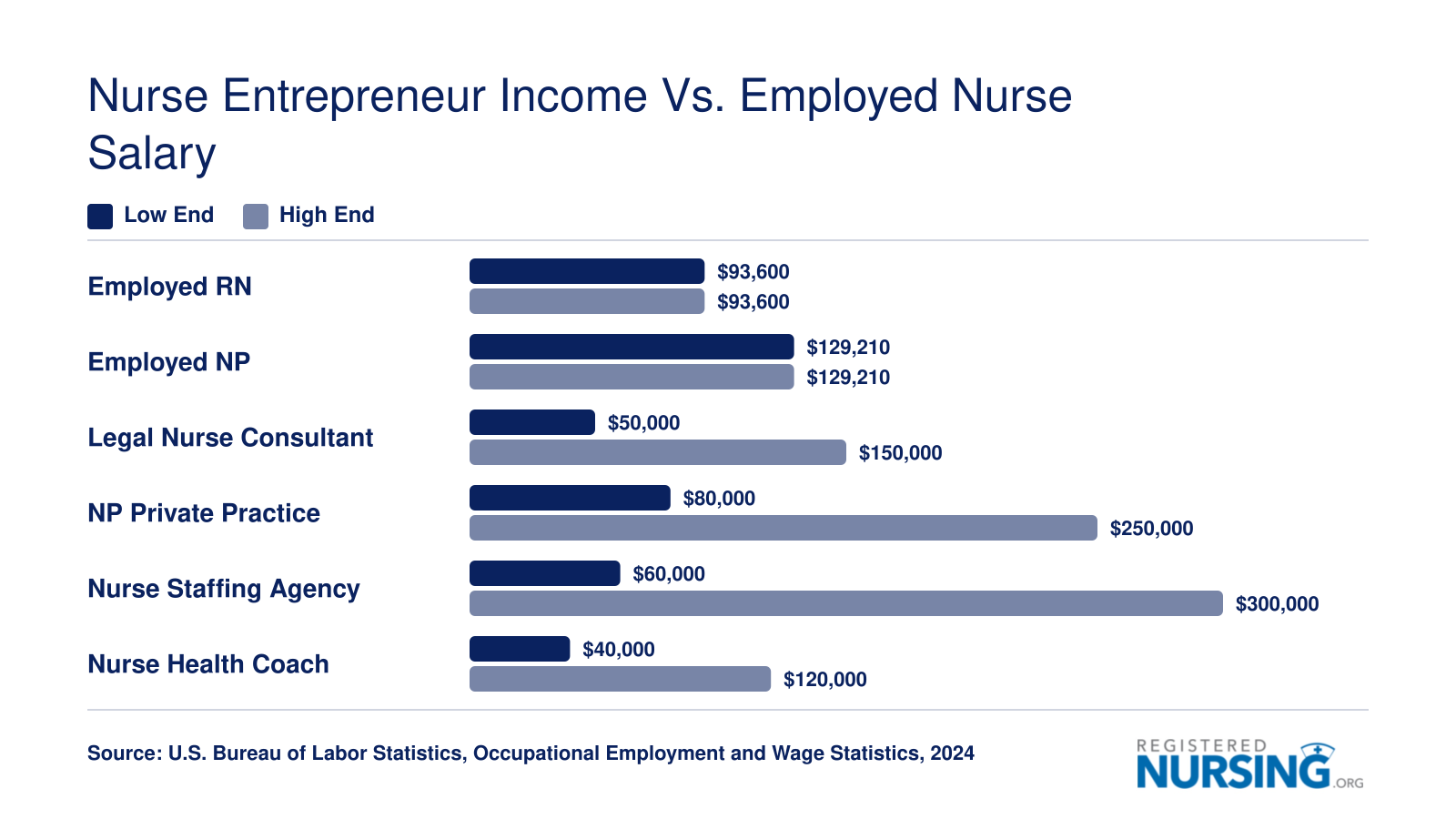
Nurse Entrepreneur Income Vs. Employed Nurse Salary
Entrepreneurship offers nurses a wider income range than traditional employment. The floor can dip below a salaried position during early startup years, but the ceiling climbs well beyond what most employed roles pay. The chart below compares BLS median salaries for employed RNs and NPs with estimated annual income ranges for select nurse-owned business models.
Startup Costs and Financial Planning by Business Type
One of the most practical realities of nursing entrepreneurship is that your startup investment can range from a few hundred dollars to several hundred thousand, depending entirely on which business model you choose. Understanding those ranges before you commit saves you from undercapitalizing a venture or overborrowing for one that simply does not need it.
Low-Cost Entry Points
Two business types stand out for nurses who want to test entrepreneurship without heavy financial risk.
- Health coaching: Startup costs typically fall between $1,000 and $10,000, covering certification fees, liability insurance, scheduling or course-delivery software, and initial marketing.1 Most coaches reach break-even within three to six months.
- Nurse consulting: Whether you focus on legal case review, compliance, or staff education, you can launch for $1,000 to $15,000.1 Your primary expenses are professional liability insurance, basic business software, and a professional web presence. Break-even timelines mirror health coaching: three to six months for consultants who price their services correctly from day one.
For both models, the biggest financial risk is underpricing. Set your rates based on the value of your clinical expertise, not on what feels comfortable to charge.
Mid-Range Investments
Some nurse-owned businesses require more upfront capital but still carry manageable risk.
- Telehealth or virtual care practice: Expect to spend $3,000 to $20,000, primarily on a HIPAA-compliant telehealth platform, equipment, multi-state licensing fees (if you plan to serve patients across state lines), and digital marketing.1 Break-even generally arrives within three to twelve months depending on patient volume.
- Private duty nursing practice: Costs range from $15,000 to $50,000 and include licensing, malpractice and general liability insurance, clinical supplies, an electronic health record system, and marketing.2 Most solo or small-team practices recover initial costs within three to nine months.
- IV hydration therapy clinic: This model sits at $25,000 to $75,000 because you need a physical space, a medical director agreement in most states, clinical equipment, IV supplies, and retail-level marketing.1 Plan for six to eighteen months before reaching consistent profitability.
High-Investment Ventures
A home health agency is the most capital-intensive option on this list, with startup costs ranging from $40,000 to well over $350,000.2 That range reflects the complexity involved: state licensure and Medicare or Medicaid certification fees, surety bonds, robust general liability and workers compensation insurance, an enterprise-grade electronic health record system, clinical equipment, a physical office, and several months of operating capital to cover payroll before reimbursements arrive. Break-even can take anywhere from nine months to two years or longer, which is why most successful agency founders either secure small business financing, pursue an SBA loan, or bring in an equity partner.
Building Your Financial Plan
Regardless of which path you choose, a few financial planning principles apply across every model.
First, separate your startup costs from your operating runway. Startup costs get you to opening day; operating capital keeps you solvent while revenue builds. A general guideline is to reserve three to six months of projected expenses before you accept your first client.
Second, account for insurance premiums early. Professional liability (malpractice) coverage is non-negotiable, and depending on your business type, you may also need general liability, commercial property, or cyber liability policies. Premiums vary by specialty and coverage limits, so get actual quotes before finalizing your budget.
Third, revisit your pricing quarterly during the first year. Many nurse entrepreneurs set rates too low initially and then find it difficult to raise them. Holistic nursing practitioners face the same challenge, where undervaluing integrative services is one of the most common early-stage business mistakes. Build in a planned rate review from the start so adjustments feel structured rather than reactive.
The U.S. Bureau of Labor Statistics projects nurse practitioner employment will grow 40.1% from 2024 to 2034, far outpacing nearly every other occupation. That surging demand for skilled nursing care creates fertile ground for entrepreneurs offering consulting, education, wellness, and clinical services to both patients and healthcare organizations.
Technology Stack and Tools for Nurse-Owned Businesses
Essential Software for Your Nurse-Owned Business
Starting solo does not mean operating without the right infrastructure. A small set of integrated digital tools keeps you compliant, efficient, and ready to grow.
- EHR and practice management: Lightweight options like Jane App and SimplePractice include scheduling, nursing charting systems, and billing for health and wellness professionals. If you anticipate needing robust medical billing, consider Athenahealth, which scales from solo practitioners to larger groups.
- HIPAA-compliant communication: Use platforms like Spruce or Klara for secure messaging, phone, and fax. These tools replace personal text and email, ensuring patient data stays protected.
- Billing and invoicing: Many EHRs include basic billing, but for standalone needs, tools like FreshBooks or Wave Health (configured for HIPAA) can handle invoicing and expense tracking.
- Telehealth: Doxy.me and Zoom for Healthcare provide simple, HIPAA-compliant video visits. They require no patient downloads and offer freemium tiers for low-volume startups.
All of these tools offer tiered pricing, so you can start on a basic plan and upgrade as your client base grows.
Clinical Governance and Quality Assurance
Even a solo practice must maintain formal documentation standards and quality controls. This protects patients and your license.
- Develop written protocols for charting, informed consent, and emergency procedures. Store these in a policy manual that you review annually.
- Use a simple incident reporting system, such as a secure digital form, to log any unexpected events or near misses. This habit supports continuous improvement and may be required by your liability insurer.
- Schedule regular peer case reviews, even if informal, with a trusted colleague or mentor. This provides external perspective and reinforces evidence-based care.
Risk Management and Compliance
Operating your own business exposes you to new risks. A proactive approach keeps you protected.
- Malpractice and tail coverage: Confirm that your professional liability policy includes tail coverage, which extends protection after you stop practicing. If you are moving from an employer's policy, you may need to purchase your own tail.
- Cyber liability insurance: Standard malpractice policies rarely cover data breaches. A standalone cyber policy helps with notification costs, legal fees, and penalties if patient data is compromised.
- HIPAA compliance checklist: Conduct an annual self-audit covering administrative, physical, and technical safeguards. Free checklists from HHS or your professional association are a good starting point. Understanding paper vs electronic medical records can help you assess where your documentation risks are greatest.
- Patient consent documentation: Use your EHR's built-in consent forms or design HIPAA-compliant digital forms that patients can sign electronically. Retain records securely for the required retention period in your state.
Start with these fundamentals and layer in additional safeguards as your practice matures. With the right technology stack and governance habits, you can focus on what matters most: delivering excellent care while running a sustainable business.
Marketing, Client Acquisition, and Scaling Your Nursing Business
How do I get my first client as a nurse entrepreneur?
How to Land Your First Clients
Your initial clients will come from the healthcare professionals who already trust your clinical judgment. Prioritize building referral relationships with physicians, discharge planners, social workers, and case managers. They frequently encounter patients who need the exact services you offer, such as private duty nursing, health coaching, or medication management. Start by reconnecting with former colleagues and scheduling brief meetings to explain how your business solves specific patient problems. Offer to provide a free educational in-service at a local clinic or hospital unit to demonstrate your expertise. A single strong referral source can generate a steady stream of clients, so nurture these relationships with consistent follow-ups and gratitude.
Establish Your Digital Presence
Even as you build personal referrals, a professional digital footprint is essential. Claim and fully optimize your Google Business Profile with accurate service categories, your address, phone number, and client reviews. Create a simple website with dedicated pages for each service and location you serve. Your website should clearly state what you do, who you serve, and how to reach you. A professional LinkedIn profile and participation in local Facebook groups for families, seniors, or health conditions can also put you in front of potential clients. Many nurse entrepreneurs find their first clients through a combination of a personal recommendation and a quick Google search that validates their legitimacy.
Scaling: From Solo to a Staffed Business
When you have more work than you can handle alone, it is time to scale. The decision to hire your first employee versus using independent contractors depends on your business structure and the level of control you need. Contractors allow flexibility and lower upfront costs, but employees give you more oversight and consistency for clinical care. Start by delegating administrative tasks, such as billing, scheduling, and insurance verification, so you can focus on high-value clinical work. Before hiring clinical staff, ensure you have clear protocols for training, supervision, and compliance with state regulations. Nurses with a background in managed care nursing may find these operational and payer-relations skills transfer directly into building a staffed business.
Overlooked Growth Levers: Credentialing and Content
Many nurse entrepreneurs miss the opportunity to become in-network providers with private insurers and government payers. Payer credentialing and insurance panel enrollment can unlock a reliable, larger client base that pays through reimbursement rather than out-of-pocket. This process requires patience and paperwork, but it can transform your business model. For nurses exploring the broader administrative and financial dimensions of running a practice, pathways for nurses interested in the business or administrative side of nursing offer useful context on formal roles that complement entrepreneurial work. Simultaneously, invest in content marketing by writing blog posts or creating patient education materials that address the questions your clients ask most often. This builds search engine authority and trust, positioning you as the obvious expert when someone searches for your services. Over time, a library of helpful content works alongside your referral network to attract clients passively.
Organizations and Resources for Nurse Entrepreneurs
Building a nursing business without professional support means reinventing solutions others have already tested. Connecting with established organizations, mentorship programs, and funding sources can shorten your learning curve and open doors to capital, clients, and collaborative partnerships that solo entrepreneurs rarely access on their own.
Professional Associations and Membership Organizations
Several national organizations cater specifically to nurses who own or plan to start businesses:
- National Nurses in Business Association (NNBA): This long-standing organization provides education, networking, and advocacy for nurse entrepreneurs across all specialties.1 Their annual conference, held July 16-18, 2026 in Scottsdale, AZ, brings together nurse business owners for workshops, vendor connections, and peer mentorship.2
- National Nurse Practitioner Entrepreneur Network (NNPEN): Focused specifically on NPs launching independent practices or consulting firms, NNPEN offers community forums, practice resources, and peer connections for advanced practice nurses navigating autonomous business ownership.3
- American Nurses Association (ANA): While primarily a professional nursing organization, ANA provides entrepreneurship resources through its career development initiatives, including guidance on transitioning from employee to business owner and navigating scope of practice questions.
- State nursing associations: Many state-level organizations offer business development tracks, local networking events, and legislative updates relevant to nurse-owned practices. Check your state association for entrepreneurship committees or small business resources.
Mentorship and Training Programs
Structured programs provide accountability, curriculum, and expert guidance that self-study cannot replicate:
- Nurse Practitioner Entrepreneur Program (NPEP): This 12-month hybrid program, launching January 2026, accepts cohorts of 20 NPs for intensive business development training.4 Applications for the current cohort closed December 2025, but future cycles typically open annually.
- Liberated Nurse Business Academy: Endorsed by the American Holistic Nurses Association as of July 2025, this program focuses on helping nurses build wellness-oriented businesses and coaching practices.5
- SCORE mentoring: This SBA-affiliated network pairs small business owners with experienced volunteer mentors at no cost. Healthcare-specific mentors may be available depending on your region.
Funding and Grant Opportunities
Capital remains one of the biggest barriers for new nurse entrepreneurs. Several pathways exist:
- SBA microloans: Loans up to $50,000 are available through SBA-approved intermediary lenders, often with more flexible qualification requirements than traditional bank financing.
- HRSA grants: The Health Resources and Services Administration offers grant programs for practices serving underserved populations or locating in health professional shortage areas. These can offset startup costs for primary care, mental health, or telehealth practices. Guide to Rural Nursing covers how shortage-area designations affect practice decisions in detail.
- Guardian Nurses Entrepreneurial Award: This $5,000 annual award supports Pennsylvania-licensed nurses with businesses under two years old. Applications typically close August 15 each year.6
- Women-owned business grants: Because nursing remains a predominantly female profession, many nurse entrepreneurs qualify for grants and financing programs targeting women-owned small businesses through the SBA and private foundations. Nurses pursuing advanced credentials may also find relevant funding through MSN degree scholarships and grants.
Networking Communities and Continuing Education
Online communities like Nurse Founder Forum on LinkedIn7 provide peer support and real-time problem solving among active nurse business owners. For formal education, Doctor of Nursing Practice programs with leadership or executive tracks prepare nurses for administrative and entrepreneurial roles, while certificate programs in healthcare administration offer shorter pathways to business management competencies without a full doctoral commitment.
Frequently Asked Questions About Nurse Entrepreneurship
Nursing entrepreneurship raises plenty of practical questions, from licensing to income expectations. Below are answers to the most common questions prospective nurse business owners ask, with references to the detailed guidance covered earlier in this article.
- How can a nurse be an entrepreneur?
- Nurses can leverage their clinical expertise, patient education skills, and healthcare knowledge to launch independent businesses. Common paths include legal nurse consulting, health coaching, telehealth services, medical staffing agencies, and continuing education companies. The key is identifying a market need that aligns with your nursing background and then following the step-by-step process outlined earlier in this guide.
- How much do nurse entrepreneurs make?
- Income varies widely depending on the business model, location, and scale. Some nurse entrepreneurs earn comparable salaries to employed RNs in their first year, while established business owners in niches like staffing, consulting, or telehealth can earn well into six figures. As noted in the income section above, earnings tend to grow significantly once overhead stabilizes and client volume increases.
- Can nurses start their own business without an NP degree?
- Yes. Many nursing businesses do not require a nurse practitioner credential. RNs and even LPNs can start ventures in legal nurse consulting, health coaching, care coordination, nurse staffing, or medical device sales. The critical factor is ensuring your business activities fall within your license's scope of practice, which varies by state.
- What licenses do you need to start a nursing business?
- At minimum, you need an active nursing license in your state and a general business license. Depending on the business type, you may also need a home health agency license, telehealth permits, or specific professional liability insurance. As discussed in the licensing section, requirements differ dramatically by state, so consult your state board of nursing and a healthcare attorney before launching.
- How do nurse entrepreneurs get their first clients?
- Most nurse entrepreneurs build their initial client base through professional networking, referrals from former colleagues, and targeted online marketing. Joining local business groups, attending healthcare conferences, and establishing a strong social media presence are effective strategies. The marketing section of this guide covers client acquisition tactics in greater detail.
- Is nursing entrepreneurship risky?
- Every business carries some financial and professional risk, but nurses often have a built-in advantage: they can maintain part-time emergency nursing or other clinical employment while building their business, which provides a safety net. Thorough financial planning, starting lean, and understanding your local regulations (as covered in the startup costs section) all help minimize risk considerably.
- What is the best business for a nurse to start?
- There is no single best business because the right choice depends on your clinical background, interests, and local market demand. High-demand options in 2026 include telehealth services, nurse coaching, legal nurse consulting, and nurse-owned staffing agencies. Review the types of nursing businesses section earlier in this article to match your skills with viable opportunities.
- Do you need a business degree to start a nursing business?
- No. While business knowledge is valuable, many successful nurse entrepreneurs learn the fundamentals through short courses, mentorship programs, and organizations dedicated to nursing entrepreneurship. Resources listed in the organizations section above can help you build financial literacy, marketing skills, and operational know-how without pursuing a formal business degree.
Explore More
- Ambulatory Care Nurse
- Burn Unit Nurse
- Cardiac Nurse
- Cath Lab Nurse
- Charge Nurse
- Chief Nursing Officer (CNO)
- Correctional Nurse
- CVOR Nurse
- Dermatology Nurse
- Developmental Disability Nurse
- Director of Nursing
- Domestic Violence Nurse
- Emergency Room Nurse
- ENT Nurse
- ET Nurse
- Fertility Nurse
- Flight/Transport Nurse
- Forensic Nurse Salary & Career Guide
- Genetic Nurse
- Geriatric Nurse
- Health Policy Nurse
- Healthcare Administrator
- Healthcare Manager
- Home Health Nurse
- Hospice Nurse
- Camp Nurse
- GI Nurse
- Holistic Nurse
- Labor and Delivery Nurse
- Nurse Writer
- Psychiatric Nurse
- School Nurse
- Telemetry Nurse
- Travel Nurse
- Aesthetic Nurse
- Infusion/IV Nurse
- Oncology Nurse
- ICU Nurse
- Infection Control Nurse
- Legal Nurse Consultant
- LTC Nurse
- Managed Care Nurse
- Medical-Surgical Nurse
- Military (Combat) Nurse
- Missionary Nurse
- Mother Baby Nurse
- Nephrology Nurse
- Neuroscience Nurse
- NICU Nurse
- Nurse Administrator
- Nurse Attorney
- Nurse Care Coordinator
- Nurse Case Manager
- Nurse Executive
- Nurse Health Coach
- Nurse Manager
- Obstetric (OB) Nurse
- Occupational Health Nurse
- Operating Room Nurse
- Ophthalmic Nurse
- Organ Procurement Coordinator
- Orthopedic Nurse
- Pain Management Nurse
- Palliative Care Nurse
- Parish Nurse
- Patient Advocate Nurse
- Pediatric Endocrinology Nurse
- Perianesthesia (PACU) Nurse
- Perinatal Nurse
- Plastic Surgery Nurse
- Public/Community Health Nurse
- Radiology Nurse
- Rehabilitation Nurse
- Research Nurse
- Respiratory Nurse
- Rheumatology Nurse
- Substance Abuse Nurse
- Telephone Triage Nurse
- Transcultural Nursing
- Transplant Nurse
- Trauma Nurse
- Wound Care Nurse (WOCN)