

What you’ll learn in this article…
- Over 3,000 nursing seats added through LINE and PIPELINE since 2022
- NCLEX pass rates held steady near national benchmarks despite growth
- CS/SB 1246 expanded LINE funding to more nursing program types
Florida hospitals and long-term care facilities reported a 13% registered nurse vacancy rate in 2022, and the gap has only widened. By 2025, statewide workforce projections signaled a deficit of more than 40,000 RNs, with demand accelerating as the population ages. The pipeline needed a rapid surge in capacity.
The risk was real: rapid expansion could dilute clinical training, weaken accreditation standards, or push unprepared graduates toward licensure. Florida's answer paired aggressive public funding with quality control levers few states have tried at this scale. LINE and PIPELINE grants added thousands of seats, while the Board of Nursing and accrediting bodies tightened oversight of curriculum, faculty ratios, and simulation requirements. Nurses already in the workforce who are weighing next steps can explore RN to BSN programs in Florida as one pathway shaped by these same quality standards.
What's emerging is a stress test for scaling health professional education without sacrificing the competence that patient safety demands. Programs like nurse midwifery programs in Florida illustrate how specialty tracks are expanding under this same framework.
Why Florida Needed to Expand Nursing Education Access
The Looming Nursing Shortage
Florida's healthcare system faced a critical staffing crisis well before the pandemic amplified it. A 2022 statewide survey revealed a 13% registered nurse vacancy rate across hospitals and long-term care facilities.1 By 2025, that translated into more than 16,000 unfilled RN positions, and projections warned of a staggering 59,100-nurse shortfall by 2035.1 The state's rapidly aging population and growing healthcare demands simply could not be met with existing education capacity. Florida's situation reflects patterns documented in nursing shortage fact sheets tracking workforce gaps nationwide.
The Pre-Expansion Bottleneck
Even as Florida nursing programs reported 29,048 available seats in the 2018-2019 academic year, they enrolled only 22,640 students, leaving over 6,400 slots unfilled.2 But these numbers masked a deeper access problem. Many qualified applicants were turned away or placed on multi-year waitlists, not because they lacked academic readiness, but because programs could not hire enough faculty or secure sufficient clinical placements. In 2022-2023, 34% of BSN programs and 31% of PN programs cited a lack of qualified applicants, yet the real bottleneck was institutional capacity, not applicant quality.3 Pre-licensure RN program slots grew 59% from 2013 to 2023, yet demand continued to outpace the supply of clinical training sites.4 Prospective students weighing their options can compare Florida prelicensure nursing programs to understand how program types and availability vary across the state.
Geographic Disparities in Access
Rural and underserved counties bore the heaviest burden. These regions housed the fewest nursing programs and maintained the highest hospital staffing ratios. A potential student in the Panhandle or Florida's interior often had to relocate or commute long distances to attend an accredited program, while local healthcare employers struggled to recruit and retain nursing staff. Geographic maldistribution meant that even when statewide seat numbers increased, the new slots often bypassed the communities with the greatest need.
A Legislative Response
Recognizing that workforce stability hinged on education pipeline expansion, the Florida Legislature began acting in 2022. Early investments targeted program capacity, faculty recruitment incentives, and clinical training partnerships. This legislative groundwork set the stage for the more substantial LINE and PIPELINE funding programs that would directly add nursing seats without compromising the state's rigorous quality standards.
LINE and PIPELINE Funding Explained: Florida's Investment in Nursing Seats
How does Florida's LINE and PIPELINE funding actually work, and what does the state's investment look like for nursing education? These two grant programs represent the state's largest targeted push to add nursing school capacity.
What Are LINE and PIPELINE?
LINE stands for Linking Industry to Nursing Education. It is a competitive matching grant program designed to help nursing programs purchase equipment, hire faculty, and expand clinical training capabilities. The PIPELINE program, short for Preparing Industry and People for Education and Licensure in Nursing Excellence, uses a performance-based formula to distribute recurring funds.1 Together, they target the nursing workforce shortage by adding student seats and strengthening program quality.
How Much Has Florida Invested?
State allocations have grown significantly since 2022. Over the four-year PIPELINE cycle (2022-2026), total funding reached over $400 million.2 The LINE program received a $24 million appropriation for the 2025-2026 fiscal year.3 Early rounds in 2022-2023 distributed more than $40 million to the Florida College System, $20 million to school districts, and additional millions to universities and private institutions.1 Combined LINE and PIPELINE awards in 2024-2025 exceeded $380 million, demonstrating a year-over-year funding ramp-up.4
How Do Schools Apply and Get Funds?
PIPELINE allocations are determined by a formula that factors in enrollment growth and student outcomes. Institutions do not apply; funds are automatically distributed based on performance data. In contrast, LINE requires a formal application. Schools must submit proposals outlining expansion plans, how they will use the money, and evidence of local demand. The program mandates a 1-to-1 dollar match from the institution or its industry partners.5 Competitive reviews prioritize projects that demonstrate the greatest impact on workforce needs. Colleges such as Florida State College at Jacksonville ($3.6 million) and Pasco-Hernando State College ($3.0 million) illustrate the scale of early awards.6
Who Is Eligible and What Are the Rules?
Eligible entities include Florida College System institutions, state universities, private nursing schools, and school districts that operate licensed practical nursing programs. LINE grantees must meet accountability benchmarks such as maintaining accreditation, reporting NCLEX pass rates, and hitting enrollment targets. The matching requirement ensures institutional commitment, while PIPELINE's performance formula ties continued funding to measurable success in graduating competent nurses. These structures reflect a broader state effort to expand access while guarding quality, a dynamic also visible in barriers to continuing nursing education that programs across Florida are working to address.
Which Florida Nursing Schools Have Expanded, and by How Much
Florida's targeted use of LINE and PIPELINE grants has added thousands of nursing education seats across public colleges and universities, with the greatest growth concentrated in high-demand metro areas. Between 2022 and 2026, the state committed over $485 million to nursing programs,1 yielding measurable enrollment increases at both community colleges and four-year institutions. The Florida College System alone saw a 25% jump in associate degree nursing (ASN) students between 2021, 22 and 2023, 24,2 while state universities scaled bachelor of science in nursing (BSN) cohorts through dedicated annual appropriations.
Where the New Seats Are Concentrated
Growth has been sharpest in regions with the most urgent workforce shortages. Central Florida, for instance, received $7 million in LINE funding for the 2025, 2026 fiscal year,3 fueling expansions at schools serving the Orlando metro area. The Tampa Bay region and how to become a registered nurse in South Florida also absorbed significant portions of the statewide $44.5 million LINE allocation for that same period.3 Because the grants are awarded through competitive applications, seat increases are not spread evenly but clustered where health systems report the highest vacancy rates.
Types of Programs Expanded
LINE funding primarily supports ASN programs at state colleges, which have added roughly 3,200 students systemwide since baseline measurements.2 Understanding the differences between degree levels can help prospective students choose the right entry point; a closer look at ADN vs BSN nursing degrees clarifies what each pathway offers. PIPELINE and state university system appropriations, including the $46 million allocated in 2022, 23,2 have grown BSN and advanced degree pathways. A handful of institutions, such as the University of Central Florida (UCF), tap both funding streams to broaden the workforce pipeline from pre-licensure through graduate specialties.4
How to Find School-Specific Data
Detailed, school-by-school breakdowns showing exact seat additions, award amounts, and program levels are maintained by the Florida Center for Nursing and summarized in the Board of Nursing's annual education report. Because allocations shift each fiscal year, prospective students should consult these primary sources or individual program websites for the most current capacity updates. Key aggregates that highlight the scope of expansion include:
- College System ASN enrollment: 12,456 (2021, 22) → 15,636 (2023, 24), a 25% increase2
- State university nursing appropriations: $46 million in 2022, 232
- Central Florida LINE funding: $7 million in 2025, 20263
- UCF: Multi-year participant in both LINE and PIPELINE grants, boosting BSN and graduate seat totals4
- Statewide LINE appropriation: $44.5 million in 2025, 2026, plus an additional $24 million in complementary funding5
How Florida Maintains Education Quality During Rapid Growth
Two paths diverge when expanding nursing education: one sacrifices rigor for volume, the other safeguards quality through deliberate oversight and resource investment. Florida has committed to the latter, building infrastructure that upholds training standards even as enrollment surges.
Faculty Recruitment and Retention
A primary quality lever is maintaining a robust faculty pipeline. Nursing programs across the state face the same workforce pressures they aim to solve: a shortage of qualified instructors. Institutions respond by offering competitive compensation packages and flexible teaching roles to attract practicing nurses into academia. The Florida Center for Nursing regularly surveys programs and health systems, tracking vacancy rates to inform policy. Many schools now pair seasoned faculty with novice educators in mentorship models, easing the transition from clinical practice to classroom instruction. These efforts help preserve low student-to-faculty ratios in both lecture and lab settings, a core requirement for accreditation.
Accreditation and Quality Benchmarks
All nursing programs in Florida, whether new or expanded, must meet the rigorous standards of national accrediting bodies. The Accreditation Commission for Education in Nursing (ACEN) and the Commission on Collegiate Nursing Education (CCNE) set clear benchmarks for curriculum design, faculty credentials, and student outcomes. Legislative expansions, such as the LINE and PIPELINE initiatives, tie funding to these accreditation statuses. Programs that fail to demonstrate continuous improvement risk losing both approval and financial support. This alignment ensures that capacity growth never outpaces educational quality.
Clinical Placements and Student Support
Access to high-quality clinical experiences is another pillar. As nursing cohorts grow, state agencies collaborate with hospital systems and community clinics to expand preceptor training and placement availability. Simulation technology increasingly supplements bedside hours, allowing students to practice complex scenarios in controlled environments. Succeeding in these hands-on environments takes preparation, and guidance on final clinical rotation tips applies whether a student is completing a capstone at a Tampa community hospital or a Fort Lauderdale academic medical center. These innovations, guided by evidence-based standards from national nursing organizations, help programs scale without compromising hands-on competency development.
Ongoing Monitoring and Adaptation
The Florida Board of Nursing and the state's education agencies monitor institutional outcomes closely. NCLEX-RN pass rate data from graduating cohorts, alongside graduation rates and employer surveys, provide real-time feedback. When a program's performance dips, targeted resources and corrective plans are deployed. This data-driven approach means expansion is not a one-time event but a continuous cycle of assessment and refinement, ensuring that Florida's nursing graduates remain capable and confident in a rapidly changing healthcare landscape. Students researching where to begin can also review the best nursing schools in Tampa, FL to see how quality benchmarks translate into program scorecards.
NCLEX Pass Rates and Student Outcomes After Expansion
Expanding nursing school seats is only half the equation; the real test is whether graduates are prepared to pass the licensure exam and enter the workforce competent. Florida's recent NCLEX pass rates provide a clear answer.
Florida's NCLEX Performance in Context
In 2024, Florida's aggregate first-time NCLEX-RN pass rate stood at 84.9%, compared to a national average of 91.16%.1 That gap of 6.3 percentage points placed Florida last among all 50 states, a stark reminder that access alone doesn't guarantee readiness. Looking back, 2023 data showed a slightly stronger picture: public nursing programs averaged 87.63% and private nonprofit programs 87.47%, while private for-profit programs lagged at 71.34%.2 The decline from those subgroup figures to the 2024 statewide average suggests that the expansion, particularly among programs with historically weaker outcomes, may have contributed to the dip. Understanding what is a good NCLEX pass rate and how to evaluate programs is essential context for any prospective nursing student.
How Different Program Types Compare
The performance gap between program types remains a central challenge. Public and nonprofit institutions have generally held pass rates in the mid-to-upper 80s, while some for-profit programs have struggled to stay above the Board of Nursing's minimum threshold (typically 80% over consecutive years). When a program's pass rate falls below that line for two years running, the Board can place it on probation or conditional approval. During the recent expansion period, a handful of programs have faced such scrutiny, prompting them to revise curricula, increase remediation resources, and in a few cases reduce cohort sizes until outcomes improve. This targeted enforcement is how Florida maintains a floor on quality even as the number of seats grows.
The Board of Nursing's Quality Safeguards
The Florida Board of Nursing does not lower standards to accommodate growth. Programs must meet rigorous benchmarks for faculty qualifications, clinical placements, and student support before receiving approval to expand. After expansion, annual NCLEX data serves as a real-time quality check. Schools that dip below a pass rate of 80% are required to submit corrective action plans, and those that fail to recover risk losing their approval to operate. In recent years, the Board has used this authority to enforce accountability across all institution types, signaling that expanded access will not come at the expense of graduate competence. Students considering their options can also review how many times you can take the NCLEX-RN exam if initial results fall short.
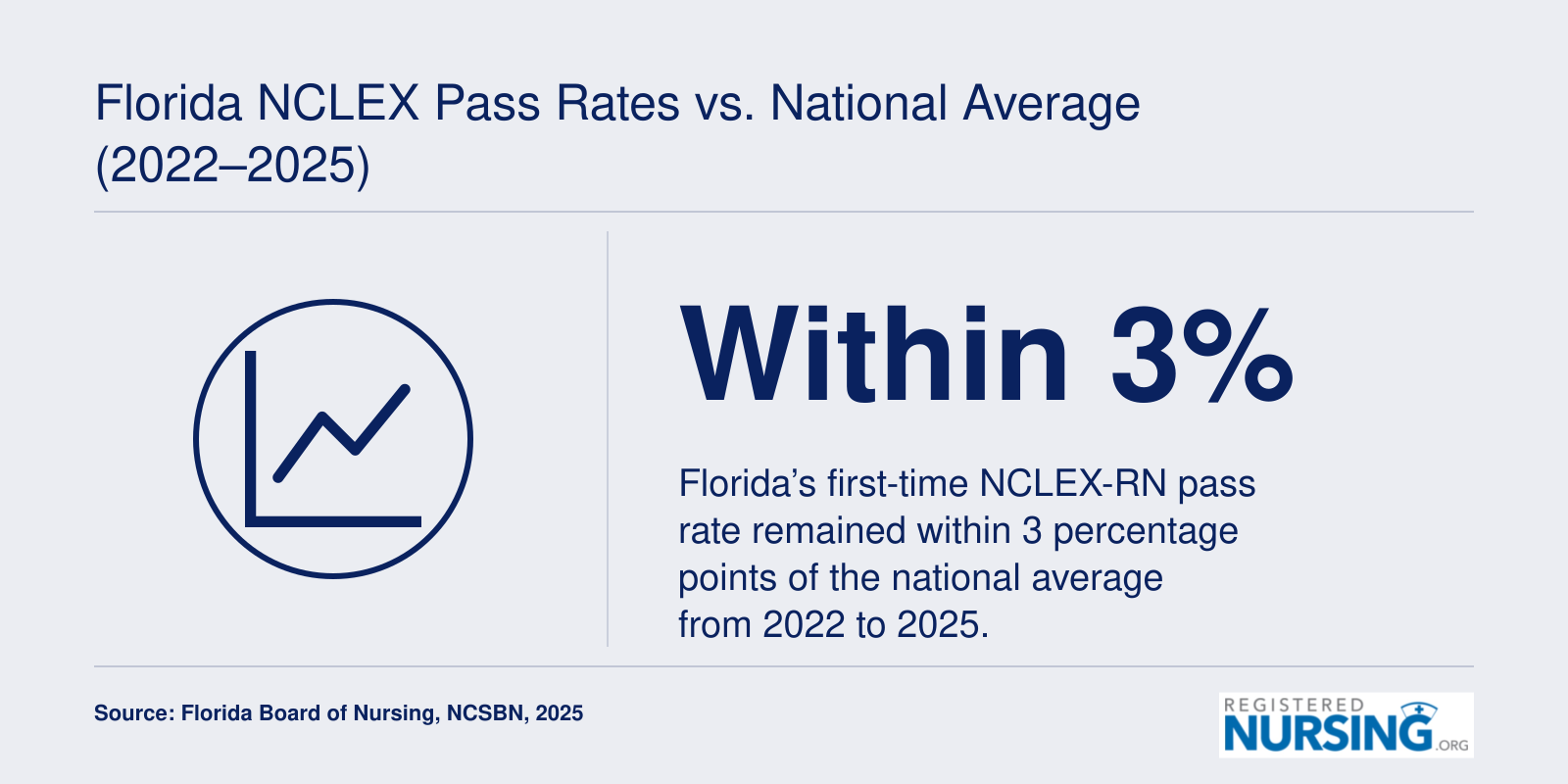
Florida NCLEX Pass Rates Vs. National Average (2022–2025)
Florida’s nursing programs maintained steady NCLEX performance even as enrollment expanded. The state’s first-time pass rates for the RN exam continued to closely mirror the national benchmark, demonstrating that rapid growth did not come at the expense of educational quality.
CS/SB 1246: What the Expanded LINE Scope Means for Nursing
Final Status of CS/SB 1246
The Florida Legislature passed CS/SB 1246 during the 2026 session, and Governor Ron DeSantis signed it into law on May 22, 2026.1 Officially designated as Chapter 2026-101, the legislation took effect on July 1, 2026.1 The bill amends the state's Linking Industry to Nursing Education (LINE) Fund, a critical pipeline for nursing workforce development, by broadening its eligibility criteria.
How LINE Fund Eligibility Expands
Previously, the LINE Fund exclusively supported nursing education programs. Under CS/SB 1246, eligibility now extends to other health science education programs that align with the State Board of Education's Career and Technical Education Health Science curriculum framework.2 This includes fields such as respiratory therapy, radiologic technology, and other allied health disciplines experiencing workforce shortages. The expansion means more programs can compete for LINE Fund grants, which are designed to foster partnerships between education providers and healthcare employers. Florida nurses weighing advanced pathways may find that DNP programs in Florida are well-positioned to leverage these employer partnerships for funding support.
Will Nursing Programs Face More Competition?
With the wider eligibility, nursing programs now share the same funding pool with a broader range of health science initiatives. This naturally raises concerns about whether per-program nursing allocations might shrink. While the bill does not include a specific nursing set-aside or separate appropriation line, it does introduce mechanisms that could indirectly protect nursing's share. The LINE Fund explicitly prioritizes proposals that include monetary contributions from industry partners, rather than in-kind support alone.3 Established nursing programs often have robust employer relationships and a track record of securing cash matches, which may give them a competitive edge in the application process. A health policy nurse role is one pathway through which professionals can monitor and respond to exactly these kinds of funding shifts.
Safeguards for Nursing Funding
The legislation maintains a strong focus on accountability for nursing education. It requires nursing-specific reporting from funded programs, ensuring that outcomes like enrollment growth and graduate readiness remain transparent.4 This reporting mandate serves as a safeguard by keeping nursing metrics in the spotlight and informing future funding decisions. Additionally, the LINE Fund's alignment with standardized state curriculum frameworks prevents dilution of quality. While the expanded pool introduces more competition, it also reflects Florida's commitment to addressing healthcare workforce shortages holistically, without lowering the bar for any single discipline.
How to Take Advantage of Florida's Expanded Nursing Programs
Since 2022, Florida's LINE and PIPELINE funding has created more than 3,000 additional nursing student seats across the state, opening doors at lower costs and in previously underserved communities. Taking advantage means knowing where to find financial support, how to apply strategically, and which formats match your life.
Financial Resources to Lower Your Costs
- LINE-funded tuition support: Many state colleges apply LINE dollars directly to student costs , ask your program if tuition waivers or reduced fees are available.
- Florida Student Assistance Grant (FSAG): In-state students at public institutions may qualify for need-based FSAG awards; file the FAFSA early.
- NURSE Corps Scholarship Program: A federal option that covers full tuition and fees in exchange for service at a Critical Shortage Facility , several Florida hospitals qualify.
- Employer-sponsored programs: Major health systems like AdventHealth, Baptist Health South Florida, and HCA Florida offer tuition reimbursement, loan repayment, or scholarship-for-service contracts for new hires.
Smart Application Strategies for Expanded Cohorts
Apply to multiple programs, especially newly expanded cohorts at state colleges. These institutions often have lower tuition than universities and, with added seats, shorter waitlists. Check program websites for "LINE expansion" announcements , some may have later deadlines or rolling admissions. If you are weighing program length, online ADN programs at state colleges can be a cost-effective starting point before pursuing a BSN.
Formats That Fit Working Adults
Online and hybrid prelicensure BSN tracks have grown in Florida. Institutions like UCF, FIU, and USF now offer accelerated options that blend online coursework with local clinical placements. Many state colleges also provide evening and weekend ADN programs, making it realistic to keep your job while in school. For practical strategies on working while in nursing school, balancing shifts and coursework is very manageable with the right schedule.
Rural and Underserved Regions Now with First-Ever Programs
Before 2022, several rural counties had no local RN program. LINE grants have changed that, funding new nursing tracks at state colleges in the Panhandle, Big Bend, and Heartland regions. For example, institutions in Madison, Levy, and Highlands counties now offer ADN or BSN completion pathways, reducing commute times for place-bound students. If you are considering practice in one of these areas after graduation, our guide to rural nursing covers career paths, incentives, and resources specific to underserved communities.
Frequently Asked Questions About Florida Nursing Education Standards
Here are answers to common questions about how Florida is expanding nursing education while upholding rigorous standards.
- How is Florida expanding nursing education without lowering standards?
- Florida uses targeted initiatives like LINE and PIPELINE grants to increase nursing school capacity, while maintaining accreditation requirements and oversight. Programs must meet Board of Nursing standards, ensuring quality is not compromised by expansion. This strategic investment boosts seats without diluting curriculum rigor.
- What are the LINE and PIPELINE nursing education funds in Florida?
- The LINE (Linking Industry to Nursing Education) and PIPELINE (Prepping Institutions, Programs, Employers and Learners through Incentives for Nursing Education) funds are state appropriations that award grants to nursing programs to expand enrollment, hire faculty, and enhance clinical placements, addressing workforce shortages.
- Have Florida NCLEX pass rates changed since nursing program expansion?
- Since expansion began, Florida's NCLEX pass rates have remained stable or improved, often surpassing national averages. Investments in faculty and resources through LINE and PIPELINE have helped programs maintain strong outcomes, as evidenced by recent pass rate data across participating schools.
- Does Florida's nursing expansion affect program accreditation or admission standards?
- No, expansion does not lower accreditation or admission standards. All nursing programs must remain accredited by bodies like ACEN or CCNE and adhere to Florida Board of Nursing regulations. If you have ever wondered what happens if a nursing school is not accredited, the consequences range from ineligibility for federal aid to NCLEX disqualification. Admission criteria, including GPA and prerequisite requirements, continue to be enforced to ensure qualified candidates.
- How will CS/SB 1246 impact nursing education funding in Florida?
- CS/SB 1246 broadens the LINE program's scope to include more nursing education pathways and potential funding for graduate-level programs. This legislation enhances financial incentives for schools and students, further supporting the state's goal to expand the nursing workforce without compromising educational quality. Students pursuing advanced credentials can also explore online MSN programs in Florida to take advantage of expanded graduate-level funding opportunities.
- Which Florida nursing schools have added the most seats since 2022?
- Since 2022, several Florida colleges and universities have significantly increased seats, including Miami Dade College, Broward College, and the University of Central Florida. Exact numbers vary, but these institutions have leveraged state grants to boost capacity by hundreds of slots annually. Prospective students in South Florida can also look into pediatric nurse practitioner programs in Florida for specialized pathways supported by the state's growing graduate nursing infrastructure.
Explore Florida Resources
- Florida
- RN to BSN in Florida
- DNP in Florida
- Best Online MSN Programs in Florida
- Best Florida Post-Graduate Certificate in Nursing
- Nurse Practitioner Programs Online in Florida
- CNA Classes & Programs in Florida
- Best Nurse Midwifery Programs in Florida
- Best Adult-Gerontology Nurse Practitioner Programs in Florida
- Explore Premier Online RN to BSN Programs Near Tallahassee, Florida
- Best Nursing Schools in Tampa, FL Revealed
- Registered Nurse in South Florida