How to Become a Certified Nursing Assistant (CNA)

- What Is a Certified Nursing Assistant (CNA)?
- How to Become a CNA
- CNA Resource Center
- CNA Training Time and Cost: What to Expect
- Skills and Qualities for Successful CNAs
- Where Do Certified Nursing Assistants Work?
- Certified Nursing Assistant Salary and Job Outlook
- CNA vs Other Healthcare Roles
- Is Becoming a CNA a Good Career Choice?
- Advancing Your Career After Becoming a CNA
- Frequently Asked Questions
- Latest Articles & Guides
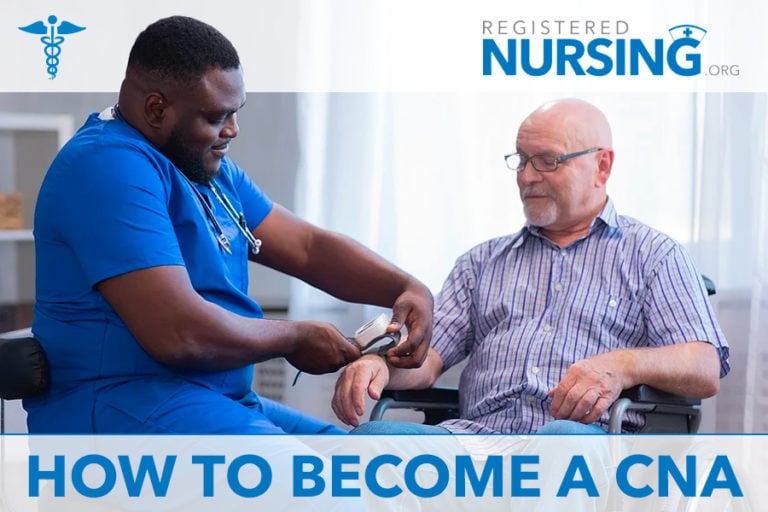
A Certified Nursing Assistant (CNA) is an essential member of the healthcare team who provides hands-on care to patients under the supervision of medical professionals such as Registered Nurses (RNs) and Licensed Practical Nurses (LPNs). CNAs assist with daily living activities, monitor patient comfort, and play a vital role in supporting nurses in hospitals, nursing homes, and other care settings.
This guide explains:
- What a CNA is and how to become one, including required training and certification steps
- Where CNAs work
- Typical CNA salary expectations
- How the CNA role can serve as a starting point for a long-term nursing career
What Is a Certified Nursing Assistant (CNA)?
Certified Nursing Assistants, also known as nursing assistants or nurse aides, are entry-level healthcare professionals who assist patients with basic yet critical aspects of care, including mobility, hygiene, nutrition, and comfort. CNAs work closely with RNs and LPN/LVNs, often serving as the primary caregivers patients interact with throughout the day.
Because of this direct patient contact, CNAs must be compassionate, detail-oriented, and comfortable working in fast-paced clinical environments.
Common CNA Job Duties and Responsibilities
Certified Nursing Assistants provide essential, hands-on care and support for patients under the direction of licensed nurses. While specific duties may vary by state, employer, and care setting, typical CNA responsibilities include:
- Maintaining a safe, clean patient environment, including equipment and room organization
- Assisting patients with activities of daily living (ADLs), such as bathing, dressing, grooming, toileting, and eating/drinking
- Helping patients transfer, reposition, and ambulate safely, including use of mobility aids
- Monitoring and recording vital signs (temperature, blood pressure, pulse, respiration) as directed
- Supporting patient hygiene and infection control, including bed making and proper use of PPE
- Collecting non-invasive specimens (such as urine or stool) per facility protocols
Becoming a CNA In Your State
Each state may have different requirements for becoming a CNA. Click to find out about each state's specific requirements.

- AL Alabama
- AK Alaska
- AZ Arizona
- AR Arkansas
- CA California
- CO Colorado
- CT Connecticut
- DE Delaware
- DC Washington, DC
- FL Florida
- GA Georgia
- HI Hawaii
- ID Idaho
- IL Illinois
- IN Indiana
- IA Iowa
- KS Kansas
- KY Kentucky
- LA Louisiana
- ME Maine
- MD Maryland
- MA Massachusetts
- MI Michigan
- MN Minnesota
- MS Mississippi
- MO Missouri
- MT Montana
- NE Nebraska
- NV Nevada
- NH New Hampshire
- NJ New Jersey
- NM New Mexico
- NY New York
- NC North Carolina
- ND North Dakota
- OH Ohio
- OK Oklahoma
- OR Oregon
- PA Pennsylvania
- RI Rhode Island
- SC South Carolina
- SD South Dakota
- TN Tennessee
- TX Texas
- UT Utah
- VT Vermont
- VA Virginia
- WA Washington
- WV West Virginia
- WI Wisconsin
- WY Wyoming
How to Become a CNA
Becoming a CNA is one of the fastest entry points into healthcare, and the process is fairly straightforward. While exact requirements vary, the steps below outline the typical pathway.
Step 1: Meet Basic Education Requirements
Most states require candidates to:
- Be at least 16–18 years old (varies by state)
- Have a high school diploma or GED (or be actively enrolled)
Step 2: Complete a State-Approved CNA Training Program
You must complete a state-approved CNA training program, which includes classroom instruction and supervised clinical practice.
- Typical program length: 4–12 weeks
- Training location: community colleges, vocational schools, hospitals, long-term care facilities
- Cost: ranges from low-cost to moderate, depending on provider and location
Learn more about CNA programs.
Step 3: Pass the CNA Certification Exam
After training, candidates must pass a state competency exam, which includes:
- A written (or oral) exam covering basic nursing knowledge
- A clinical skills exam demonstrating hands-on patient care tasks
Step 4: Get Listed on Your State's Nurse Aide Registry
Once you pass the exam, you are placed on your state's Nurse Aide Registry, which is required to legally work as a CNA.
Step 5: Maintain and Renew CNA Certification
Most states require CNA certification renewal every two years, often with:
- Proof of recent employment as a CNA
- Continuing education hours or in-service training
See Related Articles
CNA Resource Center
Ready to learn more about the Certified Nursing Assistant journey? Explore our comprehensive resources on CNA education, certification, salaries, and more.

CNA Training Programs and Classes
Learn more about CNA programs, including admissions requirements, online options, curriculum, and more.
CNA Program Costs
Explore CNA program tuition, fees, and associated costs.
CNA Certification
Learn about your state's CNA certification requirements.
CNA Salary
Find out how much you can earn as a CNA.
CNA Training Time and Cost: What to Expect
One reason many people choose the CNA path is the short training timeline.
- Programs often last just a few weeks to a few months
- Some employers (especially nursing homes) offer free or employer-sponsored CNA training; learn more about no-cost CNA programs
- Costs vary by state and provider
Learn more about CNA program costs and fees.
Skills and Qualities for Successful CNAs
Beyond the clinical training required for this role, good CNAs often possess certain soft skills to find success in the profession.
| Key Skill or Trait | Why It Matters |
| Compassion & empathy | CNAs work closely with patients who may be ill, elderly, or vulnerable |
| Attention to detail | CNAs monitor changes in patient condition and report concerns |
| Physical stamina | The role involves lifting, standing, and moving patients |
| Communication skills | CNAs relay important information to nurses and healthcare teams |
| Reliability & professionalism | CNAs are trusted with daily patient care |
Where Do Certified Nursing Assistants Work?
Certified Nursing Assistants work in a variety of healthcare settings. According to federal labor data, most nursing assistants are employed in nursing care facilities, hospitals, and residential care settings.
Common CNA Work Environments:
- Nursing homes and long-term care facilities
- Hospitals and medical centers
- Assisted living and residential care facilities
- Home health agencies
- Rehabilitation centers
This variety allows CNAs to explore different patient populations and care environments early in their careers.
Certified Nursing Assistant Salary and Job Outlook
CNA pay varies by state, employer, and experience level, but it provides a reliable entry-level healthcare wage.
- Median CNA pay: the national average is approximately $38,000–$40,000 per year, though CNA salaries vary by state/location
- Top-paying employers: hospitals and specialty facilities often pay more
- Job outlook: employment for nursing assistants is projected to grow about 2% through 2034, according to the Bureau of Labor Statistics
Get more CNA salary information.
CNA vs Other Healthcare Roles
Many people exploring CNA careers also consider related healthcare roles. Review this quick chart to see how different healthcare roles compare to the CNA role.
| Role | Primary Focus | Education & Training | Scope of Responsibility |
| Certified Nursing Assistant (CNA) | Basic patient care and daily living support | Short-term training (often 4–12 weeks) plus state certification | Assists with ADLs, monitors patient comfort, supports nursing staff |
| Medical Assistant (MA) | Clinical and administrative support | Postsecondary certificate or diploma | Performs basic clinical tasks and handles front-office duties |
| Licensed Practical Nurse (LPN) | Nursing care under RN/physician supervision | Diploma or certificate (about 1 year) | Administers medications, performs nursing procedures, monitors patients |
| Registered Nurse (RN) | Comprehensive patient care and care coordination | Associate or bachelor's degree in nursing | Develops care plans, administers treatments, supervises staff |
Tip: CNAs focus primarily on hands-on patient care, making the role ideal for individuals who want direct experience in healthcare before pursuing more advanced nursing or clinical positions.
Is Becoming a CNA a Good Career Choice?
Pursuing a CNA career is an excellent way to:
- Enter healthcare quickly
- Gain hands-on patient experience
- Explore nursing before committing to a longer degree program
However, it's important to understand that CNA work can be physically demanding, emotionally challenging, and often involves shift work.
Advancing Your Career After Becoming a CNA
Many CNAs use the role as a stepping stone into further education for nursing and healthcare careers, such as:
- LPN or LVN
- Registered Nurse (RN); learn more about CNA to RN programs
- Nurse Practitioner (NP)
- Healthcare administration or education
The patient care experience gained as a CNA is highly valued in nursing school admissions.
Frequently Asked Questions
Q: Can I Become a CNA Online?
A: CNA programs may offer online coursework, but all programs require in-person clinical training. Fully online CNA certification is not permitted.
Q: Do CNA Requirements Vary by State?
A: Yes. Training hours, exam structure, and renewal requirements vary. Always check your state's Nurse Aide Registry.
Q: Can I Work as a CNA While in Nursing School?
A: Yes. Many nursing students work as CNAs to gain experience and income while completing RN or LPN degree programs.
Q: Do I Have to Sit for the CNA Exam Again if My Certification is Expired?
A: Rules and standards for renewing expired CNA certifications will vary from state to state. In California, for example, if your certification is more than two years expired, or it is more than two years since you have worked as a Certified Nurse Assistant, you are required to have 24 hours of continuing education as well as sit for a Competency Evaluation. Check with your state's governing board for renewal requirements.
Helpful CNA Organizations, Societies, and Agencies
- National Network of Career Nursing Assistants
- National Assistants Organizations
- Home Healthcare Nurse Association
- National Association of Home Care
- American Society of Aging
Latest Articles & Guides
One of the keys to success as a registered nurse is embracing lifelong learning. Our articles and guides address hot topics and current events in nursing, from education to career mobility and beyond. No matter where you are on your nursing journey, there’s an article to help you build your knowledge base.
Browse our latest articles, curated specifically for modern nurses.