

What you’ll learn in this article…
- LNCs typically earn 20 to 40 percent above the national RN median.
- Two certifications dominate: the CLNC and the LNCC.
- Independent LNCs can charge $150 to $200 or more per hour.
A legal nurse consultant is a registered nurse who applies clinical expertise to legal cases, translating medical evidence into language attorneys can use in litigation, insurance claims, and risk management. Unlike bedside nurses who deliver patient care, LNCs review medical records, identify deviations from the standard of care, and prepare reports that shape case strategy. Demand for this role has grown alongside the complexity of healthcare litigation, with nurse consultants now embedded in law firms, insurance carriers, hospitals, and independent practices.
The path from RN to LNC typically requires three to five years of clinical experience, an active license, and optional certification through either the CLNC or LNCC credential. Some nurses pursue this transition after years in high-acuity settings, while others come from oncology nurse backgrounds or surgical specialties where detailed documentation and clinical judgment are central to the work. Earnings run 20 to 40 percent above the national RN median for certified consultants, and independent LNCs can exceed $100,000 annually once they establish a referral base. Nurses who want to go further into the legal system sometimes explore becoming a nurse attorney, a role that combines clinical training with a law degree. The discipline rewards nurses who combine analytical rigor with business development skill, and the income spread between in-house and independent roles is wide enough to drive career decisions.
What Does a Legal Nurse Consultant Do?
The role has moved well beyond its 1990s origins as "the nurse in the file room," with today's legal nurse consultants increasingly embedded in complex litigation strategy from the earliest intake calls. On any given day, an LNC translates clinical evidence into language attorneys can use to build, settle, or defend a case.
Core Daily Tasks
The bulk of an LNC's work centers on medical records analysis. Typical deliverables include:
- Record review: Reading through hospital charts, imaging reports, medication administration records, and provider notes to identify what actually happened to the patient.
- Case summaries and chronologies: Building a clear timeline of medical events, often spanning multiple providers and years of treatment.
- Standard of care analysis: Flagging where clinician actions may have deviated from accepted nursing or medical practice.
- Research support: Locating relevant clinical literature, practice guidelines, and policy documents that either support or undermine a claim.
- Deposition and trial prep: Drafting questions for attorneys to use with treating physicians, defendants, or opposing experts.
Types of Cases
LNCs are most heavily concentrated in medical malpractice work, but the caseload is broader than that. Common practice areas include personal injury (auto accidents, slip and fall, catastrophic injury), product liability (defective devices, pharmaceuticals), workers' compensation, toxic torts (asbestos, chemical exposure), elder abuse and nursing home neglect, and criminal cases involving injury or cause of death.
Where LNCs Work
Employment settings fall into four broad buckets: plaintiff and defense law firms, insurance carriers and third-party claims administrators, government agencies (state attorneys general, public defenders, risk management offices at public hospitals), and independent consulting practices that contract with multiple firms. Roughly half of experienced LNCs eventually move into independent work at least part-time, making this one of the more accessible remote nursing jobs in the specialty space.
What LNCs Do Not Do
This is where nurses new to the field often need clarity. An LNC is a clinical consultant, not a legal professional. LNCs do not give legal advice, do not represent clients, and do not practice law in any form. They also do not automatically serve as expert witnesses; testifying as an expert requires separate qualification based on active clinical practice and specialty credentials. LNCs work alongside attorneys, paralegals, and, when a case requires sworn testimony, physician or specialty nurse expert witnesses who are retained separately. Nurses interested in that testifying role should review what it takes to become an expert witness as an RN before pursuing that path.
How to Become a Legal Nurse Consultant
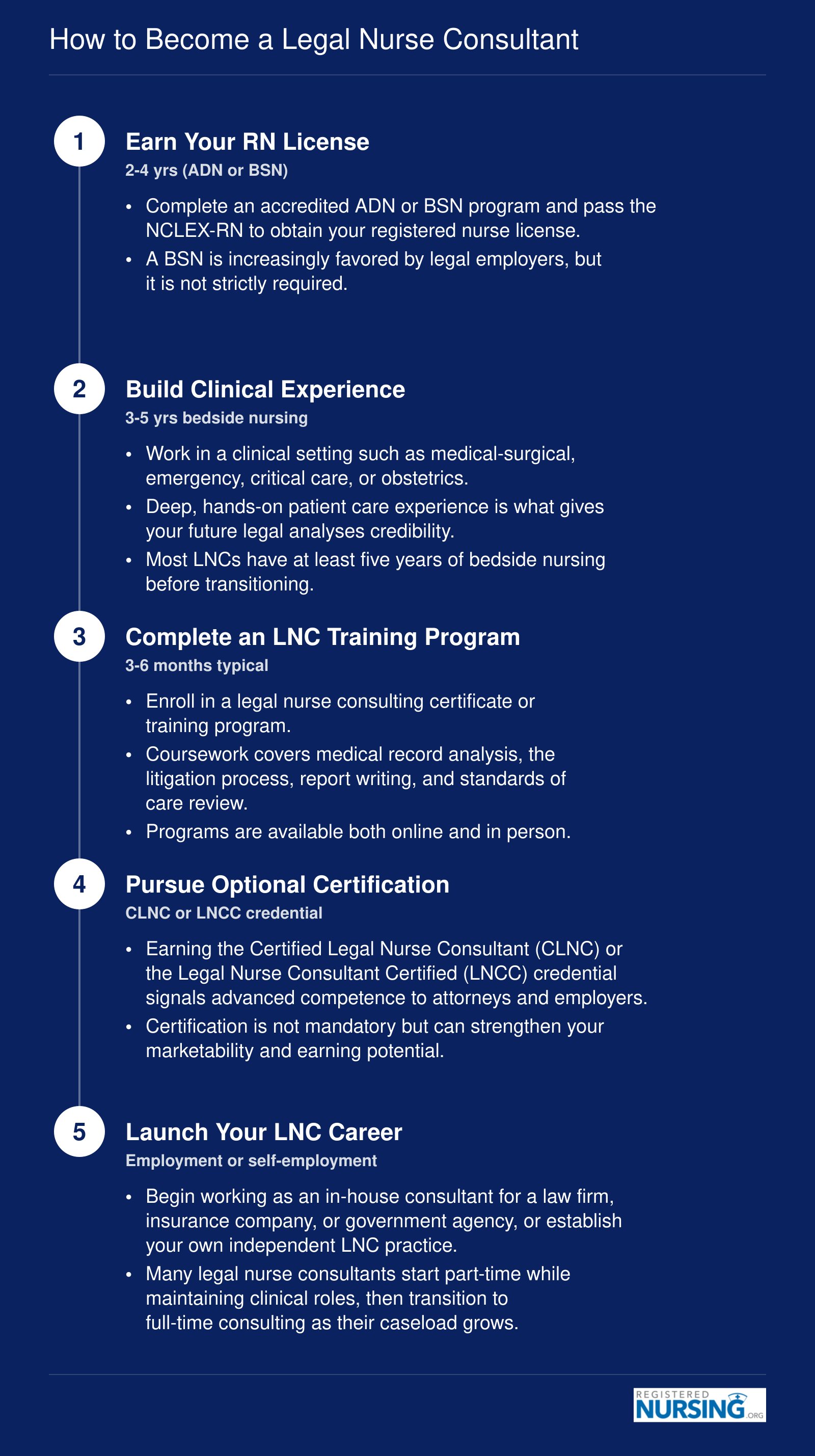
Most nurses transition into legal nurse consulting after building a strong clinical foundation. While a BSN is increasingly preferred by employers and law firms, ADN-prepared RNs with robust clinical backgrounds can also enter this specialty. The typical pathway spans five or more years from initial RN licensure to active LNC practice.
Questions to Ask Yourself
Legal Nurse Consultant Certification: CLNC Vs. LNCC
Which legal nurse consultant certification should you pursue, the CLNC or the LNCC, and does it actually matter for your career?
The short answer is that both credentials signal competence to attorneys and employers, but they differ significantly in eligibility requirements, recognition, and career positioning. Understanding these differences will help you choose the path that matches your experience level and professional goals.
CLNC: Certified Legal Nurse Consultant
The CLNC designation is a proprietary credential offered through the Vickie Milazzo Institute. It is designed as an entry-level certification, making it accessible to nurses who are newer to the legal consulting space.1
- RN experience required: None beyond active licensure.
- LNC practice hours required: None.
- Exam format: 100 multiple-choice questions completed in 90 minutes online, with a 70% passing threshold.
- Credential validity: 2 years before renewal is required.3
- Accreditation: The CLNC is not accredited by the Accreditation Board for Specialty Nursing Certification (ABSNC). It is tied directly to the Institute's training program.
Because the CLNC has no prerequisite clinical or consulting experience, it can serve as a useful stepping stone for RNs who want to explore legal nurse consulting before committing to years of specialized practice.
LNCC: Legal Nurse Consultant Certified
The LNCC is a nationally accredited specialty certification administered by the American Legal Nurse Consultant Certification Board (ALNCCB). It carries substantially more rigorous eligibility requirements and is recognized as an advanced credential.2
- RN experience required: A minimum of 5 years of clinical practice.
- LNC practice hours required: At least 2,000 hours of legal nurse consulting experience.
- Exam format: A standard proctored specialty examination.
- Credential validity: 5 years.
- Accreditation: The LNCC holds ABSNC accreditation, which is the gold standard for nursing specialty certifications in the United States.
The LNCC's eligibility bar means it is typically pursued by seasoned nurses who have already been working in legal consulting roles and want formal, nationally recognized validation of their expertise.
How to Decide Between the Two
Your choice often comes down to where you are in your career. If you are a newly licensed RN or an experienced critical care nurse or emergency nurse looking to break into legal consulting, the CLNC pathway lets you earn a credential relatively quickly and begin marketing your services to law firms. If you already have years of nursing experience plus documented legal consulting hours, the LNCC carries broader professional recognition because of its ABSNC accreditation and more demanding eligibility standards.
Some nurses pursue the CLNC first and later sit for the LNCC once they accumulate enough practice hours. The two credentials are not mutually exclusive.
Keep in mind that neither certification is legally required to work as a legal nurse consultant. Your active RN license is the foundational requirement. However, holding a recognized credential can strengthen your credibility with attorneys, differentiate you from competitors in a growing field, and potentially support higher consulting rates. When evaluating certification programs, weigh the investment of time and tuition against your current experience and the market you plan to serve.
Legal Nurse Consultant Salary: National Data and Ranges
Because the Bureau of Labor Statistics does not assign a separate occupation code to legal nurse consultants, LNC earnings are captured within the broader Registered Nurses (29-1141) category. However, LNCs typically earn above the RN median thanks to their specialized expertise in medical-legal analysis. The table below presents 2024 national wage data for registered nurses, which serves as a baseline. Keep in mind that practicing LNCs, especially those with certification or independent consulting practices, often command rates at or above the 75th percentile shown here.
| Wage Metric | Annual Salary |
|---|---|
| 25th Percentile | $78,610 |
| Median (50th Percentile) | $93,600 |
| Mean (Average) | $98,430 |
| 75th Percentile | $107,960 |
LNC Salary by Experience Level
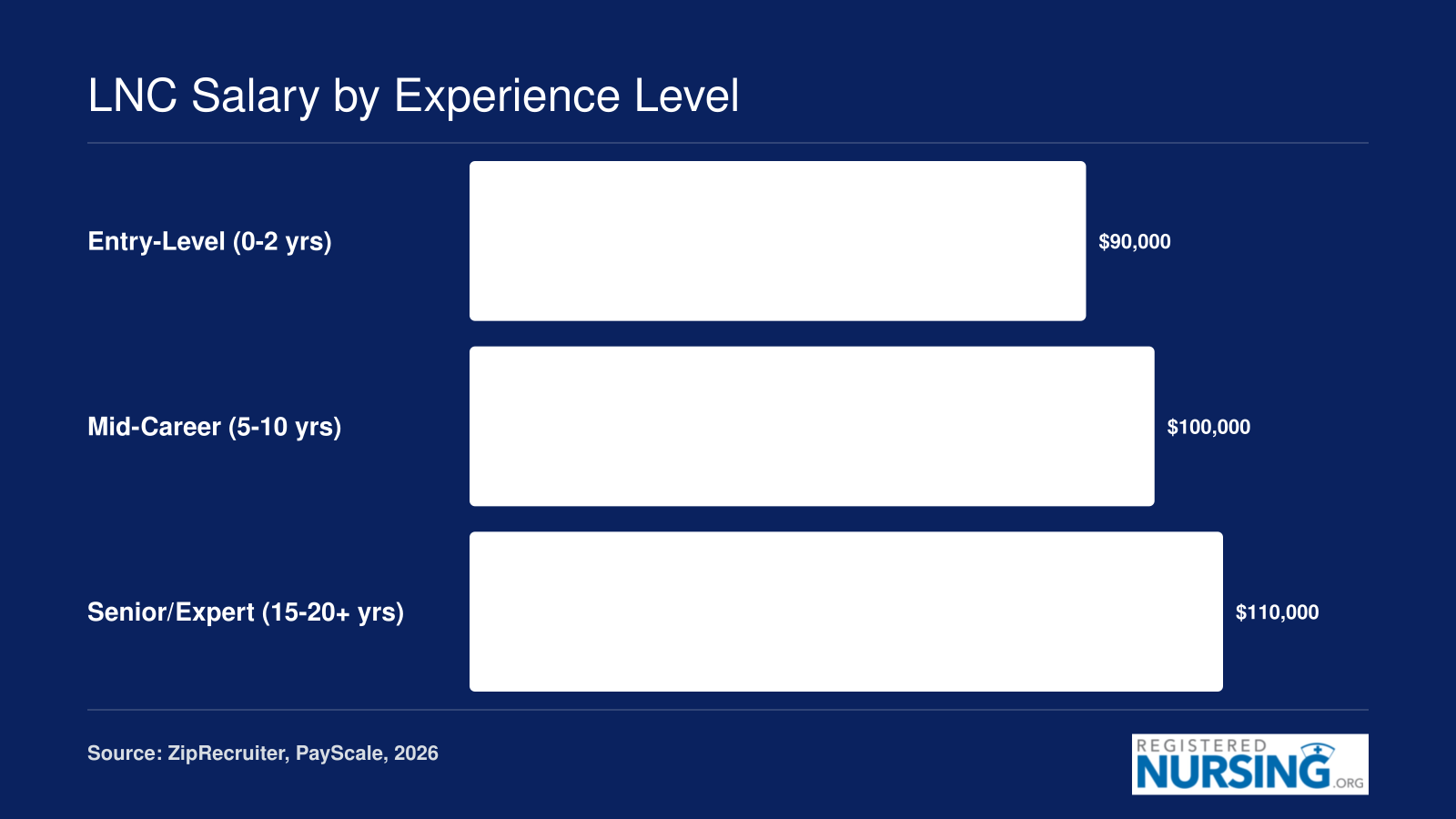
Experience is one of the strongest drivers of legal nurse consultant earnings. As you move from entry-level work into mid-career and senior roles, compensation climbs steadily. The biggest jumps often coincide with earning certification and transitioning into independent or expert-witness consulting, where hourly rates can reach $200 or more.
Legal Nurse Consultant Salary by State
Because the Bureau of Labor Statistics does not track legal nurse consultants as a separate occupation, registered nurse wages serve as the most reliable baseline for estimating LNC earning potential in each state. The data below comes from the 2024 Occupational Employment and Wage Statistics. Keep in mind that LNC premiums above standard RN pay can vary significantly depending on a state's litigation volume, with high-caseload states such as Texas, Florida, and Illinois often supporting stronger demand and higher consulting fees.
| State | Total RN Employment | Mean Annual RN Salary | Median Annual RN Salary | 25th Percentile | 75th Percentile |
|---|---|---|---|---|---|
| Rhode Island | 10,760 | $99,770 | $99,960 | $83,870 | $112,540 |
| Arizona | 64,430 | $95,230 | $96,890 | $81,390 | $105,450 |
| Maryland | 48,980 | $96,650 | $96,830 | $81,470 | $104,840 |
| New Hampshire | 16,580 | $94,620 | $96,830 | $79,720 | $105,500 |
| Colorado | 54,510 | $95,470 | $96,520 | $81,790 | $104,370 |
| Delaware | 13,260 | $95,450 | $92,610 | $82,600 | $108,360 |
| New Mexico | 17,510 | $94,360 | $88,260 | $82,630 | $104,720 |
| Vermont | 7,240 | $92,710 | $85,150 | $79,980 | $104,110 |
| Georgia | 97,410 | $91,960 | $86,560 | $76,600 | $104,790 |
| Texas | 261,050 | $91,690 | $90,010 | $77,450 | $102,200 |
| Illinois | 139,900 | $91,130 | $86,410 | $79,150 | $103,660 |
| Virginia | 77,420 | $90,930 | $88,820 | $77,650 | $100,920 |
| Pennsylvania | 146,840 | $90,830 | $87,610 | $78,570 | $102,030 |
| Michigan | 104,210 | $90,580 | $85,670 | $80,030 | $101,210 |
| Wisconsin | 64,960 | $90,450 | $86,070 | $79,570 | $100,680 |
| Idaho | 14,540 | $89,770 | $86,100 | $78,020 | $100,220 |
| Montana | 10,540 | $88,480 | $81,560 | $77,800 | $100,510 |
| Utah | 25,780 | $88,240 | $82,270 | $77,030 | $101,530 |
| Florida | 218,100 | $88,200 | $82,850 | $77,070 | $99,260 |
| Wyoming | 5,180 | $88,020 | $81,790 | $75,540 | $100,910 |
| Maine | 16,280 | $87,440 | $82,860 | $76,890 | $98,000 |
| North Carolina | 108,510 | $86,270 | $81,860 | $74,710 | $98,720 |
| Ohio | 138,360 | $86,110 | $81,250 | $77,420 | $97,440 |
| Oklahoma | 32,870 | $85,800 | $81,160 | $75,320 | $96,460 |
| Nebraska | 24,180 | $82,890 | $81,020 | $76,430 | $93,140 |
Nurses who move from bedside RN roles into legal nurse consulting commonly report earnings that run 20 to 40 percent above the national RN median, and that gap widens further for those who hold a formal certification. Certified legal nurse consultants tend to command higher hourly rates and retainer fees than their non-certified peers, making credentialing one of the most direct levers for maximizing income in this specialty.
In-House Vs. Independent LNC: Earnings Comparison
How much can you actually earn as a legal nurse consultant, and does it make more financial sense to work for a firm or start your own practice?
The answer depends on your risk tolerance, business acumen, and timeline. Legal nurse consultants pursue three main employment pathways, each with distinct income structures and trade-offs.
Salaried In-House Positions
Working directly for a law firm, insurance company, or healthcare organization provides the most predictable income. In-house LNCs typically earn between $75,000 and $110,000 annually, with hourly wages ranging from $20 to $60 depending on employer type and location.1 These positions come with traditional benefits: health insurance, paid time off, retirement contributions, and steady paychecks regardless of caseload fluctuations.
The trade-off is clear. You exchange earning potential for stability. Your income ceiling is essentially capped by salary structures, and you work cases assigned to you rather than choosing your specialty focus.
Independent Consulting Practice
Starting your own LNC practice offers significantly higher earning potential but requires patience and business development skills. Independent consultants typically charge $125 to $200 per hour for case review and analysis work.2 Specialists command premium rates: an obstetric LNC, for example, might bill $275 per hour for consulting services.3
The realistic revenue picture requires honest math. During your first one to two years building a practice, expect 300 to 700 billable hours annually.4 At $150 per hour, that translates to gross revenue between $45,000 and $105,000, before expenses. Established independents with steady referral networks bill 700 to 1,000 hours yearly, generating $80,000 to $150,000 in gross revenue.5
Industry data suggests new practices typically need 6 to 24 months to build sustainable caseloads.6 During this ramp-up period, annual income often falls between $30,000 and $70,000.4 Plan accordingly.
Expert Witness Work
Testifying as an expert witness represents the highest-paying LNC work. Hourly rates for deposition and trial testimony range from $250 to $400,2 with specialized fields like obstetrics commanding rates around $350 per hour.3 However, expert witness work requires additional qualifications, typically years of clinical experience in the relevant specialty plus comfort with courtroom environments. forensic nurse practitioners and others who work at the intersection of healthcare and law often pursue similar credentialing paths before entering courtroom settings.
Fee Structures for Independents
Independent LNCs use several billing models:
- Hourly billing: The most common structure, charging $125 to $200 per hour for time spent reviewing records and preparing reports.2
- Flat per-case fees: Some consultants quote $2,000 to $10,000 per case depending on complexity and record volume.2
- Retainer arrangements: Attorneys may pay $500 to $1,000 monthly retainers for ongoing consulting access, or $2,000 to $3,000 for expert witness availability.7
- Hybrid models: Combining a base retainer with hourly billing for work exceeding specified thresholds.
The Real Numbers
ZipRecruiter data shows independent contractor LNCs earning a median of approximately $87,700 annually, with the 25th percentile at $68,000 and the 90th percentile reaching $117,500.8 Established independents with strong practices report income between $80,000 and $150,000, with top earners approaching $140,000 in gross revenue.5
Compare this to the salaried path: consistent $75,000 to $110,000 with benefits versus variable $100,000 to $200,000 potential (before overhead) that takes years to achieve. Your choice depends on whether you value security or autonomy, and whether you have the financial runway to build a practice over one to three years before reaching full income potential. correctional nursing and other specialty roles offer a useful contrast, illustrating how employment setting shapes both income stability and career autonomy across nursing fields.
Are Legal Nurse Consultants in Demand?
Steady demand versus explosive growth: those are the two lenses through which to assess the LNC job market. The honest answer sits somewhere in between, and understanding why requires looking at both the nursing workforce and the litigation industry at the same time.
What the Data Actually Shows
The Bureau of Labor Statistics does not track legal nurse consultants as a distinct occupation, so there is no government-issued growth rate tied specifically to this role. What does exist is the broader registered nurse outlook, which projects roughly 197,200 annual job openings nationally through 2033, driven by retirements and healthcare expansion. That figure serves as a useful floor: the pipeline of clinically experienced nurses who could transition into legal consulting continues to grow.
For the LNC-specific picture, industry observers project growth in the 6 percent range through the early 2030s.3 That tracks closely with overall RN growth and is widely considered a conservative estimate given how rapidly litigation involving healthcare has expanded.
Why Litigation Volume Matters
Medical malpractice filing volume has reached what some legal industry analysts describe as near-epidemic levels in 2026.4 Personal injury cases involving pharmaceuticals, medical devices, and hospital care continue to generate consistent work for attorneys who need clinical expertise to evaluate records, identify deviations from the standard of care, and build or defend cases.
Several structural forces are sustaining this demand:
- Aging population: More Americans over 65 means more hospitalizations, more procedures, and statistically more opportunities for disputes about the quality of care received. Geriatric nurses working in complex care settings often find their clinical background directly relevant to this growing niche.
- Electronic health records: Voluminous digital documentation has made cases more complex, not simpler. Attorneys increasingly need nurses who can comb through hundreds of pages of EHR data and translate clinical findings into plain language.
- Telehealth liability: Remote care has introduced new questions about supervision, informed consent, and documentation standards. This is an emerging niche that is still being defined in courtrooms across the country.
- Corporate legal departments: A 2026 survey found that 81 percent of in-house legal departments report managing more matters than in previous years, which increases internal demand for clinical review expertise.5
Recession Resilience
One underappreciated aspect of LNC demand is its durability during economic downturns. Litigation does not contract when the broader economy does. If anything, financial stress tends to prompt more disputes over medical bills, insurance coverage, and injury claims. That makes the LNC specialty more insulated from layoff cycles than many charge nurse or bedside roles.
Taken together, the litigation environment, an aging population, growing documentation complexity, and the absence of a meaningful economic ceiling suggest that qualified legal nurse consultants should find consistent opportunities well into the next decade.
Frequently Asked Questions About Legal Nurse Consulting
Legal nurse consulting blends clinical expertise with legal analysis, and it is natural to have questions before committing to this career path. Below are answers to the questions prospective LNCs ask most often, drawing on the salary data, certification details, and demand outlook covered earlier in this guide.
- Is CLNC certification worth the investment?
- For many nurses, yes. The Certified Legal Nurse Consultant (CLNC) credential provides structured training in legal terminology, case analysis, and report writing that most nursing programs do not cover. Employers and attorneys often view certification as a mark of credibility, which can translate into higher hourly rates and more consulting opportunities. Whether you choose the CLNC or the LNCC, the return on investment typically grows as you build a client base and gain experience.
- Can you become a legal nurse consultant with an ADN instead of a BSN?
- You can. Most LNC certification programs require an active, unrestricted RN license but do not mandate a BSN. An Associate Degree in Nursing qualifies you to sit for the major credentials. That said, holding a BSN can strengthen your resume with attorneys and may open doors to higher paying in-house positions. Many ADN-prepared nurses weigh their options carefully, and a review of the ADN vs BSN nursing degree comparison can help clarify which path fits your goals before pursuing LNC training.
- How long does it take to become a legal nurse consultant?
- The timeline varies. After earning your RN license, most certification bodies recommend at least two to five years of clinical experience. The certification coursework itself can take anywhere from a few days of intensive instruction (for the CLNC) to several months of self-paced study. In total, plan on roughly three to seven years from entering nursing school to beginning LNC practice.
- Do legal nurse consultants work from home?
- Many do. Independent LNCs often operate entirely from a home office, reviewing medical records, preparing reports, and consulting with attorneys by phone or video. Even nurses employed in-house at law firms or insurance companies increasingly enjoy remote or hybrid arrangements. The nature of the work, which centers on document analysis rather than bedside care, makes it particularly well suited to remote settings.
- What is the difference between a legal nurse consultant and a nurse expert witness?
- A legal nurse consultant reviews medical records, identifies standards of care issues, and helps attorneys build or defend cases behind the scenes. A nurse expert witness, by contrast, provides sworn testimony in depositions or at trial. Some experienced LNCs serve in both roles, but expert witness work requires a higher level of clinical authority and willingness to testify publicly. The two functions complement each other yet carry distinct responsibilities.
- How does legal nurse consultant pay compare to registered nurse pay?
- Legal nurse consultants generally earn more than bedside RNs. While the median RN salary sits near $86,070 per year according to federal labor data,1 experienced LNCs, particularly those working independently, can command hourly rates of $150 or more. Salaried, in-house LNC positions also tend to exceed typical staff nurse compensation, especially in metropolitan markets. The salary uplift often grows significantly once a consultant establishes a strong reputation and steady client referrals.
Legal nurse consulting offers a concrete, well-mapped path from bedside care to a specialty where clinical knowledge directly shapes legal outcomes. The decisions that matter most are ones you can make now: choosing between the CLNC and the LNCC based on your experience level, deciding whether an in-house role or independent practice fits your risk tolerance, and setting realistic salary expectations grounded in the 20 to 40 percent earnings uplift that certified LNCs commonly report over the national RN median.
Your next concrete step is to visit the American Association of Legal Nurse Consultants (AALNC) website, compare certification programs, and, if possible, connect with a working LNC willing to answer a few questions. Nurses coming from specialties such as cardiac care nursing or operating room nursing often find their clinical depth translates directly into high-demand practice areas for legal consulting. Demand for LNCs is steady and tied to a litigation industry that shows no sign of shrinking. The specialty rewards nurses who move deliberately, and the groundwork you lay today positions you well for a career that combines clinical mastery with lasting professional growth.
Explore More
- Ambulatory Care Nurse
- Burn Unit Nurse
- Cardiac Nurse
- Cath Lab Nurse
- Charge Nurse
- Chief Nursing Officer (CNO)
- Correctional Nurse
- CVOR Nurse
- Dermatology Nurse
- Developmental Disability Nurse
- Director of Nursing
- Domestic Violence Nurse
- Emergency Room Nurse
- ENT Nurse
- ET Nurse
- Fertility Nurse
- Flight/Transport Nurse
- Forensic Nurse Salary & Career Guide
- Genetic Nurse
- Geriatric Nurse
- Health Policy Nurse
- Healthcare Administrator
- Healthcare Manager
- Home Health Nurse
- Hospice Nurse
- Camp Nurse
- GI Nurse
- Holistic Nurse
- Labor and Delivery Nurse
- Nurse Writer
- Psychiatric Nurse
- School Nurse
- Telemetry Nurse
- Travel Nurse
- Aesthetic Nurse
- Infusion/IV Nurse
- Oncology Nurse
- ICU Nurse
- Infection Control Nurse
- LTC Nurse
- Managed Care Nurse
- Medical-Surgical Nurse
- Military (Combat) Nurse
- Missionary Nurse
- Mother Baby Nurse
- Nephrology Nurse
- Neuroscience Nurse
- NICU Nurse
- Nurse Administrator
- Nurse Attorney
- Nurse Care Coordinator
- Nurse Case Manager
- Nurse Entrepreneur
- Nurse Executive
- Nurse Health Coach
- Nurse Manager
- Obstetric (OB) Nurse
- Occupational Health Nurse
- Operating Room Nurse
- Ophthalmic Nurse
- Organ Procurement Coordinator
- Orthopedic Nurse
- Pain Management Nurse
- Palliative Care Nurse
- Parish Nurse
- Patient Advocate Nurse
- Pediatric Endocrinology Nurse
- Perianesthesia (PACU) Nurse
- Perinatal Nurse
- Plastic Surgery Nurse
- Public/Community Health Nurse
- Radiology Nurse
- Rehabilitation Nurse
- Research Nurse
- Respiratory Nurse
- Rheumatology Nurse
- Substance Abuse Nurse
- Telephone Triage Nurse
- Transcultural Nursing
- Transplant Nurse
- Trauma Nurse
- Wound Care Nurse (WOCN)