

What you’ll learn in this article…
- Fertility nurse practitioners earn between $115,000 and $150,000 annually.
- A BSN is increasingly preferred for hire at fertility clinics.
- Roughly 46% of fertility nurses face risk of burnout.
More Americans are turning to assisted reproductive technology than at any point in the past three decades, and fertility clinics across the country are competing for nurses who can manage the clinical complexity that comes with treatments like IVF, IUI, and egg freezing. A fertility nurse is a registered nurse who specializes in reproductive health and works directly with patients navigating these procedures. You may also see the role listed as "IVF nurse" or "reproductive nurse," but these titles describe essentially the same position.
The specialty demands a mix of precise medication management, patient education, and emotional resilience that general nursing programs rarely cover in depth. Nurses drawn to this kind of long-term relational care sometimes come from roles like oncology nursing, where patient relationships span extended treatment journeys and emotional support is central to the work. As clinic volume grows, so does the need for nurses with targeted credentials and hands-on fertility experience.
What Does a Fertility Nurse Do?
A fertility nurse is a registered nurse who guides patients through the medical process of trying to conceive when conception isn't happening on its own. That work sits at the intersection of reproductive endocrinology, hands-on clinical care, and long-term emotional support. A typical patient may work with the same fertility nurse for months, sometimes years, across multiple treatment cycles.
Core Clinical Duties
The clinical work is precise and protocol-driven. On any given day, a fertility nurse may:
- Administer or teach patients to self-administer injectable hormones such as gonadotropins, GnRH antagonists, and trigger shots
- Assist reproductive endocrinologists with transvaginal ultrasounds to monitor follicle growth during ovarian stimulation
- Prep patients and support the physician during egg retrievals and embryo transfers
- Draw and interpret serial estradiol, progesterone, and beta-hCG labs
- Adjust and communicate medication dosing changes, often the same day results come back
Cycles are time-sensitive. A missed injection or a mistimed trigger shot can end a cycle, which is why nurses build medication calendars with patients and confirm each step.
Patient Education and Emotional Support
A large share of the job is teaching. Fertility nurses walk patients through injection techniques, explain what each medication does, set realistic expectations about success rates, and prepare couples for outcomes that don't always go their way. Infertility carries grief, financial strain, and relationship stress, and the nurse is often the first person a patient calls after a negative pregnancy test or a failed transfer. Emotional intelligence matters here as much as clinical skill. Nurses drawn to this relational side of care sometimes come from roles like obstetric nursing or oncology nursing, where patient relationships also span extended treatment journeys.
Where Fertility Nurses Work
Most fertility nurses work in private fertility clinics, which handle the bulk of IVF and IUI cycles in the United States. Hospital-based reproductive endocrinology units tend to see more complex cases, including oncofertility patients preserving eggs before chemotherapy. Research and academic centers add a layer of clinical trial coordination and protocol documentation. Pace and paperwork vary by setting, but the underlying cycle work is similar.
The Work Competitors Skip Mentioning
Documentation is heavy. Every medication change, lab value, and patient conversation is charted, and much of it feeds mandatory reporting to national ART registries. Phone and portal triage fills the gaps between procedures: dosing questions, side effect concerns, insurance authorizations, and coordination with andrology and embryology labs. New fertility nurses are often surprised by how much of the day is spent on the phone and in the chart rather than at the bedside.
Questions to Ask Yourself
How to Become a Fertility Nurse
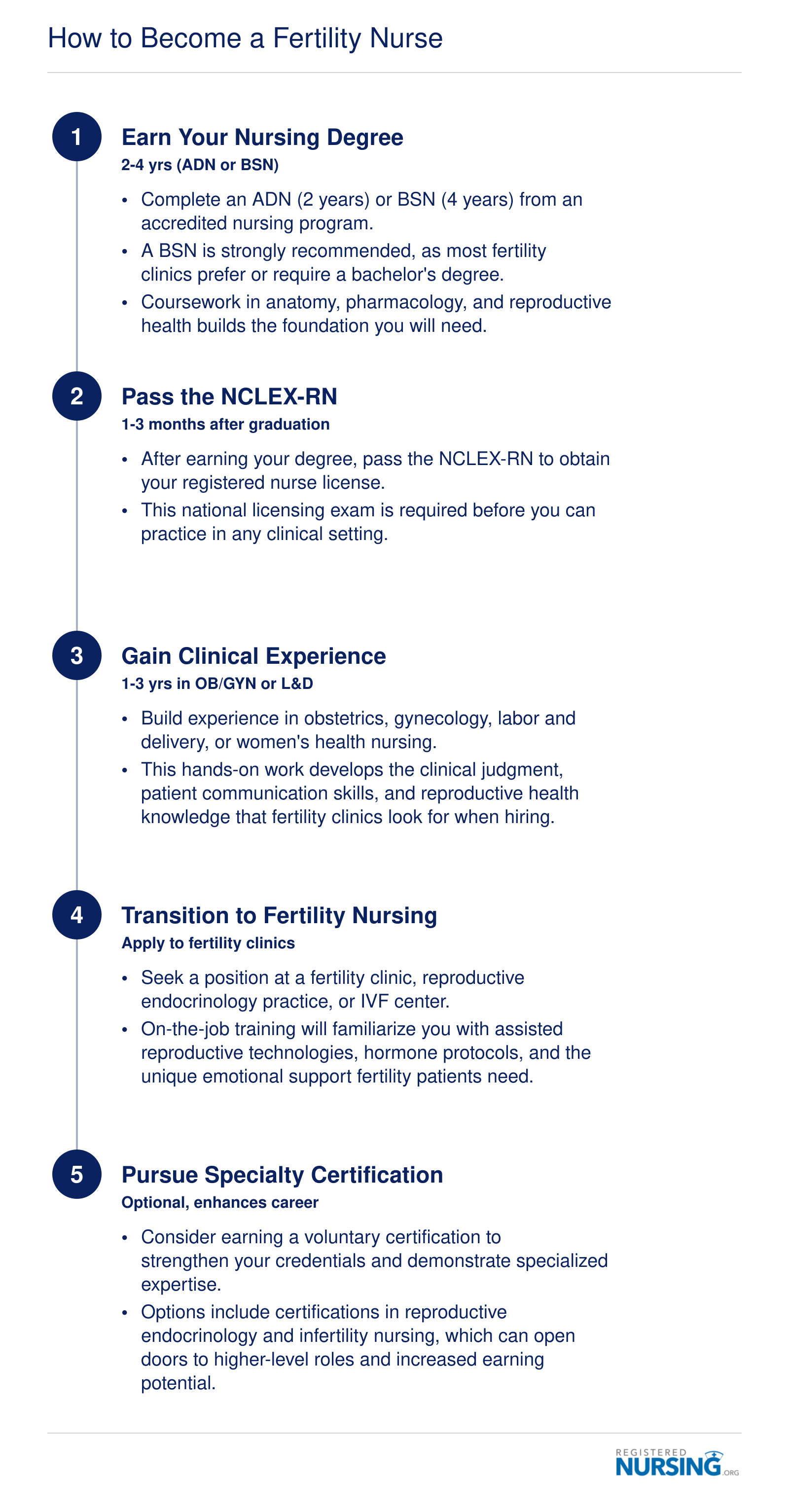
The path to becoming a fertility nurse combines foundational nursing education with hands-on clinical experience in women's health. A BSN is increasingly preferred by fertility clinics and is typically required for advancement into leadership or nurse practitioner roles. From start to finish, expect the journey to take roughly 4 to 7 years depending on your degree path.
Fertility Nurse Schooling and Education Requirements
Becoming a fertility nurse begins with earning your registered nurse license, then layering on specialized clinical experience and continuing education. The path you choose at the start will shape both your timeline and your opportunities in this competitive specialty.
ADN vs. BSN: Choosing Your Entry Point
You have two main routes to RN licensure, and which nursing degree you choose will have lasting implications for your career trajectory:
- Associate Degree in Nursing (ADN): A two-year program that gets you to the NCLEX-RN faster and at lower cost. You can begin working as an RN sooner and start building clinical hours.
- Bachelor of Science in Nursing (BSN): A four-year degree that includes broader coursework in leadership, research, and public health. Many fertility clinics and reproductive endocrinology practices prefer or require a BSN, viewing it as a marker of advanced training and critical thinking.
The trade-off is clear. An ADN puts you in the workforce quickly, but if your goal is a fertility clinic role, you may find yourself returning to school for an RN-to-BSN bridge program within a few years. Starting with a BSN opens more doors from day one and aligns with the bachelor's-preferred culture of many reproductive medicine centers.
Building Relevant Clinical Experience
During nursing school, seek out rotations and electives that prepare you for fertility work:
- Obstetrics and gynecology (OB/GYN): Exposure to reproductive anatomy, menstrual health, and patient counseling. Work in this area mirrors the day-to-day scope of an obstetric nurse in many meaningful ways.
- Maternal-child health: Experience with family planning, prenatal care, and the emotional dimensions of reproductive decisions.
- Women's health: Focus on hormonal conditions, contraception management, and patient education.
These rotations lay the clinical foundation. After graduation, most fertility clinics expect one to three years of hands-on experience in a related area such as labor and delivery, gynecology, or reproductive health before considering you for a fertility-specific position.
Continuing Education and On-the-Job Training
Fertility nursing requires knowledge that nursing school does not typically cover in depth. Much of your specialized training will happen on the job at the clinic, where you will learn protocols for ovulation induction, embryo transfer procedures, and patient cycle monitoring.
Supplement this with professional development:
- Attend conferences hosted by the American Society for Reproductive Medicine (ASRM) or the Society for Assisted Reproductive Technology (SART).
- Complete fertility-focused continuing education modules offered by nursing associations and reproductive health organizations.
- Stay current on evolving protocols, lab techniques, and ethical guidelines in assisted reproduction.
This combination of formal education, relevant clinical experience, and ongoing learning positions you to succeed in a fertility nursing role.
Fertility Nurse Certification and Credentials
No standalone certification for fertility nursing exists as of 2026, which means nurses entering this specialty must piece together a credentialing path from related certifications, professional associations, and continuing education programs. While that may sound inconvenient, it also means the field is accessible to any registered nurse willing to build targeted expertise through multiple avenues.
Relevant Certifications Through the National Certification Corporation
The National Certification Corporation (NCC) offers several certifications in women's health and maternal-newborn nursing that align closely with fertility care. Credentials such as the Registered Nurse Certified in Inpatient Obstetric Nursing (RNC-OB) and the Registered Nurse Certified in Maternal Newborn Nursing (RNC-MNN) demonstrate advanced competency in reproductive health. Although these certifications do not focus exclusively on fertility treatments, many reproductive endocrinology clinics and IVF centers view them favorably because they validate a nurse's clinical foundation in the broader reproductive health sphere. Check the NCC website directly for current eligibility requirements, exam windows, and renewal criteria.
Professional Associations for Credentialing Guidance
Two organizations stand out for nurses pursuing fertility-related practice. The American Society for Reproductive Medicine (ASRM) and the Society for Assisted Reproductive Technology (SART) both offer educational resources, annual conferences, and continuing education sessions tailored to assisted reproduction. Membership in either organization can connect you with mentors already working in fertility clinics and keep you informed about any emerging credentialing initiatives.
Additionally, the Association of Women's Health, Obstetric and Neonatal Nurses (AWHONN) provides professional development resources that complement fertility nursing. Reaching out to these groups directly is worthwhile, as credentialing requirements in reproductive health specialties can evolve quickly. Nurses interested in how genetics intersects with reproductive medicine may also find value in exploring the role of a genetic nurse, since counseling around hereditary conditions is increasingly part of fertility care.
State Nursing Boards and General Certification Pathways
Regardless of specialty focus, every fertility nurse must hold an active, unencumbered RN license in the state where they practice. Your state board of nursing is the authoritative source for licensure requirements, scope-of-practice rules, and any additional endorsements needed for specialized procedures such as ultrasound-guided monitoring or medication administration protocols common in fertility care. Nurses who administer injectable hormone therapies as part of IVF protocols will recognize overlap with the skills of an infusion nurse, where certification pathways are more established and can complement a fertility-focused portfolio.
Building a Competitive Credential Portfolio
Because a single fertility-specific certification does not yet exist, the strongest candidates tend to assemble a portfolio of complementary credentials and experiences:
- NCC certification: Pursue RNC-OB, RNC-MNN, or a related credential to validate reproductive health knowledge.
- Professional membership: Join ASRM, SART, or AWHONN for access to specialty continuing education and networking.
- Continuing education hours: Complete courses in assisted reproductive technologies, reproductive endocrinology, and patient counseling.
- Employer-sponsored training: Many fertility clinics offer in-house orientation programs covering IVF protocols, embryo transfer procedures, and hormone therapy management.
Staying engaged with specialty organizations is especially important right now. As the fertility care field continues to expand, new certification pathways may emerge, and nurses who are already active in these professional communities will be among the first to qualify.
Fertility Nurse Salary: National Overview
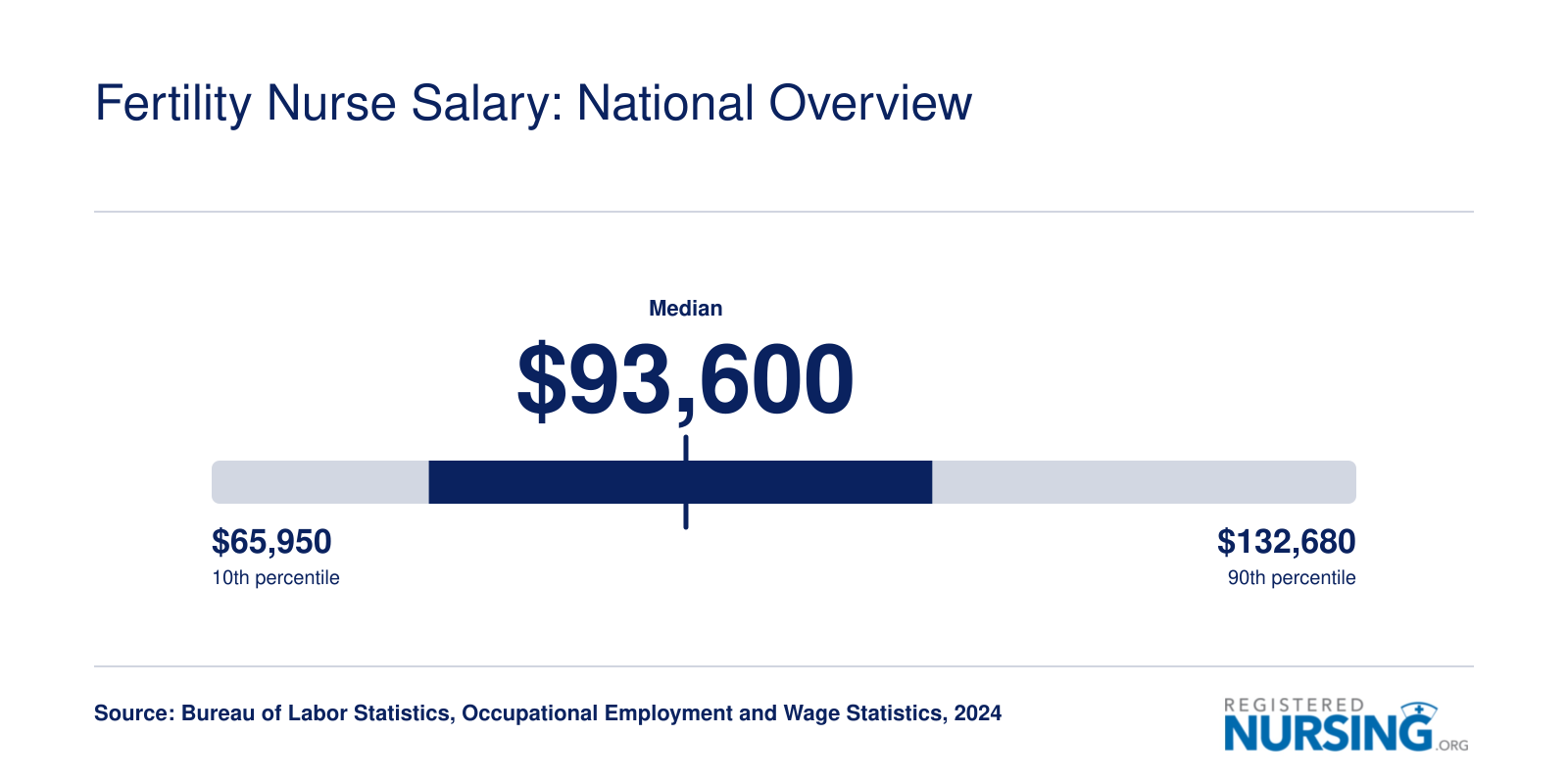
Because the Bureau of Labor Statistics groups fertility nurses under the broader Registered Nurses category (29-1141), the national RN wage distribution serves as the most reliable baseline for understanding fertility nurse compensation. Where a fertility nurse falls within this range depends heavily on specialty experience, professional certification, and metro area. Nurses with reproductive endocrinology credentials or years of IVF clinic experience typically land in the upper quartile or above.
Fertility Nurse Salary by State
Because the Bureau of Labor Statistics does not track fertility nurses as a separate occupation, the figures below reflect registered nurse salaries by state, which serve as a useful baseline for estimating fertility nurse compensation. Nurses working in reproductive endocrinology clinics or IVF centers may earn more or less than these figures depending on employer type, certifications held, and local demand. Data is drawn from the Occupational Employment and Wage Statistics program (2024).
| State | Total RN Employment | 25th Percentile Salary | Median Salary | 75th Percentile Salary | Mean Salary |
|---|---|---|---|---|---|
| Rhode Island | 10,760 | $83,870 | $99,960 | $112,540 | $99,770 |
| Arizona | 64,430 | $81,390 | $96,890 | $105,450 | $95,230 |
| New Hampshire | 16,580 | $79,720 | $96,830 | $105,500 | $94,620 |
| Maryland | 48,980 | $81,470 | $96,830 | $104,840 | $96,650 |
| Colorado | 54,510 | $81,790 | $96,520 | $104,370 | $95,470 |
| Delaware | 13,260 | $82,600 | $92,610 | $108,360 | $95,450 |
| Texas | 261,050 | $77,450 | $90,010 | $102,200 | $91,690 |
| Virginia | 77,420 | $77,650 | $88,820 | $100,920 | $90,930 |
| New Mexico | 17,510 | $82,630 | $88,260 | $104,720 | $94,360 |
| Pennsylvania | 146,840 | $78,570 | $87,610 | $102,030 | $90,830 |
| Georgia | 97,410 | $76,600 | $86,560 | $104,790 | $91,960 |
| Illinois | 139,900 | $79,150 | $86,410 | $103,660 | $91,130 |
| Idaho | 14,540 | $78,020 | $86,100 | $100,220 | $89,770 |
| Wisconsin | 64,960 | $79,570 | $86,070 | $100,680 | $90,450 |
| Michigan | 104,210 | $80,030 | $85,670 | $101,210 | $90,580 |
| Vermont | 7,240 | $79,980 | $85,150 | $104,110 | $92,710 |
| Maine | 16,280 | $76,890 | $82,860 | $98,000 | $87,440 |
| Florida | 218,100 | $77,070 | $82,850 | $99,260 | $88,200 |
| Utah | 25,780 | $77,030 | $82,270 | $101,530 | $88,240 |
| North Carolina | 108,510 | $74,710 | $81,860 | $98,720 | $86,270 |
| Wyoming | 5,180 | $75,540 | $81,790 | $100,910 | $88,020 |
| Montana | 10,540 | $77,800 | $81,560 | $100,510 | $88,480 |
| Ohio | 138,360 | $77,420 | $81,250 | $97,440 | $86,110 |
| Oklahoma | 32,870 | $75,320 | $81,160 | $96,460 | $85,800 |
| Nebraska | 24,180 | $76,430 | $81,020 | $93,140 | $82,890 |
Fertility nursing brings repeated exposure to patient grief, treatment failures, and pregnancy loss, placing a significant emotional burden on nurses. Balancing heartfelt empathy with the need for professional resilience is a daily challenge, and unprocessed grief can build up quickly. Recognizing this emotional weight is the first step toward seeking the support and coping strategies that prevent burnout.
A study published in the Australian Journal of Advanced Nursing found that 46% of fertility nurses are at risk for burnout. This statistic underscores the significant emotional demands placed on nurses in reproductive healthcare.
Fertility Nurse Practitioner: Advanced Career Path
Earning potential is one of the most significant distinctions between RN-level fertility nurses and advanced practice fertility nurse practitioners, with APRNs commanding a salary of $115,000 to $150,000.1 The higher pay reflects the extensive graduate education, expanded clinical responsibilities, and greater autonomy that nurse practitioners bring to reproductive endocrinology and fertility practices.
Education and Credentialing Requirements
Becoming a fertility nurse practitioner starts with earning a Bachelor of Science in Nursing (BSN) and obtaining RN licensure, but the critical differentiator is the completion of a graduate program. Minimum education is a Master of Science in Nursing (MSN), and some employers prefer or require a Doctor of Nursing Practice (DNP).2 Specialization matters: aspiring NPs typically pursue either the Women's Health Nurse Practitioner (WHNP) or Family Nurse Practitioner (FNP) track. After completing an accredited graduate program, candidates must pass a national board certification exam to earn credentials such as WHNP-BC or FNP-BC, and obtain state APRN licensure.2 This advanced preparation provides the deep knowledge of reproductive physiology, pharmacology, and chronic disease management needed to care for individuals navigating fertility challenges.
Expanded Scope of Practice
The scope of practice for a fertility nurse practitioner extends far beyond the RN role. While RN fertility nurses implement care plans under physician orders, NPs can independently diagnose conditions within their specialty, order and interpret diagnostic tests, and manage patient panels under a collaborative practice agreement. To learn more about how APRN roles compare across specialties, the overview of advanced practice APRN careers in nursing covers each pathway in detail. Fertility nurse practitioners may perform intrauterine inseminations (IUIs), transvaginal ultrasounds, and other selected gynecologic procedures. Crucially, they hold prescriptive authority, allowing them to prescribe fertility medications, including controlled substances, which RNs cannot do. This expanded role enables NPs to lead patient consultations, develop treatment plans, and provide continuous care throughout the reproductive journey.
Salary and Career Outlook
The financial return on the additional education is clear. Fertility RNs typically earn between $75,000 and $95,000 annually,3 while fertility nurse practitioners see salaries ranging from $115,000 to $150,000.1 The precise figure depends on geographic location, years of experience, and practice setting, but the difference underscores the value of advanced credentials. Demand for fertility services continues to grow as more individuals and couples seek assisted reproductive technologies, positioning fertility NPs for strong job prospects. Nurses drawn to women's health more broadly may also explore roles such as the postpartum nurse specialty, which shares a focus on reproductive and family-centered care. For nurses who want to practice at the top of their license with greater autonomy and deeper clinical involvement, the nurse practitioner pathway offers both professional fulfillment and enhanced compensation.
Fertility Nurse Job Outlook and Demand
Nurses considering a move into fertility care often weigh a practical question: does this specialty offer long-term job security, or is it too niche to guarantee steady demand? The short answer is that fertility nursing sits at the intersection of a stable profession and a rapidly expanding healthcare market, giving it an unusually strong outlook.
General RN Growth Sets the Floor
The Bureau of Labor Statistics projects a 5% growth rate for registered nurses from 2024 to 2034, with roughly 189,100 openings expected each year across the profession.1 That pace is faster than the 3.1% average projected for all occupations during the same period.4 Healthcare and social assistance as a broader sector is expected to account for nearly 45% of all new jobs added to the U.S. economy.3 For fertility nurses, these numbers represent the baseline: even if nothing else changed, the demand floor for RNs would remain solid.
Why Fertility Nursing May Outpace General RN Growth
Several converging trends suggest that fertility-specific roles could grow faster than the overall nursing workforce.
- Rising IVF utilization: The number of assisted reproductive technology (ART) cycles performed annually in the United States has been climbing steadily for over a decade. More cycles mean more clinical staff are needed for monitoring, egg retrievals, embryo transfers, and patient education.
- Expanding patient population: First-time parents are older on average than in previous generations, and age-related fertility challenges drive more individuals into clinical care. At the same time, LGBTQ+ family building and single parents by choice are growing segments of the fertility patient base.
- Employer fertility benefits: A rising number of employers now include fertility coverage in their benefits packages. This trend lowers the financial barrier for patients and increases the volume of people seeking treatment.
- Clinic expansion: Fertility clinic networks have been growing across the country, with both independent practices and larger health systems adding reproductive endocrinology services in markets that previously had limited access.
While federal agencies do not publish a separate job growth projection specifically for fertility nurses, the trajectory of the fertility industry as a whole points toward demand that is expanding faster than the general healthcare sector.
Limited Specialty Supply Works in Your Favor
One factor that strengthens the outlook further is the relatively small pipeline of nurses with fertility-specific training and credentials. General nursing programs do not typically include reproductive endocrinology rotations, and certifications in this area require hands-on clinical experience that takes time to build. The result is a specialty where qualified nurses are not in oversupply, which can translate into competitive compensation, stronger negotiating power, and more geographic flexibility when searching for positions. Nurses drawn to similarly specialized practice environments, such as those who pursue managed care nursing, often find that focused credentials carry real market value for the same reason.
What This Means for You
Fertility nursing offers a combination of professional stability and specialty momentum that is hard to match. The overall nursing profession provides a dependable employment foundation, and the fertility industry's growth layer adds opportunity on top of that. Nurses who invest in fertility-specific education and credentials position themselves in a market where demand is rising and experienced practitioners remain relatively scarce. Whether you prefer to work in a major metropolitan fertility center or a smaller clinic serving an underserved region, the expanding reach of reproductive medicine means opportunities are becoming available in a wider range of locations than ever before. Nurses who want to understand how credential investment pays off across specialties can also explore the home health nurse job description as a reference point for how niche clinical experience shapes hiring prospects.
Is Fertility Nursing Right for You?
Choosing a nursing specialty is a deeply personal decision, and fertility nursing is no exception. Use the advantages and challenges below as a self-assessment tool. If the pros energize you and the cons feel manageable rather than overwhelming, this specialty may be an excellent fit.
- Predictable clinic hours with no overnight or weekend shifts, supporting a healthy work-life balance.
- You build deeply meaningful, ongoing relationships with patients throughout their fertility journeys.
- The specialty is growing steadily, creating strong demand and solid job security for qualified nurses.
- Salaries are competitive within the RN range, especially for nurses who earn specialty certifications.
- You play a direct role in helping families achieve life-changing milestones, which can be profoundly rewarding.
- The emotional toll of failed cycles, pregnancy losses, and patient grief can be significant over time.
- Clinical protocols such as ultrasound monitoring and medication administration can feel repetitive day to day.
- Compared to acute care settings, the range of clinical scenarios and patient populations is more limited.
- Compassion fatigue is a real risk, particularly for nurses who struggle to set emotional boundaries with patients.
- Career advancement within the clinic setting may require pursuing an advanced practice degree or changing roles.
Frequently Asked Questions About Fertility Nursing
Fertility nursing is a rewarding specialty, but prospective nurses often have practical questions before committing to this career path. Below are concise answers to the most common questions about education, earnings, certification, and day-to-day realities of working in reproductive health.
- Is being a fertility nurse hard?
- Fertility nursing can be emotionally and clinically demanding. You will support patients through cycles of hope and disappointment, which requires strong emotional resilience alongside technical skill. The medication protocols, hormone monitoring, and procedural timing involved in treatments like IVF are detail intensive. That said, many fertility nurses describe the work as deeply fulfilling, especially when patients achieve successful pregnancies.
- Is fertility nursing a good career choice?
- Yes. Demand for reproductive health services continues to grow as more individuals and couples pursue assisted conception. The specialty offers competitive pay, typically consistent weekday schedules compared to hospital floor nursing, and strong job satisfaction. Nurses who enjoy patient education, relationship building, and working with advanced medical technology often thrive in this field.
- How long does it take to become a fertility nurse?
- Most nurses need a minimum of two to four years of nursing education (ADN or BSN) plus one to two years of clinical experience, often in areas like obstetrics or gynecology, before transitioning into fertility care. From start to finish, expect roughly three to six years. Pursuing a fertility nurse practitioner role adds another two to three years of graduate education.
- How much do fertility nurses make?
- Fertility nurse salaries generally align with registered nurse pay, with a national median around $86,070 per year as of recent Bureau of Labor Statistics data. Earnings vary by state, employer, and experience level. Nurses in metropolitan areas or those holding advanced certifications often earn above the median. Fertility nurse practitioners can earn significantly more, frequently exceeding $120,000 annually.
- How do I become a certified fertility nurse?
- To earn a recognized credential, many nurses pursue certification through organizations such as the Reproductive Nurse Certification Board. You will typically need an active RN license, a set number of clinical practice hours in reproductive health, and a passing score on a specialty examination. Maintaining certification usually requires ongoing continuing education in fertility and reproductive endocrinology. Nurses considering other specialized paths, such as emergency nursing, often find that specialty certification follows a similar framework of clinical hours plus a formal exam.
- What is the difference between a fertility nurse and a fertility nurse practitioner?
- A fertility nurse (RN) provides direct patient care such as administering medications, monitoring ultrasounds, and offering patient education under physician direction. A fertility nurse practitioner (NP) holds a graduate degree and can perform more autonomous functions, including ordering diagnostic tests, prescribing medications, and managing treatment plans. The NP role requires additional schooling and national advanced practice certification. Nurses curious about other specialty NP tracks may also explore paths like orthopedic nursing to compare scope and requirements.
Explore More
- Ambulatory Care Nurse
- Burn Unit Nurse
- Cardiac Nurse
- Cath Lab Nurse
- Charge Nurse
- Chief Nursing Officer (CNO)
- Correctional Nurse
- CVOR Nurse
- Dermatology Nurse
- Developmental Disability Nurse
- Director of Nursing
- Domestic Violence Nurse
- Emergency Room Nurse
- ENT Nurse
- ET Nurse
- Flight/Transport Nurse
- Forensic Nurse Salary & Career Guide
- Genetic Nurse
- Geriatric Nurse
- Health Policy Nurse
- Healthcare Administrator
- Healthcare Manager
- Home Health Nurse
- Hospice Nurse
- Camp Nurse
- GI Nurse
- Holistic Nurse
- Labor and Delivery Nurse
- Nurse Writer
- Psychiatric Nurse
- School Nurse
- Telemetry Nurse
- Travel Nurse
- Aesthetic Nurse
- Infusion/IV Nurse
- Oncology Nurse
- ICU Nurse
- Infection Control Nurse
- Legal Nurse Consultant
- LTC Nurse
- Managed Care Nurse
- Medical-Surgical Nurse
- Military (Combat) Nurse
- Missionary Nurse
- Mother Baby Nurse
- Nephrology Nurse
- Neuroscience Nurse
- NICU Nurse
- Nurse Administrator
- Nurse Attorney
- Nurse Care Coordinator
- Nurse Case Manager
- Nurse Entrepreneur
- Nurse Executive
- Nurse Health Coach
- Nurse Manager
- Obstetric (OB) Nurse
- Occupational Health Nurse
- Operating Room Nurse
- Ophthalmic Nurse
- Organ Procurement Coordinator
- Orthopedic Nurse
- Pain Management Nurse
- Palliative Care Nurse
- Parish Nurse
- Patient Advocate Nurse
- Pediatric Endocrinology Nurse
- Perianesthesia (PACU) Nurse
- Perinatal Nurse
- Plastic Surgery Nurse
- Public/Community Health Nurse
- Radiology Nurse
- Rehabilitation Nurse
- Research Nurse
- Respiratory Nurse
- Rheumatology Nurse
- Substance Abuse Nurse
- Telephone Triage Nurse
- Transcultural Nursing
- Transplant Nurse
- Trauma Nurse
- Wound Care Nurse (WOCN)