

What you’ll learn in this article…
- Earning the DNC credential typically boosts salary and employer appeal.
- Top-paying metro areas offer RN mean wages above $120,000 annually.
- Most dermatology nurses work predictable daytime hours in outpatient settings.
Demand for dermatology services has grown sharply over the past decade, driven by an aging population, rising skin cancer rates, and expanding cosmetic treatment options, and that growth has pulled more registered nurses into the specialty. A dermatology nurse is an RN who has focused clinical practice on conditions affecting the skin, hair, and nails, working within dermatology offices, medical spas, oncology clinics, or academic medical centers.
The role sits between a general staff RN and a dermatology nurse practitioner. Unlike a nurse practitioner, a dermatology nurse does not independently diagnose or prescribe, but the procedural scope is broader than most outpatient RN positions. Nurses in this specialty assist with biopsies, administer phototherapy, provide wound care, and counsel patients on complex skin conditions, all within a fast-paced, appointment-driven environment. For nurses exploring adjacent outpatient roles, the infusion nurse path offers a useful point of comparison.
One practical tension shapes most nurses' entry into the field: there is no single required certification, yet employers increasingly prefer candidates who hold the Dermatology Nurse Certified credential and bring prior dermatology or outpatient clinical experience.
What Does a Dermatology Nurse Do Daily?
A dermatology nurse runs at a pace that looks nothing like a hospital floor: short, procedural, back-to-back patient encounters where the skin is both the diagnostic tool and the treatment site. In a busy outpatient clinic, expect to see 20 to 40 patients in a single day,1 cycling between medical visits (suspicious lesions, acne, psoriasis, eczema flares) and cosmetic appointments (Botox follow-ups, laser resurfacing, chemical peels).
A Typical Clinic Day
Mornings usually start with patient intake and full or focused skin assessments.1 You are documenting lesion size, color, borders, and change over time before the dermatologist enters the room. From there, the day flows through a rotation of procedures:
- Biopsies and excisions: Setting up sterile fields, positioning patients, handing instruments, and labeling specimens for pathology. Skin biopsies are among the most common procedures you will assist with.1
- Mohs surgery support: Prepping the surgical site, managing hemostasis between stages, and providing wound care and pressure dressings once clear margins are confirmed. Nurses with a background as a wound care nurse will find these skills transfer directly.
- Phototherapy and laser treatments: Calibrating the unit, protecting the patient's eyes, timing exposures, and monitoring skin response during and after treatment.
- Cryotherapy and injections: Preparing liquid nitrogen, intralesional steroids, or biologic injections for chronic inflammatory conditions.
The Patient Education Piece
A large slice of the day is teaching, not tasking. Dermatology nurses coach patients on daily sunscreen use and sun-protective behavior, walk post-procedure patients through wound care (when to keep it covered, signs of infection, when to resume activity), and demonstrate correct application of topicals for psoriasis, eczema, and acne, where technique often determines whether the regimen works. Chronic-condition patients frequently return, so you build longitudinal relationships that shape adherence over months and years.
How It Differs From Med-Surg
A med-surg nurse manages a smaller patient load with higher acuity: IV medications, complex assessments, discharge coordination, and shifting priorities across a 12-hour shift. Dermatology nursing trades that acuity for volume and procedural repetition. You are hands-on with instruments and devices for most of the day, rarely deal with codes or rapid responses, and finish shifts on a predictable outpatient schedule. For nurses weighing this path, hospital nursing vs. clinical nursing is a useful comparison before committing to either setting. For those ready to advance further, the role of Dermatology Nurse Practitioner offers expanded autonomy within the same specialty.
Dermatology Nursing Subspecialties
Medical dermatology and cosmetic or aesthetic dermatology represent two distinct career tracks within the specialty, and the path you choose will shape your daily responsibilities, your training investments, and your earning potential.
Medical Dermatology Nursing
Nurses on the medical side focus on conditions such as eczema, psoriasis, skin cancer screening, wound care, and autoimmune skin disorders. You work closely with dermatologists to manage chronic conditions, assist with biopsies and excisions, and educate patients about treatment plans. The clinical foundation here is your RN license and hands-on experience in a dermatology practice or clinic. Many medical dermatology nurses pursue the Dermatology Nursing Certification through the Dermatology Nurses' Association (DNA), which validates your specialized knowledge and can strengthen your professional standing.
Cosmetic and Aesthetic Dermatology Nursing
Aesthetic nurse work centers on elective procedures: laser treatments, chemical peels, injectable neurotoxins, and dermal fillers. Because these procedures carry specific safety and regulatory considerations, additional credentials are typically required beyond your RN license. Organizations such as the DNA and the American Society for Laser Medicine and Surgery (ASLMS) list accredited courses that cover laser physics, tissue interaction, and injection techniques. Prerequisites vary by state, so reviewing your state's nurse practice act is a necessary first step before enrolling in any certification program.
Training for injectables and laser procedures often involves both didactic coursework and supervised clinical hours. Some nurses complete programs affiliated with aesthetic training organizations, while others gain competencies through employer-sponsored mentorships in medical spas or plastic surgery practices.
Salary Considerations Across Subspecialties
General registered nurse salary data is available through the Bureau of Labor Statistics, but those figures do not isolate dermatology subspecialties. Nurses working in cosmetic settings frequently report a salary premium compared to their medical dermatology counterparts, driven in part by the revenue that elective aesthetic procedures generate. However, specific dollar amounts vary widely by location, employer type, and level of certification.
To get a realistic picture of compensation in your area, consider reviewing current job postings on major employment platforms and filtering by title and geography. Recruiter reports from specialized healthcare staffing firms can also offer useful benchmarks. Alumni networks from nursing programs with aesthetic tracks are another practical source of real-world salary insight.
Other Subspecialty Niches
Beyond the two main tracks, some dermatology nurses carve out roles in:
- Pediatric dermatology: Managing skin conditions unique to infants, children, and adolescents.
- Dermatology research: Coordinating clinical trials for new treatments and medications alongside a nurse researcher.
- Wound care and ostomy: Specializing in complex or chronic wound management, often earning additional wound care certification.
- Mohs surgery assistance: Working alongside surgeons during the precise, layer-by-layer removal of skin cancers.
Each niche demands its own blend of clinical experience and targeted training, so understanding where your interests and skills align is essential before committing to additional coursework or certification.
Questions to Ask Yourself
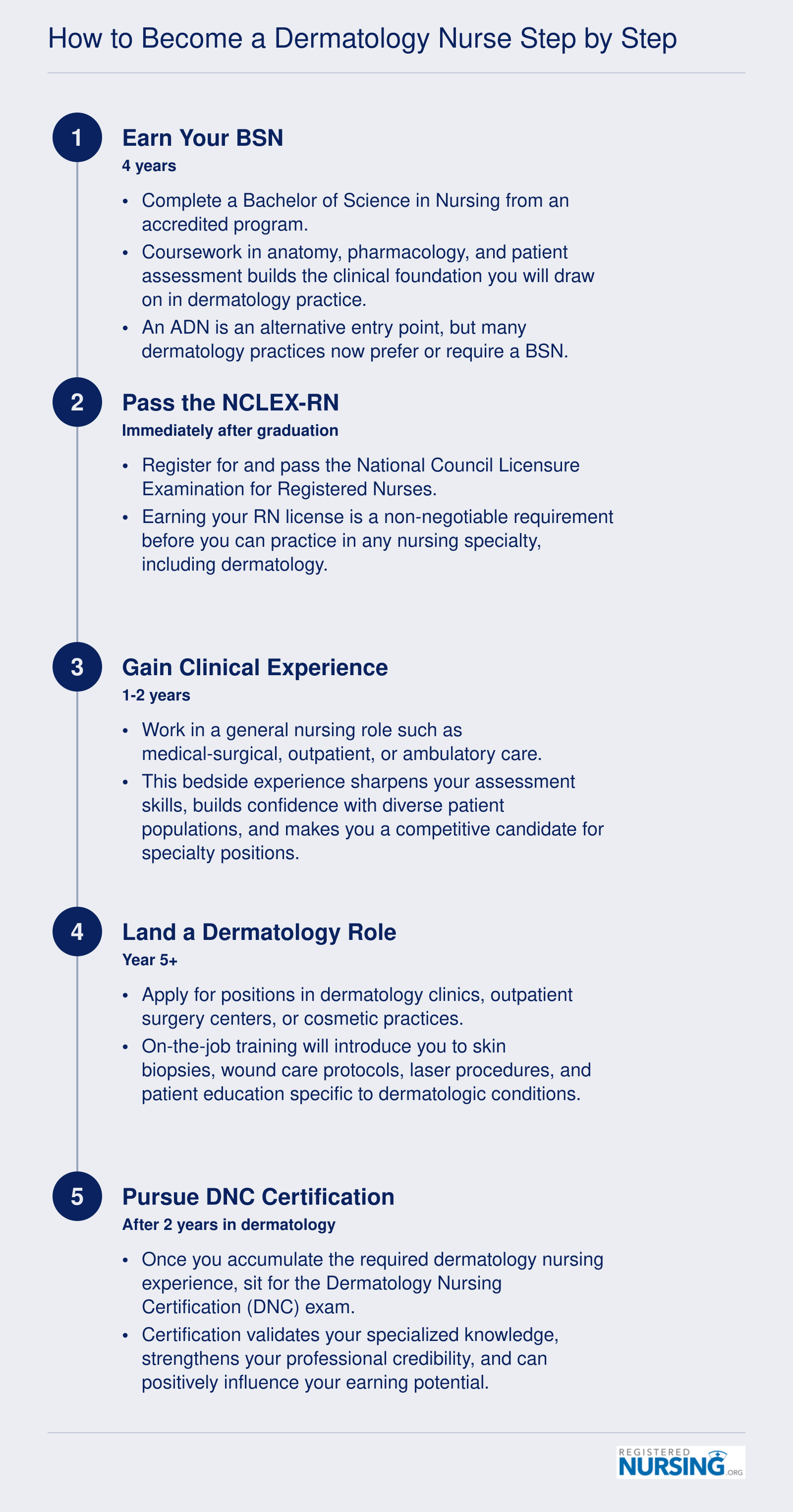
How to Become a Dermatology Nurse Step by Step
The path from nursing student to certified dermatology nurse follows a clear sequence. While ADN-prepared nurses can enter the field, a BSN is increasingly preferred by dermatology employers and opens more doors for advancement. Expect a total timeline of roughly 5 to 7 years from your freshman year to full certification.
Dermatology Nurse Certification (DNC)
What are the requirements to earn the Dermatology Nurse Certified credential, and how do you maintain it?
The Dermatology Nurse Certified (DNC) credential, awarded by the Dermatology Nursing Certification Board, validates your expertise in dermatology nursing and signals to employers that you meet rigorous national standards.1 Earning this certification requires meeting specific eligibility criteria, passing a comprehensive examination, and committing to ongoing professional development.
Eligibility Requirements for the DNC Exam
To sit for the DNC examination, you must hold an active, unrestricted registered nurse license in the United States or Canada. Beyond licensure, the DNCC requires a minimum number of hours of direct dermatology nursing practice, though specific hour thresholds may vary depending on your educational background and practice setting. Candidates typically need documented experience in dermatology nursing within a recent time frame to ensure current clinical knowledge. Review the most current handbook from the Dermatology Nurses Association before applying to confirm you meet all eligibility criteria.1
Exam Logistics and Cost
The DNC examination fee is $260 for members of the Dermatology Nurses Association and $335 for non-members.1 An initial application fee of $25 applies to all candidates. If you need to retake the exam, the fee is $195 for members and $270 for non-members. Be aware of additional fees: late applications incur a $25 charge, and returned checks carry a $20 fee.
The exam itself is a comprehensive assessment covering core content domains in dermatology nursing, including skin anatomy and physiology, common dermatologic conditions, treatment modalities, patient education, and nursing interventions specific to dermatology practice. The minimum passing score is set at 75 percent.1 While the exact number of questions and the most recent pass rates fluctuate with each exam administration, candidates should plan to demonstrate mastery across all content areas.
Recertification and Continuing Education
The DNC credential is not permanent. You must recertify periodically to maintain active status, a process that typically involves completing a set number of RN Contact Hours and Continuing Education Units (CEUs) in dermatology-related topics within a defined cycle of years. The DNCC approves specific CE providers and activities that count toward recertification. Alternatively, recertification by examination is available if you prefer to retake the exam rather than accumulate CE credits.1
DNC vs. DCNP: Understanding the Difference
It is important to distinguish the DNC from the Dermatology Certified Nurse Practitioner (DCNP) credential. The DNC is designed for registered nurses working in dermatology at the staff or advanced practice registered nurse level in states where APRN practice does not require separate NP certification in dermatology. The DCNP, by contrast, is reserved for nurse practitioners with prescriptive authority and advanced practice roles. If you are an RN without NP credentials, the DNC is the appropriate certification path. If you are a nurse practitioner specializing in dermatology, you might also explore why choosing a dermatology nurse practitioner specialty makes sense for your career before pursuing the DCNP instead.
Dermatology Nurse Salary: National Overview
Dermatology nurses are classified under the broader registered nurse (RN) occupation, so the salary figures below reflect all RNs nationally. Nurses who hold specialty certifications or work in high-demand dermatology settings may earn at the higher end of this range, particularly those in cosmetic or procedural roles. According to the Occupational Employment and Wage Statistics program from the U.S. Bureau of Labor Statistics (2024 data), the national salary landscape for registered nurses is as follows.
| Pay Metric | Annual Salary |
|---|---|
| 25th Percentile | $78,610 |
| Median (50th Percentile) | $93,600 |
| Mean (Average) | $98,430 |
| 75th Percentile | $107,960 |
Dermatology Nurse Salary by State
Dermatology nurse salaries vary considerably depending on where you practice. Because the Bureau of Labor Statistics does not track dermatology nurses as a separate category, the figures below reflect registered nurse wages in each state, drawn from the 2024 Occupational Employment and Wage Statistics. Dermatology nurses in private practices or cosmetic settings may earn above or below these benchmarks depending on employer type and experience level.
| State | Total RN Employment | 25th Percentile | Median Salary | 75th Percentile | Mean Salary |
|---|---|---|---|---|---|
| Rhode Island | 10,760 | $83,870 | $99,960 | $112,540 | $99,770 |
| Arizona | 64,430 | $81,390 | $96,890 | $105,450 | $95,230 |
| New Hampshire | 16,580 | $79,720 | $96,830 | $105,500 | $94,620 |
| Maryland | 48,980 | $81,470 | $96,830 | $104,840 | $96,650 |
| Colorado | 54,510 | $81,790 | $96,520 | $104,370 | $95,470 |
| Delaware | 13,260 | $82,600 | $92,610 | $108,360 | $95,450 |
| Texas | 261,050 | $77,450 | $90,010 | $102,200 | $91,690 |
| Virginia | 77,420 | $77,650 | $88,820 | $100,920 | $90,930 |
| New Mexico | 17,510 | $82,630 | $88,260 | $104,720 | $94,360 |
| Pennsylvania | 146,840 | $78,570 | $87,610 | $102,030 | $90,830 |
| Georgia | 97,410 | $76,600 | $86,560 | $104,790 | $91,960 |
| Illinois | 139,900 | $79,150 | $86,410 | $103,660 | $91,130 |
| Idaho | 14,540 | $78,020 | $86,100 | $100,220 | $89,770 |
| Wisconsin | 64,960 | $79,570 | $86,070 | $100,680 | $90,450 |
| Michigan | 104,210 | $80,030 | $85,670 | $101,210 | $90,580 |
| Vermont | 7,240 | $79,980 | $85,150 | $104,110 | $92,710 |
| Maine | 16,280 | $76,890 | $82,860 | $98,000 | $87,440 |
| Florida | 218,100 | $77,070 | $82,850 | $99,260 | $88,200 |
| Utah | 25,780 | $77,030 | $82,270 | $101,530 | $88,240 |
| North Carolina | 108,510 | $74,710 | $81,860 | $98,720 | $86,270 |
| Wyoming | 5,180 | $75,540 | $81,790 | $100,910 | $88,020 |
| Montana | 10,540 | $77,800 | $81,560 | $100,510 | $88,480 |
| Ohio | 138,360 | $77,420 | $81,250 | $97,440 | $86,110 |
| Oklahoma | 32,870 | $75,320 | $81,160 | $96,460 | $85,800 |
| Nebraska | 24,180 | $76,430 | $81,020 | $93,140 | $82,890 |
Highest-Paying Metro Areas for Dermatology Nurses
Location plays a significant role in earning potential for dermatology nurses. The following table highlights major metropolitan areas ranked by mean annual pay for registered nurses, which serves as a useful proxy for dermatology nursing compensation. Because the Bureau of Labor Statistics does not publish a separate category for dermatology nurses, these figures reflect the broader registered nurse occupation based on 2024 OEWS data. Dermatology nurses in high-cost metros, particularly in California, may earn above these averages when factoring in specialty certifications and cosmetic procedure experience.
| Metro Area | Total RN Employment | 25th Percentile | Median Salary | Mean Salary | 75th Percentile |
|---|---|---|---|---|---|
| San Francisco, Oakland, Fremont, CA | 40,750 | $150,580 | $188,020 | $178,450 | $212,190 |
| Los Angeles, Long Beach, Anaheim, CA | 107,340 | $108,150 | $133,440 | $138,010 | $165,290 |
| Seattle, Tacoma, Bellevue, WA | 37,250 | $101,140 | $118,570 | $120,260 | $132,160 |
| Boston, Cambridge, Newton, MA and NH | 66,440 | $84,200 | $102,440 | $115,710 | $137,160 |
| New York, Newark, Jersey City, NY and NJ | 195,470 | $100,530 | $113,490 | $115,650 | $128,430 |
| Minneapolis, St. Paul, Bloomington, MN and WI | 40,510 | $87,670 | $102,240 | $102,790 | $116,000 |
| Washington, Arlington, Alexandria, DC, VA, MD, WV | 43,640 | $83,570 | $101,800 | $102,510 | $110,760 |
| Philadelphia, Camden, Wilmington, PA, NJ, DE, MD | 74,840 | $84,040 | $99,210 | $97,510 | $107,800 |
| Dallas, Fort Worth, Arlington, TX | 72,640 | $79,170 | $98,740 | $96,720 | $106,850 |
| Houston, Pasadena, The Woodlands, TX | 65,300 | $79,640 | $97,810 | $96,730 | $105,970 |
| Atlanta, Sandy Springs, Roswell, GA | 54,370 | $79,700 | $96,370 | $96,640 | $107,550 |
| Phoenix, Mesa, Chandler, AZ | 46,330 | $82,270 | $98,160 | $96,220 | $105,900 |
| Chicago, Naperville, Elgin, IL and IN | 100,620 | $81,320 | $96,480 | $94,580 | $104,730 |
| Detroit, Warren, Dearborn, MI | 44,280 | $81,140 | $88,980 | $92,680 | $101,880 |
| Miami, Fort Lauderdale, West Palm Beach, FL | 59,880 | $78,240 | $85,610 | $92,070 | $103,110 |
Where Do Dermatology Nurses Work?
Dermatology nurses practice in a wide array of outpatient settings, with the majority working predictable business hours that make the specialty highly attractive to nurses seeking lifestyle balance after years of hospital shift work.
Private Dermatology Practices
Private dermatology clinics employ the largest share of dermatology nurses. These offices range from solo providers to multi-physician groups and handle both medical dermatology (skin cancer screenings, acne, psoriasis, eczema) and cosmetic services (Botox, fillers, laser treatments). Many nurses in private practice wear multiple hats, assisting with procedures, triaging patient concerns, and coordinating care between visits. The work is almost exclusively Monday through Friday, daytime hours, with rare evening or weekend shifts.
Hospital Outpatient Departments and Academic Medical Centers
Hospital-affiliated dermatology clinics and academic centers treat more complex cases, including autoimmune conditions, severe psoriasis requiring biologic infusions, and pre- and post-operative skin cancer patients. Academic centers also offer opportunities to participate in clinical trials and work alongside dermatology residents and fellows. Pay structures tend to be more standardized than private practice, with comprehensive benefits but less opportunity for procedure-based bonuses.
Cosmetic Surgery Centers
Dedicated cosmetic and medical spa settings focus on elective aesthetic procedures. Nurses in these environments often assist with laser resurfacing, chemical peels, injectable treatments, and body contouring. Compensation in high-end cosmetic practices, particularly in major metropolitan areas, frequently includes performance incentives, commission structures on product sales, or bonuses tied to procedure volume, pushing total earnings above the median for dermatology nurses.
Teledermatology and Niche Settings
Teledermatology platforms are a rapidly growing segment, allowing nurses to triage cases, coordinate virtual visits, and educate patients remotely. This model offers maximum schedule flexibility, including part-time and contract roles.
Niche settings such as burn unit nurses and oncology nurses also rely on nurses with dermatology training to manage complex skin integrity issues, graft care, and chemotherapy-related dermatologic side effects.
How Setting Affects Compensation
Cosmetic practices in high-cost metropolitan markets typically offer the highest earning potential through variable pay structures. Academic and hospital roles emphasize salary stability and robust benefits. Private medical dermatology practices fall in the middle, with some offering modest performance bonuses. Setting choice should balance income goals, work-life preferences, and clinical interests. Nurses weighing a move from inpatient to outpatient dermatology may find it helpful to review the challenges of transitioning from hospital nursing to clinic and ambulatory care before making that shift.
Is Dermatology Nursing Worth It?
Many dermatology nurses report that the specialty delivers a strong mix of clinical satisfaction, income stability, and predictable hours, a combination that can be elusive in other nursing tracks. Whether the trade-offs align with your priorities depends on how much you value structured schedules, moderate competition for positions, and the chance to build long-term relationships with patients managing chronic skin conditions.
Job Outlook and Demand
The Bureau of Labor Statistics projects registered nursing employment overall will grow 5 percent from 2024 to 2034, with roughly 189,100 annual openings nationwide stemming from growth and replacement needs.1 Dermatology positions typically represent a small slice of that total, and competition can be stiffer than for critical care nursing roles because clinics and medical spas attract nurses seeking Monday-through-Friday schedules and minimal on-call requirements. In metropolitan markets with large cosmetic-dermatology sectors, openings fill quickly; rural and community dermatology practices may struggle to recruit, offering earlier pathways for new graduates willing to relocate.
Work-Life Balance
Practitioners cite predictable hours as a defining benefit. Most dermatology offices close evenings and weekends, eliminating overnight shifts and holiday rotations. The pace can still be brisk during clinic hours, but emergencies are rare, and documentation follows a more routine rhythm than emergency nursing workflows. Nurses with young children or those seeking time for advanced education often rank dermatology among the top lifestyle-friendly specialties.
Financial and Professional Considerations
Dermatology nursing salaries typically mirror or slightly exceed general RN medians when accounting for geographic cost of living, and certified dermatology nurses who assist in cosmetic procedures may command hourly premiums. Career-ladder options are narrower than in hospital systems; progression often means shifting into nursing administration, product sales, or advanced-practice dermatology roles rather than climbing a clinical hierarchy. If you value depth over breadth and prefer mastering a focused set of interventions, the specialty rewards sustained expertise.
Frequently Asked Questions About Dermatology Nursing
Dermatology nursing attracts many RNs who want a specialty that blends clinical care with aesthetics. Below are answers to the questions prospective dermatology nurses ask most often.
How many years does it take to become a dermatology nurse?
Is it hard to get into dermatology as a nurse?
What is the difference between a dermatology nurse and a dermatology nurse practitioner?
What certification do dermatology nurses need?
How much do cosmetic dermatology nurses make compared to medical dermatology nurses?
What is the job outlook for dermatology nurses?
Can you become a dermatology nurse with an ADN?
Explore More
- Ambulatory Care Nurse
- Burn Unit Nurse
- Cardiac Nurse
- Cath Lab Nurse
- Charge Nurse
- Chief Nursing Officer (CNO)
- Correctional Nurse
- CVOR Nurse
- Developmental Disability Nurse
- Director of Nursing
- Domestic Violence Nurse
- Emergency Room Nurse
- ENT Nurse
- ET Nurse
- Fertility Nurse
- Flight/Transport Nurse
- Forensic Nurse Salary & Career Guide
- Genetic Nurse
- Geriatric Nurse
- Health Policy Nurse
- Healthcare Administrator
- Healthcare Manager
- Home Health Nurse
- Hospice Nurse
- Camp Nurse
- GI Nurse
- Holistic Nurse
- Labor and Delivery Nurse
- Nurse Writer
- Psychiatric Nurse
- School Nurse
- Telemetry Nurse
- Travel Nurse
- Aesthetic Nurse
- Infusion/IV Nurse
- Oncology Nurse
- ICU Nurse
- Infection Control Nurse
- Legal Nurse Consultant
- LTC Nurse
- Managed Care Nurse
- Medical-Surgical Nurse
- Military (Combat) Nurse
- Missionary Nurse
- Mother Baby Nurse
- Nephrology Nurse
- Neuroscience Nurse
- NICU Nurse
- Nurse Administrator
- Nurse Attorney
- Nurse Care Coordinator
- Nurse Case Manager
- Nurse Entrepreneur
- Nurse Executive
- Nurse Health Coach
- Nurse Manager
- Obstetric (OB) Nurse
- Occupational Health Nurse
- Operating Room Nurse
- Ophthalmic Nurse
- Organ Procurement Coordinator
- Orthopedic Nurse
- Pain Management Nurse
- Palliative Care Nurse
- Parish Nurse
- Patient Advocate Nurse
- Pediatric Endocrinology Nurse
- Perianesthesia (PACU) Nurse
- Perinatal Nurse
- Plastic Surgery Nurse
- Public/Community Health Nurse
- Radiology Nurse
- Rehabilitation Nurse
- Research Nurse
- Respiratory Nurse
- Rheumatology Nurse
- Substance Abuse Nurse
- Telephone Triage Nurse
- Transcultural Nursing
- Transplant Nurse
- Trauma Nurse
- Wound Care Nurse (WOCN)