

What you’ll learn in this article…
- Fewer than five U.S. DNP programs offer a dedicated transcultural track.
- CTN-B and CTN-A credentials independently verify transcultural nursing competence.
- Top-ranked graduates report median earnings near $71,500 to over $100,000.
Most DNP programs now weave transcultural coursework into their diversity requirements, but only a handful still offer a dedicated concentration that treats cultural competence as a systems leadership discipline rather than a single elective. A DNP in transcultural nursing prepares you to redesign care delivery models, shape institutional policy, and implement evidence-based protocols that serve linguistically and ethnically diverse populations at scale.
This differs from MSN-level transcultural work, where the emphasis is direct patient care and unit-level advocacy. At the doctoral level, the shift is toward organizational transformation: leading quality improvement projects that address health disparities, influencing payer and accreditation standards, and mentoring clinical staff in culturally congruent practice. Graduates typically move into DNP executive leadership roles, population health directorships, or faculty positions with a research portfolio in health equity.
Best Fully Online Transcultural Nursing DNP Programs
Very few DNP programs carry a formal "transcultural nursing" concentration. The programs below were selected using a composite quality score that factors in fully online delivery, institutional graduation rates, average net price, and graduate earnings data drawn from federal sources. While most of not all offer broad DNP curricula rather than a named transcultural track, each includes coursework or project flexibility in population health, health equity, cultural competence, or policy advocacy that can be directed toward transcultural nursing scholarship. Graduation rates and net price figures cited are institution-wide averages, not program-specific, as reported through federal data.
How this list was built
- Fully online program delivery
- Institutional graduation rate
- Average net price
- Graduate earnings outcomes
- Cultural or population health relevance
- College Scorecard graduate earnings — collegescorecard.ed.gov
- NCES-IPEDS federal institutional data — nces.ed.gov
- Internal program database
- Independent program research
University of North Carolina at Chapel Hill
#1Chapel Hill, NC · $12,000/yr
Best for: Leadership focused nurses in diverse communities
UNC Chapel Hill's School of Nursing consistently ranks among the nation's best, and its DNP offerings reflect that reputation. Three distinct pathways (Health Care Leadership and Administration, BSN to DNP Nurse Practitioner, and MSN to DNP) give students flexible entry points, while the curriculum's emphasis on public policy, organizational leadership, and systems change provides a natural platform for transcultural and health equity scholarship. Beginning Fall 2025, all DNP programs transitioned to a fully online format, broadening access for nurses across North Carolina's diverse rural and urban communities.
- Ranked #16 overall DNP program by U.S. News & World Report
- Three pathways: Leadership, BSN to DNP NP, and MSN to DNP
- Psych-Mental Health NP track ranked in the top 9 nationally
- Interprofessional education alongside medicine, public health, pharmacy
- Full-time and part-time enrollment options available
- Scholarships and financial aid available
- Dedicated faculty mentorship throughout the program
- Approximately 500 residency hours with tailored clinical placements
- Distance-based format designed for working professionals
- Emphasis on evidence-based practice and organizational leadership
- Policy, finance, and systems change coursework
- Faculty mentorship from experienced nurse leaders
- Financial aid and scholarship support available
- Ideal for nurses targeting executive or systems-level roles
Florida International University
#2Miami, FL · ~$9,000/yr (est.)
Best for: Nurses serving multicultural urban populations
Located in one of the most culturally diverse metropolitan areas in the United States, Florida International University's CCNE-accredited DNP program naturally embeds culturally competent care throughout its curriculum. The 36-credit program includes a clinical residency and capstone project, with five available concentrations and both BSN-to-DNP and post-master's pathways. FIU's designation as a Hispanic-Serving Institution and its Academic Health Center create an environment where interprofessional collaboration with diverse patient populations is part of daily practice.
- CCNE-accredited with five concentration options
- 36 total credit hours with 540 clinical hours required
- No GRE or entrance exam required for admission
- Fall and spring start dates each year
- Interprofessional collaboration through FIU Academic Health Center
- Full-time and part-time scheduling available
- $30 application fee with financial aid available
- Direct BSN-to-DNP pathway available online
- Prepares graduates for national certification
- Focus on health promotion and disease prevention
- Clinical placements available outside South Florida
- Apply through Nursing CAS portal
- Financial aid available for qualifying students
The University of Texas Rio Grande Valley
#3Edinburg, TX · $0 – $5,000/yr
Best for: Border region and bilingual care advocates
UTRGV sits along the U.S.-Mexico border, placing its DNP students at the intersection of two cultures and health systems. The 100% online program aligns its curriculum with AACN Essentials and prepares graduates for APRN, clinical research, and nurse executive roles. Although no formal transcultural track is named, the university's location and its status as a Hispanic-Serving Institution mean that population-focused DNP projects naturally address bilingual care delivery, border health disparities, and cross-cultural clinical challenges.
- 100% online delivery for full flexibility
- Curriculum aligned with AACN Essentials
- Prepares for APRN, clinical researcher, and nurse executive roles
- UTRGV Graduate Select Scholarship up to $1,000
- Emphasizes interprofessional team building and health policy
- Quality improvement and information management coursework
- Financial aid and scholarship support available
- Institution-level average net price of approximately $4,831
University of Central Florida
#4Orlando, FL · $10,000/yr
UCF's online DNP program emphasizes evidence-based practice, leadership, and health policy, equipping graduates to design and evaluate care models in complex systems. An Executive track appeals to experienced nurses aiming for senior administrative positions. While no named transcultural concentration exists, the population health and organizational analysis coursework can support DNP projects centered on cultural competence and health equity within Florida's diverse patient communities.
- Fully online format designed for working nurses
- Executive track available for experienced nurse leaders
- Emphasis on technology and data-driven decision-making
- DNP Project required to translate research into practice
- Interprofessional team collaboration coursework
- Leadership, policy, and organizational analysis focus
- Institution-wide graduation rate of approximately 78%
University of Connecticut
#5Storrs, CT · ~$25,000/yr (est.)
UConn's DNP program offers both post-bachelor's and post-master's entry points across nine concentration options, all delivered 100% online. With over 300 clinical training partners and a curriculum covering all eight AACN essential areas, students can steer elective coursework and their DNP project toward culturally responsive care models. The program also offers elective graduate certificates that can complement transcultural interests.
- Nine concentration options including Clinical Nurse Leaders
- 100% online with three start dates per year (fall, spring, summer)
- First DNP program of its kind in Connecticut
- Over 300 clinical training partners
- Elective graduate certificates available
- Curriculum covers all AACN eight essential areas
- Full-time and part-time scheduling options
- Four NP concentration options available online
- Direct BSN-to-DNP pathway
- Over 300 clinical training partners for clinical placement
- 84 currently enrolled students across DNP cohorts
- Designed for nurses without a prior master's degree
- Financial aid and scholarship support available
Clemson University
#6Clemson, SC · $20,000 – $25,000/yr
Clemson's DNP program requires 1,000 clinical hours and a translational DNP project, with specialties in Family NP, Adult/Gerontology NP, Pediatric NP, and Health Systems Leadership. The post-master's track is fully online, while the post-baccalaureate track uses a hybrid model. An annual Translational Research Day encourages scholarly exchange, and graduate teaching assistantships help offset costs.
- Post-master's track delivered fully online
- Four concentration options including Health Systems Leadership
- 1,000 clinical hours and capstone project required
- Graduate teaching assistantships and scholarships available
- Annual Translational Research Day for scholarly exchange
- Priority deadline November 15, final deadline February 15
- Institution-wide graduation rate of approximately 87%
University of Nevada-Las Vegas
#7Las Vegas, NV · $10,000/yr
UNLV's DNP program features four tracks, including Post-Master's Advanced Practice and Post-Bachelor's Family Nurse Practitioner, most delivered online. The curriculum highlights health care policy advocacy and interprofessional collaboration, giving students tools to address culturally driven barriers at the systems level. Las Vegas's highly diverse population provides a natural clinical backdrop for transcultural nursing scholarship.
- Four distinct tracks available, most offered online
- Post-Master's Advanced Practice and Post-Bachelor's FNP pathways
- Health care policy advocacy embedded in curriculum
- Prepares graduates for specialist, faculty, and executive roles
- Evidence-based practice and interprofessional collaboration focus
- Scholarships available for qualifying students
- Institution-level average net price of approximately $10,359
Miami University
#8Oxford, OH · $18,000 – $41,000/yr
Miami University launched its DNP in Fall 2024, building a seamless MSN-to-DNP progression. The program is pursuing initial CCNE accreditation and emphasizes quality improvement, evidence-based practice, and leadership. Its holistic educational philosophy blends clinical expertise with broader dimensions of patient care. As a newer program, it may appeal to nurses who want smaller cohorts and close faculty interaction.
- Launched Fall 2024 with CCNE accreditation in progress
- Seamless MSN-to-DNP progression
- Emphasis on quality improvement and evidence-based practice
- Holistic approach blending clinical and broader care dimensions
- Terminal degree preparing nurses for executive roles
- Online-friendly format for working professionals
Thomas Edison State University
#9Trenton, NJ · $5,000 – $10,000/yr
Thomas Edison State University's 36-credit DNP in Systems-Level Leadership is designed for completion in 12 to 24 months, making it one of the fastest post-master's options on this list. The program encourages students to integrate their scholarly immersion project with their current employer, which means nurses working in culturally diverse or underserved settings can focus DNP work directly on transcultural systems change. All mentors hold doctoral degrees, and 45% of graduates report earning leadership promotions.
- CCNE-accredited, 36-credit fully online program
- Completable in 12 to 24 months
- Scholarly immersion project integrated with current employment
- 100% of mentors hold doctoral degrees
- 45% of graduates report leadership promotions
- Covers organizational leadership, health policy, and economics
- Close advisor and mentor guidance throughout
- No separate application fee listed; financial aid available
University of North Carolina at Charlotte
#10Charlotte, NC · $15,000 – $20,000/yr
UNC Charlotte's post-master's DNP requires 42 credit hours and 1,000 clinical practice hours, with synchronous immersion sessions each semester for real-time peer and faculty collaboration. The CCNE-accredited curriculum covers biostatistics, program evaluation, and financial aspects of health care, and students can customize their practice integration to focus on culturally responsive care delivery. Located in one of North Carolina's most rapidly diversifying cities, the program provides a relevant backdrop for transcultural scholarship.
- CCNE-accredited, 42 credit hours required
- 1,000 clinical practice hours with capstone project
- Synchronous immersion sessions each semester
- Customizable practice integration for focused study areas
- Faculty mentorship from active clinical professionals
- Access to interprofessional courses and technology resources
- Fall start with a minimum 3.5 GPA required
- Institution-level average net price of approximately $15,435
DNP vs MSN in Transcultural Nursing: What Changes at the Doctoral Level
Master's-prepared nurses work within systems; doctoral-prepared nurses redesign them. An MSN in transcultural nursing equips you to deliver culturally competent direct care, translate for diverse patients, and serve as a clinical resource within a unit or clinic. A DNP lifts your scope to organizational strategy, policy influence, and program architecture that reshapes how entire institutions address health equity and cultural responsiveness.
The Practice Distinction
MSN programs prepare advanced practice nurses and clinical specialists who apply transcultural nursing frameworks at the point of care. You might conduct individual cultural assessments, tailor discharge instructions for non-English speakers, or serve as a cultural liaison on a patient-care team. DNP programs, by contrast, develop systems-level leaders. You design hospital-wide interpreter services, author health-equity policies for a regional health system, lead community-based participatory research to reduce maternal mortality in underserved populations, or direct global health initiatives that span multiple continents. The clinical expertise remains, but your primary audience shifts from patients to organizations, policymakers, and communities.
The Scholarly Project Requirement
DNP programs do not require a traditional research thesis. Instead, you complete a scholarly practice-change project, often called a DNP project or capstone, that addresses a real-world gap in health equity. Choosing the right focus is critical; the RN capstone project selection guide offers a useful framework for narrowing your scope before you commit. Typical transcultural DNP projects include implementing a refugee health screening protocol in a primary-care network, piloting a community health worker program for immigrant diabetes patients, or evaluating the impact of culturally tailored mental health outreach in underserved urban neighborhoods. These projects demand rigorous evidence review, stakeholder engagement, and measurable outcomes, but the deliverable is a sustainable practice innovation rather than publishable bench science.
Credit Hours and Clinical Practicum
Post-master's DNP tracks generally require 30 to 40 credits beyond the MSN, completed in two to three years of part-time study. BSN-to-DNP pathways span 70 to 90 credits over three to four years. Both routes mandate at least 1,000 post-baccalaureate clinical hours, and some programs specify 1,500 for transcultural tracks that include international immersions or community-based placements. These hours encompass direct patient care, policy advocacy, program evaluation, and organizational leadership experiences.
Career Reach and Role Eligibility
DNP-prepared transcultural nurses qualify for executive roles, including chief diversity officer, director of global health programs, health equity officer, and system vice president for community partnerships, that MSN holders typically cannot access. Many doctoral faculty positions in nursing schools now prefer or require a practice doctorate, and federal agencies, international NGOs, and multilateral organizations increasingly list the DNP as a minimum qualification for senior technical and policy roles. Exploring the best Doctor of Nursing Practice programs can help you identify which schools offer the executive-focused tracks most aligned with these goals. If your ambition includes shaping health systems rather than solely working within them, the doctoral credential opens doors that remain closed at the master's level.
Questions to Ask Yourself
DNP Transcultural Nursing Curriculum & Core Competencies
A DNP curriculum focused on transcultural nursing often presents a choice: pursue a dedicated leadership track that puts cultural competence at the center, or select a population health concentration where transcultural concepts are integrated across core courses. Both pathways prepare you to lead care across cultures, but the depth and framing of your education will shape the roles you can step into after graduation.
Representative Courses
Programs drawing from actual catalogs include courses that blend clinical skill, policy, and social science. At Duquesne University, for example, the transcultural nursing concentration includes Advanced Population Health, Transcultural Care and Global Health Perspectives, and Social Justice and Vulnerable Populations.1 Augsburg University's Transcultural Nursing Leadership DNP integrates global health policy, transcultural health assessment, and evidence-based practice tailored to diverse patient groups.2 Other common courses you may encounter: - Transcultural Health Assessment: Develops culturally sensitive history-taking and physical exam techniques. - Global Health Policy: Examines how international regulations and funding shape care delivery. - Advanced Population Health: Focuses on epidemiology and health promotion across cultural contexts. - Evidence-Based Practice for Diverse Populations: Translates research into clinical guidelines that account for cultural variation.
Clinical Hours and Global Immersion
All DNP programs require at least 1,000 post-baccalaureate practice hours.2 Augsburg's structure allows master's-prepared nurses to transfer up to 600 hours from an accredited MSN, while post-bachelor's students complete all hours within the program.3 Practicum sites range from U.S. community clinics to optional final clinical rotation experiences; Augsburg strongly encourages an international rotation, where you apply transcultural frameworks directly in a different healthcare system. These placements reinforce the ability to adapt care models to local resource levels, belief systems, and health priorities.
Frameworks Shaping the Competencies
Two frameworks anchor the curriculum. Leininger's Culture Care Theory is the classic foundation, teaching you to uncover culturally based care meanings and practices. The 2021 AACN DNP Essentials map transcultural content to advanced competencies: Domain 3 (Population Health) drives courses on social determinants and health equity; Domain 5 (Quality and Safety) requires you to design care that respects cultural preferences; and Domain 8 (Informatics) asks you to use data to reveal disparities. Together, they ensure that upon graduation you can lead initiatives that are scientifically sound and culturally responsive.
Integrated vs Standalone Tracks
Many DNP programs do not label a separate "transcultural" concentration. Instead, they embed this expertise within broader fields like population health, health equity, or global health. Duquesne's Transcultural Nursing track is a rare standalone example, while other schools weave transcultural content into every course, from pathophysiology to executive leadership. The tradeoff: a dedicated concentration offers greater depth and a formal credential, but an integrated approach may give you more flexibility and a wider lens on system-level change. Nurses considering both options can also review best DNP programs in California or other state-level directories to compare how regional schools structure these tracks.
BSN-To-DNP vs Post-Master's Pathways for Transcultural Nursing
A BSN-to-DNP is a single continuous doctoral program for nurses who hold a bachelor's degree in nursing and want to go straight through to the terminal practice degree, while a post-master's DNP is a shorter completion pathway for nurses who already hold an MSN and want to add doctoral-level preparation. In transcultural nursing, both routes exist, and choosing between them comes down to what you already have on your transcript and how much clinical and coursework runway you want.
What Each Pathway Looks Like
The BSN to DNP programs route is longer, typically covering advanced practice or population-health coursework, doctoral-level leadership and translational research content, and a substantial number of supervised clinical hours. Because you are earning the master's-level competencies inside the doctoral program, credit totals and clinical hour requirements are higher than a post-master's track.
The post-master's DNP assumes you have already completed graduate coursework and clinical hours through an MSN. It focuses on the doctoral scholarly project, systems leadership, evidence translation, and (in a transcultural focus) applied cross-cultural care design. Credit totals are lower, and many working nurses complete it part time.
How to Compare Programs Fairly
Because transcultural nursing is often embedded inside broader tracks such as population health, global health, or health equity leadership, admissions details vary widely. A few practical moves:
- Start with national context: Review the Bureau of Labor Statistics (BLS.gov) for general nurse practitioner and advanced practice trends before drilling into individual programs.
- Read program pages directly: School admissions pages list exact GPA minimums, prerequisite clinical hours, and credit totals for each pathway. These numbers move year to year, so trust the source.
- Check accrediting and professional bodies: The American Association of Colleges of Nursing (AACN) publishes DNP Essentials, and the National Organization of Nurse Practitioner Faculties (NONPF) publishes competency frameworks that shape curriculum. Reviewing admission requirements for top-ranked DNP programs alongside these frameworks helps you identify which programs align coursework with AACN and NONPF standards.
- Look for cultural prerequisites: Some programs list cross-cultural fieldwork, immersion experience, or language proficiency under sections labeled Special Considerations or Admissions Criteria. If transcultural focus matters to you, these lines matter.
Match the pathway to where you already are, not to the shortest calendar.
Online vs On-Campus Transcultural DNP Options
Choosing between an online and an on-campus transcultural DNP program depends on your professional obligations, learning preferences, and goals for international clinical experience. The programs ranked on this page are fully online, making them accessible to working nurses nationwide. However, some hybrid programs incorporate dedicated immersion trips abroad, which can deepen your cross-cultural clinical competencies in ways that a purely virtual format may not replicate.
Upsides
- Online programs offer maximum scheduling flexibility, letting working nurses complete coursework around clinical shifts and family responsibilities.
- Geographic barriers disappear with online delivery, giving nurses in rural or underserved areas access to specialized transcultural DNP tracks.
- Online programs often carry a lower total cost of attendance because students avoid relocation, campus fees, and commuting expenses.
- On-campus and hybrid formats provide structured global immersion components, such as faculty-led international practicums, that enrich transcultural competence.
- In-person programs tend to foster stronger mentorship networks through regular face-to-face interaction with faculty and cohort peers.
- Campus-based programs typically include hands-on simulation labs that replicate culturally diverse patient scenarios in a controlled setting.
Downsides
- Online students may need to independently arrange their own clinical and practicum placements, which can be time-consuming and logistically challenging.
- Purely online formats may lack the structured international practicum logistics that hybrid or campus programs coordinate on the student's behalf.
- On-campus programs require geographic commitment, limiting enrollment to nurses who live near or can relocate to the university.
- Campus-based attendance generally carries higher tuition, housing, and transportation costs, and offers less schedule flexibility for full-time clinicians.
Transcultural Nursing DNP Salary & Career Outcomes
A DNP in transcultural nursing positions graduates for three primary career lanes: advanced clinical practice, health services administration, and nursing education. The salary data below reflects national medians reported by the Bureau of Labor Statistics. Because these figures represent broad occupational categories rather than transcultural nursing specifically, individual earnings will vary based on employer, geographic region, and the scope of your role. Still, the numbers offer a useful benchmark for what DNP-prepared nurses in these fields can expect.
| Career Lane | Occupation | National Median Salary | 25th Percentile | 75th Percentile | Projected Job Growth (2023 to 2033) |
|---|---|---|---|---|---|
| Advanced Clinical Practice | Nurse Practitioners | $129,210 | $109,940 | $149,570 | 46% |
| Health Administration | Medical and Health Services Managers | $117,960 | $88,560 | $162,420 | N/A |
| Nursing Academia | Nursing Instructors and Teachers, Postsecondary | $79,940 | $62,210 | $102,020 | N/A |
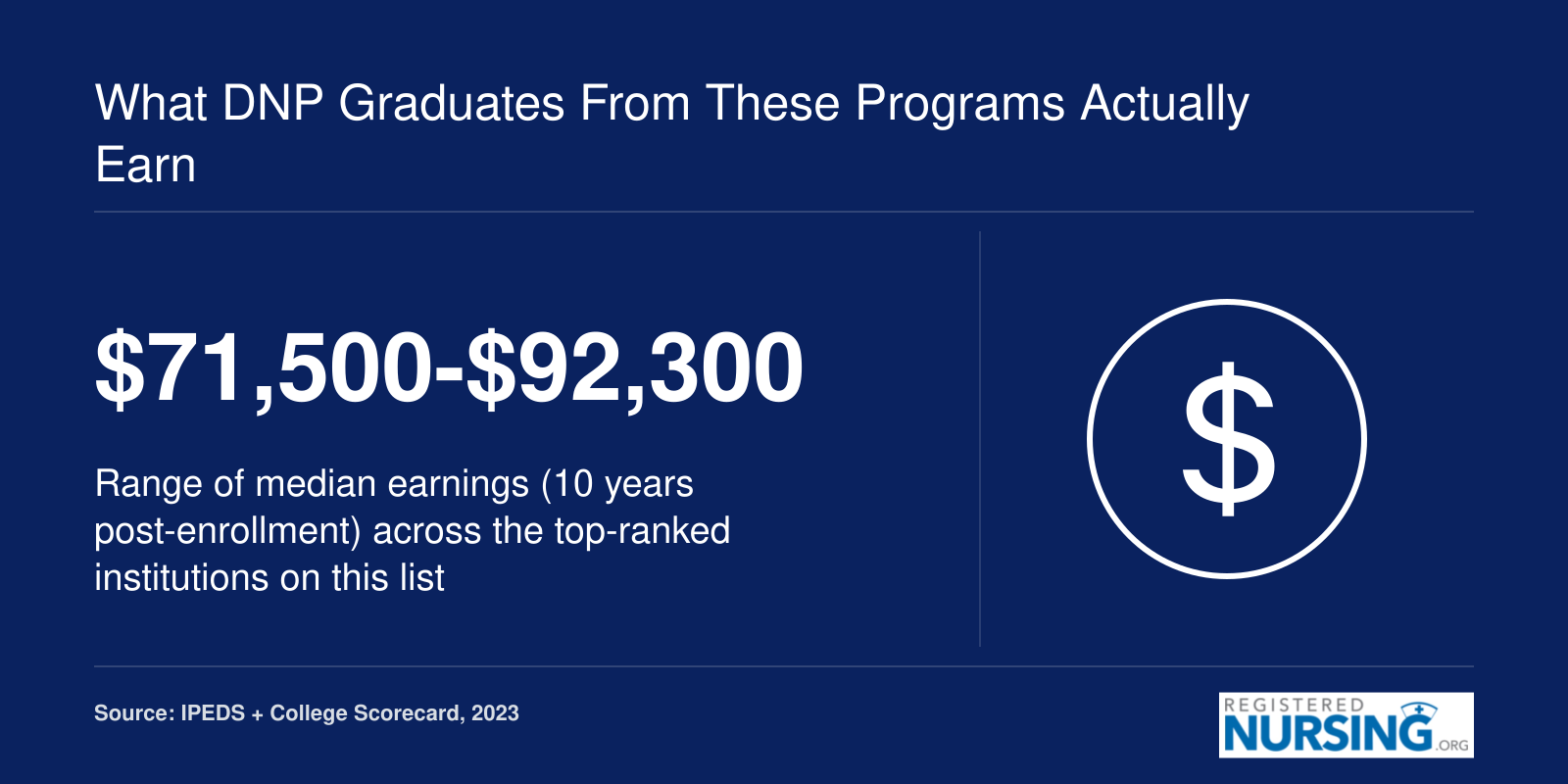
What DNP Graduates From These Programs Actually Earn
Program-level earnings data for these DNP programs is not yet available through federal reporting. However, institution-wide earnings for all graduates ten years after enrollment provide useful context. Across the top-ranked schools in our list, median earnings range from roughly $71,500 to over $92,000, reflecting differences in geographic market, specialty mix, and alumni career trajectories. Keep in mind that these figures cover all completers at each university, not transcultural nursing graduates specifically.
Certifications & Credentials in Transcultural Nursing
Earning a DNP builds the academic and clinical foundation, but a formal transcultural nursing credential is what signals to employers and patients that your cultural competence has been independently verified. Two credentials matter here: the Certified Transcultural Nurse, Basic (CTN-B) and Certified Transcultural Nurse, Advanced (CTN-A), both administered by the Transcultural Nursing Society (TCNS).
Go Straight to the Source
Certification requirements, eligibility rules, portfolio and exam expectations, fees, and renewal cycles change over time. The most reliable step you can take is to visit the TCNS official website for current CTN-B and CTN-A details. If anything on the site is unclear, email or call TCNS directly. Their staff can walk you through how doctoral-level education might satisfy or exceed specific criteria, and they are the only authority that can confirm advanced standing for DNP graduates.
How Your DNP Coursework Fits In
Many DNP programs in Minnesota and across the country now weave transcultural competencies through core courses, clinical practicum hours, and capstone projects, which means a portion of your doctoral work may already map to TCNS eligibility. Before you assume alignment, schedule time with your program's curriculum advisor or track director. Ask them to walk through:
- Which courses cover culturally congruent care, health equity, or global health frameworks.
- How supervised clinical hours are documented and whether they can be applied toward certification.
- Whether your final DNP project can double as portfolio evidence.
Keep Your Sources Straight
For broader nursing workforce trends, resources like the U.S. Bureau of Labor Statistics and major professional nursing associations are useful context. Nurses exploring DNP programs in North Carolina or other states will find that program structures vary, so verifying how local curricula align with TCNS criteria is especially important. For anything specific to CTN-B or CTN-A, TCNS is the sole governing body. Do not rely on secondhand summaries, forum posts, or older program brochures for the fine print. Confirm directly with TCNS before you invest time in exam prep, portfolio assembly, or renewal planning.
Which U.S. Programs Actually Offer a Transcultural DNP Track?
A DNP track in transcultural nursing is a structured concentration within a doctorate of nursing practice program designed to develop advanced competencies in delivering culturally responsive care across diverse populations, leading health equity initiatives, and applying transcultural theory to systems-level practice. Very few U.S. nursing schools label a standalone transcultural nursing DNP. Most programs embed these competencies within broader concentrations such as population health, health equity, or global health, meaning students interested in transcultural practice must evaluate curriculum content rather than simply searching for the term itself in program titles.
Programs With Explicit Transcultural Tracks
As of 2026, only a small number of U.S. institutions offer DNP programs that explicitly name transcultural nursing in their concentration or program title. Augsburg University in Minnesota operates the most widely recognized dedicated track, the Doctor of Nursing Practice in Transcultural Nursing Leadership, designed for post-master's nurses seeking advanced competencies in culturally congruent care and health equity leadership.1 Duquesne University in DNP programs in Pennsylvania offers a transcultural nursing concentration within its online DNP program, featuring coursework such as Transcultural Care and Global Health Perspectives that directly addresses Leininger's theory and culturally responsive practice frameworks. The University of Washington School of Nursing includes a global and cross-cultural health concentration within its Population Health and Systems Leadership DNP, embedding transcultural competencies into systems-level health equity work.3
Evaluating Programs Without the Label
Prospective students should review DNP curriculum descriptions for substantive transcultural content even when the term does not appear in the program name. Look for courses addressing health disparities, immigrant and refugee health, diversity in advanced practice, or social determinants of health. The University of St. Francis in Illinois, for example, includes Diversity and Social Justice Issues in Advanced Practice as a required DNP course, signaling meaningful attention to culturally responsive care even without a formal transcultural track designation.
How Many Exist
Combining explicitly labeled tracks and those with demonstrable transcultural curriculum depth, fewer than a dozen U.S. DNP programs offer meaningful transcultural specialization. Students seeking this focus should prioritize programs affiliated with the Transcultural Nursing Society or those that explicitly list transcultural competencies in their program outcomes and course syllabi rather than relying on track names alone.
Frequently Asked Questions About Transcultural Nursing DNP Programs
Below are answers to the most common questions prospective students ask about pursuing a Doctor of Nursing Practice with a transcultural focus. Each response draws on program details, salary data, and credential information covered earlier in this article.
What is a DNP in transcultural nursing?
Can you get a transcultural nursing DNP online?
What is the salary for a DNP-prepared transcultural nurse?
How many transcultural nursing DNP programs are there in the U.S.?
What is the difference between a transcultural nursing DNP and an MSN in transcultural nursing?
Do I need transcultural nursing certification (CTN or CTN-A) to practice?
More Online DNP Programs to Consider
Beyond the top 10, many additional fully online DNP programs offer flexibility and quality. These programs can be excellent options for nurses looking to incorporate transcultural nursing electives or leadership concentrations into their doctoral studies.
- Doctor of Nursing Practice
- Adult Gerontology Acute Care Nurse Practitioner
- Clinical Expert: Nursing Practice
- Executive Healthcare Leadership: Nursing Practice
- Family Nursing Practitioner: Nursing Practice (Family Nurse Practitioner)
- Nursing Education
- Doctor of Nursing Practice
- Doctor of Nursing Practice (Nurse Practitioner)
- Doctor of Nursing Practice
- Doctor of Nursing Practice (Family Nurse Practitioner)
- Doctor of Nursing Practice (Psychiatric Nurse Practitioner)
- Doctor of Nursing Practice
- Doctor of Nursing Practice (Adult-Gerontological Acute Care Nurse Practitioner)
- Doctor of Nursing Practice (Family Nurse Practitioner)
- Doctor of Nursing Practice (Family Nurse Practitioner)
- Doctor of Nursing Practice (Adult Gerontology Acute Care Nurse Practitioner)
- Doctor of Nursing Practice
- Doctor of Nursing Practice (Family Nurse Practitioner)
- Doctor of Nursing Practice (Psychiatric Mental Health Nurse Practitioner)
- Doctor of Nursing Practice
- Doctor of Nursing Practice
- Doctor of Nursing Practice (Nurse Practitioner)
- Doctor of Nursing Practice (Nursing Leadership)
- Doctor of Nursing Practice (Family Nurse Practitioner)
- Doctor of Nursing Practice
- Doctor of Nursing Practice
- Doctor of Nursing Practice
- Doctor of Nursing Practice (Adult-Gero Acute Care NP)
- Doctor of Nursing Practice
- Doctor of Nursing Practice (Executive Leadership)
Best DNP Programs by State
- Alabama
- Alaska
- Arizona
- Arkansas
- California
- Colorado
- Connecticut
- Delaware
- Florida
- Georgia
- Hawaii
- Idaho
- Illinois
- Indiana
- Iowa
- Kansas
- Kentucky
- Louisiana
- Maine
- Maryland
- Massachusetts
- Michigan
- Minnesota
- Mississippi
- Missouri
- Montana
- Nebraska
- Nevada
- New Hampshire
- New Jersey
- New Mexico
- New York
- North Carolina
- North Dakota
- Ohio
- Oklahoma
- Oregon
- Pennsylvania
- Rhode Island
- South Carolina
- South Dakota
- Tennessee
- Texas
- Utah
- Vermont
- Virginia
- Washington
- Washington DC
- West Virginia
- Wisconsin
- Wyoming