

What you’ll learn in this article…
- A BSN is the practical minimum for most research nurse positions.
- Pharmaceutical and CRO employers pay 15 to 30 percent above academic settings.
- RN employment is projected to grow 6 percent through 2034.
Research nursing sits at the intersection of bedside practice and scientific investigation, with clinical trial activity in the United States growing steadily and the FDA registering more than 30,000 active studies on ClinicalTrials.gov in 2026. Registered nurses working in these studies coordinate protocols, screen and consent participants, administer investigational therapies, and document data that ultimately shapes clinical guidelines and drug approvals.
The field has a naming problem. Employers, journals, and job boards use research nurse, clinical research nurse, nurse researcher, and nurse scientist somewhat interchangeably, but each title carries distinct responsibilities, educational expectations, and salary bands. A cardiac care nurse pivoting into oncology trials and a doctorally prepared nurse scientist designing that trial are doing fundamentally different work.
Those title distinctions carry real weight for hiring, credentialing, and long-term earning potential. Nurses who understand where each role sits on the continuum, from coordinator to charge nurse to principal investigator, can map a more deliberate path into research.
Research Nurse vs Clinical Research Nurse vs Nurse Scientist: What's the Difference?
As research-intensive health systems expand their study portfolios, the lines between research-focused nursing roles have become both more defined and more important to understand. All three titles, research nurse, clinical research nurse, and nurse scientist, live under the broad umbrella of nursing research, but they differ meaningfully in education requirements, daily responsibilities, and earning potential.
Research Nurse
A research nurse conducts and coordinates clinical studies while providing direct care to research participants.1 The typical entry point is a Bachelor of Science in Nursing (BSN) plus an active RN license.2 Day-to-day work centers on protocol implementation, data collection, specimen management, and participant follow-up. Research nurses are employed by academic medical centers, research hospitals, pharmaceutical companies, and contract research organizations (CROs).3 Optional credentials such as the Certified Clinical Research Professional (CCRP) can strengthen a candidate's profile but are not universally required.
Clinical Research Nurse
The clinical research nurse (CRN) role is recognized as a distinct practice specialty. According to the National Institutes of Health, CRNs focus specifically on participant safety, informed consent, protocol integrity, and data accuracy.1 While a BSN is the baseline, many CRN positions prefer or require an MSN or DNP. Settings include the NIH Clinical Center, university-affiliated hospitals, and large research networks.4 The Certified Clinical Research Nurse credential (CRN-BC) is the specialty's hallmark certification, signaling advanced competence in human-subjects research.
Nurse Scientist
A nurse scientist is a doctoral-prepared nurse who serves as a principal investigator or research program leader. This role requires a PhD in nursing or a Doctor of Nursing Practice (DNP) with a research focus. Rather than implementing someone else's protocol, nurse scientists design studies, secure grant funding, manage research teams, and publish scholarly work. They are most commonly found at universities, teaching hospitals, and federal research centers.6
How the Roles Compare at a Glance
- Education: BSN for a research nurse, BSN to DNP for a clinical research nurse, PhD or DNP for a nurse scientist.
- Primary focus: Participant care and data collection (research nurse), protocol integrity and participant safety (clinical research nurse), study design and scholarly leadership (nurse scientist).
- Key credential: RN license with optional CCRP (research nurse), CRN-BC (clinical research nurse), doctoral degree (nurse scientist).
- Compensation range: Research nurses earn a national mean near $53,500,3 clinical research nurses report median earnings around $72,000,7 and nurse scientists with doctoral preparation can earn mean salaries in the range of $132,000.
Understanding where each role sits on this continuum helps you map a realistic career path. Many nurses start as research nurses, earn specialty certification as patient advocate nurses working in clinical research, and eventually pursue doctoral education to move into nurse scientist positions. Nurses drawn to oncology nursing frequently make this transition, as cancer trials represent one of the largest segments of active clinical research.
What Does a Research Nurse Do?
A research nurse is a registered nurse who works directly within clinical studies, serving as the operational backbone of a research trial by bridging scientific protocol with real patient care.
Day-to-Day Responsibilities
The daily work of a research nurse centers on study participants from first contact to study completion. Core duties include:
- Screening and enrollment: Reviewing eligibility criteria, recruiting candidates, and walking them through study requirements before they agree to participate.
- Informed consent: Explaining the purpose, risks, and procedures of a study in plain language, answering participant questions, and documenting consent properly so it holds up to regulatory review.
- Administering investigational treatments: Depending on the trial, this may involve infusing experimental medications, collecting biological samples, or administering study interventions according to precise protocol instructions.
- Monitoring for adverse events: Watching participants closely for unexpected reactions, documenting any changes in condition, and escalating concerns to the principal investigator and sponsor as required.
Protocol Management and Regulatory Work
Beyond direct patient contact, research nurses carry significant administrative and compliance responsibilities. They coordinate closely with principal investigators to keep the study running on schedule and within protocol boundaries. This includes preparing and submitting documentation to Institutional Review Boards, maintaining regulatory binders, tracking protocol amendments, and ensuring every procedure follows the approved study plan.
Audit-readiness is a constant expectation. Research nurses record patient data in case report forms with the understanding that sponsors, regulators, or independent auditors may review those records at any time. Accuracy and completeness are non-negotiable. The advantages and disadvantages of electronic health records are worth understanding here, as most modern research settings rely on electronic systems for data capture and regulatory documentation.
The Patient-Facing Difference
What distinguishes a research nurse from a laboratory-based scientist is sustained human contact. Research nurses are frequently the primary point of contact for study participants, which means they field phone calls about side effects, schedule follow-up visits, provide emotional reassurance during long trials, and advocate for participant safety when concerns arise. The role demands the same therapeutic relationship skills as case management nursing, applied in a research context.
How Setting Shapes the Role
The specific mix of duties shifts depending on where a research nurse works. At an academic medical center, the focus often leans toward complex investigator-initiated trials with heavy IRB interaction. At a contract research organization, nurses may manage multiple simultaneous industry-sponsored studies across different therapeutic areas. At a pharmaceutical sponsor site, the work may involve oversight and monitoring rather than direct participant care. Each environment carries its own pace, documentation demands, and scope of practice.
Questions to Ask Yourself
How to Become a Research Nurse
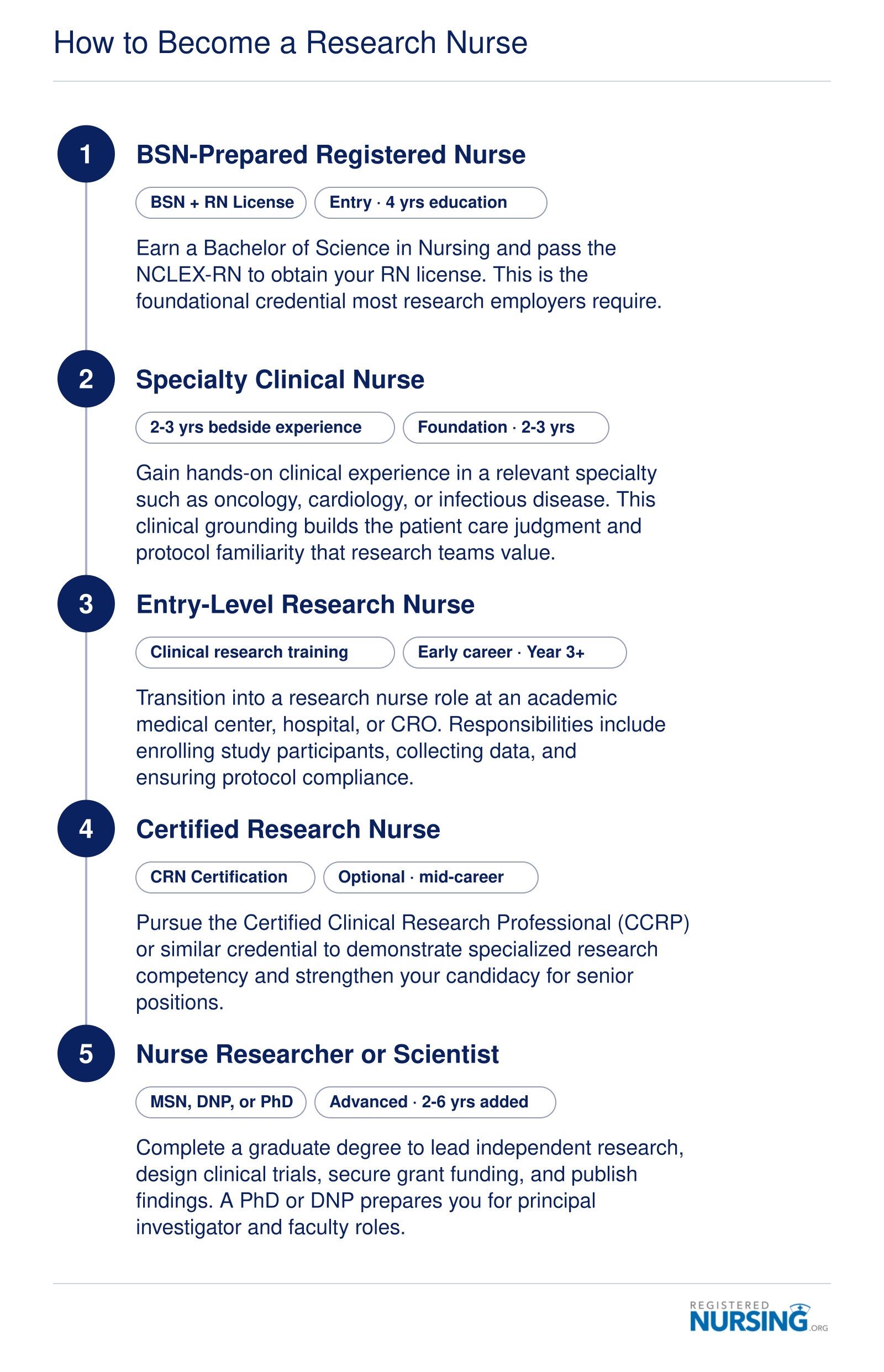
Most research nurses follow a structured progression from bedside clinical practice into investigative roles. A BSN is the practical minimum for the majority of research nurse positions, though some ADN-prepared nurses find entry points at contract research organizations (CROs). Nurses who build two to three years of specialty experience in areas like oncology, cardiology, or infectious disease are especially well-positioned to transition into research.
Research Nurse Certifications and Credentials
Certification is not legally required to work as a research nurse, but the competitive reality of clinical research increasingly favors credentialed candidates for both initial hiring and salary progression. Research nurses typically pursue board certification after gaining sufficient hands-on experience, transforming generalist research skills into documented, peer-recognized expertise.
Clinical Research Nurse , Board Certified (CRN-BC)
The CRN-BC credential, issued by the International Association of Clinical Research Nurses (IACRN), stands as the gold-standard certification for nurses in clinical research.1 Unlike most nursing certifications that use an exam-based assessment, the CRN-BC process relies on portfolio submission. Candidates compile evidence of their research practice, including a 1,000 to 1,500 word exemplar describing a clinical research scenario, and documentation of continuing education and professional activities.3
Eligibility requirements include a current unencumbered RN license, at least two years of clinical research experience, and a minimum of 4,000 hours in research nursing roles.2 The portfolio must demonstrate 100 continuing professional development points, divided between 36 to 50 points in education and 50 to 64 points in professional activities such as conference presentations, committee service, or published research contributions.3 Portfolios are scored on a 100-point scale; exemplars alone must earn at least 45 points to pass.
Application windows open twice annually, March 1 through April 1 and September 1 through October 1.1 Initial certification fees run $345 for IACRN members and $495 for non-members. If a portfolio does not pass on first submission, resubmission costs $270 for members and $420 for non-members. Certification is valid for five years, with renewal fees of $300 for members and $375 for non-members.1
How Long Does It Take to Become Eligible?
Most research nurses reach CRN-BC eligibility two to three years after entering clinical research, once they have accumulated the 4,000 required hours and the breadth of experience to write a compelling exemplar. Nurses working full-time in dedicated research roles can meet the hour requirement in roughly two years; those in hybrid clinical-research positions may take longer.
CCRC and CCRP: Complementary Credentials
Many research nurses also pursue the Certified Clinical Research Coordinator (CCRC) credential from the Association of Clinical Research Professionals (ACRP) or the Certified Clinical Research Professional (CCRP) from the Society of Clinical Research Associates (SOCRA). Both are exam-based certifications open to non-nurse coordinators, making them especially common at contract research organizations and pharmaceutical companies where multidisciplinary teams collaborate. While the CCRC and CCRP do not replace the CRN-BC, they signal proficiency in Good Clinical Practice, regulatory compliance, and protocol management, and many employers view them as interchangeable for coordinator-level roles. Nurses holding both a CRN-BC and a CCRC or CCRP credential often command higher salaries and gain access to senior coordinator and project management positions. oncology nurses frequently pursue these complementary credentials when transitioning into research roles focused on cancer treatment trials.
Certification and Salary Impact
Although precise pay differentials vary by employer and geography, certified research nurses consistently report stronger negotiating leverage and faster advancement. Certification demonstrates commitment to the specialty, familiarity with current regulations, and the ability to document outcomes, all of which translate into measurable career value over time. nephrology nurses represent another group that commonly layers research credentials onto specialty certification to broaden their professional options.
Where Do Research Nurses Work?
Choosing between academic and industry research settings defines the daily reality of a research nurse's career. Academic environments revolve around investigator-driven science and long-term patient cohorts, while industry roles focus on product development, regulatory milestones, and faster trial timelines. Understanding the core work at each type of employer helps you target the setting that matches your interests and lifestyle.
Academic Medical Centers
These teaching hospitals and university-affiliated health systems run investigator-initiated trials, Phase I-IV industry studies, and federally funded research. Research nurses here often work alongside principal investigators and may manage multiple protocols simultaneously. The role blends direct patient contact, screening, consenting, and monitoring participants, with data collection, specimen processing, and regulatory documentation. Academic centers emphasize evidence generation and publication, so you are likely to co-author papers and present at conferences. Because funding cycles affect study volume, job security can fluctuate, but the intellectual stimulation and academic recognition attract many nurse researchers.
Pharmaceutical and Biotechnology Companies
Industry sponsors design and fund the majority of drug and device trials. As a research nurse in pharma or biotech, you may work in clinical development, medical affairs, or safety surveillance. Responsibilities include writing protocols, training site staff, monitoring data for adverse events, and preparing submissions to the FDA. The pace is brisk and focused on milestone completion, with less direct patient care than in academic or hospital settings. Compensation tends to be higher than in government or academic roles, and travel to investigator sites or conferences is common.
Contract Research Organizations (CROs)
CROs manage clinical trials for sponsors, so research nurses here function as project managers, monitors, or clinical research associates. You ensure sites comply with good clinical practice, verify source data, and troubleshoot recruitment barriers. The workload is fast-paced and metric-driven, but CROs often provide structured career ladders and the opportunity to work on diverse therapeutic areas. Remote nursing jobs and hybrid positions have expanded rapidly in this sector.
Government Agencies
Federal employers like the NIH Clinical Center, Veterans Health Administration, and CDC conduct high-impact, publicly funded studies. Research nurses in these settings enjoy strong benefits, job stability, and the chance to contribute to large-scale epidemiological investigations or clinical trials. Typical duties overlap with academic roles, but bureaucracy and stricter procurement rules can slow study start-up. While government salaries lag behind industry, the loan repayment programs and pension plans offer long-term value. Nurses drawn to population-level impact may also find fulfilling work as a public health nurse.
Community Hospitals with Research Programs
Regional and community hospitals increasingly adopt clinical trials to expand treatment options for their populations. Research nurses in these settings wear many hats: coordinating a handful of studies, educating bedside staff about protocol requirements, and building trust with potential participants. Resources and advancement opportunities may be narrower than at academic giants, but the ability to stay in a single community and shape its research culture appeals to many nurses.
Remote and Hybrid Roles
The rise of decentralized clinical trials, using telemedicine, wearable devices, and home visits, has created flexible positions across all employer types. Research nurses now monitor data from a home office, consent participants virtually, and manage study logistics without relocating. This trend is particularly strong at CROs and pharma sponsors, expanding geographic reach for both employers and nurses.
Research Nurse Salary: National Overview
Because the Bureau of Labor Statistics does not track research nurses as a separate occupation, salary data for this role falls under the broader Registered Nurses category. The figures below, drawn from the 2024 Occupational Employment and Wage Statistics, offer a useful baseline. Keep in mind that research nurses with advanced degrees, specialized certifications, or experience in high-complexity clinical trials often earn above these medians, particularly in academic medical centers and pharmaceutical industry settings.
| Salary Metric | Annual Amount |
|---|---|
| Median (50th Percentile) | $93,600 |
| 25th Percentile | $78,610 |
| Mean (Average) | $98,430 |
| 75th Percentile | $107,960 |
Research Nurse Salary by State
Research nurse salaries vary significantly depending on geographic location, cost of living, and the concentration of academic medical centers and research institutions in a given state. The figures below reflect registered nurse wages reported by the Bureau of Labor Statistics (2024 Occupational Employment and Wage Statistics), which serve as a useful baseline for understanding research nurse compensation across the country. Nurses in research roles at major academic or pharmaceutical institutions may earn above these medians, particularly with advanced degrees or specialized certifications.
| State | Total RN Employment | 25th Percentile Salary | Median Salary | 75th Percentile Salary | Mean Salary |
|---|---|---|---|---|---|
| Rhode Island | 10,760 | $83,870 | $99,960 | $112,540 | $99,770 |
| Arizona | 64,430 | $81,390 | $96,890 | $105,450 | $95,230 |
| New Hampshire | 16,580 | $79,720 | $96,830 | $105,500 | $94,620 |
| Maryland | 48,980 | $81,470 | $96,830 | $104,840 | $96,650 |
| Colorado | 54,510 | $81,790 | $96,520 | $104,370 | $95,470 |
| Delaware | 13,260 | $82,600 | $92,610 | $108,360 | $95,450 |
| Texas | 261,050 | $77,450 | $90,010 | $102,200 | $91,690 |
| Virginia | 77,420 | $77,650 | $88,820 | $100,920 | $90,930 |
| New Mexico | 17,510 | $82,630 | $88,260 | $104,720 | $94,360 |
| Pennsylvania | 146,840 | $78,570 | $87,610 | $102,030 | $90,830 |
| Georgia | 97,410 | $76,600 | $86,560 | $104,790 | $91,960 |
| Illinois | 139,900 | $79,150 | $86,410 | $103,660 | $91,130 |
| Idaho | 14,540 | $78,020 | $86,100 | $100,220 | $89,770 |
| Wisconsin | 64,960 | $79,570 | $86,070 | $100,680 | $90,450 |
| Michigan | 104,210 | $80,030 | $85,670 | $101,210 | $90,580 |
| Vermont | 7,240 | $79,980 | $85,150 | $104,110 | $92,710 |
| Maine | 16,280 | $76,890 | $82,860 | $98,000 | $87,440 |
| Florida | 218,100 | $77,070 | $82,850 | $99,260 | $88,200 |
| Utah | 25,780 | $77,030 | $82,270 | $101,530 | $88,240 |
| North Carolina | 108,510 | $74,710 | $81,860 | $98,720 | $86,270 |
| Wyoming | 5,180 | $75,540 | $81,790 | $100,910 | $88,020 |
| Montana | 10,540 | $77,800 | $81,560 | $100,510 | $88,480 |
| Ohio | 138,360 | $77,420 | $81,250 | $97,440 | $86,110 |
| Oklahoma | 32,870 | $75,320 | $81,160 | $96,460 | $85,800 |
| Nebraska | 24,180 | $76,430 | $81,020 | $93,140 | $82,890 |
Nurse Researcher Salary by Work Setting and Experience Level
Where you work matters as much as how long you have worked when it comes to nurse researcher compensation. The gap between the lowest and highest paying settings can exceed $40,000 annually for professionals at the same experience level, making employer type one of the most significant factors in your earning potential.
Pharmaceutical Companies Lead in Compensation
Pharmaceutical companies consistently offer the highest salaries for nurse researchers across all experience levels. Entry-level positions (zero to two years of experience) typically pay between $80,000 and $95,000, while mid-career professionals with three to seven years can expect $95,000 to $115,000.1 Senior nurse researchers with eight or more years of experience often earn $115,000 to $135,000 at pharmaceutical employers. These premium wages reflect the specialized nature of drug development research, the regulatory scrutiny involved, and the profit margins these companies maintain.
Contract research organizations (CROs) offer the second-highest compensation. Entry-level salaries range from $78,000 to $92,000, mid-career professionals earn $92,000 to $110,000, and senior researchers command $110,000 to $130,000.1 CROs conduct studies on behalf of pharmaceutical and biotech clients, and their competitive pay helps attract talent away from direct industry employment.
Government and Hospital Settings
Government positions, including Veterans Affairs medical centers and federal research agencies, provide solid compensation with exceptional benefits. Entry-level salaries fall between $78,000 and $90,000, mid-career earnings range from $90,000 to $110,000, and senior researchers earn $110,000 to $130,000.1 Federal positions also include pension plans, generous leave policies, and loan repayment programs that add substantial value beyond base salary.
Hospital-based nurse researchers earn moderately less than their industry counterparts. Entry-level positions pay $70,000 to $82,000, mid-career roles offer $82,000 to $95,000, and senior positions range from $95,000 to $115,000.1 Hospitals often provide tuition reimbursement, clinical ladder advancement, and the opportunity to directly influence patient care practices.
Academic Medical Centers
Academic medical centers tend to offer the most modest salaries in research nursing. Entry-level positions pay $65,000 to $78,000, mid-career professionals earn $78,000 to $92,000, and senior researchers receive $90,000 to $110,000.1 The trade-off comes in the form of intellectual freedom, teaching opportunities, access to cutting-edge studies, and sabbatical options that other settings rarely provide.
How Experience Shapes Your Earnings
Regardless of setting, experience creates predictable salary growth. Moving from entry-level to mid-career typically adds $12,000 to $20,000 to annual compensation. The jump from mid-career to senior status brings another $15,000 to $25,000. Nationally, nurse researchers earn a median of approximately $95,345 per year, with the middle range spanning $77,500 to $114,500.2 Your combination of setting, experience, and credentials ultimately determines where you fall within this spectrum.
Where you work shapes your paycheck. Research nurses at pharmaceutical companies and contract research organizations often earn 15 to 30 percent more than peers in academic medical centers or government agencies like the NIH. The trade-off: industry roles typically involve more travel, tighter sponsor timelines, and less influence over how studies are designed.
Career Outlook and Growth for Nurse Researchers
Steady demand versus accelerating opportunity: registered nurses overall face a solid job market, but research nursing may see even stronger growth as clinical trial activity continues expanding. Understanding both the broad nursing outlook and the specific forces driving research positions helps you plan a sustainable career in this evolving specialty.
Overall Nursing Projections
The Bureau of Labor Statistics projects 5 percent employment growth for registered nurses between 2024 and 2034, with approximately 189,000 openings annually during that period.1 While this represents steady demand across the profession, research nursing positions are influenced by additional factors beyond general healthcare staffing needs. The clinical research sector has experienced substantial expansion, and industry observers suggest that specialized research nurse roles may grow faster than the broader RN average, though precise projections specific to research nursing are not routinely published by federal agencies.
Clinical Trial Growth as a Demand Driver
The volume of clinical trials has increased significantly over the past decade. ClinicalTrials.gov now lists hundreds of thousands of registered studies, reflecting sustained investment in pharmaceutical, biotechnology, and medical device research. Global spending on clinical research continues climbing, with biopharmaceutical companies, academic medical centers, and contract research organizations all competing for qualified staff. This expansion creates ongoing demand for nurses who can manage patient safety, collect data, and ensure protocol compliance across diverse therapeutic areas.
Emerging Specialties Creating New Roles
Several frontier areas are generating specialized research nurse positions:
- Genomics and precision medicine: Trials targeting specific genetic markers require nurses who understand biomarker testing and individualized treatment protocols. Genetic nurses who transition into research bring directly applicable expertise in this area.
- Cell and gene therapy: These complex interventions demand intensive patient monitoring and specialized safety knowledge.
- AI-assisted clinical trials: Technology platforms are changing how data is collected and analyzed, creating roles for nurses who can bridge clinical care and digital systems.
- Decentralized trials: Home-based and hybrid study designs need nurses skilled in remote patient engagement and virtual monitoring tools, skills also valued in home health nursing.
Career Ladder Progression
Research nursing offers a clear advancement pathway. Entry-level positions as research nurse coordinators lead to senior research nurse roles with broader protocol responsibilities. From there, clinical research managers oversee multiple studies and teams. Nurses pursuing doctoral education can become nurse scientists, conducting independent investigations and securing their own research funding.
Factors Affecting Demand Cycles
Federal funding trends, particularly the National Institutes of Health budget, influence how many academic research positions are available in any given year. FDA regulatory changes can also shift industry priorities, accelerating or slowing certain types of trials. Economic conditions affect pharmaceutical company investment decisions, which ripple through contract research organizations and academic partners. While long-term demand appears strong, individual job markets may fluctuate based on these broader forces. Staying informed about funding trends and regulatory developments helps you anticipate where opportunities will emerge.
Common Questions About Research Nursing
Research nursing is a growing field that blends clinical expertise with scientific inquiry. Below are answers to some of the most frequently asked questions from nurses considering this career path.
- How long does it take to become a research nurse?
- The timeline depends on your starting point. Earning a BSN typically takes four years, and most entry-level research nurse positions require at least one to two years of clinical experience on top of that. If you pursue a graduate degree to work as a nurse scientist, add another two to five years. In total, expect roughly six to ten years from your first day of nursing school to an advanced research role.
- What is the difference between a research nurse and a clinical research nurse?
- The terms overlap considerably and are often used interchangeably. A clinical research nurse (CRN) typically works hands-on in clinical trials, coordinating patient care, collecting data, and ensuring protocol compliance. A research nurse may serve in a similar capacity or take on a broader role that includes study design or data analysis. In practice, the distinction often comes down to the specific employer and the scope of the position.
- What does CRN stand for in nursing?
- CRN stands for Clinical Research Nurse. It refers to a registered nurse who specializes in conducting and managing clinical research studies. CRNs work directly with study participants, administer investigational treatments, monitor for adverse events, and help maintain regulatory compliance throughout the research process.
- What degree do you need to be a nurse researcher?
- A BSN is generally the minimum for entry-level research nurse roles, such as clinical trial coordination. However, nurse researchers who design studies, secure grants, or lead independent investigations typically hold a master's (MSN) or doctoral degree (PhD or DNP). A doctoral degree is the standard credential for nurse scientists working in academic or senior research positions.
- How can I get into research as a nurse with no research experience?
- Start by volunteering for quality improvement projects or evidence-based practice committees at your current workplace. Seek out clinical trial sites, academic medical centers, or pharmaceutical companies that hire research coordinators and are willing to train nurses new to the field. Professional organizations and continuing education courses in clinical research fundamentals can also help you build a competitive foundation without prior research experience. Nurses who have worked in settings with complex care coordination, such as nurse manager roles, often find that leadership and protocol skills transfer well into research environments.
- How much do nurse researchers make compared to bedside nurses?
- Nurse researchers generally earn salaries that are competitive with or higher than those of bedside nurses, particularly at the graduate and doctoral level. Compensation varies by education, setting, and geographic location, but nurses with advanced degrees working in pharmaceutical, biotech, or academic research environments often earn well above the median for staff RNs. Specialization and certifications can further boost earning potential. For context, forensic nursing salary data illustrates how specialty credentials and advanced practice consistently command higher pay across diverse nursing fields.
Explore More
- Ambulatory Care Nurse
- Burn Care Nurse
- Cardiac Nurse
- How to Become Cardiac Catheterization Laboratory Nurse
- Charge Nurse
- Chief Nursing Officer
- Correctional Nurse
- CVOR Nurse
- Dermatology Nurse
- Developmental Disability Nurse
- Director of Nursing
- Domestic Violence Nurse
- Emergency Room Nurse
- ENT Nurse
- Enterostomy Nurse
- Fertility/Reproductive Nurse
- Flight/Transport- Schooling & Salary
- Forensic Nurse
- Genetic Nurse
- Geriatric Nurse
- Health Policy Nurse
- Healthcare Administrator
- Healthcare Manager
- Home Health Nurse
- Hospice Nurse
- Camp Nurse
- GI Nurse
- Holistic (Complementary) Nurse
- Labor and Delivery Nurse
- Nurse Writer
- Psychiatric Nurse
- School Nurse
- Telemetry Nurse
- Travel Nurse
- Aesthetic/Cosmetic Nurse
- Infusion/IV Nurse
- Oncology Nurse
- ICU Nurse
- Infection Control Nurse
- Legal Nurse Consultant- Schooling & Salary
- Long-Term Care Nurse
- Managed Care Nurse
- Medical-Surgical Nurse
- Military (Combat) Nurse
- Missionary Nurse
- Postpartum Nurse
- Nephrology Nurse
- Neuroscience Nurse
- NICU Nurse
- Nurse Administrator
- Nurse Attorney
- Nurse Care Coordinator
- Nurse Case Manager
- Nurse Entrepreneur
- Nurse Executive
- Nurse Health Coach- Schooling & Salary
- Nurse Manager
- Obstetric (OB) Nurse
- Occupational Health Nurse
- Operating Room/Surgical/Perioperative Nurse
- Ophthalmic Nurse
- Organ Procurement Coordinator
- Orthopedic Nurse
- Pain Management Nurse
- Palliative Care Nurse
- Parish Nurse
- Nurse Advocate
- Pediatric Endocrinology Nurse
- Perianesthesia (PACU) Nurse
- Perinatal Nurse
- Plastic Surgery Nurse
- Public Health Nurse
- Radiology Nurse
- Rehabilitation Nurse
- Respiratory Nurse
- Rheumatology Nurse
- Substance Abuse/Addiction Nurse
- Telephone Triage/Telehealth Nurse
- Transcultural/Intercultural Nurse
- Transplant Nurse.
- Trauma Nurse
- Wound Care Nurse (WOCN)