

What you’ll learn in this article…
- CNOR certification boosts OR nurse salaries and job satisfaction.
- RN employment is projected to grow 6% from 2024 to 2034.
- Most hospitals require one to two years of acute care experience first.
An operating room nurse is a registered nurse who provides direct patient care before, during, and after surgical procedures. Also called perioperative nurses, these RNs function in two core sub-roles: scrub nurse, who remains sterile and passes instruments at the surgical field, and circulating nurse, who coordinates the procedure from outside the sterile zone, managing documentation, supplies, and communication with the broader care team.
Most hospitals require one to two years of acute care experience before placing new RNs in the OR, though demand for perioperative nurses is outpacing general RN growth. Specialty certification through the Competency & Credentialing Institute distinguishes candidates in a competitive field and often translates directly into higher pay and faster advancement. Nurses drawn to the precision of surgical care may also find related specialties such as cardiac care nursing a natural complement to perioperative practice.
What Does an Operating Room Nurse Do?
Operating room nurses manage patient care through every phase of a surgical procedure, from the moment a patient arrives in the preoperative area to the handoff in the recovery room. Unlike floor nurses who follow patients across days or weeks, OR nurses compress the full arc of assessment, intervention, and transition into a single high-stakes encounter.
Before the First Incision
In the preoperative phase, OR nurses conduct patient assessments, review medical histories, and verify that informed consent has been properly obtained. They confirm the surgical site is correctly marked, review allergy lists, and ensure that any implants, instruments, or special equipment are ready and sterile. This phase is also when OR nurses take on their most critical advocacy role: serving as the last line of safety before surgery begins. What Does it Mean for a Nurse to Sign a Consent for Surgery Form? is a question worth understanding before stepping into this role, because during the formal surgical timeout the nurse verifies the patient's identity, the planned procedure, and the surgical site alongside the entire OR team. That single step has been shown to prevent wrong-site and wrong-patient errors.
Inside the Operating Room
Once surgery is underway, OR nurses work in one of two primary roles, which are covered in detail in the next section. In broad terms, the intraoperative phase requires maintaining a sterile field, managing instruments and supplies, monitoring the patient's condition, and anticipating the surgical team's needs in real time. Precision and situational awareness matter as much here as clinical knowledge. Communication is constant, compressed, and consequential.
After the Procedure
The postoperative phase centers on a structured handoff to the recovery team. OR nurses document wound care, account for all sponges and instruments used during surgery, and relay critical intraoperative events to the receiving nurses. Accurate documentation in this phase directly shapes the patient's recovery plan.
The Range of Surgical Settings
OR nurses work across a wide spectrum of environments: level-one trauma centers, cardiac and vascular suites, orthopedic operating rooms, ambulatory surgery centers, and increasingly, robotic-assisted surgery suites where specialized training in robotic console workflows is required. Each setting carries its own pace, team culture, and procedural demands.
What ties them all together is the nature of the work itself: high-acuity, team-dependent, and built around patients who cannot advocate for themselves when it matters most.
Scrub Nurse Vs. Circulating Nurse: Key OR Roles Explained
In every operating room, two distinct nursing roles work in tandem: the scrub nurse and the circulating nurse. Their collaboration defines the pace and safety of each procedure, yet their responsibilities and required credentials set them apart. The Association of periOperative Registered Nurses (AORN) provides clear guidance on each role, and state laws and facility policies reinforce who can do what.1
Scrub Nurse: Keeper of the Sterile Field
- Sterility: The scrub nurse maintains a sterile gown and gloves after performing a surgical hand scrub. Any break in technique means starting over.2
- Instrument management: They arrange and hand instruments to the surgeon, often anticipating needs based on the procedure's flow.
- Sponge and sharps counts: Working with the circulator, the scrub nurse tracks all countable items to prevent retained objects.
- Who can scrub: The scrub role is not limited to registered nurses. Licensed practical nurses (LPNs) and certified surgical technologists (CSTs) frequently fill this position under supervision.1
While the scrub nurse focuses on the surgical field, the circulating nurse oversees everything outside it.
Circulating Nurse: The Unseen Safety Net
- Non-sterile role: The circulator does not wear sterile attire and moves freely in the operating room to manage the environment.
- Patient advocacy: As the only person not scrubbed in, the circulator monitors the patient's condition, updates the family, and ensures consent is complete.
- Documentation and communication: They record every detail of the procedure and coordinate with the anesthesia provider, radiology, or pathology as needed.
- Supply runner: The circulator retrieves additional instruments, sutures, or medications, preserving the sterile team's focus.
- RN requirement: AORN and state regulations mandate that the circulating nurse must be a registered nurse. This role demands nursing judgment, assessment skills, and the authority to act on behalf of the patient.1
Why the RN Circulator Cannot Be Delegated
The AORN Position Statement on RN Circulators emphasizes that circulating is a professional nursing function, not a technical task.1 The RN circulator uses critical thinking to identify safety risks, advocate for the patient, and manage unforeseen complications. Delegating this role to unlicensed personnel or to a licensed practical nurse compromises patient outcomes and violates recommended practices. Understanding the difference between LPN vs ADN vs BSN credentials helps clarify why the RN's scope of practice is uniquely suited to this non-delegable responsibility.
Collaboration in Motion
The relationship between scrub and circulating roles is seamless when done well. For example, during gowning and gloving, the circulator assists by opening sterile packages and verifying sterile indicators, while the scrub nurse maintains the sterile field. If a break in sterility occurs, the circulator is often the first to notice and intervene. Their constant, closed-loop communication prevents errors and keeps the entire team focused on the patient. This dynamic mirrors the principles covered in collaboration with interdisciplinary team frameworks taught in nursing education.
For nurses considering a perioperative career, choosing between these paths often comes down to personality. Those who thrive under direct pressure and enjoy the technical challenge of instrumentation may lean toward the scrub role. Nurses who prefer holistic patient management and thrive in a coordinating capacity often excel as circulators. Both are essential, and many perioperative nurses learn to do both, though the RN circulator remains the legal and professional anchor of every surgical suite. Nurses who enjoy the high-stakes coordination of the OR may also find adjacent specialties like CVOR nursing rewarding.
Questions to Ask Yourself
How to Become an Operating Room Nurse
The path from nursing student to confident OR nurse typically spans four to six years. While ADN-prepared nurses can enter perioperative practice, a BSN is increasingly preferred and often required at magnet-designated hospitals. Here is the standard five-step pathway.
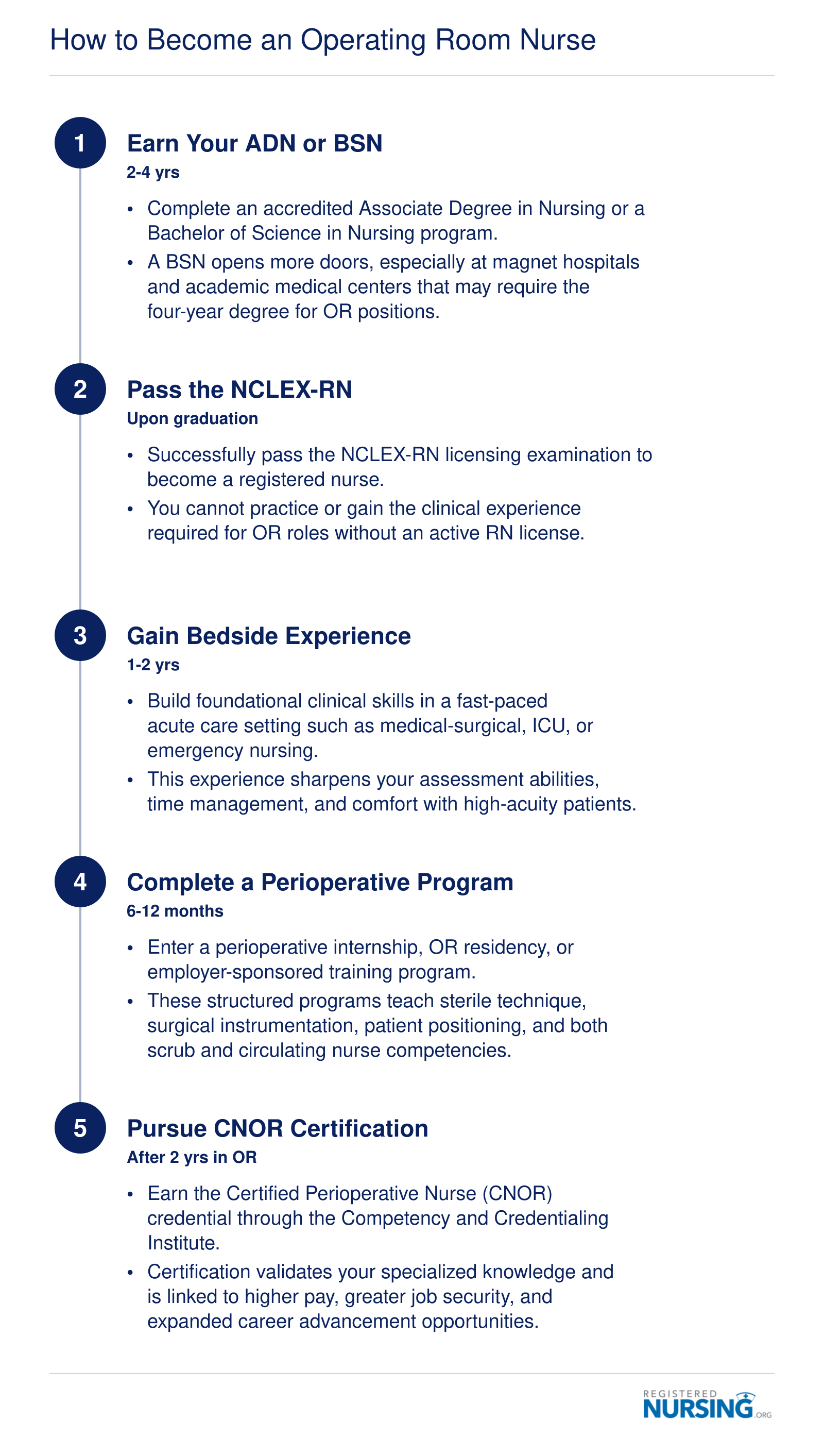
Education Pathways and Transition Into OR Nursing
Most hospitals require one to two years of acute care experience before placing registered nurses in operating room roles, with medical-surgical, intensive care, and emergency department units serving as the most common springboards into perioperative nursing.
ADN vs. BSN: Foundation Degrees for OR Nursing
Both the Associate Degree in Nursing and the Bachelor of Science in Nursing prepare graduates to sit for the NCLEX-RN and begin working as registered nurses, but the pathways differ in length, cost, and career ceiling. An ADN typically requires two years of full-time study and costs $6,000 to $20,000 at community colleges, making it the faster and more affordable route. A BSN takes four years and ranges from $40,000 to $100,000 at public and private universities, but it opens doors to Magnet-designated hospitals, specialty units, and leadership tracks that increasingly require bachelor's-level preparation. If you are weighing your options, reviewing ADN vs BSN programs can help clarify which path aligns with your goals. Many operating rooms accept ADN-prepared nurses with strong acute care backgrounds, yet BSN holders often advance more quickly into charge nurse, educator, and clinical coordinator positions within perioperative services.
The One- to Two-Year Experience Requirement
Almost every hospital system expects new graduate nurses to log at least one year of bedside experience before transferring into the operating room. Medical-surgical units provide broad exposure to post-operative care, wound management, and patient assessments. Critical care nurses build expertise around hemodynamic monitoring, ventilator management, and rapid response protocols. Emergency nurses cultivate composure under pressure and the ability to triage multiple patients simultaneously. Nurses coming from ICU or ED backgrounds often adapt fastest to the OR environment because they already handle high-acuity patients, think quickly during emergencies, and collaborate seamlessly with interdisciplinary teams during codes and traumas.
Perioperative Nurse Residency Programs
Structured transition programs help acute care nurses bridge the gap into operating room practice. The Association of periOperative Registered Nurses offers Periop 101, the gold-standard curriculum that combines didactic modules with hands-on clinical rotations in scrub and circulating roles. These residencies typically span three to six months and cover sterile technique, surgical instrumentation, patient positioning, anesthesia basics, and intraoperative crisis management. Hospitals that invest in Periop 101 or similar nursing residencies and internships report higher retention rates and faster competency development among new OR nurses, shortening the learning curve from novice to independent practitioner.
OR Nurse Certifications: CNOR, CRNFA, and Beyond
Specialty certification is not just a resume line; it is a career accelerator that sets OR nurses apart in a competitive field. The Competency & Credentialing Institute (CCI) offers a clear ladder of perioperative credentials, from early-career to advanced practice and leadership, each validating a distinct level of expertise.
CNOR: The Gold Standard for Perioperative Nurses
CNOR is the foundational specialty certification for operating room nurses and a common prerequisite for advanced roles. What Is CNOR and Why Should You Go For It? is a question worth exploring before you sit for the exam. To qualify, you must hold a current RN license, have at least two years of perioperative practice, and document 2,400 hours of experience with no less than 50% in intraoperative care.1
- Exam format: Computer-based, 200 multiple-choice questions (185 scored), delivered over 3 hours and 45 minutes.1
- Passing score: 620 out of 800.2
- Cost: $475 exam fee; retakes are $175. A $40 discount is available during select windows.3
Maintaining CNOR requires recertification every five years through CCI's Professional Activity Points program. You must earn 300 points from educational and professional activities and complete 500 hours of current perioperative practice.4 Recertification fees range from $400 to $446 in 2025.5 Many employers reimburse these costs or offer bonus incentives.
Beyond CNOR: Advanced Practice and Leadership Credentials
For nurses ready to expand their scope, CCI offers the Certified Registered Nurse First Assistant (CRNFA) and the Certified Surgical Services Manager (CSSM).4
CRNFA is designed for RNs who work directly alongside surgeons. Eligibility requires a current RN license, an active CNOR credential, and current perioperative employment. The exam is multiple-choice, and the credential follows the same five-year renewal cycle, requiring 500 practice hours and professional activity points.
CSSM validates expertise in surgical services management and is intended for nurses in or moving into charge nurse leadership roles. Candidates need a current RN license and a surgical services management position. The exam format, renewal cycle, and recertification requirements mirror the CNOR model, with 500 practice hours and point-based maintenance.
The CFPN: A Launchpad for New OR Nurses
For RNs with less than two years of perioperative experience, the Certified Foundational Perioperative Nurse (CFPN) provides an early credentialing option. Developed by CCI in collaboration with AORN, the CFPN is a computer-based, multiple-choice exam that signals foundational competence.4 It serves as a strategic stepping stone toward CNOR while you accumulate the required clinical hours and demonstrate commitment to the specialty early in your career.
No matter where you are in your OR nursing journey, there is a certification pathway that fits your goals and sends a clear signal to employers and patients that you are committed to excellence in the perioperative arena.
CNOR-certified nurses often earn higher salaries and report significantly greater job satisfaction. Consider certification an investment in your career: it not only validates your expertise but also unlocks access to specialized roles, increased earning potential, and long-term job security. Many employers reward certified nurses with higher pay and expanded opportunities, making the CNOR a credential that truly pays off in both earnings and professional fulfillment.
Operating Room Nurse Salary: National Overview
Operating room nurses are compensated under the broader registered nurse (RN) classification tracked by the Bureau of Labor Statistics. According to the most recent Occupational Employment and Wage Statistics data from 2024, OR nurses can expect earnings in line with the national RN salary benchmarks below. Keep in mind that OR nurses with specialized certifications such as the CNOR or CRNFA, or those working in high-acuity surgical settings, may earn above these median figures.
| Salary Metric | Annual Amount |
|---|---|
| Median (50th Percentile) | $93,600 |
| Mean (Average) | $98,430 |
| 25th Percentile | $78,610 |
| 75th Percentile | $107,960 |
Operating Room Nurse Salary by State
Operating room nurse salaries vary considerably depending on where you practice. Because the Bureau of Labor Statistics reports wages for registered nurses broadly rather than by surgical specialty, the figures below reflect overall RN compensation in each state. OR nurses with specialized certifications or experience in high-acuity surgical settings may earn above these medians. Data is drawn from the Occupational Employment and Wage Statistics program (2024).
| State | Total RNs Employed | 25th Percentile | Median Salary | 75th Percentile | Mean Salary |
|---|---|---|---|---|---|
| Rhode Island | 10,760 | $83,870 | $99,960 | $112,540 | $99,770 |
| Arizona | 64,430 | $81,390 | $96,890 | $105,450 | $95,230 |
| New Hampshire | 16,580 | $79,720 | $96,830 | $105,500 | $94,620 |
| Maryland | 48,980 | $81,470 | $96,830 | $104,840 | $96,650 |
| Colorado | 54,510 | $81,790 | $96,520 | $104,370 | $95,470 |
| Delaware | 13,260 | $82,600 | $92,610 | $108,360 | $95,450 |
| Texas | 261,050 | $77,450 | $90,010 | $102,200 | $91,690 |
| Virginia | 77,420 | $77,650 | $88,820 | $100,920 | $90,930 |
| New Mexico | 17,510 | $82,630 | $88,260 | $104,720 | $94,360 |
| Pennsylvania | 146,840 | $78,570 | $87,610 | $102,030 | $90,830 |
| Georgia | 97,410 | $76,600 | $86,560 | $104,790 | $91,960 |
| Illinois | 139,900 | $79,150 | $86,410 | $103,660 | $91,130 |
| Idaho | 14,540 | $78,020 | $86,100 | $100,220 | $89,770 |
| Wisconsin | 64,960 | $79,570 | $86,070 | $100,680 | $90,450 |
| Michigan | 104,210 | $80,030 | $85,670 | $101,210 | $90,580 |
| Vermont | 7,240 | $79,980 | $85,150 | $104,110 | $92,710 |
| Maine | 16,280 | $76,890 | $82,860 | $98,000 | $87,440 |
| Florida | 218,100 | $77,070 | $82,850 | $99,260 | $88,200 |
| Utah | 25,780 | $77,030 | $82,270 | $101,530 | $88,240 |
| North Carolina | 108,510 | $74,710 | $81,860 | $98,720 | $86,270 |
| Wyoming | 5,180 | $75,540 | $81,790 | $100,910 | $88,020 |
| Montana | 10,540 | $77,800 | $81,560 | $100,510 | $88,480 |
| Ohio | 138,360 | $77,420 | $81,250 | $97,440 | $86,110 |
| Oklahoma | 32,870 | $75,320 | $81,160 | $96,460 | $85,800 |
| Nebraska | 24,180 | $76,430 | $81,020 | $93,140 | $82,890 |
Highest-Paying Metro Areas for OR Nurses
Location has a dramatic effect on OR nurse earning potential. The table below highlights the top-paying metropolitan areas for registered nurses, based on 2024 data from the Bureau of Labor Statistics. Because BLS data covers all registered nurses rather than OR nurses specifically, actual perioperative salaries in these metros may vary, but the figures offer a reliable benchmark for comparing regional compensation.
| Metropolitan Area | Total RN Employment | 25th Percentile | Median Salary | Mean Salary | 75th Percentile |
|---|---|---|---|---|---|
| San Francisco, Oakland, Fremont, CA | 40,750 | $150,580 | $188,020 | $178,450 | $212,190 |
| Los Angeles, Long Beach, Anaheim, CA | 107,340 | $108,150 | $133,440 | $138,010 | $165,290 |
| Seattle, Tacoma, Bellevue, WA | 37,250 | $101,140 | $118,570 | $120,260 | $132,160 |
| Boston, Cambridge, Newton, MA and NH | 66,440 | $84,200 | $102,440 | $115,710 | $137,160 |
| New York, Newark, Jersey City, NY and NJ | 195,470 | $100,530 | $113,490 | $115,650 | $128,430 |
| Minneapolis, St. Paul, Bloomington, MN and WI | 40,510 | $87,670 | $102,240 | $102,790 | $116,000 |
| Washington, Arlington, Alexandria, DC, VA, MD, WV | 43,640 | $83,570 | $101,800 | $102,510 | $110,760 |
| Philadelphia, Camden, Wilmington, PA, NJ, DE, MD | 74,840 | $84,040 | $99,210 | $97,510 | $107,800 |
| Dallas, Fort Worth, Arlington, TX | 72,640 | $79,170 | $98,740 | $96,720 | $106,850 |
| Phoenix, Mesa, Chandler, AZ | 46,330 | $82,270 | $98,160 | $96,220 | $105,900 |
| Houston, Pasadena, The Woodlands, TX | 65,300 | $79,640 | $97,810 | $96,730 | $105,970 |
| Atlanta, Sandy Springs, Roswell, GA | 54,370 | $79,700 | $96,370 | $96,640 | $107,550 |
| Chicago, Naperville, Elgin, IL and IN | 100,620 | $81,320 | $96,480 | $94,580 | $104,730 |
| Detroit, Warren, Dearborn, MI | 44,280 | $81,140 | $88,980 | $92,680 | $101,880 |
| Miami, Fort Lauderdale, West Palm Beach, FL | 59,880 | $78,240 | $85,610 | $92,070 | $103,110 |
What Does an OR Nurse's Day Look Like?
Hospital trauma settings and ambulatory surgery centers represent two distinct realities for operating room nurses, each with its own rhythm, demands, and lifestyle implications. Understanding both helps you anticipate what daily practice will involve.
Shift Structures in Hospital ORs
Hospital operating rooms run on varied schedules depending on case volume and acuity. Many OR nurses work traditional 8- or 10-hour day shifts Monday through Friday, but the most common pattern at large facilities is three 12-hour shifts per week. Trauma centers and teaching hospitals maintain round-the-clock surgical capability, meaning evening and night shifts are often required in rotation.
Unlike ambulatory settings, hospital ORs rarely close. Weekend staffing ensures emergency surgeries proceed without delay, and complex scheduled cases sometimes extend well past standard hours. If you prefer predictability, a community hospital with elective-only caseloads may offer more consistent scheduling than a trauma nurse at a Level I trauma center.
On-Call Expectations
On-call requirements are a defining feature of hospital OR nursing. Most OR nurses take call 3 to 8 nights per month,2 with 1 to 2 weekend calls typically added to the rotation. Weekend call often spans 48 continuous hours. When called in, nurses must arrive within 20 to 30 minutes,3 so living close to the facility becomes a practical necessity.
Call pay and callback pay structures vary by employer. Some hospitals offer flat hourly rates for being available, then time-and-a-half or double-time once you clock in for a case. Others bundle call into base compensation. Before accepting a position, clarify these details because call frequency and pay significantly affect work-life balance and total earnings. If weighing shift formats, a comparison of 12-hour shifts vs. 10-hour shifts can help you evaluate the tradeoffs before committing to a setting.
Ambulatory Surgery Center Schedules
Ambulatory surgery centers present a different picture. Ambulatory care nurses commonly work four 10-hour days per week with predictable start and end times. Outpatient procedures are scheduled in advance, overnight stays are rare, and call requirements range from minimal to none, typically 0 to 2 nights per month.4 For nurses seeking weekends off and no overnight emergencies, ASC environments provide stability that hospital ORs cannot match.
The tradeoff is case complexity. ASCs handle routine orthopedic, ophthalmic, and cosmetic procedures rather than open-heart surgeries or multi-organ trauma. If you thrive on high-acuity challenges, the hospital OR will feel more professionally stimulating.
Physical and Emotional Demands
Regardless of setting, OR nursing is physically taxing. Scrub nurses often stand for hours without sitting, sometimes in awkward postures while retracting tissue or passing instruments. Lead aprons worn during fluoroscopy add weight, and exposure to surgical smoke requires vigilance about personal protective equipment.
The emotional weight is equally significant. Adverse outcomes happen despite flawless technique. A patient may code on the table, a cancer resection may reveal metastatic spread, or a pediatric case may end in loss. OR nurses develop coping strategies over time, but emotional resilience is not optional in this specialty. Strong team dynamics and institutional debriefing protocols help, yet individual self-care remains essential for long-term sustainability in the operating room.
According to the Bureau of Labor Statistics Occupational Outlook Handbook, registered nursing is projected to grow 6% from 2024 to 2034, with roughly 189,100 openings expected each year. That steady demand means OR nurses entering the field today are stepping into one of healthcare's most reliably in-demand specialties.
OR Nurse Job Outlook and Career Advancement
The demand for perioperative nurses is climbing faster than the overall RN workforce, fueled by converging forces that show no signs of slowing. The Bureau of Labor Statistics projects registered nursing employment to grow at a pace that outstrips the average for all occupations, and surgical volume trends suggest that OR nurses will benefit even more. An aging population requires more joint replacements, cardiac procedures, and cancer surgeries, while the rapid expansion of robotic-assisted surgery platforms is creating new positions in facilities that previously referred complex cases elsewhere. Together, these factors make perioperative nursing one of the more secure and upwardly mobile corners of the profession.
Specialization Paths That Boost Earning Potential
Once you have a solid foundation in general OR nursing, you can pursue subspecialties that carry higher compensation and greater professional recognition. Common paths include:
- Cardiac OR: Open-heart procedures and valve replacements, often requiring call coverage and a deep understanding of perfusion.
- Neuro OR: Craniotomies, spinal fusions, and stereotactic procedures that demand precision instrument handling.
- Orthopedic OR: Joint arthroplasty and trauma cases, frequently paired with implant vendor coordination.
- Robotic surgery: Console-side support for da Vinci and similar platforms, a rapidly growing niche with dedicated training programs.
- Transplant surgery: High-acuity organ procurement and implantation that often involves extended, unpredictable case lengths, as explored in our guide on transplant nursing.
Each of these subspecialties typically requires facility-based orientation, mentorship from experienced surgeons and nurses, and sometimes vendor-sponsored coursework. The investment pays off in the form of higher base pay, stronger negotiating leverage, and access to academic medical center positions. If you are curious about how the CNOR credential factors into these career moves, What Is CNOR and Why Should You Go For It? is worth a read.
Advancing Into Leadership and Advanced Practice
OR nurses who want to stay in the surgical suite while moving up the career ladder have several options. Becoming a charge nurse is a natural first step, involving daily case assignments and staffing coordination. From there, you might pursue an OR manager or director role, overseeing budgets, quality metrics, and staff development for an entire surgical services department. Clinical nurse specialist positions allow you to drive evidence-based practice improvements across perioperative teams. For nurses drawn to hands-on patient care at the highest level, the certified registered nurse anesthetist pathway is worth serious consideration. CRNAs are among the highest-paid advanced practice nurses, and their clinical training often builds directly on the airway management and hemodynamic monitoring skills OR nurses already possess. For a broader look at your options, advanced practice APRN careers in nursing covers all four pathways in detail.
Travel OR Nursing as a Career Option
Travel nursing remains a viable route for OR nurses who want geographic flexibility and premium compensation. While pay rates have come down roughly 42 percent from pandemic-era peaks,1 the market has stabilized.4 As of 2025, travel OR nurses earned an average of approximately $2,300 per week nationally,1 with top contracts reaching around $3,000 per week heading into 2026.2 Standard assignments run about 13 weeks,2 and demand for perioperative travelers is projected to remain strong through 2026 and beyond.3 The market has become more selective, meaning facilities increasingly favor candidates with two or more years of OR experience and proficiency in multiple surgical specialties.
Agencies such as AMN Healthcare are among the largest players placing perioperative travel nurses,2 though several mid-size firms also specialize in surgical placements. Before committing, reviewing the pros and cons of becoming a travel nurse can help you weigh whether the lifestyle fits your goals. If you are considering the travel route, build a versatile skill set across at least two or three surgical specialties before taking your first contract. That breadth makes you a more competitive candidate and opens up higher-paying assignments in desirable locations.
Frequently Asked Questions About OR Nursing
Operating room nursing sparks plenty of questions, whether you are still in school or already working at the bedside. Below are straightforward answers to the concerns prospective OR nurses ask most often.
- Is operating room nursing hard to get into?
- It can be competitive because hospitals look for nurses who thrive under pressure and have strong critical thinking skills. Many facilities offer perioperative internship or residency programs designed to onboard new OR nurses, so the path is accessible if you actively seek those opportunities. Networking with perioperative teams and earning a Basic Life Support credential can strengthen your application.
- How long does it take to become an operating room nurse?
- Plan on roughly two to four years. An Associate Degree in Nursing takes about two years, while a Bachelor of Science in Nursing typically takes four. After passing the NCLEX-RN, most new OR nurses complete a perioperative training program lasting three to six months before they function independently in the operating room.
- What certifications does an OR nurse need?
- No specialty certification is required to start, but the CNOR (Certified Perioperative Nurse) is the gold standard credential for operating room nurses. The CRNFA (Certified Registered Nurse First Assistant) is available to RNs who want to assist the surgeon directly. Both credentials demonstrate advanced expertise and can improve job prospects and earning potential. Nurses interested in a related surgical subspecialty may also want to explore the CVOR nurse role, which focuses on cardiac procedures in the operating room.
- What is the difference between a scrub nurse and a circulating nurse?
- A scrub nurse works within the sterile field, gowning and gloving alongside the surgeon and managing instruments throughout the procedure. A circulating nurse stays outside the sterile field, coordinating care for the patient, documenting the case, anticipating supply needs, and communicating with the broader surgical team. Both roles are essential and many OR nurses rotate between them.
- Can you go straight into OR nursing after nursing school?
- Yes. While some employers prefer candidates with general medical or surgical experience, a growing number of hospitals offer perioperative nurse residency programs specifically for new graduates. These structured programs provide didactic training and supervised clinical time so you can transition safely into the OR without prior bedside experience. If you are weighing other specialty options during school, reviewing working while in nursing school tips can help you build relevant clinical exposure before graduation.
- Do OR nurses work 12-hour shifts?
- Schedules vary by facility. Some OR departments run standard eight or ten hour shifts on weekdays, while others use 12-hour rotations. Most OR nurses also share on-call responsibilities for emergencies during evenings, weekends, and holidays. Ask about scheduling expectations during interviews because the call frequency can differ significantly from one hospital to another.
Explore More
- Ambulatory Care Nurse
- Burn Unit Nurse
- Cardiac Nurse
- Cath Lab Nurse
- Charge Nurse
- Chief Nursing Officer (CNO)
- Correctional Nurse
- CVOR Nurse
- Dermatology Nurse
- Developmental Disability Nurse
- Director of Nursing
- Domestic Violence Nurse
- Emergency Room Nurse
- ENT Nurse
- ET Nurse
- Fertility Nurse
- Flight/Transport Nurse
- Forensic Nurse Salary & Career Guide
- Genetic Nurse
- Geriatric Nurse
- Health Policy Nurse
- Healthcare Administrator
- Healthcare Manager
- Home Health Nurse
- Hospice Nurse
- Camp Nurse
- GI Nurse
- Holistic Nurse
- Labor and Delivery Nurse
- Nurse Writer
- Psychiatric Nurse
- School Nurse
- Telemetry Nurse
- Travel Nurse
- Aesthetic Nurse
- Infusion/IV Nurse
- Oncology Nurse
- ICU Nurse
- Infection Control Nurse
- Legal Nurse Consultant
- LTC Nurse
- Managed Care Nurse
- Medical-Surgical Nurse
- Military (Combat) Nurse
- Missionary Nurse
- Mother Baby Nurse
- Nephrology Nurse
- Neuroscience Nurse
- NICU Nurse
- Nurse Administrator
- Nurse Attorney
- Nurse Care Coordinator
- Nurse Case Manager
- Nurse Entrepreneur
- Nurse Executive
- Nurse Health Coach
- Nurse Manager
- Obstetric (OB) Nurse
- Occupational Health Nurse
- Ophthalmic Nurse
- Organ Procurement Coordinator
- Orthopedic Nurse
- Pain Management Nurse
- Palliative Care Nurse
- Parish Nurse
- Patient Advocate Nurse
- Pediatric Endocrinology Nurse
- Perianesthesia (PACU) Nurse
- Perinatal Nurse
- Plastic Surgery Nurse
- Public/Community Health Nurse
- Radiology Nurse
- Rehabilitation Nurse
- Research Nurse
- Respiratory Nurse
- Rheumatology Nurse
- Substance Abuse Nurse
- Telephone Triage Nurse
- Transcultural Nursing
- Transplant Nurse
- Trauma Nurse
- Wound Care Nurse (WOCN)