

What you’ll learn in this article…
- Parish nurses are RNs who blend health promotion with spiritual care.
- Most serve as volunteers, though paid hospital partnership roles are growing.
- ANA recognized faith community nursing preparation courses require roughly 40 hours.
Faith community nursing has been an American Nurses Association recognized specialty since 1998, yet most of the roughly 15,000 nurses practicing in this field in the United States still serve on a volunteer basis rather than in paid positions.
A parish nurse is a registered nurse who integrates clinical practice with spiritual care inside a faith community, working with congregants on health promotion, chronic disease management, advocacy, and end-of-life support. The terms parish nurse and faith community nurse refer to the same role; the ANA formally adopted "faith community nursing" as the specialty name, though "parish nurse" remains widely used in churches and denominational networks. Parish nursing shares a community-centered philosophy with school nurses, who similarly serve a defined population outside traditional clinical walls.
The practical tension for most nurses entering this specialty is compensation: the work is meaningful and clinically substantive, but paid positions remain concentrated in hospital-sponsored ministry programs. Nurses drawn to relationship-centered, values-driven work may also find it useful to compare this role with correctional nursing, another specialty where clinical care meets a specific community with underserved health needs.
What Is a Parish Nurse (Faith Community Nurse)?
A parish nurse is a registered nurse who serves as a health advisor, educator, and care coordinator within a faith community, integrating spiritual care with health promotion while operating under their state's nurse practice act. Parish nurses bridge gaps between healthcare systems and underserved populations by addressing body, mind, and spirit, but they do not replace clinical care and typically do not perform invasive procedures or prescribe medications.
Definition and Scope of Practice
Faith community nurses provide intentional spiritual care, health promotion, disease prevention, and advocacy within congregations and the wider community.1 The American Nurses Association defines their scope to include health education, counseling, care coordination, advocacy, supportive presence, basic nursing assessments, screenings, and non-invasive first aid.2 They are prohibited from diagnosing or treating medical conditions, prescribing medications, providing pastoral counseling, or performing ongoing invasive procedures.3 Every faith community nurse must be a licensed registered nurse with additional preparation in faith community nursing, and their practice remains governed by their state nurse practice act regardless of the faith-based setting.4
History and Recognition of the Specialty
Reverend Granger Westberg coined the term "parish nurse" in the 1980s when he launched the first organized faith community nursing programs. The American Nurses Association formally recognized faith community nursing as a nursing specialty in 2005 and published the Faith Community Nursing: Scope and Standards of Practice to establish professional guidelines.5 Both "parish nurse" and "faith community nurse" remain in wide use today, with many practitioners and organizations using the terms interchangeably.
How Parish Nursing Differs from Other Community Roles
Parish nurses differ from community health nurses and home health nurses in three key ways. First, they operate specifically within a faith community rather than a geographic catchment area or individual patient homes. Second, they integrate spiritual care as a core component of their practice, not an optional add-on. Third, their role emphasizes education, prevention, and coordination rather than hands-on clinical treatment. While community health nurses may focus on population-level interventions and home health nurses provide skilled nursing care in patients' residences, parish nurses serve as trusted health guides within a congregation, connecting members to resources, offering health screenings, and providing a supportive presence during illness or crisis.
The Holistic Model
Faith community nursing employs the full nursing process (assessment, diagnosis, outcomes, planning, implementation, and evaluation) with a whole-person perspective, sharing meaningful common ground with holistic nursing in its emphasis on body, mind, and spirit. Parish nurses maintain documentation consistent with ANA nursing standards and are subject to state mandatory reporting requirements for abuse, neglect, communicable diseases, and threats.1 They may be employed by health systems, congregations, or serve as volunteers, but in every case they practice within the legal scope of their RN license and maintain HIPAA-consistent confidentiality standards.4
What Does a Parish Nurse Do? Roles and Daily Responsibilities
Some nurses thrive in fast-paced clinical environments where acute interventions dominate, while others find deeper fulfillment in the slower, relationship-centered rhythm of faith community care. Parish nursing falls squarely into the second category, blending preventive health services with spiritual support across a congregation's lifespan.
Health Screening and Assessment
One of the most visible parish nursing activities is health screening. Many parish nurses set up a blood pressure station after Sunday services, offering quick checks and tracking readings over time for members managing hypertension. Screenings may also include blood glucose monitoring, vision checks for older adults, or fall-risk assessments for homebound parishioners. These touchpoints catch warning signs early and build trust that encourages members to seek care before small problems escalate.
Health Education
Parish nurses serve as health educators for their faith communities. This might mean leading a monthly workshop on diabetes prevention, writing bulletin inserts about seasonal flu vaccination, or coordinating a guest speaker series on grief and mental wellness. Education extends beyond formal presentations: a parish nurse often answers informal questions in the fellowship hall, helping members interpret lab results or understand a new diagnosis.
Referral and Advocacy
When a congregant needs care beyond the parish nurse's scope, referral and advocacy become essential. The parish nurse connects individuals with physicians, social services, food assistance programs, or mental health counselors. Much like a nurse advocate, the parish nurse may accompany a member to a doctor's appointment, help navigate insurance paperwork, or simply ensure that a vulnerable person does not fall through the cracks of a fragmented healthcare system.
Spiritual Care and Prayer
Unlike most nursing roles, parish nursing explicitly integrates faith. Parish nurses pray with patients, offer pastoral listening, and help members explore the spiritual dimensions of illness and healing. This holistic approach addresses the whole person, body and spirit, in ways that clinical settings rarely permit.
Home and Hospital Visits
Midweek often brings home visits to homebound members or hospital visits to those recovering from surgery. These encounters allow the parish nurse to assess changing health needs, provide companionship, and coordinate follow-up care with families or clergy. End-of-life situations may also involve a referral to a hospice nurse who can provide specialized comfort care.
A Typical Weekly Rhythm
A parish nurse's week might look like this: Sunday blood-pressure screenings after services, Monday and Wednesday afternoon home visits, a Thursday phone call to coordinate a hospice referral, and a Friday planning session for the next month's wellness workshop. Flexibility is key, as urgent pastoral needs can shift priorities on short notice.
Scope of Practice Boundaries
Parish nurses counsel, educate, and refer, but they do not diagnose, prescribe medications, or perform invasive procedures. Their role complements rather than replaces medical providers. Understanding these boundaries protects both the nurse and the congregation.
Documentation Expectations
Even in volunteer positions, many parish nursing programs require documentation similar to other nursing roles. Charting visits, recording referrals, and tracking screening results ensures continuity of care and supports program evaluation. Good records also protect the parish nurse professionally and help demonstrate the ministry's impact to church leadership.
Questions to Ask Yourself
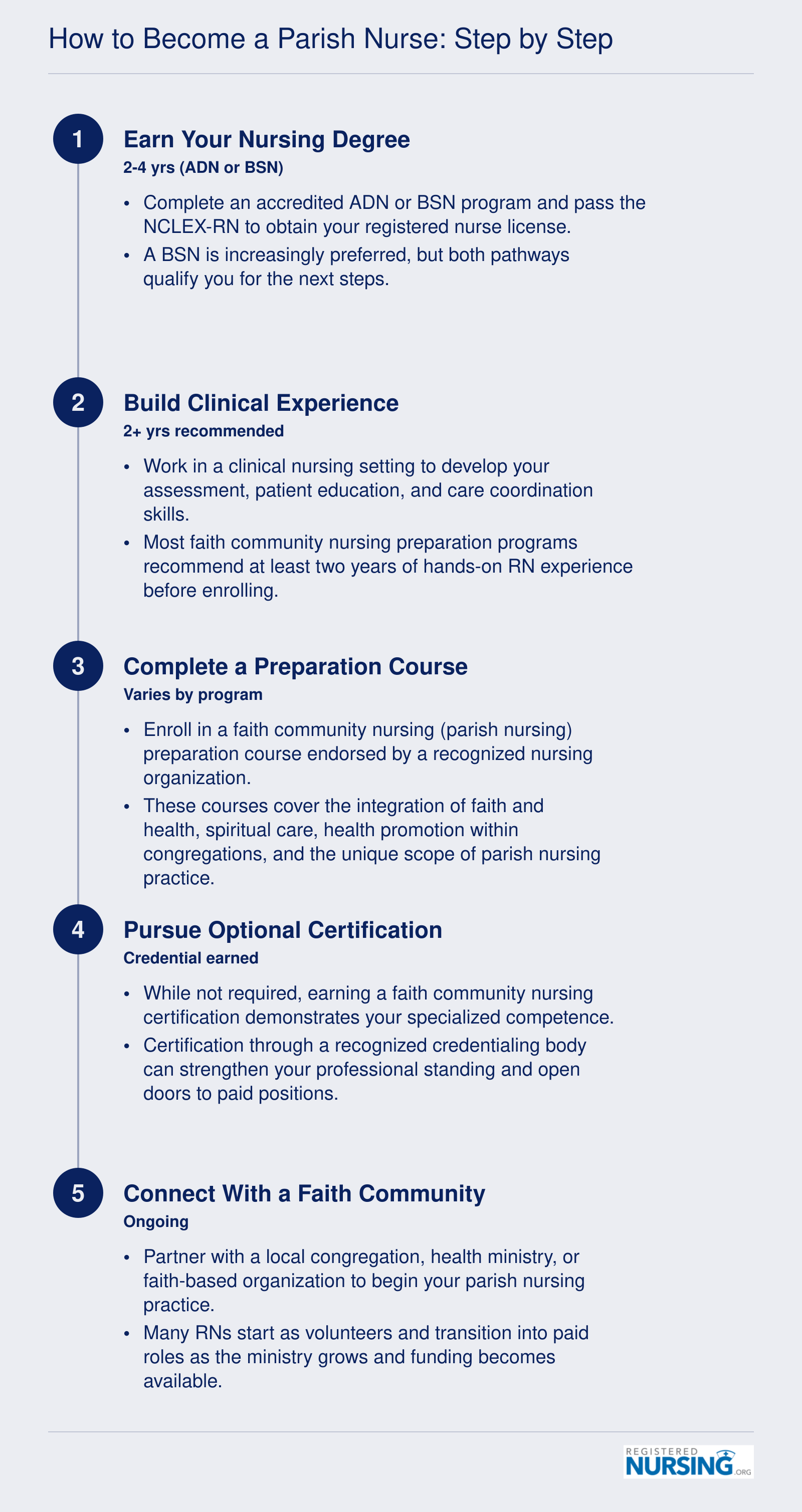
How to Become a Parish Nurse: Step by Step
The path to parish nursing combines traditional nursing credentials with specialized faith-based training. While a BSN is increasingly preferred by employers and health ministries, ADN-prepared RNs are eligible for most faith community nursing preparation courses.
Parish Nurse Education and Training Requirements
What educational preparation is needed to become a parish nurse?
The starting point for parish nursing is a current, unencumbered Registered Nurse (RN) license. While an Associate Degree in Nursing (ADN) qualifies you for licensure, most parish nurse preparation programs and hiring congregations prefer or require a Bachelor of Science in Nursing (BSN). This educational foundation ensures you have the clinical judgment and community health perspectives essential for the role.
Foundational Parish Nurse Preparation Course
Once licensed, the standard pathway is a foundational parish nurse preparation course, typically 34 to 40 contact hours. The curriculum is based on the model developed by the International Parish Nurse Resource Center and covers: - Theology of health and healing - Holistic health: integrating body, mind, and spirit - Ethical issues in faith community nursing - Program development and community assessment - Self-care and professional boundaries
Many courses are offered in flexible formats (online, in person, or hybrid) through faith-based nursing schools, denominational health ministries, or retreat centers.
Continuing Education for Deeper Competency
Parish nursing demands more than generalist knowledge. Most nurses pursue targeted continuing education (CE) in areas like: - Grief and bereavement counseling - Mental health first aid (see also: psychiatric nurse roles for clinical context) - Chronic disease management (e.g., diabetes, hypertension) - Gerontology and aging-in-place support, where long-term care nursing experience is a valuable asset
These CE topics are not required for every role, but they strengthen your ability to address the complex needs common in congregational settings.
Advanced Academic Options
For nurses seeking deeper academic preparation, several universities now offer graduate certificates or concentrations in faith community nursing. These can often be embedded into MSN or DNP programs, providing coursework in health ministry leadership, spiritual assessment, and population health. While not mandatory, such credentials can distinguish you for paid coordinator positions or teaching roles.
Parish Nurse Certification Options
Parish nurse certification isn't a single license or national exam. It is a specialized educational pathway that equips registered nurses with the unique skills needed for faith community nursing. Most employers and faith communities recognize completion of a standardized curriculum, often called Foundations of Faith Community Nursing, as the benchmark for preparation. The programs below represent the most common routes to becoming a qualified parish or faith community nurse in 2026.
The Westberg Institute Foundations Course
The Westberg Institute for Faith Community Nursing develops the most widely adopted curriculum for parish nurse education. The Foundations of Faith Community Nursing course provides 38 to 40 contact hours and is offered online or at multiple in-person sites across the country.1 Prerequisites include graduation from an accredited RN program, three to five years of clinical practice, and a current, unencumbered RN license.2 Because the Westberg curriculum forms the backbone of many local programs, completing it through any approved educator typically meets the standard for parish nursing practice.
Other Recognized Preparation Programs
Several organizations deliver faith community nurse education that aligns with the Westberg model or offers equivalent content: - Church Health: Offers Foundations of Faith Community Nursing in in-person, hybrid, or fully online formats, with 38 to 42 contact hours.2 - Faith Community Nurse Network of the Greater Twin Cities: Provides a fully online Foundations course earning 42.4 continuing education units.3 - Children's National Health System: Conducts parish nursing training totaling 39.5 contact hours.4
Many regional programs also exist, often at a low cost. St. Peter's Seminary offers a hybrid Parish Nursing Program (a week-long intensive plus two online courses) for approximately $105.5 Baptist Community Ministries' Congregational Nurse Education Program combines four in-person Saturdays with online assignments for about $200.6 Both require an active RN license.
A Note on ANCC Certification
The American Nurses Credentialing Center (ANCC) previously offered an initial Faith Community Nursing board certification (RN-BC). As of 2025-2026, this credential is available for renewal only; no new candidates are being accepted.7 Nurses who earned it previously may maintain it, but new entrants should plan on completing a recognized Foundations course instead. Nurses interested in other community-focused specialties may also want to explore the missionary nurse role, which shares a similarly values-driven approach to patient care.
Parish Nurse Salary and Compensation
Volunteer service versus paid employment defines the financial landscape of parish nursing. Many parish nurses serve without salary, viewing their work as a ministry rather than a job. Others hold compensated positions funded through church budgets, hospital partnerships, or grant programs. Understanding this spectrum helps prospective parish nurses set realistic expectations and identify the right fit for their circumstances.
How Most Parish Nurses Are Compensated
The majority of parish nurses serve on a volunteer basis. These nurses contribute their time and expertise while maintaining income from other nursing positions or retirement funds. Volunteer roles typically involve flexible hours, often a few hours per week or as-needed visits for congregational health screenings and support.
Paid parish nurse positions exist but remain less common. When churches or faith communities budget for a parish nurse, compensation structures vary widely. Some positions offer full-time salaries comparable to community health nursing roles, while others provide part-time stipends or hourly wages. A paid parish nurse might earn a salary similar to community health nursing roles in public health departments, community clinics, or occupational health settings rather than acute care hospitals.
Where Parish Nurse Funding Comes From
Churches that employ paid parish nurses typically draw funding from several sources. Direct allocation from the congregation's annual budget remains the most straightforward model. Larger churches with robust health ministries may dedicate a line item specifically for nursing staff.
Hospital system partnerships represent another funding avenue. Healthcare organizations with community benefit missions sometimes sponsor parish nurse programs in their service areas, providing either direct salary support or program infrastructure. These arrangements align with population health goals and extend the hospital's reach into underserved communities.
Grant funding through denominational bodies or health-focused foundations occasionally supports parish nurse positions. Faith-based health organizations sometimes offer seed grants to launch new programs or sustain existing ones during transition periods.
Researching Compensation in Your Area
Prospective parish nurses should investigate local compensation patterns directly. Contact active parish nurse programs in your region to ask about their funding models and whether positions are paid or volunteer. Professional associations focused on faith community nursing often conduct member surveys that include compensation data, though this information may require membership access.
Denominational websites sometimes publish resources on establishing and funding parish nurse programs, including budget templates and funding strategy guides. The Bureau of Labor Statistics provides salary data for registered nurses in community health settings, offering a baseline for estimating potential parish nurse pay in compensated roles. Nurses who want to expand their professional footprint beyond a single congregation may also find guidance in nursing resources covering career pathways and professional development.
Parish Nurse Jobs: Where to Work and How to Find Positions
Finding a parish nurse position often requires more initiative than scanning job boards because many roles are embedded within congregations or health ministry networks rather than listed with traditional employers. Unlike a standard hospital posting, these opportunities are frequently created through relationships, denominational connections, or innovative funding partnerships. Understanding where parish nurses work and how to uncover hidden openings puts you in a stronger position to land a role that aligns with your calling.
Common Employment Settings
Parish nurses serve in a variety of settings that extend far beyond a single church building. The most familiar model is an individual congregation that hires or designates a nurse to care for its members. However, many parish nurses are placed through hospital-affiliated health ministries, where a health system partners with multiple faith communities to provide nursing services. Denominational health networks, such as those run by Catholic, Methodist, or Adventist organizations, also employ nurses to coordinate wellness programs across regional congregations. Community health organizations with faith-based outreach initiatives hire nurses to bridge clinical care and spiritual support, particularly in underserved areas. Senior living facilities that include chapel programs or spiritual care departments are another growing employer, blending geriatric nursing with faith community health.
Understanding the Three Funding Models
How a parish nurse role is funded shapes everything from job stability to daily responsibilities. You will typically encounter one of three models during your search:
- Church-funded: The congregation allocates part of its budget to pay a stipend or salary. These positions often start as volunteer roles that evolve into paid part-time or full-time jobs once the congregation recognizes the value. The application process is usually direct: reach out to church leadership or a health ministry committee.
- Hospital-partnered: A health system places nurses in affiliated congregations as part of a community health outreach strategy. The nurse is employed by the hospital but embedded in faith communities, providing a bridge between clinical services and spiritual care. Check local hospital community health departments for these hybrid roles.
- Grant-funded: Foundations like the Robert Wood Johnson Foundation or denominational grant programs occasionally fund parish nurse positions for a set period. These roles may focus on specific initiatives, such as chronic disease management or mental health support. Grant postings appear on funder websites, denominational newsletters, and the Health Ministries Association job board.
Practical Job-Search Strategies
Because many parish nurse jobs are never publicly listed, your search strategy matters as much as your qualifications. Start by contacting community health departments at local hospitals and asking whether they have a faith community nursing program or are interested in starting one. Denominational nursing associations, such as the Catholic Health Association or the United Methodist Health Ministry Network, often share position openings and can connect you with local coordinators. The Health Ministries Association maintains a dedicated job board that includes parish nursing and faith community nurse roles across the country. Networking at faith community nursing conferences and summits remains one of the most effective ways to learn about unadvertised positions and meet decision-makers who can create a role for the right candidate. Nurses with an entrepreneurial mindset may also find it worthwhile to explore how to start a nursing business as an independent health ministry contractor.
Career Outlook and Growing Demand
Overall demand for registered nurses remains strong. The Bureau of Labor Statistics projects 5% growth in RN employment from 2024 to 2034, with an estimated 166,100 to 189,100 annual openings stemming from both growth and replacement needs.1 While parish nursing is not separately classified, demand for health ministry roles is clearly rising as congregations age and recognize the need for intentional wellness support. Long-term care nurses working in faith-affiliated senior settings represent one adjacent path worth exploring as the population ages. Dedicated "parish nurse" postings remain limited compared to hospital or clinic roles, so proactive outreach to churches, hospitals, and denominational networks often yields better results than waiting for a traditional job listing to appear.
Parish Nursing Organizations and Resources
Where can a parish nurse turn for training, credible standards, and a network of peers doing the same work? Several established organizations, plus a growing number of denominational networks and online communities, form the backbone of this specialty.
National Professional Organizations
- Westberg Institute for Faith Community Nursing: Currently a program of the Spiritual Care Association's Nursing Division, the Westberg Institute is the primary source of the Foundations of Faith Community Nursing curriculum used across the country.1 It hosts the annual Westberg Symposium, publishes evidence-based position statements, and maintains an online Knowledge Sharing Platform for nurses in the field.
- Health Ministries Association (HMA): Active and serving as an American Nurses Association Organizational Affiliate, HMA offers membership, continuing education, national conferences, newsletters, and advocacy updates.2 HMA co-develops the Faith Community Nursing: Scope and Standards of Practice with the ANA, which is the definitive practice document for the specialty.
- Faith Community Nurses International (FCNI): Widely recognized as the research arm of the specialty, FCNI supports education, research, and global connection among faith community nurses.2
- Church Health (Memphis): A large faith-based health organization that has historically supported faith community nursing education and ministry, though current program specifics change year to year and should be confirmed directly.
Denominational and Regional Networks
Many parish nurses connect through their own tradition or region. The Catholic Health Faith Community Nurse Program in Buffalo, NY offered an online Foundations course in Spring 2026,3 and the Faith Community Nurse Network of the Greater Twin Cities ran a Winter/Spring 2025 Foundations course.4 Similar Catholic, Lutheran, and Protestant regional networks continue to deliver Westberg-based training into 2025 and 2026.5 If you belong to a denomination, check with its health ministries office first, as it is often the fastest path to a local cohort.
Online Communities
Informal peer support matters. Facebook groups such as "Faith Community Nurses" and "Parish Nurse Network" host active discussions on care planning, boundaries, and ministry ideas. LinkedIn groups tied to HMA and Westberg Symposium alumni are also useful for connecting with nurses beyond your immediate region. Parish nursing shares some of this community-centered philosophy with school nursing, where practitioners likewise serve a defined population outside traditional clinical walls, and with rural nursing, where independent judgment and broad scope are everyday realities.
Common Questions About Parish Nursing
Parish nursing blends clinical expertise with spiritual care, so it naturally raises questions about training, compensation, and scope. Below are direct answers to the questions prospective parish nurses ask most often.
What is the difference between a parish nurse and a faith community nurse?
Are parish nurses paid or volunteer?
How do I become a parish nurse?
What certification do you need to be a parish nurse?
What does a parish nurse do on a daily basis?
Where do parish nurses work?
Can an LPN or LVN serve as a parish nurse?
Explore More
- Ambulatory Care Nurse
- Burn Unit Nurse
- Cardiac Nurse
- Cath Lab Nurse
- Charge Nurse
- Chief Nursing Officer (CNO)
- Correctional Nurse
- CVOR Nurse
- Dermatology Nurse
- Developmental Disability Nurse
- Director of Nursing
- Domestic Violence Nurse
- Emergency Room Nurse
- ENT Nurse
- ET Nurse
- Fertility Nurse
- Flight/Transport Nurse
- Forensic Nurse Salary & Career Guide
- Genetic Nurse
- Geriatric Nurse
- Health Policy Nurse
- Healthcare Administrator
- Healthcare Manager
- Home Health Nurse
- Hospice Nurse
- Camp Nurse
- GI Nurse
- Holistic Nurse
- Labor and Delivery Nurse
- Nurse Writer
- Psychiatric Nurse
- School Nurse
- Telemetry Nurse
- Travel Nurse
- Aesthetic Nurse
- Infusion/IV Nurse
- Oncology Nurse
- ICU Nurse
- Infection Control Nurse
- Legal Nurse Consultant
- LTC Nurse
- Managed Care Nurse
- Medical-Surgical Nurse
- Military (Combat) Nurse
- Missionary Nurse
- Mother Baby Nurse
- Nephrology Nurse
- Neuroscience Nurse
- NICU Nurse
- Nurse Administrator
- Nurse Attorney
- Nurse Care Coordinator
- Nurse Case Manager
- Nurse Entrepreneur
- Nurse Executive
- Nurse Health Coach
- Nurse Manager
- Obstetric (OB) Nurse
- Occupational Health Nurse
- Operating Room Nurse
- Ophthalmic Nurse
- Organ Procurement Coordinator
- Orthopedic Nurse
- Pain Management Nurse
- Palliative Care Nurse
- Patient Advocate Nurse
- Pediatric Endocrinology Nurse
- Perianesthesia (PACU) Nurse
- Perinatal Nurse
- Plastic Surgery Nurse
- Public/Community Health Nurse
- Radiology Nurse
- Rehabilitation Nurse
- Research Nurse
- Respiratory Nurse
- Rheumatology Nurse
- Substance Abuse Nurse
- Telephone Triage Nurse
- Transcultural Nursing
- Transplant Nurse
- Trauma Nurse
- Wound Care Nurse (WOCN)