

What you’ll learn in this article…
- CPSN certification can boost plastic surgery nurse pay by 15 to 25 percent.
- Most RNs transition into this specialty after three to five years of experience.
- Commission-based medspa injector roles often push total compensation well above staff RN averages.
Plastic surgery nurses blend high-acuity surgical skills with aesthetic expertise, a combination that explains why CPSN-certified nurses often command salaries 15 to 25 percent above general staff RN pay. These registered nurses assist plastic surgeons through the full procedural arc: pre-operative assessments, intra-operative circulating or scrub duties, and post-operative monitoring for both reconstructive cases (burn debridement, cleft palate repair, mastectomy reconstruction) and elective cosmetic work (rhinoplasty, abdominoplasty, facelifts).
The role differs from aesthetic or cosmetic nurses, who typically deliver non-surgical treatments such as Botox, dermal fillers, and laser therapies in medspa settings. It also stands apart from surgical technologists, who lack RN licensure and do not perform patient assessments or administer medications. Plastic surgery nursing requires an active RN license and, increasingly, employers favor candidates with BSN preparation and two or more years of perioperative experience before specialty training begins.
How to Become a Plastic Surgery Nurse
Entering the plastic surgery nursing specialty requires a combination of foundational nursing education, clinical experience, and targeted credentials. Most nurses transition into plastic surgery roles three to five years after earning their initial RN license. A BSN is increasingly preferred by employers, particularly private practices and ambulatory surgery centers.
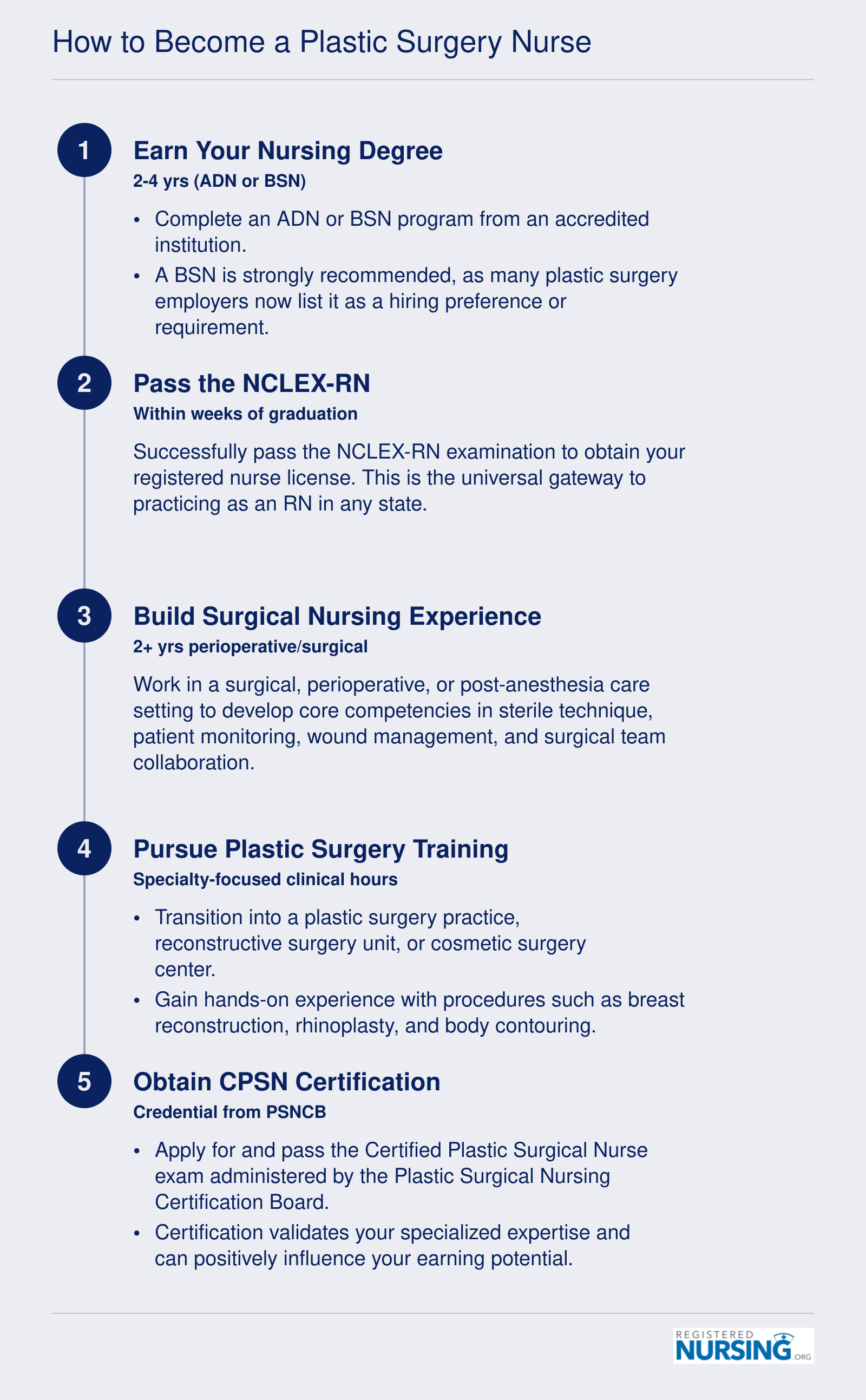
CPSN Certification: Requirements, Exam Details, and Pay Impact
Earning the Certified Plastic Surgical Nurse credential signals to employers and patients that you possess specialized expertise in this demanding field. The Plastic Surgical Nursing Certification Board, known as PSNCB, administers the CPSN examination and sets all eligibility standards.1 Understanding what the certification process involves, and whether the investment pays off, helps you plan your professional development strategically.
Eligibility Requirements
Before applying for the CPSN exam, you must meet three core prerequisites:
- Active RN license: You need a current, unrestricted registered nurse license in the United States, its territories, or Canada.
- Clinical experience: A minimum of two years working in plastic surgery nursing is required.
- Direct patient care hours: You must document at least 1,000 hours of hands-on clinical practice in plastic surgical nursing within your eligibility period.
These requirements ensure that candidates bring real-world competence to the examination, not just theoretical knowledge. The clinical hour threshold reflects the specialty's emphasis on both preoperative assessment and postoperative recovery management.
Exam Format and Costs
The CPSN examination is a computer-based test consisting of 175 multiple-choice questions. You have 240 minutes to complete the exam, which covers topics such as patient assessment, intraoperative care, wound management, and ethical considerations specific to aesthetic and reconstructive procedures. Nurses with a background as an operating room nurse will find many of these topics familiar.
Financially, you should budget for the following:
The current pass rate stands at approximately 72 percent,2 indicating that while the exam is achievable with proper preparation, it does require dedicated study. Many successful candidates spend several months reviewing clinical guidelines and taking practice examinations before sitting for the test.
Renewal and Recertification
CPSN certification remains valid for three years.1 To maintain your credential, you must complete continuing education requirements rather than retaking the full examination. If you have questions about how continuing education credits work across specialties, the CE/CME FAQs for Medical Professionals resource offers a useful overview. The recertification criteria include:
- Total continuing education: 45 contact hours3
- Specialty-specific hours: At least 30 of those hours must focus on plastic surgery nursing topics3
- Recertification fee: $325, with an additional $100 late fee if you miss the deadline4
This renewal cycle encourages ongoing professional development and ensures that certified nurses stay current with evolving techniques, technologies, and patient safety protocols.
Salary Premium for CPSN Holders
The financial return on certification is a common question among nurses considering this investment. According to available compensation data, certified plastic surgical nurses earn a mean annual wage of approximately $71,730, translating to roughly $34.48 per hour on a national basis.5 While direct comparison data between certified and non-certified plastic surgery nurses can vary by employer and region, industry surveys consistently show that specialty certifications correlate with higher pay. Many healthcare organizations offer certification differentials ranging from two to six percent above base salary, and private practices often view the CPSN credential as a hiring advantage that justifies premium compensation.
Is CPSN Certification Worth It?
For nurses committed to building a long-term career in plastic surgery, the CPSN credential offers tangible benefits beyond salary. Certification demonstrates your dedication to the specialty, which matters in competitive job markets and when negotiating with prestigious surgical practices. It also opens doors to leadership roles, such as clinical coordinator or nurse educator positions within plastic surgery departments. Nurses who transition from adjacent specialties, such as dermatology nursing, often find the CPSN a natural next step for formalizing their aesthetic care expertise.
The total upfront cost of approximately $220 for application and exam fees represents a modest investment compared to the potential salary gains and career mobility. When weighed against the professional credibility and continuing education structure the certification provides, most nurses find the return well worth the effort.
Questions to Ask Yourself
What Does a Plastic Surgery Nurse Do?
The field of plastic surgery nursing has expanded dramatically as more procedures shift from inpatient to outpatient settings, and nurses increasingly take on autonomous roles in pre- and post-operative care as well as minimally invasive treatments.
Pre-Operative Responsibilities
Plastic surgery nurses begin each case by conducting thorough patient assessments, reviewing medical histories, and identifying potential risk factors like allergies or bleeding disorders. They educate patients on what to expect before and after surgery, including medication restrictions, fasting guidelines, and realistic outcomes. In the surgical suite, they help prepare and sterilize instruments, ensure the correct implants or grafts are available, and verify that the operating room is set up for the specific procedure.
Intra-Operative Support
During surgery, the nurse plays a critical role in assisting the plastic surgeon. This may involve passing instruments, retracting tissues, or operating suction devices to maintain a clear surgical field. The nurse monitors the patient's vital signs continuously, watching for any signs of distress under anesthesia. Maintaining a strict sterile field is a constant responsibility, as any break in sterile technique can lead to infection and complications that undermine cosmetic or reconstructive outcomes.
Post-Operative Care
After the procedure, the focus shifts to recovery. Plastic surgery nurses manage wound care, changing dressings and inspecting incisions for signs of infection. They handle drains, monitoring output and ensuring they function properly. Patient education remains central: nurses teach individuals how to care for their surgical sites at home, recognize warning signs, and adhere to activity restrictions. They also provide emotional support, as recovery can be physically and psychologically challenging, particularly after major reconstructive surgeries.
Reconstructive vs. Cosmetic Settings
The daily work of a plastic surgery nurse varies significantly by setting. In hospital-based reconstructive units, nurses care for patients recovering from trauma, burn care, cancer reconstruction (such as mastectomy with flap procedures), or congenital defect repairs. These cases often involve longer hospital stays and complex wound management. In contrast, cosmetic-focused settings like ambulatory surgery centers or private practices handle elective procedures such as facelifts, rhinoplasty, and breast augmentation, where patients are typically discharged the same day. The nurse must adapt to the faster pace and heightened emphasis on aesthetic detail and patient satisfaction in these environments.
The Injector Role
A growing number of plastic surgery nurses are trained to administer Botox, dermal fillers, and laser treatments under physician supervision. While this work overlaps with dermatology nursing, it often occurs within plastic surgery practices where patients receive both surgical and non-surgical services. Nurses in this role must complete specialized training in facial anatomy and injection techniques, and they often work with a higher degree of autonomy than in traditional surgical assisting.
Essential Soft Skills
Beyond clinical competence, plastic surgery nursing demands compassion and strong communication. Many patients struggle with body image concerns or have unrealistic expectations. Nurses must listen empathetically, provide honest guidance, and help manage expectations without diminishing hope. Meticulous attention to detail is non-negotiable, whether it is double-checking implant sizes, monitoring for subtle changes in a flap's perfusion, or ensuring every instrument is accounted for. These skills together create a safe and supportive environment that underlies successful outcomes.
Where Do Plastic Surgery Nurses Work?
Plastic surgery nurses practice across four distinct settings, each offering a unique combination of patient acuity, procedure volume, schedule predictability, and compensation structure.
Hospital Operating Rooms
Hospital-based plastic surgery nurses work in the most clinically demanding environment. These positions center on reconstructive and aesthetic surgeries, including trauma cases, burn unit care, and complex reconstructive procedures following cancer treatment or congenital abnormalities. Patient acuity runs high, and nurses must be prepared for emergent situations alongside scheduled operations.
Schedules typically involve 12-hour shifts with variable days, and many positions include nights, weekends, and on-call requirements. Annual compensation reflects this intensity, ranging from approximately $75,100 to $133,100 per year.1 Nurses who thrive here appreciate the clinical challenge and the life-changing impact of reconstructive work.
Ambulatory Surgery Centers
Ambulatory surgery centers, including office-based operating rooms, handle high-volume cosmetic procedures in an outpatient setting. An ambulatory care nurse performs pre-operative assessments, circulates or scrubs during procedures, and manages PACU and post-operative recovery. Patient acuity is generally lower than in hospital settings because most cases involve healthy elective-surgery candidates.2
These positions typically offer daytime hours, Monday through Friday, with no weekends or holidays. Hourly wages fall between roughly $39 and $48,1 making ambulatory centers attractive for nurses seeking schedule stability without sacrificing competitive pay.
Private Plastic Surgery Practices
Private clinics employ nurses for a broad scope of duties: conducting pre-consultation evaluations, assisting with in-office procedures, handling telephone triage, and coordinating post-operative follow-up.3 The pace can be fast, but the patient population consists almost entirely of elective cosmetic clients with predictable needs.
Schedules mirror standard business hours, Monday through Friday.4 Hourly pay typically ranges from $32 to $36.3 Nurses in these roles often build long-term relationships with patients who return for multiple procedures over time.
Medspas and Cosmetic Surgery Offices
Medspas represent the fastest-growing segment of aesthetic nursing. Nurses here perform injectables such as Botox and dermal fillers, administer laser treatments, and provide non-surgical aesthetic services. A background in dermatology nursing can be a strong foundation for this work, given the overlap in skin-focused treatments. Patient acuity is low, and outcomes are visible almost immediately, which can be professionally gratifying.
Base hourly pay generally falls between $35 and $40,5 but the real financial advantage lies in compensation structure. Many medspas offer base salary plus commission on injectable and aesthetic services. This commission model can significantly increase total compensation for nurses who build a loyal client base and develop strong sales skills. Schedule predictability mirrors private practices, with most positions running daytime hours on weekdays.5
Plastic Surgery Nurse Salary
Because the U.S. Bureau of Labor Statistics does not track plastic surgery nursing as a separate occupation, the best national baseline comes from the broader Registered Nurses category. The figures below reflect 2024 OEWS data for all RNs nationwide. Plastic surgery nurses working in high-demand cosmetic markets, particularly major metropolitan areas known for aesthetic procedures, may earn above these general RN benchmarks due to specialized skills, CPSN certification, and performance-based incentives common in cosmetic and medspa settings.
| Wage Measure | Annual Salary |
|---|---|
| National Median (50th Percentile) | $93,600 |
| National Mean (Average) | $98,430 |
| 25th Percentile | $78,610 |
| 75th Percentile | $107,960 |
Plastic Surgery Nurse Salary by Experience Level
Plastic surgery nurse salaries generally follow the same experience-driven trajectory seen across nursing specialties: entry-level nurses earn toward the lower end of the registered nurse pay scale, mid-career nurses with specialty certifications such as the CPSN tend to command higher compensation, and senior nurses with extensive surgical experience or advanced practice credentials often reach the top tier. Because plastic surgery nursing is a niche specialty, verified salary breakdowns by experience level are limited. For the most current figures, check BLS.gov for regional RN data, filter job sites like Salary.com and ZipRecruiter for "plastic surgery nurse," and review member surveys from the American Society of Plastic Surgical Nurses.
Highest-Paying States and Metros for Plastic Surgery Nurses
Because federal labor data does not break out plastic surgery nurses as a separate occupation, the registered nurse (RN) wage figures below serve as a useful baseline. Metro areas that are also major cosmetic surgery hubs, such as Los Angeles, Miami, Dallas, and New York, often pay plastic surgery nurses a premium above these general RN averages thanks to high patient demand for elective procedures. States with dense concentrations of cosmetic and reconstructive practices, including California, Florida, New York, and Texas, tend to push specialty pay even higher.
| Metro Area | State | Total RN Employment | Median Annual Salary | Mean Annual Salary | 75th Percentile Salary |
|---|---|---|---|---|---|
| San Francisco, Oakland, Fremont | CA | 40,750 | $188,020 | $178,450 | $212,190 |
| Los Angeles, Long Beach, Anaheim | CA | 107,340 | $133,440 | $138,010 | $165,290 |
| Seattle, Tacoma, Bellevue | WA | 37,250 | $118,570 | $120,260 | $132,160 |
| New York, Newark, Jersey City | NY/NJ | 195,470 | $113,490 | $115,650 | $128,430 |
| Boston, Cambridge, Newton | MA/NH | 66,440 | $102,440 | $115,710 | $137,160 |
| Minneapolis, St. Paul, Bloomington | MN/WI | 40,510 | $102,240 | $102,790 | $116,000 |
| Washington, Arlington, Alexandria | DC/VA/MD | 43,640 | $101,800 | $102,510 | $110,760 |
| Philadelphia, Camden, Wilmington | PA/NJ/DE/MD | 74,840 | $99,210 | $97,510 | $107,800 |
| Dallas, Fort Worth, Arlington | TX | 72,640 | $98,740 | $96,720 | $106,850 |
| Phoenix, Mesa, Chandler | AZ | 46,330 | $98,160 | $96,220 | $105,900 |
| Houston, Pasadena, The Woodlands | TX | 65,300 | $97,810 | $96,730 | $105,970 |
| Atlanta, Sandy Springs, Roswell | GA | 54,370 | $96,370 | $96,640 | $107,550 |
| Chicago, Naperville, Elgin | IL/IN | 100,620 | $96,480 | $94,580 | $104,730 |
| Detroit, Warren, Dearborn | MI | 44,280 | $88,980 | $92,680 | $101,880 |
| Miami, Fort Lauderdale, West Palm Beach | FL | 59,880 | $85,610 | $92,070 | $103,110 |
Injector and Medspa Compensation: Base Pay Plus Commission
Many aesthetic injector and medspa nursing roles blend a guaranteed base salary with production-based commissions, creating a compensation structure distinct from traditional hospital or clinic employment. Understanding both components and how they interact is essential when evaluating offers in the cosmetic and aesthetic nursing market.
Base Pay Benchmarks
Registered nurse salary data published by the Bureau of Labor Statistics provide a useful starting point for evaluating base compensation, but BLS figures do not capture commission, bonuses, or production-based incentives that are common in aesthetic practice. To complement these national benchmarks, review salary aggregators such as Indeed and Glassdoor for location-specific medspa and injector postings. Keep in mind that advertised base rates often represent the guaranteed floor, with actual take-home pay contingent on service volume and commission structure.
Commission and Production-Based Pay
Commission percentages on injectables vary significantly by employer, market, and nurse experience. Some practices offer a flat percentage on every syringe of dermal filler or vial of neuromodulator, while others use tiered schedules that increase the commission rate once a monthly production threshold is met. Total compensation in high-volume clinics can exceed base salary by a substantial margin, particularly for nurses who build a loyal client base and consistently meet booking targets. Nurses with an entrepreneurial mindset who treat their nurse business owners approach seriously often see the steepest earnings growth in these settings.
Because commission structures are not standardized and are rarely disclosed in public datasets, direct inquiries during the interview process are critical. Ask prospective employers to specify commission percentages, production thresholds, and whether the practice tracks individual or team-based metrics.
Industry Association Surveys and Peer Networks
The American Med Spa Association and the American Society for Aesthetic Plastic Surgery periodically release aggregate compensation surveys covering injector roles and aesthetic nursing positions. These reports, though not updated continuously, offer the most authoritative industry-wide snapshots of base pay, commission norms, and total earnings.
Networking with peers through local medspa groups or national aesthetic nursing forums can surface real-world examples and help you identify outlier offers or unusually favorable commission tiers. Dermatology nurses who have crossed over into aesthetic injector roles are one particularly useful peer group, given the overlap in clinical setting and client-facing practice. Compensation varies widely by geography, clinic business model, and patient volume, so regional peer benchmarks often prove more actionable than national averages when negotiating or comparing offers.
Plastic Surgery Nurse Salary Vs. Other Nursing Specialties
Plastic surgery nursing sits at an interesting intersection of surgical skill and aesthetic expertise, and its compensation reflects that dual demand. Understanding how this specialty stacks up against related nursing roles can help you decide whether the investment in specialized training and certification is worthwhile.
How to Research Reliable Comparisons
Salary data for niche nursing specialties can be harder to pin down than figures for general registered nurses. A few strategies will help you find meaningful numbers:
- Government sources: The Bureau of Labor Statistics publishes median pay data for registered nurses as a whole, and it sometimes breaks figures down by work setting. This baseline gives you a useful anchor for comparison, though it does not separate plastic surgery nurses from other RNs.
- Compensation databases: Sites such as Salary.com and Payscale allow you to search by specific job titles like "cosmetic nurse" or "operating room nurse," which can surface self-reported salary ranges closer to the specialty level.
- Professional associations: Organizations focused on perioperative, perianesthesia, or aesthetic nursing occasionally publish workforce surveys that include compensation benchmarks. These tend to be more granular than government data.
- Alumni and peer networks: Nursing school alumni salary reports and discussion forums can offer anecdotal but useful context, especially when you filter by specialty and geographic area.
General Patterns Across Specialties
Plastic surgery nurses typically earn salaries that are competitive with, and in many markets slightly above, the general RN median. However, they generally earn less than advanced practice providers such as certified registered nurse anesthetists (CRNAs), who require doctoral or master's level education and command some of the highest salaries in nursing.
Perioperative nurses tend to fall in a comparable range to plastic surgery nurses, since both roles demand surgical environment expertise. Ophthalmic nurse salary data offers another useful benchmark, as that specialty shares a similarly narrow procedural focus and comparable practice settings. Orthopedic nurse salary figures round out the picture, reflecting what surgical-specialty RNs can expect across different procedure types. Dermatology nurses and aesthetic nurses may earn similar base pay, though those working in medspas or cosmetic clinics sometimes supplement their income through commission or bonus structures tied to patient volume and product sales.
Context Matters More Than Averages
When comparing specialties, keep in mind that raw salary medians only tell part of the story. Plastic surgery nurses who hold the Certified Plastic Surgical Nurse (CPSN) credential, work in high-cost metro areas, or take on injector responsibilities often earn well above published averages. Meanwhile, a CRNA in a rural setting might earn more in base pay but face a very different scope of practice, schedule, and educational debt load.
Rather than relying on a single source, cross-reference data from government reports, professional surveys, and peer forums. Searching for direct comparisons, such as "plastic surgery nurse salary vs. CRNA" or "cosmetic nurse salary vs. OR nurse," can surface survey results, blog analyses, and community discussions that add nuance to the numbers. The clearer your picture, the more confidently you can weigh the financial return of this specialty against alternatives.
Plastic surgery nurses who hold CPSN certification or work as injectors consistently out-earn general staff RNs, often by 15 to 25 percent or more. Those in commission-based medspa roles can push total compensation significantly higher, making this specialty one of the more lucrative paths for nurses seeking above-median income without advanced practice credentials.
Job Outlook and Career Advancement for Plastic Surgery Nurses
Staying in direct bedside care versus advancing into leadership or advanced practice: both tracks are viable, but each requires different time horizons and credentials. The job outlook for plastic surgery nurses mirrors the broader demand for registered nurses, with additional tailwinds from the aesthetic-medicine boom.
Baseline Job Growth and Industry Demand
The Bureau of Labor Statistics projects 5 percent growth for registered nurses between 2024 and 2034, adding 166,100 net new jobs and generating nearly 189,100 annual openings when accounting for retirement and turnover.1 Healthcare and social assistance employment as a whole is expected to grow 8.4 percent over the same period, reflecting sustained demand across all specialties.
Plastic surgery nursing benefits from two accelerating trends. First, an aging population increasingly seeks reconstructive procedures such as breast reconstruction after mastectomy, skin-cancer removal, and facial rejuvenation. Second, cosmetic procedures have surged among younger adults; data from the American Society of Plastic Surgeons shows consistent year-over-year increases in noninvasive treatments like neurotoxin injections, dermal fillers, and laser resurfacing. As these procedures shift from hospital operating rooms to outpatient clinics and medspas, demand for nurses trained in aesthetic techniques continues to climb.
Career Advancement Pathways
A newly licensed RN typically spends three to five years building expertise in perioperative, ambulatory, or medspa settings before transitioning to a focused plastic surgery role. From that established base, several advancement options emerge:
- Clinical coordinator or nurse manager: Oversee staff scheduling, quality assurance, patient flow, and regulatory compliance in a private practice or surgery center. Most coordinators hold a BSN and have five or more years of direct clinical experience.
- Advanced practice registered nurse (APRN) with aesthetic focus: Complete a master's or doctoral program to become a nurse practitioner, then obtain prescriptive authority and specialized training in injectables, lasers, and nonsurgical rejuvenation. The RN-to-NP timeline typically adds two to four years of graduate study and clinical hours. Nurses pursuing the highest academic credential can explore best DNP programs to compare options.
- Clinical educator or staff-development specialist: Train new hires, develop competency protocols, and liaise with medical device vendors. Larger group practices and academic medical centers employ educators to standardize techniques and maintain certification compliance.
- Practice owner or partner: Some experienced aesthetic nurses open their own medspa or wellness clinic, leveraging state scope-of-practice laws and physician-collaboration agreements. This path demands business acumen, capital, and regulatory expertise beyond clinical skills.
Overall, the combination of stable RN demand, rising procedure volumes, and multiple advancement ladders makes plastic surgery nursing a specialty with strong long-term growth potential and clear pathways for those who invest in ongoing education and certification. Nurses weighing this specialty against other procedure-focused fields may also find it useful to review what a geriatric nurse does, since reconstructive care for older adults increasingly overlaps with both disciplines.
Frequently Asked Questions About Plastic Surgery Nursing
Below are straightforward answers to the questions prospective plastic surgery nurses ask most often. If you are weighing this specialty against other career paths, these responses can help you make an informed decision.
- How long does it take to become a plastic surgery nurse?
- Most nurses need a minimum of two years of surgical or perioperative experience before transitioning into plastic surgery nursing. When you factor in earning your nursing degree (two years for an ADN, four years for a BSN) and passing the NCLEX, the full timeline typically ranges from four to six years. Adding CPSN certification requires at least two years of specialty experience beyond that.
- Do plastic surgery nurses make more money than regular nurses?
- In many cases, yes. Plastic surgery nurses who work in outpatient surgical centers or private practices often earn salaries above the national RN median, and those who perform injectable treatments may receive commission or bonus pay on top of a base salary. Holding the CPSN credential can further increase earning potential by signaling advanced expertise to employers.
- What is the CPSN certification and how do you get it?
- The Certified Plastic Surgical Nurse (CPSN) credential is awarded by the Plastic Surgical Nursing Certification Board. To qualify, you must hold an active RN license and have at least two years of plastic surgical nursing experience. The exam covers preoperative assessment, intraoperative care, postoperative management, and patient safety. Passing demonstrates specialized competence and can lead to higher pay and stronger job prospects.
- Can you be a plastic surgery nurse with an ADN instead of a BSN?
- Yes. An Associate Degree in Nursing is sufficient to obtain RN licensure and begin working in plastic surgery settings. However, many employers, especially large surgical centers and academic medical centers, prefer or require a BSN. If you are weighing your options early on, reviewing an ADN vs BSN comparison can help clarify which path suits your goals. Earning a BSN through an RN to BSN bridge program can open doors to leadership roles and may be necessary if you eventually pursue advanced practice credentials.
- What is the difference between a plastic surgery nurse and an aesthetic nurse?
- A plastic surgery nurse works alongside plastic surgeons in surgical environments, assisting with both reconstructive and cosmetic procedures. An aesthetic nurse typically focuses on nonsurgical treatments such as injectables, laser therapy, and skin rejuvenation in medspa or dermatology settings. There is overlap between the two roles, and some nurses practice in both capacities.
- Do plastic surgery nurses perform injections like Botox and fillers?
- In many states, registered nurses can administer Botox and dermal fillers under a physician's supervision or standing orders. Nurse practitioners working in plastic surgery may perform these treatments more independently. Scope of practice laws vary by state, so it is essential to verify your state's regulations before offering injectable services. Additional training and certification in aesthetic injectables are strongly recommended.
Explore More
- Ambulatory Care Nurse
- Burn Unit Nurse
- Cardiac Nurse
- Cath Lab Nurse
- Charge Nurse
- Chief Nursing Officer (CNO)
- Correctional Nurse
- CVOR Nurse
- Dermatology Nurse
- Developmental Disability Nurse
- Director of Nursing
- Domestic Violence Nurse
- Emergency Room Nurse
- ENT Nurse
- ET Nurse
- Fertility Nurse
- Flight/Transport Nurse
- Forensic Nurse Salary & Career Guide
- Genetic Nurse
- Geriatric Nurse
- Health Policy Nurse
- Healthcare Administrator
- Healthcare Manager
- Home Health Nurse
- Hospice Nurse
- Camp Nurse
- GI Nurse
- Holistic Nurse
- Labor and Delivery Nurse
- Nurse Writer
- Psychiatric Nurse
- School Nurse
- Telemetry Nurse
- Travel Nurse
- Aesthetic Nurse
- Infusion/IV Nurse
- Oncology Nurse
- ICU Nurse
- Infection Control Nurse
- Legal Nurse Consultant
- LTC Nurse
- Managed Care Nurse
- Medical-Surgical Nurse
- Military (Combat) Nurse
- Missionary Nurse
- Mother Baby Nurse
- Nephrology Nurse
- Neuroscience Nurse
- NICU Nurse
- Nurse Administrator
- Nurse Attorney
- Nurse Care Coordinator
- Nurse Case Manager
- Nurse Entrepreneur
- Nurse Executive
- Nurse Health Coach
- Nurse Manager
- Obstetric (OB) Nurse
- Occupational Health Nurse
- Operating Room Nurse
- Ophthalmic Nurse
- Organ Procurement Coordinator
- Orthopedic Nurse
- Pain Management Nurse
- Palliative Care Nurse
- Parish Nurse
- Patient Advocate Nurse
- Pediatric Endocrinology Nurse
- Perianesthesia (PACU) Nurse
- Perinatal Nurse
- Public/Community Health Nurse
- Radiology Nurse
- Rehabilitation Nurse
- Research Nurse
- Respiratory Nurse
- Rheumatology Nurse
- Substance Abuse Nurse
- Telephone Triage Nurse
- Transcultural Nursing
- Transplant Nurse
- Trauma Nurse
- Wound Care Nurse (WOCN)