

What you’ll learn in this article…
- Becoming a perinatal nurse typically takes 4 to 6 years total.
- The NCC's RNC-OB credential is strongly preferred at Magnet hospitals.
- Advancing to perinatal nurse practitioner requires a graduate degree.
A perinatal nurse is a registered nurse who specializes in caring for patients across the full arc of childbearing, from antepartum monitoring through labor and delivery to postpartum recovery. The term "perinatal" is broader than many people realize: it encompasses the work of prenatal nurses (who focus on the months before birth) and overlaps with OB nurses, though perinatal nurses are distinguished by their involvement across all three phases rather than a single stage.
Because perinatal nursing spans such a wide clinical scope, terminology confusion is common among nurses entering the specialty. Adding to the complexity, most employers expect at least one to two years of acute care or mother-baby experience before hiring into perinatal units. Nurses who want to explore adjacent newborn care roles may also consider a career as a NICU nurse, where the focus shifts to critically ill neonates. Magnet-designated hospitals increasingly favor candidates who hold the RNC-OB credential from the National Certification Corporation.
What Does a Perinatal Nurse Do?
Some nurses prefer the structured predictability of a medical-surgical unit, while others thrive in the fast-changing environment of maternal care, where a routine prenatal visit can shift to an emergency cesarean delivery within minutes. Perinatal nurses work across the full childbearing continuum, and their responsibilities shift considerably depending on the phase of care.
Antepartum: Before Delivery
During the antepartum phase, perinatal nurses focus on monitoring pregnancies and educating expectant families. Core duties include performing prenatal assessments, tracking fetal growth, and screening for complications such as gestational diabetes and preeclampsia. For high-risk patients, this may involve serial non-stress tests, blood pressure monitoring protocols, and coordinating with maternal-fetal medicine specialists. Patient education is a major component as well: perinatal RNs teach families about nutrition, warning signs, labor preparation, and birth plan options.
Intrapartum: During Labor and Delivery
Once labor begins, the perinatal nurse becomes the constant presence at the bedside. Responsibilities during this phase include:
- Continuous fetal monitoring: Interpreting heart rate tracings and identifying signs of fetal distress that require immediate intervention.
- Labor support: Coaching patients through contractions, positioning techniques, and pain management options.
- Medication administration: Managing oxytocin drips, epidural monitoring, and other pharmacologic interventions under provider orders.
- Surgical assistance: Preparing patients for and assisting during cesarean deliveries, including instrument counts and post-operative handoffs.
- Preterm labor management: Administering tocolytics and corticosteroids when labor begins before term, often under time-sensitive protocols.
Nurses who specialize exclusively in the intrapartum setting may also pursue a career as a Labor and Delivery Nurse, where this phase of care becomes the primary focus.
Postpartum: After Delivery
Postpartum care covers both the birthing parent and the newborn. Perinatal nurses assess uterine tone, monitor for hemorrhage, support breastfeeding initiation, and perform initial newborn assessments including Apgar scoring and vital signs. They also educate families on safe sleep practices, umbilical cord care, and signs of postpartum complications. Nurses drawn specifically to this phase of care may find a natural fit in the role of a postpartum nurse.
The Interdisciplinary and Emotional Dimensions
Perinatal RNs rarely work in isolation. They collaborate closely with obstetricians, certified nurse-midwives, anesthesiologists, and NICU teams, often serving as the communication bridge that ensures critical information moves quickly between providers. When a newborn requires a NICU admission or a labor plan changes unexpectedly, the perinatal nurse is typically the one translating clinical decisions into clear language the family can understand.
The emotional weight of this specialty deserves honest acknowledgment. Perinatal nurses guide families through some of life's most intense moments, including pregnancy loss, stillbirth, and emergency interventions that reshape a family's expectations in seconds. The ability to provide compassionate, steady support during these experiences is not a soft skill in perinatal nursing; it is a core competency. Nurses drawn to this field should be prepared to navigate grief alongside joy, often within the same shift.
Perinatal Nurse vs Labor and Delivery Nurse
The term "perinatal nurse" is often used synonymously with labor and delivery nurse, but these roles have distinct scopes of practice and patient care responsibilities.
Scope of Practice: Intrapartum vs. the Full Perinatal Continuum
Labor and delivery nurses provide specialized care during the intrapartum period, which encompasses active labor, delivery, and the immediate postpartum recovery. Their practice is concentrated on monitoring fetal heart rates, administering medications, assisting with childbirth, and managing emergent situations like shoulder dystocia or postpartum hemorrhage.
Perinatal nurses, by contrast, work across the entire perinatal continuum, from preconception through the first year after birth.1 This broader scope includes prenatal assessments, high-risk pregnancy management, postpartum home visits, lactation support, and even perinatal loss care. While many perinatal nurses also work in labor and delivery units, the specialty itself is not confined to the birthing room.
Work Settings and Patient Populations
A labor and delivery nurse almost exclusively works in hospital-based labor and delivery units, caring for pregnant people who are actively in labor or undergoing induction. The patient population is, by definition, in an acute phase of pregnancy.
Perinatal nurses can be found in a wider range of settings: obstetric clinics, maternal-fetal medicine practices, community health agencies, home health nursing, and educational programs. They may care for patients who are not yet pregnant, are in the early stages of pregnancy, or are adjusting to life with a newborn. This diversity means perinatal nurses often build longer-term relationships and focus on preventive, holistic care.
Training and Certification Paths
Both roles typically start with an ADN or BSN, but the specialization paths diverge.3 Labor and delivery nurses often pursue the RNC-OB (Inpatient Obstetric Nursing) certification, which validates expertise in intrapartum and immediate postpartum care. Perinatal nurses may seek a range of certifications, such as those for fetal monitoring, lactation, or perinatal mental health, reflecting their broader scope. Many employers value these credentials but do not universally require them.
Overlap and Title Variations
Practically, many labor and delivery nurses are considered perinatal nurses because they care for pregnant people, but the reverse is not always true: a perinatal nurse working in a prenatal clinic or postpartum home care program does not typically work in a labor and delivery unit. Hospital naming conventions add to the confusion. Some facilities use "perinatal nurse" as an umbrella term for all maternity nurses, while others reserve it for roles outside the labor unit. When exploring job descriptions, look beyond the title at the specific duties and unit to understand the role fully.
Questions to Ask Yourself
How to Become a Perinatal Nurse
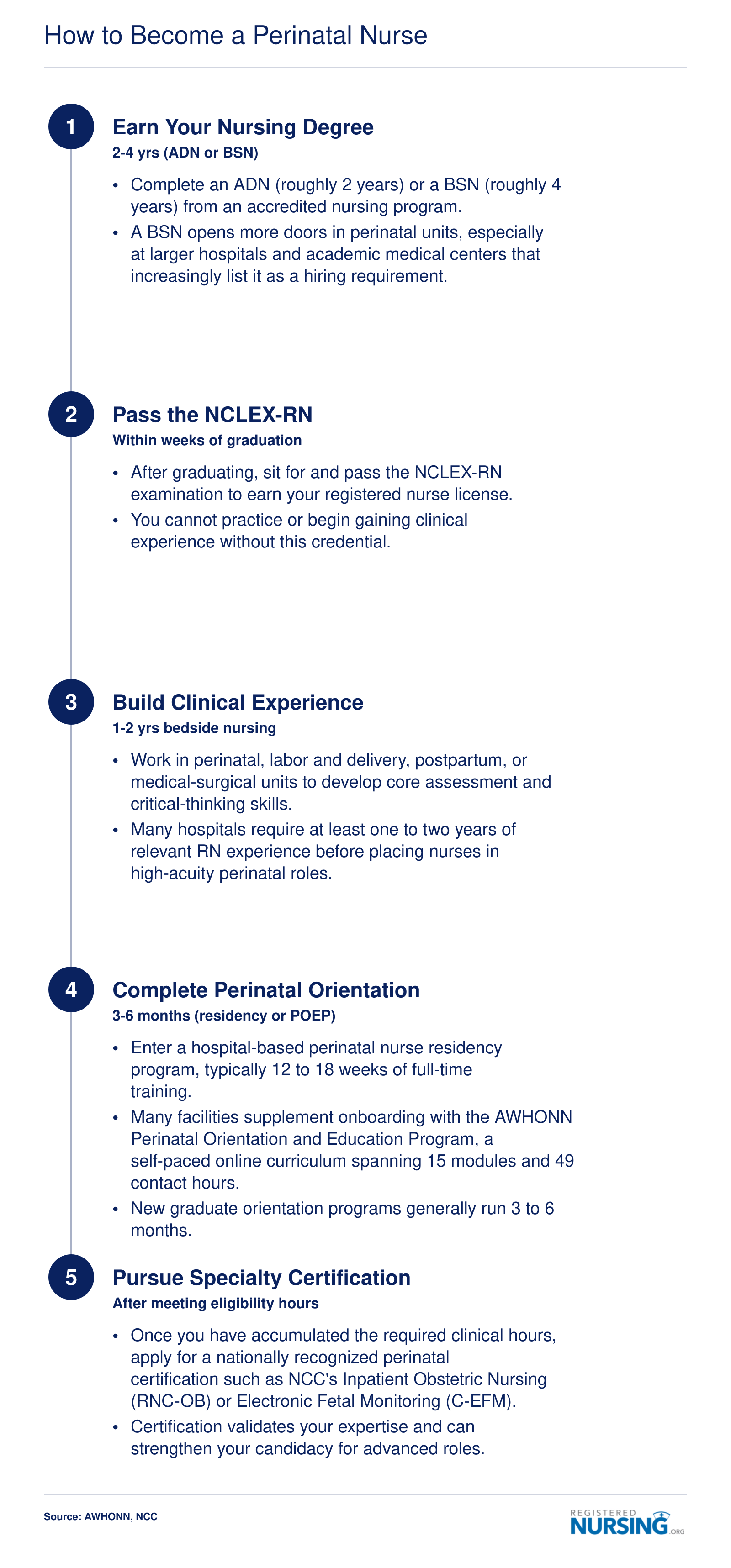
The path to becoming a perinatal nurse follows a clear progression that blends formal education, licensure, hands-on clinical training, and specialty certification. Most nurses can expect the full journey to take roughly 4 to 6 years from the start of their nursing program to earning a perinatal certification. A BSN is increasingly preferred and often required at academic medical centers, so consider that route if perinatal nursing is your goal from the start.
Perinatal Nurse Certifications and Credentials
Earning a specialized certification is one of the most effective ways to demonstrate your commitment and competence in perinatal nursing. While state licensure is mandatory to practice, voluntary board certifications, most notably those offered by the National Certification Corporation (NCC), signal to employers, colleagues, and patients that you have met rigorous national standards. Many healthcare facilities strongly prefer or even require certification for certain roles, and achieving it can lead to expanded responsibilities, charge nurse opportunities, and competitive salary differentials.
Key Perinatal Nursing Certifications
The NCC provides several credentials directly relevant to perinatal care. Among the most recognized are:
- RNC-OB (Inpatient Obstetric Nursing): This certification validates specialized knowledge in caring for women during labor, birth, and the immediate postpartum recovery period. It covers everything from fetal assessment to management of complications.
- C-EFM (Electronic Fetal Monitoring): Designed for nurses who use fetal monitoring technology, this credential demonstrates proficiency in interpreting fetal heart rate tracings and intervening appropriately.
- RNC-MNN (Maternal Newborn Nursing): This certification focuses on the care of mothers and newborns during the postpartum stay, emphasizing newborn assessment, breastfeeding support, and maternal recovery.
Each of these certifications has distinct eligibility requirements, such as a minimum number of practice hours and a current RN license. Because the NCC periodically updates exam content outlines, fees, and prerequisites, the precise criteria should always be confirmed through official channels.
How to Navigate Certification Requirements
To avoid outdated or incorrect information, follow these reliable paths:
- Visit the NCC website directly. The NCC is the sole authority on its certifications. You'll find the most current eligibility criteria, exam applications, and fee schedules there.
- Consult AWHONN. The Association of Women's Health, Obstetric and Neonatal Nurses often shares study resources, policy updates, and links to certification changes. While not the certifying body, it is a trusted professional organization that supports perinatal nurses.
- Talk to your employer or academic program. Your workplace's credentialing department can clarify whether they have specific requirements or reimbursement policies for certification. Similarly, accredited perinatal nursing programs stay informed about industry shifts and may offer exam preparation courses aligned with the latest NCC standards.
- Use BLS for salary data only. For general career outlook figures, refer to the Bureau of Labor Statistics, but remember that certification details are managed exclusively by NCC.
Maintaining Your Certification
Certification isn't a one-time achievement. NCC credentials are renewed on a cycle, typically every three years, through continuing education or re-examination. To stay current, log your contact hours in approved perinatal topics and submit renewal applications on time. Many nurses find that their employer supports this process by offering in-house education or financial assistance. Nurses who pursue ongoing credentialing often position themselves well for roles in community and public health nursing and other settings that value documented specialty expertise.
Perinatal Nurse Salary: National Overview
Because the Bureau of Labor Statistics (BLS) does not track perinatal nurses as a separate occupation, salary data falls under the broader Registered Nurses category. The figures below, drawn from the 2024 Occupational Employment and Wage Statistics published by the BLS, offer a reliable baseline. Perinatal nurses with specialty certifications or advanced experience may earn above these medians, particularly in high cost of living regions or at large academic medical centers.
| Pay Metric | Annual Salary |
|---|---|
| 25th Percentile | $78,610 |
| Median (50th Percentile) | $93,600 |
| Mean (Average) | $98,430 |
| 75th Percentile | $107,960 |
Perinatal Nurse Salary by State
Where you practice matters almost as much as how long you have practiced, because geographic location and local cost of living can shift perinatal nurse earnings significantly, even among nurses with identical credentials. Understanding the resources available to research these differences can help you make informed decisions about relocation, negotiation, and long-term career planning.
Using Federal Wage Data
The U.S. Bureau of Labor Statistics publishes Occupational Employment and Wage Statistics for registered nurses, which you can filter by state and by industry, such as general medical and surgical hospitals. While BLS data does not isolate perinatal nurses as a separate occupation, it does report wage percentiles. Comparing the 10th percentile (often a proxy for entry-level pay) with the 90th percentile (representative of senior or highly experienced nurses) gives you a useful window into how compensation grows over a career within your state.
Salary Aggregator Platforms
Sites like Payscale and Salary.com allow you to search specifically for "perinatal nurse" or "OB nurse" salaries. Many of these platforms let you filter results by years of experience, breaking ranges into bands such as zero to two years, five to ten years, and fifteen or more years. Some also display experience-based pay charts so you can visualize how compensation typically rises over time. Keep in mind that self-reported data can vary in accuracy, so treat these figures as helpful benchmarks rather than guarantees.
Professional Association Resources
Organizations like the Association of Women's Health, Obstetric and Neonatal Nurses (AWHONN) and the American Nurses Association periodically publish salary surveys or career resources that touch on perinatal nursing compensation. These reports sometimes include experience-based pay ranges and may be available through member portals or career centers. If you are already a member, checking these resources during annual survey release windows can give you specialty-specific insight that general aggregator sites may lack. For context, comparing how other specialties report compensation, such as cardiac nurse salary data from professional bodies, can help you benchmark perinatal pay against similar acute-care roles.
Direct Employer Research
Many hospitals and health systems post salary ranges for nursing positions on their career pages or in job listings. Reaching out to a human resources department can sometimes yield information about typical pay progression across experience levels at that facility. Additionally, some state nursing workforce development boards and nursing schools publish compensation reports that reflect local market conditions. Combining data from multiple sources: federal statistics, aggregator platforms, professional associations, and direct employer research, gives you the most complete picture of what you can expect to earn as a correctional nurse salary comparison illustrates, even within the same state, different care settings can produce notably different pay scales, and the same holds true for perinatal nursing.
Highest-Paying Metro Areas for Perinatal Nurses
The Bureau of Labor Statistics does not track perinatal nurses as a separate category, so the figures below reflect registered nurse wages across major metropolitan areas. Because perinatal nurses typically work in high-acuity hospital settings, their actual compensation may differ from these general RN benchmarks. California and Northeast metros consistently rank among the highest-paying regions, though cost of living should be factored into any relocation decision.
| Metropolitan Area | Total RN Employment | 25th Percentile Salary | Median Salary | Mean Salary | 75th Percentile Salary |
|---|---|---|---|---|---|
| San Francisco, Oakland, Fremont, CA | 40,750 | $150,580 | $188,020 | $178,450 | $212,190 |
| Los Angeles, Long Beach, Anaheim, CA | 107,340 | $108,150 | $133,440 | $138,010 | $165,290 |
| Seattle, Tacoma, Bellevue, WA | 37,250 | $101,140 | $118,570 | $120,260 | $132,160 |
| New York, Newark, Jersey City, NY/NJ | 195,470 | $100,530 | $113,490 | $115,650 | $128,430 |
| Boston, Cambridge, Newton, MA/NH | 66,440 | $84,200 | $102,440 | $115,710 | $137,160 |
| Minneapolis, St. Paul, Bloomington, MN/WI | 40,510 | $87,670 | $102,240 | $102,790 | $116,000 |
| Washington, Arlington, Alexandria, DC/VA/MD/WV | 43,640 | $83,570 | $101,800 | $102,510 | $110,760 |
| Philadelphia, Camden, Wilmington, PA/NJ/DE/MD | 74,840 | $84,040 | $99,210 | $97,510 | $107,800 |
| Dallas, Fort Worth, Arlington, TX | 72,640 | $79,170 | $98,740 | $96,720 | $106,850 |
| Phoenix, Mesa, Chandler, AZ | 46,330 | $82,270 | $98,160 | $96,220 | $105,900 |
| Houston, Pasadena, The Woodlands, TX | 65,300 | $79,640 | $97,810 | $96,730 | $105,970 |
| Atlanta, Sandy Springs, Roswell, GA | 54,370 | $79,700 | $96,370 | $96,640 | $107,550 |
| Chicago, Naperville, Elgin, IL/IN | 100,620 | $81,320 | $96,480 | $94,580 | $104,730 |
| Detroit, Warren, Dearborn, MI | 44,280 | $81,140 | $88,980 | $92,680 | $101,880 |
| Miami, Fort Lauderdale, West Palm Beach, FL | 59,880 | $78,240 | $85,610 | $92,070 | $103,110 |
Where Do Perinatal Nurses Work?
High-acuity academic medical center or low-intervention birth center? The setting you choose shapes almost everything about your day as a perinatal nurse: the acuity of your patients, the size of your team, your schedule, and how much clinical autonomy you carry. Most perinatal RNs work in one of five environments, and each rewards a different temperament.
Academic Medical Centers
Large teaching hospitals see the most complex pregnancies: maternal cardiac disease, preeclampsia with severe features, multiples, and fetal anomalies requiring Level III or IV NICU support. Perinatal nurses here work alongside residents, maternal-fetal medicine specialists, and neonatologists. Expect 12-hour shifts, high patient acuity, frequent emergencies, and strong opportunities for research participation and clinical ladder advancement. This is the setting for nurses who thrive on complexity and teaching moments.
Community Hospitals
Community hospital L&D units handle the bulk of routine deliveries in the United States. Teams are smaller, relationships with providers are tighter, and nurses often float between labor, postpartum, and nursery. Acuity is lower on average, though high-risk patients get transferred out. Scheduling is still typically three 12s, and the culture tends to feel more like a close-knit unit than a sprawling department.
Freestanding Birth Centers
Birth centers focus on low-risk, physiologic birth, usually under midwifery-led care. Perinatal nurses here support unmedicated labor, water birth, and early postpartum recovery, then transfer any patient who develops complications. The pace is calmer, the philosophy is holistic nursing, and autonomy runs high, but you will not be starting mag drips or managing emergent cesareans.
Outpatient OB Clinics
Clinic-based perinatal nurses run prenatal visits, triage phone calls, coordinate diabetic and hypertensive pregnancies, teach childbirth classes, and manage postpartum follow-up. Hours are typically Monday through Friday, no nights or holidays, which appeals to nurses balancing family life.
Telehealth and Remote Monitoring
Telehealth is the fastest-growing setting. Nurses conduct virtual prenatal check-ins, monitor blood pressure and glucose remotely, and provide postpartum lactation and mental health support. This model is especially valuable in rural and underserved communities where in-person perinatal care is scarce, and nurses interested in that broader context may find the Guide to Rural Nursing a useful companion resource. Nurses drawn to fully remote schedules can also explore work from home nursing jobs across a range of specialties.
Career Advancement for Perinatal Nurses
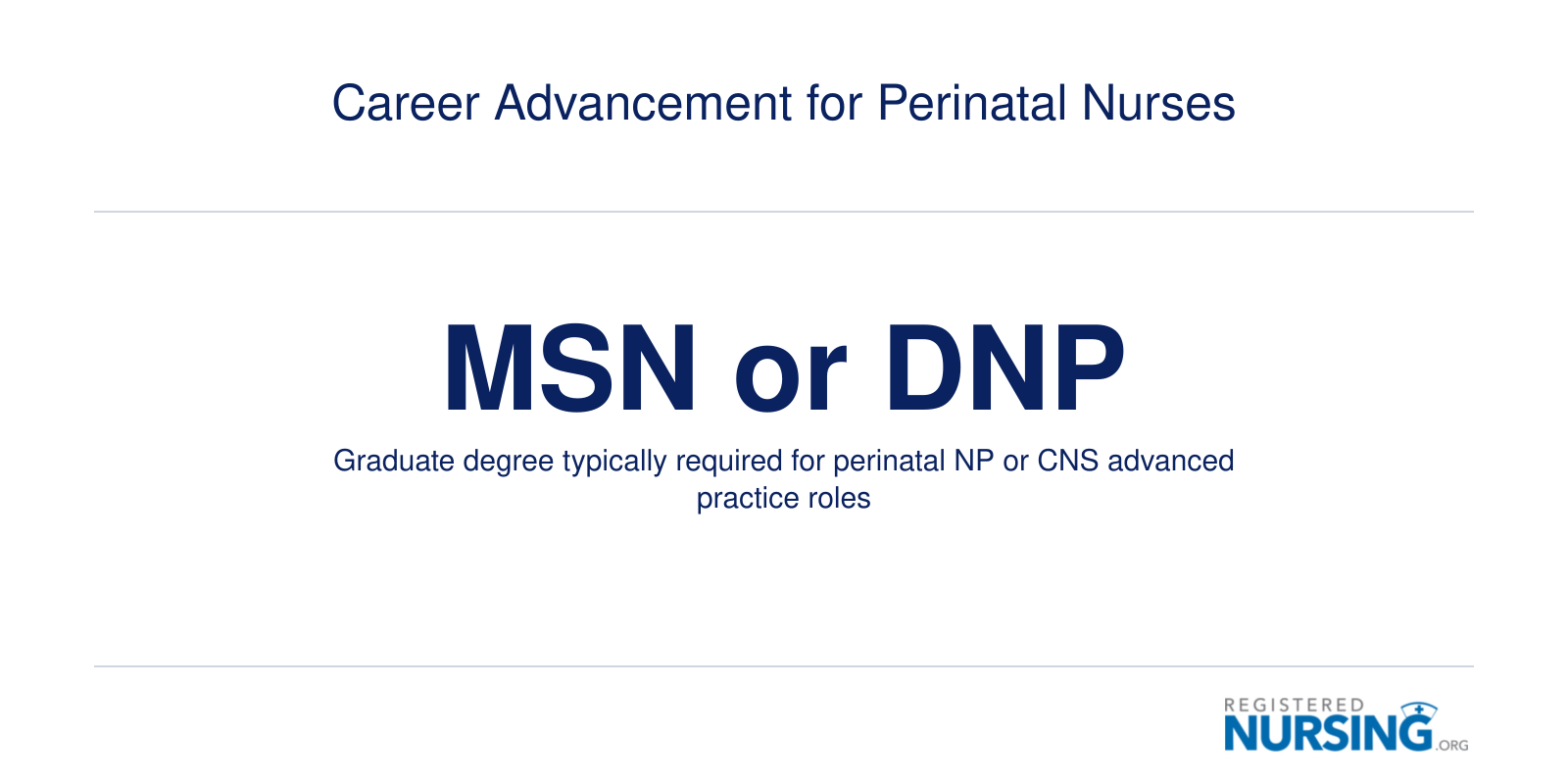
Perinatal nurses who pursue advanced practice roles can significantly expand their scope of practice and earning potential. Two primary pathways exist: the perinatal nurse practitioner (NP) route and the clinical nurse specialist (CNS) route. Both require graduate-level education, typically a Master of Science in Nursing (MSN) or a Doctor of Nursing Practice (DNP), though the clinical focus and prescriptive authority differ by role and state. Resources such as the American Association of Nurse Practitioners and the National Association of Clinical Nurse Specialists publish scope-of-practice statements and compensation surveys that can help you compare these tracks. For salary benchmarks, the Bureau of Labor Statistics reports compensation for nurse practitioners and registered nurses separately, though CNS roles are sometimes grouped with one or the other depending on reporting methodology. Prospective advanced practice nurses should also consult their state board of nursing for official scope-of-practice guidelines and review accredited program curricula to understand clinical hour requirements for each pathway.
Frequently Asked Questions About Perinatal Nursing
Below are answers to some of the most common questions prospective perinatal nurses ask. Each response offers a brief overview, and you can find more comprehensive information in the corresponding sections of this guide.
What does a perinatal RN do?
How is a perinatal nurse different from a labor and delivery nurse?
What certifications do perinatal nurses need?
How long does it take to become a perinatal nurse?
What is a perinatal nurse practitioner?
How much do perinatal nurses make by state?
Explore More
- Ambulatory Care Nurse
- Burn Unit Nurse
- Cardiac Nurse
- Cath Lab Nurse
- Charge Nurse
- Chief Nursing Officer (CNO)
- Correctional Nurse
- CVOR Nurse
- Dermatology Nurse
- Developmental Disability Nurse
- Director of Nursing
- Domestic Violence Nurse
- Emergency Room Nurse
- ENT Nurse
- ET Nurse
- Fertility Nurse
- Flight/Transport Nurse
- Forensic Nurse Salary & Career Guide
- Genetic Nurse
- Geriatric Nurse
- Health Policy Nurse
- Healthcare Administrator
- Healthcare Manager
- Home Health Nurse
- Hospice Nurse
- Camp Nurse
- GI Nurse
- Holistic Nurse
- Labor and Delivery Nurse
- Nurse Writer
- Psychiatric Nurse
- School Nurse
- Telemetry Nurse
- Travel Nurse
- Aesthetic Nurse
- Infusion/IV Nurse
- Oncology Nurse
- ICU Nurse
- Infection Control Nurse
- Legal Nurse Consultant
- LTC Nurse
- Managed Care Nurse
- Medical-Surgical Nurse
- Military (Combat) Nurse
- Missionary Nurse
- Mother Baby Nurse
- Nephrology Nurse
- Neuroscience Nurse
- NICU Nurse
- Nurse Administrator
- Nurse Attorney
- Nurse Care Coordinator
- Nurse Case Manager
- Nurse Entrepreneur
- Nurse Executive
- Nurse Health Coach
- Nurse Manager
- Obstetric (OB) Nurse
- Occupational Health Nurse
- Operating Room Nurse
- Ophthalmic Nurse
- Organ Procurement Coordinator
- Orthopedic Nurse
- Pain Management Nurse
- Palliative Care Nurse
- Parish Nurse
- Patient Advocate Nurse
- Pediatric Endocrinology Nurse
- Perianesthesia (PACU) Nurse
- Plastic Surgery Nurse
- Public/Community Health Nurse
- Radiology Nurse
- Rehabilitation Nurse
- Research Nurse
- Respiratory Nurse
- Rheumatology Nurse
- Substance Abuse Nurse
- Telephone Triage Nurse
- Transcultural Nursing
- Transplant Nurse
- Trauma Nurse
- Wound Care Nurse (WOCN)