

What you’ll learn in this article…
- Certified nephrology nurses often earn 10 to 15 percent more than non-certified peers.
- CNN, CDN, and CCHT each target a different scope of practice.
- Growing CKD prevalence drives strong nephrology nurse demand through 2026 and beyond.
A nephrology nurse might spend the morning titrating medications for a newly diagnosed CKD patient and the afternoon managing a dialysis treatment for someone who has been on the machine for a decade. That breadth defines the specialty: nephrology nursing covers the full arc of kidney disease, from early intervention through transplant follow-up.
Nephrology nurses are registered nurses who specialize in caring for patients with kidney-related conditions, including chronic kidney disease (CKD), acute kidney injury, end-stage renal disease (ESRD), and post-transplant recovery. Nurses drawn to this specialty often find that their work intersects with transplant nursing as patients progress through the full continuum of renal care.
Rising rates of diabetes and hypertension, the two leading causes of kidney failure, are driving steady demand for nurses with renal expertise across hospitals, dialysis clinics, and outpatient centers. The specialty rewards nurses who become comfortable with complex medication regimens, fluid and electrolyte balance, and the long-term relationships that chronic care demands.
How to Become a Certified Nephrology Nurse
Becoming a certified nephrology nurse is a four-to-six-year journey that begins with earning a nursing degree, passing the national licensing exam, building hands-on experience in kidney care, and then qualifying for a specialty credential. The timeline and requirements are straightforward, but understanding where each piece fits helps you plan strategically from the start.
Earn Your Nursing Degree and RN License
The first step is completing an Associate Degree in Nursing (ADN), which takes about two years, or a Bachelor of Science in Nursing (BSN), which typically requires four years. Both paths qualify you to sit for the NCLEX-RN, the national licensure exam that every state requires. Once you pass the NCLEX and receive your RN license, you are eligible to work in any nursing specialty, including nephrology.
Employer preferences have shifted in recent years. Outpatient dialysis providers such as DaVita and Fresenius Medical Care accept ADN-prepared nurses and often hire new graduates into their residency programs. DaVita's Transition to Practice program, for example, is open to ADN-prepared clinicians.2 In contrast, Magnet-designated hospitals and transplant centers increasingly prefer or require a BSN for nephrology roles.3 If your goal is to work in an acute-care or transplant setting, starting with a BSN or planning an RN-to-BSN bridge early in your career is a strategic move.
Accumulate Two Years of Nephrology Experience
The Nephrology Nursing Certification Commission requires 2,000 hours of nephrology-specific clinical practice within the past three years before you can sit for the Certified Nephrology Nurse (CNN) exam. That translates to roughly two years of full-time work. New graduates typically meet this requirement by working in outpatient dialysis centers, which hire aggressively and offer structured training. DaVita's Bridge to Your Dream tuition reimbursement and Global Nephrology Resident program both help early-career nurses build the clinical hours they need while gaining exposure to chronic dialysis, acute care, and transplant nephrology.4
Pass the Certification Exam
Once you have your clinical hours documented, you apply to take the CNN exam. Certification is voluntary in most settings. Fresenius Medical Care does not require it at hire and does not offer a pay differential or reimbursement for exam fees.5 DaVita prefers certification but does not mandate it. Still, certified nephrology nurses consistently report higher salaries and faster advancement, making the credential a worthwhile investment once you meet the experience threshold.
In total, the path from starting nursing school to earning CNN certification takes four to six years, depending on your degree choice and how quickly you accumulate nephrology hours. The next section compares the three main nephrology credentials so you can choose the certification that aligns with your career goals.
Nephrology Nursing Certifications: CNN Vs. CDN Vs. CCHT
Three credentials dominate the nephrology nursing landscape, each targeting a different professional level and scope of practice. The Certified Nephrology Nurse (CNN) and Certified Dialysis Nurse (CDN) are designed for registered nurses, while the Certified Clinical Hemodialysis Technician (CCHT) serves dialysis technicians who may not hold an RN license. All three are issued by the Nephrology Nursing Certification Commission (NNCC) and follow a three year renewal cycle.
| Feature | CNN | CDN | CCHT |
|---|---|---|---|
| Full Credential Name | Certified Nephrology Nurse | Certified Dialysis Nurse | Certified Clinical Hemodialysis Technician |
| Minimum Education | BSN or MSN with active RN license | Active RN license (no BSN required) | High school diploma or GED |
| Clinical Experience Required | 3,000 hours of nephrology nursing within the past 3 years | 2,500 hours of dialysis nursing experience | Must be a practicing dialysis technician |
| Continuing Education Prerequisite | 30 contact hours in nephrology nursing | 15 to 20 contact hours in dialysis nursing | Not specified beyond general eligibility |
| Exam Format | Computer based, 175 questions (150 scored, 25 unscored), 3.5 hours | Computer based, 150 to 175 questions, 3 to 3.5 hours | Computer based, 150 to 175 questions, 3 to 3.5 hours |
| Exam Fee | $350 | $300 to $350 | $200 to $250 |
| Renewal Cycle | Every 3 years | Every 3 years | Every 3 years |
| Best Suited For | RNs seeking broad nephrology expertise across acute, chronic, and transplant settings | RNs focused primarily on dialysis patient care | Dialysis technicians looking to validate clinical hemodialysis skills |
Questions to Ask Yourself
What Does a Nephrology Nurse Do?
Nephrology nurses care for patients across a wide spectrum of kidney disease, from early chronic kidney disease (CKD) management through end-stage renal disease (ESRD) and transplant recovery. The day-to-day work varies considerably depending on the clinical setting, but a few core responsibilities run through every role: close monitoring, meticulous patient education, and steady interdisciplinary communication.
Hemodialysis Nurses
In an outpatient dialysis center or hospital-based unit, hemodialysis nurses manage patients who typically come in three times a week for three-to-four-hour sessions. Core tasks include:
- Cannulation: Accessing arteriovenous fistulas or grafts safely and accurately, which is a skill that takes consistent practice to refine.
- Machine monitoring: Tracking blood flow rates, transmembrane pressure, and conductivity throughout the session to catch complications before they escalate.
- Fluid-shift assessments: Evaluating a patient's weight, blood pressure trends, and symptoms to determine how much fluid to remove without triggering cramps, hypotension, or cardiac stress.
The pace in a dialysis unit is structured but demanding. A single nurse may oversee four to six patients simultaneously, requiring strong prioritization skills.
Peritoneal Dialysis and Home Dialysis Nurses
Peritoneal dialysis (PD) nurses work with patients who perform their own exchanges at home, making education the primary intervention. These nurses train patients on catheter care, aseptic technique, and how to recognize early signs of peritonitis. Ongoing home-care coordination with social workers and equipment suppliers is a routine part of the job, and the nurse often serves as the patient's main clinical contact between clinic visits.
Transplant Nurses
Nurses working on transplant units or in transplant clinics cover a different scope entirely. Pre-operatively, they assist with donor-recipient workups and ensure patients meet readiness criteria. Post-operatively, the focus shifts to immunosuppression management, rejection surveillance, infection prevention, and long-term follow-up that can extend years beyond the surgery itself. The coordination required across these stages shares some parallels with what operating room nurses manage during complex surgical cases.
The Relational and Emotional Dimension
Across all three modalities, patient education is a constant. Nephrology nurses spend significant time coaching patients on fluid restrictions, low-phosphorus and low-potassium diets, and medication compliance, because adherence directly affects survival outcomes.
Beyond the clinical tasks, nephrology nursing carries a relational weight that is difficult to overstate. Many patients live with CKD or ESRD for years, and their nurses become familiar, trusted figures in their lives. That continuity can be deeply rewarding, and it also creates real risk of compassion fatigue when patients deteriorate or die. Honest conversations about burnout are increasingly common in nephrology nursing communities, alongside equally honest acknowledgment of the profound job satisfaction that long-term therapeutic relationships can bring. Geriatric nurses encounter a similar dynamic, given the chronic, long-term nature of care for aging populations.
Nephrologists, renal dietitians, social workers, and vascular surgeons all collaborate closely with nephrology nurses, making strong communication skills as important as any clinical technique.
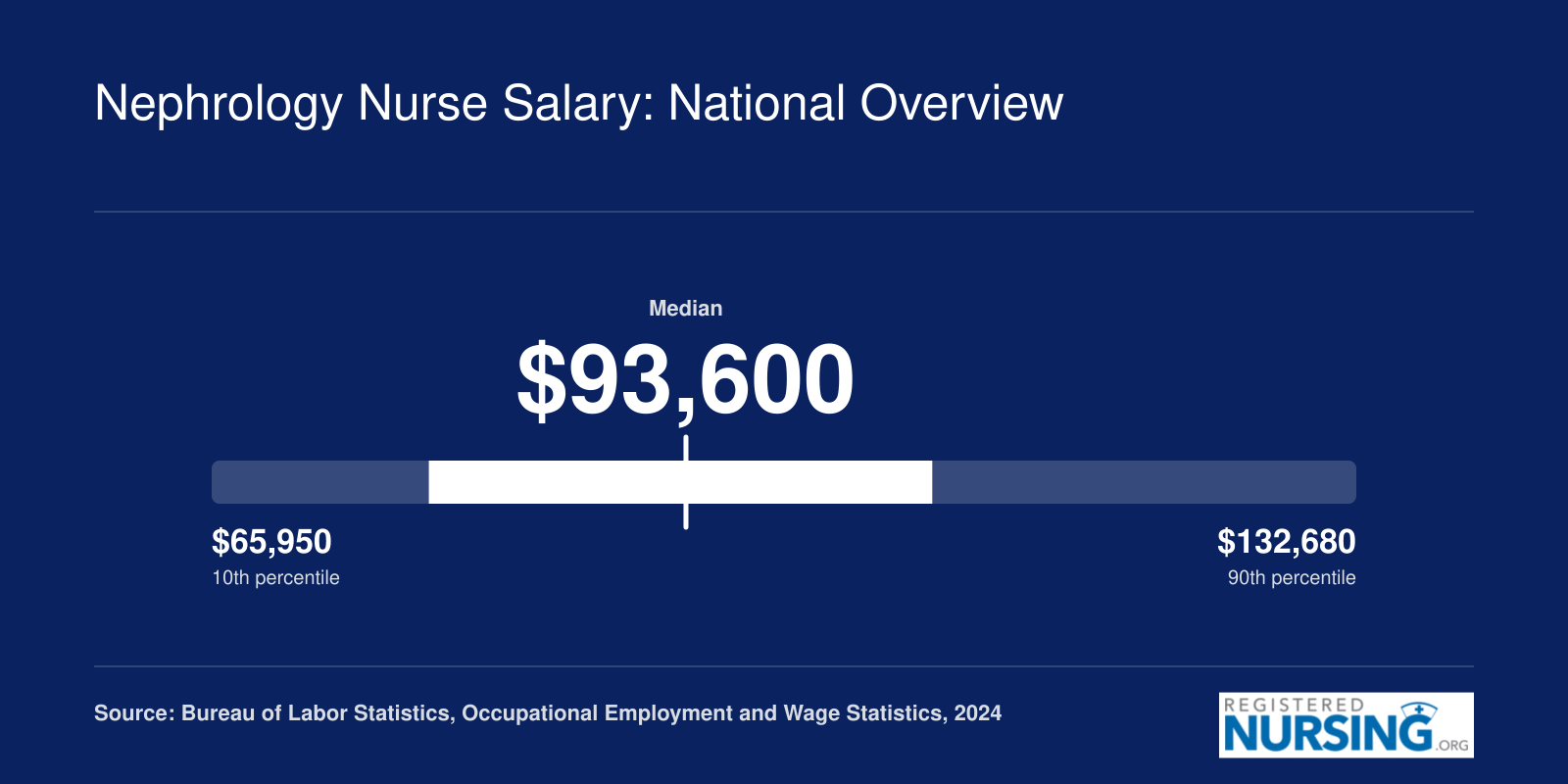
Nephrology Nurse Salary: National Overview
Nephrology nurses earn salaries in line with or slightly above the national registered nurse median. The figures below reflect BLS wage data for registered nurses, which serves as the closest available proxy for nephrology nursing compensation. Nurses who hold specialty certifications such as the CNN or CDN typically command a premium over non-certified peers, making certification a worthwhile investment for long-term earning potential.
Nephrology Nurse Salary by State
Because the Bureau of Labor Statistics does not report a separate category for nephrology nurses, the figures below reflect overall registered nurse pay in each state. Nephrology nurses with specialty certification often earn at or above these medians, particularly in states with high demand for dialysis and renal care services. Data is drawn from the Occupational Employment and Wage Statistics program (2024).
| State | Total RN Employment | 25th Percentile | Median Salary | 75th Percentile | Mean Salary |
|---|---|---|---|---|---|
| Rhode Island | 10,760 | $83,870 | $99,960 | $112,540 | $99,770 |
| Arizona | 64,430 | $81,390 | $96,890 | $105,450 | $95,230 |
| New Hampshire | 16,580 | $79,720 | $96,830 | $105,500 | $94,620 |
| Maryland | 48,980 | $81,470 | $96,830 | $104,840 | $96,650 |
| Colorado | 54,510 | $81,790 | $96,520 | $104,370 | $95,470 |
| Delaware | 13,260 | $82,600 | $92,610 | $108,360 | $95,450 |
| Texas | 261,050 | $77,450 | $90,010 | $102,200 | $91,690 |
| Virginia | 77,420 | $77,650 | $88,820 | $100,920 | $90,930 |
| New Mexico | 17,510 | $82,630 | $88,260 | $104,720 | $94,360 |
| Pennsylvania | 146,840 | $78,570 | $87,610 | $102,030 | $90,830 |
| Georgia | 97,410 | $76,600 | $86,560 | $104,790 | $91,960 |
| Illinois | 139,900 | $79,150 | $86,410 | $103,660 | $91,130 |
| Idaho | 14,540 | $78,020 | $86,100 | $100,220 | $89,770 |
| Wisconsin | 64,960 | $79,570 | $86,070 | $100,680 | $90,450 |
| Michigan | 104,210 | $80,030 | $85,670 | $101,210 | $90,580 |
| Vermont | 7,240 | $79,980 | $85,150 | $104,110 | $92,710 |
| Maine | 16,280 | $76,890 | $82,860 | $98,000 | $87,440 |
| Florida | 218,100 | $77,070 | $82,850 | $99,260 | $88,200 |
| Utah | 25,780 | $77,030 | $82,270 | $101,530 | $88,240 |
| North Carolina | 108,510 | $74,710 | $81,860 | $98,720 | $86,270 |
| Wyoming | 5,180 | $75,540 | $81,790 | $100,910 | $88,020 |
| Montana | 10,540 | $77,800 | $81,560 | $100,510 | $88,480 |
| Ohio | 138,360 | $77,420 | $81,250 | $97,440 | $86,110 |
| Oklahoma | 32,870 | $75,320 | $81,160 | $96,460 | $85,800 |
| Nebraska | 24,180 | $76,430 | $81,020 | $93,140 | $82,890 |
Nephrology Nurse Salary by Experience Level
Early career versus seasoned specialist: the gap in nephrology nurse pay between those two points is substantial, and understanding where you fall on that spectrum helps you set realistic goals and plan your next move.
Because the Bureau of Labor Statistics does not break down wages by years of experience, the figures below draw from sources such as ZipRecruiter, Salary.com, and RNtoNP.com, which aggregate self-reported and employer-posted data.
Entry-Level (0-2 Years)
RNs entering nephrology right out of nursing school or making an early specialty switch typically earn somewhere between $82,000 and $95,000 annually.1 That range reflects roles in outpatient dialysis clinics, inpatient renal units, and hospital-based nephrology teams. Pay at this stage is largely determined by base RN wages in your region, the type of employer, and whether any shift differentials apply. Certification is not yet on the table (most require at least one to two years of nephrology-specific experience), so wages here reflect unlicensed specialty experience rather than credentialed expertise.
Mid-Career (3-7 Years)
This is where compensation shifts noticeably. Mid-career nephrology nurses generally see salaries in the $100,000 to $112,000 range. This window also coincides with eligibility for the Certified Nephrology Nurse (CNN) or Certified Dialysis Nurse (CDN) credential, and earning either one makes a measurable difference. Data from 2025 shows that CNN holders average around $103,200 per year, while CDN holders average roughly $98,750, compared to approximately $94,500 for non-certified nephrology RNs. That certification premium, often several thousand dollars annually, tends to compound over time through merit increases and competitive hiring leverage. Nurses curious about how nephrology credentials compare to other specialties will find useful context in this overview of advanced certifications available for nurses.
Senior and Experienced (8+ Years)
Nephrology nurses with eight or more years in the specialty typically earn between $112,000 and $125,000, with top earners approaching the 90th percentile of around $133,500.3 At this stage, moving into roles such as transplant coordinator, charge nurse, clinical educator, or nephrology nurse manager opens access to higher pay bands that can push compensation well above the standard staff nurse ceiling. Those considering an advanced practice pivot may also want to review nurse practitioner salary expectations to gauge how an NP credential reshapes earning potential over the long term.
Whichever stage you are at now, the trajectory is consistent: specialty experience, paired with certification, drives the most reliable upward movement in nephrology nursing pay.
Earning a Certified Nephrology Nurse credential can translate to a meaningful pay advantage: certified nephrology nurses often report salaries 10 to 15 percent higher than non-certified RNs working in the same renal care settings. Over a full career, that premium compounds significantly, making certification one of the highest-return investments a nephrology nurse can make.
Where Do Nephrology Nurses Work?
Your day-to-day schedule and scope will hinge more on where you work than on which certification you hold. Nephrology nursing spans five distinct practice settings, each with its own rhythm, staffing model, and clinical focus.
Outpatient Dialysis Centers
Dialysis clinics are the largest employer of nephrology nurses. DaVita and Fresenius Health Partners together operate more than 70 percent of U.S. dialysis centers, meaning most RNs in this specialty will work for one of these two chains or a smaller regional provider. Outpatient dialysis demands early mornings (first shift often begins at 5:30 a.m.), but the trade-off is predictable hours with minimal weekend or overnight work. You will manage a consistent panel of patients three times per week, building continuity that many nurses find rewarding.
The Certified Dialysis Nurse (CDN) credential aligns tightly with this setting and is often preferred or required for advancement to charge-nurse or clinical-coordinator roles.
Hospital Inpatient Nephrology Units
Inpatient nephrology units care for acutely ill patients with renal failure, electrolyte crises, or post-transplant complications. Expect rotating shifts, weekend obligations, and higher acuity. Staffing ratios are typically 4:1 to 5:1, tighter than med-surg but not as intensive as critical care. The Certified Nephrology Nurse (CNN) credential is the standard here, reflecting the broader clinical scope beyond dialysis alone.
Transplant Centers
Transplant nursing combines inpatient post-operative care with outpatient follow-up. On-call obligations are heavy: donor procurements and recipient surgeries occur around the clock. Schedules are the least predictable in nephrology, but the work is among the most specialized and financially rewarding. Nurses drawn to this setting may also want to explore the role of organ procurement coordinator, which intersects closely with transplant nursing.
Nephrology Physician Offices
Office-based roles center on chronic kidney disease management: patient education, pre-dialysis planning, and coordination of diagnostics. Hours are typically Monday through Friday, eight to five, with no weekends. Caseloads are high, but acuity is lower than inpatient or dialysis settings.
Home Health and Telehealth
Remote monitoring of peritoneal dialysis patients, telehealth triage for nephrology practices, and virtual nurse-educator roles are growing rapidly. Many positions are fully remote or hybrid, offering geographic flexibility. Nurses interested in these arrangements can find a broader look at remote nursing jobs across specialties. Certification requirements vary by employer, but CNN is increasingly expected for triage and clinical-decision roles.
Nephrology Nurse Job Outlook and Demand
Is nephrology nursing a stable career choice in 2026 and beyond? Yes. The field offers sustained demand driven by demographic shifts, chronic disease trends, and an aging nursing workforce, making it one of the more secure specialty pathways within registered nursing.
National RN Growth and Nephrology Context
The Bureau of Labor Statistics projects 5% job growth for registered nurses between 2024 and 2034, with approximately 189,100 annual openings nationwide.1 While that baseline applies to all RNs, nephrology-specific demand is expected to outpace general nursing growth for three compounding reasons:
- Aging population: Americans aged 65 and older are the fastest-growing demographic, and this cohort experiences chronic kidney disease at disproportionate rates.
- Rising CKD prevalence: More than 37 million Americans live with chronic kidney disease, and progression to end-stage renal disease continues to climb year over year.
- Kidney transplant waitlist growth: As of mid-2026, tens of thousands of patients remain on transplant waiting lists, requiring interim dialysis care and post-transplant nephrology nursing support.
These trends create specialty-specific openings that exceed the overall 5% RN projection, particularly in outpatient dialysis centers and transplant units.
Workforce Retirement and Dialysis Nurse Shortages
A significant portion of the current nephrology nursing workforce is approaching retirement age. The American Nephrology Nurses Association has documented ongoing concerns about succession planning and the need to recruit new nurses into dialysis and inpatient renal roles. Facilities report difficulty filling open positions, particularly in rural and underserved areas, and the gap between retiring nurses and incoming specialty-trained staff continues to widen.2 nursing shortages across states compound this pressure, as nephrology remains among the hardest specialties to staff in underserved markets.
Dialysis centers, which operate on tight staffing ratios mandated by federal regulation, are especially vulnerable to shortages. Many offer sign-on bonuses, tuition reimbursement for certification prep, and flexible shift structures to attract new hires.
Why Nephrology Nursing Is a Good Career
Beyond stable demand, nephrology nursing offers:
- Multiple practice settings: acute care, outpatient dialysis, transplant centers, home dialysis support, and research.
- Certification-driven advancement: CNN, CDN, and CCHT credentials open pathways to charge nurse, educator, and clinical coordinator roles with higher pay.
- Meaningful patient relationships: Many nephrology nurses work with the same patients over months or years, building continuity of care that is rare in other specialties.
For nurses seeking a specialty with longevity, intellectual challenge, and patient-centered focus, nephrology remains a compelling choice in 2026 and the decade ahead. Nurses who also manage vascular access or fluid therapies may find that experience in infusion nurse certification transfers well when moving between nephrology and other specialty settings.
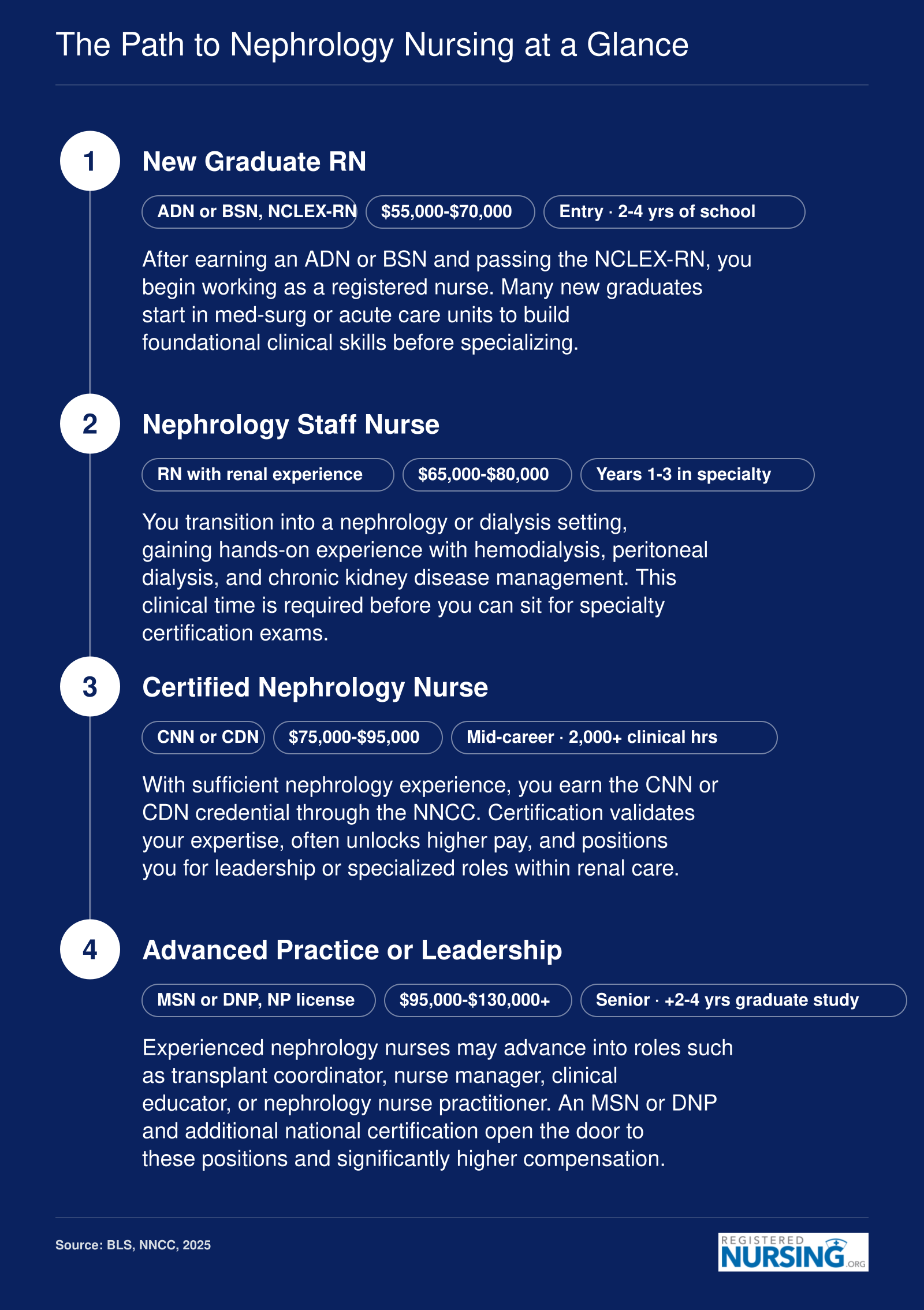
The Path to Nephrology Nursing at a Glance
Building a career in nephrology nursing follows a clear progression. Each stage adds clinical depth, credentials, and earning potential. Here is a snapshot of how the journey typically unfolds from your first nursing degree through advanced practice.
Helpful Organizations and Resources for Nephrology Nurses
The American Nephrology Nurses Association (ANNA) serves more than 8,000 members and stands as the premier professional organization for nurses working in kidney care. Whether you are just entering the specialty or looking to advance, connecting with the right organizations strengthens your clinical knowledge, expands your professional network, and keeps you current on evidence-based practice.
American Nephrology Nurses Association (ANNA)
ANNA offers a robust portfolio of continuing education, including an annual national symposium, regional conferences, and on-demand online modules that satisfy contact-hour requirements for license renewal and certification maintenance. Members also gain access to a career center with nephrology-specific job postings, mentorship programs, and the peer-reviewed Nephrology Nursing Journal. If you are serious about building a long-term nephrology career, ANNA membership is a practical starting point.
Nephrology Nursing Certification Commission (NNCC)
NNCC is the independent certifying body responsible for the Certified Nephrology Nurse (CNN), Certified Dialysis Nurse (CDN), and other nephrology credentials. The commission sets eligibility criteria, administers examinations, and oversees recertification. Visiting the NNCC website directly is the most reliable way to confirm current exam windows, fees, and continuing-education requirements for maintaining your credential.
National Kidney Foundation (NKF) and American Association of Kidney Patients (AAKP)
Both NKF and AAKP are patient-advocacy organizations, yet each provides educational resources that benefit nurses as well. NKF publishes clinical practice guidelines, sponsors research grants, and hosts community health events. AAKP offers patient-education materials that nephrology nurses can incorporate into counseling sessions, helping bridge the gap between clinical care and patient understanding.
Board of Nephrology Examiners Nursing and Technology (BONENT)
For readers considering the Certified Clinical Hemodialysis Technician (CCHT) pathway, BONENT is the certifying body to know. BONENT administers the CCHT examination and provides study resources and practice tests. Technician-level certification can serve as a stepping stone for those who plan to pursue nursing education and eventually earn the CNN or CDN. Nurses who enjoy other procedure-intensive environments, such as cardiac care nurses who monitor patients with complex cardiovascular conditions, follow a similarly credential-driven path.
Why These Resources Matter
Each of these organizations represents an authoritative, externally recognized source of nephrology knowledge. Engaging with them signals to employers, patients, and peers that you are committed to validated standards of care. Bookmark their sites, subscribe to their newsletters, and take advantage of member benefits. Nurses drawn to other specialty tracks, such as oncology nurses working in hematology and cancer care, will find that specialty organizations play an equally vital role in professional development. Investing a small amount of time in these professional communities pays dividends throughout your nephrology nursing career.
Nephrology Nurse FAQs
Below are answers to some of the most common questions prospective and practicing nephrology nurses ask. Each response draws on the certification details, salary data, and career information covered throughout this guide.
- How long does it take to become a nephrology nurse?
- The timeline depends on your starting point. Earning an ADN typically takes about two years, while a BSN takes four years. After graduating and passing the NCLEX-RN, you will need to gain clinical experience in nephrology, usually around two years, before you are eligible for certification. In total, most nurses can enter the specialty within four to six years of starting their education.
- What is the difference between a certified dialysis nurse and a certified nephrology nurse?
- A Certified Nephrology Nurse (CNN) has a broad scope that covers the full spectrum of kidney care, including chronic kidney disease management, transplant coordination, and dialysis. A Certified Dialysis Nurse (CDN) focuses specifically on hemodialysis and peritoneal dialysis treatments. Both credentials are offered by the Nephrology Nursing Certification Commission (NNCC), but the CDN is more narrowly targeted toward dialysis practice settings.
- How much does a nephrology nurse make?
- Nephrology nurse salaries vary by location, experience, and certification status. On a national level, most nephrology nurses earn competitive wages that align with or exceed the median for registered nurses overall. Certified nephrology nurses often command higher pay than their non-certified peers, and those working in metropolitan areas or states with a higher cost of living tend to see the strongest compensation.
- What are the requirements to become a certified nephrology nurse?
- To sit for the CNN exam, you must hold a current, unrestricted RN license and have completed a minimum number of practice hours in nephrology nursing within a defined timeframe. The NNCC sets specific eligibility criteria, which typically include at least two years of nephrology nursing experience. A BSN is not strictly required, but it can strengthen your candidacy and open additional career doors.
- Is nephrology nursing a good career?
- Yes. The growing prevalence of chronic kidney disease and diabetes continues to drive strong demand for nephrology nurses. The specialty offers a variety of work settings, from outpatient dialysis centers to transplant programs and acute care hospitals. Nurses in the field often cite meaningful patient relationships and the ability to make a tangible difference in long-term outcomes as key reasons they find the career rewarding.
- Can you become a nephrology nurse with an ADN?
- You can. An Associate Degree in Nursing qualifies you to take the NCLEX-RN and begin working as a registered nurse. From there, you can gain nephrology experience and pursue certification such as the CNN or CDN. However, many employers increasingly prefer or require a BSN, and earning one through an RN to BSN bridge program can improve your job prospects, salary potential, and eligibility for advanced roles.
Explore More
- Ambulatory Care Nurse
- Burn Unit Nurse
- Cardiac Nurse
- Cath Lab Nurse
- Charge Nurse
- Chief Nursing Officer (CNO)
- Correctional Nurse
- CVOR Nurse
- Dermatology Nurse
- Developmental Disability Nurse
- Director of Nursing
- Domestic Violence Nurse
- Emergency Room Nurse
- ENT Nurse
- ET Nurse
- Fertility Nurse
- Flight/Transport Nurse
- Forensic Nurse Salary & Career Guide
- Genetic Nurse
- Geriatric Nurse
- Health Policy Nurse
- Healthcare Administrator
- Healthcare Manager
- Home Health Nurse
- Hospice Nurse
- Camp Nurse
- GI Nurse
- Holistic Nurse
- Labor and Delivery Nurse
- Nurse Writer
- Psychiatric Nurse
- School Nurse
- Telemetry Nurse
- Travel Nurse
- Aesthetic Nurse
- Infusion/IV Nurse
- Oncology Nurse
- ICU Nurse
- Infection Control Nurse
- Legal Nurse Consultant
- LTC Nurse
- Managed Care Nurse
- Medical-Surgical Nurse
- Military (Combat) Nurse
- Missionary Nurse
- Mother Baby Nurse
- Neuroscience Nurse
- NICU Nurse
- Nurse Administrator
- Nurse Attorney
- Nurse Care Coordinator
- Nurse Case Manager
- Nurse Entrepreneur
- Nurse Executive
- Nurse Health Coach
- Nurse Manager
- Obstetric (OB) Nurse
- Occupational Health Nurse
- Operating Room Nurse
- Ophthalmic Nurse
- Organ Procurement Coordinator
- Orthopedic Nurse
- Pain Management Nurse
- Palliative Care Nurse
- Parish Nurse
- Patient Advocate Nurse
- Pediatric Endocrinology Nurse
- Perianesthesia (PACU) Nurse
- Perinatal Nurse
- Plastic Surgery Nurse
- Public/Community Health Nurse
- Radiology Nurse
- Rehabilitation Nurse
- Research Nurse
- Respiratory Nurse
- Rheumatology Nurse
- Substance Abuse Nurse
- Telephone Triage Nurse
- Transcultural Nursing
- Transplant Nurse
- Trauma Nurse
- Wound Care Nurse (WOCN)