

What you’ll learn in this article…
- COHN and COHN-S certifications differ by education level and exam scope.
- BLS projects 5 percent RN growth nationally from 2024 to 2034.
- Certified occupational health nurses typically earn 10 to 15 percent more.
Occupational health nurses are registered nurses who identify, prevent, and manage workplace injuries, illnesses, and environmental hazards. Unlike emergency nurses who focus on acute crisis care or case managers who coordinate care across settings, OHNs specialize in the intersection of worker well-being, employer compliance, and safety engineering.
Their role demands fluency in OSHA regulations, workers' compensation, and population health analytics, making the COHN or COHN-S certification a near-requirement for advancement. The specialty's growth is tied directly to employer demand for lower injury rates and reduced insurance premiums, not just nursing workforce trends.
How to Become an Occupational Health Nurse Step by Step
Most nurses enter occupational health after gaining foundational clinical experience in another specialty, then layering on certification once they understand workplace health systems. The transition rewards nurses who bring assessment skills, an eye for prevention, and comfort navigating regulatory frameworks. Here is the complete roadmap from nursing school through certification.
Start with RN Licensure
Becoming an occupational health nurse begins with earning initial RN licensure. You have two pathways: complete a Bachelor of Science in Nursing (BSN), which typically takes four years, or earn an Associate Degree in Nursing (ADN) in two to three years and later bridge to a BSN if desired. Weighing ADN vs BSN carefully helps you choose the path that best fits your timeline and career goals. All candidates must then pass the NCLEX-RN examination to practice as a registered nurse. Many employers prefer or require a BSN for occupational health roles because the degree includes coursework in community health, epidemiology, and health promotion that aligns closely with workplace health missions.
Build Clinical Experience
After licensure, plan to work two to three years in a clinical setting before moving into occupational health. Emergency department, medical-surgical, urgent care, and public health nursing roles provide the most transferable skills. ER and urgent care build rapid triage and acute-injury management capabilities. Medical-surgical rotations strengthen physical assessment and chronic-disease monitoring. Public health experience cultivates population-level thinking, health education design, and regulatory familiarity. All three backgrounds prepare you to handle the wide clinical variety and independent decision-making that define occupational health nursing.
Pursue Specialty Training and Certification
Once you have the required experience, you are eligible to sit for the Certified Occupational Health Nurse (COHN) or Certified Occupational Health Nurse-Specialist (COHN-S) examination administered by the American Board for Occupational Health Nurses. Both certifications require an active, unrestricted RN license and at least 3,000 hours of occupational health nursing practice within the past five years. No separate occupational health nursing license exists. COHN and COHN-S are credentials layered on top of your RN license, signaling advanced competency to employers and regulatory agencies.
Consider Advanced Degrees for Leadership Roles
If you plan to lead corporate health programs, consult on ergonomics and industrial hygiene, or practice as an occupational health nurse practitioner, consider earning a Master of Science in Nursing (MSN) or Doctor of Nursing Practice (DNP) with a focus in occupational health, public health, or adult-gerontology primary care. Preparing for graduate programs early, including reviewing nurse practitioner school interview questions, gives you a competitive edge when applying. These degrees are optional for staff-level occupational health nurses but open pathways to program director, compliance officer, and independent-practice roles.
Timeline from Start to Certification
From the first day of nursing school to earning COHN certification, expect five to seven years. A BSN takes four years, followed by two to three years of clinical work to meet certification eligibility. ADN-to-BSN bridge programs can extend the timeline by one to two years if pursued part-time while working. Nurses who begin in occupational health immediately after licensure will need three additional years of full-time practice before sitting for the exam.
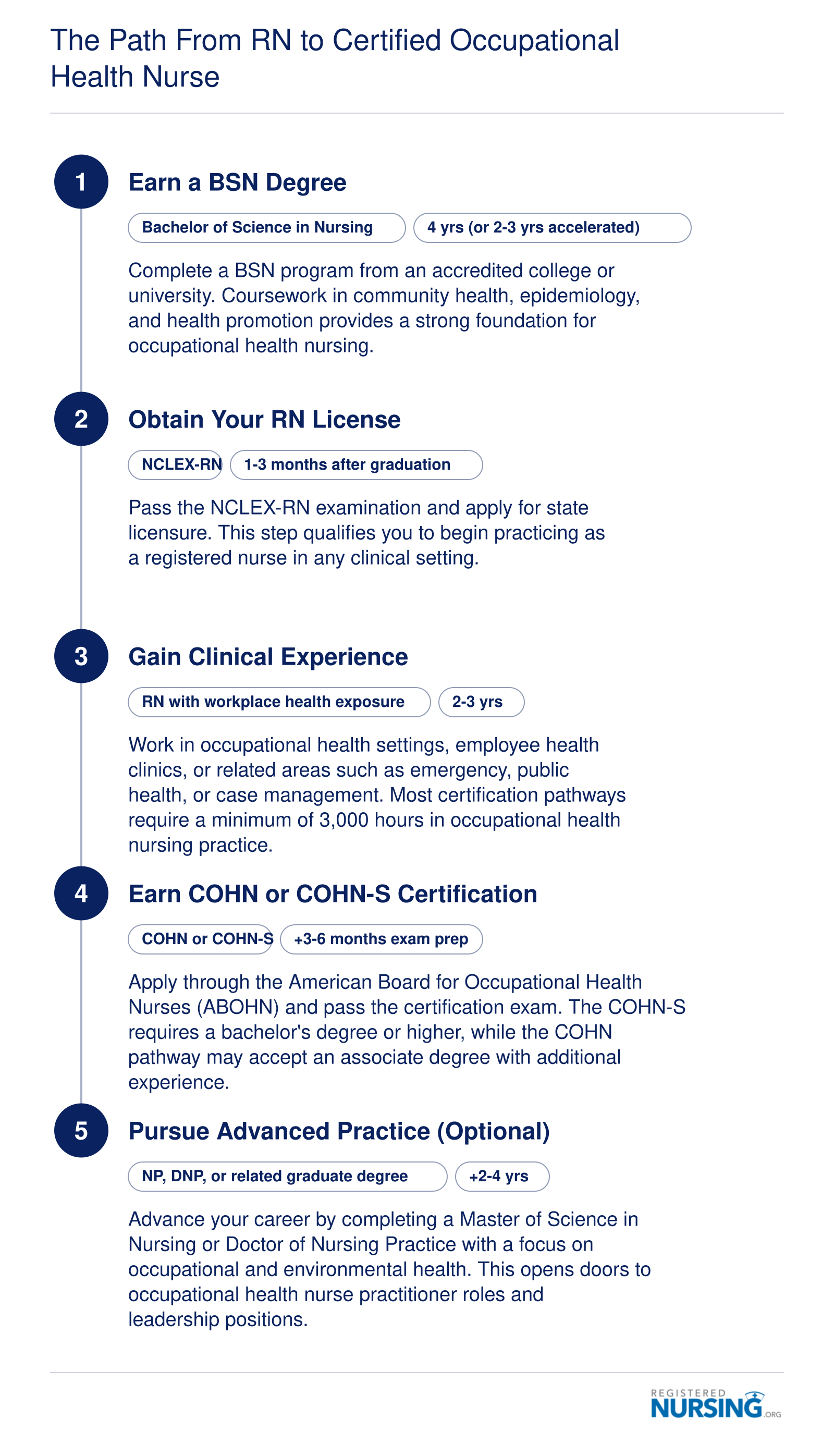
The Path From RN to Certified Occupational Health Nurse
Becoming a certified occupational health nurse is a structured journey that builds on your foundational nursing education and clinical experience. Here is a realistic timeline from your first day in a BSN program to advanced practice options.
COHN Vs. COHN-S Certification: Requirements, Exam, and Differences
Nurses entering occupational health can pursue two distinct board certifications: the Certified Occupational Health Nurse (COHN) and the Certified Occupational Health Nurse-Specialist (COHN-S). While both credentials validate expertise in worker health and safety, the COHN-S requires a bachelor's degree and covers broader management and research domains. Understanding the nuances helps you choose the path that aligns with your education and career goals.
Eligibility at a Glance
Both certifications demand an active, unrestricted RN license in the United States and at least 3,000 hours of occupational health nursing practice completed within the preceding five years.1 The educational threshold sets them apart. COHN candidates do not need a degree beyond their nursing diploma or associate's, whereas COHN-S applicants must hold a bachelor's or higher degree in nursing or a related field.1 This distinction reflects the specialist-level focus on program coordination, policy development, and advanced case management.
Exam Structure and Content Domains
The COHN and COHN-S exams are identical in format. Each is a computer-based, multiple-choice test with 160 total questions, of which 135 are scored and 25 are unscored pretest items.2 Candidates have three hours to complete the exam. While both tests assess core occupational health nursing knowledge, the COHN concentrates on clinical care, direct worker interaction, hazard recognition, and regulatory compliance. The COHN-S adds a heavier emphasis on management, administration, research, and education principles. ABOHN publishes detailed content outlines for both exams, so reviewing those early in your preparation is wise.
Application Process and Fees
Applying for either certification involves submitting an online application to ABOHN along with the required documentation. As of 2026, the application fee is $150 and the exam fee is $400, for a combined total of $550. This fee structure is the same for initial candidates and for those retaking the exam. ABOHN will notify you of your eligibility, after which you schedule the test at a Prometric testing center. Fees are nonrefundable, so confirm you meet all requirements before applying.
Renewal and Continuing Competency
Both credentials follow a five-year renewal cycle. To recertify, you must earn 50 contact hours of continuing education in occupational health and safety topics, or you can retake the certification exam.4 ABOHN also offers a flexible option that combines fewer CE hours with professional activities such as writing articles, presenting at conferences, or developing workplace programs. The recertification handbook, last updated in 2022, remains current with no major revisions announced for the 2026 cycle. Staying engaged in lifelong learning helps you maintain the credential and stay current with evolving workplace health challenges. Nurses who move into managed care nursing roles after earning the COHN-S often find that the credential's emphasis on program coordination transfers directly to those settings.
Which Certification is Right for You?
If you hold an associate degree or diploma and want to demonstrate foundational occupational health expertise, the COHN is the direct path. If you already have a bachelor's or plan to earn one and you aspire to leadership, program management, or consultant roles, the COHN-S aligns with that trajectory. Many employers recognize both credentials, but the COHN-S may be preferred for positions involving policy development and interdisciplinary collaboration. Nurses drawn to patient advocate nurse responsibilities within occupational health will also find the COHN-S's case management domains especially relevant.
Questions to Ask Yourself
Certification Exam Preparation: Pass Rates, Study Resources, and Tips
Preparing for the COHN or COHN-S exam requires a structured approach to content review, practice testing, and time management, but the right study resources can make the difference between a passing score and another attempt. Understanding where to find authoritative information and how to prepare effectively will help you approach exam day with confidence.
Official Exam Statistics and Candidate Information
The American Board for Occupational Health Nurses (ABOHN) publishes candidate handbooks and exam statistics on its website at abohn.org. These documents outline current eligibility requirements, application deadlines, and testing windows for both the COHN and COHN-S credentials. While ABOHN releases aggregate pass rate data periodically, specific figures vary by year and exam cycle. The candidate handbook is the most reliable source for understanding the exam blueprint, including content distribution across domains such as case management, health promotion, legal and regulatory issues, and emergency response. Review the handbook thoroughly before beginning your study plan to ensure you allocate time proportionally to the exam's emphasis areas.
Recognized Review Courses and Study Materials
Several organizations offer structured review courses designed specifically for the ABOHN exams. The Institute for Health and Productivity Management (IHPM) and the American Association of Occupational Health Nurses (AOOHN) both provide continuing education programs and exam preparation workshops that align with the COHN and COHN-S content outlines. ABOHN also recommends authoritative textbooks such as "Occupational Health Nursing" by Salazar, which covers the breadth of practice areas tested on the exam. Many candidates find that combining a comprehensive textbook with a live or recorded review course helps reinforce key concepts and identify knowledge gaps. Additionally, practice exams and question banks allow you to gauge your readiness and become familiar with the question format. If you are weighing how nursing exam pass rate data factors into your school or program selection, resources on how to read NCLEX-RN pass rate data offer useful context for interpreting aggregate statistics.
Nurse Practitioner-Level Occupational Health Certification
For advanced practice registered nurses seeking occupational health nurse practitioner credentials, the American Nurses Credentialing Center (ANCC) website is a primary resource. Search for "Occupational Health Nurse Practitioner" to identify current certification options and eligibility pathways. Requirements vary by state, so verify your state board of nursing regulations and consult the Bureau of Labor Statistics O*NET database for role definitions and competency frameworks. Graduate programs such as those at the University of Cincinnati and the University of Washington offer specialized occupational health nursing curricula at the master's or doctoral level, and program coordinators can provide information on curriculum alignment with certification exams and historical pass rate data.
Leveraging Professional Associations
Organizations like the Association of Occupational Health Professionals in Healthcare (AOHP) publish market surveys, salary benchmarks, and workforce trend reports that provide context for certification value and career trajectory. These resources help you understand how certification fits into your long-term professional goals and the competitive landscape for occupational health roles. Nurses who later pursue subspecialties such as holistic nursing or nurse attorney roles often find that the legal, regulatory, and health-promotion competencies developed for the COHN exam transfer directly into those fields.
What Does an Occupational Health Nurse Do on a Daily Basis?
Routine clinical work versus behind-the-scenes program management: both define the occupational health nurse's day in equal measure. The role is far more than patching up a cut finger or clearing someone to return to work. It blends hands-on patient care with regulatory compliance, data analysis, and cross-functional collaboration in ways that make no two days identical.
The Clinical Side of the Job
Mornings in a busy manufacturing plant OHN clinic often begin with a walk-through of the production floor, scanning for new hazards, checking ergonomic setups, and touching base with supervisors before the first shift gets rolling. Once clinic hours open, the caseload can include:
- Injury assessment: Triaging sprains, lacerations, repetitive-motion complaints, and chemical exposures, then deciding whether to treat on-site or refer out.
- Audiometric testing: Running baseline and annual hearing evaluations for workers in high-noise environments.
- Drug and alcohol screening: Collecting and processing specimens for pre-employment, post-accident, and random testing programs.
- First aid and urgent care: Managing acute conditions and coordinating with physicians for anything beyond the nurse's independent scope.
The Administrative and Compliance Half
Afternoons frequently shift to the desk. OSHA recordkeeping requires precise documentation: determining whether an injury is work-related, calculating days away or restricted, and keeping the 300 log current. Workers' compensation case management adds another layer, with the OHN serving as the link between the injured worker, the treating provider, HR, and the insurer. Wellness program design rounds out the administrative workload, including planning health fairs, flu clinics, and chronic-disease management initiatives.
How the Day Changes by Setting
The rhythm looks different across work environments. A manufacturing plant OHN handles a higher volume of acute injuries and industrial hygiene concerns. A corporate office OHN spends more time on ergonomic assessments, mental health resources, and preventive screenings for a largely sedentary workforce. A remote nursing job OHN conducts video-based fitness-for-duty evaluations, guides employees through self-reported symptoms, and coordinates care without ever seeing a patient in person.
Collaboration as a Core Competency
Regardless of setting, the occupational health nurse rarely works in isolation. Daily communication with safety engineers keeps hazard-control measures grounded in clinical reality. Conversations with HR connect medical restrictions to job accommodation options. Consultations with occupational medicine physicians ensure complex cases get appropriate oversight. That web of relationships is what separates occupational health nursing from most other specialty roles and makes the position a genuine bridge between workforce safety and employee well-being.
Where Do Occupational Health Nurses Work?
Occupational health nurses practice in any setting where employees face health risks, from factory floors to home offices. The variety of work environments is one of the specialty's strongest draws, and the setting you choose will shape your daily routine, compensation, and schedule.
Manufacturing and Industrial Facilities
Manufacturing plants, chemical processing facilities, and warehouses remain the traditional home of occupational health nursing. In these settings you manage chemical exposure monitoring, hearing conservation programs, injury triage, and return-to-work evaluations. Industrial roles often come with competitive pay because employers depend heavily on injury prevention to control workers' compensation costs.
Corporate Headquarters
Large companies hire occupational health nurses to run on-site wellness clinics, conduct ergonomic assessments, manage employee health screenings, and coordinate mental health initiatives. Corporate settings tend to offer predictable weekday hours and strong benefits, making them appealing for nurses who prioritize work-life balance. Nurses drawn to mental health support in the workplace may also find value in understanding the broader scope of mental health nursing.
Construction Sites
Construction OHN roles involve heat illness prevention, fall-injury response, substance abuse testing, and compliance with safety regulations. These positions may require travel between project sites and irregular hours, but they often carry higher pay to compensate for the demanding conditions.
Government Agencies
Federal and state agencies such as OSHA, the Department of Defense, the VA health system, and public health departments employ occupational health nurses for policy development, workplace inspections, and veteran care. Government positions typically feature structured pay scales, generous retirement benefits, and stable schedules.
Hospitals and Health Systems
Some hospitals maintain employee health departments staffed by OHNs who handle immunization compliance, bloodborne pathogen exposure protocols, and fitness-for-duty evaluations for clinical staff.
Remote and Telehealth Roles
The shift toward distributed workforces accelerated demand for virtual occupational health services. OHNs now perform remote ergonomic assessments via video, conduct telehealth triage for employees in multiple locations, and manage digital wellness programs. This model grew substantially during the pandemic era and continues to expand as companies maintain hybrid or fully remote teams.
A Role Defined by Autonomy
Regardless of setting, roughly 40 percent of occupational health nurses work as the sole healthcare professional within their organization. That level of independence means you will often make clinical and programmatic decisions without immediate peer consultation, a reality that attracts experienced nurses who thrive on self-directed practice. If you value autonomy and want to shape an entire company's health strategy, this specialty delivers.
Occupational Health Nurse Salary: National Overview
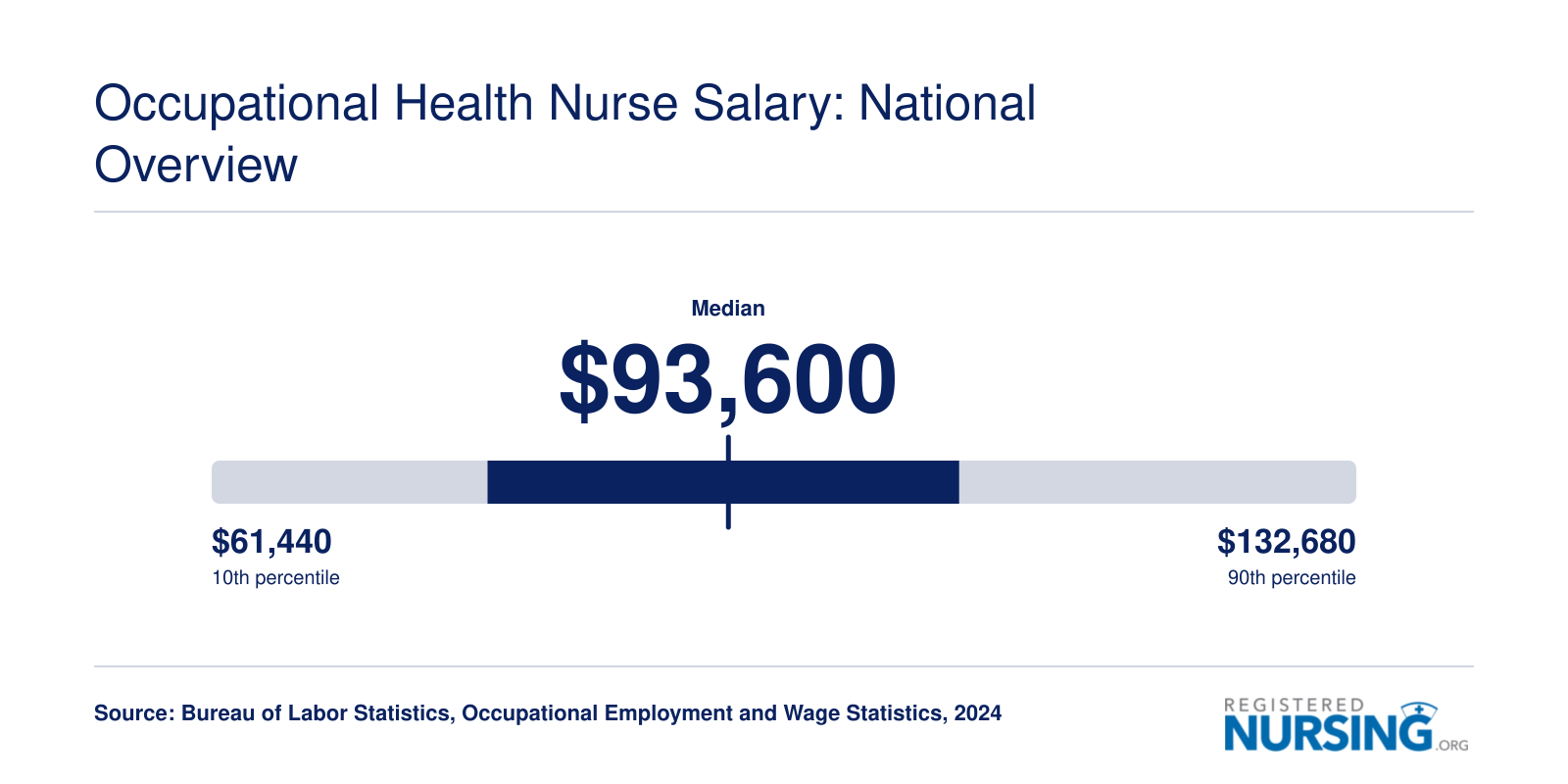
The Bureau of Labor Statistics does not publish a separate salary category for occupational health nurses, so registered nurse wages serve as the closest national benchmark. Because OHN roles typically require specialty certification and workplace health expertise, many employers offer compensation above the general RN median.
Occupational Health Nurse Salary by State
Because the Bureau of Labor Statistics does not track occupational health nurses as a separate category, the figures below reflect registered nurse salaries across each state. Occupational health nurses with specialty certification (COHN or COHN-S) may earn above these medians, particularly in states with large manufacturing, energy, or logistics sectors. Data is drawn from the 2024 Occupational Employment and Wage Statistics published by the U.S. Bureau of Labor Statistics.
| State | Total RN Employment | 25th Percentile | Median Salary | 75th Percentile | Mean Salary |
|---|---|---|---|---|---|
| Rhode Island | 10,760 | $83,870 | $99,960 | $112,540 | $99,770 |
| Arizona | 64,430 | $81,390 | $96,890 | $105,450 | $95,230 |
| New Hampshire | 16,580 | $79,720 | $96,830 | $105,500 | $94,620 |
| Maryland | 48,980 | $81,470 | $96,830 | $104,840 | $96,650 |
| Colorado | 54,510 | $81,790 | $96,520 | $104,370 | $95,470 |
| Delaware | 13,260 | $82,600 | $92,610 | $108,360 | $95,450 |
| Texas | 261,050 | $77,450 | $90,010 | $102,200 | $91,690 |
| Virginia | 77,420 | $77,650 | $88,820 | $100,920 | $90,930 |
| New Mexico | 17,510 | $82,630 | $88,260 | $104,720 | $94,360 |
| Pennsylvania | 146,840 | $78,570 | $87,610 | $102,030 | $90,830 |
| Georgia | 97,410 | $76,600 | $86,560 | $104,790 | $91,960 |
| Illinois | 139,900 | $79,150 | $86,410 | $103,660 | $91,130 |
| Idaho | 14,540 | $78,020 | $86,100 | $100,220 | $89,770 |
| Wisconsin | 64,960 | $79,570 | $86,070 | $100,680 | $90,450 |
| Michigan | 104,210 | $80,030 | $85,670 | $101,210 | $90,580 |
| Vermont | 7,240 | $79,980 | $85,150 | $104,110 | $92,710 |
| Maine | 16,280 | $76,890 | $82,860 | $98,000 | $87,440 |
| Florida | 218,100 | $77,070 | $82,850 | $99,260 | $88,200 |
| Utah | 25,780 | $77,030 | $82,270 | $101,530 | $88,240 |
| North Carolina | 108,510 | $74,710 | $81,860 | $98,720 | $86,270 |
| Wyoming | 5,180 | $75,540 | $81,790 | $100,910 | $88,020 |
| Montana | 10,540 | $77,800 | $81,560 | $100,510 | $88,480 |
| Ohio | 138,360 | $77,420 | $81,250 | $97,440 | $86,110 |
| Oklahoma | 32,870 | $75,320 | $81,160 | $96,460 | $85,800 |
| Nebraska | 24,180 | $76,430 | $81,020 | $93,140 | $82,890 |
Occupational Health Nurse Salary by Metro Area
The Bureau of Labor Statistics does not report a separate occupational health nurse category, so the registered nurse wage data below serves as the closest available benchmark. Occupational health nurses in these metro areas may earn above or below the general RN median depending on employer, certification status, and years of experience. Figures reflect 2024 Occupational Employment and Wage Statistics from the U.S. Bureau of Labor Statistics.
| Metro Area | Total RN Employment | 25th Percentile | Median Salary | 75th Percentile | Mean Salary |
|---|---|---|---|---|---|
| San Francisco, Oakland, Fremont, CA | 40,750 | $150,580 | $188,020 | $212,190 | $178,450 |
| Los Angeles, Long Beach, Anaheim, CA | 107,340 | $108,150 | $133,440 | $165,290 | $138,010 |
| Seattle, Tacoma, Bellevue, WA | 37,250 | $101,140 | $118,570 | $132,160 | $120,260 |
| New York, Newark, Jersey City, NY and NJ | 195,470 | $100,530 | $113,490 | $128,430 | $115,650 |
| Boston, Cambridge, Newton, MA and NH | 66,440 | $84,200 | $102,440 | $137,160 | $115,710 |
| Minneapolis, St. Paul, Bloomington, MN and WI | 40,510 | $87,670 | $102,240 | $116,000 | $102,790 |
| Washington, Arlington, Alexandria, DC, VA, MD, and WV | 43,640 | $83,570 | $101,800 | $110,760 | $102,510 |
| Philadelphia, Camden, Wilmington, PA, NJ, DE, and MD | 74,840 | $84,040 | $99,210 | $107,800 | $97,510 |
| Dallas, Fort Worth, Arlington, TX | 72,640 | $79,170 | $98,740 | $106,850 | $96,720 |
| Phoenix, Mesa, Chandler, AZ | 46,330 | $82,270 | $98,160 | $105,900 | $96,220 |
| Houston, Pasadena, The Woodlands, TX | 65,300 | $79,640 | $97,810 | $105,970 | $96,730 |
| Chicago, Naperville, Elgin, IL and IN | 100,620 | $81,320 | $96,480 | $104,730 | $94,580 |
| Atlanta, Sandy Springs, Roswell, GA | 54,370 | $79,700 | $96,370 | $107,550 | $96,640 |
| Detroit, Warren, Dearborn, MI | 44,280 | $81,140 | $88,980 | $101,880 | $92,680 |
| Miami, Fort Lauderdale, West Palm Beach, FL | 59,880 | $78,240 | $85,610 | $103,110 | $92,070 |
Job Outlook and Demand for Occupational Health Nurses
Broad nursing employment versus niche occupational health specialization: the Bureau of Labor Statistics projects 5 percent growth for registered nurses nationally from 2024 to 2034, adding approximately 189,100 openings each year driven by both expansion and replacement demand.1 Healthcare occupations as a whole are expected to grow faster at 8.4 percent over the same decade, creating two million new jobs.2 While occupational health nursing falls within the broader RN category, its demand trajectory is shaped by factors distinct from acute-care and clinical roles.
Factors Driving Occupational Health Nurse Demand
Several industry trends amplify the need for qualified occupational health nurses beyond general RN growth rates. Stricter enforcement of Occupational Safety and Health Administration regulations following the COVID-19 pandemic has pushed employers to invest in workplace safety infrastructure, including on-site health services. Many manufacturing, logistics, and construction employers now view occupational health programs as both compliance necessities and tools for controlling workers' compensation costs. Expanded wellness initiatives, mental health nurse support, and injury-prevention programs have broadened the scope of workplace health beyond traditional first aid, creating roles for nurses with OHN training.
Telehealth adoption has also reshaped occupational health delivery. Some employers use hybrid models in which a single on-site occupational health nurse coordinates remote consultations, case management, and electronic health record integration, extending the reach of each practitioner. This model allows smaller work sites to access specialized occupational health services that previously were feasible only at large facilities.
Replacement Demand and Workforce Aging
The occupational health nursing workforce itself is aging. Many current practitioners entered the specialty in the 1990s and early 2000s and are now approaching retirement eligibility. Industry surveys conducted by professional organizations indicate that a significant share of certified occupational health nurses are over age 55, and replacement demand may exceed the number of newly minted COHNs entering the field each year. This demographic shift creates sustained hiring opportunities even in sectors where overall headcount remains stable.
Employers seeking to retain institutional knowledge and regulatory expertise often recruit early to ensure mentorship overlap before senior practitioners retire. For nurses considering the occupational health path, these converging trends point to steady demand through the remainder of the decade and beyond.
Resources and Professional Organizations for Occupational Health Nurses
Staying current in occupational health nursing means choosing the right organizations to follow, knowing where to earn continuing education credit, and tracking renewal deadlines before they sneak up on you. The resources below give you a reliable starting point. If you have broader questions about how CE credit works across nursing specialties, the CE/CME FAQs for Medical Professionals is a useful reference.
Core Organizations
- AAOHN (American Association of Occupational Health Nurses): The primary professional association for occupational health nurses. AAOHN offers networking, advocacy, evidence-based practice resources, and continuing education opportunities at both the national and chapter level.
- ABOHN (American Board for Occupational Health Nurses): The certification body that issues the COHN and COHN-S credentials.1 ABOHN's online portal is the place to submit exam applications, pay annual fees, and log continuing education hours for recertification tracking.
- NIOSH (National Institute for Occupational Safety and Health): The federal research arm focused on worker health and safety. NIOSH publishes studies, training curricula, and free educational content relevant to occupational health practice.
- OSHA (Occupational Safety and Health Administration): The regulatory agency whose standards directly shape what occupational health nurses do on the job. Familiarity with OSHA guidelines is essential for anyone practicing in this specialty.
Certification Renewal Requirements
Both the COHN and COHN-S credentials follow a five-year recertification cycle.1 To renew, you must hold a current active RN license,3 complete 50 continuing education contact hours in occupational health, and log 3,000 practice hours over the certification period.1 The annual maintenance fee is $150 for both credentials.2 If you miss your renewal window, a late fee of $100 applies,1 so tracking your timeline through ABOHN's portal early is worth the effort.
If you hold the optional Case Management add-on credential, renewal requires an additional 10 continuing education hours and an extra $50 annual fee.4
AAOHN is one of the most accessible sources for ABOHN-approved continuing education, offering webinars, conferences, and self-study modules. NIOSH training programs also count toward CE in many cases. When evaluating any course, verify approval through ABOHN's recertification handbook before enrolling.
Key Publications
Two journals keep occupational health nurses connected to current research and practice trends: the AAOHN Journal and Workplace Health and Safety. Both are peer-reviewed and cover clinical topics, policy updates, and workforce research relevant to the specialty. AAOHN members receive access to both as part of membership benefits.
Common Questions About Occupational Health Nursing
Below are answers to some of the most frequently asked questions about entering and advancing in occupational health nursing. For deeper detail on any topic, refer to the corresponding section earlier in this guide.
How long does it take to become an occupational health nurse?
What is the difference between COHN and COHN-S certification?
What do you need to be an occupational health nurse?
How much does an occupational health nurse make?
Can you work as an occupational health nurse remotely?
What are the requirements for occupational health nursing certification renewal?
Explore More
- Ambulatory Care Nurse
- Burn Unit Nurse
- Cardiac Nurse
- Cath Lab Nurse
- Charge Nurse
- Chief Nursing Officer (CNO)
- Correctional Nurse
- CVOR Nurse
- Dermatology Nurse
- Developmental Disability Nurse
- Director of Nursing
- Domestic Violence Nurse
- Emergency Room Nurse
- ENT Nurse
- ET Nurse
- Fertility Nurse
- Flight/Transport Nurse
- Forensic Nurse Salary & Career Guide
- Genetic Nurse
- Geriatric Nurse
- Health Policy Nurse
- Healthcare Administrator
- Healthcare Manager
- Home Health Nurse
- Hospice Nurse
- Camp Nurse
- GI Nurse
- Holistic Nurse
- Labor and Delivery Nurse
- Nurse Writer
- Psychiatric Nurse
- School Nurse
- Telemetry Nurse
- Travel Nurse
- Aesthetic Nurse
- Infusion/IV Nurse
- Oncology Nurse
- ICU Nurse
- Infection Control Nurse
- Legal Nurse Consultant
- LTC Nurse
- Managed Care Nurse
- Medical-Surgical Nurse
- Military (Combat) Nurse
- Missionary Nurse
- Mother Baby Nurse
- Nephrology Nurse
- Neuroscience Nurse
- NICU Nurse
- Nurse Administrator
- Nurse Attorney
- Nurse Care Coordinator
- Nurse Case Manager
- Nurse Entrepreneur
- Nurse Executive
- Nurse Health Coach
- Nurse Manager
- Obstetric (OB) Nurse
- Operating Room Nurse
- Ophthalmic Nurse
- Organ Procurement Coordinator
- Orthopedic Nurse
- Pain Management Nurse
- Palliative Care Nurse
- Parish Nurse
- Patient Advocate Nurse
- Pediatric Endocrinology Nurse
- Perianesthesia (PACU) Nurse
- Perinatal Nurse
- Plastic Surgery Nurse
- Public/Community Health Nurse
- Radiology Nurse
- Rehabilitation Nurse
- Research Nurse
- Respiratory Nurse
- Rheumatology Nurse
- Substance Abuse Nurse
- Telephone Triage Nurse
- Transcultural Nursing
- Transplant Nurse
- Trauma Nurse
- Wound Care Nurse (WOCN)