

What you’ll learn in this article…
- South Dakota grants full practice authority to nurse practitioners.
- BSN-to-DNP programs typically take three to four years to complete.
- Sioux Falls leads the state in nurse practitioner salaries.
South Dakota's DNP landscape is defined by scarcity. As of 2026, only two CCNE-accredited DNP programs are headquartered in the state, a reality that turns program selection into a high-stakes decision. For nurses in rural communities, online and hybrid delivery models become essential, not just convenient.
With such limited in-state seats, prospective students must scrutinize clinical placement networks, curriculum focus, and accreditation status more carefully than applicants in larger markets. South Dakota nursing programs at the RN-to-BSN level reflect a similar pattern of concentrated access, so nurses moving up the degree ladder will recognize the dynamic. The state's full practice authority for NPs raises the return on a doctoral degree, but access to that degree remains tightly concentrated.
Best DNP Programs in South Dakota
South Dakota offers a limited but focused selection of DNP programs, making each option worth a careful look. The University of South Dakota stands out as the state's dedicated online DNP pathway for nurses pursuing organizational and system leadership at the doctoral level. Below, we break down what the program offers, what it costs, and who it serves best.
How this list was built
- Program specialization and focus
- Tuition and affordability
- Online accessibility for working nurses
- Graduate outcomes and earning potential
- Institutional graduation and retention rates
- Independent program research
- Internal program database
- NCES-IPEDS federal institutional data — nces.ed.gov
- College Scorecard graduate earnings — collegescorecard.ed.gov
University of South Dakota
#1Vermillion, SD · $20,000/yr
Best for: Working nurses seeking affordable online leadership training
The University of South Dakota launched its DNP program with a first cohort admitted in spring 2021, making it a newer but purpose-built offering designed to address South Dakota's nursing shortage. Delivered entirely online, the program is structured so working nurses across the state, including those in rural communities, can earn a doctoral degree without relocating. USD's in-state tuition of approximately $406 per credit makes it one of the most affordable DNP options in the region. The school offering this program has an institution-wide graduation rate of about 60%, and median graduate earnings across all programs at USD reach roughly $51,926 within ten years, with a median graduate debt of around $23,592. Note that net price figures (approximately $19,858) reflect an institution-level average and are not specific to the DNP program.
- 100% online format designed for working nurses across South Dakota
- Concentrates on organizational and system leadership, not clinical APRN tracks
- Prepares graduates for CNO, executive director, and faculty roles
- Develops business acumen and strategic decision-making skills
- Addresses South Dakota's nursing shortage through doctoral-level training
- Fosters transformational leadership in complex regional health systems
- Approximately $406 per credit for in-state students
DNP Specializations Available in South Dakota
Choosing a DNP specialization in South Dakota often comes down to two broad directions: a direct patient care role like Family Nurse Practitioner programs in South Dakota or Psychiatric Mental Health Nurse Practitioner, or a systems-level role such as Nurse Executive or organizational leadership. Both paths lead to the same terminal degree, but the day-to-day work, clinical hour requirements, and certification exams differ significantly. Confirming which tracks are actively enrolling at any given time takes a little legwork, because availability shifts year to year based on faculty capacity, clinical placement partnerships, and cohort size.
Where to Verify Current Track Offerings
Start with the official nursing program pages of the DNP-granting institutions in the state. University websites typically list the specializations they offer, whether admission is open for the upcoming cycle, and any cohort caps. Program pages also note whether a track runs every year or on an alternating schedule, which matters for planning.
Professional organizations maintain accredited program directories that can help you cross-check what a school advertises. The American Association of Nurse Practitioners and the American Nurses Credentialing Center both publish searchable directories of accredited programs and recognized certification pathways, which is useful when you want to confirm that a specialization aligns with a national certification exam.
Getting Answers Directly
Websites do not always reflect the newest changes. Calling or emailing the nursing department is often the fastest way to confirm whether a specific concentration is accepting applications, what the current cohort looks like, and whether any new tracks are in development. Admissions coordinators can also clarify prerequisites specific to a specialization, such as required clinical experience for psychiatric or acute care focuses.
Finally, review the institutional catalog or program handbook, which is generally updated on an annual cycle. These documents spell out course sequences, clinical hour expectations, and admission timelines in more detail than a marketing page, and they are the most reliable place to see how a specialization is actually structured. Nurses considering post-graduate options beyond the DNP may also find South Dakota post-graduate certificate nursing programs worth exploring alongside their specialization research.
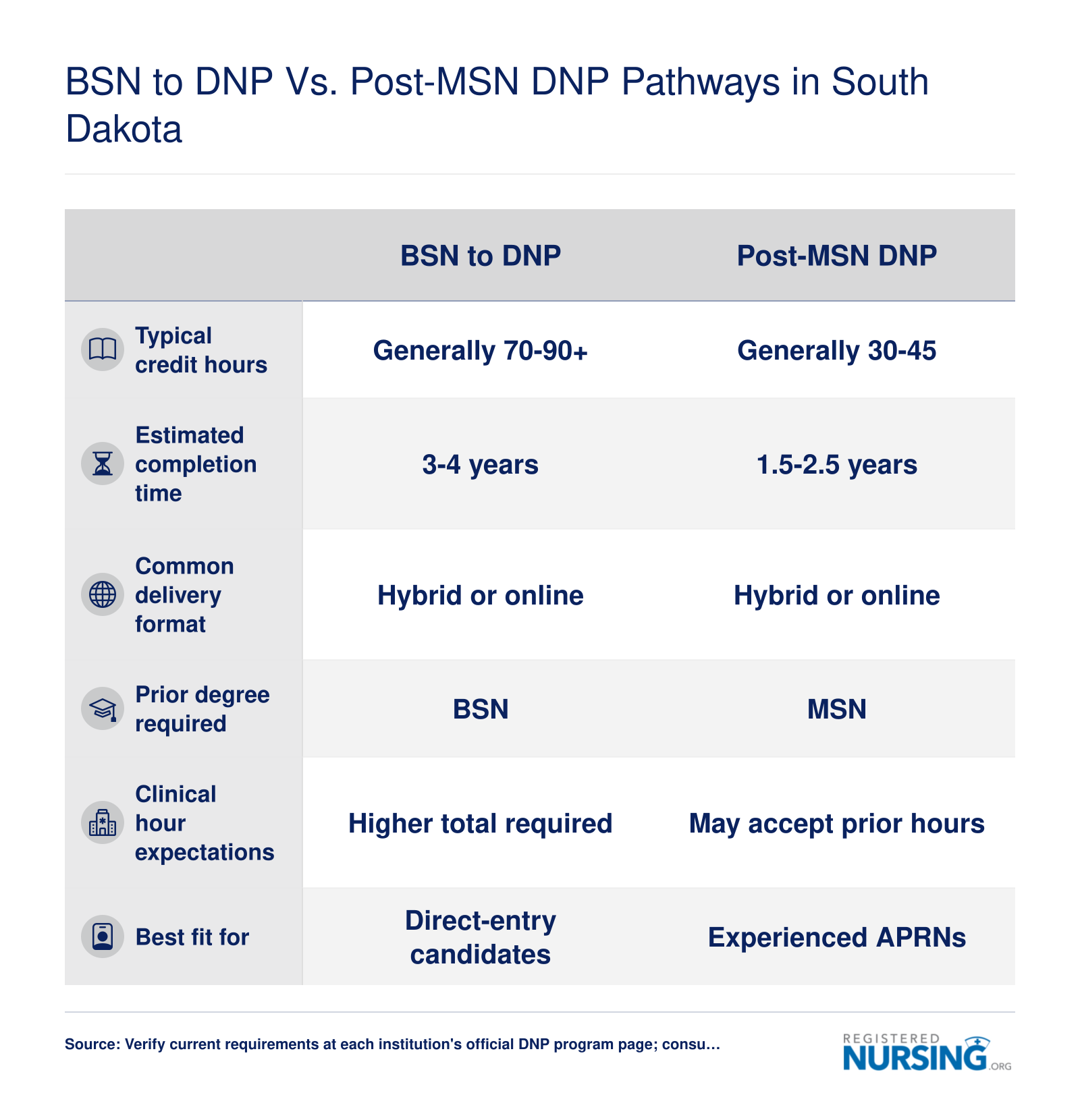
BSN to DNP Vs. Post-MSN DNP Pathways in South Dakota
South Dakota nurses considering a DNP have two primary entry points: the BSN-to-DNP pathway, designed for nurses who want to move directly from a bachelor's degree to a practice doctorate, and the Post-MSN DNP pathway, built for those who already hold a master's degree. Credit-hour totals, completion timelines, and delivery formats vary by institution, so always verify current details on each school's official website or by contacting the program's admissions office directly. The American Association of Colleges of Nursing (AACN) and the South Dakota Board of Nursing are reliable sources for confirming program accreditation.
How Much Do DNP Programs Cost in South Dakota?
Tuition is one of the most important factors when choosing a DNP program, and costs in South Dakota vary significantly depending on the institution and your residency status. The two public universities offer considerably lower tuition for in-state students, while Mount Marty University, a private institution, charges a flat rate regardless of where you live. South Dakota residents may also benefit from the National Health Service Corps Loan Repayment Program and state-level rural loan forgiveness initiatives, which can offset costs for DNP graduates who commit to practicing in underserved areas.
| Factor | South Dakota State University (SDSU) | University of South Dakota (USD) | Mount Marty University |
|---|---|---|---|
| Per-Credit Cost (In-State) | $358 | $314 | $1,024 |
| Per-Credit Cost (Out-of-State) | $689 | $605 | $1,024 |
| Estimated Total Cost, BSN to DNP (In-State) | Approximately $26,163 | Approximately $22,922 | Approximately $74,752 |
| Estimated Total Cost, BSN to DNP (Out-of-State) | Approximately $50,305 | Approximately $44,065 | Approximately $74,752 |
| Institution Type | Public | Public | Private |
| In-State vs. Out-of-State Differential | Yes, roughly double for out-of-state students | Yes, roughly double for out-of-state students | No differential; flat rate for all students |
| Delivery Format | Online options available | Online options available | Online options available |
Questions to Ask Yourself
Admission Requirements for South Dakota DNP Programs
BSN-to-DNP pathways and post-master's entry tracks impose different sets of prerequisites, and South Dakota programs reflect that divide. Most applicants enter with either a bachelor's in nursing or an advanced-practice master's, and the admission bar adjusts accordingly.
Minimum Academic Credentials
All DNP tracks require proof of prior nursing education and active RN licensure. The University of South Dakota sets a 3.0 cumulative GPA floor for its Doctor of Nurse Anesthesia Practice (DNAP) program, measured across all undergraduate and graduate coursework.1 Applicants who earned their initial degree outside the United States must provide a course-by-course credential evaluation and demonstrate English proficiency if their prior instruction was not conducted in English.
Prerequisite coursework extends beyond core nursing curriculum. USD's nurse anesthesia track mandates completion of a statistics course and one semester of organic chemistry or biochemistry, each with a grade of B or better.1 These science prerequisites ensure that incoming students can handle advanced pharmacology and pathophysiology without remediation.
Licensure and Clinical Experience
A current, unencumbered registered nurse license issued by any U.S. state or territory is non-negotiable. For the DNAP program, USD further requires a minimum of one year of acute-care critical-care nursing experience, with two years strongly preferred.1 Applicants must also complete an eight-hour observation shift alongside a practicing certified registered nurse anesthetist and submit a signed log documenting that shadow experience.
Mount Marty University's Family Nurse Practitioner programs in South Dakota similarly expects RN licensure and often prefers candidates with clinical hours in settings aligned with their intended specialty, though exact hour counts vary by cohort.
Application Materials and Deadlines
USD accepts DNAP applications for fall admission only, with a firm March 1 deadline.1 The application packet includes a 500-to-1,000-word written statement explaining career goals and motivation for doctoral study, a current résumé or curriculum vitae, and three letters of recommendation from supervisors or faculty familiar with the applicant's clinical and academic work. Official transcripts from every college attended must arrive directly from the issuing institution.
Neither USD nor Mount Marty currently requires GRE scores for DNP admission, removing one financial and scheduling hurdle for working nurses. If you are comparing admission standards across the region, reviewing DNP programs in North Dakota can offer useful context on neighboring program requirements. Programs review files holistically, weighing leadership potential, communication skills, and professional references alongside GPA and clinical tenure.
How Long Does a DNP Program Take in South Dakota?
The length of a Doctor of Nursing Practice program in South Dakota depends on several factors, including your starting point, whether you study full-time or part-time, and the structure of the specific program. Understanding these variables can help you plan a realistic timeline for completing your degree.
BSN to DNP Pathways
For registered nurses entering with a Bachelor of Science in Nursing, a BSN to DNP program is the most common route. These programs typically integrate master's-level content with doctoral study. On a full-time schedule, students often complete the curriculum in three to four years. Part-time options allow working nurses to spread coursework over a longer period, which can extend completion to five years or more. The total time commitment reflects both didactic coursework and a substantial number of supervised clinical practicum hours.
Post-MSN DNP Pathways
Nurses who already hold a Master of Science in Nursing, often with an advanced practice specialization, can pursue a post-master's DNP. These programs are designed to build on existing graduate education and typically require fewer credits than BSN-to-DNP tracks. Full-time students may finish in one to two years, while part-time study often adds an additional year. Much of the program focuses on translating evidence into practice, and clinical hours are sometimes reduced if the prior MSN included advanced practice clinical training.
Factors That Influence Timeline
Several elements can affect how quickly you progress through a DNP program in South Dakota. The number of credit hours required, which can range widely across institutions, directly impacts length of study. Clinical practicum requirements, including total hours and the pace at which they can be completed, are another key variable. Some programs arrange clinical placements for students, while others ask students to secure sites independently, which can introduce delays. Additionally, whether courses are offered year-round or only in traditional semesters may influence completion speed.
Getting Accurate Information for South Dakota Programs
Because program lengths vary, prospective students should contact individual schools for current details. The three primary institutions offering DNP programs in South Dakota are South Dakota State University, the University of South Dakota, and Mount Marty University. Their official websites typically list credit requirements and sample degree plans for full-time and part-time enrollment. However, for the most accurate picture, especially regarding clinical hour totals and placement support, reaching out to the nursing admissions office or program coordinator is recommended. Students exploring related advanced practice options may also want to review Nurse Practitioner programs in South Dakota for context on how NP pathways connect to doctoral-level study. General DNP standards and accreditation guidelines can be found through organizations like the American Association of Colleges of Nursing (AACN) and the Commission on Collegiate Nursing Education (CCNE), which set broad expectations for program length and rigor. For a broader national view, best Doctor of Nursing Practice programs can provide helpful comparisons across institutions and program structures.
DNP Salary and Career Outcomes in South Dakota
Earning a DNP in South Dakota can open the door to several high-paying advanced practice and leadership roles. While nominal salaries in the state sometimes trail the national median, South Dakota's notably lower cost of living helps stretch those earnings further. According to Bureau of Labor Statistics data, the state employs a solid workforce across these DNP-prepared occupations, and demand for advanced practice providers continues to grow in both urban and rural communities.
| Occupation | Total Employment in SD | Median Annual Salary | 25th Percentile | 75th Percentile |
|---|---|---|---|---|
| Nurse Practitioners | 950 | $122,600 | $104,610 | $135,060 |
| Medical and Health Services Managers | 1,140 | $116,210 | $99,180 | $144,580 |
| Nursing Instructors and Teachers, Postsecondary | 240 | $63,940 | $56,960 | $78,010 |
| Registered Nurses (for comparison) | 14,500 | $69,510 | $62,510 | $80,490 |
DNP Salary by Metro Area in South Dakota
Salary potential for DNP graduates in South Dakota varies by metro area and career path. According to the Occupational Employment and Wage Statistics program from the U.S. Bureau of Labor Statistics (2024), Sioux Falls leads the state in both nurse practitioner employment and pay, while Rapid City also offers strong compensation. The table below compares key DNP-relevant roles across these two major metro areas.
| Metro Area | Role | Employment | Median Salary | Mean Salary | 25th Percentile | 75th Percentile |
|---|---|---|---|---|---|---|
| Sioux Falls, SD-MN | Nurse Practitioners | 470 | $130,580 | $124,890 | $105,500 | $136,460 |
| Rapid City, SD | Nurse Practitioners | 170 | $111,810 | $115,850 | $101,740 | $128,590 |
| Sioux Falls, SD-MN | Medical and Health Services Managers | 510 | $120,870 | $137,960 | $100,280 | $161,120 |
| Rapid City, SD | Medical and Health Services Managers | 170 | $117,860 | $129,750 | $101,020 | $151,470 |
| Sioux Falls, SD-MN | Nursing Instructors (Postsecondary) | 80 | $56,960 | $59,850 | $54,510 | $63,910 |
| Sioux Falls, SD-MN | Registered Nurses | 7,480 | $68,890 | $71,060 | $62,600 | $78,440 |
| Rapid City, SD | Registered Nurses | 2,600 | $69,510 | $73,640 | $61,570 | $84,640 |
Accreditation and Licensing for DNP Graduates in South Dakota
When evaluating DNP programs in South Dakota, you will encounter two primary accreditation bodies: the Commission on Collegiate Nursing Education (CCNE) and the Accreditation Commission for Education in Nursing (ACEN). Both are U.S. Department of Education-recognized and meet the state board's requirement, but they differ in scope. CCNE exclusively accredits baccalaureate and graduate nursing programs, while ACEN covers all levels including associate degrees and diplomas.1 For DNP candidates, either accreditation signals a program that meets national standards, so your decision should rest on curriculum and faculty rather than the accreditor.
Obtaining APRN Licensure
After graduating from an accredited program, the South Dakota Board of Nursing guides you through these steps via its online Nurse Portal:2
- National certification: Pass a board-recognized exam from organizations such as ANCC, AANP/AANPCB, AACN, or others. The exam validates clinical competency in your chosen population focus.
- State application: Submit official transcripts, verification of 500 supervised clinical hours, and proof of an active South Dakota or compact RN license.2 Expect a processing window of four to six weeks.
- Prescriptive authority: Once licensed, you can add prescriptive authority after completing 1,040 hours of supervised prescribing practice under an approved mentor.3 This step is required for independent prescribing.
Full Practice Authority in South Dakota
South Dakota maintains full practice authority for APRNs.3 This means DNP-prepared nurses can evaluate patients, diagnose conditions, order tests, and initiate treatments, including prescribing medications, without a mandatory collaborative agreement with a physician. The autonomy allows you to establish independent practices, especially in underserved rural communities. License renewal is biennial, with a $70 fee, and you must attest to meeting continuing education requirements and holding valid national certification.4
Verifying Accredited Programs
You may notice conflicting counts of DNP programs across third-party websites. In reality, the two active institutions in the state, South Dakota State University and the University of South Dakota, offer BSN-to-DNP and post-master's DNP tracks, all holding CCNE accreditation. If you are weighing options in the region, reviewing best DNP programs in Nebraska or DNP programs in Iowa can help you benchmark curriculum structures. To avoid outdated listings, consult the CCNE or ACEN directories directly or visit the South Dakota Board of Nursing's approved programs page. This ensures you are applying to a qualifying program.
Frequently Asked Questions About DNP Programs in South Dakota
Below are answers to some of the most common questions prospective students ask about Doctor of Nursing Practice programs in South Dakota. If you are weighing your options, these quick answers can help you plan your next steps with confidence.