

What you’ll learn in this article…
- CANS and CPSN certification both require 1,000 clinical hours minimum.
- Scope of practice rules differ in every state.
- Aesthetic nurse practitioners often out-earn general RNs significantly.
The medical aesthetics industry generated roughly $17 billion globally in 2024 and is projected to exceed $25 billion by 2030, and that growth is reshaping what a nursing career can look like outside the hospital.
An aesthetic nurse is a registered nurse who performs minimally invasive cosmetic procedures, such as neuromodulator and dermal filler injections, laser treatments, and skin therapies, under physician oversight. The tension for most RNs weighing this specialty is real: the work offers predictable daytime hours and strong earning potential, but entry requires specialty training, state-specific scope rules, and often out-of-pocket certification costs before an employer will let you inject a single patient.
Demand is outpacing the supply of properly credentialed injectors, particularly in states tightening delegation rules. Nurses drawn to patient-centered, relationship-driven care may also find parallels with holistic nursing practice, where individualized attention and whole-person assessment are equally central to the role.
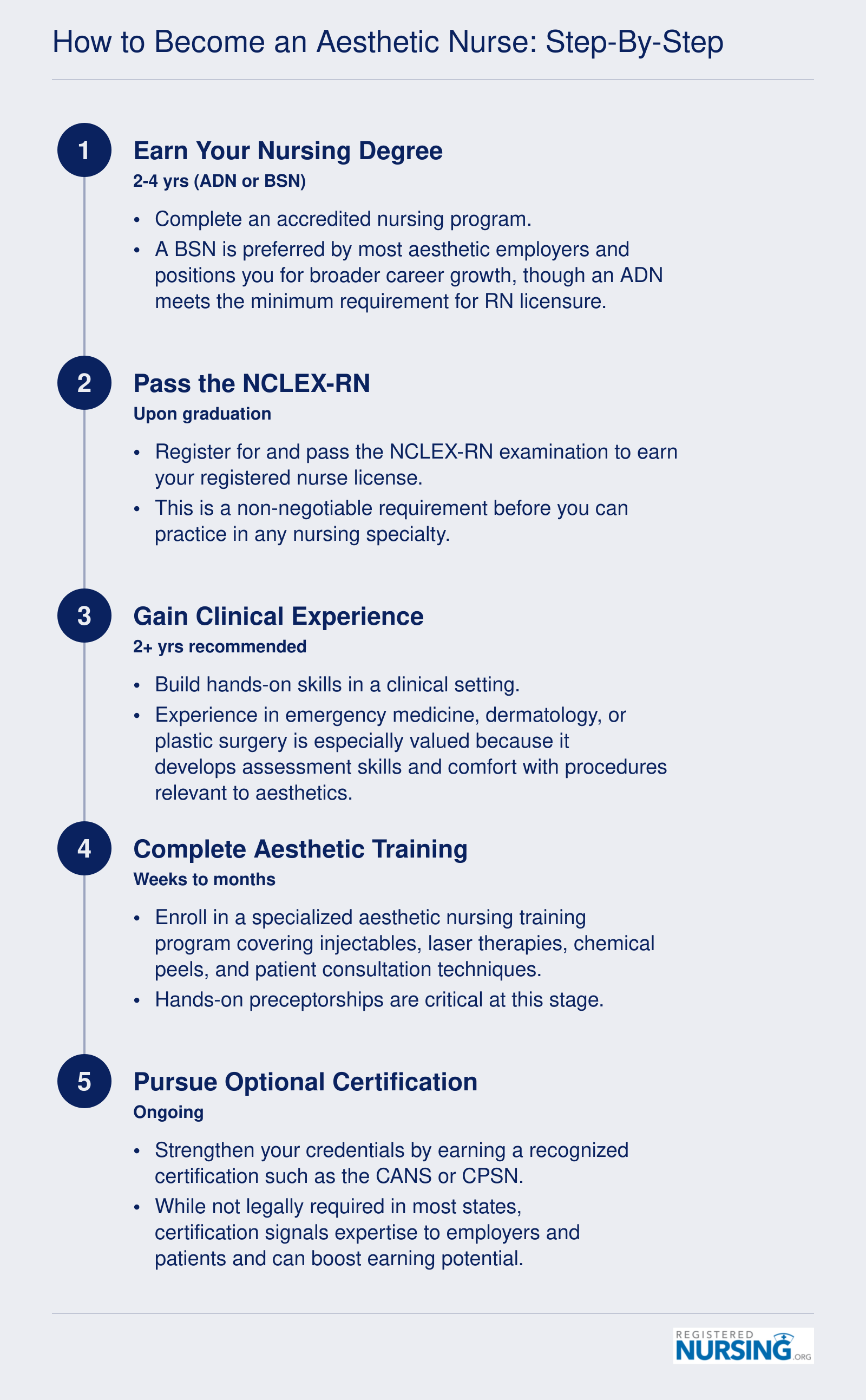
How to Become an Aesthetic Nurse: Step-By-Step
There is no single undergraduate major required to enter aesthetic nursing, though nursing or health sciences degrees are the standard path. Most aspiring aesthetic nurses can expect a minimum timeline of about four to five years from their freshman year to practicing in the specialty. An ADN can shorten the academic phase, but a BSN is strongly preferred by employers and opens more doors for advancement.
Aesthetic Nurse Training Programs Worth Considering
Choosing a training program is one of the most consequential decisions you will make as you transition into aesthetic nursing. The market is crowded with options ranging from weekend workshops to multi-week intensives, and the quality gap between them is real.
The Training Landscape
Most programs fall into one of three formats. Weekend intensives, which typically run one to two days, give you concentrated hands-on time but require you to arrive already grounded in the relevant anatomy and pharmacology. Multi-week or hybrid programs blend online didactic instruction with in-person clinical days, letting you absorb the theory at your own pace before practicing on live patients. A smaller number of programs use a preceptorship or mentorship model, pairing you with an experienced injector or aesthetic provider over an extended period for a more apprenticeship-style experience.
Programs Commonly Mentioned in the Field
Several names come up repeatedly among nurses exploring this specialty.
- AAFE (American Academy of Facial Esthetics): Offers in-person injectable training with an online prerequisite component.1 Sessions typically span one to two days and include live patient and cadaver work at locations across the country. Open to licensed clinicians including nurses, and nationally recognized in the aesthetic space.
- Empire Medical Training: A hybrid, workshop-style option priced around $1,599 as of 2025, making it one of the more accessible entry points for continuing medical education-style injector courses.2
- National Laser Institute: Focuses heavily on laser and energy-based device training, making it a strong choice if you want to specialize in laser treatments alongside injectables.
- IAPAM (International Association for Physicians in Aesthetic Medicine): Offers broader aesthetic-medicine exposure through classroom and practical components, useful if you want a wider clinical foundation rather than a single-modality focus.
- Boston College Clinical Aesthetics: Formally approved for nursing continuing education through ANA Massachusetts and the ANCC, which gives it a credentialing legitimacy that many shorter courses lack.2
What to Look For Before You Enroll
Before committing to any program, weigh these factors carefully.
- Hands-on hours with live patients: A course heavy on lecture and light on supervised patient contact will not build the tactile confidence you need.
- Instructor credentials: Look for physicians, nurse practitioners, or nurses with verifiable clinical backgrounds in aesthetics, not just business or sales experience.
- Endorsement or approval by a recognized body: Nursing CE approval through the ANCC or a state nurses association adds meaningful credibility.
- Post-course support: Some programs offer follow-up mentorship, case review, or access to a clinical community. That ongoing support matters more than many prospective students realize.
- Cost transparency: Fees vary widely. Clarify upfront what is included, such as supplies, models, and course materials, so you can compare programs on equal footing.
On-the-Job Training as an Alternative
Many med spas and aesthetic practices train nurses directly, particularly for Botox and filler administration. Nurses who enjoy the business side of patient care may also find themselves drawn toward a nurse entrepreneur path, opening or co-managing their own aesthetic practice. If you land a position with a well-supervised clinical team, that employer-provided training can be just as formative as a formal course, and it comes with the added benefit of direct patient volume. For nurses newer to aesthetics, seeking a role where experienced providers are on-site and actively mentoring is worth prioritizing over a higher base salary at a less supervised practice. Those with a background in dermatology nursing may find the clinical overlap with aesthetic practice especially significant.
Aesthetic Nurse Certification Options: CANS vs CPSN vs Laser Credentials
Two years of specialty practice and 1,000 clinical hours form the baseline eligibility threshold for both the Certified Aesthetic Nurse Specialist (CANS) and Certified Plastic Surgical Nurse (CPSN) credentials, the profession's most recognized certifications.1 Both credentials are issued by the Plastic Surgical Nursing Certification Board (PSNCB) and carry equal rigor but serve distinct practice environments: CANS targets medical aesthetics such as injectables and laser treatments, while CPSN applies to perioperative and reconstructive plastic surgery nursing.
CANS: Certified Aesthetic Nurse Specialist
The CANS credential validates expertise in nonsurgical cosmetic procedures. Eligibility requires an active RN license, at least two years of aesthetic nursing experience, 1,000 clinical hours in the specialty, and documented collaboration with a board-certified physician.1 The computer-based exam consists of 150 multiple-choice questions covering injectable techniques, laser safety, patient assessment, complications management, and regulatory compliance.2 Candidates have four hours to complete the test.
Exam fees range from $325 to $495 depending on application timing and PSNCB membership status.3 The credential renews every three years, with continuing education requirements tied to aesthetic nursing practice.4 Pass rates are not publicly disclosed, but candidates report that clinical experience and familiarity with FDA device regulations are critical to success.
CPSN: Certified Plastic Surgical Nurse
CPSN certification parallels CANS in structure but emphasizes surgical nursing competencies. Eligibility mirrors CANS: RN licensure, two years in plastic surgical nursing, 1,000 clinical hours, and collaboration with a board-certified plastic surgeon.5 The exam format is similar (approximately 150 multiple-choice questions over four hours), but content skews toward perioperative care, wound management, surgical anatomy, anesthesia considerations, and postoperative complications. Nurses who split time between surgical and nonsurgical aesthetics sometimes pursue both credentials sequentially to maximize career flexibility.
Fees match the CANS exam ($325 to $495), and the renewal cycle is also three years.6 Dermatology nurses sometimes pursue the CANS credential as well, given the overlap in laser and skin-care procedures.
Laser Safety and Device-Specific Credentials
Beyond PSNCB certifications, many aesthetic nurses obtain laser safety officer (LSO) training and device-specific credentials from manufacturers such as Cynosure, Candela, or Cutera. These certifications are often employer-mandated and focus on safe operation, maintenance protocols, and legal compliance.6 State boards of nursing may require documented training before nurses operate Class IV lasers or intense pulsed light (IPL) systems.
While laser credentials rarely substitute for CANS or CPSN, they complement formal certification and signal specialized competence to employers. Nurses entering aesthetics should verify their state's scope-of-practice rules and employer requirements before selecting a certification pathway.
Questions to Ask Yourself
Aesthetic Nurse Scope of Practice by State
No two states regulate aesthetic nursing the same way, and understanding where you can legally practice specific procedures is the single most important step before you invest in training or accept a job offer. Every state treats injectables and laser treatments as delegated medical acts, meaning an RN cannot perform them independently. The differences lie in how much physician involvement is required and what form that oversight takes on a daily basis.
How Supervision Models Shape Your Practice
Three supervision models govern most aesthetic nursing roles, and each one affects how much autonomy you have in a clinical setting.
- Direct supervision: A physician must be physically present in the facility while the RN performs procedures. This is the most restrictive model and limits the number of patients you can see if the physician is pulled away.
- General (indirect) supervision: A physician delegates authority to the RN but does not need to be on-site for every procedure. The physician must remain "immediately reachable" by phone or telehealth in some states, but the RN carries out day-to-day treatments with more independence. Understanding when a nurse should delegate helps clarify how these arrangements work in practice.
- Collaborative agreement: Typically applies to nurse practitioners rather than RNs. An NP enters a formal agreement with a physician outlining the scope of delegated procedures, often with periodic chart reviews.
The model your state uses determines everything from your scheduling flexibility to how many med spa locations you can rotate between in a given week.
Key State Examples
California classifies Botox, dermal fillers, and laser treatments as delegated medical acts.1 RNs may perform these procedures under general supervision through standardized procedures approved by a supervising physician. The physician does not need to be in the room but must be immediately reachable.1 California also enforces its corporate practice of medicine doctrine, which means non-physicians generally cannot own a medical practice outright. A notable change took effect in 2026: nurse practitioners in California gained independent practice authority, which opens new pathways for aesthetic NPs but does not change the rules for RNs.1
Florida also operates under a general supervision framework, and delegatory authority is widely used in the state's large med spa market.2 Non-physicians can own aesthetic businesses through management services organizations, which is one reason Florida has become a hub for cosmetic nursing careers. RNs perform injectables and laser treatments under physician delegation without requiring the physician to be physically present.
Texas requires physician delegation for all aesthetic procedures performed by RNs.2 Supervision is classified as general, so a physician does not need to be on-site at all times, but a clear delegation order must be in place. RNs working in Texas med spas should confirm that their delegation agreements are current and documented.
New York stands out as one of the stricter states. Injectables and laser treatments are delegated medical acts performed under direct physician supervision.2 The physician must be present in the facility while procedures take place. New York also enforces stringent corporate practice of medicine restrictions, limiting who can own aesthetic practices. These requirements reduce the flexibility RNs have compared to states with general supervision models.
Across all four states, no RN is authorized to independently administer injectables or laser treatments without a supervising or delegating physician.2
Why This Matters More Than Any Other Legal Issue
Scope of practice violations are the leading legal risk for aesthetic nurses. Performing a procedure outside the boundaries your state allows, or without proper physician delegation, can result in disciplinary action from your state board of nursing, including license suspension or revocation. Malpractice insurance may also deny coverage if a claim arises from a procedure you were not authorized to perform.
Before you enroll in any training program or accept a position at a med spa, take these steps:
- Review your state board of nursing's current position statements on aesthetic procedures, including injectables and laser treatments.
- Confirm whether your state requires direct or general supervision for the specific procedures you plan to perform.
- Ask prospective employers for copies of their physician delegation protocols and verify that a supervising physician is appropriately credentialed.
- Revisit these rules annually, because state legislatures and boards of nursing update scope of practice regulations regularly.
The aesthetics field is exciting and lucrative, but no certification or training course overrides state law. Your license is your career, and protecting it starts with knowing exactly what your state permits.
What Does an Aesthetic Nurse Do? Daily Duties and Procedures
Aesthetic nursing blends hands-on clinical expertise with a strong customer service orientation. Because patients in this field are typically elective clients rather than acute care patients, every interaction carries elements of healthcare delivery and client experience management. Understanding daily responsibilities helps you decide whether this specialty aligns with your skills and temperament.
A Typical Day in the Treatment Room
Most aesthetic nurses begin their day reviewing the schedule and preparing treatment rooms with supplies, injectables, and equipment. Patient consultations follow, during which the nurse evaluates skin conditions, discusses goals, reviews medical history, and sets realistic expectations. From there, the day may include a mix of:
- Botox and dermal filler injections: Assessing facial anatomy, marking injection sites, and administering neurotoxins or hyaluronic acid fillers.
- Chemical peels and microneedling: Selecting appropriate peel strengths or needle depths based on skin type and desired outcome.
- Laser treatments: Performing laser skin resurfacing, hair removal, or photofacial sessions using devices that require specific training.
- Post-procedure education: Walking patients through aftercare instructions, expected downtime, warning signs, and follow-up timelines.
- Charting and documentation: Recording treatment details, product lot numbers, dosages, and before-and-after photos.
Between procedures, aesthetic nurses often field phone calls from prospective clients, assist with treatment planning for returning patients, and restock supplies.
Entry-Level vs. Advanced Responsibilities
Not every aesthetic nurse steps into independent practice on day one. Early-career nurses typically assist the lead injector or physician, handle patient intake, perform less complex procedures like laser hair removal, and learn injection techniques under supervision. With experience and additional credentials, nurses advance to independent injectable administration, customized treatment planning across multiple modalities, and the ability to recognize and manage complications such as vascular occlusion, infection, or allergic reactions.
Patient Safety Protocols
Elective procedures still carry real medical risks, so safety is nonnegotiable. Every aesthetic nurse should follow established protocols that include:
- Thorough allergy screening and contraindication review before each procedure.
- Informed consent documentation that clearly explains risks, benefits, and alternatives.
- Recognition of adverse reactions, including signs of vascular compromise (blanching, severe pain, dusky skin discoloration) that require immediate intervention.
- Access to emergency supplies such as hyaluronidase for filler-related occlusions, epinephrine for anaphylaxis, and a clear escalation plan if a complication exceeds the nurse's scope. In those moments, the judgment of an emergency nurse becomes the relevant benchmark for rapid, decisive action.
Where Healthcare Meets the Beauty Industry
What makes aesthetic nursing distinctive is the dual identity it requires. You are a licensed healthcare professional responsible for patient safety, accurate assessment, and evidence-based therapeutic procedures. At the same time, you are serving clients who expect a polished, welcoming environment, clear communication about costs and results, and a level of attentiveness that mirrors the hospitality or beauty sectors. Nurses who thrive in this specialty tend to enjoy building long-term client relationships, have a keen eye for facial symmetry and aesthetics, and feel comfortable discussing appearance-related goals with empathy and honesty. If that combination excites you rather than overwhelms you, aesthetic nursing may be an excellent fit.
Aesthetic Nurse Salary: National Overview
Aesthetic nurses typically earn a premium over their bedside counterparts, with compensation varying significantly based on role, experience, and credentialing. The table below compares national salary benchmarks for aesthetic RNs and aesthetic nurse practitioners, alongside general registered nurse figures for context. According to recent industry salary surveys and federal wage data, aesthetic RNs can expect to earn roughly 5 to 25 percent more than bedside RNs, while aesthetic NPs command salaries that are 30 to 50 percent higher than aesthetic RN pay.
| Role | Median Annual Salary | Typical Salary Range | Premium Over Bedside RN |
|---|---|---|---|
| General Registered Nurse (all settings) | $93,600 | $78,610 to $107,960 | Baseline |
| Aesthetic RN | $80,321 | $80,000 to $100,000 | 5% to 25% |
| Aesthetic Nurse Practitioner | $129,250 | $95,000 to $115,000 | N/A |
Aesthetic Nurse Salary by State
Because the Bureau of Labor Statistics does not track aesthetic nursing as a separate occupation, the table below uses 2024 registered nurse wage data as a baseline. Aesthetic nurses who hold specialty certifications or work in high-volume cosmetic practices often earn above these median figures, particularly in states with strong demand for elective procedures. Keep in mind that cost of living varies considerably and can offset higher pay in some regions.
| State | Total RN Employment | 25th Percentile | Median Salary | 75th Percentile | Mean Salary |
|---|---|---|---|---|---|
| Rhode Island | 10,760 | $83,870 | $99,960 | $112,540 | $99,770 |
| Arizona | 64,430 | $81,390 | $96,890 | $105,450 | $95,230 |
| New Hampshire | 16,580 | $79,720 | $96,830 | $105,500 | $94,620 |
| Maryland | 48,980 | $81,470 | $96,830 | $104,840 | $96,650 |
| Colorado | 54,510 | $81,790 | $96,520 | $104,370 | $95,470 |
| Delaware | 13,260 | $82,600 | $92,610 | $108,360 | $95,450 |
| Texas | 261,050 | $77,450 | $90,010 | $102,200 | $91,690 |
| Virginia | 77,420 | $77,650 | $88,820 | $100,920 | $90,930 |
| New Mexico | 17,510 | $82,630 | $88,260 | $104,720 | $94,360 |
| Pennsylvania | 146,840 | $78,570 | $87,610 | $102,030 | $90,830 |
| Georgia | 97,410 | $76,600 | $86,560 | $104,790 | $91,960 |
| Illinois | 139,900 | $79,150 | $86,410 | $103,660 | $91,130 |
| Idaho | 14,540 | $78,020 | $86,100 | $100,220 | $89,770 |
| Wisconsin | 64,960 | $79,570 | $86,070 | $100,680 | $90,450 |
| Michigan | 104,210 | $80,030 | $85,670 | $101,210 | $90,580 |
| Vermont | 7,240 | $79,980 | $85,150 | $104,110 | $92,710 |
| Maine | 16,280 | $76,890 | $82,860 | $98,000 | $87,440 |
| Florida | 218,100 | $77,070 | $82,850 | $99,260 | $88,200 |
| Utah | 25,780 | $77,030 | $82,270 | $101,530 | $88,240 |
| North Carolina | 108,510 | $74,710 | $81,860 | $98,720 | $86,270 |
| Wyoming | 5,180 | $75,540 | $81,790 | $100,910 | $88,020 |
| Montana | 10,540 | $77,800 | $81,560 | $100,510 | $88,480 |
| Ohio | 138,360 | $77,420 | $81,250 | $97,440 | $86,110 |
| Oklahoma | 32,870 | $75,320 | $81,160 | $96,460 | $85,800 |
| Nebraska | 24,180 | $76,430 | $81,020 | $93,140 | $82,890 |
Highest-Paying Metro Areas for Aesthetic Nurses
Because federal data does not track aesthetic nursing as a standalone occupation, the table below uses registered nurse wages by metro area as a baseline. Aesthetic nurses in high-demand cosmetic markets often earn above these figures, especially those holding specialty certifications or working in luxury med-spa settings. The metros ranked here by mean annual pay also happen to be some of the strongest markets for elective cosmetic procedures.
| Metro Area | Total RN Employment | Mean Annual Salary | 25th Percentile | Median Salary | 75th Percentile |
|---|---|---|---|---|---|
| San Francisco, Oakland, Fremont (CA) | 40,750 | $178,450 | $150,580 | $188,020 | $212,190 |
| Los Angeles, Long Beach, Anaheim (CA) | 107,340 | $138,010 | $108,150 | $133,440 | $165,290 |
| Seattle, Tacoma, Bellevue (WA) | 37,250 | $120,260 | $101,140 | $118,570 | $132,160 |
| Boston, Cambridge, Newton (MA, NH) | 66,440 | $115,710 | $84,200 | $102,440 | $137,160 |
| New York, Newark, Jersey City (NY, NJ) | 195,470 | $115,650 | $100,530 | $113,490 | $128,430 |
| Minneapolis, St. Paul, Bloomington (MN, WI) | 40,510 | $102,790 | $87,670 | $102,240 | $116,000 |
| Washington, Arlington, Alexandria (DC, VA, MD, WV) | 43,640 | $102,510 | $83,570 | $101,800 | $110,760 |
| Philadelphia, Camden, Wilmington (PA, NJ, DE, MD) | 74,840 | $97,510 | $84,040 | $99,210 | $107,800 |
| Dallas, Fort Worth, Arlington (TX) | 72,640 | $96,720 | $79,170 | $98,740 | $106,850 |
| Houston, Pasadena, The Woodlands (TX) | 65,300 | $96,730 | $79,640 | $97,810 | $105,970 |
| Atlanta, Sandy Springs, Roswell (GA) | 54,370 | $96,640 | $79,700 | $96,370 | $107,550 |
| Phoenix, Mesa, Chandler (AZ) | 46,330 | $96,220 | $82,270 | $98,160 | $105,900 |
| Chicago, Naperville, Elgin (IL, IN) | 100,620 | $94,580 | $81,320 | $96,480 | $104,730 |
| Detroit, Warren, Dearborn (MI) | 44,280 | $92,680 | $81,140 | $88,980 | $101,880 |
| Miami, Fort Lauderdale, West Palm Beach (FL) | 59,880 | $92,070 | $78,240 | $85,610 | $103,110 |
Aesthetic Nurse Practitioner vs Aesthetic RN: Which Path Is Right for You?
The aesthetic nursing field is rapidly stratifying, with nurse practitioners increasingly operating independent practices while RNs anchor collaborative clinical teams.
Education and Credentialing Differences
The entry point for an aesthetic RN is an Associate or Bachelor's degree in nursing, followed by state licensure and specialized on-the-job training in injectables, lasers, and skin therapies.1 Aesthetic nurse practitioners, by contrast, must earn a Master's or Doctoral degree, obtain national NP certification, and often pursue additional fellowships or preceptorships in dermatology or plastic surgery.2 To better understand how these advanced roles compare across the broader profession, see The 4 Advanced Practice (APRN) Careers in Nursing. This fundamental gap in education shapes everything from clinical decision-making to career mobility.
Scope of Practice and Autonomy
An aesthetic RN works under supervision or delegation, administering treatments like neurotoxin injections, dermal fillers, and laser procedures as directed by a physician or NP. They carry limited autonomy and cannot independently diagnose or design complex treatment plans. Aesthetic NPs enjoy high autonomy, especially in states with full practice authority. They assess patients, develop comprehensive aesthetic plans, prescribe medications, and in many jurisdictions, own and operate medical spas outright. This independence can translate into greater professional satisfaction but also more business risk.
Earning Potential and Career Trajectory
Nationally, aesthetic RNs earn between $80,000 and $130,000, with entry-level positions starting at $65,000 to $80,000.5 Aesthetic NPs command $110,000 to $200,000, and even entry-level NP roles rarely dip below $95,000.5 Beyond base salary, NPs who own practices often see their income tied to procedure volume and business growth, making the ceiling much higher. However, the RN path offers a quicker return on educational investment, while the NP route requires more upfront time and tuition but unlocks greater long-term earning power. If you are weighing your initial degree options, the LPN vs ADN vs BSN comparison is a useful starting point.
Choosing Your Path
Your choice hinges on career goals, tolerance for debt and schooling, and desired autonomy. If you enjoy performing procedures with a supportive team and prefer a shorter educational timeline, the aesthetic RN route may be ideal. If you aspire to own a med spa, manage complex patient cases independently, or maximize lifetime earnings, the NP path is worth the commitment. In many markets, both roles are in high demand, so neither is a wrong choice, just a different destination on the aesthetics career map.
Career Outlook and Work Settings for Aesthetic Nurses
Aesthetic nursing sits at the intersection of clinical skill and consumer wellness, and the job market reflects that dual appeal. While general nursing is growing steadily, the medical aesthetics segment is expanding at a noticeably faster clip, driven by rising demand for non-surgical cosmetic procedures across all age groups.
Job Growth Baseline and What It Means for Aesthetics
The Bureau of Labor Statistics projects registered nurse employment to grow about 5 percent over the coming decade, generating roughly 189,100 job openings each year nationwide.1 That baseline is healthy on its own. The medical aesthetics field, however, is outpacing general nursing growth because it is fueled by consumer spending rather than insurance cycles. Non-surgical treatments such as injectables, laser resurfacing, and body contouring continue to attract patients who are paying out of pocket and returning regularly, which translates into consistent staffing demand at clinics and med spas. For nurses who want to pivot into aesthetics, the timing is favorable.
For those considering the advanced practice route, the growth picture is even stronger. APRNs are projected to see roughly 38 percent growth,2 making the aesthetic nurse practitioner pathway a compelling long-term option.
Work Settings: Tradeoffs Worth Knowing
Where you practice shapes almost every aspect of your daily experience, from your schedule to your income structure.
- Med spas: Typically offer the highest earning potential through commission structures and gratuities, but the environment is more sales-oriented and medical oversight can be lighter than in clinical settings. Patient relationships are often built around repeat cosmetic services rather than acute care.
- Dermatology offices: Tend to offer a steadier, more predictable schedule with a blend of medical and cosmetic cases. Insurance-based dermatology work provides stability, though the pace can feel more templated than the entrepreneurial energy of a med spa.
- Plastic surgery practices: The most clinically intensive setting of the three. Aesthetic nurses here gain exposure to pre- and post-operative care alongside cosmetic procedures, which builds a deeper clinical foundation and can open doors to more complex roles over time. Operating room nurses who transition into plastic surgery practices often find this blend of procedural and recovery-focused care familiar.
Across all three settings, one advantage stands out consistently: most aesthetic practices run on weekday daytime hours. Night shifts, weekend call rotations, and holiday coverage are rarely part of the picture, which is a meaningful quality-of-life difference compared to hospital-based nursing.
A Realistic Career Progression Timeline
Aesthetic nursing is not typically an entry point right out of nursing school. Most practitioners follow a progression that looks something like this.
In the first two years, the priority is building a solid clinical foundation, whether in a hospital, outpatient clinic, or urgent care. Strong IV skills, patient assessment experience, and comfort with adverse event management are all directly relevant to aesthetic practice. Nurses who develop expertise as infusion nurses often find that their IV proficiency translates especially well to injectable aesthetic treatments.
By years three and four, nurses with that clinical base are well-positioned to pursue their first aesthetic role, often starting as an injector-in-training or cosmetic clinic nurse under the supervision of a more experienced provider.
From year five onward, the paths diverge. Some nurses grow into experienced independent injectors with a loyal patient panel, potentially earning performance-based income that exceeds standard nursing wages. Others use the aesthetic experience as a launching point into nurse practitioner programs, where they can eventually practice with greater autonomy and take on a broader scope of aesthetic procedures.
The trajectory is gradual by design. Aesthetic outcomes are visible, patient expectations are high, and technical skill builds through repetition over time. Nurses who approach the specialty with patience and a commitment to continued training tend to advance further and faster than those who rush the process.
Common Questions About Becoming an Aesthetic Nurse
Aesthetic nursing attracts a lot of interest, but the path can feel unclear at first. Below are straightforward answers to the questions prospective aesthetic nurses ask most often.
- How long does it take to become an aesthetic nurse?
- The timeline depends on your starting point. Earning an ADN takes about two years, while a BSN typically takes four. After passing the NCLEX-RN, most employers expect at least one to two years of clinical experience before you move into aesthetics. Add a few months for specialized training or certification, and most nurses can enter the field within three to six years from the start of their education. For comparison, how long it takes to become a travel nurse follows a similar trajectory, requiring clinical experience before specialty placement.
- What major do you need to be an aesthetic nurse?
- You need a nursing degree, either an Associate Degree in Nursing (ADN) or a Bachelor of Science in Nursing (BSN). There is no separate "aesthetics" major at the undergraduate level. After earning your RN license, you build aesthetic expertise through continuing education courses, hands-on training programs, and optional board certifications such as the CANS credential.
- Can you be an aesthetic nurse with an ADN instead of a BSN?
- Yes. An ADN qualifies you to sit for the NCLEX-RN, and a valid RN license is the core requirement for aesthetic nursing positions. That said, many med spas and dermatology practices prefer BSN-prepared nurses, and a bachelor's degree may open doors to higher pay and leadership roles. If you hold an ADN, an RN-to-BSN bridge program is a practical way to strengthen your candidacy.
- What is the difference between an aesthetic nurse and an aesthetic nurse practitioner?
- An aesthetic RN works under a physician's or nurse practitioner's supervision, performing procedures like laser treatments, chemical peels, and patient education. An aesthetic nurse practitioner (NP) holds a graduate degree and advanced practice license, which allows independent or semi-independent practice depending on the state. NPs can often diagnose skin conditions, prescribe medications, and perform a broader range of injectables without direct physician oversight. If you are considering the NP route, reviewing nurse practitioner school interview questions can help you prepare for graduate program admissions.
- Do aesthetic nurses make more than bedside nurses?
- In many cases, yes. Aesthetic nurses frequently earn above the national median for registered nurses, especially in high-volume practices or metropolitan areas. Compensation often includes a base salary plus bonuses or commissions tied to procedure volume and product sales. The exact difference varies by location and employer, but aesthetic roles can offer a meaningful pay premium over traditional bedside positions.
- Can an RN do Botox injections without certification?
- Legally, certification is not always required, but the answer depends heavily on your state's nurse practice act. Some states allow RNs to administer Botox under a physician's direct supervision without a specialty credential. However, most employers and malpractice insurers strongly prefer (or require) documented training in neurotoxin injection techniques. Earning a recognized certification also signals competence to patients and can reduce your liability exposure.
Explore More
- Ambulatory Care Nurse
- Burn Unit Nurse
- Cardiac Nurse
- Cath Lab Nurse
- Charge Nurse
- Chief Nursing Officer (CNO)
- Correctional Nurse
- CVOR Nurse
- Dermatology Nurse
- Developmental Disability Nurse
- Director of Nursing
- Domestic Violence Nurse
- Emergency Room Nurse
- ENT Nurse
- ET Nurse
- Fertility Nurse
- Flight/Transport Nurse
- Forensic Nurse Salary & Career Guide
- Genetic Nurse
- Geriatric Nurse
- Health Policy Nurse
- Healthcare Administrator
- Healthcare Manager
- Home Health Nurse
- Hospice Nurse
- Camp Nurse
- GI Nurse
- Holistic Nurse
- Labor and Delivery Nurse
- Nurse Writer
- Psychiatric Nurse
- School Nurse
- Telemetry Nurse
- Travel Nurse
- Infusion/IV Nurse
- Oncology Nurse
- ICU Nurse
- Infection Control Nurse
- Legal Nurse Consultant
- LTC Nurse
- Managed Care Nurse
- Medical-Surgical Nurse
- Military (Combat) Nurse
- Missionary Nurse
- Mother Baby Nurse
- Nephrology Nurse
- Neuroscience Nurse
- NICU Nurse
- Nurse Administrator
- Nurse Attorney
- Nurse Care Coordinator
- Nurse Case Manager
- Nurse Entrepreneur
- Nurse Executive
- Nurse Health Coach
- Nurse Manager
- Obstetric (OB) Nurse
- Occupational Health Nurse
- Operating Room Nurse
- Ophthalmic Nurse
- Organ Procurement Coordinator
- Orthopedic Nurse
- Pain Management Nurse
- Palliative Care Nurse
- Parish Nurse
- Patient Advocate Nurse
- Pediatric Endocrinology Nurse
- Perianesthesia (PACU) Nurse
- Perinatal Nurse
- Plastic Surgery Nurse
- Public/Community Health Nurse
- Radiology Nurse
- Rehabilitation Nurse
- Research Nurse
- Respiratory Nurse
- Rheumatology Nurse
- Substance Abuse Nurse
- Telephone Triage Nurse
- Transcultural Nursing
- Transplant Nurse
- Trauma Nurse
- Wound Care Nurse (WOCN)