

What you’ll learn in this article…
- Becoming a psychiatric RN takes two to four years after high school.
- PMHNPs earn a median salary near $128,000 compared to roughly $86,000 for RNs.
- BLS projects 40% job growth for nurse practitioners through 2034.
Demand for psychiatric nurses has outpaced supply for years: as of late 2025, 137 million Americans lived in federally designated Mental Health Professional Shortage Areas, and the existing behavioral health workforce covers barely a quarter of that need. A psychiatric nurse is a registered nurse who specializes in mental health and behavioral health care, working with patients across diagnoses that range from acute psychosis to chronic anxiety disorders.
The role exists at two levels. A staff psychiatric RN holds an ADN or BSN and provides direct patient care on inpatient units, in crisis centers, or through outpatient programs. A Psychiatric-Mental Health Nurse Practitioner, or PMHNP, completes graduate education and can independently diagnose, prescribe, and manage treatment plans. The distinction matters because the two tracks differ sharply in timeline, earning potential, and scope of practice.
Psychiatric RN Vs. PMHNP: Understanding the Two Career Tracks
Two distinct educational pathways lead to professional psychiatric nursing practice: the registered nurse (RN) with a psychiatric specialty and the psychiatric-mental health nurse practitioner (PMHNP). A psychiatric RN enters the field with either an associate degree in nursing (ADN) or a bachelor of science in nursing (BSN), requires two to four years of initial education, and works under the supervision of physicians or advanced practice providers. In contrast, a PMHNP holds a master's degree (MSN) or doctorate (DNP) in psychiatric-mental health nursing, can prescribe medications and manage treatment plans independently in most states, and represents an additional two to three years of graduate education beyond RN licensure.
Scope of Practice: What Each Role Can Do
Psychiatric registered nurses focus on direct patient care within a collaborative treatment team. Their responsibilities center on comprehensive mental health assessments, administration of prescribed medications, coordination of care across providers and community resources, crisis intervention, patient and family education, and therapeutic communication techniques. Psychiatric RNs implement treatment plans developed by psychiatrists, PMHNPs, or interdisciplinary teams, monitor patient responses to interventions, and document clinical observations that inform ongoing treatment decisions.
Psychiatric-mental health nurse practitioners function as advanced practice providers with diagnostic and prescriptive authority. PMHNPs conduct psychiatric evaluations, formulate diagnoses using DSM-5-TR criteria, prescribe psychotropic medications, order and interpret laboratory tests, provide psychotherapy using evidence-based modalities, and manage complex treatment plans with minimal or no physician oversight depending on state regulations. Psychiatric Nurse Practitioner vs. Psychiatrist: Which Path is Right for You? offers a deeper look at how these two roles compare in clinical settings.
Education and Time Investment
The path to psychiatric RN practice requires two years for an ADN or four years for a BSN, followed by passing the NCLEX-RN examination and obtaining state licensure. Many psychiatric RNs then pursue the Psychiatric-Mental Health Nursing (RN-BC) certification after gaining clinical experience. Advancing to PMHNP requires completion of RN education, active RN licensure, typically one to two years of psychiatric nursing experience (program-dependent), and a graduate degree that adds two to three years of full-time study or three to four years part-time. Weighing Part-Time vs. Full-Time Nursing Programs: Which Is Better? can help candidates plan the most realistic timeline for their circumstances.
Focus of This Article
This guide primarily addresses the psychiatric registered nurse pathway, including education requirements, certification options, daily responsibilities, and career outlook for RNs specializing in mental health and behavioral health settings. The PMHNP track represents a significant advancement opportunity for psychiatric RNs seeking expanded autonomy and prescriptive authority, but the graduate-level preparation and advanced practice scope warrant separate detailed exploration.
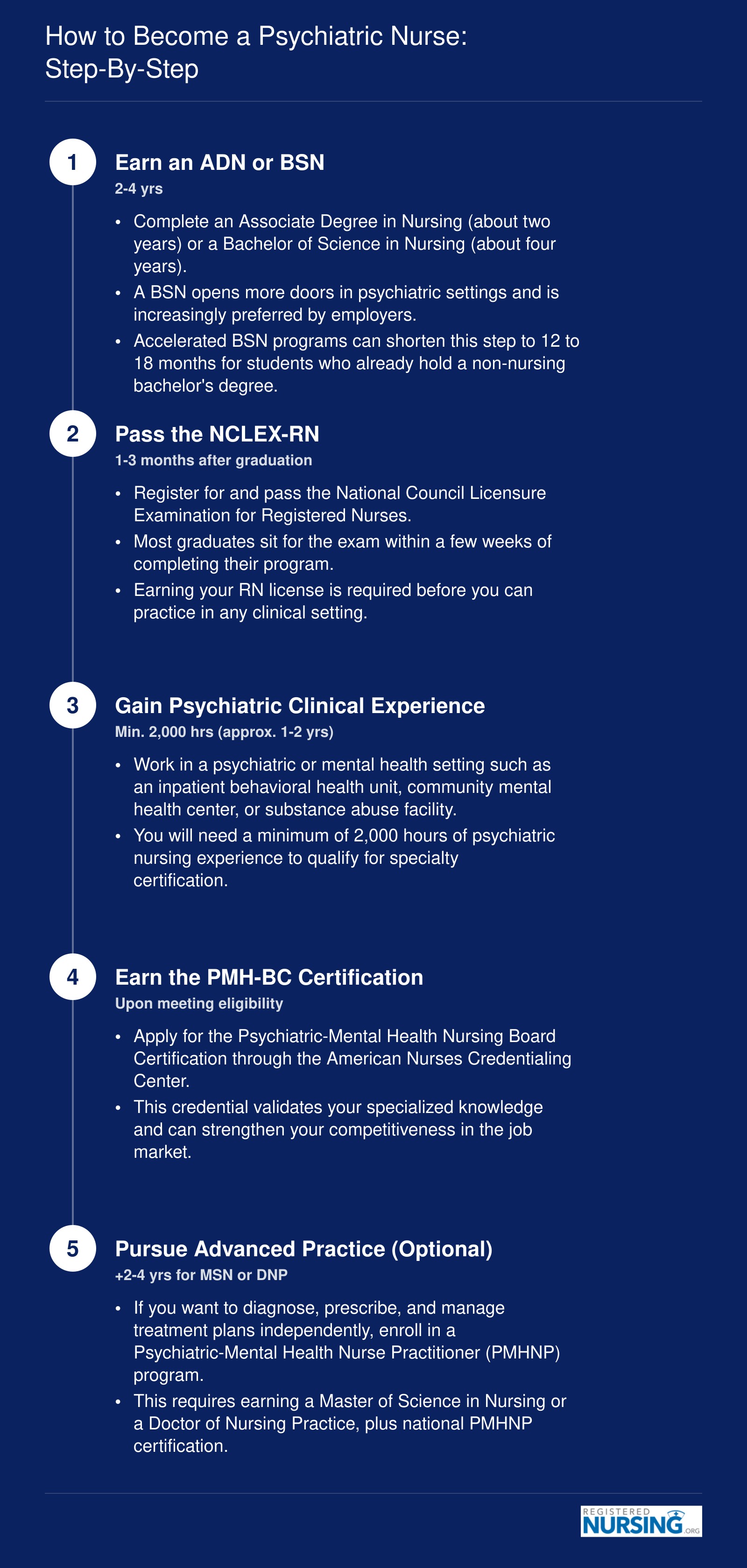
How to Become a Psychiatric Nurse: Step-By-Step
The path to becoming a psychiatric nurse follows a clear sequence of education, licensure, clinical experience, and optional specialization. Here is a roadmap with approximate timelines so you can plan your journey from day one to advanced practice.
How Long Does It Take to Become a Psychiatric Nurse?
How long does it take to become a psychiatric nurse? The honest answer depends almost entirely on where you are starting from. A student walking in from high school faces a very different timeline than an RN who already works on a behavioral health unit.
Timelines by Starting Point
The table below maps five common starting points to realistic total timelines, including the time needed to sit for the Psychiatric-Mental Health Nursing (PMH-BC) certification through the American Nurses Credentialing Center.
- High school graduate, ADN path: Two to three years to earn an Associate Degree in Nursing and pass the NCLEX-RN, then at least two years of qualifying practice before PMH-BC eligibility. Total: four to six years.
- High school graduate, BSN path: Four years for the degree, then two years of qualifying practice. Total: five to seven years, though dedicated psych rotations during school can streamline the post-graduation experience.
- LPN transitioning to RN: LPN-to-ADN bridge programs typically run 12 to 18 months. Add the PMH-BC practice requirement and the total lands around three to four years.
- ADN-holding RN with existing psychiatric experience: This is the fastest path. If you already meet the PMH-BC practice-hours requirement (1,000 hours in psychiatric-mental health nursing within the past three years), you may be eligible to sit for certification in under one year after passing the NCLEX.
- Non-nursing bachelor's degree holder, ABSN path: accelerated BSN programs compress the clinical curriculum into 12 to 18 months nationally.1 Programs such as those at the University of Colorado Anschutz2 (12 months), the University of Washington3 (12 months), and the University of Oklahoma Health Sciences Center5 (12 months) are among the fastest available. Marymount University's accelerated second-degree program runs 15 months4 and Kennesaw State University's option ranges from 15 to 18 months.6 GPA minimums vary by program, commonly falling between 2.5 and 3.0. Add two years of post-licensure practice for PMH-BC, and the total comes to roughly three to four years from enrollment.
Part-Time Students
If you are balancing school with work or family obligations, working while in nursing school typically adds 50 to 100 percent more time to any of the estimates above. A part-time ADN program that runs two years full time may take three to four years part time, pushing the overall psychiatric nursing timeline to six or more years for someone starting from high school.
The Bottom Line
For most people, plan on three to five years from the start of nursing school through PMH-BC certification. Career changers with a non-nursing degree who choose an accelerated program and then prioritize psychiatric placement can reach that milestone closer to three years. The only group that can realistically compress the timeline to under one year is an RN who is already practicing in a behavioral health setting and simply needs to formalize that expertise with a credential.
Education Pathways: ADN Vs. BSN Vs. Accelerated BSN
Two years at a community college versus four years at a university: that contrast captures the core decision most aspiring psychiatric nurses face before they ever set foot on a unit. Each path leads to the same RN license, but the routes differ in cost, timeline, and long-term opportunity in meaningful ways.
Associate Degree in Nursing (ADN)
ADN programs typically run about 24 months and are offered primarily through community colleges, making them the most accessible and affordable entry point.1 Graduates sit for the NCLEX-RN and can begin working as registered nurses right away. The 2022 first-time NCLEX pass rate for ADN graduates was approximately 77.9 percent, and median annual earnings for nurses at this credential level sit around $80,000 as of 2025.
The trade-off is career mobility. Many hospitals, including those with inpatient psychiatric units, now prefer or outright require a Bachelor of Science in Nursing for staff positions. This has made ADN vs BSN comparison a common and practical next step rather than an optional upgrade.
Traditional BSN
A traditional BSN program runs roughly 48 months at a four-year university.1 The investment in time and tuition is higher, but the payoff is measurable: BSN-prepared nurses report median annual wages closer to $99,000 as of 2025, and their 2022 first-time NCLEX pass rate came in at about 82.3 percent. For psychiatric nursing specifically, the BSN opens doors to more clinical leadership roles, specialty units, and direct pathways toward graduate education if you eventually pursue a psychiatric mental health nurse practitioner credential.
Accelerated BSN (ABSN)
For career changers who already hold a bachelor's degree in another field, the accelerated BSN is the fastest route into psychiatric nursing. These intensive programs compress BSN coursework into roughly 21 to 24 months by building on the prerequisite sciences and general education credits you have already completed.1 The credential and earning potential are identical to a traditional BSN, and the compressed schedule makes ABSN graduates competitive candidates for hospital-based psychiatric positions from day one. For a deeper look at how these two paths compare, traditional BSN vs. accelerated BSN breaks down the key trade-offs in scheduling, cost, and outcomes.
Choosing Your Path
If affordability and speed are your primary concerns and you do not yet hold any college degree, the ADN programs route gives you a way to start earning as an RN while continuing your education. If you already hold a non-nursing bachelor's degree, the accelerated BSN is almost always the smarter investment of time and money. And if you are entering nursing fresh from high school or early college, starting directly in a traditional BSN program puts you in the strongest position for psychiatric nursing roles from the outset.
Psychiatric Nurse Certifications and Credentials
What credentials do you need to specialize as a psychiatric nurse, and how do you actually earn them?
While certification is not legally required to work as a psychiatric nurse, earning a recognized credential demonstrates your expertise and commitment to the specialty. The primary certification for registered nurses in this field is the Psychiatric Mental Health Nurse Certification, known as the PMH-BC, awarded by the American Nurses Credentialing Center.
PMH-BC Eligibility Requirements
Before you can sit for the PMH-BC exam, you must meet several prerequisites established by the ANCC:1
- Active RN license: You must hold a current, unrestricted registered nurse license in the United States or its territories.
- Clinical experience: A minimum of 2,000 hours of clinical practice in psychiatric-mental health nursing, accumulated within the past three years.
- Continuing education: At least 30 hours of continuing education focused specifically on psychiatric-mental health nursing, also completed within the past three years.
- Practice duration: At least two years of experience as a registered nurse.
These requirements ensure that candidates have substantial hands-on experience before attempting certification.
Exam Format and Scoring
The PMH-BC examination consists of 150 multiple-choice questions, though only 125 of those questions are scored.2 The remaining 25 are pretest questions used for future exam development. You have three hours to complete the test.
Scoring uses a scaled system ranging from 0 to 500, with a passing score of 350.2 The exam covers four primary content areas: assessment and diagnosis, planning, implementation, and evaluation. These domains reflect the full scope of psychiatric nursing practice, from initial patient evaluation through treatment outcomes.
Costs and Renewal
Application fees vary based on professional membership status.3 The standard fee is $395, while American Nurses Association members pay $295. Members of the American Psychiatric Nurses Association receive the most significant discount at $220, and International Society of Psychiatric-Mental Health Nurses members pay $340. An additional administrative fee of $140 applies to all applicants.4
Certification remains valid for five years. To renew, you must complete 75 hours of continuing education, with at least 60 of those hours formally approved by a recognized accrediting body. Alternatively, you may renew by retaking the examination.
PMH-BC vs. PMHNP-BC: Understanding the Difference
The PMH-BC is designed specifically for registered nurses working at the bedside or in direct care roles. It is distinct from the PMHNP-BC, which is a certification for Psychiatric Nurse Practitioners. The PMHNP-BC requires completion of a graduate-level nurse practitioner program and qualifies nurses for advanced practice roles, including prescribing medications and providing psychotherapy independently in many states.
If you are working as an RN and want to demonstrate psychiatric specialization, the PMH-BC is your credential. If you plan to pursue advanced practice with prescriptive authority, you would eventually pursue the PMHNP-BC after completing a master's or doctoral program. Exploring online Psychiatric Mental Health Nurse Practitioner programs is a practical next step for RNs considering that path.
Why Certification Matters
Though voluntary, earning the PMH-BC signals to employers that you have verified expertise in psychiatric nursing. Many healthcare organizations prefer or require certification for positions in behavioral health units, substance abuse programs, and crisis intervention teams. Certified nurses often report greater hiring competitiveness and may qualify for higher pay scales or salary differentials compared to non-certified peers. The credential also provides a strong foundation for nurses considering eventual advancement to nurse practitioner roles.
What Does a Psychiatric Nurse Do on a Daily Basis?
The growing emphasis on integrated behavioral health care has expanded what psychiatric nurses do well beyond traditional medication rounds. On any given shift, a psychiatric nurse blends clinical expertise with interpersonal sensitivity to support patients navigating complex mental health challenges.
Core Clinical Responsibilities
A psychiatric nurse's day typically begins with reviewing patient charts, completing mental health assessments, and evaluating changes in mood, cognition, or behavior since the last encounter. From there, daily tasks may include:
- Medication administration and monitoring: Dispensing psychiatric medications, tracking side effects, and adjusting dosing schedules in coordination with the prescribing provider.
- Crisis intervention: Recognizing escalating behaviors, employing de-escalation techniques, and initiating safety protocols when a patient poses a risk to themselves or others.
- Treatment plan collaboration: Working alongside psychiatrists, psychologists, social workers, and therapists to develop and revise individualized care plans.
- Patient and family education: Teaching patients about diagnoses, coping strategies, medication adherence, and community resources.
- Documentation: Recording assessments, interventions, and outcomes in electronic health record systems with accuracy and timeliness.
Essential Skills
Psychiatric nursing demands a distinct skill set that goes beyond standard medical-surgical competencies. Therapeutic communication, the ability to build trust while maintaining professional boundaries, is foundational. Trauma-informed care guides every interaction, ensuring that treatment avoids re-traumatization. Cultural competency is equally important, as mental health presentations and treatment preferences vary widely across populations. Above all, the ability to remain calm and composed when patient behavior becomes unpredictable is what separates effective psychiatric nurses from those who struggle in the role.
How the Setting Shapes the Work
Daily responsibilities shift dramatically depending on the practice environment. Inpatient versus outpatient nursing settings shape the work in fundamentally different ways. Inpatient psychiatric nurses manage acute crises, monitor patients on involuntary psychiatric holds, and maintain safety on locked units where situations can change in seconds. Outpatient psychiatric nurses, by contrast, spend more time on medication management visits, psychoeducation, relapse prevention planning, and connecting patients with longer-term support services. Community mental health settings may add home visits or group facilitation to the mix.
Managing Emotional Demands
Psychiatric nursing is one of the most emotionally intensive specialties in the profession. Repeated exposure to patient suffering, aggression, and traumatic disclosures can lead to compassion fatigue and burnout if left unaddressed. Unlike emergency nurses, who often process acute physical trauma, psychiatric nurses contend with prolonged emotional exposure across extended therapeutic relationships. Regular clinical supervision, peer support, and deliberate self-care practices are not optional extras; they are essential for longevity in the field. Many employers now offer structured debriefing sessions after critical incidents, recognizing that caring for the caregiver is just as important as caring for the patient.
Questions to Ask Yourself
Where Do Psychiatric Nurses Work?
Psychiatric nurses practice across a diverse range of clinical, community, and correctional settings, each offering distinct patient populations, challenges, and rewards. Understanding these environments can help you identify where your interests and skills will have the greatest impact.
Inpatient and Acute Care Settings
Many psychiatric nurses begin their careers on inpatient psychiatric units within general hospitals or dedicated psychiatric hospitals. These settings serve patients in acute mental health crisis, including individuals experiencing severe depression, psychosis, suicidal ideation, or violent behavior. The work is intense, fast-paced, and requires strong de-escalation skills, medication management expertise, and the ability to coordinate with multidisciplinary teams. Shifts typically run 12 hours, and you will often encounter patients admitted involuntarily under legal holds.
Outpatient and Community Mental Health
Outpatient mental health clinics and community mental health centers employ psychiatric RNs to provide ongoing care for patients with chronic mental illness. Roles often include medication monitoring, care coordination, crisis intervention, and patient education. Demand is especially strong in rural and underserved areas where psychiatrist shortages push more clinical responsibility to RNs , our Guide to Rural Nursing outlines what nurses can expect in these communities. These environments tend to offer regular business hours and the chance to build long-term therapeutic relationships.
Forensic Psychiatric Nursing
Forensic psychiatric nursing is a subspecialty focused on individuals involved in the criminal justice system. Forensic nurses work in jails, prisons, and forensic psychiatric hospitals, caring for inmates and defendants with serious mental illness. The role blends psychiatric care with security awareness and often involves court testimony or evaluations. If you are curious about how this specialty intersects with law enforcement, forensic nurses working with law enforcement is worth exploring. Because of the unique challenges and specialized skills required, forensic positions frequently carry higher pay than general correctional nursing roles.
Substance Abuse Treatment Facilities
Substance abuse treatment centers, both inpatient and outpatient, employ psychiatric nurses to manage co-occurring mental health and addiction disorders. This dual-diagnosis population requires integrated care that addresses both psychiatric symptoms and substance use, making it an ideal setting for nurses drawn to working as a substance abuse nurse in holistic, recovery-focused practice.
Veterans Affairs and Military Settings
Veterans Affairs (VA) hospitals and clinics are major employers of psychiatric nurses. VA settings often serve veterans with PTSD, traumatic brain injury, depression, and substance use disorders. These roles typically offer competitive federal benefits and the opportunity to serve a population with unique mental health needs.
Telehealth and Remote Care
Since the COVID-19 pandemic, psychiatric telehealth roles have expanded rapidly. Psychiatric RNs now conduct remote assessments, medication follow-ups, and crisis interventions via video and phone. Telehealth platforms allow greater schedule flexibility and the ability to reach patients in rural or homebound situations, making this one of the fastest-growing work settings in psychiatric nursing. Nurses interested in this model can explore a broader range of remote nursing jobs available across specialties.
Psychiatric Nurse Salary: National Overview
The table below compares national wage data for Registered Nurses and Nurse Practitioners, based on 2024 figures from the Bureau of Labor Statistics. These numbers reflect broad occupational categories rather than psychiatric specialty roles specifically. Psychiatric RNs may earn more or less than the general RN median depending on their work setting, shift differentials, geographic location, and whether they hold specialty certifications. For nurses considering advancement, the jump from RN to Psychiatric Mental Health Nurse Practitioner (PMHNP) represents a significant increase in earning potential, with median pay rising by roughly $35,000 per year.
| Occupation | Total Employment | 25th Percentile Salary | Median Salary | Mean (Average) Salary | 75th Percentile Salary |
|---|---|---|---|---|---|
| Registered Nurses | 3,282,010 | $78,610 | $93,600 | $98,430 | $107,960 |
| Nurse Practitioners | 307,390 | $109,940 | $129,210 | $132,000 | $149,570 |
Psychiatric Nurse Salary by State
Salaries for psychiatric nurses vary significantly depending on where you practice. The table below draws from 2024 Occupational Employment and Wage Statistics published by the U.S. Bureau of Labor Statistics. Because these figures cover all registered nurses broadly, psychiatric-specialty RNs working in high-acuity inpatient or forensic settings may earn above the state median. Keep in mind that the highest-paying states often carry a higher cost of living, which can reduce real purchasing power. States with the largest total employment, such as Texas, Florida, Pennsylvania, and Illinois, signal strong demand and a wider range of available positions.
| State | Total RN Employment | 25th Percentile | Median Salary | 75th Percentile | Mean Salary |
|---|---|---|---|---|---|
| Rhode Island | 10,760 | $83,870 | $99,960 | $112,540 | $99,770 |
| Arizona | 64,430 | $81,390 | $96,890 | $105,450 | $95,230 |
| New Hampshire | 16,580 | $79,720 | $96,830 | $105,500 | $94,620 |
| Maryland | 48,980 | $81,470 | $96,830 | $104,840 | $96,650 |
| Colorado | 54,510 | $81,790 | $96,520 | $104,370 | $95,470 |
| Delaware | 13,260 | $82,600 | $92,610 | $108,360 | $95,450 |
| Texas | 261,050 | $77,450 | $90,010 | $102,200 | $91,690 |
| Virginia | 77,420 | $77,650 | $88,820 | $100,920 | $90,930 |
| New Mexico | 17,510 | $82,630 | $88,260 | $104,720 | $94,360 |
| Pennsylvania | 146,840 | $78,570 | $87,610 | $102,030 | $90,830 |
| Georgia | 97,410 | $76,600 | $86,560 | $104,790 | $91,960 |
| Illinois | 139,900 | $79,150 | $86,410 | $103,660 | $91,130 |
| Idaho | 14,540 | $78,020 | $86,100 | $100,220 | $89,770 |
| Wisconsin | 64,960 | $79,570 | $86,070 | $100,680 | $90,450 |
| Michigan | 104,210 | $80,030 | $85,670 | $101,210 | $90,580 |
| Vermont | 7,240 | $79,980 | $85,150 | $104,110 | $92,710 |
| Maine | 16,280 | $76,890 | $82,860 | $98,000 | $87,440 |
| Florida | 218,100 | $77,070 | $82,850 | $99,260 | $88,200 |
| Utah | 25,780 | $77,030 | $82,270 | $101,530 | $88,240 |
| North Carolina | 108,510 | $74,710 | $81,860 | $98,720 | $86,270 |
| Wyoming | 5,180 | $75,540 | $81,790 | $100,910 | $88,020 |
| Montana | 10,540 | $77,800 | $81,560 | $100,510 | $88,480 |
| Ohio | 138,360 | $77,420 | $81,250 | $97,440 | $86,110 |
| Oklahoma | 32,870 | $75,320 | $81,160 | $96,460 | $85,800 |
| Nebraska | 24,180 | $76,430 | $81,020 | $93,140 | $82,890 |
As of December 2025, 137 million Americans lived in Mental Health Professional Shortage Areas, and in 2026, the existing behavioral health workforce meets only 26.4 percent of that need.
Career Outlook and Job Growth for Psychiatric Nurses
Bedside RN roles and advanced-practice psychiatric positions both show positive job growth through 2034, but the trajectories are strikingly different. Understanding these projections can help you choose the path that aligns with your career goals and desired level of job security.
RN and Nurse Practitioner Growth Projections
According to the Bureau of Labor Statistics, registered nursing employment is projected to grow by about 5 percent from 2024 to 2034, adding roughly 166,100 new positions across all specialties.1 With approximately 189,100 annual openings (including replacements for nurses who retire or change careers), demand remains steady.1 Nurse practitioners, on the other hand, are on one of the fastest growth curves in healthcare, with a projected growth rate of about 40 percent over the same decade and an estimated 128,400 new positions.2 Psychiatric-mental health nurse practitioners (PMHNPs) represent a significant share of that growth because of the acute shortage of mental health providers nationwide.
What Is Driving Demand
Several converging forces are fueling the need for psychiatric nurses at every practice level.
- Mental health awareness: Public understanding of anxiety, depression, PTSD, and other conditions has expanded considerably, increasing the number of people seeking treatment.
- Insurance parity laws: Federal and state mandates requiring equitable coverage for behavioral health services have widened patient access, creating more clinical positions.
- Aging population: Older adults experience higher rates of cognitive decline, depression, and substance misuse, all of which require specialized psychiatric nursing care.
- Substance use crisis: The ongoing opioid epidemic and rising polysubstance use disorders continue to strain treatment centers, detox units, and outpatient programs.
- Post-pandemic mental health needs: Elevated rates of anxiety, burnout, and trauma-related disorders that emerged during and after the COVID-19 pandemic persist in many communities, sustaining demand well into 2026 and beyond.
Workforce Shortage and Job Security
The Health Resources and Services Administration (HRSA) has long designated large portions of the United States as Mental Health Professional Shortage Areas. Hundreds of counties, particularly in rural regions, lack adequate psychiatric providers, and the states with the largest nursing shortages illustrate just how uneven that distribution can be. For psychiatric nurses, this shortage translates directly into strong job security, competitive salaries, and significant negotiating leverage on scheduling, sign-on bonuses, and loan-repayment incentives.
Psychiatric nursing is consistently cited as one of the hardest-to-fill nursing specialties. Hospitals, community mental health centers, and telehealth platforms often compete for the same limited talent pool. For a broader look at the forces behind this gap, the nursing shortage fact sheet offers useful context on workforce trends affecting all specialties. If you are evaluating whether this specialty can offer long-term stability, the data points clearly in your favor. Demand is not only present today but projected to intensify as the gap between patient need and provider supply continues to widen over the coming decade.
Frequently Asked Questions About Psychiatric Nursing
Choosing a career in psychiatric nursing raises a lot of practical questions about education, credentials, and earning potential. Below are answers to the most common questions prospective mental health nurses ask.
What degree does a psychiatric nurse need?
What is the difference between a psychiatric nurse and a psychiatric nurse practitioner?
What is the fastest way to become a psychiatric nurse?
Do psychiatric nurses need certification to practice?
How much does a forensic psychiatric nurse make compared to other psychiatric nurses?
Can you become a psychiatric nurse with an associate degree?
Explore More
- Ambulatory Care Nurse
- Burn Unit Nurse
- Cardiac Nurse
- Cath Lab Nurse
- Charge Nurse
- Chief Nursing Officer (CNO)
- Correctional Nurse
- CVOR Nurse
- Dermatology Nurse
- Developmental Disability Nurse
- Director of Nursing
- Domestic Violence Nurse
- Emergency Room Nurse
- ENT Nurse
- ET Nurse
- Fertility Nurse
- Flight/Transport Nurse
- Forensic Nurse Salary & Career Guide
- Genetic Nurse
- Geriatric Nurse
- Health Policy Nurse
- Healthcare Administrator
- Healthcare Manager
- Home Health Nurse
- Hospice Nurse
- Camp Nurse
- GI Nurse
- Holistic Nurse
- Labor and Delivery Nurse
- Nurse Writer
- School Nurse
- Telemetry Nurse
- Travel Nurse
- Aesthetic Nurse
- Infusion/IV Nurse
- Oncology Nurse
- ICU Nurse
- Infection Control Nurse
- Legal Nurse Consultant
- LTC Nurse
- Managed Care Nurse
- Medical-Surgical Nurse
- Military (Combat) Nurse
- Missionary Nurse
- Mother Baby Nurse
- Nephrology Nurse
- Neuroscience Nurse
- NICU Nurse
- Nurse Administrator
- Nurse Attorney
- Nurse Care Coordinator
- Nurse Case Manager
- Nurse Entrepreneur
- Nurse Executive
- Nurse Health Coach
- Nurse Manager
- Obstetric (OB) Nurse
- Occupational Health Nurse
- Operating Room Nurse
- Ophthalmic Nurse
- Organ Procurement Coordinator
- Orthopedic Nurse
- Pain Management Nurse
- Palliative Care Nurse
- Parish Nurse
- Patient Advocate Nurse
- Pediatric Endocrinology Nurse
- Perianesthesia (PACU) Nurse
- Perinatal Nurse
- Plastic Surgery Nurse
- Public/Community Health Nurse
- Radiology Nurse
- Rehabilitation Nurse
- Research Nurse
- Respiratory Nurse
- Rheumatology Nurse
- Substance Abuse Nurse
- Telephone Triage Nurse
- Transcultural Nursing
- Transplant Nurse
- Trauma Nurse
- Wound Care Nurse (WOCN)