

What you’ll learn in this article…
- Home health nurses average 75 to 90 patient visits per month independently.
- BLS projects faster job growth for home health than hospital nursing.
- An ADN and active RN license meet minimum entry requirements.
What qualifications do you actually need to work as a home health nurse, and what does the job involve day to day?
A home health nurse is a registered nurse who delivers skilled clinical care directly in a patient's residence, ranging from post-surgical wound management to IV therapy to chronic disease monitoring. The role is distinct from that of a home health aide, who is not a licensed clinician and cannot perform skilled nursing procedures. It also differs from hospice nursing, which focuses on comfort and end-of-life care for patients who are no longer pursuing curative treatment.
Demand for home health RNs is expanding faster than for most other nursing settings, driven by an aging population, shorter hospital stays, and payer pressure to shift post-acute care out of facilities. That growth has real implications for compensation, scheduling autonomy, and the clinical skills employers now expect at hire. Nurses weighing this specialty against other options sometimes compare it to roles like orthopedic nursing, where acute facility experience and independent clinical judgment are equally valued.
Home Health Nurse Vs. Hospital Nurse Vs. Hospice Nurse
Choosing between home health, hospital, and hospice nursing is really about deciding which phase of a patient's journey and which type of care delivery best fits your professional values. Each role serves a distinct population and operates under a different care philosophy, so understanding the core contrasts helps you pick the setting where you'll thrive.
Setting and Patient Focus
Home health nurses provide post-acute care, visiting patients in their own residences after hospital discharge, injury, or during management of chronic conditions.1 They teach medication regimens, monitor recovery, and coordinate with families to maintain independence. Hospital nurses work at the bedside in acute care environments, handling rapid changes in patient status, administering complex treatments, and collaborating with multidisciplinary teams in a structured facility. Hospice nurses concentrate on comfort, dignity, and symptom control for those with terminal illness, focusing entirely on quality of life rather than curative treatment, a shift that demands emotional resilience and deep communication skills.
Compensation and Work Environment
Median hourly pay reflects some of these differences. Home health nurses earn a median of $45.81 per hour,3 while hospital nurses report a median of $42.55 and hospice nurses $42.48.4 Beyond wages, the daily rhythm varies sharply: home health nurses manage their own schedules, travel from home to home, and often enjoy greater autonomy. Hospital nurses work fixed shifts with around-the-clock support but face high patient-to-nurse ratios and the physical demands of an acute setting. Nurses considering a shift away from the hospital floor may also want to review the challenges transitioning from hospital nursing to clinic or ambulatory care before committing to a new environment. Hospice nurses combine home-like settings, whether private homes or hospice facilities, with a reflective, slower-paced approach to care, though emotional burnout is a well-documented challenge in end-of-life work. For those drawn to patient-centered, relationship-focused practice, holistic nursing offers another lens through which to explore values-aligned specialties.
What Does a Home Health Nurse Do? Core Duties and Responsibilities
Home health nurses make an average of seventy-five to ninety patient encounters per month, each requiring comprehensive assessment, documentation, and care coordination, all performed independently in patients' homes without immediate physician or colleague backup. This autonomy defines the role and shapes every duty from wound care to medication reconciliation.
Clinical Assessments and OASIS Documentation
Every home visit begins with a clinical assessment. Home health nurses evaluate vital signs, lung and heart sounds, skin integrity, mobility, pain levels, and changes in condition since the last encounter. For Medicare-certified agencies, nurses complete the Outcome and Assessment Information Set (OASIS) at admission, resumption of care, recertification, transfer, and discharge. OASIS is a standardized data collection tool required by CMS, and its completion is a daily reality for home health nurses. nursing charting systems follow every visit, capturing assessment findings, interventions performed, patient response, and progress toward goals. Documentation isn't ancillary work: it drives reimbursement, regulatory compliance, and continuity of care.
Medication Management and Patient Safety
Home health nurses reconcile medication lists, educate patients on dosing schedules, monitor for adverse effects, and report changes to prescribing physicians. In the home environment, nurses often discover that patients fill prescriptions at multiple pharmacies, skip doses due to cost, or misunderstand complex regimens. Simplifying pill organizers, teaching injection techniques, and recognizing early signs of toxicity or noncompliance are routine responsibilities. Because there is no on-site physician to consult, strong clinical judgment and timely communication with the care team are essential.
Wound Care and Skilled Procedures
Many home health referrals involve wound management: surgical incisions, pressure injuries, diabetic ulcers, or trauma wounds. Nurses perform dressing changes, debridement, infection surveillance, and measurement, tasks that parallel the expertise of a wound care nurse. They also administer IV infusions, manage central lines and feeding tubes, and provide respiratory treatments. Each procedure demands the same sterile technique and clinical rigor as hospital care, adapted to the home setting.
Patient and Family Education
Teaching is woven into every visit. Home health nurses educate patients and caregivers on disease processes, symptom recognition, medication administration, equipment use, fall prevention, and nutrition. They assess health literacy, tailor instruction to individual learning styles, and confirm understanding through return demonstration. This education empowers patients to manage their conditions between nursing visits.
Care Planning and Coordination
Home health nurses develop and update individualized care plans based on physician orders, patient goals, and ongoing assessment data. They coordinate with physical therapists, occupational therapists, speech-language pathologists, social workers, and home health aides to ensure a cohesive approach. Regular communication with the supervising physician, via phone calls, secure messages, or formal progress reports, keeps the entire team aligned and responsive to changes in patient status. This breadth of coordination sets home health nursing apart from roles like geriatric nursing, where a clinical team is typically on-site.
A Typical Day as a Home Health Nurse: Visit Workflow and Caseload
Home health nursing unfolds across miles of road, multiple living rooms, and a rhythm that looks nothing like a hospital shift. Understanding how the day actually flows helps prospective nurses gauge whether this career fits their working style and personal life.
Morning Prep and Route Planning
Most home health nurses start between 7:30 and 8:00 a.m., but the workday technically begins the night before when they review the next day's schedule. Morning tasks include checking the electronic health record for updated orders, confirming visit times with patients or caregivers, and mapping an efficient driving route. Nurses pack supply bags with wound care materials, blood draw equipment, and portable vital-signs monitors. Because no two homes stock the same resources, experienced nurses learn to anticipate what each patient will need.
Patient Visits and Travel
A typical caseload ranges from four to eight patient visits per day,1 with seven visits being a common benchmark according to productivity data from the Fazzi Associates study.2 Each visit lasts roughly 30 to 60 minutes of direct care,3 though total time on site often stretches to 60 to 90 minutes once you factor in caregiver education, supply restocking, and impromptu problem solving.4 Travel between homes can add 15 to 45 minutes depending on geography, so nurses in rural areas may see fewer patients simply due to distance.
Scheduling models vary by employer:
- Per-visit pay: Nurses earn a set fee for each completed visit, incentivizing efficiency but sometimes pressuring speed.
- Salaried positions: Offer predictable income and often include benefits, with caseloads capped around 20 to 25 patients total.5
- PRN or per diem: Provide flexibility for nurses who want part-time hours or supplemental income. Nurses seeking maximum schedule control sometimes also explore remote nursing jobs as a complement to field-based work.
The Documentation Crunch
Paperwork rarely fits neatly into the visit itself. After the final patient of the day, most home health nurses spend one to two additional hours completing required documentation. This includes OASIS assessments, visit notes, medication reconciliation, and care-plan updates in the agency's EHR system. Understanding the advantages and disadvantages of electronic health records can help nurses advocate for more efficient charting tools at their agency. Many nurses finish charting at home in the evening, which can blur the line between work and personal time.
Autonomy and Independent Decision Making
Unlike hospital nurses who can consult a charge nurse or colleague down the hall, home health nurses troubleshoot alone. A patient's home may lack electricity, have aggressive pets, or present family dynamics that complicate care. This independence is one of the role's greatest appeals for nurses who thrive on critical thinking without constant oversight, but it also means you must trust your clinical judgment in unpredictable settings. Phone access to supervisors and physicians exists, yet the on-the-ground decisions fall squarely on your shoulders.
Before accepting a home health nursing position, ask specifically about mileage reimbursement rates and whether the employer provides route-planning tools: most home health nurses drive 50 to 100 or more miles per day between patient homes, and those fuel and vehicle costs add up quickly in ways that a standard job description rarely spells out.
How to Become a Home Health Nurse: Education, Licensing, and Certifications
The pathway into home health nursing has broadened considerably as agencies compete for staff and payers push more skilled care into the home. What was once considered a role reserved for experienced hospital nurses is now open to a wider range of candidates, though the core credentials have not changed.
The Standard Pathway
Most home health nurses follow a predictable route into the field:
- Earn an ADN or BSN: An Associate Degree in Nursing typically takes two years at a community college, while a Bachelor of Science in Nursing (BSN) Degree runs four years. Both qualify you to sit for licensure.
- Pass the NCLEX-RN: This national licensure exam is required in every state to practice as a registered nurse.
- Build acute care experience: Agencies commonly prefer one to two years of hospital medical-surgical experience before you take on independent home visits. It is a strong recommendation rather than a universal rule, and some agencies now hire new graduates into structured orientation programs.
- Apply to home health agencies: Certified agencies, hospital-affiliated home care divisions, and hospice-adjacent providers all hire RNs directly.
ADN vs. BSN in Hiring
Larger agencies, Magnet-affiliated systems, and Medicare-focused providers often prefer BSN-prepared nurses, and some case management or supervisory roles require the bachelor's. That said, ADN holders are widely hired, particularly in rural areas, underserved communities, and smaller regional agencies where staffing pressure outweighs degree preference. Many ADN nurses complete an RN-to-BSN bridge program online while working.
Key Certifications
Several credentials strengthen a home health resume, though none are legally required to practice:
- HCS-D (Home Care Coding Specialist, Diagnosis): Issued by the Board of Medical Specialty Coding & Compliance.1 The 90-question exam runs 3.5 hours, costs $339, and requires a 76% passing score.2 Two years of coding experience is recommended. Renewal is annual, requiring 20 CEUs and a $229 fee.3
- COS-C (Certificate for OASIS Specialist, Clinical): Focused specifically on OASIS assessment accuracy, a critical skill for Medicare-certified home health.
- ANCC Home Health Nursing Certification: Offered by the American Nurses Credentialing Center for experienced RNs seeking board certification in the specialty.
OASIS Documentation Competency
Even without formal certification, OASIS proficiency is a de facto requirement. The Outcome and Assessment Information Set drives Medicare reimbursement, care planning, and quality metrics. Agencies train new hires on their documentation systems, but supervisors expect functional competency within a few weeks of orientation. If you can demonstrate familiarity with OASIS during interviews, you will stand out.
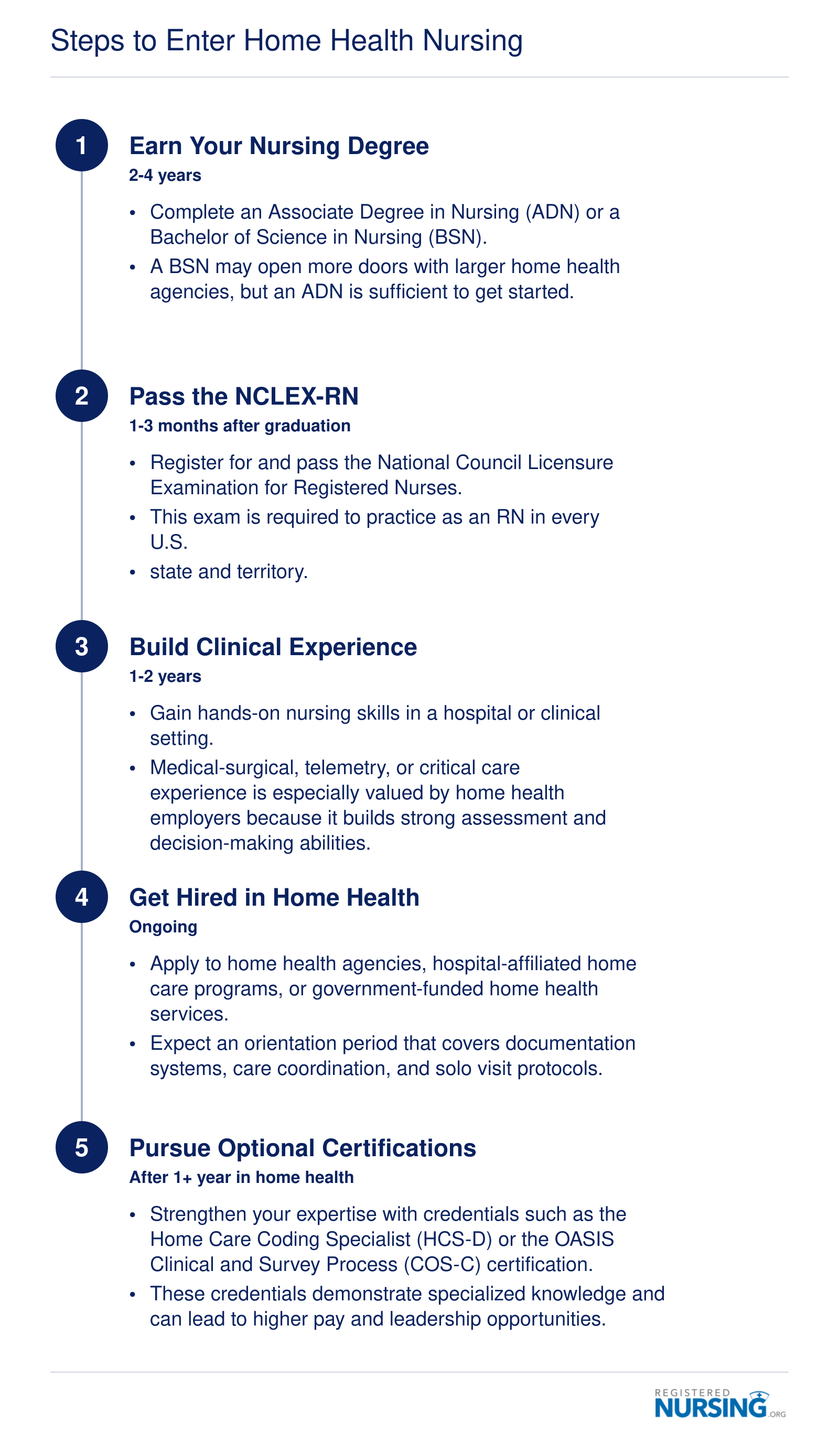
Steps to Enter Home Health Nursing
Breaking into home health nursing follows a clear, achievable pathway. Most nurses can transition into this specialty within a few years of earning their license, and optional certifications can boost both credibility and earning potential.
Home Health Nurse Salary: National, State, and Metro Pay Data
According to 2024 Occupational Employment and Wage Statistics from the U.S. Bureau of Labor Statistics, the national median annual salary for registered nurses is $93,600, with a mean (average) salary of $98,430. Because BLS data covers all registered nurses rather than home health nurses specifically, it is worth noting that home health RN earnings typically fall near or slightly below the overall median. Compensation also varies by pay model. Many home health agencies use per visit reimbursement, which can range from roughly $40 to $80 or more per visit depending on the region, visit type, and complexity of care. Nurses who manage a full caseload in higher paying markets can earn salaries that rival or exceed hospital based roles.
| Pay Metric | Annual Salary |
|---|---|
| National Median | $93,600 |
| National Mean (Average) | $98,430 |
| 25th Percentile | $78,610 |
| 75th Percentile | $107,960 |
| Total Employed RNs (Nationwide) | 3,282,010 |
Top-Paying States for Registered Nurses (Including Home Health)
The table below ranks 25 states by median annual pay for registered nurses, based on data from the Occupational Employment and Wage Statistics program (2024) published by the U.S. Bureau of Labor Statistics. Keep in mind that many of the highest-paying states also carry a higher cost of living, so your net purchasing power may not stretch as far as the salary figure suggests. It is also worth noting that within any single state, home health agencies in urban metro areas often pay $10,000 or more above what rural agencies offer for comparable roles.
| State | Total RN Employment | 25th Percentile | Median Pay | 75th Percentile | Mean Pay |
|---|---|---|---|---|---|
| Rhode Island | 10,760 | $83,870 | $99,960 | $112,540 | $99,770 |
| Arizona | 64,430 | $81,390 | $96,890 | $105,450 | $95,230 |
| New Hampshire | 16,580 | $79,720 | $96,830 | $105,500 | $94,620 |
| Maryland | 48,980 | $81,470 | $96,830 | $104,840 | $96,650 |
| Colorado | 54,510 | $81,790 | $96,520 | $104,370 | $95,470 |
| Delaware | 13,260 | $82,600 | $92,610 | $108,360 | $95,450 |
| Texas | 261,050 | $77,450 | $90,010 | $102,200 | $91,690 |
| Virginia | 77,420 | $77,650 | $88,820 | $100,920 | $90,930 |
| New Mexico | 17,510 | $82,630 | $88,260 | $104,720 | $94,360 |
| Pennsylvania | 146,840 | $78,570 | $87,610 | $102,030 | $90,830 |
| Georgia | 97,410 | $76,600 | $86,560 | $104,790 | $91,960 |
| Illinois | 139,900 | $79,150 | $86,410 | $103,660 | $91,130 |
| Idaho | 14,540 | $78,020 | $86,100 | $100,220 | $89,770 |
| Wisconsin | 64,960 | $79,570 | $86,070 | $100,680 | $90,450 |
| Michigan | 104,210 | $80,030 | $85,670 | $101,210 | $90,580 |
| Vermont | 7,240 | $79,980 | $85,150 | $104,110 | $92,710 |
| Maine | 16,280 | $76,890 | $82,860 | $98,000 | $87,440 |
| Florida | 218,100 | $77,070 | $82,850 | $99,260 | $88,200 |
| Utah | 25,780 | $77,030 | $82,270 | $101,530 | $88,240 |
| North Carolina | 108,510 | $74,710 | $81,860 | $98,720 | $86,270 |
| Wyoming | 5,180 | $75,540 | $81,790 | $100,910 | $88,020 |
| Montana | 10,540 | $77,800 | $81,560 | $100,510 | $88,480 |
| Ohio | 138,360 | $77,420 | $81,250 | $97,440 | $86,110 |
| Oklahoma | 32,870 | $75,320 | $81,160 | $96,460 | $85,800 |
| Nebraska | 24,180 | $76,430 | $81,020 | $93,140 | $82,890 |
Job Outlook: Is Home Health Nursing Growing?
Working in a hospital setting versus choosing home health nursing leads to very different career trajectories, especially when examining where healthcare employment is headed over the next decade. While both paths offer job security, home health nursing is positioned for particularly strong growth as the healthcare system continues its shift toward community-based care.
National Employment and Projected Growth
The Bureau of Labor Statistics reports that approximately 3.4 million registered nurses are currently employed across the United States, making nursing one of the largest healthcare professions in the country. Employment for RNs overall is projected to grow 5 percent from 2024 to 2034, adding roughly 166,100 new positions to the workforce. Beyond new job creation, the profession expects approximately 189,100 openings annually due to retirements, career changes, and workforce turnover.
These national figures tell only part of the story. The broader healthcare and social assistance sector is projected to grow at 8.4 percent during the same period, adding an estimated 2 million jobs. More telling for prospective home health nurses: services for the elderly and persons with disabilities are expected to surge by 21 percent, creating over 528,500 new positions. This subsector captures much of where home health nursing operates, suggesting demand for nurses willing to work in patient homes will outpace traditional hospital hiring.
Why Home Health Is Outpacing Hospital Growth
Several forces are driving this accelerated demand. An aging population is the most significant factor. As baby boomers move into their seventies and eighties, more patients require ongoing care management for chronic conditions, post-surgical recovery, and end-of-life support. Many prefer receiving this care at home rather than in institutional settings.
The shift toward value-based care is also reshaping where nursing jobs exist. Medicare and private insurers increasingly reimburse for home-based services, recognizing that keeping patients out of hospitals reduces costs and often improves outcomes. The Centers for Medicare and Medicaid Services has expanded home health coverage in recent years, and reimbursement trends continue favoring community-based models. This growth mirrors broader patterns documented in largest nursing shortages across the country, where home and community-based settings are absorbing much of the unmet demand.
Competitive Hiring Environment
The broader nursing shortage compounds demand in home health specifically. Agencies are competing aggressively for qualified RNs, often offering signing bonuses, flexible schedules, and competitive pay packages to attract talent. Nurses exploring adjacent orthopedic nursing roles or other hospital-based specialties will find that home health frequently offers comparable compensation with greater schedule autonomy. For nurses seeking leverage in salary negotiations or schedule preferences, home health represents a sector where employer demand frequently exceeds candidate supply.
Questions to Ask Yourself
Pros and Cons of Home Health Nursing
Home health nursing offers a distinct set of rewards and challenges that set it apart from virtually every other practice setting, and understanding both sides before you commit can save you from burnout or, conversely, confirm that this career path is the right fit.
Advantages Worth Considering
- Autonomy: You manage your own schedule, plan your route, and make clinical decisions independently. Many home health nurses cite this freedom as the single biggest reason they stay in the field.
- One-on-one patient relationships: Without the competing demands of a busy unit, you can spend meaningful time with each patient and their family, often following the same individuals over weeks or months.
- Variety: No two homes, no two patients, and no two days look the same. You may dress a wound in the morning, teach diabetes self-management at midday, and perform a pediatric assessment in the afternoon.
- Work-life flexibility: Shifts typically fall during daytime hours on weekdays, and many agencies offer part-time or per-diem options that accommodate school, family, or a second role.
- Growing demand: As the population ages and health systems push to reduce costly hospital readmissions, home health nurses are increasingly central to the continuum of care.
Challenges You Should Prepare For
- Safety risks: OSHA identifies home health care workers as facing unique hazards, including workplace violence1, aggressive pets, unsanitary living conditions, and the simple reality of entering unfamiliar neighborhoods alone. Nurses must stay vigilant and follow agency safety protocols.
- Ergonomic strain: Unlike a hospital, a patient's home rarely has ceiling lifts, adjustable beds, or proper transfer equipment. Moving or repositioning patients in tight spaces raises the risk of musculoskeletal injuries.
- Infection control limitations: You cannot control the cleanliness of every environment you enter. Standard precautions still apply, but the conditions are far less predictable than a clinical facility.
- Isolation: Working solo means you lack the immediate backup of colleagues. Clinical questions that would be a quick hallway conversation in a hospital may require a phone call to a supervisor or physician.
- Documentation burden: Thorough charting is essential for reimbursement and regulatory compliance. Many home health nurses report spending significant time on paperwork after their last visit of the day. paper medical records pros and cons is one dimension of that burden worth reviewing if your agency still relies on non-digital systems.
- Travel and weather: Driving between patient homes adds unpaid windshield time, and inclement weather does not cancel the need for care.
Weighing the Balance
For nurses who thrive on independence and genuinely enjoy building patient relationships, the pros often outweigh the cons. If you are weighing home health against other flexible roles, a look at the pros and cons of becoming a travel nurse can help clarify which type of autonomy fits your lifestyle. However, if you prefer the structured support and team environment of a hospital, the isolation and unpredictability of home visits may feel uncomfortable. Before accepting a position, ask the agency about their safety protocols, mileage reimbursement policies, and average caseload so you can make an informed decision.
Home Health Nursing Specializations and Career Advancement
Home health nursing offers more upward mobility than many nurses realize, with defined specialty tracks, leadership ladders, and technology-driven roles that reward clinical experience without requiring a return to the hospital bedside.
Specialized Clinical Tracks
Several areas of home health demand focused clinical expertise. Pediatric home health nurses care for medically fragile children, managing tracheostomies, feeding tubes, and developmental support within the family environment. Psychiatric nurses deliver medication management, crisis intervention, and therapeutic communication to patients with mental health conditions in their own homes. Palliative care home health nurses emphasize symptom control, goals-of-care conversations, and comfort measures for patients facing serious illness. High-tech home care, including ventilators, IV infusion therapy, and total parenteral nutrition (TPN), requires advanced assessment skills and the ability to troubleshoot equipment independently.
Leadership and Quality Roles
Experienced nurses can advance into positions that shape care delivery across an agency. A case manager coordinates services, authorizes visits, and tracks outcomes for a panel of patients. Clinical supervisors mentor field staff, review documentation, and ensure regulatory compliance. The director of nursing (DON) oversees all clinical operations, staffing, and performance improvement. Quality assurance and OASIS reviewer roles focus on data accuracy and outcome measures, a critical function since reimbursement and star ratings depend on precise documentation. These paths often require a BSN or higher and certification in home health or case management.
Advanced Practice and Prescriptive Authority
Advanced Practice Registered Nurses (APRNs), including nurse practitioners (NPs) and clinical nurse specialists (CNSs), increasingly practice within home health settings, conducting in-home assessments, managing chronic diseases, and adjusting treatment plans. In many states, NPs hold independent prescriptive authority, allowing them to fully manage patient care without waiting for a physician's signature. This extends the reach of home health agencies while offering APRNs a level of autonomy that hospital-based roles may not provide.
Emerging Technology Roles
Home health agencies are scaling telehealth and remote patient monitoring (RPM) programs, creating positions for telehealth coordinators and RPM specialists. These nurses set up Bluetooth blood pressure cuffs, glucometers, pulse oximeters, and scales; teach patients and caregivers to use them; and review transmitted data for trends and alerts.1 They also conduct structured virtual visits using Zoom or health-specific platforms, document encounters in point-of-care EHRs like WellSky and MatrixCare, and collaborate with the care team via clinical messaging apps.2 Agencies expect digital confidence, including basic data literacy, HIPAA-compliant handling of protected health information,3 and a willingness to adopt AI-enhanced documentation aids as they emerge.4
Pediatric home health nursing frequently demands additional training in tracheostomy care, ventilator management, and seizure protocols. At many agencies, nurses who maintain these advanced competencies earn premium per-visit rates, reflecting the specialized skill set and higher-acuity caseloads.
Home Health Nurse Resources and Professional Organizations
Four nationally recognized organizations anchor the professional infrastructure for home health nursing, and knowing what each one offers can sharpen your career strategy from day one.
Professional Associations
The National Association for Home Care and Hospice (NAHC) is the largest trade and advocacy organization in the field. It publishes policy research, hosts an annual conference, and maintains a legislative voice for home health providers across the country. The Visiting Nurse Associations of America (VNAA) focuses specifically on nonprofit, community-based home health and hospice organizations. It provides members with quality benchmarking tools, workforce training, and advocacy support. The Home Care Association of America (HCAOA) represents home care agencies and their workers, with a strong emphasis on private-duty and personal care services. All three organizations maintain member directories and publish industry data that can help nurses research potential employers and regional workforce trends.
State-level associations operate alongside these national bodies. Most states have a home health or home care association that tracks Medicaid policy changes, offers networking events, and sometimes sponsors continuing education hours that count toward license renewal.
Certification Bodies
The American Nurses Credentialing Center (ANCC) offers board certification in Home Health Nursing, a credential that signals advanced clinical competency to employers and patients alike. Eligibility requires an active RN license and documented hours in home health practice.
For nurses working with OASIS documentation, OASIS Answers, Inc. issues two nationally recognized credentials.1 The COS-C (OASIS-based) is widely regarded as the standard for demonstrating expertise in OASIS assessments,2 and remains a sought-after credential for case managers and clinical supervisors. The CHS-C is a newer specialty exam tied to HOPE (Hospice Outcomes and Patient Evaluation) documentation, available in both computer-based and paper-and-pencil formats.3
The Board of Certification for Homecare and Hospice Compliance (BCHH-C) addresses the regulatory and compliance side of home health operations, a credential more common among agency directors and compliance officers but useful context for any nurse moving into a leadership role.
Continuing Education
Beyond certification prep, NAHC and VNAA both offer webinars and in-person training on clinical topics specific to home settings. Nurses who also hold a hospice nurse role will find particular value in VNAA's quality benchmarking and workforce training resources. Many state associations partner with community colleges or university nursing programs to provide continuing education units. Staying current through these channels is practical career maintenance as home health regulations, coding requirements, and reimbursement models continue to evolve. Nurses considering a shift into community-based care may also explore the Public Health Nurse Certification as a complementary credential.
Explore More
- Ambulatory Care Nurse
- Burn Unit Nurse
- Cardiac Nurse
- Cath Lab Nurse
- Charge Nurse
- Chief Nursing Officer (CNO)
- Correctional Nurse
- CVOR Nurse
- Dermatology Nurse
- Developmental Disability Nurse
- Director of Nursing
- Domestic Violence Nurse
- Emergency Room Nurse
- ENT Nurse
- ET Nurse
- Fertility Nurse
- Flight/Transport Nurse
- Forensic Nurse Salary & Career Guide
- Genetic Nurse
- Geriatric Nurse
- Health Policy Nurse
- Healthcare Administrator
- Healthcare Manager
- Hospice Nurse
- Camp Nurse
- GI Nurse
- Holistic Nurse
- Labor and Delivery Nurse
- Nurse Writer
- Psychiatric Nurse
- School Nurse
- Telemetry Nurse
- Travel Nurse
- Aesthetic Nurse
- Infusion/IV Nurse
- Oncology Nurse
- ICU Nurse
- Infection Control Nurse
- Legal Nurse Consultant
- LTC Nurse
- Managed Care Nurse
- Medical-Surgical Nurse
- Military (Combat) Nurse
- Missionary Nurse
- Mother Baby Nurse
- Nephrology Nurse
- Neuroscience Nurse
- NICU Nurse
- Nurse Administrator
- Nurse Attorney
- Nurse Care Coordinator
- Nurse Case Manager
- Nurse Entrepreneur
- Nurse Executive
- Nurse Health Coach
- Nurse Manager
- Obstetric (OB) Nurse
- Occupational Health Nurse
- Operating Room Nurse
- Ophthalmic Nurse
- Organ Procurement Coordinator
- Orthopedic Nurse
- Pain Management Nurse
- Palliative Care Nurse
- Parish Nurse
- Patient Advocate Nurse
- Pediatric Endocrinology Nurse
- Perianesthesia (PACU) Nurse
- Perinatal Nurse
- Plastic Surgery Nurse
- Public/Community Health Nurse
- Radiology Nurse
- Rehabilitation Nurse
- Research Nurse
- Respiratory Nurse
- Rheumatology Nurse
- Substance Abuse Nurse
- Telephone Triage Nurse
- Transcultural Nursing
- Transplant Nurse
- Trauma Nurse
- Wound Care Nurse (WOCN)