

What you’ll learn in this article…
- DC grants nurse practitioners full practice authority for independent practice.
- Metro area NP salaries exceed $126,260, well above the national median.
- BSN-to-DNP and MSN-to-DNP pathways are both available in the district.
Prospective DNP students in Washington, DC face a real tradeoff: a small pool of local programs versus one of the most favorable practice environments in the country. The District is among roughly two dozen US jurisdictions granting nurse practitioners full practice authority, meaning licensed NPs can diagnose, treat, and prescribe without a physician collaboration agreement.
That regulatory advantage sits alongside a dense federal health infrastructure, including the VA, the NIH Clinical Center, and Walter Reed, plus academic medical centers that actively recruit doctorally prepared nurses. Tuition at Washington, DC DNP programs runs well above the national median, and admissions cycles for BSN-to-DNP and FNP tracks remain competitive year over year. Nurses weighing the broader financial picture can benchmark expected returns using DNP salary by state and specialty data before committing to a program.
Why Washington, DC Is a Strong Market for Nurse Practitioners
What makes Washington, DC a uniquely strategic market for nurse practitioners, especially compared to the surrounding suburbs in Virginia and Maryland?
Full Practice Authority: A Clear Path to Independent Practice
In 2025, the District of Columbia grants nurse practitioners full practice authority.1 You can evaluate patients, diagnose conditions, prescribe medications, and manage care independently, without a mandatory collaborative physician agreement.2 This authority was reinforced by the Health Occupations Revision Act amendments in 2024, which removed outdated supervisory requirements.3 For NPs, this means you can open your own practice, serve as a primary care provider, or lead clinics without the administrative burden of contracting a supervising physician. That autonomy is rare and influences everything from your daily workflow to your earning potential.
By contrast, Virginia maintains a restricted practice environment.1 NPs there must complete 9,000 hours of supervised clinical practice before even becoming eligible for any independent function.2 Many never reach that threshold and remain tethered to physician oversight for their entire careers. Maryland operates under reduced practice authority, requiring a mentorship agreement for 18 months and ongoing collaboration with a physician after that.4 For students weighing where to practice after graduation, best states for family nurse practitioners eliminates much of the guesswork when comparing regulatory landscapes across the DMV and beyond.
Major Employers and Patient Populations Unlike Any Other Market
DC's healthcare ecosystem includes hospital systems and federal facilities that create demand not found in most metro areas. Top employers include MedStar Health, Children's National Hospital, George Washington University Hospital, Howard University Hospital, the DC VA Medical Center, and the NIH Clinical Center. These institutions treat a diverse, often complex patient population, including veterans, research participants, and a large insured population. The high insured rate in DC helps stabilize clinic revenues and supports steady NP hiring.
Additionally, the city has a dense network of Federally Qualified Health Centers. FQHCs actively recruit family nurse practitioners to meet primary care needs in underserved neighborhoods. For a closer look at community-based nursing roles in the District, public health nurse jobs and employment in Washington, DC offers useful context on where these positions are concentrated. Because FNP-prepared providers can treat patients across the lifespan, they align perfectly with these community-based roles. The combination of prestigious teaching hospitals, federal institutions, and safety-net clinics means NP graduates have multiple entry points into both specialized and general practice.
Commuting Across the DMV: Practice Authority Differences Shape Your Options
The DC metropolitan area extends into Arlington and Alexandria (Virginia) and Bethesda, Silver Spring, and Baltimore (Maryland). Many clinical placement sites and employment opportunities sit just across state lines. If you train in DC but take a job in Virginia, you immediately step into that restricted practice model. If you work in Maryland, you deal with the mentorship requirement. For students who value full practice authority, staying within the District becomes a calculated career move. Understanding these boundaries early helps you plan where to apply for licensure after your DNP, and it may influence everything from your choice of preceptor sites to your long-term earning goals. Reviewing nurse practitioner programs in Washington, DC can help you identify training sites that keep your clinical hours firmly within full-practice-authority territory.
BSN-To-DNP Vs. MSN-To-DNP: Choosing Your Pathway in DC
Choosing between a BSN-to-DNP and an MSN-to-DNP is one of the first real decisions you'll make on the path to becoming a nurse practitioner in the District. The right answer depends on where you are in your nursing career, how quickly you want to practice independently, and how much time you can commit to graduate study.
The BSN-to-DNP Pathway
BSN-to-DNP programs are designed for registered nurses who hold a bachelor's degree in nursing and want to move directly to the terminal practice degree without stopping at a master's. In DC, several universities offer this direct entry route with a family nurse practitioner (FNP) focus. Expect a longer program overall, typically three to four years of full-time study, because you're completing both master's-level NP coursework and doctoral-level content in a single continuous curriculum. This pathway tends to appeal to nurses who know early on that they want the DNP credential and prefer not to reapply later.
The MSN-to-DNP Pathway
If you already hold an MSN, especially one that includes NP preparation, the MSN-to-DNP (sometimes called a post-master's DNP) is usually shorter. Programs generally focus on the doctoral competencies: evidence-based practice, systems leadership, quality improvement, and a scholarly project. Time to completion is often one to two years of full-time study, with part-time options available at many schools. Nurses pursuing this route may also want to review Washington D.C. Post-Graduate Certificate in Nursing Programs to understand how post-master's credentials can stack with doctoral coursework.
How to Compare Programs
Because credit hours, clinical requirements, and admission prerequisites vary by school and change over time, verify the specifics directly. For broader context on how best Doctor of Nursing Practice programs are evaluated nationally, the AACN's program directory is a reliable starting point.
- Program pages: Review each university's official DNP or DNP-FNP page for current credit totals, curriculum plans, and program handbooks.
- Accreditation directories: Use the American Association of Colleges of Nursing (AACN) directory to confirm a program is accredited.
- Admissions contacts: Call or email admissions coordinators for the most current entry requirements and cohort start dates.
- Cross-reference: Compare details across bulletins, program coordinators, and professional associations like the ANA before committing.
Can You Complete a DNP-FNP Program Online in Washington, DC?
The short answer is yes, at least partially. Several DC-area universities offer DNP-FNP tracks with online or hybrid delivery, but nearly every program builds in some in-person component, whether that's clinical hours, skills intensives, or campus residencies. The nuance is in the details, and those details change often enough that you should verify them directly with each school before applying.
Where to Confirm Program Format
Start with the official program pages of the DC-area schools you're considering, including Georgetown, George Washington, Catholic University, and Howard. Look specifically for language describing delivery format (fully online, hybrid, or campus-based), the frequency and length of any on-campus intensives, and whether the program accepts students residing outside the District. Program pages sometimes bury the residency requirement several clicks deep, so read carefully.
If a page is vague, call or email the admissions office. A five-minute conversation will clarify more than an hour of guessing, and admissions staff can tell you whether the online option is genuinely open to your state of residence. Nurses in neighboring states often explore DNP programs in Virginia for similar hybrid options close to the DC metro area.
Use Professional Associations to Compare
Two resources are worth bookmarking. The American Association of Colleges of Nursing (aacnnursing.org) maintains information on accredited DNP programs, and the National Organization of Nurse Practitioner Faculties (nonpf.org) publishes guidance on NP education standards. Both can help you compare accredited options and understand what a legitimate DNP-FNP curriculum should include.
Verify Career and Licensure Details Separately
The Bureau of Labor Statistics (bls.gov) is a solid reference for nurse practitioner career outlook and general licensing context, but it won't tell you whether a specific DC program will enroll you as an out-of-state online student. Nurses already licensed in Washington, DC should confirm that any online program they choose aligns with local licensure requirements. That answer only comes from the school itself, so treat direct outreach as a required step, not an optional one.
Questions to Ask Yourself
Clinical Hours and Practicum Placements in DC DNP-FNP Programs
Clinical training is where a DNP-FNP program either sets you up for success or leaves you scrambling, and understanding how each school handles placements before you enroll can save you significant stress down the road.
How Many Clinical Hours Will You Need?
DNP-FNP programs require substantial direct patient care hours to prepare graduates for independent practice. While the exact number varies by institution and curriculum design, national accreditation standards and professional organizations such as the National Organization of Nurse Practitioner Faculties (NONPF) have long emphasized that FNP preparation demands rigorous hands-on clinical training across multiple patient populations and care settings. BSN-to-DNP pathways, which include the full master's-level FNP component, typically require more total clinical hours than MSN-to-DNP completion programs.
For the precise hour requirements at any program you are considering, go directly to the source. Program websites, student handbooks, and curriculum outlines are the most reliable places to find this information. When in doubt, contact the program coordinator by phone or email and ask for the total supervised clinical hours required for degree completion.
Who Arranges Your Clinical Sites?
This is one of the most consequential questions to ask before you commit to a program, and the answer differs across schools. Some programs maintain established relationships with health systems, community health centers, and specialty clinics in the DC metro area and coordinate placements on your behalf. Others expect students to identify and secure their own preceptors, with the school providing guidance and approval rather than direct coordination.
Neither model is inherently better, but each demands something different from you. If a program requires self-sourced placements, you will need to start networking early, potentially before your first semester begins. The Washington, DC area does offer a range of clinical environments, from large academic medical centers to federally qualified health centers and Veterans Affairs facilities, which can work in your favor if you are building your own preceptor network. Neighboring DNP programs in Maryland follow similar models, so students near the district border may find preceptor opportunities across state lines as well.
How to Get the Real Picture
Official program materials tell part of the story. Current students and recent alumni can tell you the rest. Reach out through university forums, LinkedIn groups, or professional associations such as the American Association of Nurse Practitioners (AANP) to connect with people who have navigated clinical placements in the DC market. Ask them how long it took to secure sites, whether the school's support was responsive, and whether certain specialties or geographic areas were harder to place in than others.
Taking the time to investigate these logistics now will help you choose a program whose clinical infrastructure actually matches your schedule, specialty focus, and professional network. Nurses in the district exploring related advanced practice options may also find it useful to review Washington, DC nurse midwifery programs for comparison on how practicum coordination is handled across different specialty tracks.
Tuition, Costs, and Financial Aid for DC DNP Students
Financing a Doctor of Nursing Practice degree requires careful planning, but multiple funding sources exist to help DC students manage the investment. Between federal loan repayment programs, local workforce initiatives, and employer tuition benefits, prospective DNP students can often reduce their out-of-pocket costs significantly.
Federal Funding Through HRSA Programs
The Health Resources and Services Administration (HRSA) offers two major opportunities for nursing students and graduates. The NURSE Corps Scholarship Program covers tuition, fees, and a monthly living stipend for students committed to working in underserved communities after graduation. The NURSE Corps Loan Repayment Program helps practicing nurses pay off existing educational debt in exchange for service at critical shortage facilities. Eligibility requirements, award amounts, and application deadlines change annually, so check the official HRSA website directly for current details on the upcoming funding cycle. These programs are competitive, and early preparation of application materials improves your chances.
DC Government Resources
The District of Columbia periodically offers healthcare workforce development programs aimed at expanding the pipeline of qualified providers. Visit the official dc.gov website and search for terms like "tuition assistance" or "healthcare workforce programs" to identify any active grants, scholarships, or loan forgiveness options for nursing students. Some initiatives target nurses who commit to practicing in medically underserved neighborhoods within the District. Because local funding availability shifts with budget cycles, checking annually ensures you do not miss new opportunities.
Hospital System Tuition Reimbursement
Major healthcare employers in the DC metro area often provide tuition reimbursement or educational assistance benefits to employees pursuing advanced degrees. These programs typically require you to maintain employment during your studies and may include service commitments after graduation. Contact the human resources or education benefits departments at employers where you currently work or plan to seek employment. Ask specifically about reimbursement caps, eligible degree programs, application timelines, and any restrictions on which schools qualify. Some systems also offer clinical placement assistance to employees enrolled in DNP programs.
Professional Association Scholarships
Organizations such as the American Association of Colleges of Nursing and the National League for Nursing periodically announce scholarship and fellowship opportunities for graduate nursing students. MSN degree scholarships, grants, and loan forgiveness can also apply to DNP candidates in many cases, so review those resources when building your funding strategy. Set up email alerts on these sites to receive notifications when new funding becomes available. Many specialty nursing organizations also offer awards for students pursuing specific concentrations, so explore groups aligned with your clinical interests.
Planning Your Investment
Before committing to a program, request a complete cost breakdown from each school you are considering. Factor in tuition, fees, books, clinical supplies, and any travel expenses for practicum placements. Review salary data from the Bureau of Labor Statistics at bls.gov to understand earning potential after graduation, which helps contextualize the return on your educational investment. Building a realistic budget that accounts for both program costs and available funding sources positions you for financial stability throughout your studies. Nurses who are earlier in their careers and exploring options in Washington, DC can also find state-specific guidance on programs and resources that may support their path to advanced practice.
NP Salaries in the Washington, DC Metro Area
Nurse practitioners in the Washington-Arlington-Alexandria metro area earn well above the national median, which sat near $126,260 as of the most recent federal wage data. With approximately 4,430 NPs employed across the metro, the DC area represents one of the larger and better-compensated markets for nurse practitioners on the East Coast. The table below breaks down annual wages at key percentile levels so you can see the full earning range, from early-career to top-tier compensation.
| Occupation | Total Employment | 25th Percentile | Median (50th Percentile) | Mean (Average) | 75th Percentile |
|---|---|---|---|---|---|
| Nurse Practitioners | 4,430 | $117,310 | $129,920 | $131,380 | $150,380 |
| Registered Nurses | 43,640 | $83,570 | $101,800 | $102,510 | $110,760 |
| Medical and Health Services Managers | 11,640 | $115,290 | $136,490 | $156,970 | $173,780 |
| Nursing Instructors (Postsecondary) | 730 | $67,640 | $90,150 | $87,920 | $103,570 |
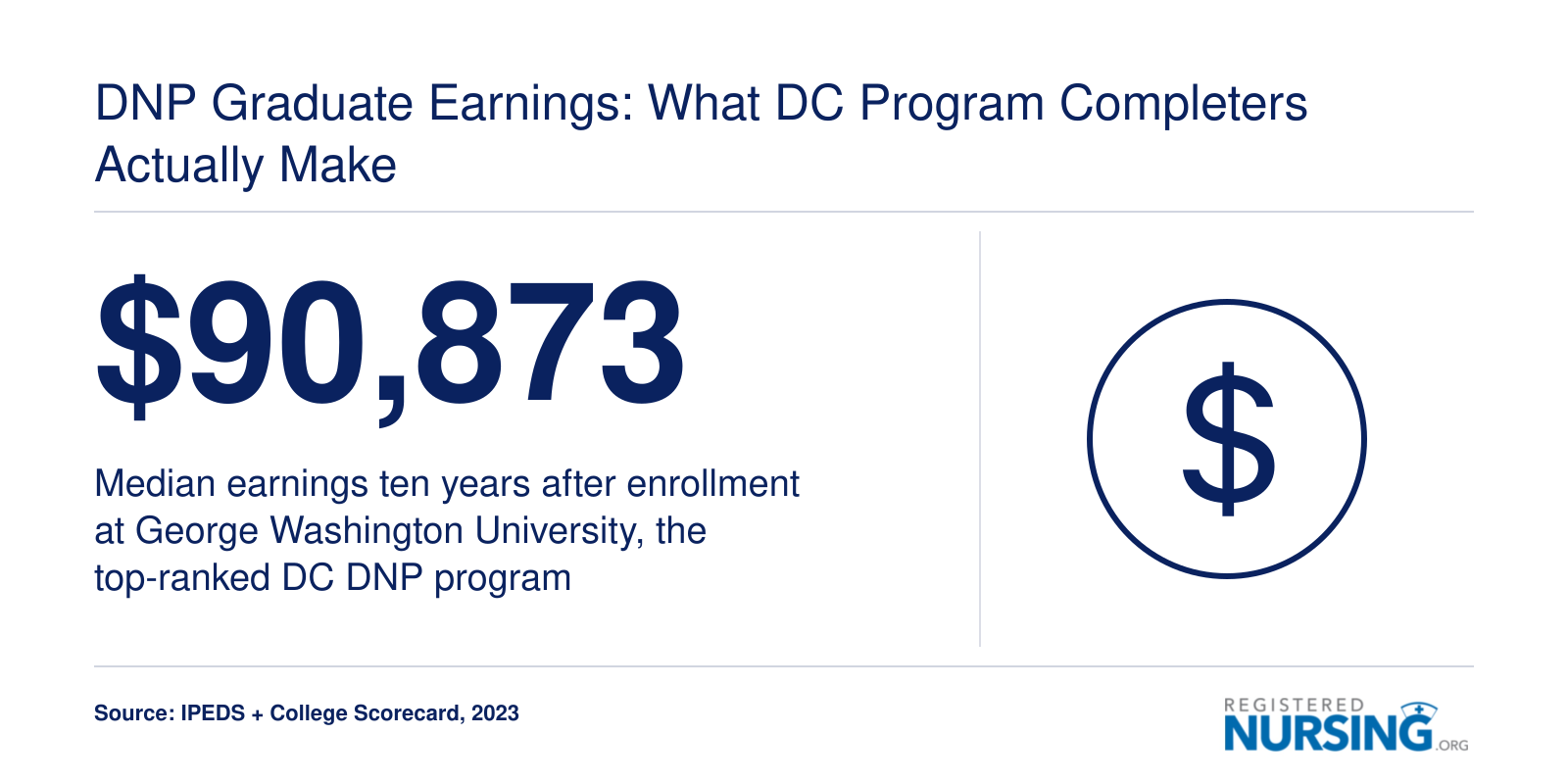
DNP Graduate Earnings: What DC Program Completers Actually Make
The salary table above draws on Bureau of Labor Statistics occupational wage data, which captures what all nurse practitioners in the DC metro area earn regardless of where they went to school. The figures here are different: they come from the U.S. Department of Education's College Scorecard and track what actual DNP program completers from DC schools report earning shortly after graduation. Program-level earnings and debt data for DC DNP programs have not yet been published by the College Scorecard, so a direct cost-versus-return comparison is not available at this time. When those figures are released, they will offer a more precise, school-specific snapshot of post-graduation income and student debt for each program.
How to Become a Nurse Practitioner in Washington, DC
The District of Columbia grants Full Practice Authority to nurse practitioners, meaning NPs can evaluate patients, diagnose, order tests, and prescribe medications, including controlled substances, without a mandatory physician collaboration agreement.1 That regulatory environment shapes every step of how to become a nurse practitioner in the District of Columbia, from the graduate degree you choose to the paperwork you file with the DC Board of Nursing.
The Five-Step Licensure Path
The path from prospective NP to practicing clinician follows a predictable sequence:
- Earn a BSN: Complete a Bachelor of Science in Nursing from an accredited program. This is the foundation for graduate NP study and for RN licensure.
- Obtain an active RN license: You must hold an unencumbered DC RN license (or a compact-state equivalent recognized in DC) before you can practice as an APRN in the District.2
- Complete an accredited graduate NP program: A CCNE- or ACEN-accredited MSN or DNP with a population focus (FNP, AGPCNP, PMHNP, etc.) is required. Your certification specialty must match your academic preparation.1
- Pass a national certification exam: FNPs typically sit for the ANCC FNP-BC or the AANP FNP-C. Certification in your population focus is required for DC licensure.2
- Apply for APRN licensure: Submit your application through the DC Health APRN online portal.2
What the DC Board of Nursing Requires
Applicants file through DC Health's online portal and submit an official graduate transcript, proof of current national certification, and a criminal background check.2 Standard fees for 2025-2026 are a $230 APRN application fee and a $50 background check fee.2 If you are applying for your RN and APRN licenses together as a new DC nurse, the combined application fee is $375.3 Because DC is a Full Practice Authority jurisdiction, no collaborative practice agreement or physician supervision documentation is required.1
Prescriptive Authority and DEA Registration
DC NPs hold full prescriptive authority, including Schedules II-V.1 To prescribe controlled substances, you must complete the DC controlled substances registration (a $130 fee) and then obtain a federal DEA registration tied to your DC practice address.4 Both are separate from your APRN license itself and must be renewed on their own cycles.
Renewal and Continuing Education
DC APRN licenses expire June 30 of odd-numbered years, so the renewal cycle runs two years.1 The renewal fee is $118.4 Each cycle you must complete 24 CE hours, and DC specifies where a portion of those hours must go:
- 15 hours in pharmacology (aligned with your prescriptive authority)1
- 3 hours in public health priorities4
- 2 hours in LGBTQ cultural competency continuing education1
Maintaining your underlying national certification (ANCC or AANP) is also required, since DC ties RN to BSN Washington, DC licensure progression and active APRN certification to your population focus.1
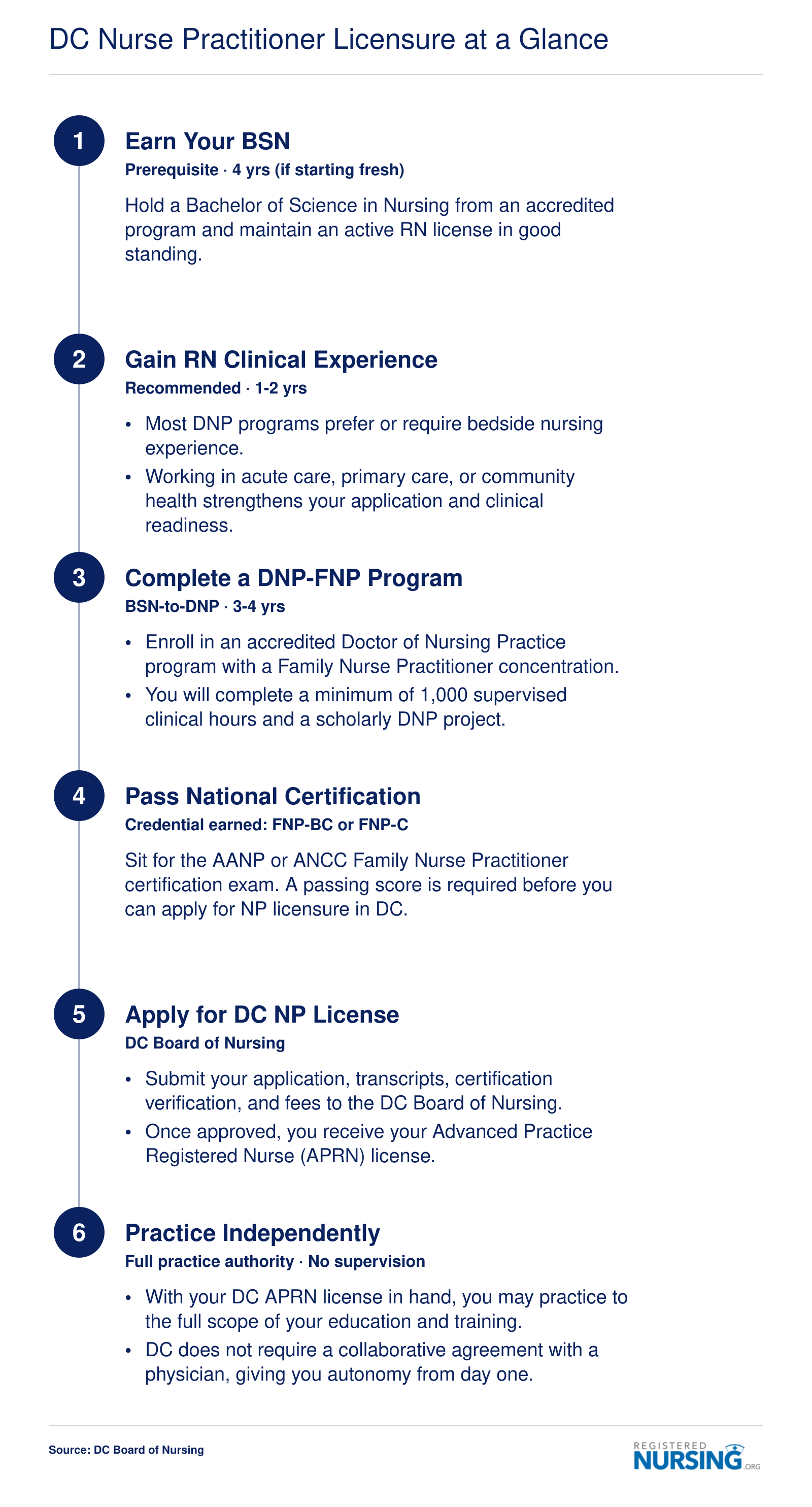
DC Nurse Practitioner Licensure at a Glance
Washington, DC grants nurse practitioners full practice authority, meaning once you hold your NP license you can evaluate, diagnose, and prescribe independently with no collaborative or supervisory agreement required. The pathway from BSN to independent NP practice typically spans four to five years of post-baccalaureate education and credentialing.
DNP Programs in Washington, DC
Below are the top DNP programs serving Washington, DC students, ranked by IPEDS completion data, accreditation status, and program fit. George Washington University stands out as the district's premier option for aspiring nurse practitioners and nursing leaders, offering multiple DNP pathways that capitalize on Washington's unique position as the center of federal health policy and home to major hospital systems.
- Institutional graduation rates
- Program accreditation and format
- Available concentrations and pathways
- Clinical partnership strength
- Regional accessibility for DC students
- NCES-IPEDS federal institutional data — nces.ed.gov
- Internal program database
- Independent program research
George Washington University
#1Washington, DC · ~$37,000/yr (est.)
Best for: Policy-minded nurses near federal agencies
George Washington University houses its DNP programs within a standalone School of Nursing that blends clinical excellence with policy leadership. Schools offering this program have graduation rates of approximately 84%, according to 2023 IPEDS data. GW's formal partnership with MedStar Washington Hospital Center provides DNP students access to one of the district's largest tertiary care environments, while an expanded collaboration with Children's National Hospital deepens opportunities in maternal and child health. The hybrid delivery model pairs online coursework with focused on-campus intensives, making the program accessible to working nurses throughout the DC, Maryland, and Virginia corridor.
- Hybrid format with online coursework and on-campus skills sessions
- 72 total credit hours with a fall start
- BSN-to-DNP pathway prepares graduates for NP certification
- Requires 500 supervised clinical hours
- Capstone project spans multiple DNP project phases
- Curriculum includes health policy and health economics coursework
- Minimum 3.0 GPA and active RN license required
- Focus on evidence-based primary care leadership
- 39 credit hours designed for post-master's entry
- Full-time and part-time scheduling options available
- Requires 1,000 clinical hours including a 75-hour policy practicum
- Faculty include nationally recognized health policy leaders
- Located steps from federal agencies and Congress
- Prepares graduates for policy analyst and advocate roles
- Graduate-level statistics prerequisite required
- Distance-based hybrid program accessible across the Mid-Atlantic
- Practice-focused doctoral program with multiple specialty tracks
- Post-BSN and post-master's entry pathways offered
- Hybrid online and on-campus format for working professionals
- Nationally recognized faculty in clinical and leadership domains
- Clinical partnerships with MedStar and Children's National in DC
- Graduates eligible for national NP certification in applicable tracks
- Emphasizes translating research into improved patient outcomes
- Prepares nurse leaders and change agents across diverse settings
George Washington University
#2Washington, DC · ~$37,000/yr (est.)
Best for: Working RNs seeking hybrid doctoral study
George Washington University houses its DNP programs within a standalone School of Nursing that blends clinical excellence with policy leadership. Schools offering this program have graduation rates of approximately 84%, according to 2023 IPEDS data. GW's formal partnership with MedStar Washington Hospital Center provides DNP students access to one of the district's largest tertiary care environments, while an expanded collaboration with Children's National Hospital deepens opportunities in maternal and child health. The hybrid delivery model pairs online coursework with focused on-campus intensives, making the program accessible to working nurses throughout the DC, Maryland, and Virginia corridor.
- Hybrid format with online coursework and on-campus skills sessions
- 72 total credit hours with a fall start
- BSN-to-DNP pathway prepares graduates for NP certification
- Requires 500 supervised clinical hours
- Capstone project spans multiple DNP project phases
- Curriculum includes health policy and health economics coursework
- Minimum 3.0 GPA and active RN license required
- Focus on evidence-based primary care leadership
- 39 credit hours designed for post-master's entry
- Full-time and part-time scheduling options available
- Requires 1,000 clinical hours including a 75-hour policy practicum
- Faculty include nationally recognized health policy leaders
- Located steps from federal agencies and Congress
- Prepares graduates for policy analyst and advocate roles
- Graduate-level statistics prerequisite required
- Distance-based hybrid program accessible across the Mid-Atlantic
- Practice-focused doctoral program with multiple specialty tracks
- Post-BSN and post-master's entry pathways offered
- Hybrid online and on-campus format for working professionals
- Nationally recognized faculty in clinical and leadership domains
- Clinical partnerships with MedStar and Children's National in DC
- Graduates eligible for national NP certification in applicable tracks
- Emphasizes translating research into improved patient outcomes
- Prepares nurse leaders and change agents across diverse settings
George Washington University
#3Washington, DC · ~$37,000/yr (est.)
Best for: BSN holders pursuing direct DNP entry
George Washington University houses its DNP programs within a standalone School of Nursing that blends clinical excellence with policy leadership. Schools offering this program have graduation rates of approximately 84%, according to 2023 IPEDS data. GW's formal partnership with MedStar Washington Hospital Center provides DNP students access to one of the district's largest tertiary care environments, while an expanded collaboration with Children's National Hospital deepens opportunities in maternal and child health. The hybrid delivery model pairs online coursework with focused on-campus intensives, making the program accessible to working nurses throughout the DC, Maryland, and Virginia corridor.
- Hybrid format with online coursework and on-campus skills sessions
- 72 total credit hours with a fall start
- BSN-to-DNP pathway prepares graduates for NP certification
- Requires 500 supervised clinical hours
- Capstone project spans multiple DNP project phases
- Curriculum includes health policy and health economics coursework
- Minimum 3.0 GPA and active RN license required
- Focus on evidence-based primary care leadership
- 39 credit hours designed for post-master's entry
- Full-time and part-time scheduling options available
- Requires 1,000 clinical hours including a 75-hour policy practicum
- Faculty include nationally recognized health policy leaders
- Located steps from federal agencies and Congress
- Prepares graduates for policy analyst and advocate roles
- Graduate-level statistics prerequisite required
- Distance-based hybrid program accessible across the Mid-Atlantic
- Practice-focused doctoral program with multiple specialty tracks
- Post-BSN and post-master's entry pathways offered
- Hybrid online and on-campus format for working professionals
- Nationally recognized faculty in clinical and leadership domains
- Clinical partnerships with MedStar and Children's National in DC
- Graduates eligible for national NP certification in applicable tracks
- Emphasizes translating research into improved patient outcomes
- Prepares nurse leaders and change agents across diverse settings
Frequently Asked Questions About DNP Programs in DC
Choosing a DNP program is a major professional and financial commitment. Below are answers to some of the most common questions prospective students ask about Doctor of Nursing Practice programs in Washington, DC, including timelines, costs, licensure, and practice authority.
- How long does it take to complete a DNP program in Washington, DC?
- Timeline depends on your entry point. BSN-to-DNP programs typically require three to four years of full-time study, while MSN-to-DNP (post-master's) programs can often be completed in roughly two years. Part-time options extend the timeline by one to two additional years. Clinical hour requirements (a minimum of 1,000 across the doctoral curriculum) are a major driver of program length.
- Does DC have full practice authority for nurse practitioners?
- Yes. The District of Columbia grants full practice authority to nurse practitioners. After completing a transition-to-practice period, NPs in DC can evaluate patients, diagnose conditions, order tests, and prescribe medications, including controlled substances, without a collaborative agreement with a physician. This regulatory environment is one reason DC is attractive to NPs seeking independent practice. For a broader look at nursing licensure and scope of practice in the district, the Washington, DC state nursing page offers additional context.
- What is the difference between a DNP and an MSN for nurse practitioners?
- Both degrees can qualify you for NP licensure, but the DNP is a doctoral-level degree that adds coursework in evidence-based practice, healthcare systems leadership, and quality improvement. The MSN focuses on advanced clinical preparation. If you are weighing the two paths, reviewing MSN programs in Washington, DC can help clarify what the master's track covers before committing to a doctoral program. The nursing profession is trending toward the DNP as the recommended terminal degree for advanced practice, and some employers now prefer or require it.
- How much does a DNP program cost in Washington, DC?
- Tuition varies significantly by institution. Among DC schools reporting data, published per-credit rates can place total program costs anywhere from roughly $60,000 to well over $100,000, depending on whether the school is public or private and whether you qualify for in-district tuition. Financial aid, employer tuition assistance, and federal loan programs can help offset these costs.
- Can I use my DC nurse practitioner license to practice in Virginia or Maryland?
- Not directly. Virginia and Maryland each have their own NP licensure requirements, so you must apply separately in those states. However, DC is not part of the Nurse Licensure Compact, meaning you will need individual state licenses for any jurisdiction where you plan to practice. Proximity to both states does make cross-border employment common, so many DC-area NPs hold multiple licenses.
- Are there direct-entry DNP programs in DC for nurses without an MSN?
- Yes. Several DC schools offer BSN-to-DNP pathways that allow registered nurses to enter a doctoral program without first completing a separate master's degree. These direct-entry programs integrate graduate-level clinical training and doctoral coursework into a single curriculum. They are a good option for BSN-prepared nurses who know they want to practice at the doctoral level and prefer to avoid earning two separate degrees.