

What you’ll learn in this article…
- Certified nurse case managers earn 15 to 20 percent more than non-certified peers.
- Most employers now require a BSN plus clinical experience for entry.
- Three main certifications exist: CCM, CMGT-BC, and ACM.
A nurse case manager is a registered nurse who coordinates patient care across providers, settings, and payers to improve clinical outcomes while controlling costs. The role sits at the intersection of clinical nursing, health insurance, and social services, requiring RNs to navigate complex care transitions, authorize treatment plans, and monitor resource utilization in real time.
Are case managers nurses? Most are. The majority of case managers working in hospitals, insurance companies, and rehabilitation facilities hold active RN licenses, though some employers hire licensed social workers or non-clinical case managers for roles that emphasize resource navigation over medical decision-making. The distinction matters because RN case managers carry clinical oversight responsibilities that non-RN coordinators cannot perform.
The role has grown alongside value-based reimbursement models, which reward hospitals and payers for reducing readmissions and managing high-cost, high-risk populations. As Medicare and commercial insurers shift from fee-for-service to bundled payments, demand for RNs who can bridge clinical care and cost containment continues to rise. Nurses considering this path will find useful context in how long-term care nursing and other complex-patient specialties build the foundational skills case management employers value most.
What Does a Nurse Case Manager Do Day to Day?
No two days in case management are identical, but the role consistently revolves around four core responsibilities: needs assessment, care planning, resource coordination, and outcomes monitoring. What changes is the setting, and the setting shapes nearly everything, including caseload size, communication channels, and the pace of the work.
Across all environments, expect to spend a significant portion of the day on the phone or in meetings. Industry observers and case managers themselves routinely note that 60 percent or more of the workday involves direct communication with patients, physicians, payers, and community providers. The paperwork and documentation are real, but the role is fundamentally relational.
In the Hospital: Morning Rounds and Discharge Planning
A hospital case manager typically starts the day with a census review, scanning overnight admissions, flagging new patients who need assessment, and checking the status of patients already in the discharge pipeline. Morning interdisciplinary rounds follow, where the case manager sits alongside physicians, social workers, and bedside nurses to discuss each patient's clinical progress and anticipated discharge date.1
Typical caseloads in this setting run between 10 and 30 patients, with most managers carrying around 20 to 22 active cases at any given time.2 In high-volume or short-staffed facilities, that number can climb to 40 or more. The afternoon often shifts toward payer communication: calling insurance companies to obtain authorizations, updating utilization review documentation, and arranging post-acute placements such as skilled nursing facilities or home health services.
In Insurance and Utilization Review: Queue Work and Outbound Calls
Insurance-based case managers face a different kind of volume. Monthly open caseloads in this environment often run 60 to 70 cases, and a busy day can include around 30 outbound calls to members, providers, and facilities.3 The morning typically starts with a queue review, identifying members recently discharged from the hospital who need a follow-up check-in, or flagging high-cost cases that require a closer look at the care plan.
The work here is less visible than bedside care but carries real clinical weight. Reviewing claims patterns, ranking members by acuity, collaborating with treating physicians on alternative care options, and preparing outcome reports are all part of the routine.4 For nurses drawn to this environment, it is worth knowing that much of it can be done remotely , making insurance case management one of the more common remote nursing jobs in the field.
In Home Health: Patient Visits and Care Plan Adjustments
Home health case managers spend a portion of their day in the field, conducting home visits that combine clinical assessment with patient education. They review how well the current care plan is working, adjust medication regimens or therapy orders in coordination with the physician, and identify new barriers such as a patient who can no longer safely navigate stairs or a caregiver who is burning out.5
Caseloads in home health generally fall between 20 and 35 patients. After visits, the afternoon is filled with interdisciplinary coordination calls, arranging services like durable medical equipment or meal delivery, and completing documentation before the next day's visits are scheduled. Nurses who want a deeper look at how graduate-level training shapes this kind of role may find it useful to compare an MSN in Care Coordination vs MSN in Case Management before choosing a specialization path.
The Through Line
Whether the setting is a hospital corridor, a claims platform, or a patient's living room, the case manager is always doing the same fundamental work: understanding what a patient needs, building a plan to meet those needs, connecting the right resources, and watching the outcomes closely enough to adjust course when something is not working.
Questions to Ask Yourself
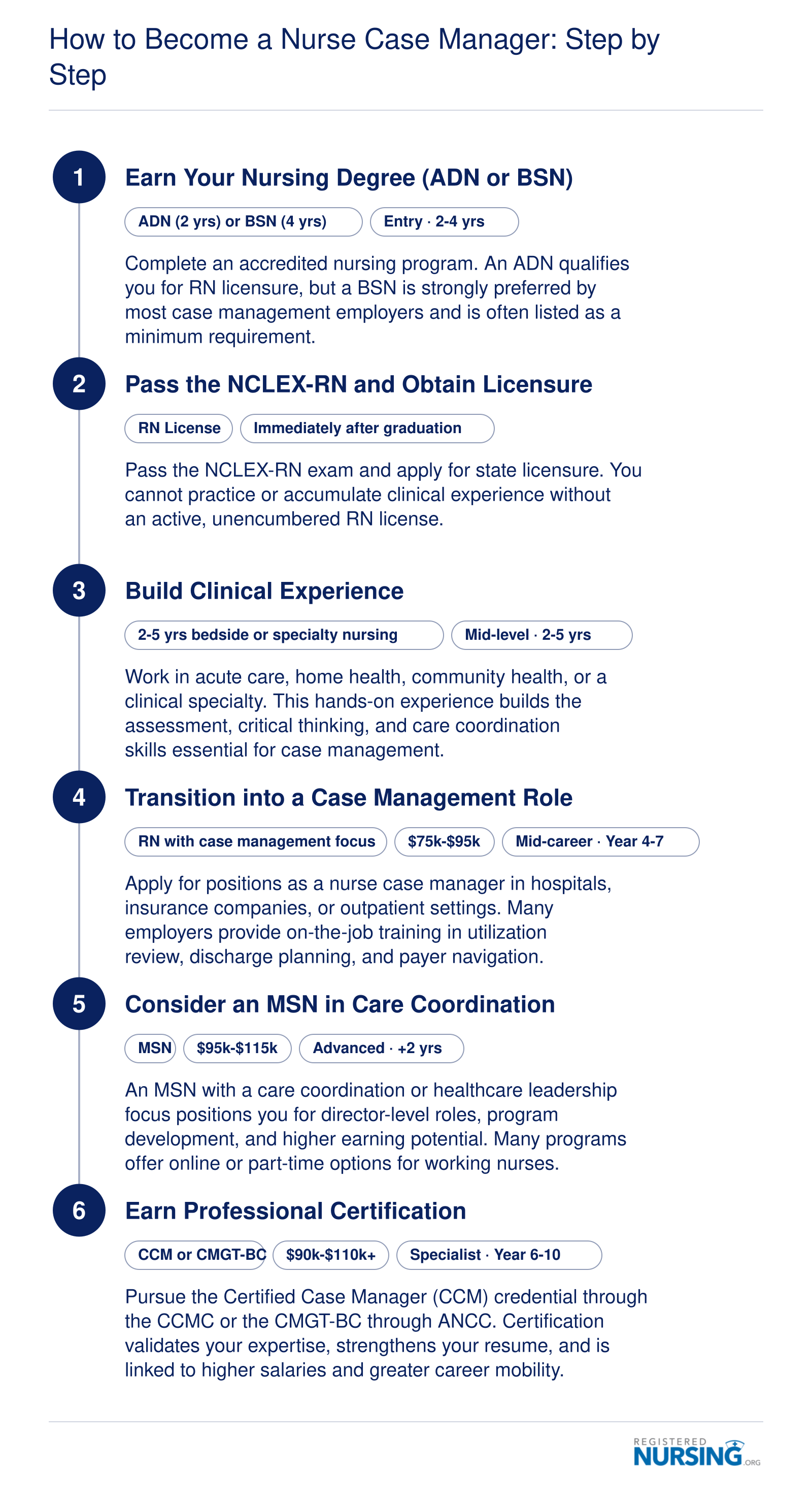
How to Become a Nurse Case Manager: Step by Step
The path from nursing student to certified nurse case manager typically spans 6 to 10 years. While an ADN can get you started as an RN, most case management employers require a BSN at minimum, and earning an MSN opens the door to leadership and director-level positions. Here is the progression most nurse case managers follow.
Education and Experience Requirements
The path to becoming a nurse case manager combines formal education with hands-on clinical experience, and the requirements have shifted noticeably over the past decade. Employers and certification bodies now expect candidates to bring both academic preparation and real-world patient care skills to the role.
Degree Entry Points
Three educational pathways can lead to case management nursing, though they carry different weight in today's job market:
- Associate Degree in Nursing (ADN): Some employers still hire ADN-prepared nurses for case management positions, particularly in smaller facilities or rural settings. However, these opportunities are shrinking. Many health systems now require a bachelor's degree as a baseline, and ADN holders often find themselves competing against candidates with more advanced credentials.
- Bachelor of Science in Nursing (BSN): This has become the standard expectation for most nurse case manager roles. A BSN curriculum includes foundational courses in leadership, evidence-based practice, and community health that translate directly to care coordination responsibilities. If you hold an ADN and want to move into case management, completing an RN-to-BSN program is typically the most practical first step.
- Master of Science in Nursing (MSN): An MSN in Case Management with a focus on care coordination, population health, or nursing leadership is increasingly preferred for competitive positions and essential for leadership roles. These programs dive deeper into health policy, informatics, care delivery models, and quality improvement, all of which align directly with what case managers do daily.
Some employers will accept equivalent professional experience in place of a master's degree, but this flexibility is narrowing. For nurses eyeing supervisory or director-level case management positions, the MSN is becoming a practical necessity rather than a nice-to-have credential.
Clinical Experience Requirements
Beyond the degree, most employers and certification bodies expect nurse case managers to have two to five years of direct patient care experience. This clinical foundation matters because case managers must understand how care unfolds across settings, recognize when a patient's condition is deteriorating, and communicate effectively with specialists across disciplines.
Certain clinical backgrounds are particularly valued:
- Medical-surgical nursing, where you gain exposure to diverse patient populations and complex discharge needs
- Emergency room nursing experience, which builds rapid assessment and triage skills
- Intensive care units, where critical care nurses learn to manage critically ill patients and coordinate with multidisciplinary teams
- Community health or home health nursing, which provides insight into post-discharge challenges and social determinants of health
If your background is in a specialty like labor and delivery or pediatrics, you can still transition into case management, but you may need to seek out positions that align with your clinical expertise or pursue additional training in adult medical populations.
Nurse Case Manager Certifications: CCM, CMGT-BC, and More
You have three main paths to certify as a nurse case manager: the CCM from the Commission for Case Manager Certification, the CMGT-BC from the American Nurses Credentialing Center, and the ACM from the American Case Management Association. Each carries weight with employers, but they target slightly different practice settings and career goals. For a broader look at how these fit into the credentialing landscape, nursing certifications can help you compare options across specialties.
Certified Case Manager (CCM)
The CCM, offered by the Commission for Case Manager Certification, is the most widely recognized case management credential across healthcare, insurance, workers' compensation, and rehabilitation settings.1 It is not nursing-specific, which is part of its appeal: RNs, social workers, and other licensed health and human services professionals all sit for the same exam.
- Eligibility: An active, unrestricted health or human services license (or a qualifying degree plus certification), combined with 12 to 24 months of full-time case management experience depending on which employment category you fall into.1
- Exam format: Computer-based, 180 multiple-choice questions (150 scored, 30 pretest), delivered in a three-hour window.2
- Cost: Roughly $420 to $430 for the application and exam in 2026.2
- Renewal: Every five years, requiring 80 continuing education hours (including 8 to 10 hours in ethics) or a retake of the exam.1
- Pass rate: The most recently published first-time pass rate sits around 76 percent, so preparation matters.2
Nursing Case Management Certification (CMGT-BC)
The CMGT-BC from the ANCC is designed specifically for registered nurses working in case management. If you want a credential that clearly signals nursing expertise (rather than a broader interdisciplinary role), this is the one to consider.
Eligibility requires an active RN license, a BSN or higher, two years of RN practice, and a specified number of practice hours in case management nursing.3 Because it is board certification through the ANCC, it tends to be favored in hospital-based and health system roles where nursing leadership values ANCC portfolios.
Accredited Case Manager (ACM)
The ACM credential, offered by the American Case Management Association, is tailored to case managers working within the healthcare delivery system, particularly acute care and transitions of care. RNs need two years of RN practice plus one year (2,080 hours) of supervised case management experience in a healthcare setting.4 The Care Coordination and Transition Management Certification is a related credential worth exploring if your focus is on discharge planning and post-acute coordination.
The exam is computer-based, roughly three hours long, and split into two parts: a core section shared across disciplines and a discipline-specific section for nurses or social workers.3 Renewal typically falls on a three to four year cycle with continuing education requirements.4
Which One Should You Choose?
A useful rule of thumb: choose the CCM if you want maximum portability across insurance, workers' comp, and healthcare settings; the CMGT-BC if your career is anchored in hospital nursing; and the ACM if you work in acute care transitions and discharge planning. Some experienced nurse case managers eventually hold two credentials, though for most, one well-matched certification is enough to strengthen a resume and support salary negotiations.
While no state requires certification to practice as a nurse case manager, earning credentials like the CCM or CMGT-BC significantly boosts your career. Research from the Case Management Society of America shows that certified case managers earn 15 to 20 percent more than their non-certified peers and report stronger job security, especially during workforce shifts.
Nurse Case Manager Salary: National Overview
Nurse case managers draw on clinical nursing expertise while coordinating complex patient care, and their compensation reflects that blend of skills. Because the Bureau of Labor Statistics does not track nurse case managers as a separate occupation, salary benchmarks are typically drawn from the Registered Nurses category (which encompasses most case management nurses) and, for those in supervisory or administrative roles, the Medical and Health Services Managers category. The figures below, based on 2024 BLS data, give you a realistic salary range to expect as you plan your career path.
| Occupation | Total Employment | 25th Percentile | Median Salary | Mean Salary | 75th Percentile |
|---|---|---|---|---|---|
| Registered Nurses | 3,282,010 | $78,610 | $93,600 | $98,430 | $107,960 |
| Medical and Health Services Managers | 565,840 | $88,560 | $117,960 | $137,730 | $162,420 |
Nurse Case Manager Salary by State
Nurse case manager pay varies significantly depending on where you practice. Because the Bureau of Labor Statistics does not publish a standalone category for nurse case managers, the table below draws from 2024 data for registered nurses, the classification that captures most case management nurses. States with higher costs of living or greater demand for care coordination services tend to offer the strongest compensation. Keep in mind that nurses who hold case management certifications or move into health services management roles often earn above these median figures.
| State | Total RN Employment | 25th Percentile | Median Salary | 75th Percentile | Mean Salary |
|---|---|---|---|---|---|
| Rhode Island | 10,760 | $83,870 | $99,960 | $112,540 | $99,770 |
| Arizona | 64,430 | $81,390 | $96,890 | $105,450 | $95,230 |
| New Hampshire | 16,580 | $79,720 | $96,830 | $105,500 | $94,620 |
| Maryland | 48,980 | $81,470 | $96,830 | $104,840 | $96,650 |
| Colorado | 54,510 | $81,790 | $96,520 | $104,370 | $95,470 |
| Delaware | 13,260 | $82,600 | $92,610 | $108,360 | $95,450 |
| Texas | 261,050 | $77,450 | $90,010 | $102,200 | $91,690 |
| Virginia | 77,420 | $77,650 | $88,820 | $100,920 | $90,930 |
| New Mexico | 17,510 | $82,630 | $88,260 | $104,720 | $94,360 |
| Pennsylvania | 146,840 | $78,570 | $87,610 | $102,030 | $90,830 |
| Georgia | 97,410 | $76,600 | $86,560 | $104,790 | $91,960 |
| Illinois | 139,900 | $79,150 | $86,410 | $103,660 | $91,130 |
| Idaho | 14,540 | $78,020 | $86,100 | $100,220 | $89,770 |
| Wisconsin | 64,960 | $79,570 | $86,070 | $100,680 | $90,450 |
| Michigan | 104,210 | $80,030 | $85,670 | $101,210 | $90,580 |
| Vermont | 7,240 | $79,980 | $85,150 | $104,110 | $92,710 |
| Maine | 16,280 | $76,890 | $82,860 | $98,000 | $87,440 |
| Florida | 218,100 | $77,070 | $82,850 | $99,260 | $88,200 |
| Utah | 25,780 | $77,030 | $82,270 | $101,530 | $88,240 |
| North Carolina | 108,510 | $74,710 | $81,860 | $98,720 | $86,270 |
| Wyoming | 5,180 | $75,540 | $81,790 | $100,910 | $88,020 |
| Montana | 10,540 | $77,800 | $81,560 | $100,510 | $88,480 |
| Ohio | 138,360 | $77,420 | $81,250 | $97,440 | $86,110 |
| Oklahoma | 32,870 | $75,320 | $81,160 | $96,460 | $85,800 |
| Nebraska | 24,180 | $76,430 | $81,020 | $93,140 | $82,890 |
Where Do Nurse Case Managers Work?
Where do nurse case managers actually work, and which settings offer the best combination of pay, autonomy, and patient contact?
The answer depends on your priorities. Nurse case managers practice across a wide range of environments, each with its own pace, technology stack, and professional focus. Understanding these settings before you commit to a role can save you from a poor fit down the road.
Hospitals
Hospital-based case managers typically focus on discharge planning and utilization review, working alongside physicians, social workers, and insurance representatives to move patients safely out of acute care. The pace is fast, the caseloads are high, and the documentation demands are constant. Most hospital systems rely on major EHR platforms integrated with case management modules, so comfort with clinical software is essential from day one.
Insurance and Managed Care Organizations
Managed care nursing roles center on prior authorization, medical necessity reviews, and population health oversight. These positions tend to offer some of the highest compensation in the field, and they are also where remote and hybrid work arrangements are most common.1 Roughly 30% of nurse case managers work remotely or in hybrid settings, and insurance-based roles account for a significant share of that figure. Platforms like TruCare are widely used in payer care coordination environments,1 and cloud-based tools with mobile access have become the standard rather than the exception.
Home Health Agencies
Home health case managers guide patients through post-acute transitions, coordinating care between hospital discharge and recovery at home. This setting offers some of the richest patient contact in the specialty, though it comes with travel demands and the need to work independently in the field. Offline functionality in case management platforms matters here,1 since connectivity in patient homes is not always reliable.
Workers' Compensation
Workers' compensation case management is a niche but well-compensated specialty. The focus is return-to-work planning, coordinating medical treatment with employer expectations and legal timelines. Caseloads tend to be smaller, but the documentation and compliance requirements are detailed and exacting.
Community and Public Health Agencies
Community-based roles address chronic disease management and the social determinants of health, connecting patients to housing, nutrition, mental health, and social services. Platforms like Netsmart are commonly used in behavioral health and social services settings.1 The pay in community roles is generally lower than in insurance or workers' compensation, but for nurses motivated by upstream, prevention-focused care, community and public health nursing can be deeply rewarding.
Technology Across All Settings
Regardless of setting, case management in 2026 increasingly relies on telehealth integration for scheduling, messaging, and remote patient monitoring.2 Automation tools handle outreach, appointment reminders, and care escalations, freeing nurses to focus on complex clinical decisions.1 The specific platform varies by employer, but fluency with cloud-based, mobile-accessible systems is now a baseline expectation across virtually every practice environment. Nurses who want a broader view of how care coordination intersects with these roles may find an MSN in Care Coordination useful preparation for leadership-level positions.
Nurse Case Manager Vs. Care Coordinator: Key Differences
While both roles aim to improve patient outcomes, nurse case management and care coordination follow distinct paths: one centers on a specific episode of care with high clinical oversight, the other on sustained relationships and holistic continuity.
Core Focus: Episode vs. Relationship
Nurse case managers typically work within a defined episode of care, such as a hospital stay or a complex treatment plan, ensuring efficient use of resources and timely transitions. Nurse Care Coordinators, on the other hand, build long-term relationships with patients, often spanning primary care, chronic disease management, and community support, to maintain continuity and prevent gaps.1
Clinical Complexity and Licensure
The clinical demands of each role differ significantly. Nurse case managers handle high medical complexity, frequently requiring an RN license and advanced certification like the CCM (Certified Case Manager). Care coordinators may operate with less clinical intensity, and positions can be filled by RNs, LPNs, social workers, or even unlicensed staff depending on the setting. This lower barrier to entry reflects the role's emphasis on navigation and resource connection rather than direct clinical decision-making.
Salary and Work Intensity
These differences show up in compensation as well. Nationally, nurse case managers earn a mean annual wage of about $69,8183, while care coordinators earn around $58,670.3 The higher salary aligns with the case manager's high-intensity work, which often involves managing utilization review, discharge planning, and payer requirements under tight deadlines. Care coordination, described as low-to-moderate intensity, may offer more predictable schedules but fewer financial rewards.
Choosing the Best Path
For nurses drawn to fast-paced, clinically complex environments and a healthcare management perspective, case management offers a challenging career with strong earning potential. Those who prefer sustained patient relationships, preventive care, and community-based work may find care coordination more fulfilling. Both roles are essential to a healthcare system striving for better outcomes and lower costs, but the day-to-day responsibilities and required skills diverge significantly.
Career Outlook and Growth for Nurse Case Managers
Career outlook measures how many job openings a profession is likely to have over a coming decade, combining new positions from industry growth with vacancies left by retiring workers. For nurse case managers, this outlook is shaped by broad nursing trends and a sharp rise in demand for care coordination.
Projected Growth for Nursing and Management Roles
The Bureau of Labor Statistics does not publish a standalone category for nurse case managers, but two related occupations offer strong proxy benchmarks. Registered nurses overall are projected to add about 166,100 new jobs from 2024 to 2034, a growth rate of 5 percent.1 Medical and health services managers, a group that includes many case management directors, are projected to grow 23.2 percent, adding roughly 142,900 positions over the same period.1 Both categories reflect the expanding infrastructure that supports case management work in hospitals, insurers, and community settings.
Three Demand Drivers Shaping the Field
- Value-based care reimbursement: Payers increasingly reward providers for outcomes rather than volume. This shift demands dedicated professionals who can coordinate across episodes and settings, making case managers central to population health strategies.
- Aging baby boomer population: The large cohort moving into Medicare eligibility brings higher rates of multiple chronic conditions, complex medication regimens, and frequent transitions between care sites, all of which require skilled care navigation.
- Rising chronic disease prevalence: Conditions like diabetes, heart failure, and COPD are managed over years, not days. Case managers help patients adhere to plans, avoid hospital readmissions, and access community resources, directly addressing cost and quality goals.
New Roles Created by Payment Reform
Centers for Medicare & Medicaid Services bundled payment initiatives and Accountable Care Organization models have spurred health systems to create case management positions that did not exist previously. These programs tie reimbursement to total episode cost and quality, encouraging hospitals and clinics to hire case managers who can oversee a patient's journey from admission through post-discharge follow-up.
Typical Career Progression
Entry into case management usually starts with a staff case manager role. With experience and certification, professionals can advance to lead case manager, then to nurse manager role within a department. Further career growth can lead to executive titles such as vice president of population health or chief nursing officer, particularly in large integrated delivery systems.
Frequently Asked Questions About Nurse Case Management
Below are answers to some of the most common questions prospective and practicing nurses ask about case management nursing. For a deeper look at any topic, refer to the corresponding section earlier in this article.
- Are case managers nurses?
- Not all case managers are nurses, but a large number are. Case management is a multidisciplinary field that also includes social workers, counselors, and other allied health professionals. Registered nurses are especially well represented because their clinical training gives them a strong foundation for coordinating patient care across settings. See the intro section of this article for a fuller definition of the nurse case manager role.
- What certifications do nurse case managers need?
- Certification is not legally required, but it is strongly encouraged. The two most recognized credentials are the Certified Case Manager (CCM) from the Commission for Case Manager Certification and the Case Management Administrator, Certified (CMGT-BC) from the American Nurses Credentialing Center. Both validate expertise and can lead to higher pay. Our certifications section above covers eligibility requirements and exam details.
- What is the difference between a nurse case manager and a care coordinator?
- While the titles are sometimes used interchangeably, nurse case managers typically handle more complex, long-term patient needs, including insurance navigation, discharge planning, and cross-provider coordination. Care coordinators often focus on scheduling, follow-up appointments, and day-to-day logistics within a single care setting. The dedicated comparison section earlier in this article breaks down the key distinctions in scope, education, and compensation.
- How much do nurse case managers make?
- Salaries vary by location, experience, and work setting, but nurse case managers generally earn competitive RN-level wages. Factors like holding a BSN or an advanced certification can push earnings higher. For a detailed breakdown by state and setting, refer to the salary tables provided earlier in this article.
- Can you become a nurse case manager with an ADN?
- Yes. An Associate Degree in Nursing (ADN) paired with an active RN license meets the minimum educational threshold for many case management positions. However, employers increasingly prefer candidates with a Bachelor of Science in Nursing (BSN), and a BSN is required for certain certifications. If you are weighing your degree options, the ADN vs BSN: How to Choose the Right Path to Start Your Nursing Career guide offers a thorough side-by-side comparison. The education and experience section of this article outlines what each credential level opens up.
- How long does it take to become a certified nurse case manager?
- The timeline depends on the certification you pursue. Most credentials, including the CCM, require at least one to two years of supervised case management experience after earning your RN license. When you add the time for nursing school (two to four years) and exam preparation, the full path from start to certification typically ranges from about four to seven years. You may also want to explore whether an LPN/LVN can become a Certified Managed Care Nurse, as that path has its own distinct timeline. Our step-by-step infographic above maps out each phase.
Explore More
- Ambulatory Care Nurse
- Burn Care Nurse
- Cardiac Nurse
- How to Become Cardiac Catheterization Laboratory Nurse
- Charge Nurse
- Chief Nursing Officer
- Correctional Nurse
- CVOR Nurse
- Dermatology Nurse
- Developmental Disability Nurse
- Director of Nursing
- Domestic Violence Nurse
- Emergency Room Nurse
- ENT Nurse
- Enterostomy Nurse
- Fertility/Reproductive Nurse
- Flight/Transport- Schooling & Salary
- Forensic Nurse
- Genetic Nurse
- Geriatric Nurse
- Health Policy Nurse
- Healthcare Administrator
- Healthcare Manager
- Home Health Nurse
- Hospice Nurse
- Camp Nurse
- GI Nurse
- Holistic (Complementary) Nurse
- Labor and Delivery Nurse
- Nurse Writer
- Psychiatric Nurse
- School Nurse
- Telemetry Nurse
- Travel Nurse
- Aesthetic/Cosmetic Nurse
- Infusion/IV Nurse
- Oncology Nurse
- ICU Nurse
- Infection Control Nurse
- Legal Nurse Consultant- Schooling & Salary
- Long-Term Care Nurse
- Managed Care Nurse
- Medical-Surgical Nurse
- Military (Combat) Nurse
- Missionary Nurse
- Postpartum Nurse
- Nephrology Nurse
- Neuroscience Nurse
- NICU Nurse
- Nurse Administrator
- Nurse Attorney
- Nurse Care Coordinator
- Nurse Entrepreneur
- Nurse Executive
- Nurse Health Coach- Schooling & Salary
- Nurse Manager
- Obstetric (OB) Nurse
- Occupational Health Nurse
- Operating Room/Surgical/Perioperative Nurse
- Ophthalmic Nurse
- Organ Procurement Coordinator
- Orthopedic Nurse
- Pain Management Nurse
- Palliative Care Nurse
- Parish Nurse
- Nurse Advocate
- Pediatric Endocrinology Nurse
- Perianesthesia (PACU) Nurse
- Perinatal Nurse
- Plastic Surgery Nurse
- Public Health Nurse
- Radiology Nurse
- Rehabilitation Nurse
- Research Nurse
- Respiratory Nurse
- Rheumatology Nurse
- Substance Abuse/Addiction Nurse
- Telephone Triage/Telehealth Nurse
- Transcultural/Intercultural Nurse
- Transplant Nurse.
- Trauma Nurse
- Wound Care Nurse (WOCN)