

What you’ll learn in this article…
- Indiana offers 12 distinct DNP specializations across accredited programs.
- IU's BSN-to-DNP requires 66 credits; MSN-to-DNP needs only 38.
- Rural primary care shortages fuel strong demand for DNP graduates statewide.
Which Indiana DNP program fits your career goals, budget, and timeline?
Indiana's healthcare system faces a documented shortage of primary care providers, particularly in rural counties, and doctoral-prepared nurses are increasingly filling those gaps. The state offers 12 accredited DNP programs across public flagships like Indiana University and private institutions with varying tuition structures and delivery formats. Entry pathways split into two main routes: BSN-to-DNP programs requiring around 66 credits for nurses without a master's degree, and MSN-to-DNP tracks running closer to 38 credits for those who already hold an MSN.
Net price differences between public and private options can exceed $30,000, making program selection a financial decision as much as an academic one. Clinical hour requirements, typically around 1,000, often dictate completion timelines more than credit loads alone. Nurses considering neighboring markets can also review DNP programs in Illinois or DNP programs in Michigan to compare regional options before committing to an Indiana institution.
BSN-To-DNP Vs. MSN-To-DNP: Understanding Indiana's Pathways
Indiana University's BSN-to-DNP pathway at IU Indianapolis requires 66 total credits,1 while MSN-prepared nurses complete the same terminal degree in just 38 credits1 , a difference that fundamentally shapes timelines, costs, and the student profiles each route serves. Understanding these two pathways helps nurses choose the route that aligns with their current credentials, career goals, and availability for intensive clinical immersion.
Credit Requirements and Duration
BSN-to-DNP programs in Indiana typically span 62 to 78 credits depending on the institution and specialty track. Ball State University's BSN-entry DNP totals 76 to 78 credits,3 while the University of Indianapolis lists 62 credits for the family nurse practitioner track and 68 credits for neonatal.2 Completion timelines range from three to four years at Purdue University, with the University of Indianapolis estimating 10 to 11 semesters for most BSN-direct students.2 Nurses weighing how quickly they can finish may also find value in reviewing shortest DNP programs available nationally.
Clinical Hours and Advanced Standing
Clinical immersion distinguishes the two pathways. BSN-to-DNP students at Ball State log 1,060 clinical hours over the program's duration,3 and the University of Indianapolis mandates 1,050 to 1,250 hours depending on specialty.2 MSN-to-DNP students often arrive with substantial practicum credits already satisfied. Indiana University permits MSN holders to transfer up to 475 clinical hours at IU Indianapolis1 and up to 500 hours through IU Online,4 reducing the additional practicum burden and accelerating time to graduation.
Advanced standing policies vary by school. Some institutions evaluate MSN transcripts course by course, granting credit for doctoral-level equivalencies in areas such as health policy, statistics, or evidence-based practice. Others apply a blanket credit reduction but require all students to complete core DNP essentials, leadership capstones, and final scholarly projects on campus or online.
Who Each Pathway Serves
BSN-to-DNP programs appeal to registered nurses who want to bypass a separate master's degree, consolidating advanced practice preparation and terminal doctoral education into a single curriculum. This route suits nurses early in graduate study who have clear specialty goals and the flexibility to commit to three or more years of part-time or full-time enrollment.
MSN-to-DNP programs serve experienced advanced practice nurses, including nurse practitioners, clinical nurse specialists, nurse anesthetists, and nurse midwives, who already hold national certification and seek the terminal credential for leadership, academia, or system-level roles. These students prioritize efficiency, often balancing full-time clinical practice with coursework, and value programs that recognize prior graduate learning through transfer credit and flexible scheduling. Indiana nurses in this group can also explore nurse practitioner programs online in Indiana to review the MSN-level foundation many DNP applicants bring to the table.
Questions to Ask Yourself
How Much Do DNP Programs in Indiana Cost?
The cost of earning a DNP in Indiana varies significantly depending on whether you attend a public or private institution, whether you qualify for in-state tuition, and how many credits your chosen pathway requires. The figures below draw from U.S. Department of Education data (IPEDS and College Scorecard, 2023). The net price column reflects the institution-wide average net price after financial aid for all students at that school. It is an approximation, not a guaranteed DNP-specific figure. Actual graduate tuition will differ, so treat these numbers as a starting point for comparison rather than a final cost estimate. Among public schools, Purdue University Northwest offers the lowest annual graduate tuition for Indiana residents at roughly $6,638, while out-of-state students at Ball State University could face annual tuition above $30,000. Private institutions such as Saint Mary's College and the University of Saint Francis list higher per-credit rates, though locked tuition and scholarship programs can offset sticker price. Keep in mind that MSN-to-DNP students typically complete fewer total credit hours than BSN-to-DNP students, so their overall tuition outlay is often substantially lower even at the same school. For example, Indiana Wesleyan University's MSN-to-DNP track requires about 31 credits compared to 76 credits on the BSN-to-DNP pathway, both priced at $859 per credit.
| School | Sector | Annual Graduate Tuition (In-State) | Annual Graduate Tuition (Out-of-State) | Institution-Wide Avg. Net Price After Aid |
|---|---|---|---|---|
| Purdue University Northwest | Public | $6,638 | $11,960 | $6,079 |
| Purdue University Global | Public | $10,211 | $11,241 | $7,770 |
| Indiana State University | Public | $8,596 | $16,642 | $10,873 |
| Indiana University, Indianapolis | Public | $11,180 | $28,964 | $11,668 |
| University of Southern Indiana | Public | $11,667 | $21,948 | $12,923 |
| Purdue University (West Lafayette) | Public | $9,992 | $28,794 | $14,600 |
| Ball State University | Public | $12,342 | $30,052 | $14,940 |
| Indiana Wesleyan University (National and Global) | Private | $10,926 | $10,926 | $16,898 |
| University of Saint Francis, Fort Wayne | Private | $26,092 | $26,092 | $18,196 |
| Indiana Wesleyan University (Residential) | Private | $10,620 | $10,620 | $22,866 |
| Marian University | Private | $22,860 | $22,860 | $24,018 |
| Saint Mary's College | Private | $29,803 | $29,803 | $25,292 |
Explore other Indiana related topics
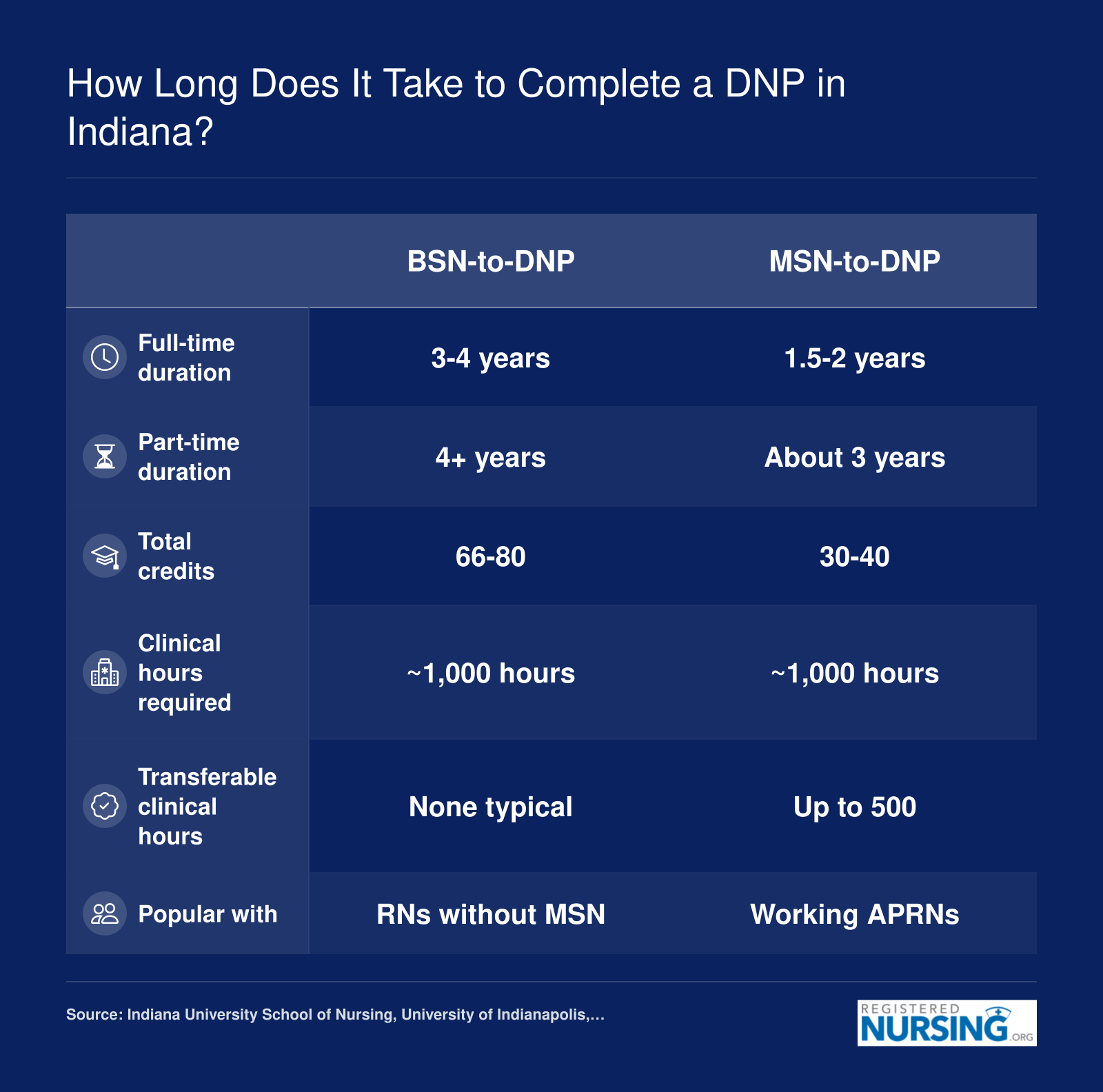
How Long Does It Take to Complete a DNP in Indiana?
Your timeline to a Doctor of Nursing Practice depends heavily on which entry point you choose and whether you can study full time. Clinical practicum and capstone project hours, typically totaling around 1,000, are often the single biggest factor that extends completion. Here is a side-by-side look at what to expect from each pathway.
DNP Specializations Available in Indiana
Twelve distinct DNP concentrations are currently offered across Indiana's accredited programs, split between nurse practitioner (NP) clinical tracks and non-NP leadership or systems-focused pathways. Your choice of specialization determines not only your certification eligibility and scope of practice but also your clinical placement requirements, patient population, and long-term career trajectory.
Nurse Practitioner Tracks
The Family Nurse Practitioner (FNP) concentration remains the most widely available NP track in Indiana. Purdue University, Indiana Wesleyan University, Saint Mary's College, Marian University, Indiana State University, and University of Southern Indiana all offer FNP pathways, preparing graduates to provide primary care across the lifespan. Most FNP programs require 600 to 1,000 clinical hours and prepare students to sit for the American Academy of Nurse Practitioners Certification Board (AANPCB) or American Nurses Credentialing Center (ANCC) exams.
Psychiatric Mental Health Nurse Practitioner (PMHNP) programs are also available, with the University of Saint Francis-Fort Wayne offering a dedicated PMHNP concentration. This track prepares graduates to diagnose and treat mental health conditions, prescribe psychotropic medications, and provide psychotherapy.
Adult-Gerontology Primary Care Nurse Practitioner (AGPCNP) and Adult-Gerontology Acute Care Nurse Practitioner (AGACNP) options appear in the portfolios of several Indiana programs, including Purdue. Indiana University-Indianapolis offers a Pediatric Nurse Practitioner programs in Indiana track with a primary-care focus, requiring 1,005 clinical hours and preparing graduates for the Pediatric Nursing Certification Board exam. Neonatal Nurse Practitioner (NNP) tracks, while less common, are available at select institutions for nurses focused on high-acuity neonatal intensive care.
Non-NP Leadership and Systems Tracks
Indiana Wesleyan University offers a Systems Leadership concentration for nurses pursuing executive, administrative, or quality improvement roles without direct patient care. Ball State University provides a Nurse Educator cognate within its DNP program, requiring 29 additional credits and designed for those entering academic or staff development positions. Purdue University Northwest emphasizes Translation Science, preparing graduates to implement evidence-based practice initiatives and lead organizational change. Nurses drawn to executive roles may also find value in exploring a Master's in Executive Nurse Leadership as a complementary pathway.
These non-NP tracks typically require fewer clinical hours (often 500 to 750) and focus on capstone projects that address organizational, policy, or educational challenges rather than direct clinical care.
Online vs. Hybrid Delivery
Most Indiana DNP programs operate on a hybrid model. Purdue Global, Ball State, and Indiana State offer fully online DNP pathways, ideal for nurses managing work and family commitments. Hybrid programs, including those at Purdue University, Saint Mary's College, Marian University, Indiana Wesleyan, and Purdue Northwest, require periodic on-campus intensives or immersion weekends. Saint Mary's, for example, schedules immersion weekends on its Notre Dame campus, while Indiana Wesleyan mandates three on-site residencies and an international travel component.
Clinical placements for NP tracks must occur in person and are typically arranged cooperatively between the student, faculty, and preceptor. Programs may provide placement assistance, but students often bear responsibility for securing sites within commuting distance.
Career Outcomes and Salary for DNP Graduates in Indiana
Doctoral-prepared nurses in Indiana are entering a job market shaped by persistent workforce shortages and growing demand for advanced practice providers, particularly in primary care and behavioral health. Understanding what DNP graduates actually earn, and how those earnings compare to program costs, helps you make an informed decision about this significant investment.
What Indiana DNP Graduates Can Expect to Earn
Program-level earnings data for specific Indiana DNP programs are not yet published by federal reporting sources, so prospective students should rely on occupational wage benchmarks when projecting post-graduation income. According to 2026 first-quarter data, nurse practitioners in Indiana earn a median annual wage of $125,600.1 The range is wide: entry-level positions at the 25th percentile pay around $95,500, while experienced NPs at the 90th percentile earn upward of $207,200.1
Northern Indiana's rural nonmetropolitan areas show comparable figures, with a 2024 median of $125,790 for nurse practitioners.2 These rural wages actually exceed national medians, reflecting the premium that underserved areas place on advanced practice nurses willing to work outside urban centers.
For context, the national median for nurse practitioners sits at $121,610,3 meaning Indiana NPs earn slightly above average. Nurse anesthetists, who require additional specialized training, typically command higher salaries, often exceeding $200,000 annually in hospital and surgical settings.
Calculating Your Return on Investment
Without program-specific debt figures from federal sources, a rough ROI calculation requires looking at typical DNP program costs. Indiana programs range from approximately $25,000 for post-master's tracks at public institutions like Purdue Northwest to over $65,000 for BSN-to-DNP pathways at private schools.
Assuming a median debt somewhere around $25,000 to $35,000 and first-year earnings near $125,600, most graduates can expect to recoup their educational investment within one to two years of practice. This payback period compares favorably to many other doctoral programs, though individual circumstances vary based on specialization, employer, and geographic location within the state.
Indiana's Healthcare Workforce Demand
Indiana projects a 45.8 percent growth rate for nurse practitioner positions between 2022 and 2032,4 significantly outpacing most other occupations. This demand stems from several factors:
- Physician shortages: Rural counties face persistent gaps in primary care coverage
- Aging population: Medicare-eligible residents require more chronic disease management
- Behavioral health crisis: Psychiatric mental health nurse practitioners are in acute demand statewide
- Hospital system expansion: Indianapolis-area health networks continue growing outpatient services
Graduates prepared in family practice, adult-gerontology, and psychiatric mental health specializations find particularly strong employment prospects. Reviewing best states for family nurse practitioners can help you weigh Indiana's market against competing opportunities nationwide.
Practice Authority and Career Autonomy
Indiana operates under reduced practice authority for APRNs, meaning nurse practitioners must maintain a collaborative agreement with a physician to prescribe medications and deliver certain services. While this requirement adds administrative complexity, it does not significantly limit employment opportunities or earning potential in most settings.
Some DNP-prepared nurses pursue leadership and administrative roles that sidestep prescriptive authority requirements entirely. The Executive Nursing Leadership DNP track is well suited for these positions, as the degree's emphasis on systems leadership, quality improvement, and evidence-based practice prepares graduates to step into senior management. For those committed to direct patient care, the collaborative agreement requirement is typically straightforward to establish, particularly within larger health systems that employ both physicians and nurse practitioners.
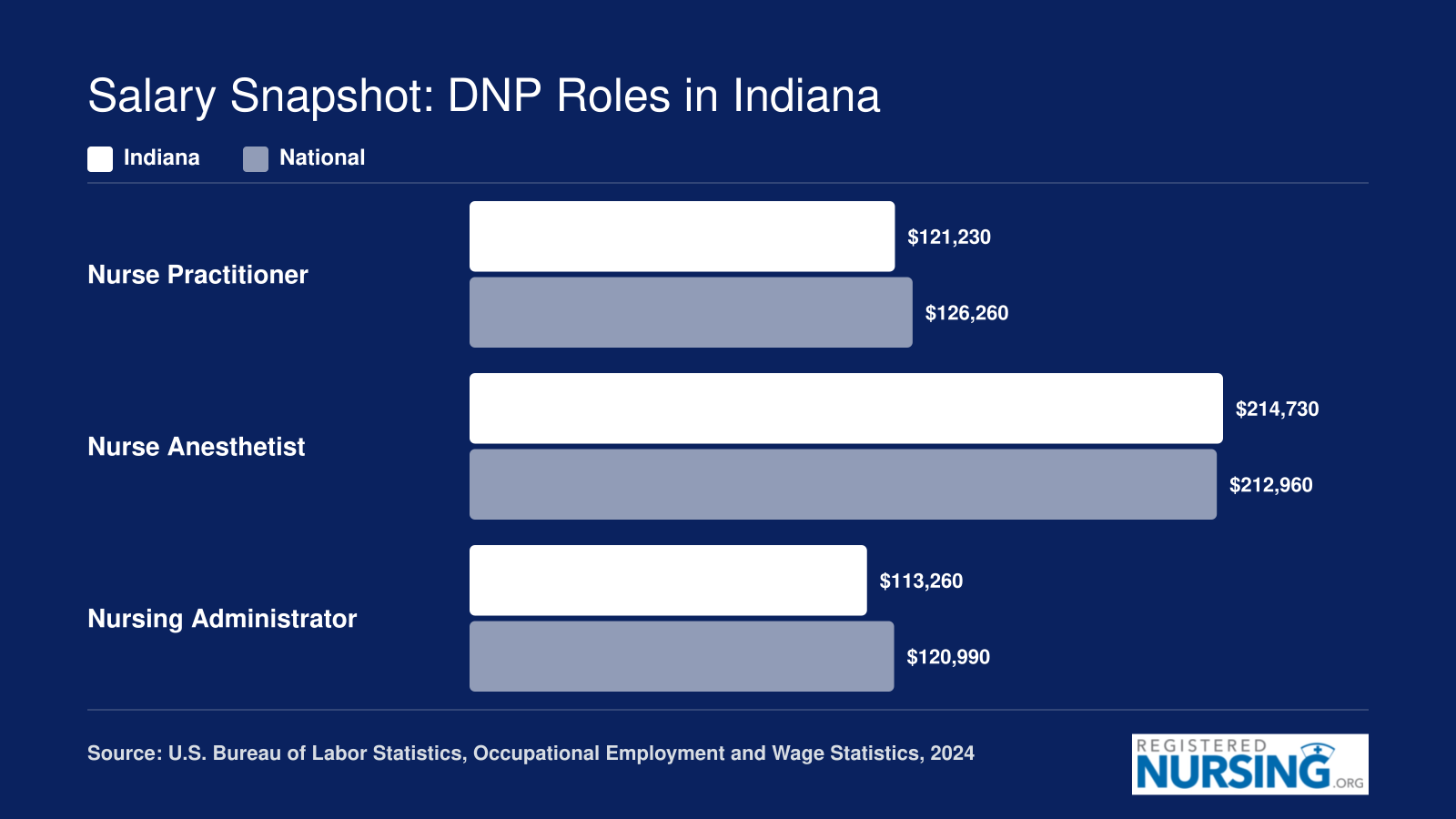
Salary Snapshot: DNP Roles in Indiana
DNP-prepared nurses in Indiana earn competitive salaries across several advanced practice and leadership roles. The chart below compares median annual wages for key DNP-level positions in Indiana against national medians, helping you gauge how local compensation stacks up.
Admission Requirements for Indiana DNP Programs
DNP admission standards vary across Indiana's universities, so verifying each school's specific prerequisites is essential. Below is a general overview of what most programs expect, along with guidance on where to confirm the details.
- Earned BSN or MSN from an Accredited ProgramMost Indiana DNP programs require either a Bachelor of Science in Nursing or a Master of Science in Nursing from a program accredited by the CCNE or ACEN. BSN-to-DNP and MSN-to-DNP pathways each have distinct prerequisite coursework, so review the program page on each school's website carefully to confirm which degrees and credits they accept.
- Active, Unencumbered RN LicenseApplicants typically need a current, unrestricted registered nursing license. If you plan to practice in an advanced practice role after graduation, familiarize yourself with Indiana's APRN licensing requirements through the Indiana Professional Licensing Agency website. State rules around practice authority and any collaborative agreement expectations can influence your specialty choice, so it is worth reviewing these early.
- Minimum GPA ThresholdA cumulative GPA of 3.0 or higher on a 4.0 scale is a common baseline, though some programs set higher or lower thresholds depending on the applicant pool and specialty track. Check each program's admissions page for the exact requirement and whether they consider the last 60 credit hours separately.
- Clinical ExperienceMany programs ask for a minimum number of years of direct patient care experience as a registered nurse. The exact requirement differs by school and track; some BSN-to-DNP programs accept applicants with less experience, while post-master's pathways often expect more seasoned clinicians.
- Standardized Test Scores and Supplemental MaterialsSome Indiana DNP programs have moved away from requiring the GRE, but others still list it as a prerequisite. Additional materials commonly requested include a professional resume, a statement of purpose, letters of recommendation from clinical or academic references, and proof of current certifications.
- Where to Verify RequirementsAlways start with the official program website for the most current admission criteria. For broader context, consult the American Association of Colleges of Nursing for accreditation standards, the Bureau of Labor Statistics at BLS.gov for career and salary benchmarks, and professional organizations such as the American Association of Nurse Practitioners for scope-of-practice updates specific to Indiana.
Frequently Asked Questions About DNP Programs in Indiana
Choosing a DNP program is a significant decision, and prospective students frequently have questions about format, cost, timeline, and career outcomes. Below are answers to the most common questions about pursuing a Doctor of Nursing Practice in Indiana.