

Alaska's healthcare workforce is built around nurse practitioners because its geography leaves little room for physician-dependent care models. In roadless villages and tribal health clinics from the Aleutians to the North Slope, NPs are often the only consistent primary care providers for hundreds of miles. Full practice authority makes that role practical: NPs can evaluate, diagnose, prescribe, and manage care without physician oversight.
For that reason, most Alaska-based nurses choose online NP programs from accredited universities that support Alaska clinical placements. Relocating to a Lower 48 campus for two to three years is rarely feasible, and the University of Alaska Anchorage remains the only accredited in-state option. Cost, specialty fit, salary expectations, licensing requirements, and local preceptor availability carry more weight than campus name recognition.
Best Online Nurse Practitioner Programs for Alaska Residents in 2026
Alaska's geography makes online and hybrid NP programs essential for nurses who want to stay in state while advancing their careers. The University of Alaska Anchorage stands out as the only accredited in-state option, with distance-friendly FNP and PMHNP tracks and clinical placements arranged across Alaska. Here is the program, and what it offers working RNs in the state.
How this list was built
- Graduate earnings
- Median debt load
- Completion volume
- Online delivery eligibility
- Internal program database
- College Scorecard graduate earnings — collegescorecard.ed.gov
- NCES-IPEDS federal institutional data — nces.ed.gov
- Independent program research
University of Alaska Anchorage
#1Anchorage, AK · $15,000/yr
Best for: Alaska RNs needing in-state clinical placements
University of Alaska Anchorage (UAA) is the only institution in Alaska offering accredited nurse practitioner pathways, with hybrid MSN concentrations in Family Nurse Practitioner (FNP) and Psychiatric Mental Health Nurse Practitioner (PMHNP), plus graduate certificates in both specialties. Its NP programs are built for Alaska-based RNs: online core coursework is paired with face-to-face intensives, and clinical placements are arranged at sites across the Aleutian, Interior, and Southeast regions. Admission requires a BSN with a 3.0 GPA, an Alaska RN license, and one year of clinical experience, and graduates are eligible for national certification. The institution's overall graduation rate is about 30 percent, reflecting UAA's large part-time and commuter undergraduate population.
- 50 credits plus 750 clinical hours
- Hybrid delivery with face-to-face intensives
- Part-time study, six to ten semesters
- Requires BSN, Alaska RN license, and one year of experience
- 3.0 minimum GPA plus statistics and research prerequisites
- ACEN accredited
- Eligible for national FNP certification
- Clinical placements limited to Alaska
- 16 to 34 credit hours depending on prior coursework
- For RNs who already hold a graduate degree
- Family primary care focus
- Requires Alaska RN license and advanced practice certification
- Gap analysis identifies any needed coursework
- Minimum B grade required
- Hybrid format with Alaska clinical sites
- National certification exam eligibility
- 50 credit hour minimum
- Online core courses plus campus visits for clinicals
- Annual admission cycle
- BSN from an accredited program required
- National certification eligibility in psychiatric mental health
- Meets Alaska licensure requirements
- May serve as foundation for doctoral study
- 24 credit hour curriculum
- For nurses with a graduate degree
- Requires Alaska RN license and APRN license
- 3.00 minimum GPA
- Continuous enrollment required
- National certification eligibility
- Focus on psychiatric mental health services
- Face-to-face intensives included
NP Specialties You Can Earn Online: FNP, PMHNP, and More
The University of Alaska Anchorage (UAA) Psychiatric Mental Health Nurse Practitioner track requires 50 credit hours and 750 clinical hours in a hybrid format, with placements at Alaska sites. That in-state program offers the clearest Alaska-specific PMHNP evidence, but FNP, PMHNP, and other NP specialties are often available from out-of-state online nurse practitioner schools as well. Because no reliable consolidated list confirms which schools accept Alaska residents for every track, verification belongs at the top of your search.
Start With Accredited PMHNP Options
Ask each program two questions directly: Does it accept Alaska residents for the PMHNP specialty, and will it help arrange clinical placements inside Alaska? Use the official program page or an admissions specialist, not a third-party roundup.
- UAA: ACEN-accredited hybrid PMHNP, 50 credit hours, 750 clinical hours, with statewide distance-learning capacity in Aleutian, Interior, and Southeast regions.
- Purdue Global and Wilkes University: A 2026 Alaska program guide lists them as Alaska-authorized and describes clinical placement support, but confirm those claims on each school's own page.
- Frontier Nursing University: Offers an online PMHNP specialty track full-time or part-time; Alaska clinical placement support should be verified directly.1
- West Coast University and Old Dominion University: Both offer online PMHNP programs (West Coast is CCNE-accredited MSN2; ODU has an August 24, 2026 start date3), but Alaska authorization or placement support is not confirmed in this evidence.
Use Licensing, Certification, and Accreditation Guides
Match program accreditation to your certification path. The American Nurses Credentialing Center (ANCC) sets PMHNP certification requirements, and the Alaska Board of Nursing can confirm whether an out-of-state online program meets license eligibility. The U.S. Bureau of Labor Statistics (BLS.gov) adds PMHNP job outlook context, while the American Psychiatric Nurses Association and nursing accreditation bodies such as CCNE and ACEN help you identify accredited distance programs. Program-level earnings are not yet available for many online PMHNP tracks, so rely on state licensure and certification sources before choosing a specialty. FNP and other specialty tracks follow the same pattern: obtain written confirmation of Alaska acceptance and clinical site support before applying.
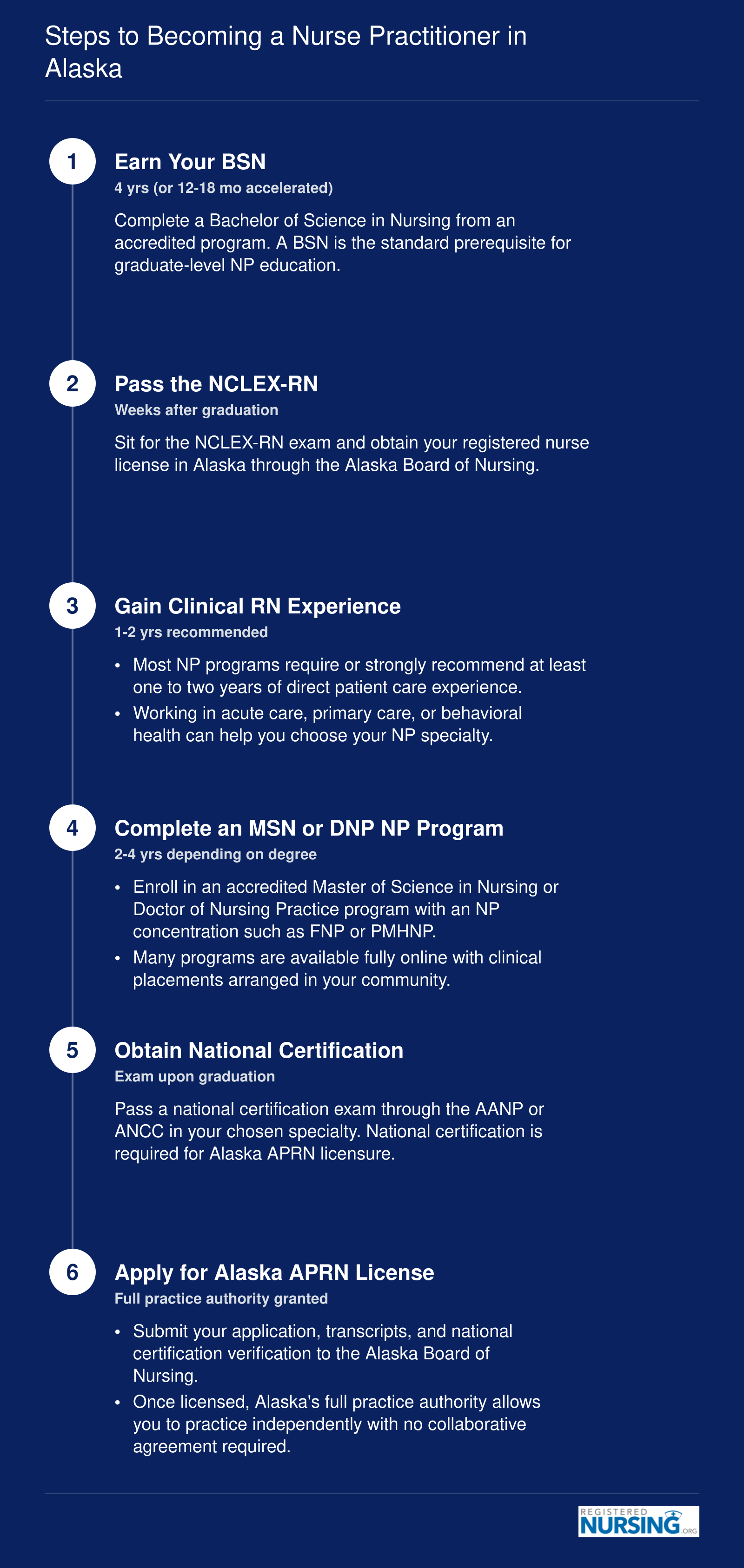
Steps to Becoming a Nurse Practitioner in Alaska
Alaska is one of a growing number of states that grants nurse practitioners full practice authority, meaning you can diagnose, treat, and prescribe independently once you hold your APRN license. Here is the typical pathway from your BSN through independent practice.
NP Program Costs and Financial Aid Options in Alaska
The financial fork for many Alaska NP students is not which program to choose, but which tuition rate they will pay: resident or nonresident.
Tuition Benchmarks and Student Debt
For the University of Alaska Anchorage (UAA) Family Nurse Practitioner track, program charges sit near $10,532 for Alaska residents and $20,720 for nonresidents. The school's average net price, after aid, is roughly $15,301. That gap shows how much residency and financial aid can shift the total bill. UAA also reports a median graduate debt around $20,210, a useful benchmark even though individual NP borrowing will vary.
Federal Loan Repayment and Tribal Health Incentives
- NHSC Loan Repayment: Up to $75,000 for primary care NPs at approved Health Professional Shortage Area sites, with a two-year commitment; other eligible clinicians may receive up to $50,000.
- IHS Loan Repayment: $40,000 to $50,000 for a two-year commitment at facilities serving American Indian and Alaska Native communities, with a possible federal tax-liability payment.
Because most of Alaska is designated as a Health Professional Shortage Area, many NP positions meet NHSC site requirements, making this a realistic first stop for repayment help.
State-Level Support: SHARP and WWAMI
- Alaska SHARP: SHARP-1 and SHARP-3 offer up to $20,000 per service year for NPs and PAs, with two-year and three-year terms. Some hard-to-fill sites may offer higher awards; payments are taxable.1
- WWAMI Loan: Has no annual or aggregate maximum, covers tuition and program costs such as room and board, books, supplies, and travel, carries a fixed 5.75% interest rate, and requires repayment of half the annual state support fee plus interest.2
No separate NP-specific Alaska loan forgiveness program appears beyond SHARP and WWAMI-related loans, so most students will combine federal repayment options with carefully assessed in-state program costs.
Alaska NP Licensing, Certification, and Full Practice Authority
What exactly does it take to get licensed as a nurse practitioner in Alaska, and what kind of practice freedom does that license give you?
Alaska is a full practice authority state, meaning NPs are recognized as licensed independent practitioners. Once licensed, you can evaluate patients, diagnose conditions, and prescribe medications, including controlled substances, without a collaborative agreement with a physician. That independence makes the licensing process worth understanding in detail.
Application Steps and Required Documents
Alaska requires an active RN license before you can apply for APRN authorization. The application itself (form 08-4028) must be signed and notarized. Along with it, you will submit:
- Official transcripts: Sent directly from your qualifying graduate NP program.
- National certification: Current certification from ANCC or AANP in your population focus, sent directly by the certifying body.1
- CE documentation: Evidence of 60 contact hours of continuing education completed within the previous two years.1
- Prescriptive authority addendum: If you plan to prescribe, you must also document 15 contact hours of advanced pharmacology and clinical management within the past two years.1
All documents must be in English or accompanied by a certified translation.
Fees to Budget For
- Application fee: $1001
- License fee: $1001
- Prescriptive authority (legend drugs only): $1001
- Prescriptive authority (controlled substances plus legend): $2001
NPs who prescribe controlled substances must also register with the federal DEA1 (approximately $888 for a three-year registration) and enroll in Alaska's Prescription Drug Monitoring Program within 30 days of obtaining controlled-substance authority.1
Starting December 1, 2025, reinstatement applications carry an additional $100 late fee. No other regulatory changes to APRN practice authority have been announced for the 2025 to 2026 period.
Renewal and Continuing Education
Alaska APRN licenses renew on a two-year cycle. At minimum, plan for 30 contact hours of APRN continuing education each renewal period. NPs who hold prescriptive authority must include at least 15 of those hours in pharmacology. The Alaska Board of Nursing renewal page is the most reliable source for current requirements, as some secondary references vary slightly in how they describe the CE rules.
Keeping your national certification current through ANCC or AANP is also essential, since Alaska ties APRN licensure directly to that credential.
What Nurse Practitioners Earn in Alaska
Alaska nurse practitioners earn competitive salaries that reflect the state's high cost of living and strong demand for advanced practice providers in both urban and rural settings. According to the Bureau of Labor Statistics, the statewide median annual wage for NPs in Alaska is approximately $145,450, which exceeds the national median of $114,510 by roughly $31,000. With about 570 NPs employed statewide, the relatively small workforce and vast geography contribute to healthy compensation across all experience levels.
| Wage Percentile | Annual Salary (Alaska NPs) |
|---|---|
| 25th Percentile | $104,000 |
| Median (50th Percentile) | $145,450 |
| 75th Percentile | $165,510 |
| Mean (Average) | $142,340 |
| National Median (for comparison) | $114,510 |
NP Demand and Employment Outlook in Alaska
Nurse practitioners rank among the fastest growing healthcare occupations in the country, and Alaska's unique geography and healthcare infrastructure magnify that demand well beyond national averages.1 According to Bureau of Labor Statistics projections, NP employment is expected to increase by 40.1 percent between 2024 and 2034, adding approximately 128,400 positions nationwide, a growth rate that places nurse practitioners third among all 832 occupations tracked for numeric employment gains.1
Why Alaska Needs More NPs
Alaska's vast terrain and dispersed population create barriers to healthcare access that few other states experience. Much of the state qualifies as a Health Professional Shortage Area under federal guidelines, meaning primary care providers are in critically short supply. Rural communities, remote villages, and areas accessible only by air or water depend on advanced practice providers who can deliver comprehensive care without physician oversight. Alaska's full practice authority law allows NPs to assess, diagnose, prescribe, and manage patients independently, positioning them as essential frontline providers.
The state's tribal health system represents one of the largest employers of nurse practitioners in Alaska. Organizations such as the Alaska Native Tribal Health Consortium and Southcentral Foundation operate extensive clinic networks serving Alaska Native and American Indian populations. These systems actively recruit NPs to staff community health centers, specialty clinics, and village-based care sites. Indian Health Service facilities similarly rely on nurse practitioners to fill gaps in rural and frontier regions.
Telehealth as an Expanding Channel
Alaska's telehealth infrastructure has grown substantially, creating new employment pathways for NPs who can deliver virtual primary care, behavioral health services, and chronic disease management across remote areas. For nurse practitioners licensed in Alaska, telehealth nursing positions offer the ability to serve patients statewide without relocating to isolated communities.
An aging population compounds demand. Alaska's proportion of residents over 65 continues to climb, increasing the need for geriatric primary care and chronic condition management. Nurse practitioners trained in family or adult-gerontology specialties, including graduates of DNP programs in Alaska, are well positioned to meet this growing patient population.
Admissions Requirements for Online NP Programs
While each program sets its own criteria, most online nurse practitioner programs share a core set of admissions requirements. Meeting these benchmarks early can help you build a competitive application and avoid delays.
- Active, Unencumbered RN LicenseYou must hold a current registered nursing license in good standing. Programs will verify your license status, so resolve any restrictions or encumbrances well before applying.
- BSN from an Accredited InstitutionA Bachelor of Science in Nursing earned at a regionally or nationally accredited school is the standard prerequisite. Some programs accept ADN-prepared nurses through RN-to-MSN bridge pathways, though these typically add coursework and extend the timeline.
- Minimum GPAMost programs require a cumulative GPA of at least 3.0 on a 4.0 scale, with some setting the bar slightly lower or higher. If your GPA falls short, strong clinical experience, a well-crafted personal statement, or prerequisite coursework with higher grades can strengthen your candidacy.
- RN Clinical ExperienceExpect to document one to two years of direct-patient-care experience as a registered nurse. Programs value hands-on clinical competence, so time spent in acute care, primary care, or specialty settings works in your favor.
- GRE ScoresThe majority of online NP programs have waived the GRE requirement in recent years. A small number of universities still request scores, so check each program's current admissions page to confirm whether the exam is needed.
- Application MaterialsStandard submissions include a professional resume or CV, a personal statement outlining your goals and interest in advanced practice nursing, and two to three professional or academic references. Some programs also request a writing sample or supplemental essay.
- Application Deadlines and Start DatesMany online NP programs offer rolling admissions or multiple start dates throughout the year, giving working nurses added flexibility. Still, individual cohort-based programs may have firm deadlines, so review each school's academic calendar and apply early to secure your preferred term.